Archive
Beaujolais Nouveau 2013 – Well Worth Your Attention
It that time of the year again – the festive labels are lining up in front of the wine stores to remind us that we are entering into literally a six week of non-stop celebrations – Thanksgiving, Christmas, New Year, friends, families, holiday parties. With its festive label, coming out every third Thursday in November, Beaujolais Nouveau signifies both arrival of the wines of the new harvest, and the arrival of the holidays.
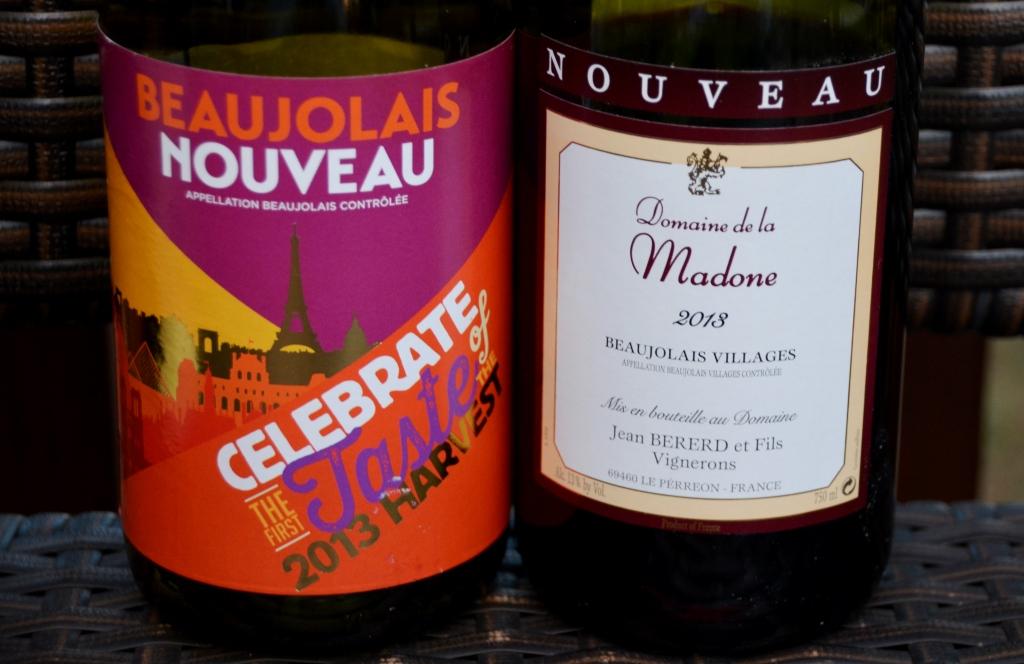
Beaujolais Nouveau Arrived!
The tradition of celebration of the new harvest with the wines of Beaujolais is well more than hundred years old. It became linked to the third Thursday of November in 1985, and then little by little, became a huge marketing success. That huge success became the worst enemy of the wine, with the producers starting to make soulless, insipid wines, void of any substance – and Beaujolais Nouveau phenomenon almost died at the very end of 20th century, with people simply ignoring the wines as only a marketing ploy.
Luckily, over the last few years, the situation started to change to the better, or I would even dare to say, to the “much better”. The wine behind festive labels started to show substance and character. I think Beaujolais Nouveau offers a very unique opportunity for the wine lovers, as you can taste every new vintage of the same wine, and compare – something which is rather difficult to do with many other wines – and you can see how the wine is changes year over year.
This year I had an opportunity to taste two different Beaujolais Nouveau wines – one from Georges Duboeuf, and another one from Jean Bererd & Fils, Domaine de la Madone – technically a Beaujolais Villages Nouveau, which is a different AOC designation, but for all intents and purposes it is produced in the same way as a regular Beaujolais Nouveau.
Can the wine be made better and better every year? Of course the question is way too generic to have an answer, but I can tell you that in case of Georges Duboeuf Beaujolais Nouveau, the answer is “yes”. I was quite happy with the 2012 wine, but I think this year it is even better. The 2013 Georges Duboeuf Beaujolais Nouveau (12% ABV, $10.99) showed beautiful dark purple inky color in the glass. The nose was full of bright fresh fruit – ripe cherries, succulent raspberries, some violets. The palate came in quite restraint and structured, even firm – good fruit presence of the same dark cherries and ripe raspberries, but not over the top, showing of respectfully mature, concentrated wine with good acidity and medium finish. Depending on the serving temperature, the acidity was more of less noticeable, and overall the wine showed well balanced. Definitely recommended for your Thanksgiving table, perfectly attune to the Harvest celebration. Drinkability: 8-
The 2013 Jean Bererd & Fils Domaine de la Madone Beaujolais Villages Nouveau (13% ABV, $10.99) had very similar inky purple color in the glass. On the nose, it exhibited very similar notes of dark cherries and raspberries. And yes, the palate profile was very similar, but somehow, while the wine was perfectly drinkable and enjoyable, also showing firm structure, I was unable to find the right temperature when acidity was fully in check and harmony with the rest of the wine. Still, not a bad wine by all means. Drinkability: 7
When it comes to Thanksgiving, which we are about to celebrate, my choice of wine tends to be all-American – Chardonnay, Pinot Noir, Zinfandel – but nevertheless, I love opening the celebration with the glass of Beaujolais Nouveau – that clearly sets the mood to the Holidays, which have arrived.
Did you happen to taste Georges Duboeuf or any other Beaujolais Nouveau wines? What do you think? Happy Holidays and Cheers!
Weekly Wine Quiz #82: Grape Trivia – Gamay

Gamay grapes
Source: Wikipedia
The Wine Quiz series is not meant to intimidate. The whole idea here is to have fun and learn something new. When answering the questions, it is fully encouraged to use all available sources of information, including Google or any other search engines. There are no embarrassing answers – the most embarrassing thing is not giving it a try…
Welcome to the weekend and your new wine quiz!
We are continuing our grape trivia series, with the focus again on the red grapes, and today’s subject is Gamay, also called Gamay Noir, and fully officially a Gamay Noir à Jus Blanc.
Gamay is a purple-skinned grape, taking its name from the village of Gamay, located south of Beaune in France. Gamay is considered to be a cross between Pinot Noir and ancient white grape called Gouais Blanc. First mentions of Gamay go all the way back to the 14th century, so it had being around for a while.
Gamay grapes have thin skin, and have a tendency to overproduce, creating the grapes with very high level of acidity and low sugar, which often results in the production of lightly colored and quite acidic wines. The overproduction and high acidity were the reasons for the Gamay being literally outlawed and pushed out of Burgundy by the royal rulers at the end of 14th century, to give way for much rounder Pinot Noir. As the result, Gamay mostly settled in Beaujolais area, where it became the major red grape variety. Gamay is used in Beaujolais to produce a wide range of wines, starting from the famous Beaujolais Nouveau, the wine produced within 6 weeks of the harvest – young, grape-y and quaffable, but usually not very exciting; and then going to the Cru Beaujolais ( there are 10 villages in Beaujolais, which have this status), which can be dense, concentrated and age-worthy.
In addition to Beaujolais, Gamay is also growing in Loire region, where it is often blended with other local grapes such as Cabernet Franc and Cot ( Malbec) and it is used to produce both red and Rosé wines. The Rosé from Loire are typically a lot fruitier than the ones from Provence. Gamay is also successfully grown in Switzerland, especially in the area around lake Geneva – it is often blended with Pinot Noir there. Outside of France, Gamay is planted in the number of regions, such as United States and Italy, but it doesn’t produce much of the well known wines. Interestingly enough, a world renowned wine writer and critic, Jancis Robinson, was raving about Gamay wines produced by Sorrenberg of Beechworth in north east Victoria, Australia – she mentioned that it might be “one of the most exciting Gamays I have ever tasted”.
And now, to the quiz!
Q1: Gamay is closely associated with every third Thursday in November. Can you explain why?
Q2: Carbonic maceration is an important method in production of wines made out of Gamay. Can you briefly explain what is carbonic maceration and how does it helps here?
Q3: Fill in the blanks: In Beaujolais, Fleuri is considered to produce the most ___ wine, and Moulin-à-Vent produces the most ___ wines.
Q4: Which one doesn’t belong and why:
a. Brouilly
b. Côte de Brouilly
c. Côte Chalonnaise
d. Juliénas
e. Régnié
Q5: True or False: Beaujolais Nouveau wines can be aged for a few years before consumption.
Good luck, enjoy the quiz and your weekend! Cheers!
Weekly Wine Quiz #78: Grape Trivia – Petit Verdot
Petit Verdot, as shown in Wikipedia
The Wine Quiz series is not meant to intimidate. The whole idea here is to have fun and learn something new. When answering the questions, it is fully encouraged to use all available sources of information, including Google or any other search engine. There are no embarrassing answers – the most embarrassing thing is not giving it a try…
Welcome to the weekend and your new wine quiz!
We are continuing our grape trivia series, and we are back to the red grapes! Today’s subject is Petit Verdot.
Origins of Petit Verdot are unknown, and according to one of the theories, the grape came to Bordeaux region in France with ancient Romans. Petit Verdot is a very tricky grape in the vineyard – its early budding makes it susceptive to the early spring dangers, such as frost. Its very late ripening puts it in danger of the same frost and some of the diseases, At the same time, small berry with thick skin offers a lot of concentrated tannins and structure when it ripens properly.
This tricky behavior in the vineyard with tendency to underripe, results in Petit Verdot sometimes even not included in the final blend in Bordeaux wines. However, the grape behaves a lot more consistently in the warmer climates. Petit Vedot made it to Australia in 1800s, and it is successfully growing in most of the wine making countries around the world (Spain, Italy, US, Chile, Argentina, New Zealand), producing the best results in the warmer climates. in the US, it is growing in many regions across the country, from New York to Texas to California to Oregon. At its best, Petit Verdot produces dense, powerful, concentrated and age-worthy wines.
And now, to the quiz!
Q1: Explain the meaning of the name Petit Verdot
Q2: Name four grapes, main blending partners of Petit Verdot in France
Q3: True or False: Australia’s plantings of Petit Verdot far exceed the plantings of Petit Verdot in France
Q4: While Petit Verdot is a difficult grape to work with, two events were major contributors to the demise of Petit Verdot in Bordeaux. Can you name those two events?
Q5: While it is not impossible to find a pure 100% Petit Verdot wines made in Bordeaux, those wines are rather the exceptions. What is the typical percentage of Petit Verdot in Bordeaux blends?
Bonus question: what was your personal encounter with Petit Verdot? Do you have any memorable bottles?
Good luck, enjoy the quiz and your weekend! Cheers!
Wednesday’s Meritage – Wine Quiz Answer, #MWWC4 Theme, Merlot is Back!, And a Few Videos
Meritage time!
Let’s start from the answer to our weekly wine quiz #76, grape trivia – Roussanne. In the quiz, you were supposed to answer 5 questions about white grape called Roussanne.
Here are the questions, now with the answers:
Q1: Explain the source of the name Roussanne
A1: Name Roussanne most like comes from the word “roux”, which refers to the reddish color of the grapes.
Q2: Which one doesn’t belong and why:
a. Hermitage, b. Côte-Rôtie, c. Châteauneuf-du-Pape, d. St.-Joseph
A2: b. Côte-Rôtie. Roussanne is allowed to be blended into the red wines of the three other regions – but the white grape allowed to be used in Côte-Rôtie is Viognier.
Q3: Outside of Northern Rhône, the traditional bending partner of Roussanne is…
A3: Grenache Blanc is the most popular blending partner for Roussanne outside of Northern Rhône
Q4: Roussanne was re-introduced in California in the 1980s, only to be proven in the late 1990s to be not the Roussanne but another grape. Do you know what grape was that?
A4: Viognier. Randall Grahm, winemaker from Bonny Doon winery, brought [illegally] a number of cuttings of supposedly Roussanne from France at the beginning of 1980s. In 1998 it was found that the grape is actually Viognier, not the Roussanne.
Q5: One of the first California “Roussanne” wines from the 1980s had a specific name. Can you name that wine?
A5: The “Roussanne” wine was produced by Randall Grahm under the name of Le Sophiste.
Sadly, there was very little participation in this quiz – I have to acknowledge Julian at VinoInLove, who was a sole participant – thank you Julian! I guess I’m going to far into the vineyard with some of my latest quizzes… Well, one more white grape, and we are switching back to the red right after.
Now, to the interesting stuff around the vine and the web!
First of all, we have a new theme for the Monthly Wine Writing Challenge! Now in its 4th round, it is hosted by The Wine Kat, winner of the round #3. The theme of the #MWWC4 is… OOPS!, and I can tell you that oops is looming, as the submission deadline is already very close, it is only two weeks away – October 23rd. Get your writing pants… oops, may be glass? Writing hat? Well, whatever oops gets you moving, get it on and start writing. The theme announcement and all the important dates can be found here.
Just a quick question at the moment. What do you think of Merlot? Do you still have an image of Miles “I’m not drinking no #$%^ Merlot”, or does it trickle back to you table and Cellar? Well, I can tell you that about 100 Merlot producers from California want to make sure you will once again look at Merlot seriously. Tomorrow, October 10th, is actually the start of #MerlotMe, a month-long celebration of Merlot, taking place both with the live events and all over the social media. You can find more details about the festivities here – and don’t wait, grab your bottle already!
Continuing the theme of Merlot, I wanted to share with you this video, made by one of the Merlot pioneers, Gundlach Bundschu:
And for no other reason, but just for your enjoyment on this Wine Wednesday, here is the video which I wanted to share a while ago – a “Blurred Lines” parody, made by the enterprising folks at Jordan (in addition to making great wines, they also have one of the best social media outreach in the wine industry):
That’s all I have for you for today, folks. The glass is empty – but refill is on its way. Until the next time – cheers!
Weekly Wine Quiz #76: Grape Trivia – Roussanne
 Welcome to the weekend and your new wine quiz!
We are continuing our grape trivia series, still focusing on the white grapes, and today’s subject is the white grape called Roussanne.
Last week we talked about grape called Marsanne, and today’s quiz is about its close friend, Roussanne. Similar to Marsanne, Roussanne is also seemed to appear first in the Northern Rhône, and then from there it slowly got into the other wine regions. Today it is growing in different areas in France, in Australia, California, Washington, Texas ( up and coming to the greatness), Spain and … Italy. If you remember, Italy was the major winemaking country which didn’t make any Marsanne wines. Another interesting note about Roussanne is that it is actually allowed to be a part of the 18 grapes permitted in Châteauneuf-du-Pape wines.
Roussanne is a late ripening variety, and it is also susceptible to the various grape diseases, which makes it tricky to work with in the vineyard. However, Roussanne compensate from those vineyard difficulties with great flexibility in the hands of the winemaker, helping to create full bodied, long living wines which greatly improve with age. This is where Roussanne is often paired with Marsanne to create those spectacular ( and very expensive 😦 ) white wines of Northern Rhône.
And now, to the quiz!
Q1: Explain the source of the name Roussanne
Q2: Which one doesn’t belong and why:
a. Hermitage
b. Côte-Rôtie
c. Châteauneuf-du-Pape
d. St.-Joseph
Q3: Outside of Northern Rhône, the traditional bending partner of Roussanne is…
Q4: Roussanne was re-introduced in California in the 1980s, only to be proven in the late 1990s to be not the Roussanne but another grape. Do you know what grape was that?
Q5: One of the first California “Roussanne” wines from the 1980s had a specific name. Can you name that wine?
Good luck, enjoy the quiz and your weekend! Cheers!
Wednesday’s Meritage – Wine Quiz Answer, #MWWC3 Winner, The Way You Pour, Wine and Shutdown, and more
Meritage time!
As usual, let’s start from the answer to the wine quiz #75, grape trivia – Marsanne. In the quiz, you were supposed to answer 5 questions about white grape called Marsanne. Here are the questions, now with the answers:
Q1: Name the grape, typical blending partner of Marsanne in Northern Rhône
A1: Roussanne.
Q2: True or False: Plantings of Marsanne in Australia far exceed Marsanne plantings in France.
A2: True. Actually, about 80% of worldwide plantings of Marsanne are located in Australia
Q3: Solve the riddle and explain: Part of 8, but not part of 18
A3: Marsanne is one of the 8 white grapes officially allowed in the Rhône appellations. At the same time, Marsanne is not a part of the 18 grapes officially allowed to be used in Châteauneuf-du-Pape appellation
Q4: Marsanne is known in Switzerland under the name of …
A4: Ermitage [blanc]
Q5: Name major wine producing country which doesn’t make any Marsanne wines of notice
A5: Italy. Yes, Italy makes no wines out of Marsanne – at least no wines which can be easily accessible or found on the internet.
I’m glad to report that we have a winner! Jeff of the drunken cyclist fame correctly answered all 5 questions, so he is our uncontested winner and he gets the coveted prize of unlimited bragging rights. Well done!
And now, to the interesting stuff around the web and the vine!
First of all, we have a winner for the Monthly Wine Writing Challenge #3! The Wine Kat wrote the winning story, which you can find here. Congratulations to the winner! Now we are all eagerly waiting to learn the theme for the challenge #4 – hopefully it will be announced soon…
Do you know that the way you pour the wine affects how much you drink? Here is the link to the post on the subject. Weather you hold the glass, tilt the glass, pour red or white – all of this factors affect the amount you consume – according to this study, of course.
Wondering about the connections between US Government shutdown and wine? I had no idea there is one, until I read this post by Dr. Vino. TTB, the government agency which approves all the new labels, is part of the shutdown. On one side it makes perfect sense as it is seemingly not-essential. At the same time, as opposed to many other parts of the government, this one actually makes money… Anyway, read the article for more details.
Actually, there is another small post by the same Dr. Vino, which I want to bring to your attention. Before you read it, I have a question for you. Which country do you think might request to put the words “wine kills” on the labels? No, it is not United States. Interestingly enough, it is France, which is concerned with the fact that people drink wine, so this was one of the proposals as a way to reduce wine consumption. Another, similarly bright proposal, was suggesting to ban all the internet writing about the wine – brilliant, isn’t it? You can read the post here – it is short and interesting.
That’s all I have for you for today, folks. The glass is empty – but refill is on its way. Until the next time – cheers!
Weekly Wine Quiz #74: Grape Trivia – Trebbiano

Ugni Blanc grapes, as shown in Wikipedia
Welcome to the weekend and your new wine quiz!
We are continuing our grape trivia series, still focusing on the white grapes, and today’s subject is Trebbiano.
Have you had Trebbiano wines? How about Ugni Blanc? Before you answer no, think again. There is a very high degree of probability that you had the wine made either from Trebbiano, a.k.a. Ugni Blanc, or at least with Trebbiano being a part of the blend, as Trebbiano is second most planted grape in the world. Ugni Blanc is the most planted grape in France, spanning from Bordeaux to Provance to Corsica. In Italy, Trebbiano is allowed to be used in more than 80 different DOCs and has 7 DOCs of its own.
The grape’s historical (as well as genetical) roots are still not fully established yet. It seems that the first mentions come from the area of Bologna in Italy in 13th century. In the 14th century, the grape made it to France together with the Papal court, where it became known as Ugni Blanc. Starting from 16th century, the plantings of the Trebbiano increased quite substantially, but the grape practically never made it on its own. Trebbiano’s main characteristics include high acid, low sugar, minimum aromatics and vigorous growth, which are not the star quality when we are talking about the wines. At the same time, these very characteristics make it an excellent foundation for producing all kinds of distilled spirits – this is where majority of the Trebbiano/Ugni Blanc grapes are used today.
And now, to the quiz!
Q1: Ugni Blanc is a main grape in the production of what famous spirit?
Q2: Name the wine, in which Trebbiano was a required part of the blend, and it was considered to be the reason for a bad, flabby quality of that wine (it is no longer required to be used in that wine).
Q3: Trebbiano is often a foundation for the popular food product (containing no alcohol). Do you know what food product it is?
Q4: Contrary to the name, Trebbiano di Lugano is not considered to be a part of the Trebbiano family, but rather related to another Italian grape. Do you know what grape is that?
Q5: When used for the wine production (as opposed to the distilled spirits), Ugni Blanc is rarely used on its own – it is typically a part of the blend. Name 3 grapes, traditional blending partners of Ugni Blanc.
Good luck, enjoy the quiz and your weekend! Cheers!
Weekly Wine Quiz #73: Grape Trivia – Sémillon

Sémillon grapes affected by noble rot, as shown in Wikipedia
Welcome to the weekend and your new wine quiz!
We are continuing our grape trivia series, still focusing on the white grapes, and today’s subject is Sémillon.
Sémillon is a white grape, once considered the most planted grape in the world. One interesting fact is that the origin of Sémillon is not easy to pinpoint – while working on this quiz, I went through quite a few articles on Internet and even books, and it is hard to find any historical data outside of the fact that Sémillon was very popular in the early 19th century throughout the world. In the early 19th century, over the 90% of all grape plantings in South Africa was Sémillon – considering its popularity, it was simply called Wyndruif, the “wine grape”. Today, Sémillon occupies roughly 1% of the grape plantings in South Africa. It is still the most planted white grape in Bordeaux, where it is used in the production of most of the white wines, from dry wines of Pessac-Léognan, Graves and Entre-deux-mers, to the spectacular dessert jewels of Sauternes and Barsac. Sémillon plantings exist in many other winemaking countries – Australia, Chile, Italy, New Zealand, California and Washington in US – but you rarely hear about Sémillon, as it is mostly used as a blending grape. Well, this might be changing – but we will not be talking about it in the quiz.
The issue with Sémillon is that under normal growing conditions, it tends to produce plump and dull wines, the wines which are not showing much of the aromatics and have very low acidity. When the grape is forced to work hard, it can produce amazing wines. In Sauternes, Sémillon is typically affected by Botrytis cinerea, the noble rot, which leads to the shriveling of the grapes which concentrates the sugar – dessert wines produced from such shriveled grapes are some of the best in the world (Châteaud’Yquem, anyone?) – they also make some of the longest living wines in the world, being capable of ageing for 100 years and beyond. In Australia’s Hunter Valley region, the grapes are exposed to the harsh climate with the high level of humidity, which leads to the grapes accumulating high level of acidity. Hunter Valley Sémillon is known to age very well, and the wines also improve with age quite significantly.
And now, to the quiz!
Q1: Name a grape, primary blending partner of Sémillon
Q2: Below is the list of years. There is something common between all of them (and of course it has a relationship with Sémillon) – do you know what is common among those years?
1930, 1952, 1964, 1974, 2012
Q3: Ture or False: Sauternes produces only sweet wines
Q4: Name a key factor for the great tasting dry Sémillon wines
Q5: What is Semageddon?
There is nothing wrong with answering even only one question from the quiz – your participation is always appreciated! Also, without any regard to the questions, please share your personal experiences with Sémillon wines.
Good luck, enjoy the quiz and your weekend! Cheers!
Madonia Restaurant: Good Food, Great Wine
 I like to write about restaurant experiences. In general, I do it only when I’m really wowed. And for just plain restaurant reviews I typically use Yelp. However, recently I discovered Urbanspoon – well, I knew about Urbanspoon for a while already, but I didn’t know that, unlike Yelp and TripAdvisor, Urbanspoon actually allows you to link your blog post to the particular restaurant’s page, which to me is somewhat of a game-changer. Taking this into account, you should expect to see more restaurant “reviews” in this blog. Well, let’s make it straight – I’m not going to convert into a restaurant critic. My reviews will [continue to] comprise of a bunch of pictures and a few words about food and wine. But I will make an effort to write more posts about our restaurant experiences.
And here we go…
The restaurant I want to talk about today is called Madonia and it is located in Stamford, CT. The restaurant defines its food as Modern Mediterranean – however, looking at the menu, I would simply classify it as Italian, considering the prevalence of the traditional Italian dishes. The restaurant is also offering a “tasting menu” featuring seasonal ingredients.
Talking about food, nothing was really stunning or even simply standing out – with the exception of the white bean spread served with the bread, which was outstanding and gone in two seconds. We ordered a number of dishes (some pictures are below), and all of them shared the same trait [unfortunately] – they were good but plain. All the food was perfectly cooked – but real seasoning, the “umph”, was missing, while it was greatly desired.
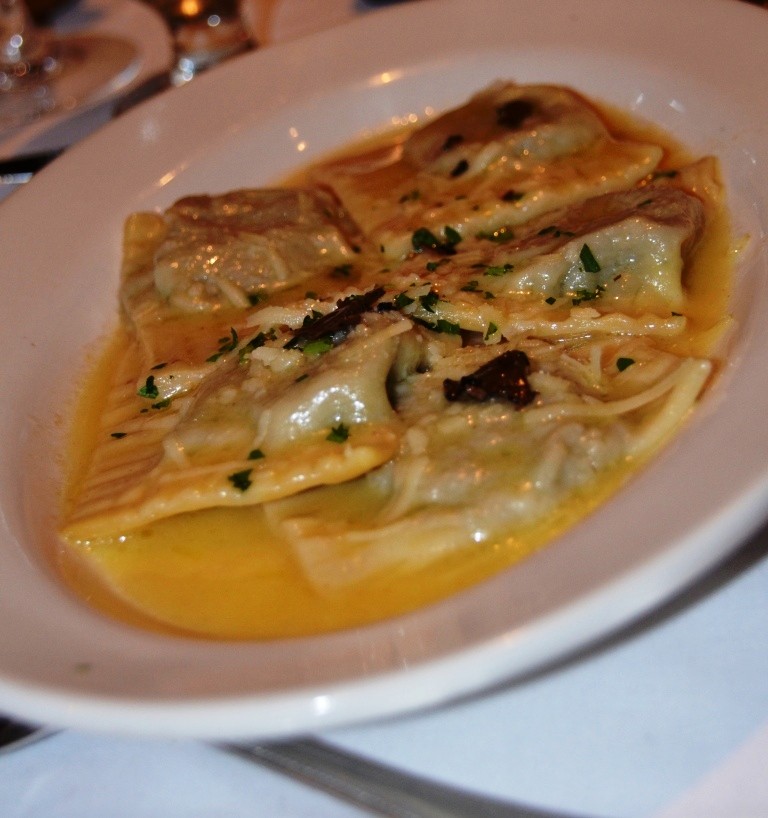
Mushroom Ravioli
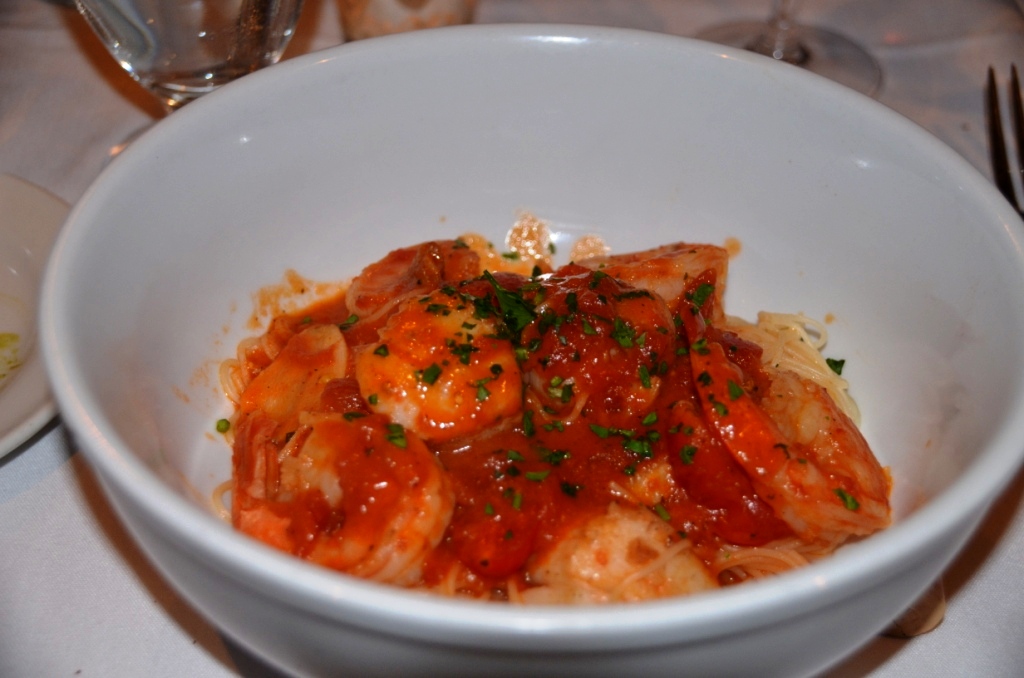
Capellini with Shrimp and Scallops
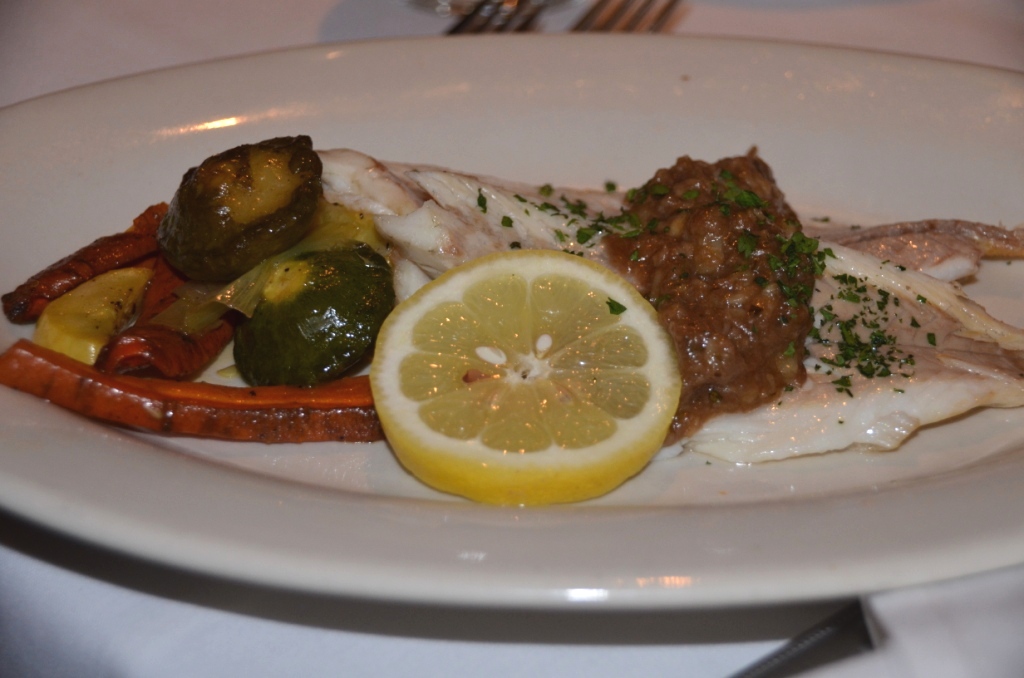
Branzino

Chicken Milanese
The wines, luckily, represented a different story. First of all, the wine list was well priced (there is enough selection of decent wines in the proximity of $30, which is not often in restaurants). Chef (and owner) Enzo is quite passionate about the wines, and he likes to please his guests. We started talking about wine, and Enzo mentioned that he has a number of wines that are not on the list, and which he will be glad to offer to us. One of those wines was called Shatter, a Grenache wine out of France.
I heard of Shatter before, I believe I read a rave review in one of the blogs (sorry, it’s been a while). Shatter is a joint project of Dave Phinney, the winemaker at Orin Swift Cellars, and Joel Gott, the winemaker at the eponymous winery. My initial thought was “no, thank you, I don’t want this wine”. First, I don’t like the style of Orin Swift wines – one of their most famous wines is called Prisoner, a Zinfandel blend, which I find over-extracted. Second, I lost my love of French Grenache – I definitely prefer the Spanish Grenache style, in general, more velvety and round than the French and less biting. But then, considering our other options, the fact that I heard about the wine before and the great price ($45) – oh well, we decided to give this wine a try – and we happened to hit the home run.
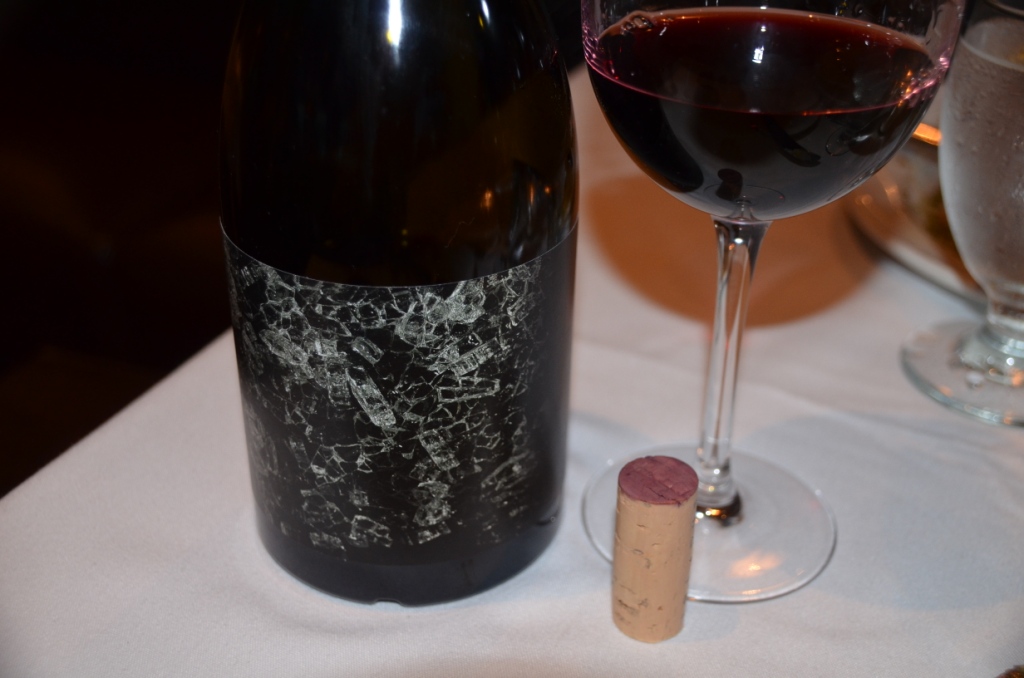
Shatter
2011 Shatter Grenache Vin de Pays des Côtes Catalanes, France (15.9% ABV, 100% Grenache, 10 months in French oak, 30% new) – dark garnet color in the glass, nose of dark fruit with a hint of espresso beans. On the palate, velvety texture with blueberries and cherries prevalent, a touch of spice, few peppery notes, dark chocolate, firm structure, supple tannins, perfect acidity, and overall very balanced. I have to say, surprisingly balanced (again) for 15.9% ABV. Drinkability: 8
Then there was dessert, and so here are more food pictures for you:


Overall, it was a good meal, definitely anchored on the great wine experience. And we plan to come back, as Enzo showed us his secret wine room – the room is used both as a cellar and the place for the special wine dinners. You can eat surrounded by wine – don’t think I know of any other restaurant in Stamford where you can do the same. Yes, we will be back…

Ready for wine dinner
That’s all I have for you for today, my friends. Cheers!
Madonia
1297 Long Ridge Rd
Stamford, CT 06903
(203) 322-8870
https://www.madoniarestaurant.com/

Wines, Wines, Wines – Part 2
As promised, here is the second part of the Wines, Wines, Wines post. In the first part, we talked about great Riesling and Gewurzrtraminer wines, with some extra value wines and Prosecco. Let’s continue our “memorable wine extravaganza” with a couple of Chardonnays.
Chardonnay
It is so interesting how things work in life. You might walk past say, a picture, every day, and never notice it. And then all of a sudden you say “what is it? Was it always here, or is it something new??”, and people around you look at you like you have two heads or something. Where am I going with this? Give me a minute, I will make my point.
Couple of month ago I got a bottle of Chardonnay, accompanied by the words “try it, it is pretty good”. I’m a sucker for good Chardonnay (yeah, true, you can substitute “Chardonnay” with any other varietal – I’m just a sucker for any good wine, but this can be a subject for a different post). But this Chardonnay was from New Zealand. And New Zealand in by book is the land of Sauvignon Blanc and Pinot Noir – but not really a Chardonnay. So I finally got the bottle opened and … wow.

Seresin Chardonnay
2008 Seresin Chardonnay Reserve Marlboro New Zealand (13.5% ABV, 11 month in oak). The symbol of the hand on the label has a deep meaning. Quoting few words from Seresin Estate web site, “The hand is a symbol of strength, gateway to the heart, tiller of the soil, the mark of the artisan, and embodies the philosophy of Seresin Estate”. Here are my tasting notes for this wine: Outstanding, classic. Perfect nose of vanilla and white apples, just right. Very balanced fruit on the palate – hint of butter, vanilla, oak, good acidity – one of the most balanced Chardonnays ever. Drinkability: 8+
Oh yes, you are still waiting for me to connect to the opening sentence about passing by and not seeing things around for the long time, right? As of very recently, as I walked in the New Zealand isle in the store, I noticed all of a sudden that almost every producer now features Chardonnay in addition to Sauvignon Blanc and Pinot Noir. When did it happen, how long this was the case with New Zealand Chardonnays – I don’t have any idea, but based on this experience, I definitely want to try more.
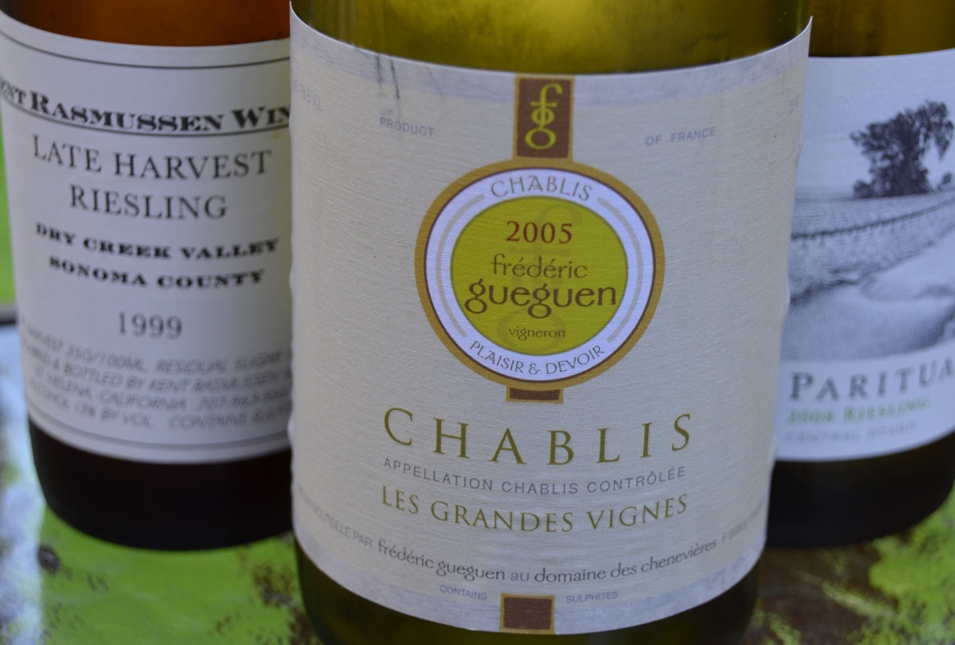
Frédéric Gueguen Chablis
2005 Frédéric Gueguen Chablis Les Grandes Vignes (13% ABV) – I don’t have a lot of experience with Chablis overall. I had a few bottles of Chablis here and there, but never was really impressed with it (I never had Chablis of a Grand Cru or even Premier Cru level). I don’t know what possessed me to get this wine from the Benchmark Wine Company, I guess it was in the right price range ( under $20), and somehow caught my attention. Then I read somewhere, that Chablis requires on average about 10 years of age in the bottle to really start transforming and going past the initial “steely acidity” flavor profile to get to the next level. And then I tried this Frédéric Gueguen wine – wow. Here are my tasting notes: some darker yellow color, but not quite golden yet. Amazing nose, reminiscent of Côte-Rôtie – almost a touch of sulfur (think freshly burnt matches), or even more of a smell of a hot piece of granite on a summer day, a “roasted rock”. Side note: pardon my naive definition here – I recently learned that professionals call it a “gunflint” – but I will not use this term as it doesn’t lead to any associations for me. Perfect complexity on the palate – white fruit, vanilla. Lots and lots of minerality. Full bodied and very balanced, excellent wine overall. Drinkability: 8+
Pinot Noir
And we are moving along to the Pinot Noir wines – both of the wines below were excellent:

Siduri Pinot Noir
2011 Siduri Pinot Noir Sonoma County (13.1% ABV) – perfectly clean California Pinot – good smokey nose, with a touch of red fruit aromas. Light cherries on the palate, hint of earthiness, medium body, perfect acidity, very clean and balanced. Drinkability: 8-
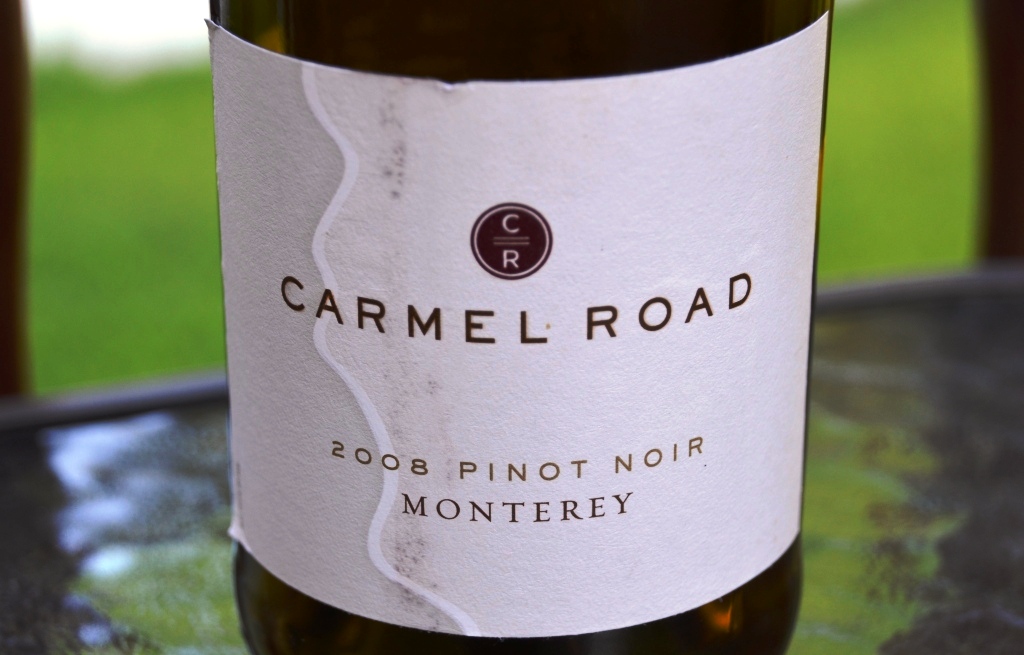
Carmel Road Pinot Noir
2008 Carmel Road Pinot Noir Monterey (14.0% ABV) – outstanding. Bright ruby color in the glass, raspberries and hint of smokiness on the nose. Raspberries, cranberries and cherries on the palate. Medium to full body. Excellent acidity, overall perfectly balanced. Drinkability: 8+
Cabernet Franc
I have only one wine for you here, but it was mind blowing.
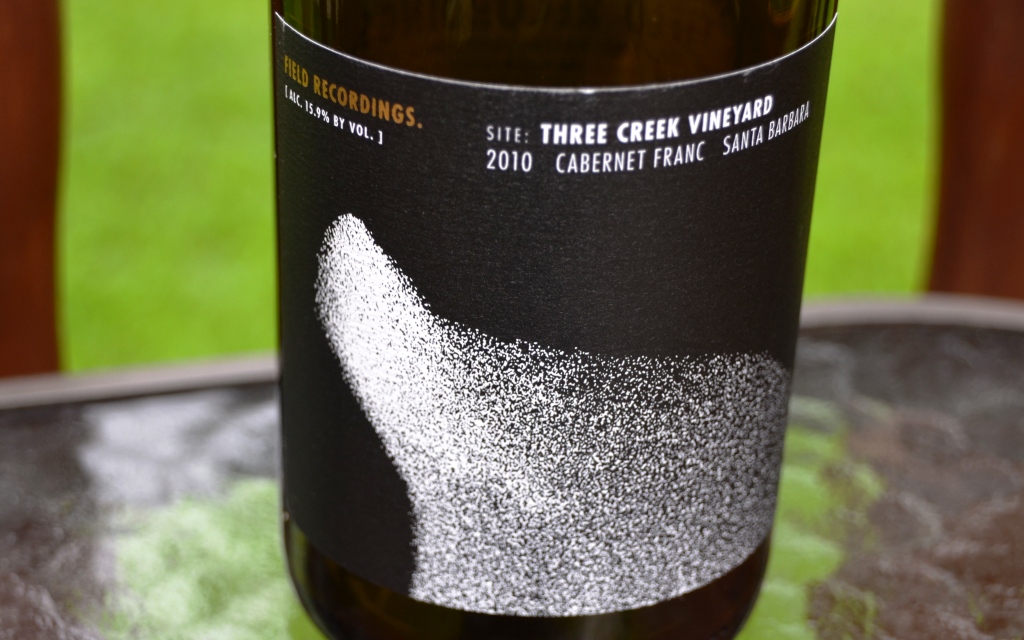
Field Recordings Cabernet Franc
2010 Field Recordings Three Creek Vineyard Cabernet Franc Santa Barbara (15.9% ABV, 90% Cabernet Franc, 10% Malbec, 18 month in French oak) – spectacular. If you read this blog on the regular basis, you know that I’m very impartial to the wines of Field Recordings – but this is not my fault, it is Andrew Jones’ fault ( Andrew Jones is the winemaker behind Field Recordings). This wine had beautiful garnet color in the glass. The nose was clean and open, withhint of black currant and other red fruit. The palate is stunning with black currant, cherries, touch of black pepper, dark chocolate, perfect acidity, soft and supple tannins, all in the format of full-bodied wine. Perfect balance of fruit, acidity, tannins and alcohol – which is pretty amazing at 15.9% ABV. Drinkability: 9
Last, but not least – Syrah
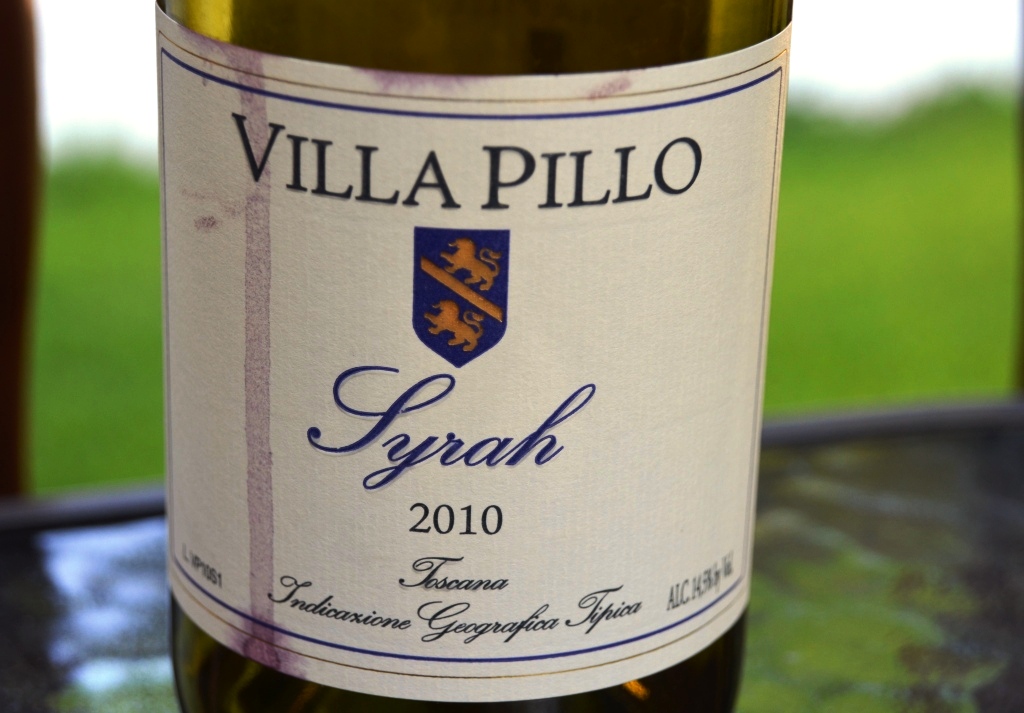
Villa Pillo Syrah
Appearance of the large amount of Italian Syrah wines is also somewhat of a revelation, similar to the one I mentioned at the beginning of this post. All of a sudden I start noticing that there are more Italian Syrah wines showing in the wine stores, and people are just talking more about them, in the blogs and otherwise.
2010 Villa Pillo Syrah Toscana IGT (14.5% ABV) – we got this wine when we visited Millbrook Winery in New York (this will be a subject of a separate post), as they are importing this and a number of other wines from Italy. Tasting notes: Dark garnet color in the glass. Nose of dark fruit and dark chocolate. Outstanding on the palate – hint of pepper, cherries, plums and raspberries, more dark chocolate. Full bodied, with the velvety texture weaved over firm structure. Drinkability: 8
Whew, we are done here! Enjoy the rest of your weekend and cheers!
Last Bottle Sign Up ($10 credit)




 Talk-A-Vino