Archive
Made With Organic Grapes: Domaine Bousquet
Today we will be talking about two subjects we already discussed in the past. The first subject is the wines made from organic grapes. Organic grapes are becoming more and more available, and winemakers around the world are more eager to use organic grapes in winemaking, especially as wine consumers happily embrace the trend.
The second subject is the wines of Domaine Bousquet in Argentina. Last time we talked about unpretentious and delicious Domaine Bousquet bubbles, sparkling wines well suitable for every day. Today we want to continue that conversation and talk about few more wines.
The organic viticulture is fair and square a centerpiece of Domaine Bousquet winemaking. The picture below perfectly summarizes it – these are all the certifications that the domain already has:
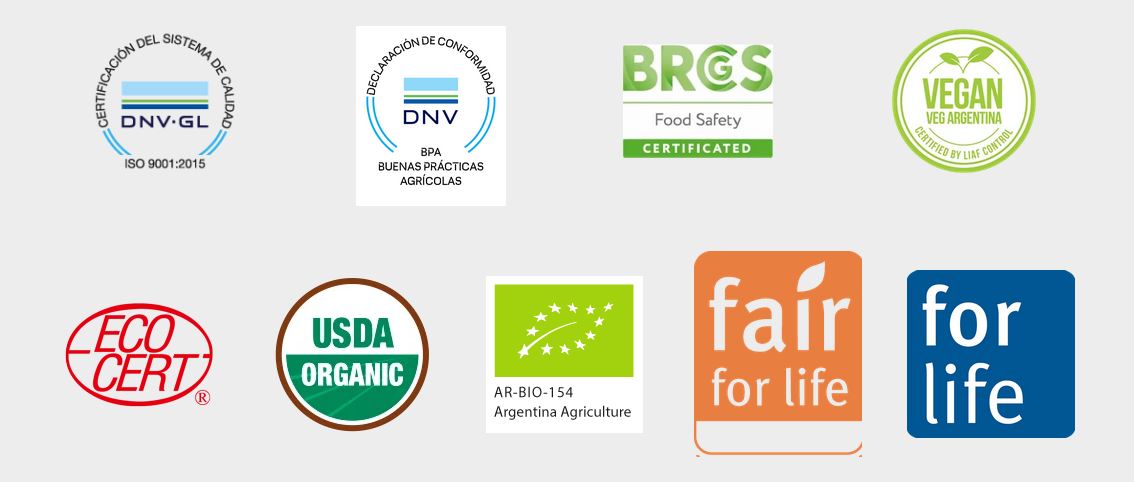
Source: Domaine Bousquet website
Organic viticulture is only a stepping stone for Domaine Bousquet – the goal is to convert to biodynamic farming in 2021/2022, which is not an easy task, considering the sheer size of Domaine Bousquet’s vineyards (more than 500 acres) and the fact that biodynamic viticulture is 30% more labor-intense compared with traditional methods, and 15% more intense than sustainable. But once you get on this road, there is no turning back.
Organic/sustainable/biodynamic is an important part, but still only a part of the story. The terroir is essential, and it is a classic combination of the soil and climate which contributes to the quality of the Domaine Bousquet wines. Many of the Domain Bousquet vineyards are located in the Gualtallary region of Uco Valley, at an altitude of about 4,200 feet. The high altitude by itself doesn’t guarantee the quality of the wines, but it helps. Domaine’s vineyards are located on the patches of sandy soils, which are great for the vines as they limit the spread of the disease, provide good drainage and force the vines to work hard to get to the water.
Gaultallary offers a desert-like climate, with constant winds blowing for the Andes, and less than 8 inches of rain being total precipitation for the year. In such conditions, it is important that Domaine Bousquet vineyards are located in areas with access to the ground water – not everybody in the Gaultallary is that lucky. And then there are Zonda winds (Zonda in local dialect means “The Witch’s Wind”, which are showing up in the spring, and they are dry (relative humidity of 0), strong, and unpredictable – but they help to reduce the crop size and concentrate the flavor.
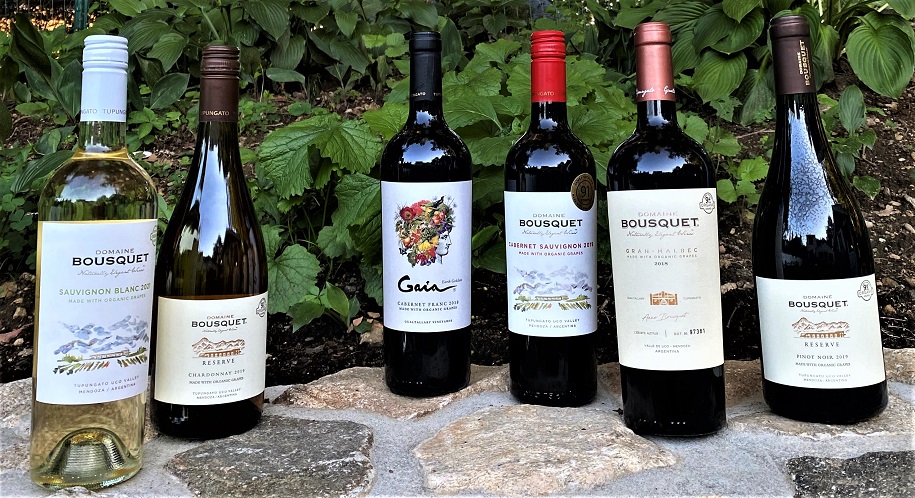
Domaine Bousquet produces about 10 different lines of wines. I was able to taste wine belonging to the 4 different lines (samples). Below are my notes.
First, 2 wines from the Premium selection:


2021 Domaine Bousquet Sauvignon Blanc Tupungato Uco Valley (12.5% ABV, $13)
Straw pale
Ultimately inviting nose, a touch of fresh grass, lemon, uplifting intensity.
Crisp, clean, lemony, grassy, tart, fresh, pure delight.
8+, perfect, delicious.
2019 Domaine Bousquet Cabernet Sauvignon Tupungato Uco Valley Mendoza (14% ABV, $13, no oak – unusual)
Dark Ruby
A touch of bell pepper, dark berries, medium-plus intensity
Bell pepper, eucalyptus, mint, blackberries, good acidity, fresh, good energy, good balance
8-/8, easy to drink. And I have to say that unoaked Cabernet Sauvignon is mind-boggling.
Next were two wines form the Reserve line:


2019 Domaine Bousquet Chardonnay Reserve Tupungato Uco Valley (14.5% ABV, $18)
Straw pale
Vanilla, a hint of butter, inviting, generous
Crisp, vibrant, a touch of butter and vanilla, tightly weaves around the citrus core. Excellent balance, delicious.
8+, superb. If this wine can age, it might be amazing, if this bright acidity will evolve into the honey note as it works with the best Chardonnays.
2019 Domaine Bousquet Pinot Noir Reserve Tupungato Uco Valley (14.5% ABV, $18, 6-8 months in French oak)
Dark ruby
Not very expressive, a hint of tart cherries
Tart cherries, bright acidity, crisp, tart
7/7+, not my wine, but should be okay as food wine or for those who like austere, bone-dry wines.
Next was the wine from the Gaia line – the wines dedicated to the goddess of Earth, Gaia, sporting a very attractive label. This is the second time I was able to taste the wine from the Gaia line – the first was Gaia Rosé, which was excellent. 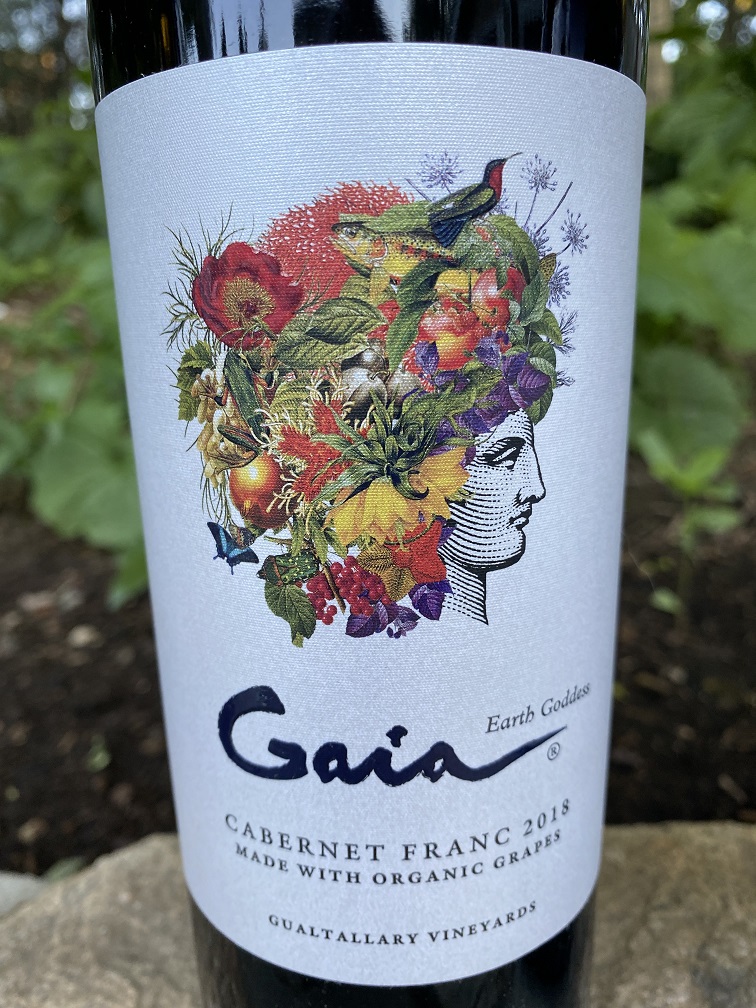
2019 Domaine Bousquet Gaia Cabernet Franc Gualtallary Vineyards (15% ABV, $20, 8-10 months in French oak)
Dark garnet
A touch of barnyard, earthy notes, dark berries
Dark fruit, explicit minerality, a distant hint of bell pepper, mint, dense, good structure
8-, not the most striking Cab Franc, but interesting on its own
And the last one for today – the wine from the Gran series:
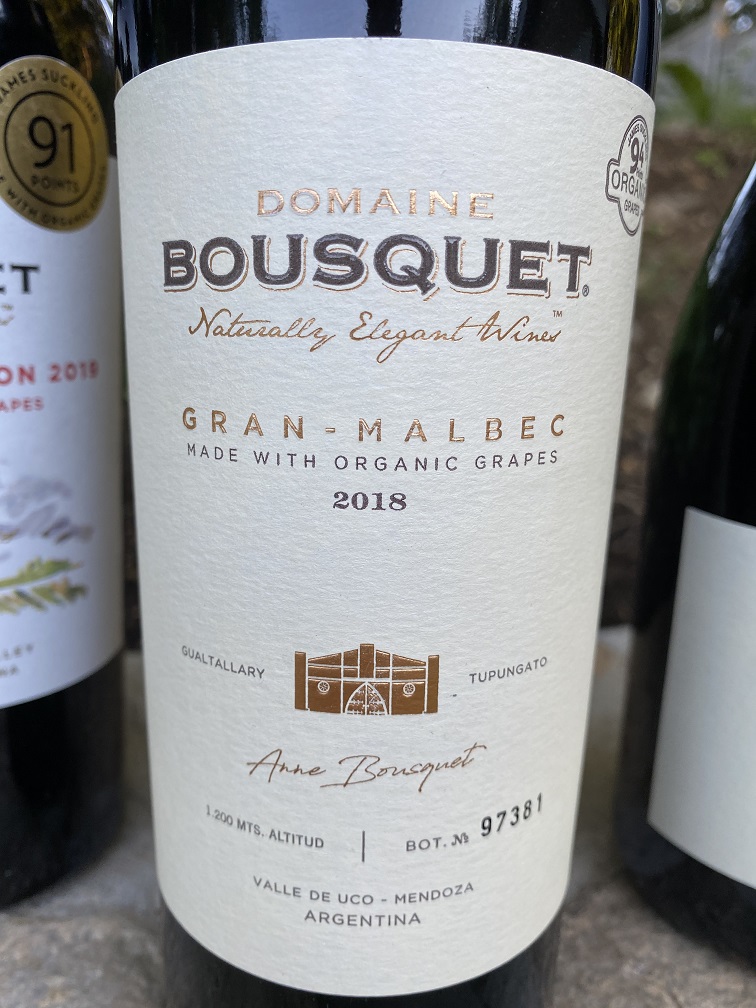
2018 Domaine Bousquet Gran-Malbec Valley de Uco (14.5% ABV, $25, 85% Malbec, 5% Cabernet Sauvignon, 5% Merlot, 5% Syrah, 10 months in French oak)
Dark garnet, almost black with purple hues
Dark fruit, eucalyptus, cassis, intense, powerful
Beautiful fruit on the palate, firm structure, big, brooding, perfectly balanced
8+, outstanding
Here you are, my friends – more organic wines you can choose from. As an added bonus, with Domaine Bousquet, you don’t have to break the bank to enjoy delicious organic wines any time you want. Cheers!
Made With Organic Grapes: Red, White, and Rosé
Have you looked attentively at the wine labels lately? I don’t know about you, but “made with organic grapes” is something I see on more and more wine labels. Red, white, Rosé, bubbles – no exception. As winemaking methods are advancing, organic viticulture is almost becoming a new norm.
While “organic” and “sustainable” are not the same, organic designation is often a stepping stone toward sustainable and biodynamic viticulture. Sustainability seems to be the word of the day, not only in the viticulture but all areas of human activities – but this is a wine blog, so let’s just stay with our beloved subject here.
A few weeks ago, I shared my impressions of the organic wines of Viñedos Veramonte from Chile. As I believe we are looking at the trend, let’s continue our search for organic grapes, and let’s take a quick trip to the old continent – Italy, to be more precise. Once we are in Italy, let’s go to Sicily, where Cantine Ermes had been producing wines since 1998.
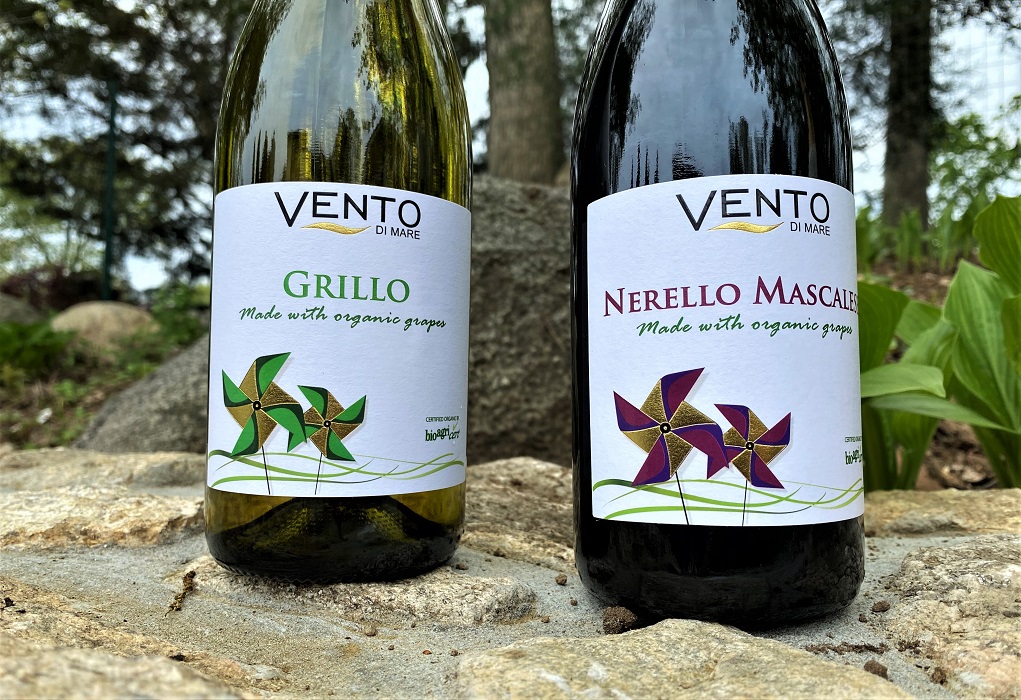
Cantine Ermes is a coop-type winery. The numbers behind Cantine Ermes are quite impressive – 2,355 associates, 9 cellars, more than 25,000 acres of land under vineyards, and about 12M bottles annually are sold in 25 countries. Despite its sheer size, Cantine Ermes practices organic and sustainable farming and has tight control over all steps of wine production.
Two wines I tasted brilliantly represented Sicily, made from the local grapes:
2019 Cantine Ermes Vento Di Mare Nerello Mascalese Terre Siciliane IGT (13.5% ABV, $13)
Ruby red
The nose of freshly crushed berries, cherries, and eucalyptus.
Playful on the palate, a touch of fresh cherries, intense tobacco, minerality, medium body, clean acidity, good balance.
8-/8, perfect on its own, but will play well with food.
2019 Cantine Ermes Vento Di Mare Grillo Sicilia DOC (12.5% ABV, $13)
Light Golden
Fresh lemon, Whitestone fruit, medium+ intensity, inviting
Crisp, clean, fresh lemon, nicely present body, a touch of white plum, good minerality, a hint of sweetness
8/8+, superb, delicious white wine all around.
We are continuing our organic grape quest by going west and leaving the old continent and arriving at Mendoza in Argentina. Earlier this year I discussed sparkling wines of Domaine Bousquet – the product of the obsession of the French winemaker Jean Bousquet, who fell in love with the raw beauty of Gualtallary Valley in Mendoza. Interestingly enough, two sparkling wines I was talking about before were also made from organic grapes – I guess I simply didn’t see it as a trend yet.
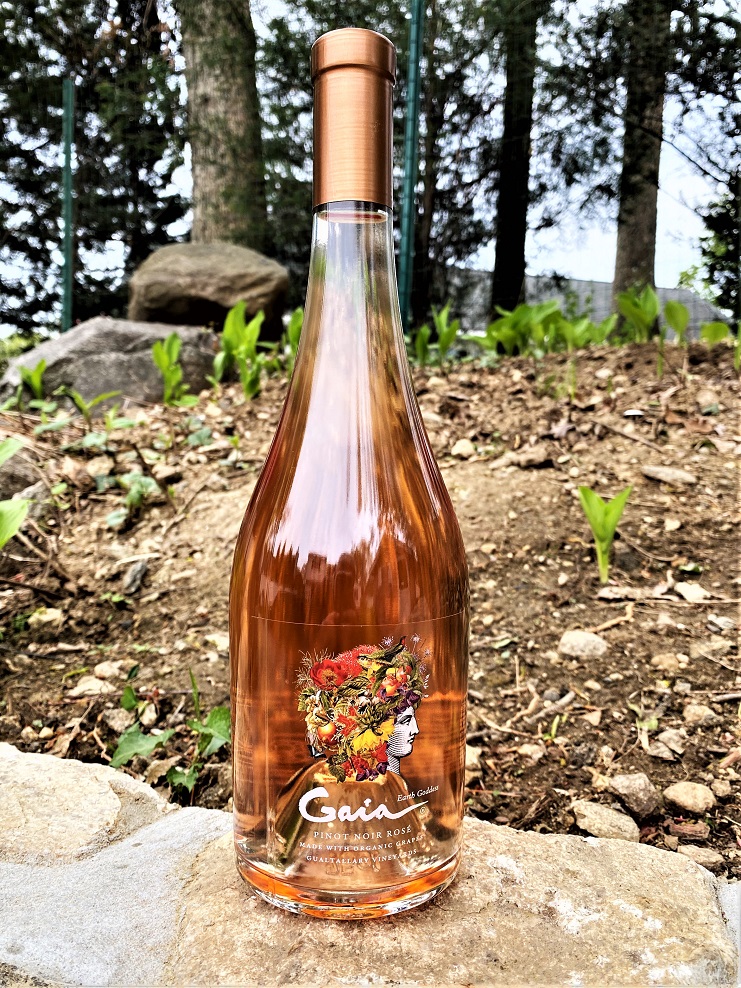
Gaia Rosé is the inaugural vintage of the wine made from 100% Pinot Noir, from the vineyards in the Uco Valley located at the 4,000 feet/1,200 meters elevation. The wine takes its name from Gaia, the ancient Greek goddess of the Earth and an inspiration for the Bousquet family. Just take a look at this beautiful bottle and tell me that you will be able to resist the urge to grab this bottle off the shelf at the first sight.
Here are my thoughts about the wine:
2020 Domaine Bousquet Gaia Pinot Noir Rosé Gualtallary Vineyards Mendoza Argentina (13.1% ABV, $20, vegan friendly)
Light salmon pink
Complex, onion peel, a touch of strawberries
Fresh Strawberries, grapefruit, bright acidity, a touch of sweetness, firm, present
8, delicious. Unusual
Here you are, my friends. Red, white, and Rosé from around the world. made from organic grapes, delicious, affordable, with a great QPR. What else should wine lovers want?
Everyday Bubbles – Domaine Bousquet
In my wine lover’s journey, bubbles were never essential. I grew up with only sweet sparkling wines available, and I still have no idea if those wines were even made out of grapes. Plus, the bubbles were strictly associated with only a celebration – New Year, maybe a big birthday, and a wedding. I have no idea what was the first Champagne I ever tasted, but the first Champagne I actually appreciated was vintage Krug, and ever since I have a full appreciation for a tasty glass of bubbles – and no, I didn’t become “Krug or nothing” zealot.
I can imagine drinking Champagne every day. No, let me take that back. I can imagine drinking Champagne on any day I crave bubbles – yes, this is a better way to put it, as drinking Champagne every day would quickly become really boring. However, while I have no issues with the imagination, drinking Champagne at will is hardly practical. I can find a tasty bottle of still wine for around $10 – no matter what “premiumization” trend dictates – but most of the drinkable Champagne today pushes the $40-$45 boundary (unless you find your success on WTSO) – and this is hardly an “at will” range for me. If you are craving bubbles but want them to be reasonably priced, you can find better luck with Prosecco or a Cava, but you better know producers by name.
And here I come, extending my helpful hand, to bring to your attention delicious bubbles which you really – and I mean it, really – can afford to drink on any day. And not only to afford but also to enjoy. Cue in Domaine Bousquet Charmat-method sparkling wines from Argentina, made from organic grapes and priced at a whopping $13 – and this is the suggested retail price, which means you can probably even find them in the stores for less.
Before I will share my impressions of the wines, let’s take a quick look at the Domaine Bousquet, the product of vision, obsession, and dedication. “Vision, obsession, and dedication” are not just words. In 1990, during his vacation, Jean Bousquet, a French third-generation winemaker, fell in love at a first sight with the high altitude remote area in Argentina – Gualtallary Valley in the Tupungato district of the Uco Valley in Mendoza. You really need to have vision and dedication to leave your country and buy 1,000 acres of essentially a desert (real estate broker told Jean Bousquet that he is making a mistake of his life) – you would probably think so too if you will look at the picture below:
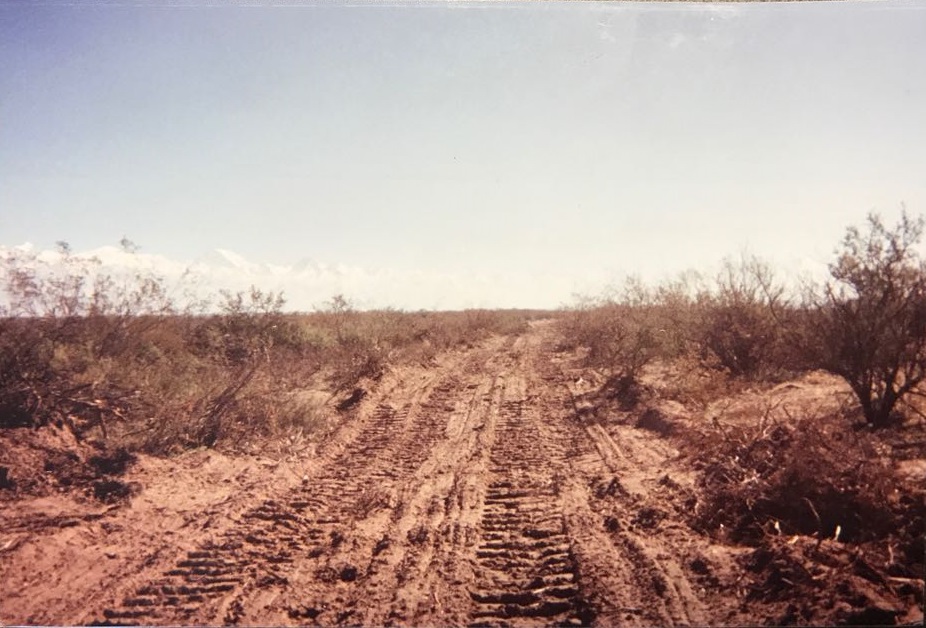
Source: Domaine Bousquet
Jean Bousquet had a vision and dedication, and most importantly, he knew what he is doing, he knew the importance of water and proper irrigation. You would never tell that the picture below represents the same land today (also note that today Gualtallary Valley represents one of the most expensive farmlands in all of the Mendoza):
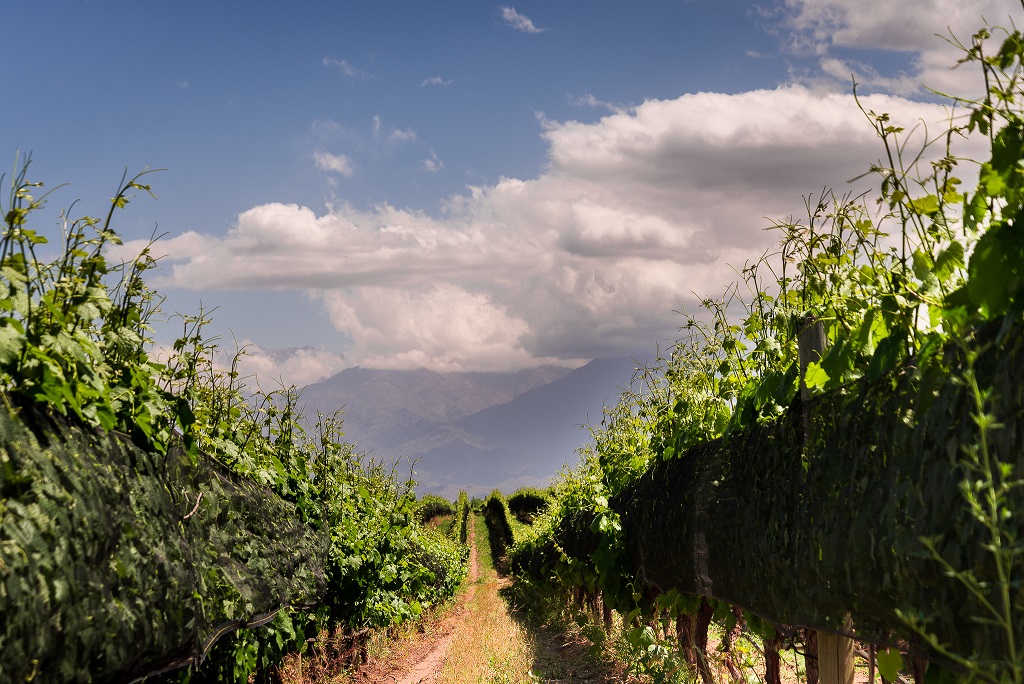
Source: Domaine Bousquet
Fast forward to today, Domaine Bousquet sustainably and organically farms 667 acres of land, produces 50 million liters of wine, 95% of which is exported to 50 countries around the world, and ranks among the top 20 Argentinian wineries in terms of export and a leader in the organic wine.
The winery produces a large range of still wines from traditional Argentinian varieties – Chardonnay, Malbec, Cabernet Sauvignon, etc, and it also offers a series of sparkling wines, both traditional method and Charmat. I got samples of Charmat-method wines, both white and Rosé, made from the Chardonnay and Pinot Noir in different proportions.


NV Domaine Bousquet Brut Tupungato Uco Valley Mendoza (12.5% ABV, SRP $13, 75% Chardonnay, 25% Pinot Noir, certified organic, vegan friendly) offers a nice fresh nose of golden delicious apple, crisp, fresh, energetic on the palate with cut-through lemony acidity. It is definitely enjoyable by itself and will play nicely with a wide range of dishes (Drinkability: 7+).
NV Domaine Bousquet Brut Rosé Tupungato Uco Valley Mendoza (12.5% ABV, SRP $13, 75% Pinot Noir, 25% Chardonnay, certified organic, vegan friendly) is a beautiful Rosé in its own right. It is not only the color, but it is also the wine which presents itself as a classic still Rosé would, with a nose of fresh strawberries and a full range of strawberry flavors on the palate, from tart to candied, perfectly balanced, fresh, vibrant, and full of life (Drinkability: 8-/8). Out of the two, Rosé was definitely my favorite.
At $13, these are the bubbles that you can consume any day without feeling guilty. You should, actually, feel guilty while drinking these wines, as the amount of pleasure you will derive is unproportionally more than what you are paying for them. But I will let you deal with your conscience, while I’m off to look for more values. Cheers!
Mystique of Mythic Malbec
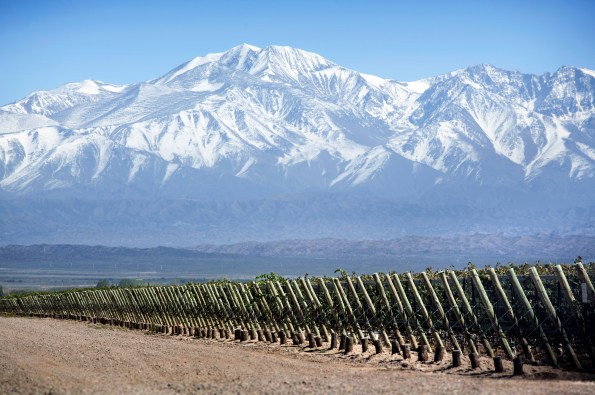
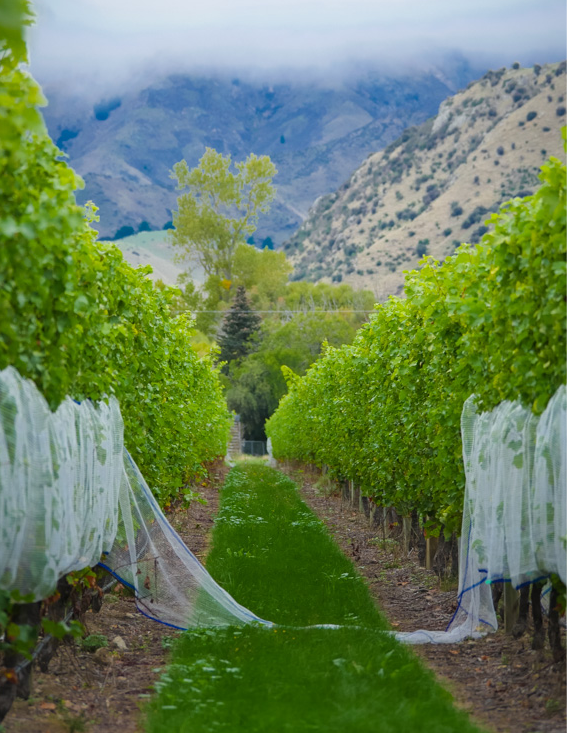
A long, long time ago, in a place far, far away, lived a dragon. That dragon was known for the love of all things green. The vast land he called his home was all covered in luscious flowers, bushes, and trees, always perfect and beautiful. He would use his huge wings to keep the plants cool during the hot days, and he would plan his gardens in the most meticulous ways, to make sure all the plants were happy together.
There was one plant that he loved above all, and it was the grapevine. His vineyards always looked amazing, and his hard work was handsomely rewarded by the most perfect grapes you can imagine anywhere. He loved Malbec above all other grapes, as those gapes made him happy. Sometimes, he would make wine out of them, and sometimes, he would just eat them fresh and delicious.
One day, the dragon was just gone. The plants didn’t feel the air moving with the flaps of his giant, powerful wings. But his presence still was felt in a magical way, as all the plants continued to happily grow, and the grapes were always delicious.
The legend has it that this far, far away magical place was in Mendoza, Argentina, and when people discovered it, they could still feel something magical, something mythical while standing between magnificent grapevine rows. So when they decided to create the winery and call it MYTHIC, that felt the most appropriate.
The MYTHIC winery is rather young, formed in 2014, but ambitious. The winery was founded by the same team which is behind the Casarena wines with the idea to showcase the best wines Argentina can produce – but also by going beyond the tradition. You know how you can taste a well made Bordeaux blend from Napa or Washington and be completely sure you are drinking the old world wine? This is what the MYTHIC winemaking team was trying to achieve – make the world-class wines, whether they appear to be Argentinian or not – and judging by my tasting experience, the mission was accomplished with flying colors.
Continuing what the dragon started, MYTHIC farms about 400 acres of the vineyards in Luján De Cuyo area in Mendoza, which is often regarded as the Napa Valley of Argentina. Some of the vineyards are 90 years old, and most of them are located at about 3000 feet elevation. These high altitude vineyards are protected by the Andes, its snow-covered tops being the best source of water for the sustainably growing vines.
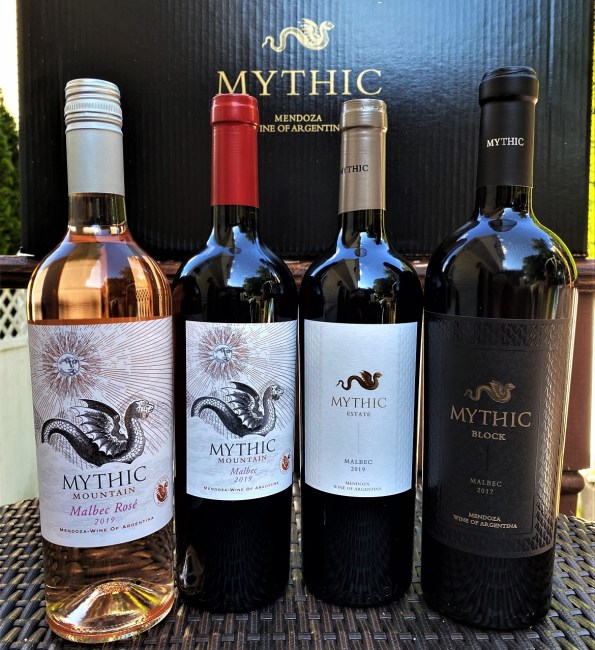
Malbec is the star at MYTHIC, used in the majority of wines – there are also multiple levels of wines, from the general to the vineyard, block, and even barrel-specific. The mystique of MYTHIC lies in the ability to show so many different expressions of Malbec, using seemingly negligible variations in the levels of fruit and oak regiment – but the diversity and the range are mind-boggling – or, rather, mythical. Take a look at my notes and see for yourself:
2019 Mythic Mountain Malbec Rosé Mendoza Argentina (12.5% ABV, $11.99)
Light pink
Fresh strawberries, good minerality, a touch of gunflint
Crisp, fresh, underripe strawberries, vibrant acidity, fresh lemon.
8+, perfect heat quencher – and a great value. This wine would successfully compete with any Provencal Rosé in the blind tasting.
2019 Mythic Mountain Malbec Mendoza Argentina (13.9% ABV, $11.99, 70% stainless steel, 30% 3nd/3rd use French oak)
Dark garnet
Freshly crushed berries, pencil shavings, tobacco, sweet sage
A touch of vanilla, tart cherries, soft, round, good acidity.
8-/8, easy to drink, perfectly representative of the “soft” Argentinian Malbec qualities.
2019 Mythic Estate Malbec Mendoza Argentina (13.9% ABV, $15.99, 4 months in French oak)
Dark garnet
Fresh berries, raspberries, blackberries, beets undertone (yeah, I know it sounds strange)
Fresh, open, ripe raspberries, hint of espresso, firm structure, well balanced.
8/8+, delicious on its own, but will be outstanding with the food. The wine clearly presents itself as an old-world wine – I would bet it is Cahors from France in the blind tasting.
2017 Mythic Block Malbec Mendoza Argentina (14.5% ABV, $34.99, 10 months in French oak)
Dark garnet
Cherries, herbs, clean, soft. More complex on the second day, a touch of roasted meat, funk, and chocolate
Succulent fruit, clean acidity, crunchy blackberries, earthy notes, perfect balance, silky smooth.
8+, outstanding, delicious wine. This wine is very international – a delicious wine which can be from anywhere.
Four wines made out of Malbec. Four totally different expressions of the grapes, some of them I didn’t know where even possible, such as Provence-style supremely elegant Malbec Rosé, also priced as a borderline steal – an outstanding QPR. Also, having the full old-world impression with the Estate Malbec? Not an easy feat, not for the New World wines.
Was our dragon real? I don’t know. I’m the one who is happy to believe in dragons and sorcerers. But the dragon made it on the labels, and the wines are as real as they can be, also great values in their own categories. The only thing left is for you to find these wines and judge them for yourself. The “thank you” notes can be left in the comments section with no limitations whatsoever.
CASARENA, The Next Level Of Argentinian Wines
The next level of Argentinian wines – I can literally see a “yeah, come on, really???” reaction from many of you. What does that even mean – the next level?
Okay, no need to get all feisty here – let’s talk about it. Argentinean wines require no introduction to any of the wine lovers today. Argentinian Malbec is practically a mandatory element of any bar or restaurant wine list, on equal footing with Cabernet Sauvignon from California. Cabernet Sauvignon and Bordeaux blends from Argentina also command topmost respect of wine lovers around the world. If the top-level is already achieved, what is the next level above it?
The “next level” here is my attempt to convey the emotion, the excitement of pleasure of tasting the delicious wines. While Argentinian wines are unquestionably the world-class, many of them are hardly distinguishable. The taste of Argentinian Malbec sometimes gets too predictable, and the wines lose their personality. Thus when you discover the wine which doesn’t conform to the “universal profile”, you feel like you are advancing to the next level of the game. I hope my tasting notes will convey my feeling about these wines, but let’s talk about the region first.
I perfectly remember listening to Kevin Zraly explaining the concept of quality of the wines. Imagine the set of enclosed circles. The biggest circle is equated to the big region – let’s say, California. Wines labeled with California as the region can be made from grapes grown anywhere in the state of California. The next circle is a sub-region – let’s say, Napa Valley. Wines labeled as Napa Valley can be produced only from the grapes grown in Napa Valley. That gives us a higher level of confidence in the quality of the wines, as Napa Valley is well known for the quality of the grapes. We can still narrow our circles, and now we are looking at the sub-region of the Napa Valley itself – Howell Mountain, Rutherford, Spring Mountain – there are many. Now your choice of grapes is restricted only to such a sub-region, which often offers a common taste profile coming from the vineyards in that subregion, such as famous Rutherford dust in the Cabernet Sauvignon wines sourced from the Rutherford appellation. And even now we might not be done with our circles, as we can restrict our source of grapes even further to the individual vineyard, such as Beckstoffer To-Kalon, and then even to the individual blocks and plots within the same vineyard. The smaller the circle is, the higher is the quality of the grapes, and that should translate into the quality of the wines.
Let’s now apply our circles to Argentina. We will start in Mendoza, probably the best-known winemaking area in Argentina – think about all the Argentinian Malbecs you are consuming. Continuing narrowing down, let’s now go to the Luján de Cuyo, the region located just south of Mendoza city. Luján de Cuyo is the first officially recognized appellation in Argentina (established in 1993), and home to some of the best known Argentinian wineries such as Catena Zapata and Cheval des Andes. Continuing narrowing down we now need to go to the town of Agrelo, where CASARENA Bodega & Viñedos is located.
I don’t like to use cliché in my writing. Nevertheless, if I would try to describe what makes Luján de Cuyo (and Agrelo for that matter) a great winemaking region, I feel that I’m doing exactly that – shamelessly using all available wine cliché all the way. See for yourself: Most of the vineyards in the region are located on a high altitude, which increases the sun exposure during the day and also creates a significant temperature drop in the evening – we are talking about significant diurnal temperature variation which slows down the ripening and helps grapes to retain acidity. Close proximity to the Andes creates a desert-like environment as it significantly reduced the rainfall – now we are talking about dry farming. Many vineyards in the region are also located on the rocky soils, forcing the vines to work hard to reach the nutrients. There is rarely greatness without adversity, and the combination of all the factors mentioned above presents exactly the adversity needed to produce excellent grapes – and yes, this unavoidable wine cliché.
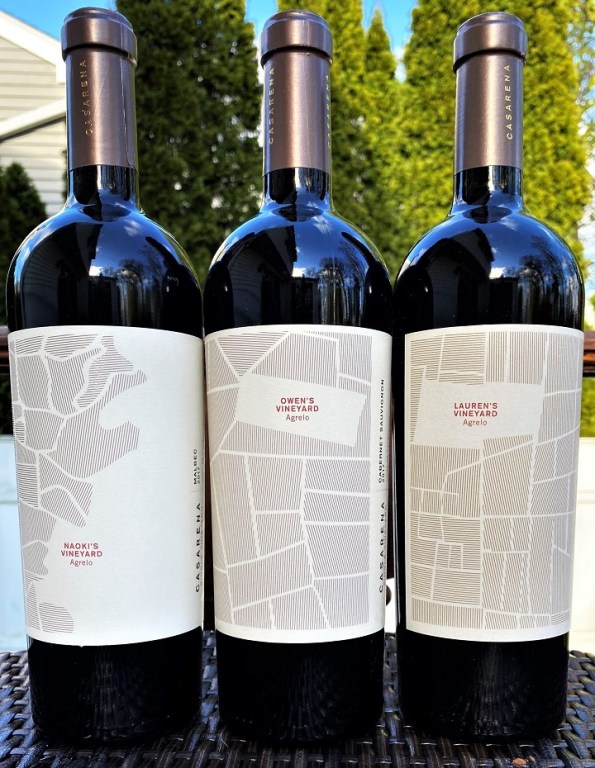
CASARENA Bodega & Viñedos was founded in 2007, with the first officially released vintage being 2009, starting, quite expectedly, with Malbec. After tasting its first commercial success with a slew of good critic ratings, CASARENA continued to narrow down the circles and created 7 single-vineyard wines coming from 4 different vineyards. I had the pleasure of tasting samples of 3 of these single-vineyard wines and was literally blown away by the quality.
Here are my notes:
2017 Casarena Malbec Naoki’s Vineyard Agrelo Luján de Cuyo Mendoza (14.5% ABV)
Dark garnet, very inviting
Dark fruit, cassis, tobacco, pencil shavings, a touch of mint
Medium to full body, succulent red fruit, vanilla, perfect acidity, silky smooth, well-integrated tannins, good minerality
8+, balanced, and delicious. Well refined compared to a typical Argentinian Malbec
2017 Casarena Cabernet Sauvignon Owen’s Vineyard Agrlo Luján de Cuyo Mendoza (14% ABV, 80 years old vines)
Dark garnet, practically black
Day 1:
Nose – dark, funky, concentrated, earth, tobacco
The palate is very contrasting to the nose, classic Cab with Cassis and bell pepper, not very expressive
Day 2:
Nose and palate are similar, more of a Malbec style – vanilla, blue fruit, coffee, dark chocolate.
Day 3:
Nose – Autumn forest, cherries, coffee
Palate – classic Bordeaux, a touch of currant, bell peppers, soft, supple, luscious, the well present core of minerality.
8/8+, excellent. My best analogy for this wine would be Dunn Howell Mountain wines, with the dark power imparted on the wines.
2017 Casarena Cabernet Franc Lauren’s Vineyard Agrelo Luján de Cuyo Mendoza (14.2% ABV, 18 months in new French oak)
Dark garnet, almost black
Coffee, a hint of cherries, minerally-driven
Cassis, cherries, soft, round, goos texture
8+, might be my favorite of the tasting.
These are three wines which would bring any dinner or friends gathering to the next level – I don’t know if you can see my point just by reading, the best way would be to pour a glass of CASARENA wine and take a quick trip to Argentina. Cheers!
Tale of Two Reds – Are All Wine Lovers Eternal Optimists?
Let’s talk about red wines. And optimism. The connection between the two? You will see – give me a few minutes.
Let’s start from a simple question – how many chances do you give to a bottle of wine? Fine, let’s rephrase it. You open a bottle of wine. It is not corked, or if you think it is, you are not 100% sure. You taste the wine. The wine is not spoiled, but you don’t like it – doesn’t matter why, we are not interested in the reason – the bottom line is that it doesn’t give you pleasure. What do you do next?
Of course, breathing is the thing. You let the wine breathe – you pour it into a decanter, and let is stand – few hours, at least. You taste it again – and it still doesn’t make you happy. Your next action?
Let’s take a few notes here. First, we are not talking about the wine you feel obliged to drink – it is not a $200 bottle, it is not a first-growth Bordeaux – it is an average bottle of wine, let’s say, of $20-$40 value. Second, it is a quiet evening – let’s say, it is you and your spouse, and you have a luxury of opening another bottle of wine to enjoy.
As we said, two hours in decanter didn’t do anything. And another 4 hours didn’t help either. Or maybe you didn’t use the decanter, as you only wanted a glass, and dealing with moving the wine in and out of decanter was not your priority, so the wine was standing in the open bottle. In any case, it is the end of the day, and it is time to go to sleep – and the wine is still not what you want to drink. What is next?
At this point, you got a few options – leave the bottle on the counter, dump it into the sink, put it aside into the “to cook with” section, or pump the air out and see what the next day will bring. Let’s assume you’ve chosen the latter option, but the next day didn’t improve the situation – for how long will you keep trying?


While I’m sending you on the trip down the memory lane (or maybe not), let me share with you my most recent experience. On December 31st, I opened the bottle of 2012 Codice Citra Laus Vitae Riserva Montepulciano d’Abruzzo DOP (14% ABV, $32). I had very high expectations of this bottle for a few reasons. First, the bottle itself is a BAB (for the uninitiated, it stands for Big Ass Bottle – a heavy, thick glass, pleasant to hold, bottle), which always creates high expectations for me. Second, I have high respect to the Montepulciano d’Abruzzo – was surprised with the quality more often than not. Third, I just tasted through the samples of a new line of wines from the same producer, Codice Citra (the line is called Ferzo), four delicious wines, more about it in a later post – obviously, all of this added up to the expectations. Only the first sip delivered nothing but disappointment.
I took a sip of the wine, all ready to say “wow”, and instead the first thought was – “heat damage”? Most prominent note on the palate was stewed fruit, which is definitely a problem for the 6/7 years old wine, clearly meant to have a long cellar life. What happened? Was the wine stored improperly? No way I can pour this to my guests, so put the cork in, pump the air out and let’s see what will happen.
Every day from there on, I would pull the cork out, pour a glass, taste, and sigh. Still, the stewed fruit in various amounts – day three seem to show some improvement only to go back on day 4. Can you see me winding up the drama? What do you expect happened on day 5?
January 4th, I’m pouring another glass, not expecting anything good, but willing to finish the “experiment”, and subconsciously still surprised that BAB didn’t deliver. The first sip extorts “wow” and the thought of “what just happened”? The core of pure, ripe, tart cherries with a touch of a cherry pit, the hallmark of good Montepulciano, is laughing at me. Firm structure, fresh tannins, balancing acidity – the transformation couldn’t have been more dramatic. I thoroughly enjoyed every last drop of that wine, still utterly amazed at how little I understand in the mystery of the wine.


The second wine, which I happened to open a day later, but played with in parallel to the Montepulciano, worked in a very similar fashion. I got the bottle of 2014 Ernesto Catena “Tikal Amorio” Malbec Mendoza Argentina (13.5% ABV, $30) as the present from Chuck Prevatte of Food, Wine, Beer, Travel blog as part of the “Secret Wine Santa” fun originated and run by Jeff Kralik, a.k.a. The Drunken Cyclist. Chuck sent me a bottle with the message that Malbec is his favorite wine, and he was hoping that I will also enjoy his selection.
Okay, so here is another gaping hole in my “I don’t discriminate against any wine” adage – Argentinian Malbec is not my thing. I will gladly jump at Cahors, but given an option, unless I perfectly know the producer and the wine, I will avoid Argentinian Malbec as a generic category (as an example Broquel, Kaiken, Achaval-Ferrer, Trapiche are all on the “good list”). Yes, I will still try the Malbec I don’t know (someone has to eat the broccoli, right?), but only if asked. If you are interested in the reason, it has something to do with the flavor profile – I had a lot of Argentinian Malbecs which lack acidity and have too much of the overripe fruit and baking spices – interestingly enough, that exact flavor profile often wins the “easy to drink” praise among wine consumers.
Anyway, the Tikal Amorio Malbec had a very attractive label and sounded good from the description – the wine was created for the love of the grape and represented a blend of Malbec grapes from 3 different vineyard sites in Mendoza. Besides, it was recommended, so as I was opening the bottle, the thought was a happy “what if…” The first sip, however, brought (I’m sure you guessed it) the “this is why I don’t like the Argentinian Malbec” sigh – flabby fruit, very little acidity, and lots of baking spices. Ooh. I will spare you the day by day description – not much changed over the three days. But on the 4th day… The first sip brought in perfectly ripe blueberries with the core of acidity – nothing flabby, perfect structure, firm, fresh “pop in your mouth” blueberries with undertones of tobacco. The wine beautifully transformed (another mystery), and similarly to the Montepulciano, was gone in no time.
Here it is, my friends, a tale of two reds – and an ode to the optimism, don’t you think? Have you been in a similar situation? What do you do when you discover the wine you don’t like at first sight? How many chances would you give it? Cheers!
New and Noteworthy: Red Wines Edition
Recently, we were talking about the Spanish wine samples I had a pleasure of trying. Now, let’s visit some other countries. Would France and Argentina be okay with you?
Let’s start with something very simple – how about some Cotes du Rhone? Cotes du Rhone reds are known to be easy drinking and soft. They typically can be classified as GSM – Grenache, Syrah, Mourvedre – however, the exact proportions of those three grapes can vary from 0 to 100%. It is recommended that Cotes du Rhone reds should be consumed within 3-4 years after release, but some of the better specimens can last for close to 10 – still, they are not meant to be aged extensively.


Les Dauphins became a family wine venture in the 1920s, when France was experiencing a “bistro revolution”. Easy drinking Cotes du Rhone wines were a perfect pairing for a vibrant bistro fare, and Les Dauphins became one of the popular suppliers for such wines. Fast forward to today, Les Dauphins offers a full range of Cotes du Rhone wines – white, rosé and a number of reds, still well suitable for a bistro experience. The wine I had was 2015 Les Dauphins Reserve Cotes du Rhone:
2015 Les Dauphins Réserve Côtes du Rhône (14% ABV, $18, 70% Grenache, 25% Syrah, 5% Mourvedre)
C: dark Ruby
N: medium intensity, touch of sweet tobacco, fall leaves, plums
P: hint of pepper, good acidity, touch of alcohol heat, graphite, black plums
V: 7, maybe needs a bit of breathing time to round up. Definitely evolved and smoothed out over the next couple of days. 7+ on the next day
Last year, I had a pleasure of learning about Cru Bourgeouis wines, and the wines were so good that I proudly declared that my faith in affordable and tasty Bordeaux wines was restored. This year, I was happy to find out that my conclusion was not an accident, and it is definitely possible to find deliciously tasting [and reasonably priced] Bordeaux wines.
Château Haut-Logat vineyards overlook the village of Cissac-Médoc, located between Saint-Estèphe and Pauillac, and it is a part of the Cheval Quancard properties. The wine was perfect from the get go:
2012 Château Haut-Logat Cru Bourgeois Haut-Médoc AOC (12.5 ABV, $25, 45% Merlot, 45% Cabernet Sauvignon, 10% Cabernet Franc)
C: garnet
N: intense, mint, touch of bell pepper, touch of freshly crushed cassis
P: beautiful, medium body, cassis, eucalyptus, tobacco, touch of sweet oak, medium finish
V: 8, excellent Pop’n’Pour wine


The next two wines come from Argentina, and yes, both are Malbec.
Ruca Malen means “the house of the young girl” in the local language of the ancient tribes inhabiting the area, and it has a nice legend attached to that name (which you can read on the back label above). Bodega Ruca Malen was born in 1998 with the vision of creating terroir-driven wines. The grapes for the Ruca Malen Malbec came from the two high-altitude vineyards – one in the Uco Valley, at 3600 feet, and the second one in Agrelo, Luján de Cuyo, at 3115 feet above sea level, from the 22+ years old vines. The wine was varietally correct and easy to drink:
2014 Ruca Malen Malbec Reserva Mendoza Argentina (13.5% ABV, $18.99, 12 months in 80% French Oak/20% American oak)
C: dark garnet, almost black
N: touch of pepper, sage, freshly crushed blackberries, intense
P: medium body, plums, mint, soft, good acidity and overall good balance, medium finish
V: 8-, easy to drink


Nieto Senetiner history predates Ruca Malen’s by more than 100 years – it starts from the first vineyard in Vistalba, Luján de Cuyo in Mendoza, planted by the Italian immigrants in 1888. Today, Nieto Senetiner farms more the 1000 acres of vines, located in the 3 estates in Mendoza.
Don Nicanor Single Vineyard is a flagship wine produced at the estate and it is named after the mentor of Bodegas Nieto Senetiner who was instrumental in setting the direction and the vision for the winery.
2010 Nieto Senetiner Don Nicanor Malbec Villa Blanca Lujan de Cuyo Mendoza Argentina (15% ABV, $44.99, 18-24 months in French oak barrels)
C: dark garnet, practically black
N: intense, red and black berries, baking spices, vanilla, fresh blackberries
P: intense, fresh, noticeable tannins (French oak), clean acidity, a bit of the alcohol burn, slightly underripe, crunchy berries, more of a raspberry profile, tar. A couple of days later, the intensity still there.
V: 8. Needs time to open up, can’t judge from the get go. Even a few days later, packs a lot of power. Craves food – nice charred steak feels the most appropriate. Will develop over next 10–15 years at the minimum.
Here you are, my friends – a few red wines well worthy of your attention. Cheers!
Argentina Beyond Malbec with Achaval-Ferrer and #WineStudio
 Of course, Argentina wine industry can’t be subsided only to Malbec – Torrontes and Chardonnay for the whites and Malbec and Cabernet Sauvignon (and Bordeaux-style blends, of course) for the reds comprise an absolute majority of Argentinian wines available at any given moment. You can find some Argentinian Bonarda, Pinot Noir and Sauvignon Blanc, but they don’t carry the full recognition of the 4 main grapes.
Winemaking has a long history in Argentina, starting in the 16th century and entering an international trade in the second half of 19th century. If we will take into account that most of the grape plantings in Argentina are at high altitude, with climatic conditions and terroir overall ideal for the grape growing and providing protection against many grape diseases, such as phylloxera, we will quickly realize that Argentina is home to some of the best and oldest vineyards in the world. However, it is only during the last 20-25 years Argentinian wines start receiving a full international recognition they deserve, with Malbec been the brightest shining star.
Achaval-Ferrer winery was founded in 1998, and over its relatively short history, became a leading winery in Argentina, garnering numerous awards and high critic scores for its wines. To the great pleasure of wine geeks, wines of Achaval-Ferrer were also a focus of April #WineStudio educational program, allowing us to experience some of the very best wines Argentina is capable of producing – Malbec, Cabernet Sauvignon and Bordeaux blend called Quimera. But for the last April session, Achaval-Ferrer and #WineStudio took us on the trip in entirely new direction with the inaugural vintage of the Cabernet Franc wine.
I guess it is time to reveal one of my (no, not darkest) deepest wine secrets – I have “a thing”, an obsessive passion for the Cabernet Franc wines. I can’t explain to you why or how. I don’t know how it happened that out of most grapes, the words “Cabernet Franc” make me literally jump. No matter how tired I am at the end of the large tasting, say to me “let’s go try Cab Franc” and I’m ready to run. Thus you can imagine how excited I was at this opportunity to try a new first release of Cabernet Franc.
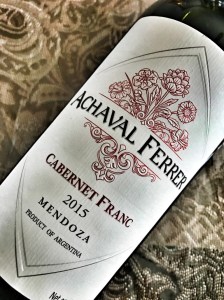
There was a lot of excitement around this wine, seems everybody really enjoyed it. As for all the wines of Achaval-Ferrer, the grapes for this Cabernet Franc came from the high altitude vineyards (3,280 ft above sea level) in the Uco Valley, mostly sustainably farmed. Here are my tasting notes:
2015 Achaval-Ferrer Cabernet Franc Mendoza Argentina (14.5% ABV, $24.99, 100% Cabernet Sauvignon, 10 months in 3-year old French oak barrels)
C: Dark garnet
N: intense, baking spices, dark fruit, mint, dark chocolate
P: medium-full body, fresh cut-through acidity, mint, hint of cassis, touch of white pepper on the finish, smooth, long finish with tannins kicking in at the end and lingering. Needs time…
V: 8, nice, can be drunk on its own, will be great with the food, and will evolve with time – at least 10 years. The wine opened up more on the second day, and I’m sure will further improve on the 3rd.
Definitely an excellent wine which will be hard to find – 1,400 cases total production, and a lot of this wine went to Morton’s steakhouse (so if you plan to visit Morton’s keep that in mind) – but it is well worth seeking. If you will score some of these bottles, lay them down in the cellar and let them evolve. At least this is what I would do.
This wine concluded a delicious #WineStudio experience with the Achaval-Ferrer wines, and to sum it up, I want to leave you with the twitter quote from Tina Morey, the host of #WineStudio:
I can fully sign under every word here – beautiful, expressive wines, well representing what Argentina is capable of. Salud!
Geekiest Way to Celebrate #MalbecWorldDay – #WineStudio Blind Tasting with Achaval-Ferrer
 Starting in 2011, April 17th is the day when we celebrate Malbec – one of the noble French grapes, which almost disappeared in France, but found its new life in Argentina, where it became a star. I don’t want to bore you with the Malbec history – you can read it on your own in many places, including few posts in this very blog (here is a bit about the history of the Malbec grape, and here you can take a Malbec quiz).
Typical “grape holiday” celebration usually includes an opening of an upscale (high end, memorable, etc) varietally correct bottle. Our today’s celebration was a bit different, as it was based on the concept of pure, unadulterated, geeky wine lovers’ fun – a blind tasting, and, of course, guessing.
This blind tasting was a part of the educational program run by the WineStudio during the month of April. In case you are not aware of the Wine Studio, it is a brainchild of Tina Morey, and it is wine education and marketing program which helps to expand people’s wine horizon and help them discover new regions, new grapes and new wines. April program, quite appropriately (April is designated as a Malbec wine month), was focused on the wines of Achaval-Ferrer, one of the very best wine producers from Argentina.
To facilitate the blind tasting, all the participants received a set of two bottles, some wrapped in colorful foil, and some in the black plastic – mine were the second type:


About an hour before the session I opened the bottles to let the wines breathe a little, as it was suggested by the organizers. And then the session started.
Of course, this was not the usual blind tasting. There are many ways to run the blind tasting, some of them quite extreme – for instance, tasting the wine without any known information from the black glass – an extreme sensual challenge. Going less extreme, in a typical blind tasting you will have at least some kind of limits installed – Pinot Noir grape, for instance, or wines of Pauillac. Our #winestudio blind tasting was on one side a lot less challenging, as we knew that the wines were made by Achaval-Ferrer, so we didn’t expect to find Petite Sirah in any of those bottles, and we even knew the vintage years, 2013 and 2012. At the same time, for sure for me, it was almost more challenging, as I was trying to guess the wines based on what I knew about Achaval-Ferrer and thinking about what they might want to showcase in the tasting, instead of focusing on the actual wines.
 We were asked to evaluate wines using WSET Level 3 tasting grid (you can find it here if you are curious). Here is a summary of my tasting notes – I’m distinguishing the wines by their vintage:
Wine 2013
APPEARANCE
Clarity: clear
Intensity: deep
Colour: garnet
NOSE
Condition: clean
Intensity: medium
Aroma characteristics: touch of funk, mint, underbrush, blackberries
Development: youthful
PALATE
Sweetness: off-dry
Acidity: medium+
Tannin: medium
Alcohol: medium
Body: medium+
Flavour intensity: medium+
Flavour Characteristics: cassis, eucalyptus, mint, blackberries
Finish: medium-
CONCLUSIONS
Quality level: outstanding
Level of readiness for drinking/potential for ageing: can drink now, but has potential for ageing
Wine 2012
APPEARANCE
Clarity: clear
Intensity: deep
Colour: garnet
NOSE
Condition: clean
Intensity: medium+
Aroma characteristics: tar, tobacco
Development: developing
PALATE
Sweetness: off-dry
Acidity: medium+
Tannin: medium
Alcohol: medium
Body: medium+
Flavour intensity: medium+
Flavour Characteristics: red and black fruit, salinity, raspberries, anis
Finish: medium
CONCLUSIONS
Quality level: outstanding
Level of readiness for drinking/potential for ageing: can drink now, but has potential for ageing
As it is usually the case with the blind tastings, I didn’t do well. I really wanted the wines to be pure Malbec and Cab Franc, and this is what I included into my final guess:
then, of course, I second guessed myself and changed the answer:
When the bottles were finally unwrapped, we found this beautiful Bordeaux blend called Quimera been our Quimera for the night – it is no wonder every back label of Quimera explains the name: “Quimera. The Perfection we dream of and strive for. The search for an ideal wine”.


The wines were 2013 and 2012 Quimera, both classic Bordeaux blends, but with a high amount of Argentinian star variety – Malbec. Both vintages had the same composition: 50% Malbec, 24% Cab Franc, 16% Merlot, 8% Cab Sauv and 2% Petit Verdot. Just as a point of reference, I still have a few bottles of 2008 Quimera, and that wine has 40% of Malbec. Both wines were beautiful, but very different in its own right – and they will for sure age quite nicely. This was definitely a treat and yet another testament to the great wines Argentina is capable of producing.
Here you go, my friends. Another great night at #winestudio, celebrating the grape well worth a celebration. Next Tuesday, April 25, we will be tasting Achaval-Ferrer Cabernet Franc, their new single-varietal bottling – been Cab Franc aficionado, I can’t tell you how excited I am. Join the fun – see you at 9 pm! Cheers!
Precision of Flavors – Tasting the Wines of Achaval-Ferrer
 Drinking wine is a pleasure – for sure it should be, and if you don’t feel like it, maybe you shouldn’t drink it at all. At the same time, there are multiple ways to look at one and the same thing.
A pleasure of drinking of the glass of wine may be just as it sounds, very simple – take a sip of the liquid in the glass, say “ahh, it tastes good”, and continue to the next sip or with the conversation, whatever entices you the most at the moment.
Then there are many of us, wine lovers, who, professionally or unprofessionally, can’t stop just at that. Yes, we take pleasure in every sip, but then we need to dig in. We feel compelled to put on the Sherlock Holmes hat and play the wine sleuth, figuring out exactly what we are tasting in that very sip. What was that flavor? Was that a raspberry? Hmmm, maybe not. And that whiff of something? It is so familiar! Why can’t I put a name on it? Grrrr.
Everyone who engaged in that wine tasting exercise I’m sure can relate to what I’m saying. But every once in a while, we do get a break, when the flavor simply jumps at you, pristine and obvious. And the best twist here is when the flavor is matching to what is expected to find in the wine, like fresh cut grass in Sauvignon Blanc, black currant in Cabernet Sauvignon, or pepper in Syrah – don’t we love those pure and precise flavors?
Achaval-Ferrer winery is only about 20 years old, built on the passion and vision of a group of friends in Mendoza, Argentina. In those 20 years, Achaval-Ferrer accomplishments are nothing short of enviable. Achaval-Ferrer wines earned multiple Decanter magazine 5-star ratings (the highest). There are 29 wines from Argentina rated as “Classic” by Wine Spectator (95-100 ratings) – 13 out of those 29 wines are Achaval-Ferrer wines; the flagship Malbec Finca Altamira consistently getting 96 points rating year after year.
In addition to passion, vision, hard work and perseverance, the success foundation of Achaval-Ferrer is its high altitude vineyards, located from 700 to 1100 meters above sea level (2,300 – 3,600 ft). Three out of four main vineyards of Achaval-Ferrer are also about 100 years old, and boast pre-phylloxera vines, as Phylloxera simply can’t survive in those high mountains conditions. Now all left to do is to take the beautiful fruit those vineyards produce and make it into equally beautiful wines – the Achaval-Ferrer does it quite successfully.
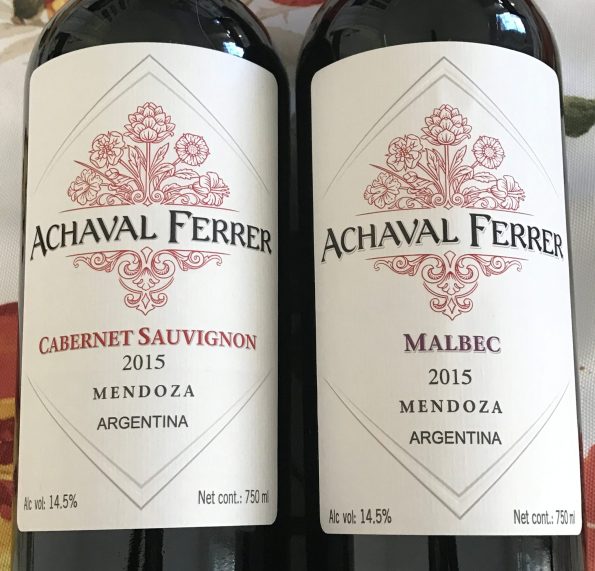
Here is what triggered my “precision of flavors” opening. I had an opportunity to taste a sample of Achaval-Ferrer wines recently, Cabernet Sauvignon and Malbec. While Malbec was a very good wine, but clearly needed time to mature, Cabernet Sauvignon was stunning, with flavors and aromas just jumping at your right away from the glass, with easy to relate to, textbook-correct cassis – also intensifying its purity with the time. This was a perfect example of why Argentinian wines are so popular and deserving of all your attention. And at a price of $24.99, the Cabernet Sauvignon offer an outstanding QPR, easily beating many classic Napa Cabs which would also cost you at least three times as much.
Here are my detailed notes:
2015 Achaval-Ferrer Cabernet Sauvignon Mendoza Argentina (14.5% ABV, $24.99, 100% Cabernet Sauvignon)
C: dark garnet, almost black
N: very intense, dark roasted fruit, cassis. The roasted fruit intensity diminishes as the wine breathes.
P: beautiful cassis, clean acidity, soft tannins, lots of layers. As the wine breathes, the tannins show better and more pronounced. Pure clean black currant after a day.
V: 8+, outstanding, wow. Will evolve.
2015 Achaval-Ferrer Malbec Mendoza Argentina (14.5% ABV, $24.99, 100% Malbec)
C: practically black
N: roasted meat, smoke, tar, intense, baking spices
P: dark fruit, bright acidity, mint, alcohol burn in the back?, succulent, lavender, spicy. Blueberries showed up on the second day.
V: 8, needs time, but perfectly delicious on the second day.
Here you are, my friends. Achaval-Ferrer definitely makes wines worthy of oenophile’s attention – and the QPR makes these wines worth seeking. Cheers!
Last Bottle Sign Up ($10 credit)




 Talk-A-Vino