Archive
Wines of Uruguay: Delicious, Interesting, Unique
Uruguay is the second-smallest country in mainland South America (only Suriname is smaller than Uruguay). It also has the highest level of education in South America, and the highest level of beef consumption in the entire world – and cows outnumber people in Uruguay 4 to 1.
Uruguay also makes world-class wines.
There are 14, 804 acres of vineyards in Uruguay, occupying an area a little bit bigger than Saint-Émilion in Bordeaux and a little bit smaller than Alexander Valley in California. Uruguay is the only South American winemaking country whose terroir is affected by the Atlantic Ocean. It is also interesting to note that the vineyards of Maldonado, the largest winemaking region in Uruguay, are planted above some of the oldest rocks on earth, the Río de La Plata craton, which is 2.5 billion years old. Currently, there are 168 wineries in Uruguay, producing 70 million bottles annually.

Bodega Garzón. Source: Uruguay Wine
Uruguay is best known for its Tannat wines, and Tannat occupies about 27% of all the area under vine in Uruguay. Actually, Merlot is the second most planted variety, followed by Cabernet Sauvignon, Cabernet Franc, Marselan, Sauvignon Blanc, Chardonnay, Albariño, and others. There are also six main winemaking regions in Uruguay – Northern Shore, Southern Shore, Metropolitan, Oceanic, Center, and North, each divided into subregions. There are also five distinctive terroirs across these six winemaking regions, influenced by the Atlantic Ocean, rivers, amounts of rain (these can differentiate widely), and winds.
For more grapey details and the latest statistics, I need to refer you to the Uruguay Wine website, where we will talk about delicious, interesting, and unique.
The last time I tasted Uruguayan wines was about a year and a half ago. This year, I had a “double exposure” to the wines from Uruguay – Tannat red wines at the beginning of the year, and then the whites a few weeks ago. So the delicious part is easy, as many of the wines were simply delicious. Interesting and unique require some explanations.
Typically, when it comes to food (and wine), “interesting” is rarely a positive descriptor. However, in our case, it is also not negative, and it really should be processed together with unique. The white wines were interesting, as while they were made from the familiar grapes (Riesling, Sauvignon Blanc, Viognier, Albariño), they didn’t taste much like familiar grapes, maybe with the exception of the Sauvignon Blanc and Viognier to some degree. Another unique trait of this group was in the fact that the wines kept evolving for probably 2 weeks after being first opened, mostly just getting better and rounder as time passed. I have some reflections on this in the notes, so this is what you will see below.
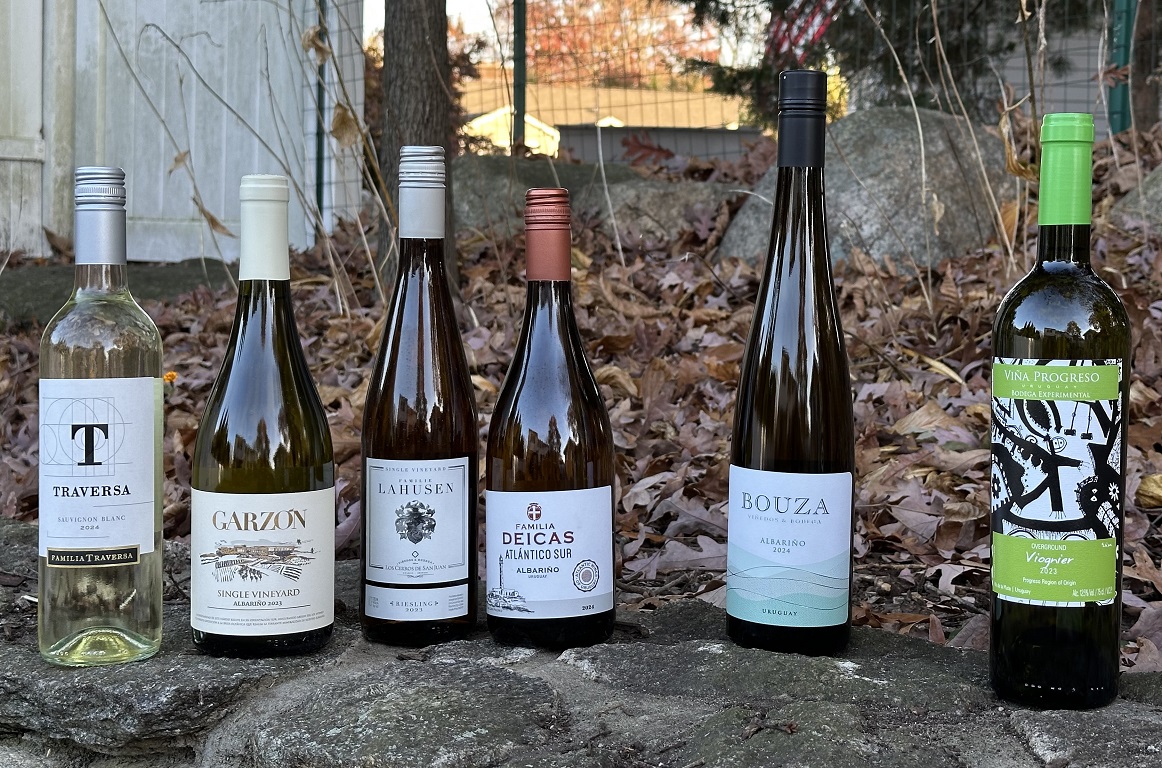
Here are my notes:
2023 Famile Lahusen Riesling Los Cerros de San Juan (12.3% ABV, $25) – the oldest winery in Uruguay, producing wines since 1854.
Straw pale
Herbs, Meyer lemon
Sweet fruit on palate, doesn’t taste like Riesling at all. Better tasting on the 3rd day, a bit more balanced.
Not bad, 7+
It actually became better over the next few days, getting to an 8- rating, but by no means this is your classic Riesling…
2024 Traversa Sauvignon Blanc Montevideo (13.5% ABV, $16)
Light Straw pale
Citrus, freshly cut grass, delicate, inviting
A touch of freshly cut grass, but mostly whitestone fruit on the 3rd day.
8-, enjoyable.
2013 Viña Progreso Bodega Experimental Overground Viognier Progreso Region (12.5% ABV, $26)
Straw pale
Interesting nose with a hint of brown butter notes, hints on plumpiness of the wine (day 3)
A hint of butter on the palate, quickly displaced by cut-through acidity. The wine had a lot more Viognier aromatics on the 1st day, but now feels like a nice Chardonnay (in blind tasting this would be my only guess)
8, very nice. One of my favorite whites of the tasting.
2024 Bouza Albariño Uruguay (12.5 % ABV, $28)
Straw pale
Perfumy, flowery nose with tropical fruit notes
Guava, a tropical fruit on the palate. Missing characteristic acidity and salinity. Not a bad wine, but doesn’t sing “Albariño” for me
7+
2023 Garzón Single Vineyard Albariño Maldonado (14% ABV, $35)
Light golden
Second day nose – hint of gunflint, butter, a distant hint of honey (first day the smell was not great)!
Second day palate – excellent, salinity, acidity, very much resembling a classic Albariño, still with a distant hint of kerosene, but now it can be ignored. The first day was chemically undrinkable.
8, needs time
2024 Familia Deicas Atlántico Sur Albariño Uruguay (12.3% ABV, $20)
Greenish/very light golden color
On the first day, the nose was very sweet. Second day- less sweet, tropical fruit.
Sweet but now with salinity coming through – this is on the second day. The first day the wine was cloyingly sweet.
7+, it is drinkable, but don’t try pairing oysters with it.
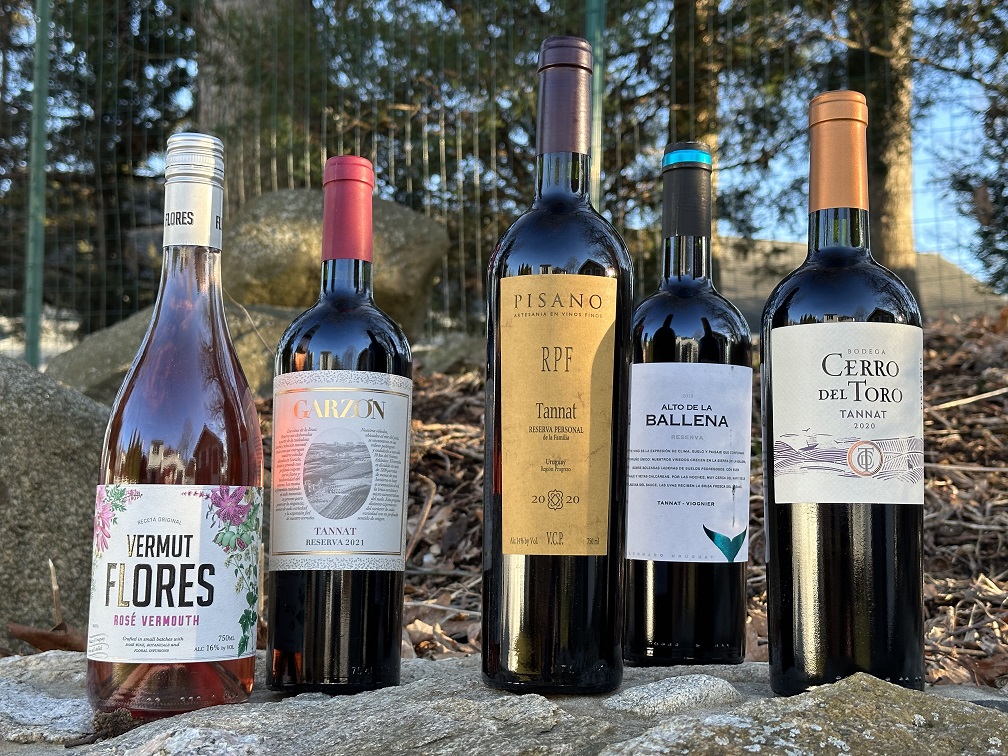
And now, for the reds:
2018 Alto de La Ballena Reserva Tannat Viognier Maldonado Uruguay (14% ABV, 85% Tannat, 15% Viognier)
Dark garnet, almost black
Dark cherries, tobacco, inviting
Tart cherries, minerality, crisp acidity, well integrated tannins, a bit of chalk, perfectly balanced
8+ – happy to see that I continue liking this wine the year after tasting it for the first time (last year’s notes can be found here)
2020 Cerro del Torro Tannat Maldonado Uruguay (15% ABV)
Dark garnet
A hint of a barnyard, herbs, dark fruit
Cherries, earthiness, pronounced minerality, a hint of tobacco, good acidity, tart finish.
7+/8-
2021 Garzón Tannat Reserva Uruguay (14% ABV)
Dark garnet
Ripe dark fruit, stony minerality, herbs, distant hint of barnyard
Dark fruit, espresso, cherries, firm structure, clean acidity, round, well balanced.
8-/8
2020 Pisano RPF Tannat Reserva Personal de la Familia Uruguay (14% ABV)
Dark Ruby
Red fruit, herbs, medium+ intensity
Tart, crisp, tart cherries, medium body, firm structure, cut-through acidity.
8-, food wine more than anything.
If you took a moment to glance at the notes, I’m sure you found them all – delicious, interesting, and unique. The whites definitely need some additional work, but they are unquestionably interesting, and I do mean it in a positive way. There are plenty of simply delicious wines from Uruguay, definitely worth seeking, so I hope that I encouraged you to give them a try when you have an opportunity. Cheers!
Celebrate Tannat!
Yesterday, April 14th, Tannat Day was celebrated around the world.
Obviously, I’m late to the “Celebrate Tannat” party, so why even bother, right?
Tell me honestly – have you ever forgotten to wish a happy birthday to a friend on the actual birthday day, only to call the next day, apologize, and still wish a happy birthday? If you have never done that, you can probably skip this post altogether as “too late”. For those who had been in this movie once or twice, let’s still celebrate the Tannat grape.
Tannat is an interesting grape due to a number of reasons. First, this is one of the most tannic grapes out there, with one of the highest levels of phenolic compounds in seeds and skin (you can check this article if you would like to get some actual scientific data), competing for the leadership here with Sagrantino grapes from Umbria in Italy. Second, Tannat’s story is very similar to the story of its very close cousin, Malbec.
I’m not implying that Tannat and Malbec are genetically related. But they share similar lifecycle stories. Both grapes originate from the cradle of the French wine world, Southwest France, also known as Sud Ouest. Once upon a time, Malbec used to be the king of Cahors, and Tannat was ruling in Madiran. Both grapes managed to lose their crowns and were reincarnated in full glory in South America – Malbec found kingship in Argentina, and Tannat became an uncontested star of Uruguayan winemaking.
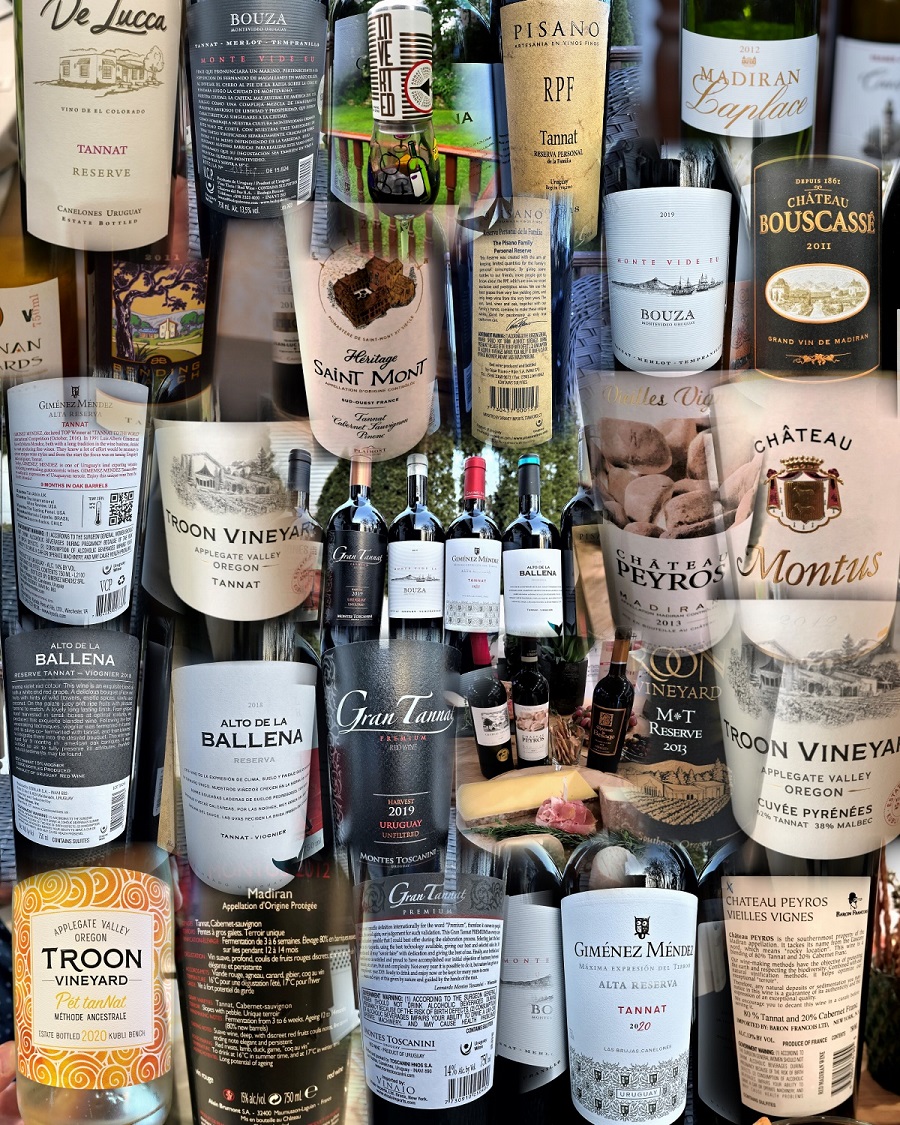
While Tannat found its new home in Uruguay, the grape is actually growing all around the world. But Uruguay is not just the new home. The interesting part about Tannat’s story in Uruguay is that the local winemakers found a way to tame its powerful tannins and acidity, and are able to produce delicious single-grape Tannat wines. However, Tannat can be found in Australia, Chile, Argentina, France, California, Oregon, Texas, and many other winemaking regions, where it is often used as a part of the blend.
While working on this post, I decided to check how often I mentioned Tannat one way or the other in my blog. From almost 1,500 posts, 34 posts contain the word “Tannat”. For comparison, 453 posts contain the words “Cabernet Sauvignon”, 13 times difference. However, just looking at the website word count, the word “Tannat” was mentioned in the blog about 700 times, and Cabernet Sauvignon about 2,500, less than 4 times difference.
Never mind the word count. As we said before, Tannat is the star of Uruguayan winemaking. Also, if you care to look for them, Madiran wines made somewhat of a comeback as of late, and Tannat is a major grape there. You can also find single-grape Tannat wines in Oregon, Texas, and Virginia. Speaking of Oregon, I have to mention the wines of Troon Vineyard. Craig Camp, the head winemaker at Troon, makes wonders with Tannat, from beautiful full-bodied organic reds to sparkling Tannat wines – Pet tanNat is definitely the wine to experience.
And then there is blending. If you would care to look at the list of grapes in the blend, lots of red wines from around the world have some amount of Tannat. Sometimes it is only 1% or 2%, but this might be enough to add acidity and tannins to the blend, to make the wine shine a little bit more.
Playing solo or in a minor supporting role, Tannat is well worth celebrating. Whether you celebrated Tannat yesterday or not, give this grape a chance – you might well like it in your glass.
Uruguay Wines – Coming Of Age
Do you know the problem many wine lovers share? We are creatures of habit.
Once we develop our inner “favorite wine” profile, we don’t let any changes happen to it. We like what we like. Never heard of this region? Thank you, I’ll pass. God forbid we fall in love with the particular producer – this is even worse than the region – nothing is ever good enough outside of the circle of our favorites.
And this is generally okay. Except we are putting ourselves in danger of losing on new, enlightening, delicious experiences.
When I was invited to the Uruguay wine webinar, my first reaction was “nah”. I mean, Uruguay, really? Between Chile and Argentina, my South American world-class wine circle is already full – do I need to bother with the wines from a totally unknown region?
On second thought – this is a webinar. Wine is coming to me, not like I need to travel somewhere to taste the wines I can potentially be disappointed by. Why not?
I’m glad I accepted the invitation. Both the information and the wines were lots of fun. We learned that while Uruguay has a population of 3.5M people, 2nd smallest size-wise country in Latin America, the country has a 98.7% level of literacy, the highest in Latin America. People in Uruguay are mainly descendants of Italians and Spaniards so they literally have wine embedded in their DNA.
Winemaking in Uruguay started in the 13th century. Today, there are 164 active wineries, producing 70M bottles of wine annually. Uruguay is currently in the process of implementing its own sustainability program. And by the way, the oldest winery in Uruguay dates back to 1854 and is called Los Cerros de San Juan (still open today!).
Uruguay has primarily a maritime climate with strong Atlantic influence, with the majority of low-lying coastal vineyards. Uruguay’s climate is closer to Bordeaux than the rest of South America, and it is significantly wetter if compared with Chile, where it rains only during the winter. Soils are clay based with lots of river deposits. Uruguay has six main winemaking areas, boasting 5 different terroirs. Warm and cold ocean currents collide right around Uruguay, creating significant influence. Interestingly enough, Uruguay is the only winemaking country in South America whose terroir is affected by the Atlantic Ocean.
When it comes to grapes, there are 14,804 acres under vine (a little smaller than Alexander Valley in California). Tannat is unquestionably a star, accounting for 27% of vineyard plantings., but it is not the only grape, obviously – Merlot, Cabernet Sauvignon, Cabernet Franc, Sauvignon Blanc are all quite popular as well.
And before we talk about wines, few more interesting tidbits: cows outnumber humans in Uruguay 4 to 1 and Uruguayans consume more meat per capita than any other country in the world!
Okay, now you know all that I learned in the webinar, and we can talk about the wines.
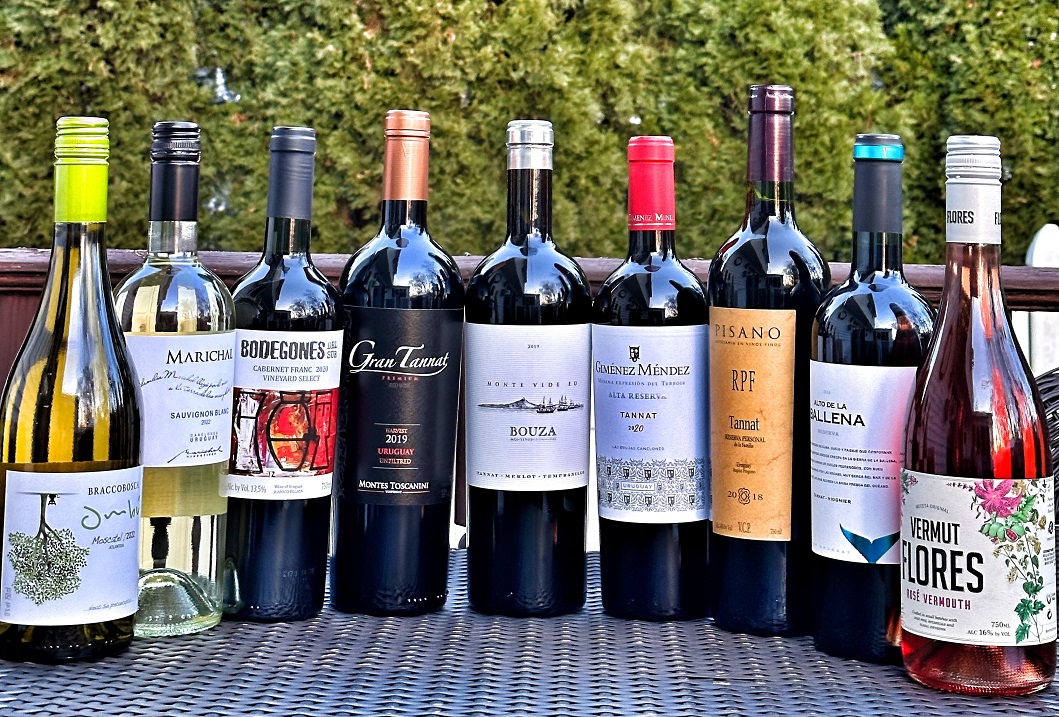
We had 2 whites, 6 reds, and one Vermouth wine in the tasting. Spoiler alert: I literally liked them all. In the blind tasting, these wines would be surely regarded as world-class, placing them in California, France, maybe Chile – Uruguayan origin of these wines would be a total surprise for many – for sure for me. And yet, here they are – world-class wines from Uruguay.
2022 Marichal Sauvignon Blanc Canelones Uruguay (12.5% ABV, $14)
C: light golden
N: plump, round, Whitestone fruit, a hint of gunflint
P: crisp acidity, fresh, bright. More resembling Muscadelle than anything else. Good balance.
V: 8, very refreshing.
2022 Bracco Bosca Ombú Moscatel Atlantida East Costal Region of Uruguay (13% ABV, $16)
C: light golden
N: very interesting. Muscat’s spicy, nutmeg profile comes as a distant hint. A touch of perfume
P: restrained tropical fruit with an acidic finish.
V: 7, not balanced enough for me; On the second and third days the wine showed much better, more coherent and more elegant – Drinkability: 8-.
2020 Familia Deicas Bodegones del Sur Vineyards Select Cabernet Franc Juanico Region Uruguay (13.5% ABV, $20, 30% aged in American and French oak)
C: Beautiful bright ruby
N: round vanilla, new world style
P: interestingly restrained on the palate, with noticeable tannins. The palate shows the absolutely old world (Saumur, Chinon). Interesting cranberry notes after an hour and a half in the open bottle.
V: 7+/8-, a bit unexpected, but not bad
Improved on the second day, became more round. Final: 8-
2020 Giménez Méndez Alta Reserva Tannat Las Brujas Canelonés Uruguay (14% ABV, $18, aged for 9 months)
C: Dark Garnet
N: Open, inviting, dark fruit, blackberries
P: Dark fruit, firm structure, smokey undertones, herbs, very good balance.
V: 8, well drinkable now
2019 Montes Toscanini Gran Tannat Premium Uruguay (14% ABV, $59, 18 months aged in oak, BAB with a huge punt)
C: dark garnet, practically black
N: wow. Cassis, sweet oak, eucalyptus, open, inviting, invigorating. In a blind tasting, I would bet my life on Napa Cabernet Sauvignon.
P: the palate is leaner than the nose suggests. Red and black fruit weave around a firm structure, tannins showed up a while after opening.
V: 8-/8, very impressive
2018 Pisano RPF Reserva de la Familia Tannat Region Progreso Uruguay (% ABV, $24, 10–12 months in French oak)
C: dark garnet
N: dark fruit, coffee, smoke
P: a hint of smoke, sapidity, dark, concentrated but not overpowering. Good balance, medium-long finish
V: 8-/8, very nice. Will be great with the steak.
2018 Alto de la Ballena Tannat – Viognier Uruguay (14% ABV, $24, 85% Tannat, 15% Viognier)
C: Dark garnet, almost black
N: herbs-forward nose, sage, a hint of cherries
P: fresh fruit, salivating acidity, sage, firm structure, and perfectly lingering cherries and cherries pit finish.
V: 8, great by itself, and will be great with beef roast
2019 Bouza Monte Vide Eu Montevideo Uruguay (13.5% ABV, $67, 20% Tempranillo, 30% Merlot, 50% Tannat, vinified separately, 16 months in French and American oak barrels)
C: dark garnet with a beautiful ruby hue
N: very complex, cherries, rosemary
P: roasted notes, dark fruit, elegant package, firm structure with a perfectly balanced mouthfeel.
V: 8, excellent, a world-class wine.
Basta Spirit Vermut Flores Rosé Uruguay (16% ABV, $16, Tannat, 27 botanicals)
C: beautiful salmon pink
N: Herbaceous, but a bit strange, stewed strawberries
P: a bit too sweet for my palate.
V: I’m very particular about the vermouth, so this is probably not the one for me.
Here you are, my friends. Next time you see an Uruguayan wine on the shelf, obey your thirst and grab it – and you don’t even have to thank me later.
Last Bottle Sign Up ($10 credit)




 Talk-A-Vino