Archive
New Zealand, Familiar and Not
 Here is your motivational quote of the day: “open your mind, and discovery will follow”. If you are wondering what the heck is wrong with this Talkavino guy starting the wine post with motivational quote, read on, I will explain.
Today we will be talking about the wines of New Zealand. What is the first wine which comes to mind when you think “New Zealand”? Don’t know about you, but for me it is a Sauvignon Blanc. Closely followed by Pinot Noir. But then there is beautiful Chardonnay, and Bordeaux blends, and Riesling – please, don’t forget the Riesling!
Two weeks ago I attended the New Zealand wine tasting event in New York. The event consisted of the seminar and the tasting, so below you will find my notes from both. But before I will inundate you with the wines and the tasting notes, let me share some general thoughts.
New Zealand wine industry is relatively young. First Sauvignon Blanc was planted in 1973, and first commercial release took place in 1979. [However, the first vines were planted in New Zealand in 1819, and in 1881 Pinot Noir from Central Otago got gold medal in the “Burgundy” category at the wine show in Sydney – but let’s leave it aside for now]. Through the 1980s, Cloudy Bay found its magic, and New Zealand wines spread out throughout the world (definitely in US). The New Zealand wine export had been growing steadily for many years, from 30M gallons of wine in 2009 to the 44M gallons in 2013, also reaching almost US $1B in revenues in 2013. Also, a lot of New Zealand wineries utilize sustainable winemaking methods and use organic grapes (you can read more here).
What I also sense from reading the blogs and listening to the experts is that the New Zealand winemakers are feeling constrained by what they already achieved and are trying to break the boundaries. Few simple facts for you. There are 11 defined wine regions in New Zealand. However, many winemakers believe that this is not enough, and want to define the sub-regions with much smaller boundaries. Such sub-regions are not yet official [I might stand corrected here – according to the New Zealand wine web site, the sub-regions are defined, but I still don’t know how widespread or how official those designations are], but on many labels you can already see designations for the sub-regions, such as Awatere or Waihopai in Marlborough, or Pisa in Central Otago. Different soils, different micro-climates, different terroirs, if you will – all lead to production of stylistically different wines coming from the different areas of the same bigger region.
There is more to this “breaking the boundaries”. New Zealand wine is not only a Sauvignon Blanc and Pinot Noir. There are Syrah, Merlot, Pinot Gris, Chardonnay and even Grüner Veltliner and Chenin Blanc wines which are shining. And even familiar Sauvignon Blanc is taking to the totally new territories, by using oak and not only – which leads us to the seminar, so we can finally talk wines.
The seminar was very interesting. It was done in the unusual format. There was no classroom with a head table and presenters. There was a big roundtable (well, it was actually a square), with presenters and winemakers sitting around the room among the participants. But this was not the most unique characteristic of the event. There were 9 Sauvignon Blanc wines presented in the event. And all 9 were … oaked. With the various degree, but yes, all Sauvignon Blanc wines went through some oak ageing process. There was also a 7 years old Sauvignon Blanc wine, which was quite unique for me. All in all, it was very different and interesting. Was it successful? I will defer you to my notes below. Here we go.
2014 Amisfield Sauvignon Blanc Central Otago (SRP $20)
C: pale straw
N: fresh cut grass, very restrained, lemon notes, minerality, touch of sapidity, interesting complexity.
P: tremendous acidity, more of a Muscadet style, lots of minerality, food wine (oysters!)
V: nice and restrained, Drinkability: 8-
2014 Nautilus Sauvignon Blanc Marlboro (SRP $17.99)
C: light straw, greenish
N: concentrated green notes, more of a fresh vegetables greens in the garden than grass. Touch of sweetness after swirling the glass.
P: very restrained, complex, salinity, white stone fruit, acidity on the finish.
V: Drinkability: 7+
2014 Huia Sauvignon Blanc Marlboro (SRP $19)
C: pale straw
N: hint of gasoline – disappeared after intense swirling. Touch of white fruit, restrained. Hint of lemon. Overall, nose is not very pronounced.
P: tremendous acidity, hint of Granny Smith apples
V: wine finishes nowhere, lacking conclusion. Drinkability: 7-
2014 Neudorf Sauvignon Blanc Nelson (SRP $17.95)
C: light straw yellow
N: non-typical. But may be a distant hint of grass.
P: lemon, fresh, supple, good acidity, nice textural presence. Still, tremendous amount of acidity is coming through, plus tannins in the finish!
V: Drinkability: 7+, okay wine
2014 Craggy Range Te Muna Road Sauvignon Blanc Marlboro (SRP $28.99)
C: pale yellow
N: touch of vanilla, touch of tropical fruit, hint of grapefruit
P: great complexity, restrained, guava, lemon, minerality, grass, touch of tannins, but it is well integrated.
V: Drinkability: 7+
2013 Seresin Marama Sauvignon Blanc Marlboro (SRP $40)
C: light yellow
N: butter, vanilla, butterscotch- wow, is this is a Chard? Pronounced, concentrated flavors!
P: vanilla, butter, more akin to a butterscotch candy, fresh and exuberant! The clearest expression of butterscotch candy of any wines I ever had (bold, I know)
V: it gets 8 (or even 8+) as a Chardonnay and 6 as Sauvignon Blanc. I would be glad to drink this wine – just don’t tell me what it is.
2013 Trinity Hill Sauvignon Blanc Hawke’s Bay (SRP $16.99)
C: light straw yellow
N: very inexpressive. Whatever I think I smell, is a product of my imagination. After 5 minutes of swirling, grass showed up, more of a typical expected SB. Still Very restrained.
P: nice acidity, good with oysters, nice touch of white fruit, fresh and clean
V: Drinkability: 7
2012 Pegasus Bay Sauvignon Blanc Waipara Valley (SRP $28)
C: pale straw yellow
N: complex aromatics, touch of oak, elevated white fruit (apples, hint of tropical fruit). One of the best on the nose so far. Distant hint of grass
P: Elegant, fresh, well integrated acidity, apples
V: one of the best in the tasting. Drinkability: 8-
2008 Mahi Ballot Block Sauvignon Blanc Marlborough (SRP $24)
C: light yellow, doesn’t show the age at all
N: some vegetative notes and fresh salami (yes, you can unfollow me if you want). Some distant resemblance of fruit. On a second thought, it has a Chablis-like minerality. The sausage is off, Chablis is in.
P: most elegant palate in the tasting. Acidity definitely wore off, but the wine is elegant, complex, mellow, just an interesting wine in the style of nicely aged white Rhône.
V: best of the tasting. Very round and elegant. Drinkability: 8.
And then there was a tasting. I didn’t get an opportunity to taste all the wines. Also, as you would expect, I liked some wines more than the others. Thus below are the wines which I liked the most from what I tasted. Oh wait, I still have to explain myself with that “open your mind” intro. Let me do it now, the story is rather simple.
What flavors do you typically associate with the Sauvignon Blanc? Grass? Check. Lemon? Check. Grapefruit? Check. Gooseberry? As Chris Kassel mentioned recently, most of the people who didn’t live in Europe have no idea how Gooseberry smells or tastes, but okay. Check. Some white tropical fruit? Possible and Check. But what about Black Currant? I don’t know about you, but I don’t associate red or black berry aromas with Sauvignon Blanc. But – black currant is one of the main characteristic aromas of Cabernet Sauvignon. And Sauvignon Blanc is a parent of Cabernet Sauvignon. Thus when I heard from one of the hosts talking about the wine “beautiful black currant aroma”, that was a nail on the head! Yes – exactly – the revelation – forget the damn Gooseberry, just open your mind (talking to myself) and understand that black fruit can be associated with white wine (I’m sure the opposite is true). I would honestly say this was my main discovery of the tasting, the revelation.
Now let’s get back to wines. My absolute favorites where Sophora Sparkling wines (simply a wow and an incredible QPR), Syrah from Elephant Hill, Chenin Blanc from Astrolabe, Sauvignon Blanc from Saint Clair, Doctors Grüner Veltliner and Lake Chalis lightly fizzed Sauvignon Blanc – all shown in blue below. But all in all, lots of delicious wines in the tasting. All prices are suggested retail as listed in the brochure. Let’s go:


2014 Amisfield Sauvignon Blanc Pisa, Otago ($20) – +++, clean, restrained
2013 Amisfield Pinot Gris Pisa, Otago ($25) – +++, nice touch of oak
2011 Amisfied Pinot Noir Pisa, Otago ($35) – ++1/2, nice balance, still needs time
2012 Amisfied Pinot Noir Pisa, Otago ($35) – +++, elegant, round, touch of green notes
2014 Ara Pathway Sauvignon Blanc Waihopai, Marlborough ($16.99) – +++, very good, traditional
2013 Ara Pathway Pinot Noir Waihopai, Marlborough ($18.99) – ++1/2, nice, clean
2014 Ara Single Estate Sauvignon Blanc Waihopai, Marlborough ($19.99) – +++, clean, balanced
2013 Ara Single Estate Pinot Noir Waihopai, Marlborough ($23.99) – ++1/2, very good, tannins, needs time
2012 Astrolabe Province Sauvignon Blanc Marlborough ($23) – +++, excellent, black currant, perfect balance
2014 Astrolabe Province Pinot Gris Marlborough ($23) – +++, beautiful aromatics
2012 Astrolabe Province Pinot Noir Marlborough ($28) – +++1/2, excellent!! Best of tatsing?
2013 Astrolabe Vineyards Chenin Blanc Wrekin Vineyard Southern Valleys, Marlborough ($22) – +++, concentrated, Vouvray-like, excellent, creamy
NV Sophora Sparkling Rosé Hawke’s Bay ($16) – +++, wow! beautiful – aromatics and structure of the classic Chgampagne. Outstanding QPR
NV Sophora Sparkling Cuvée Hawke’s Bay ($16) – +++, equally excellent as the previous wine
2012 Domaine-Thomson Surveyor Thomson Single Vineyard Pinot Noir Lowburn, Otago ($44) – ++1/2
2011 Domaine-Thomson Surveyor Thomson Single Vineyard Pinot Noir Lowburn, Otago ($44) – +++, excellent!
2013 Elephant Hill Syrah Hawke’s Bay ($28) – ++++, spectacular! An absolute precision of Syrah with peppery profile
2014 Fire Road Sauvignon Blanc Marlboro ($13) – ++1/2, nice, simple, balanced
2013 Fire Road Pinot Noir Marlboro ($15) – ++1/2, probably best QPR at the tasting
2013 Doctors Grüner Veltliner Marlborough ($18) – +++, touch of petrol, nice
2014 Doctors Sauvignon Blanc Marlborough ($18) – +++, nice, clean, good acidity
2013 Seifried Pinot Gris Nelson ($18) – ++1/2, clean, nice
2012 Seifried Riesling Nelson ($18) – +++, petrol, beautiful
2013 Maimai Syrah Hawke’s Bay ($20) – +++, excellent, dark
2014 Lake Chalis Cracklin’ Savie Sauvignon Blanc Marlborough ($18) – +++1/2, beautiful, fresh, lightly fizzed, very unique. Similar to Moscato in creaminess, but dry
2014 Lake Chalis Sauvignon Blanc Marlborough ($18) – +++, perfect, black currant, beautiful!
2014 Saint Clair Family Estate Sauvignon Blanc Marlborough ($17.99) – +++, beautiful balance
2014 Saint Clair Pioneer Block 18 Snap Block Sauvignon Blanc Marlborough ($26.99) – +++, interesting complexity
2012 Saint Clair Wairau Reserve Sauvignon Blanc Wairau, Marlborough ($31.99) – +++1/2, very complex, very unusual
2012 Saint Clair Pioneer Block 16 Pinot Noir Awatere, Marlborough ($17.99) – +++, Oregon-like, very elegant
And we are done here. What do you think of New Zealand wines? What are your favorites? Did you ever associated Sauvignon Blanc aromas with black currant? Until the next time – cheers!
What To Drink On Valentine’s Day
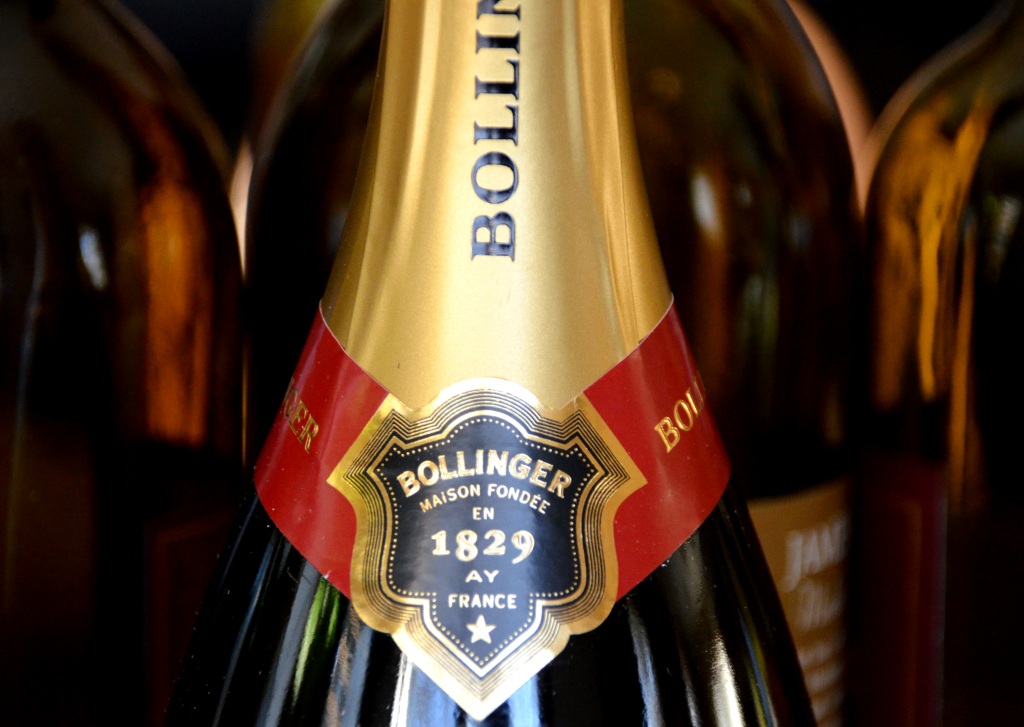 I generally avoid holiday-related wine posts, and I do it for a number of reasons. First of all, every information source on the planet considers it to be their duty to produce some piece of writing with wine recommendations. And then for someone who drinks wine all the time, the holidays are not so much of a special occasion to have a reason to open a bottle of wine. Oh well – somehow I felt compelled to share my thoughts on the wines for the Valentine’s Day, hence this post…
Pink. Red. Extreme. Commercialized beyond belief, still increasingly so year after year. Heart-shaped to the point of insanity. There are many things which turn people away from the Valentine’s Day, and I can understand that. However, I take this holiday as an extra opportunity to celebrate love and life. All you need to do is to find your way – ignore pink paraphernalia, ignore meaningless cards, ignore conveyer belt – style experience at the restaurants – and celebrate love and romance as a pure meaning of this holiday.
Let’s agree that we will celebrate love and romance in our oenophile’s way, and let’s talk about wine – without wine on the table, celebration is … just another boring dinner, right? By the way, when I said “felt compelled” in the opening of this post, this was not entirely true. I also had a pleasure to be a guest at the Off the Vine Radio Show, talking with Benita and Latisha about … you guessed it – Valentine’s Day wines – thus as you can imagine, I gave some thought to the subject (and then yes, “felt compelled”). In case you have a bit of time, you can listen to that episode here.
What can I tell you about wines for the Valentine’s Day? First of all, if you have a plan already, it doesn’t matter what I have to say. If you have some specific celebratory dish in mind, and have a pairing ready – it doesn’t matter what I have to say. But if you are still thinking how to make this holiday special, then let me share my thoughts with you. But remember – drink what you like. The wine for the Valentine’s day doesn’t have to be pink, and it doesn’t have to be sweet. It has to be something which will give you pleasure – as simple as that.
The wine for the Valentine’s Day should have balance and it should have finesse. While thought provoking is good for the wine, on Valentine’s Day you should focus on romance and not on deciphering the complex flavors. Go after balance, finesse and simplicity. This is why I would never suggest, for instance, the natural wines of Frank Cornelissen or Jean-Pierre Robinot, or the dark magic of Randy Dunn with his Howell Mountain Cabernet Sauvignon – those wines will drain you emotionally, and it is a wrong angle for the Valentine’s day. Thus let’s talk about balance and finesse.
First wine I want you to consider is Champagne. As the very least, it can be an Italian Sparkling wine from Franciacorta or Trento, or some of the California sparklers. Prosecco, Cava and many other sparklers are simply not consistent enough, so for the Valentine’s Day, go with classic – remember – balance and finesse. For the Champagne, my choice would be Bollinger, as I think it is one of the finest non-vintage Champagnes, with lots of finesse. Ferrari from Trento and Bellavista from Franciacorta in Italy would definitely my next choice. But – I don’t want to forget California – Roederer Estate L’Ermitage, Schramsberg Rosé, J Cuvée 20 or any of the Gloria Ferrer sparkling wines would live you with a happy smile.
Moving on, let’s talk white wines. As we are looking for the balance and finesse, I have a few recommendations for you – and you might be surprised with these. For this holiday, I want you to step outside of your “usual circle”. My first recommendation is for the white wines of the Rhône valley in France. Yes, Rhône is mostly known for their reds, but the white wines there are equally stunning. For instance, try to find Domaine Saint Préfert Cuvée Speciale – I called this wine once “a symphony in the glass”. But in general, look for the Clairette or Grenache Blanc wines from Southern Rhône, or Marsanne/Roussanne from the North – those wines are often not easy to find, but they will deliver lots of balance, finesse and pleasure.
Let me give you a few more suggestions – equally difficult to find, but worth looking for. Viognier from Washington is a white wine worthy of celebrating love and romance with. Look for Mark Ryan or Willis Hall – their Viognier is nothing short of stunning. To close on the whites, here are 3 more rare beauties. First, 2 Sauvignon Blanc from … Italy: Gaja Alteni di Brassica and Poggio alle Gazze dell’Ornellaia – stunning balance and finesse. And the last one – Ken Forrester The FMC. You can’t go wrong with either one of these wines – go, start looking, you don’t have lots of time.
Now, we arrived at the red wine junction. Looking for the balance and finesse will dramatically reduce our choices. I would say, let’s go for Pinot Noir. I will limit my recommendations to this one grape only – and here is why. We are looking for the balance and finesse, right? Think about Cabernet Sauvignon from California – what would be the first word or words you would use to describe those wines – probably “big and powerful” – and this is not what I’m looking for suggesting the wines for the Valentine’s Day. Same goes for many Merlot, Syrah and Grenache wines – never mind the Petite Sirah. Even with my beloved Rioja – there are few wines, which will deliver that exact balance and finesse – La Rioja Alta Reserva Especiale would be definitely the one – and I highly recommend it. But for the Rioja – and then for Barolo, Brunello and even Super-Tuscan – as a general class, the probability of running into “big and powerful” is a lot higher than finding “balance and finesse”.
Talking about Pinot Noir, I wish I would recommend some of the classics to you – yes, the Burgundy – but unfortunately, my exposure to the Burgundy is way too limited, so you will need to ask your trusted wine merchant for the advice. Next up – California and Oregon. For the most of the time, California Pinot Noir will deliver exactly that – balance and finesse. To give you a few names, go look for Siduri, Loring Wine Company, Calera, Drew, Copain, Laetitia – but there are many others and it is hard to go wrong with California Pinot Noir. Oregon would be also a perfect choice – look for Adelsheim, Chehalem, Antica Terra, Evening Land – finesse is a middle name for the Oregon Pinot, so you will not be disappointed. And last but not least – don’t forget the New Zealand! Pinot Noir from Central Otago, Marlborough and Martinborough are typically well balanced and round, perfectly fitting our quest for finesse. Look for the wines from Craggy Range, Mt. Difficulty and Amisfield among the others.


Dessert time! People often underestimate how bad the dessert wines can be – one sip of the cloying, single-sugar-note wine would ruin the experience of an amazing dinner. You really have to put a lot of care in selecting the dessert wine which will have balance and finesse. Of course I would like to recommend Sauternes and Barsac wines for you, but again, my personal experience is very limited. I’m sure you can’t go wrong with Château d’Yquem – if you can afford it, go for it! What would be a bit easier to find (and afford) is a Port. Not just any Port – balance and finesse, remember – so go for a nicely aged Tawny, 20-, 30- or 40-years old. As Port ages, it loses power, and becomes fragrant and sublime, guaranteed to deliver lots of pleasure. Look for Rozes, Graham, Quinta do Noval – lot’s of excellent choices. Then of course, the king of the dessert wines – Riesling. For the special experience, I would only recommend to go to the BA and TBA levels – you know, the stuff which always comes in the small bottles. You see, it is very hard to mass-produce BA or TBA level Rieslings – you can’t harvest enough grapes at those sugar levels – thus it is hard to go wrong with BA or TBA Riesling from any producer. And the last recommendation for today – an Icewine. Not any Icewine, but I want to recommend my personal favorite – Inniskillin Cabernet Franc Icewine. This wine is vibrant, perfectly balanced and has lots of finesse – I guarantee you will finish your Valentine’s Day dinner on a high note with this wine.
Here you go, my friends – in the quest for the balance and finesse, these are some of my personal recommendations to enhance you Valentine’s Day experience. Let me know what do you think about my suggestions and feel free to provide your own. Happy Valentine’s Day and cheers!
Daily Glass: A Super-Local Pinot
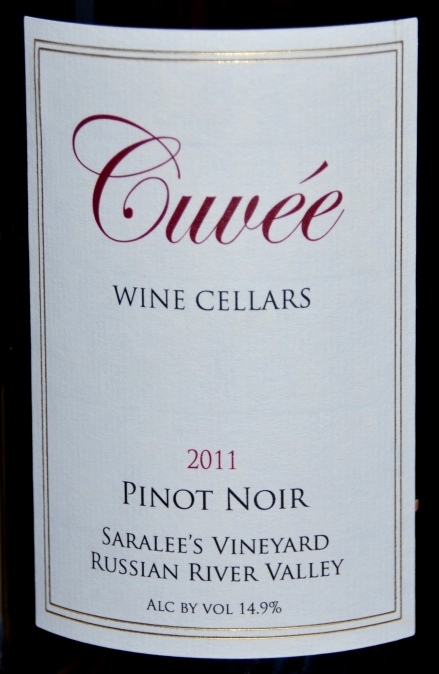 While talking to a friend on Facebook, she asked: “would like to try a local Pinot Noir”? Care to guess my response? Yeah, a dumb question, you know what I said – “of course” and “yes, please” (insert an appropriate number of exclamation points on your own). Mentioning that she will be sending the wine in a few days, she reiterated again – it will be a local Pinot Noir, or may be even rather a super-local.
As my friend lives in Silicon Valley in California, my thought was – okay, of course it will be a California Pinot Noir, so “local” means produced locally in California. I was of course curios what exact Pinot Noir it will be, but hey, patience is a virtue of a oenophile, isn’t it?
The package arrived, with the bottle of California Pinot Noir in it. 2012 Cuveé Wine Cellars Pinot Noir Saralee’s Vineyard Russian River Valley (14.9% ABV). Okay, so I’m sure that most of you never heard of Cuveé Wine Cellars – but the wine has Russian River Valley designation, so that’s the whole “local California” story, you ask?
Well, the wine actually is super-local. While the grapes were harvested in Russian River Valley, the wine was made locally in Silicon Valley, in the town of San Carlos, a small town near San Jose, where Cuveé Wine Cellars is located. As it often happens, especially with the urban wineries, the driving force behind Cuveé Wine Cellars is passion – and you can check their story on the Cuveé Wine Cellars web site.
How was the wine? In a few words – delicious with a great aging potential. When I opened it on the first day, the aromatics of Pinot Noir were incredible, one of the most pronounced California Pinot I ever had a pleasure to smell – forest floor, smoke, mushrooms, licorice – all very concentrated. The palate was well supporting the aroma, with silky-smooth, rich texture. Very concentrated (using the word again, sorry), with lots of fruit, chocolate, the same mushroom undertones and good acidity. But honestly, it was a bit too much. Don’t get me wrong – there was no jammy fruit or sharp biting alcohol in this wine – but you know how sometimes you are looking for the subtlety of the favors, for a bit more grace and mystery? My wish was granted on the day 3, when wine still had all the aromatics, but the palate became more mellow and intricate. Drinkability: 8+
That’s my story of the super-local Pinot – and an ode to the great friends. Cheers!
Daily Glass: Wonderwall Pinot Noir
I had to settle for this simple title of the post after a few futile attempts to be clever. “Don’t judge the wine by the first sip”, “Give it some time”, “Patience, the most important virtue of Oenophile” were all contenders, but none of them where hitting the spot, so I went for a simple, not catchy title for this post, just with the name of the wine.
But we have to talk about first sip, time and patience, as we have a great case in point. 2013 Wonderwall Pinot Noir Edna Valley (14.9% ABV) is made by Field Recordings, one of my all time favorite producers from California – I wrote about Field Recordings wines many times in this blog. I don’t think I ever had a Field Recordings wine I didn’t like. Or such was my very first thought after the very first sip of this wine.


On the first sip, the wine was simply … sweet. No, nothing is wrong with the sweet wines – but not when the wine is called Pinot Noir. The wine had tons of nice fresh fruit – but more in the compote flavor profile. Well, this is the young wine, very young – it is 2013 vintage, and probably was bottled just a few month ago – so the first thing to do, before declaring the wine been no good, is to give it time. Which I did. In about 30 minutes, the sweetness subsided, and acidity increased. The longer this wine was opened, the more restrained it became.
The next day the wine converted itself into a powerful, full bodied California Pinot Noir, with the hint of smoke on the nose, and ripe plums and hint of blueberries on the palate, with good structure and very good balance (Drinkability: 8 -). I was really glad that Field Recordings came around for me, and I can still call it a favorite producer without any afterthoughts.
And the general lesson(s)? Don’t judge the wine by the very first sip – in a lot of cases, freshly opened bottle might not taste as you expect it, especially if the wine is young – you should really refrain from judging the young wine until it had an opportunity to breathe and open up. And be patient. I’m sure this wine would show itself quite differently in the 4-5 years, so quite often, waiting for the wine to be ready, to be at its peak, makes a lot of sense.
Have you ever been in situation when you declared the wine “not good” based on the first sip, only to find out (or not) that the wine considerably improved after some breathing time? Comment away! Cheers!
Wednesday Meritage – Wine Quiz Answer, Bordeaux 2012, Bottle Variations, Dishcrawl and more
Meritage time!
Let’s start with the answer for Wine Quiz #55, Grape Trivia: Pinot Noir. In the quiz you were supposed to answer five questions about Pinot Noir grape – here are the questions with the answers:
Q1: Can you explain the source and meaning of the grape’s name “Pinot Noir”?
A: Pinot Noir literally translates as “black pine”, due to the grape cluster’s resemblance of the pine cone.
Q2: True or False: Burgundy has the biggest plantings of Pinot Noir in France?
A: False – Champagne has much bigger area planted with Pinot Noir
Q3: Match the wine/producer with its country/region:
| A. Mt. Difficulty | 1. Burgundy |
| B. Evening Land | 2. New Zealand |
| C. Fleury | 3. Champagne |
| D. Hamilton Russell | 4. Oregon |
| E. Clos de Tart | 5. South Africa |
A: A2, B4, C3, D5, E1
Q4: Which major wine-producing country is literally unknown as a Pinot Noir producer?
A: Spain. There are literally no Pinot Noir wines coming out of Spain
Q5: From 1990 to 2010, annual Pinot Noir harvest in California increased approximately:
a. 2 times, b. 3 times, c. 5 times, d. 7 times, e. 9 times
A: According to the information you can find here, production of Pinot Noir went from 32,000 tons in 1990 to 147,732 in 2010 – thus correct answer is C, about 5 times.
Looking at the answers, it seems that everybody had no issues answering first 3 questions, but the last two proved to be more difficult. Nevertheless, we have 2 winners – armchairsommelier and vinoinlove both answered all questions correctly, so they get unlimited bragging rights. Jeff at thedrunkencyclist gets honorable mention with 4 correct Google free answers, as well as RedWineDiva also with 4 correct answers. Well done!
By the way, what do you think the theme of the next quiz will be? I’m going along the lines of major grapes, so what do you think is next?
Now, to the interesting stuff around the grapevine. Let’s start from Bordeaux 2012, or En Primeur 2012 event which recently took place in Bordeaux. This event takes place in the Spring of each year in Bordeaux, and this is the time when Bordeaux wines of previous year are offered for the future sales, and prices for those future sales are set. En Primeur 2012 was different from most of the prior years’ events – first, because Chateau Latour, one of the five famous First Growth producers, stopped participating in this events (from now on, they will only sell their wines when they are actually ready to drink, not the futures). Second interesting element – China’s appetite for Bordeaux is getting smaller, and now prices need to be corrected. Anyway, here is a summary by Jancis Robinson, offering her insight after attending the En Primeur 2012.
Now, I want to bring to your attention an interesting article about… bottle variations. No, I’m not talking about imperfections of the glass – I’m talking about the actual content, the wine, being different from bottle to the bottle. Here is the link – I think it is a very interesting reading.
Do you like beer? Yes, of course it is okay to like beer even if you are a wine lover. So if you like beer, here is an interesting site for you – BrewGene. It is both a web site and an app, which will allow you to find information on the beer, see what the others think about it, get recommendations for similar beers and more – I think this is pretty cool, so check it out.
Last but not least, a couple of food events – sorry, they are really only local events, but I want to mention them in any case. Dishcrawl, which I mentioned in my previous Meritage post, just announced a new event on June 11th, which will be taking place in Old Greenwich, Connecticut. As of the time of this writing, there were still 17 tickets available – if you are local in the area, or plan to visit around June 11th date – don’t miss out. Here is the link to the web site for you.
Another food related event is Taste of Westport, which will take place on May 2nd from 6 pm to 9 pm. Here is the link with lots of information about the event, all coming from OmNomCT blog which is a priceless source of information about all things food and drink in CT – if you live in Connecticut or in a close proximity, and you are not following this blog, you have to correct this mistake immediately.
And that’s about all I have for you, folks. The glass is empty. Until the next time – cheers!
Weekly Wine Quiz #55 – Grape Trivia: Pinot Noir
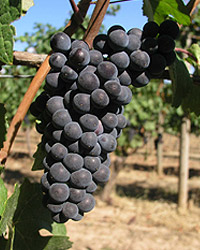
Image source: Wikipedia
And the time has come for the new wine quiz. Continuing with our Grape Trivia theme, the new quiz is about Pinot Noir.
Pinot Noir. The grape behind some of the most expensive and thought after wines in the world. Almost never blended with other grapes. A major weapon in the hands of ABC oenophiles (Anything But Cabernet). At the same time, one of the most finicky, difficult to deal with grapes. To produce great wines, Pinot Noir requires ideal growing conditions. It is genetically unstable, and can easily mutate in the vineyard, producing grapes which look nothing like their parents. It can also “throw a fit” during fermentation and take the process out of control. But – all of it worth the “goodness in the bottle”, so today there is no shortage of great Pinot Noir wines coming in from all over the world.
Pinot Noir is one of the oldest known Vitis Vinifera grapes, specifically grown to be used in winemaking, with historical references going all the way back to the 4th century in Burgundy, France. Today Pinot Noir is growing literally in every winemaking country in the world, with the wines taking on wide range of expressions depending on the location’s climate and soil. Taste profile of Pinot Noir often includes lighter red fruits and berries – cranberries, strawberries, tart cherries, with hint of smokiness and mushrooms (earthiness).
Now, to the quiz!
Q1: Can you explain the source and meaning of the grape’s name “Pinot Noir”?
Q2: True or False: Burgundy has the biggest plantings of Pinot Noir in France?
Q3: Match the wine/producer with its country/region:
| A. Mt. Difficulty | 1. Burgundy |
| B. Evening Land | 2. New Zealand |
| C. Fleury | 3. Champagne |
| D. Hamilton Russell | 4. Oregon |
| E. Clos de Tart | 5. South Africa |
Q4: Which major wine-producing country is literally unknown as a Pinot Noir producer?
Q5: From 1990 to 2010, annual Pinot Noir harvest in California increased approximately:
a. 2 times
b. 3 times
c. 5 times
d. 7 times
e. 9 times
Have fun, good luck and enjoy your weekend. Cheers!
Special Tasting Report: Trione Winery
A few month ago I got an email from Trione winery offering me a gift. Not just any gift – wine. Free wine. Words “free” and “wine” put together sound almost magical for the anyone who drinks wine daily (I refuse to take the calculator out – don’t ask). But the word “free” in the email usually means danger. After careful consideration, and actually looking at the winery web site, I decided that it was not a scam or phishing attempt, so I answered that I would be happy to get a free wine. The only caveat in the follow up response was that they can only ship wine to the limited number of states. Connecticut not included (of course). But New York was. And so my friend Emil became a recipient for the wine.
When Emil called me that he got the wine, he mentioned that the box looks very small. Well, okay – it is what it is – free wine, whatever the package is. And then some time later, the package made it to my house. A small black box, probably half of the shoebox in size. But there was actually wine inside. And this is how it looked like:
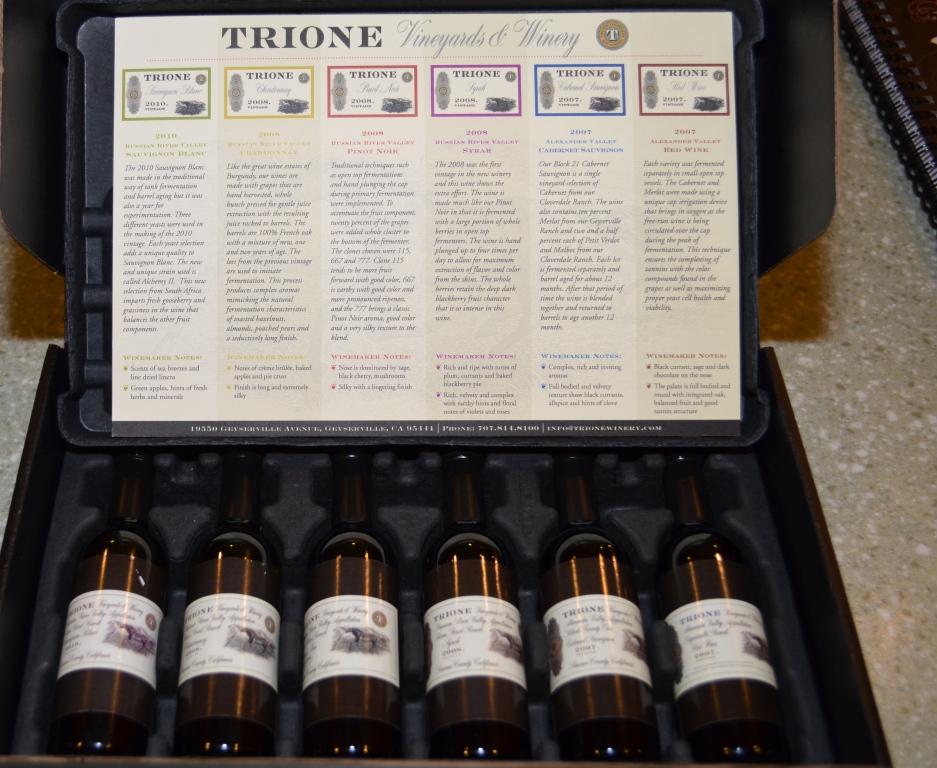
Trione Winery, which I never heard of before, is a new venture of Trione family who was growing grapes in Sonoma for 35 years. Here is what you can read on the front page of their web site:
“For over three decades, the Trione family has raised premium grapes that have been the foundation of many award-winning wines. Now we bring our grapes to you in wines bottled under our own label, Trione Vineyards & Winery. It is the culmination of our family’s long commitment to Sonoma County.”
Here are few more views for you (just trying to build up the anticipation here):


Another interesting detail – it appears that this tasting set consisting of the tiny bottles is actually a concept called Tasting Room. While web site provide literally no information, the card enclosed with the package explained the concept:
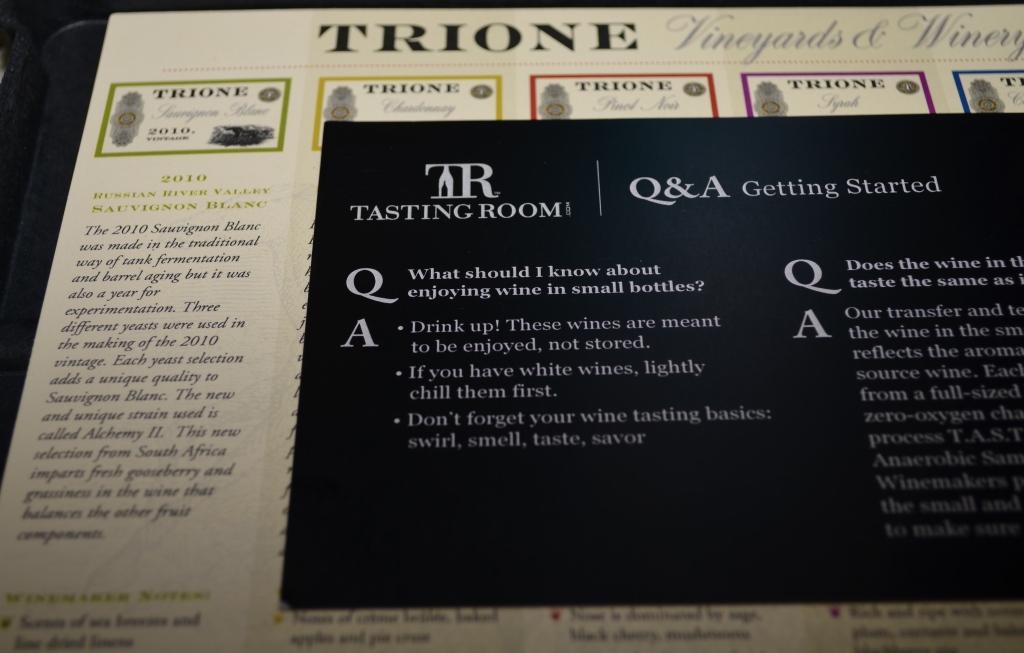
The wines are bottled in the small bottles using special technology which preserves all specifics of the wine, so it is exact same wine which will go into the regular bottles. The only exception – the wine in small bottles is not intended for aging (as you can imagine), so as the card says – drink up!
And with this, let me share my tasting notes. Well, not only mine – in majority of the cases we drink wine together with my wife, especially when we are looking at the interesting and unusual experience – so I’m including her tasting notes too.
2010 Trione Russian River Valley Sauvignon Blanc (14% ABV) – “Pear Grove” my wife said. Some fresh grass on the nose with a bit of grapefruit, but mostly earthy and herbaceous, Earthy and herbaceous on the palate as well, lots of residual acidity, but not “in-your-face”. Food friendly. Interesting. Drinkability: 7+
2010 Trione Russian River Valley Chardonnay(14.3% ABV) – nice butter on the nose, vanilla. Nose is very promising, but palate is not good, very acidic, no fruit, kind of flat. I’m sure it needs time or at least different serving temperature, therefore it is not rated.
2008 Trione Russian River Valley Pinot Noir (14.2% ABV) – Nice nose of dark fruit, tobacco, touch of roasted meat flavor. Nice palate of dark fruit, raspberries, plums, tobacco, pencil and sage undertones. Good palate, good balance. Very good overall. Drinkability: 8-
2008 Trione Russian River Valley Syrah (14.8% ABV) – Wow color – very dark, intense, almost black. My wife’s notes were “oh, this is good” , “great potential”, “very promising” (disclaimer – my wife loves Syrah, probably her favorite wines). Dark roasted fruit, silky smooth, perfect balance, perfect acidity, cherries, earthy notes. Definitely very promising. Very good overall. Drinkability: 8-
2007 Trione Alexander Valley Cabernet Sauvignon (14.5% ABV) – absolutely beautiful nose – perfectly classic, with mint and blackcurrant – textbook flavors. Coffee showed up later on the nose. Wife’s notes: “overpowering , but very yummy”. Big, powerful, silky smooth, noticeable tannins – but excellent balance. Touch over-extracted on the palate, but only in terms of power, not sweetness. Needs time. Drinkability: 8
2007 Trione Alexander Valley Red Wine (14.5% ABV) – Dark chocolate, coffee, blackberries on the palate, nice complexity. Beautiful, round and open fruit. Needs time. Drinkability: 8-
As you can see, it was a very enjoyable experience (it’s too bad that the bottles were that small) – next time you see Trione wine in the store, don’t just stand there, grab a bottle…
That concludes my special tasting report, folks. Until the next time (hopefully someone will send me good and free wine soon) – cheers!
Disclaimer: the wine was provided by Trione Vineyards and Winery free of charge. All opinions are my own.
Weekly Wine Quiz #32 – A Guessing Game: Ultimate Challenge, Part 2
And yet another Saturday is here, and, of course, a new quiz. It will be the last one (at least for now) in the Guessing Game series (previous three can be found here: #29, #30, #31). As promised, this one is about red grapes, but we will kick it up a notch – you have 7 grapes to match with 6 reviews – one grape is there just for fun, but in my opinion, it easily could’ve been for real. So here are your grapes:
A. Cabernet Sauvignon
B. Malbec
C. Merlot
D. Nebbiolo
E. Pinot Noir
F. Syrah
G. Zinfandel
And here are the reviews:
1. “complex, yet subtle, with blackberries, minerals and berries. Full-bodied and very velvety, with lovely rich fruit, with chocolate and berry character. Very long and refined. A joy to taste.”
2. “aromas of tar and smoke, with very pure, concentrated blackberry and spice notes underneath mark this exotic, seductive red. Silky and complex, it caresses the palate. It needs a little time to absorb the oak, but this is long and has great potential.”
3. “a seductive red, drawing you in with its pure cherry and floral aromas and flavors, then capturing you with the silky texture and harmonious profile. Stays fresh and elegant, with a long, ethereal finish.”
4. “still tight, with a wall of mocha and raspberry ganache covering the massive core of fig fruit, hoisin sauce and plum cake notes. This is extremely dense but remarkably polished, with a long, tongue-penetrating finish that drips of fruit and spice laid over massive grip.”
5. “delicious stuff; not huge, but impeccably balanced, nuanced and tremendously long and pure. It’s a cascade of currant, blueberry and plum fruit shaded on one side by subtle, toasty oak, on the other by hints of minerality and exotic spice. But it’s the elegance and the length that make this a winner.”
6. “torrent of blackberry, boysenberry and bittersweet ganache notes. But there’s exceptional drive and focus here as well, with a great graphite spine driving through the spice- and floral-infused finish. A stunner for its combination of power and precision.”
For an extra credit, try to figure out the country of origin for the wine in the reviews.
Good Luck! Have a great weekend and drink well! Cheers!
Weekly Wine Quiz #6 – No Pinot?
I guess it is Saturday, therefore, it is a time for our weekly wine quiz. Before we get to the new quiz, let me give you an answer for the past week’s quiz “Do you know Kosher wines” – correct answer is Massaya. While the name might be suggestive that it would be a kosher wine, this [very tasty, full bodied] wine is produced in Lebanon, and it is not Kosher. The rest of the wines on the list are Kosher, including Goose Bay, which I saw was a popular choice as a “non-kosher” wine.
Now, the theme for today’s poll is Pinot Noir. Pinot Noir is one of the most popular grapes in the world, and literally there are very few regions where wines are not made out of Pinot Noir. Below is a list of regions where great wines are made out of Pinot Noir – all except one. Which one do you think it is? Answer is coming next week.
Enjoy your weekend, everyone! Cheers!
Daily Glass: 2009 Irony Pinot Noir
 I guess partially encouraged by all the #pinotsmackdown conversations on Twitter, I decided to open Pinot Noir tonight. The bottle I opened was 2009 Irony Pinot Noir, Russian River Valley.
My luck with California Pinot Noir varies widely (I think I can count more misses than hits, I just typically don’t write about those). To my delight, this wine was a hit. After a few moments of breathing, it came out very smooth and mellow, with beautiful smoky nose (one of my favorite properties of a good Pinot). Balanced fruit on the palate, lots of strawberries, some violets, good acidity and soft tannins. Very long finish. I will put Drinkability at 8-.
Next week, on September 1st, we will be celebrating Cabernet Day (#CabernetDay, for more information and rules of participation you can click here) – make sure to celebrate with all the wine lovers by opening that special bottle you’ve being saving for so long. Also, considering that there are more than 600 grapes used in winemaking, and only 365 days in a year, I’m sure we can make every day a special grape day. Cheers!
Last Bottle Sign Up ($10 credit)




 Talk-A-Vino