Archive
Restaurant Files: An Ultimate Dining Experience
As a food and wine lover, I know I can’t complain about the lack of great dining experiences. But great doesn’t necessarily mean memorable. I will give you a few minutes to reflect, but seriously, how many dining experiences have stuck in your memory? How many of those experiences were memorable because of the food and wine pairing?
I’m sure you know where I’m heading with this preamble. During my last trip to Sweden, I actually experienced the unique greatness of the food and wine singing together in perfect harmony – and I have to share that with you.
As was going on a business trip to Gothenburg, the second largest city in Sweden, a friend who was already there sent me a restaurant recommendation which he got locally from someone – SK Mat & Människor. I quickly looked at the website, which portrayed a very attractive image, saw that a reservation would be required and quickly made one, as my free time was very limited.
The day before, I decided to check the menu (I like coming to the restaurant prepared if possible) and discovered that the restaurant doesn’t have a menu per se – the restaurant offers two tasting menus with local seasonal ingredients – one with 4 courses and one with 6. The only other information was the required time – a 4-course dinner takes 2 hours, and a 6-course takes at least 2 and a half. Well, it is fun to be surprised, isn’t it?
Upon arrival we were quickly escorted to our table and presented with the printed menus that still didn’t provide much details – 2 tasting menus with available matching wine pairings – that’s it. We decided that 4 courses sounded good enough and let the magic begin.
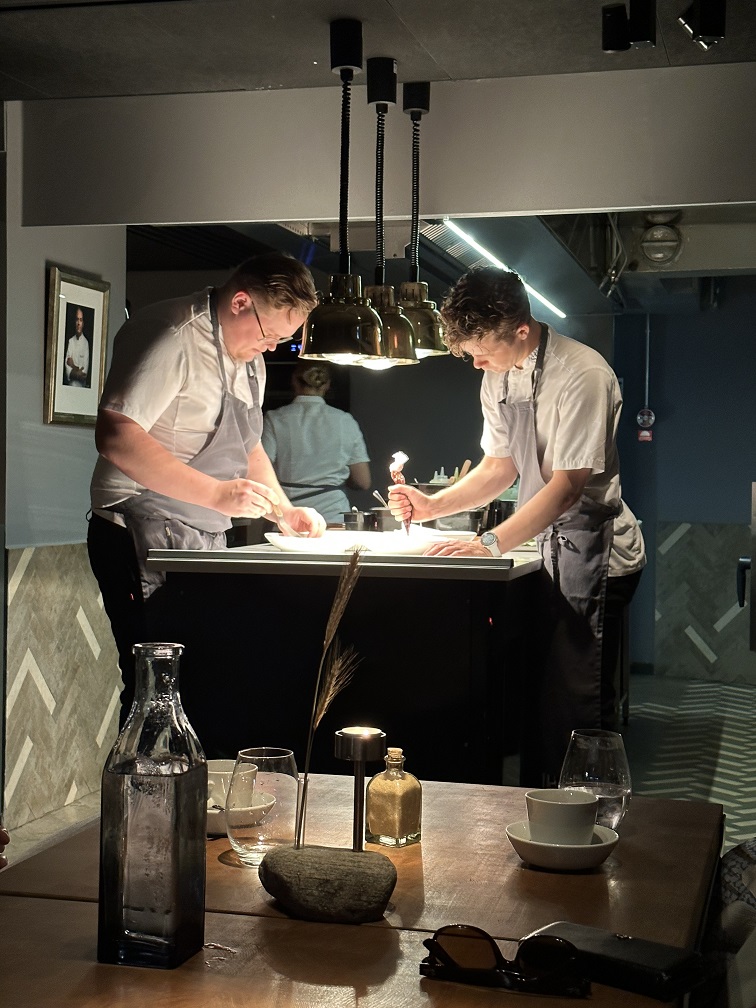
Chefs at work
We were explained that everything at the restaurant is seasonal, locally made and procured. The restaurant has 3 open kitchens, one for cold appetizers, one for warm appetizers and entrees, and one for bread and desserts – yes, fresh bread is made at the restaurant.
The bread arrived first, a little basket with 3 types of bread, and butter which is also made daily at the restaurant, from fresh milk. Also, our first wine was poured – André Lurton Chateau Bonnet Réserve Bordeaux (Sauvignon Blanc/Sémillon), perfectly refreshing as a starter. Next, our first appetizer was presented at a table.


Here lies a problem with how much I can really share with you. The purpose of the dinner was to enjoy it, not to take detailed notes for the blog. I had no printed menu, and each dish was briefly presented by the chef, including all ingredients, spices, and cooking techniques – all within 30 seconds or so. I don’t know about you, but my memory definitely has its limits. Thus my descriptions will be lacking…


The first dish was a fish – I believe haddock (local, of course). I don’t remember any of the spices and condiments, but – the appetizer was brought to the table with a little bowl of grilled tomato broth (yep), and each one of our bowls received two tablespoons of such broth. The appetizer was very tasty and worked well with the wine.
The next wine was the 2020 Leopard’s Leap Culinaria Collection Chenin Blanc Franschhoek Valley South Africa. The wine had a beautiful, concentrated nose, and very good textural presence on the palate, something that good Chenin Blanc can usually deliver.


A warm appetizer was served with this dish – I guess it could be called a confit of artichoke – the artichoke was slowly cooked for a very long time, then deep fried and served with some effervescent cream. The dish was delicious, and pairing with the Chenin Blanc was excellent, with wine complementing and elevating every bite.
The choice of next wine was a bit surprising for me – 2021 Oakridge Over the Shoulder Pinot Noir Yarra Valley Australia. Of course, Australia produces Pinot Noir – but I would definitely look at other regions first if I would want to serve my guests Pinot Noir. The wine was tasty on its own, with a nice nose of smoke, plums, and violets and a firm texture on the palate, definitely on the tart side.


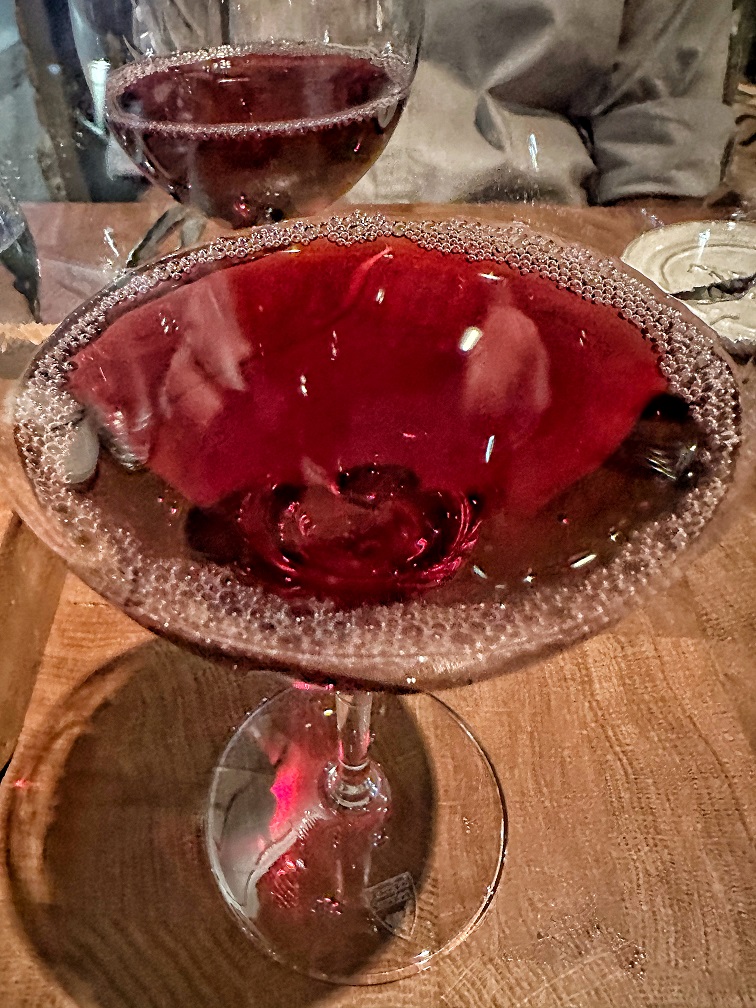
Just look at this color…
Seeing Pinot Noir I was guessing that our main course will be either duck or lamb. To my surprise, we were served local Swedish beef, prepared with celeriac (root of celery) three ways – as a purée, as a spice, and in some other form (sorry, see the note about my memorization skills above), served with the wine reduction sauce. And I don’t know how, but in this dish, taking a bite of food with a sip of that Pinot Noir was akin to some dark magic – remember the restaurant scene in “When Harry Met Sally”? Yeah, that type. Just magic.
Over wine pairing for dessert was essentially a dessert in itself – 2022 Prunotto Asti Spumante DOCG from Italy. The wine was beautiful, pleasantly sweet but with perfect acidity and light fizz, delicious on its own.


Our dessert was a combination of herbal sorbet and local Swedish strawberries. The sorbet was barely sweet and delightful, but taken with a sip of Asti Spumante … OMG (yeah, laugh all you want)… We both agreed that this was truly a “heaven on earth” type of experience… An amazing finish to an amazing meal.
Believe it or not, this dinner took a little bit more than two hours, and the flow of wine and food was such that we didn’t notice how the time had passed. Absolutely different experience compared to an average restaurant visit, where you look at the watch when the bill arrives and realize that you barely spent 50 minutes…
Here you are, my friends. If your travel will take you to Gothenburg, I can’t recommend SK Mat & Människor any higher. Visit, and you will understand.
Experience Lugana in New York
“Drink your Lugana young, very young and you will enjoy its freshness. Drink it after two or three years and you will enjoy its fullness. Drink it after ten years and you will be amazed by its dignified authoritativeness. Lugana wines, a rarity of their kind, have an extraordinary ability to make themselves known. If you taste a Lugana, and you are a competent taster, you cannot forget it”
– Luigi Veronelli
Imagine yourself sitting by the lake, a beautiful lake.

Source: Consorzio Tutela Lugana DOC
Let’s make it more precise, to make the picture vivid.
Imagine yourself sitting by Lake Garda in Northern Italy, on a beautiful summer day. The water is tranquil, there are tiny waves and an endless horizon. Next to you, there is a little table with a glass of white wine. You take the glass, take a sip of the wine. The wine is delicious, it is locally made, it is called Lugana, and you take another sip of the liquid pleasure. You capture the moment of this pure, hedonistic pleasure in your memory, Next, you put the glass down and go back to your happy thoughts. In that moment, life is absolutely perfect.
What if I will tell you that you don’t have to travel to Italy right this moment to experience this life’s perfection? What if this experience can come to you?
If you live in New York or the New York area or plan to visit the city over the next few weeks, you are in luck. Instead of you going to Lugana, Lugana is coming to you. The Lugana wine experience is coming to New York. And this Lugana experience will move past just the Lugana wine itself – it will bring you the ultimate gourmet’s salvation – wine and food paired together.
Starting on Monday, June 12th, 19 producers from Lugana will have their wines paired at a series of dinners taking place at 6 New York restaurants (I will give you a full list of restaurants and producers in a minute). All the wines will be specifically paired with the dishes – and as someone who never visited Lugana, I was really curious about what one can expect to find on such special dinner menus. I reached out to Consorzio Tutela Lugana DOC which is organizing this event, and asked a simple question (or two): What is the traditional Lugana food? What are the traditional pairings for the Lugana dishes and wines? Here is the reply that I received:
“Like all Italian wines with century-long traditions linking them to their place of origin, Lugana is lovingly paired with the classic gastronomic repertoire of the region. This of course includes dishes of freshwater fish: from the lake, river or stream, whether noble or poor. But even better-known sea fish can be happily matched with this refined and versatile white. Therefore the “base” version can be readily paired with seafood antipasti, fried pessìn (small fish or whitebait from the paddy fields), boiled bass, boiled shrimps and large carp. The Superiore and the Riserva are literally the perfect partner for richer and more complex dishes, such as pike in sauce (boiled pike with anchovies lightly sautéed in oil, from Lake Garda of course), grilled eel, trout with grape, risotto with frogs, as well as grilled crustaceans, peppered clams, salted bass, and several white meat dishes, such as chicken, capon and rabbit (especially roasted in the oven). The Vendemmia Tardiva (late harvest) wines are ideally matched with cheeses, from the fresher varieties such as ricotta, robiola and crescenza, to the more seasoned and flavoursome such as several exquisite D.O.P. cheeses like Monte Veronese, Grana Padano and Provolone Valpadana. Spumante has a broad range of possible pairings, since this “bubbly” wine can be served right throughout the meal. However, since a spumante is usually uncorked at the beginning of a lunch or dinner, why not try it with all types of antipasto, ranging from the broad range of tasty local cold meats to the wide variety of egg-based dishes. Instead avoid serving it with dessert. The versatility of this wine does not stop here. International tastes are certainly no obstacle for Lugana. This white wine, either in its “base” version, Spumante, Superiore or Riserva, is in fact the perfect match for raw fish, from the Japanese sashimi and sushi to all the variations on the theme proposed at the international level. It is also ideal with salmon and tuna and the perfect match for seafood finger food. Ideal serving temperature (in broad bowl tulip-shaped wine glasses for all varieties): Lugana Spumante at 8°C; Lugana “base” at 12°C; Lugana Superiore and Riserva at 14°C; Lugana Vendemmia Tardiva at 12°C.”

Lugana wines are produced from the local indigenous variety called Turbiana. Lugana wines can be still, sparkling, and late harvest (sweet), but no matter what the style is, they are literally guaranteed to be delicious. I had an opportunity to do a little preview of what someone might anticipate experiencing during the tasting – here are my notes on 3 wines that will be presented during the tasting:
2022 Corte Sermana Cromalgo Lugana DOC (13% ABV)
Straw pale
Beautiful intensity of tropical fruit, lemon and honey
Lemon and lemon zest, a hint of white peach and underripe white plum, tart, perfectly structured, with medium-long, tart finish
8, delicious.
2022 Ottella Lugana DOC (12.5% ABV)
Straw pale
Tropical fruit, guava, lemon, honey, herbaceous undertones
Crisp, fresh, tight, Meyer lemon, clean acidity, a tiny hint of gunflint.
8, imbues seafood craving
2022 Perla del Garda Lugana DOP (12.5% ABV)
Straw pale
Tropical fruit, honey, fresh, inviting, enticing, seductive. It says “drink me”
Beautiful. Fresh Whitestone fruit, cut through acidity, lemon. Crisp, fresh, delicious. A happy wine that can transpose you.
8+, superb. Had a few friends try this wine too, and they were literally blown away by it.
As promised, here is the list of participating restaurants, dinner dates, and the wines which will be poured at each:
IL FIORISTA (Monday, June 12, 2023)
Le Morette, Mandorlara 2022
Cantine Di Verona, Torre di Falasco 2022
Tommasi, Le Fornaci
VICEVERSA (Tuesday, June 13, 2023)
Ca’ Maiol, Lugana Prestige 2022
Scolari, Lugana Doc Premium 2022
Zenato, Riserva 2020
GNOCCO (Monday, June 19, 2023)
Sguardi di Terra, Riserva 2018 Fachetnabia
Selva Capuzza, Selva 2021
Ceresa, Ceresa 2022
Montonale, Montunal 2022
HEARTH (Monday, June 19, 2023)
Zeni 1870, Vigne Alte 2022
Tenuta Roveglia, Vigne Catullo Riserva 2019
Famiglia Olivini, Lugana 2022
MISIRIZZI (Wednesday, June 21, 2023)
Pasini, Il Lugana 2022
Perla del Garda, Madonna della Scoperta 2021
Citari, Conchiglia 2022
OSTERIA CARLINA TRIBECA (Thursday, June 22, 2023)
Corte Sermana, Riserva 2017
Vigneti Villabella, Lugana 2022
Ottella, Lugana 2022
You can find additional details of the Lugana festivities in New York on the Destination Lugana website.
This is not every day that instead of you going to your travel destination to experience delicious life’s offerings, the travel destination comes to you. This is your chance for a memorable experience and I hope you will not miss it.
And I will be sure to tell you more… Who knows, maybe we will run into each other during one of the dinners. Cheers!
Wine Lover Geeking Out: Pairing Soup and Wine
 Finally, the snow was coming. Cold weather can be perfectly paired with the soup. So this was an easy equation to solve – snow means soup.
New England Clam Chowder is one of my all-time favorite soups. I’m generally happy with restaurant versions, but I have a recipe that is much lighter than a typical restaurant version, as it uses half and half instead of heavy cream. One day I might be able to share that recipe, but as this is not my recipe, I would need first to get permission. I can tell you that the main ingredients there are bacon, potatoes, celery, and good quality clams (so far I find that ocean clams are the best). And half and half as I mentioned before.
In the morning, I realized that I’m not sure what wine I should pair with this soup, and I decided to ask the wine folks on the twitter for a recommendation. This turned out into a fun conversation. Here are the recommendations I received (I will try not to miss any, but I can’t guarantee):
- lightly oaked, moderate-climate Chardonnay
- Austrian Gruner
- Siegerrebe, Pinot Blanc, and Chenin Blanc (from South Africa or Loire)
- Riesling or Pinot Blanc / Gris from Alsace
- Brut Sparkling
- Viognier (I missed this recommendation when it was originally sent)
- Ribolla Gialla, perhaps even a skin-contact (e.g. Gravner)
- Godello
- Manzanilla
Not a bad list, isn’t it?
My goal was to use what I have on hand and not to go to the store. This eliminated Austrian Gruner, Siegerrebe (had to use Google to learn about this obscure grape), Pinot Blanc, anything from Alsace, Ribolla Gialla, and especially Ribolla Gialla with skin contact (I wish I had a bottle of Gravner), Viognier, Godello, and Manzanilla. So the only 2 options I had from this list were lightly oaked Chardonnay and sparkling Brut. After careful consideration, I realized that I probably don’t have lightly oaked Chardonnay on hand either. And I didn’t feel like opening Champagne – besides, Champagne perfectly pairs with everything anyway, so this would not be a fun exercise anyway.
Then I realized that I have a few samples of Portuguese wines, as well as a few Sherries – this was enough to experiment, which is exactly what I did.

These are the wines I tried with the soup:
2020 Esporão Branco Colheita Alentejo (Antão Vaz, Viosinho, Alvarinho, 4 months on the lees) – didn’t work. Creamy and round wine clashed with the soup.
2020 Esporão Branco Reserva Alentejo (Antão Vaz, Arinto, Roupeiro, six months in stainless steel tanks and in new American and French oak barrels) – it worked! The pairing was complementary, probably because the wine had a good amount of clean acidity, and so it was the most food-friendly by definition.
2018 Esporão Tinto Colheita Alentejo (Alicante Bouschet, Touriga Nacional, Aragonez, Cabernet Sauvignon, Touriga Franca, 6 months in concrete tanks) -trying this wine with the soup was a mistake – can I leave it at that?
Gonzalez Byass Alfonso Oloroso – I had big expectations for this pairing, and it didn’t work. The combination was not bad – the wine and the soup simply stayed in their own worlds without impacting each other.
González Byass Solera 1847 Cream Dulce – big mistake. That sweetness of the wine just didn’t go well with the soup.
Here is my report on this simple experiment. I might try a few more combinations tomorrow and will update the post if I will encounter something exciting.
What would you pair a clam chowder with? What do you think of pairing soup and wine in general – does that even makes sense?
Expect the Unexpected?
Wine is meant to go with food.
Food is meant to go with wine.
Together, food and wine are supposed to give you a much better experience than two individually.
You already know all of this.
And yet this is theory. When met at the table, sometimes food and wine actually work together and deliver a heavenly, memorable experience. Sometimes, food and wine just coexist without interfering. And sometimes they clash, ruining the experience completely.
The food and wine pairings typically work in one of two cases:
- Food and wine are professionally paired. The chef and sommelier work together, adjusting the flavors of the dish to work with the wine which was selected as a pairing.
- Food and wine come from the same place and had been playing together nicely for centuries. Think about Beef Bourgogne paired with Bourgogne wine – I think we can trust this combination, don’t we? Or would you ever question Chianti with the pasta with nice red sauce?
Now, for most of the time, we are not traveling and we are not eating at the high-end restaurant, yet we still should be able to enjoy the elevated food and wine experience at home – the rules are simple, right?
Maybe the rules are simple indeed, but we need to tread carefully. Beef Bourgogne is made with Bourgogne wine, and all Bourgogne reds are made from Pinot Noir. So what would happen if we will make the dish with actual Bourgogne, and then try pairing it with a nice big Pinot from California? There is a good chance that you will not enjoy that combination, not at all.
Chianti is made out of the Sangiovese grape (predominantly) – but don’t try to pair your pasta with the Sangiovese from California – again, there lies a great opportunity for disappointment.
I’m not saying that Beef Bourgogne will never work with the California Pinot – find a more restrained version, such as Sanford Pinot Noir, for example, and you might be fine – or better yet, simply cook the dish using the same wine you want to drink. Similarly, there are some California Sangiovese that might perfectly complement and elevate your favorite spaghetti dish, such as Castello di Amorosa Sangiovese – but you should expect some trial and error on the road to perfection.
I love Georgian wines. I would gladly drink Georgian Saperavi on any day. I love Georgian cuisine – properly made, the flavors are incredible and so is the pleasure you will derive out of each and every dish. And considering that wine is an indelible part of the Georgian lifestyle literally for thousands of years, it is rather logical to assume that Georgian wines should work perfectly with Georgian dishes.
While I love Georgian cuisine, this is not the food I would generally try to make on my own, I prefer to defer the cooking to a few of the Georgian restaurants which we have in reasonable proximity, even though the experience is typically a mix of hit and miss. However, when my sister in law sent me the video with the recipe of the Georgian dish called Odjakhuri, the video looked so good that I decided that I must make the dish as soon as possible, considering that the main ingredients are near and dear to me from the childhood – meat and potatoes.
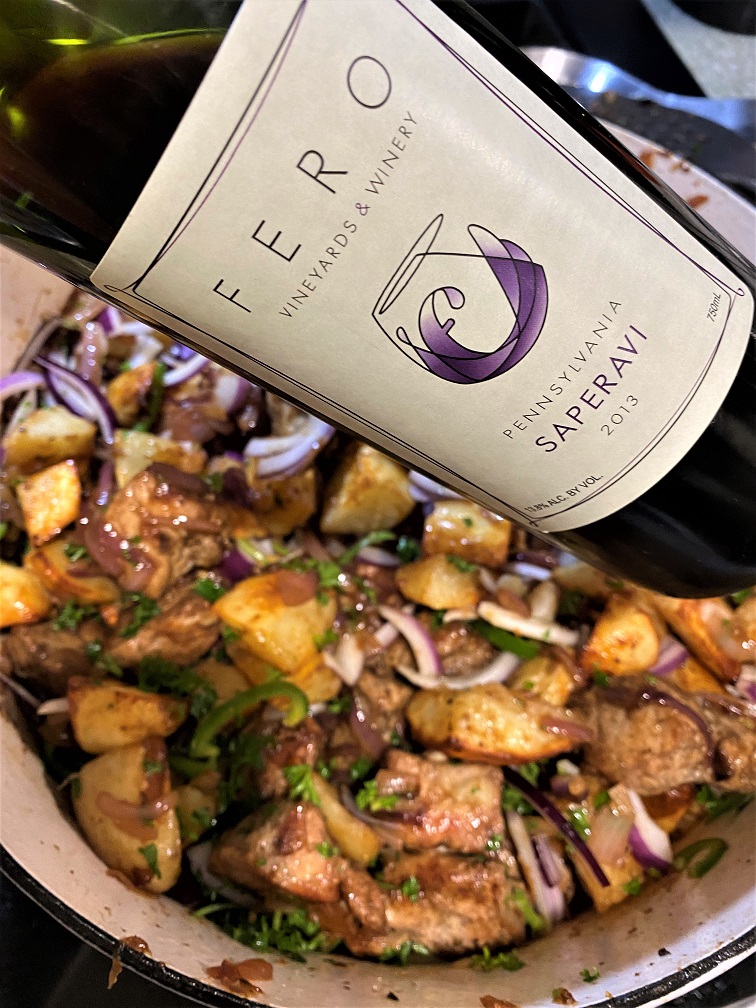
Back in 2015, we visited a winery in Pennsylvania called Fero Vineyards. In addition to all of the traditional east coast wines, the winery also was making the wine out of my beloved Georgian grape, Saperavi. I tried the wine during our visit, liked it very much (Fero Saperavi made it to the 2015 edition of my annual Top Dozen wines of the year list as #12), and brought home a bottle. After I decided that I will make an Odjakhuri for the Friday night dinner, I realized that I have no Georgian wines on hand – but then I remembered that I had a bottle of Fero Saperavi which I had been looking for a good reason to open for quite some time – and what can I be a better reason than trying it at a family dinner with Georgian dish?
To tell you the truth, I had no idea how it is going to work. First, the bottle I had was the 2013 Fero Saperavi. Who knows if the wine from Pennsylvania can age for 8 years? The wine might be gone already, way gone. But even if the wine is not gone, would Saperavi from Pennsylvania work with the flavors of the dish? Local wines work with local dishes because they went through a slow process of alignment over hundreds of years – well, maybe that is one of the reasons. And here we have a dish with the supposedly proper flavor profile, and proper grape from totally different terroir – everything is possible…
When I was opening the bottle of Fero, I had no expectations. Let me take that back. When I was opening the bottle of Fero, I was expecting that the wine will be past prime. And even if it will be still drinkable, that it will not work with the dish, not for a second. And I’m glad I didn’t make any bets with anyone because I lost on both counts.
The wine was perfectly fresh. It had a ruby color, not hinting at any age. On the nose, there were cherries and herbs, nicely restrained. On the palate, the wine showed a hint of cherries, sage, gamey undertones, tobacco. Perfectly live, perfectly fresh, excellent acidity, medium-plus finish.
The wine also perfectly complemented the dish, enhancing and elevating the flavors and creating a better experience.
Was this pure luck on both counts? The wine was perfectly drinkable and it complimented the dish very well? I don’t have an answer, I’m just reporting on the experience, and raising the question – where are the wine and food pairings created?
This pretty much ends my story about expecting the unexpected, but before we part, I want to leave you with the recipe for this simple and delicious dish.
Disclaimer: Odjakhuri in translation from Georgian means “family”. So as a family meal, I’m sure there are tons of “correct” recipes for this dish. The recipe which I’m sharing is exactly the one we made, thus this is the one I recommend.
Apology: I would love to share a video with you, but an actual video that I have is in the Russian language. Still, I believe it will be useful even without understanding the language, so here it is:
Odjakhuri – Georgian meat and potatoes family dish
Ingredients:
- Meat (pork, beef, chicken) – 2 lb
- Potatoes (Russet would work the best) – 4 lb
- Red onion, medium size, sliced – 4
- Garlic, chopped – 4 cloves
- Cilantro (can be replaced with parsley), chopped – 2 tbsp
- Hot pepper, sliced – 1
- Coriander, ground – 1 tsp
- Sweet paprika – 1 tsp
- Cayenne pepper – 1/2 tsp
- Dill (dried) – 1/2 tsp, optional
- Black pepper, ground – 1/2 tsp
- Salt, by taste
- Olive oil
Steps:
- Potatoes: Preheat oven to 375F. Peel potatoes and slice them into the pieces about 1 inch in size. Put into a large bowl. Add olive oil (you can use any oil you like for roasting), coriander, black pepper, cayenne, paprika, dill (if using), and 2 tbsp of salt (I prefer kosher salt). Mix everything together. Line roasting pan with parchment paper and arrange potatoes preferably in a single layer. Roast for 45-50 minutes – check readiness, potatoes should be crispy but shouldn’t be overlooked. Once ready, get it out of the oven and put it aside.
- Meat. Meat should be prepared as it would be for a kebab. Ideally, it should be sliced into 1-inch cubes and marinated overnight. You can, of course, just roast the meat without marinating it, but marination will add to the flavor of the dish. In our dish, we used bone-in pork loin, I just cut the meat off the bone. If you will be using pork, look for darker meat, it is less prone to drying up while frying.
- Once you put potatoes in the oven, you can start on the meat. Heat a small amount of oil on medium-high heat in the cast iron dutch oven, and fry the meat until ready. If meat is not marinated, use salt, pepper, and any other spices you would like. When ready, get the meat out of the pan. make an effort not to overcook the meat.
- Reduce heat to medium-low, add 3 sliced onions and sauté them slowly, pay attention not to burn them. When almost ready, in about 12 minutes, add garlic and let it cook for another 3 minutes. Now it is time to assemble the dish.
- Reduce heat to low. Return meat to the dutch oven, add roasted potatoes. Add fresh cilantro (or parsley), sliced hot pepper, and last sliced onion, mix everything lightly (try not to crush the potatoes). Let the dish heat up, uncovered, for about 10 minutes, to let the flavors meld. In 10 minutes, turn off the heat, serve and enjoy!
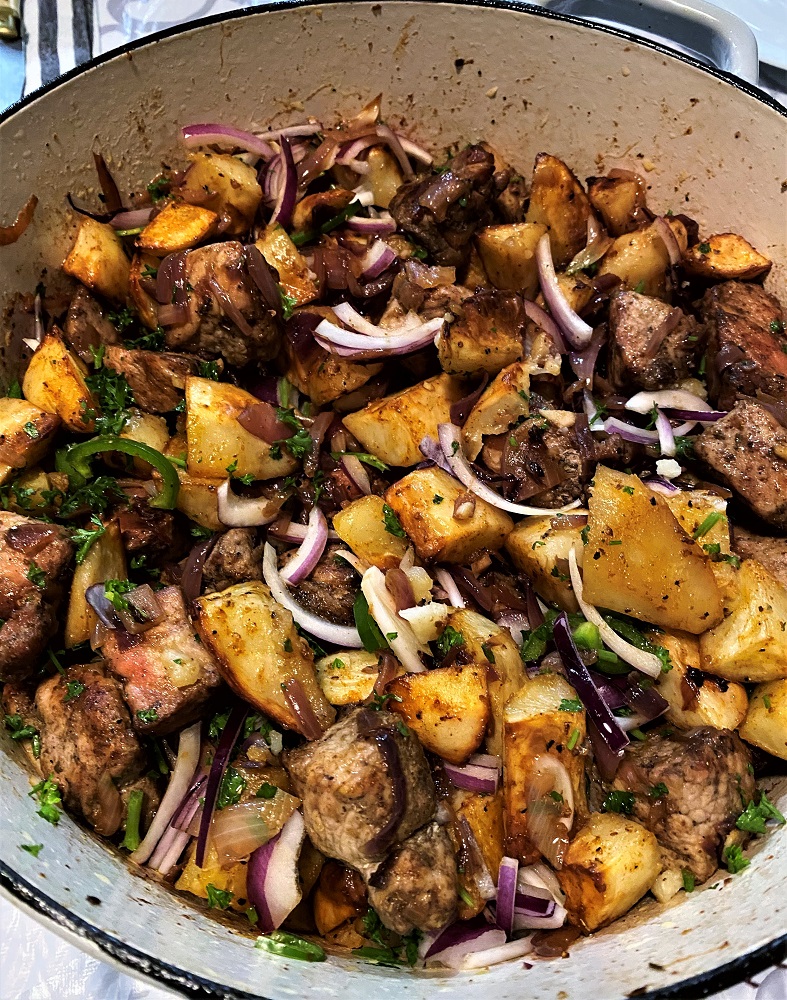
There you have it, my friends. If you don’t have Saperavi on hand, try it with any wine you’d like, and expect the unexpected. Cheers!
Restaurant Files: Art of Food And Wine at Domaine Hudson in Wilmington, Delaware
 Almost for as long as this blog exists, and practically every year around this time, I confess my love of traditions. The reason it happens every year around August is rather simple – this is the time when we typically have our “Adults getaway” – a group of friends going away for a weekend of food, wine, and laughter, an insane amount of laughter.
We always spend time arranging for a special dinner – this year was not an exception. It took a bit of work, but after calling and emailing many places around our destination – Longwood Gardens in Kennett Square in Pennsylvania – we found the place which was willing to accommodate our group and seemed to offer good food and wine options. Typically we try to find the restaurant which will offer a tasting menu and allow us to bring our own wines. It does take a bit of effort to come up with wine pairings for the dishes we never tasted – but usually, we fare reasonably well at that exercise. This year, for a change, we found the restaurant which offered us a tasting menu – and paired all the dishes with wines, so all we needed to do is to come and enjoy (one would hope, at least).
It was not just the fully paired tasting menu which was different this time. Typically, when we select a restaurant, we go by Yelp ratings and close proximity to the place we are staying at. As we usually stay in small towns, the restaurants we find are more of a “local significance”. The story with Domaine Hudson is quite different as the restaurant has Wine Spectator’s Best of Award of Excellence. There are only about 1200 restaurants with this type of awards in the whole of the United States, so I hope you agree that it builds some level of expectations.
All the planning behind, and finally we arrived at the Domaine Hudson in Wilmington. Once we got situated, the dinner started with the “Chef’s Surprise” (the Amuse-bouche), which became a double-surprise. The first part of the surprise was in the fact that it was not expected, of course. But the second surprise was the dish itself – Deviled Eggs.
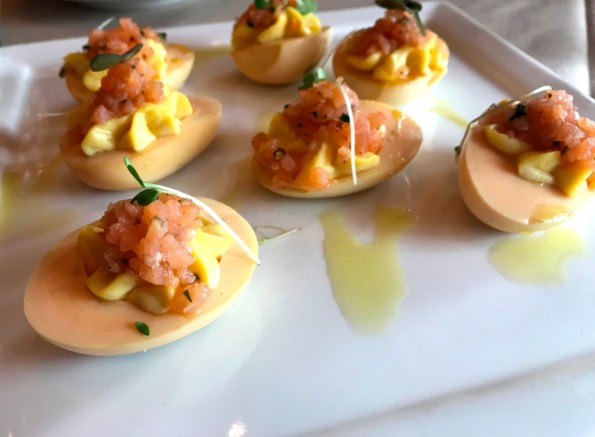
Okay, what can be surprising about the deviled eggs, you ask? You see, for people with Russain heritage, deviled eggs is a staple of the party, and I’m very, very particular to how this simple dish is executed. I had deviled eggs on multiple occasions in the restaurants, and don’t mean to offend anyone, but in the absolute majority of the cases the dish could be described simply as “blah”. Not here. At Domaine Hudson, this was one superb deviled eggs – the egg white was smoked, the filling was creamy and perfectly seasoned, and the smoked salmon on top gave the texture and completed the dish. The simply delicious beginning of the evening.
Before we continue, I have a confession to make. Every once in a while, you want to forget all your social media obligations (obsessions?) and just be a normal person on vacation – don’t take pictures, don’t take notes, don’t try to memorize the experience, just relax, have fun and enjoy the moment. This is what I honestly tried to do. I didn’t bring my SLR, I decided not to take any pictures, just enjoy the dinner and the company. After the first sip of wine and bite of food, which were both excellent, all good intentions went out of the window, and the need to “document the story” kicked in, more as an instinct, a muscle memory so to speak. But – I was left with only my cell phone (meaning – mediocre pictures), and any missed picture opportunities are just that – missed picture opportunities. Now, let’s get back to our dinner and the wine pairings.
Duck Liver Mousse (port wine aspic, pickled stone fruit, grilled bread)
Wine: 2015 Rubus Old Vine Zinfandel Lodi
Superb is a word. The mousse was delicious – texture, flavor combination with all the condiments – I finished the full ramekin by myself, couldn’t stop until the last morsel. The wine was excellent as well – nice raspberries profile, a touch of fresh fruit, not overbearing, but enough sweetness to perfectly complement the mousse. A successful pairing by all means.


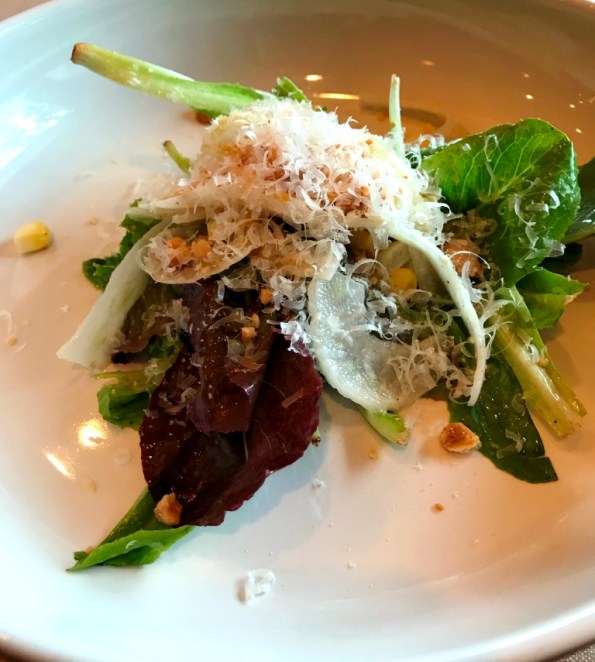
Culver Farms Baby Greens (grilled corn, fennel, Marcona almonds, lemon aioli, Pecorino)
Wine: 2017 Gateway Vinho Verde DOC, Portugal
Another delicious dish. Fresh, simple, light, very summer-y, fun to eat with all the different crunch elements. Vinho Verde was fresh, grassy and lemony, just as you would expect, and it obviously played perfectly with the salad. Another successful pairing.


Ricotta Gnocchi (forest mushrooms, hazelnuts, summer truffle cream)
Wine: 2016 Domaine Cornu-Camus Bourgogne Hautes-Côtes de Beaune, France
I love mushrooms, so this dish definitely delivered that – great variety of mushrooms, a perfect textural addition of hazelnuts, truffle cream was very flavorful. The gnocchi, which were supposed to be the star of the dish were too dense, I would definitely prefer for them to be lighter and fluffier. Still, not the dish you can really complain about. The wine was fresh and young, red crunchy berries, great minerality, very firm and structured, with excellent acidity – an excellent young Burgundy. However, the pairing didn’t work. I guess the idea was to pair on the contrast, but that didn’t work for me. But – I definitely enjoyed the wine on its own.


Nordic Halibut (Fava beans, Holland leeks, forest mushrooms, lemon butter sauce)
Wine: 2015 Talley Vineyards Estate Chardonnay Arroyo Grande Valley
Crispy fish? Check. Fava beans? One of my personal favorites; check. Mushrooms? Check. You got all my happy ingredients, and they worked very well together. Chardonnay was spot on – varietally correct, just a touch of butter, vanilla, apples, fresh, well balanced with good acidity. And a successful pairing for sure.


Prime Holstein New York Strip (fingerling potatoes, Fois Gras butter, braised greens, red wine demi)
Wine: 2013 Three Wine Company Suscol Creek Cabernet Sauvignon Block 5 Napa Valley
Steak and Cab – need I say more? The steak was perfectly cooked, great flavor, juicy, good sauce – nothing else I can say – if you like steak, you would like this dish. But then the wine… This was easily the best Cabernet Sauvignon I tasted in a long time (bold statement for me, I know). This was in-your-face, juicy, powerful, super-extracted, luscious wine only California can produce – imagine having a ripe bunch of cassis in your hand, and just taking a full bite right there – cassis, blackberries, mint, eucalyptus, everything is there – but perfectly balanced, with good acidity and unquestionably dry – wow. I would never guess this wine had 15.3% ABV – it was just perfectly integrated. Bottom line – superb wine and excellent pairing.
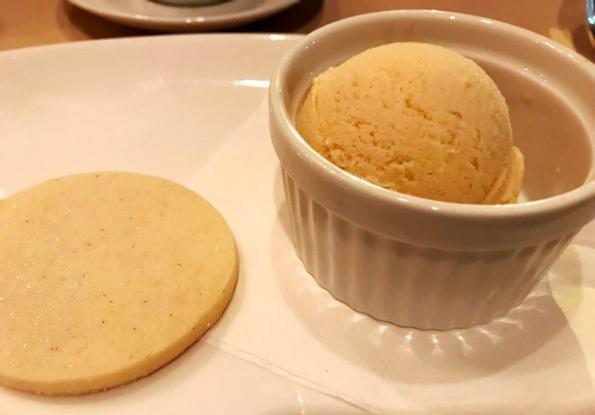
Plum Gelato with Sugar Cookie
The meal should have a sweet ending, right? Excellent gelato, light, fresh, good flavor. A perfect finishing touch.
Let’s summarize the experience – in a word, outstanding. The food was very good, and the wine program was excellent, most of the pairings worked, so I have to say that the Best of Award of Excellence has a good merit, and it definitely makes sense to me.
Have you dined at the restaurant with similar distinctions? How was your experience? Cheers!
Restaurant Files: Mountain View Brasserie in Greenville, NY
 We already talked about our day in the Hudson Valley during traditional adults getaway trip (you can read about it here). Culmination point of the Saturday night was a special dinner. I call it “special” as this is something we always spend time preparing for as part of our getaway. Our ideal scenario is to find a restaurant which would do a special tasting menu for our group, and would allow us to bring our own wines which we would pair with the dishes. More often than not we are successful in this plan – this year was no exception.
The Mountain View Brasserie restaurant in Greenville, New York agreed to create for us a special tasting menu, and we came up with the wine pairings for all the dishes. Of course, the challenging part is doing the “blind” pairing if you will – all we have is the list of ingredients in the dish, and the pairing is solely based on our imagination. The good thing is that we usually do this “hard work” together with my friend Zak, who owns the wine store, so we have a good number of wine options. We always make an effort to keep the cost reasonable – talking about this dinner, only one of the wines was $25 retail, the rest were $20 or less.
For what it worth, here is our dinner menu, with the wine and pairing notes, and addition of the pictures. As the idea here was a relaxing dinner with friends and not a blogger’s dinner, all the pictures are taken with the iPhone and, well, it is what it is…


We started dinner with NV Rivarose Brut Rosé, Provence, France (Syrah/Grenache blend) which was nice, round and simple, well supporting the conversation.


Our first dish was Maryland Crab Cakes served with Lobster Sauce, which was delicious and very generous in size. We paired it with 2014 Templar Cellars Komtur Ekko Pinot Gris, Czech Republic (100% Pinot Gris) – I wrote about this wine before, and while the wine was excellent on its own, the pairing was simply outstanding, with the wine nicely complementing the dish.


Our next dish was House-smoked Salmon Napoleon with horseradish cream and gaufrettes garnished with capers and red onion – the dish was interesting, quite tasty, but rather unexpected under the category of “Napoleon”. Our wine pairing was 2015 Notorious Pink Grenache Rosé, Vin de France (100% Grenache), which was medium bodied Rosé, and the pairing was okay, but not mind-blowing (the flavors didn’t fight, but were not enhancing each other either).
Warm Hazelnut Crusted Goat Cheese with Market Greens was more successful as a dish, nice crunch on outside contrasting with the goat cheese acidic profile. We used the same wine for the pairing and it worked perfectly, complementing the dish very well.


You can’t have dinner without salad, right? We had Grilled Portobello Salad with Roasted Peppers, Fresh Mozzarella Cheese, Tomatoes, Spicy Walnuts, Market Greens with Balsamic Vinaigrette which was very tasty, but most importantly, it paired deliciously with 2014 Sangiovanni Kiara Pecorino Offida DOCG, Marche, Italy (100% Pecorino). Yet another wine I tasted before and loved, and it was perfectly complementing the salad flavors.
Vegetable Risotto with Parmigiano-Reggiano Cheese served with Roasted Sea Scallop was one of the absolute favorite dishes – perfectly seared scallop, working nicely with sweet flavors of corn risotto. Interestingly enough, we missed the sweetness as dominant taste element in this dish (just one word in our defense – corn was not listed among ingredients), and the same wine, Pecorino, didn’t work that well – it was just an okay pairing.


Our next dish was Baked Salmon Fillet with Orange and Olive Butter – again, perfect execution, moist and flavorful fish. The wine, 2011 Portal del Priorat Trossos Tros Blanc, Montsant, Spain (100% Grenache Blanc) was full-bodied, plump and delicious, working very well with the dish.


We were definitely looking forward to the Sautéed Wiener Schnitzel with Spaetzle, and the dish didn’t disappoint – very tasty, perfectly seasoned, delicious sauce. The pairing choice was 2013 Templar Cellars Komtur Ekko Pinot Noir, Czech Republic (100% Pinot Noir), yet again the wine I was familiar with – and I’m glad to admit that the pairing was spot on, with the perfect melding of flavors.


We finished our main course with Roasted Herb Crusted Rack of Lamb Provencal – I’m sure that even from the quick glance at the picture, you would expect that this was a tasty dish, as you can tell that meat was properly cooked – and you would be right, as it tasted appropriately delicious. Equally appropriate was our choice of wine pairing – succulent 2012 Seigneurs d’Aiguilhe, Côtes de Castillon, Bordeaux (Merlot/Cabernet Franc blend) Bordeaux, classic cassis and mint taste profile and classic complement to the lamb – outstanding pairing.
This concluded main portion of our dinner – and before we talk about dessert, I would like to commend restaurant on the smart way to present the tea. Take a look below:
 If you look in the middle of the picture on top, you will see a sand clock – what a great and simple way to help you steep that perfect cup of tea? Very thoughtful!


Our first dessert was Warm Apple Tart with Vanilla Bean Ice Cream and Caramel Bourbon Sauce – I’m sure you don’t need my lame description here, it was simply indulgent. And for the pairing – you can’t beat one of the best and most universal dessert wine pairings – Moscato d’Asti. We had 2015 Cascinetta Vietti Moscato D’Asti DOCG, Italy (100% Moscato d’Asti) – light, effervescent and clean.


Our last dish was Grand Marnier Chocolate Mousse with Fresh Orange Sections – excellent by itself, and pairing very well with 2014 Quady Essencia, California (100% Orange Muscat).
I think this was one of the most successful tasting dinners we put together, so for the next year, we have a very difficult task at hand – but we are up for the challenge. Cheers!
Mountain View Brasserie
10697 State Route 32
Greenville, NY 12083
Ph: (518) 966-5522
Vintage Vespa: Podere Brizio Brunello Dinner
Brunello needs no introduction for the oenophiles. Quintessential, coveted Italian wines, coming from the heart of Tuscany, made from the signature Italian grape Sangiovese (Sangiovese Grosso clone, to be precise). Brunello di Montalcino was the first area in Italy which received in 1980 the status of DOCG (Denominazione di Origine Controllata e Garantita), top quality level designation for the Italian wines; Brunello are some of the most expensive wines coming from Italy today, with some of the bottle prices exceeding $500 on the release (Biondi Santi, Soldera). Wines had been produced in Montalcino for a very long time, going back to the middle ages – it is said that King Charlemagne frequented hills and taverns of the beautiful region – however, back then Montalcino was known for its white wine, called Moscadello. In the 1600s, the red Brunello started to take over the Moscadello, and today, most of the people don’t even know that the white wines are produced in the Montalcino region, as it is the powerful reds we all associate Montalcino with.
 Podere Brizio is a relatively young estate in Montalcino, founded in 1996. The estate has about 30 acres of vineyards, practices sustainable viticulture and in the process of becoming certified organic. The grapes are harvested by hand, natural yeasts are used in the winemaking process. Folks at Podere Brizio love the Montalcino history so much that they put “10 Parpagliola coin, coined in 1556 as a symbol of the Republic of Siena in a year in which about 600 noble Sienese families took refuge in the fortress of our town in order to keep the Sienese Republic alive” on the labels of their wines. Podere Brizio produces about 50,000 bottles annually, with the whole production consisting of 3 red wines – Rosso di Montalcino, Brunello di Montalcino and Brunello di Montalcino Riserva.
Now, let’s talk about the dinner, which took place at the restaurant called Vespa in Westport, Connecticut. Not only Vespa offers delicious Italian and Mediterranean food, but the restaurant boasts a wine list which has a lot of unique and interesting wines – when was the last time you saw Erbaluce from Piedmont, Cinque Terre Bianco from Liguria, Frappato from Sicily or a “wine geek special”, Rosso del Contadina from Frank Cornelissen, Sicilian maestro of natural wines? Owner Bobby Werhane has special affinity for the uncommon wines and not afraid to put them on the wine list, which of course makes Vespa a perfect food and wine destination for any foodie and wine aficionado alike – and Vintage Vespa is the series of the wine dinners which serves as a testament to that.
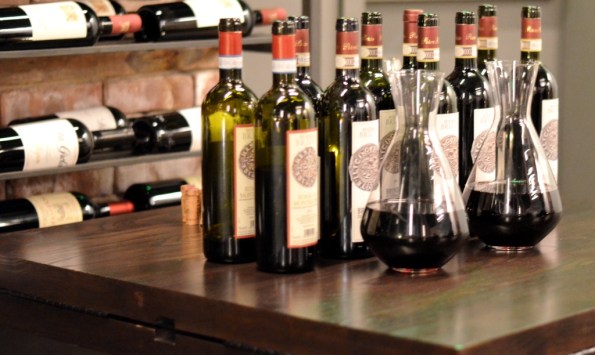
The wines made it into the decanters at some point
We tasted through 4 different wines from Podere Brizio – 2013 Rosso, and Brunello from 2010, 2007 and 2001 vintages, so in essence, this was a vertical tasting. There was one small challenge – the wines were not sufficiently decanted prior to the tasting. Brunello typically are big wines, and they need an ample time in the decanter, or they will not show all its beauty – as you will see from my tasting notes below, this is what happened.
Our dinner consisted of 4 courses. We started with Chicken Liver Pate (Red Onion Mostarda, Toasted Brioche) which had great texture and was absolutely delicious. To my surprise, 2013 Podere Brizio Rosso di Montalcino worked very well with the dish, contrasting the sweet nuances with its tart acidity.
Our second course was Ricotta Cavatelli (Braised Pork Shoulder, Tuscan Kale, Golden Raisins, Toasted Pine Nuts) – again, outstanding, touch of heat and great flavor, hearty and heartwarming (sorry, 2010 was too tight for that, so no pairing notes).


Our main course was Prosciutto Wrapped Veal Tenderloin (Pickeld Sautéed Carrots, Almond Purée) – my notes mostly consist of the exclamation points – wow! flavor! presentation!, so yes, the dish was a treat for the eyes and taste buds alike. After decanting, 2007 Brunello was an excellent complement to this dish, and 2001 Brunello worked very well too.


The desert was outstanding – Coffee Crunch Profiteroles (Mascarpone Cream, Cappuccino Gelato) – imagine a marriage of a classic Profiterole with classic Tiramisu – yep, that was good. And no, we didn’t try to pair the dessert with the wine, we just enjoyed it by itself.
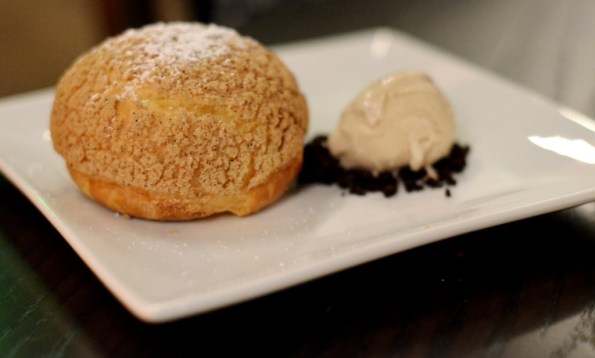 All in all, this was one delicious dinner we have to thank the Executive Chef David White for.
I did my best taking the tasting notes, juggling both delicious food and conversations with other guests, so for what it worth, my tasting notes are below:


2013 Podere Brizio Rosso di Montalcino (13.5% ABV)
C: Garnet
N: Tobacco, earthy undertones, violet
P: Clean acidity, medium body, tart cherries, blackberries, tobacco
V: 7+
2010 Podere Brizio Brunello di Montalcino (14.5% ABV)
C: Garnet
N: Violet, raspberries, blackberries
P: closed. Hint of tart cherries, but not much else
V: the wine was not decanted initially – and this is way too young, needed lots of time in the decanter. No rating.
2007 Podere Brizio Brunello di Montalcino (14.5% ABV)
C: Dark Garnet
N: Touch of plums, but mostly closed
P: Plums, nice tannins, good acidity.
V: 7+, needs time – should be decanted for at least 2 hours
2001 Podere Brizio Brunello di Montalcino (14% ABV)
C: dark Garnet, not a sign of age
N: Intense crushed berries, tar, leather, blackberries
P: Fresh tannins, great acidity, open, vibrant, great concentration and structure
V: 8/8+, just started to open, will shine in 5-10 years.
There you have it, my friends. Delicious food + Great wines = Vintage Vespa. Make sure to keep an eye on Vespa (probably their Facebook page is the easiest) so you will not miss the next wine dinner. Or better yet – head over to the restaurant and just make your own wine dinner – I’m sure you will not be disappointed. Cheers!
Vespa Westport
2A Post Rd West
Westport, CT 06880
Ph:(203) 557-9057
http://vespawestport.com/
Oversold and Underappreciated Premise of Wine Pairing
 This post is an entry for the 21st Monthly Wine Writing Challenge (#MWWC21), with the theme of “Pairing”. Previous themes in the order of appearance were: Transportation, Trouble, Possession, Oops, Feast, Mystery, Devotion, Luck, Fear, Value, Friend, Local, Serendipity, Tradition, Success, Finish, Epiphany, Crisis, Choice, Variety.
Let’s start from the mini quiz – is food and wine pairing an art or a science? Or is it neither and the question makes no sense?
I’m sure you can successfully argue both sides, as they do in debate competitions. Technically, cooking process is based on science – heat conduction, protein’s reaction to heat and cold, combining acid and alkaline – we can go on and on, of course the scientific approach to the food and then the pairing can be argued very well. But one and the same dish can be flawlessly composed from the scientific point of view – think about a steak which is perfectly cooked with a beautiful crust – but missing on all the seasoning and having either none or way too much salt – it would require an artistry and magic of the Chef to make it a wow food experience. So may be food and wine pairing is an art after all?
I don’t have an answer, and I don’t believe it is even important. The problem is that in many cases, that “food and wine pairing”, which is typically sought out and praised, is not possible, not universal and even not needed.
Yes, there are rules for the pairing of wine and food. Contrast, complement, balance of the body of the wine with the perception of the “weight” of the food, tannins and fat and so on. The rules work well when you create a tasting menu and pair each dish individually with the very specific wine, based on practical trial and error. However, once you try to extend your recommendation to say “try this stew with some Syrah wine”, that begs only one question – really? And overbearing Shiraz from Australia, or earthy, spicy and tremendously restrained Côte-Rôtie or espresso loaded Syrah from Santa Ynez Valley – which one?
Here is another example, simply a personal one. At a restaurant, my first food preference is seafood – scallops, bouillabaisse, fish – anything. My wife typically prefers meat, and so do many of our friends. Going by the standard rules (white with fish etc.), we are either stuck with water or have to order wine by the glass, and ordering wine by the glass is typically not something I enjoy doing – very often, “by the glass” list is short, boring and grossly overpriced. So instead of trying to pair wine with the food (don’t get me wrong – I like the “spot-on” pairing as much as any other foodie and oenophile), I prefer to pair the wine with the moment – a good bottle of wine which doesn’t match the food is still a lot better than crappy wine which would denigrate the experience.
Still not convinced? Think about a simple situation – old friends are coming for a visit, and you know that these friends like wine. Yes, I’m sure you will give some thought to the food, however, there is a good chance that you will comb your cellar over and over again in a search of the wines to create the meaningful wine program for the evening, even if the whole dinner would consist of one dish. You will spend time and time again thinking about your friends and trying to come up with a perfect, special, moment-appropriate and moment-enhancing wines.
Wine is an emotional connector. Wine elevates our experiences, making them a lot more memorable. You might have problem remembering what dish you had at a restaurant, but if the bottle of wine made you say “wow” on the first sip, there is a good chance that the special moment will stay in your memory, thanks to that special pairing which took place.
We pair wine with moments, and we pair wine with the people, for good and bad of it. If Aunt Mary comes for a visit, who enjoys a glass of Chardonnay with a cube of ice in it, is it really the time to break out Peter Michael or Gaja Rossj Bass? A Bogle Chardonnay would pair perfectly with Aunt Mary (not that there is anything wrong with Bogle – it is just perfectly priced for such occasions). However, if you know that your friend Jeff will stop by, who you know as a Pinot Noir aficionado, all the best Pinot Noir in your cellar will all of a sudden enter into a “chose me, I’m better” competition. And if none of them will win, the Pinot Noir at near by store will enter the fray. And keep in mind, all of this will be happening whether you will be serving steak, salmon or cheese and crackers…
Yes, when food is well paired with wine, it is really a special experience. But food and wine pairing which doesn’t work is really not the end of the world, it is still just a nuisance – and a learning experience, if you will. When the wine pairs well with the moments and the people, that’s when the memories are created, and that, as MasterCard likes to teach us, is priceless. Let’s drink to lots of special moments in our lives. Cheers!
The Dinner Party Collective – Full Spring Menu and Smoked Salmon Recipe
 As Fall settling in the most of the Northern Hemisphere (slowly, I have to admit – it is still very warm and green here in Connecticut), the Spring is coming to the people of Southern Hemisphere, who are I’m sure very happy to forget the cold and embrace the sun. With Spring comes The Dinner Party Collective Spring Menu (if you need more information about The Dinner Party Collective, please see one of my previous posts about TDPC, as we call it for short).
Our Spring Menu had been fully published, and I was very happy to pair all the delicious dishes the wines, as you will see below in the wine pairing suggestions post:
Appetizer – Smoked Salmon Salad
Main course – Lemon Thyme Lamb Racks with Goat Cheese Aioli
Dessert – Lemon & Coconut Cheesecake with Strawberry Purée
I think all the dishes are absolutely spectacular, and I hope you are all already inviting your friends over for a delicious dinner (and let me know how the wine pairings would work).
This time around, I want to take a liberty to add a little trick, if you will, to one of the dishes on this menu – a Smoked Salmon Salad created by Margot from Gather and Graze. You see, my family loves smoked salmon in any shape and form – on the bagel, in the salad, in the appetizer, anywhere. When you buy smoked salmon from the store, there are couple of issues. First one is the taste and overall quality – sometimes it can be oversalted, dry or even rubbery. Second, the better quality smoked salmon is often quite expensive – Fairway store in Stamford charges $24 – $30 per pound of that smoked salmon. So instead of dealing with uncertain quality and high prices, you can make smoked salmon on your own – it is very easy – and you fully control the flavor profile. That’s right – when making smoked salmon on your own ( and you don’t have to make it taste “smoked” if you don’t like it), you can add any spices – dill, pepper, herbs – anything – and it is really easy to make.
Here is what you will need:
- 3 lb fresh salmon fillet, preferably with the skin (make sure all the pin bones are removed)
- 1 cup kosher salt (Kosher salt without iodine is a must for curing and brining)
- 1/2 cup brown sugar (I use “sugar in the raw”)
- pepper – by your taste
- liquid smoke (if you want to make “smoked salmon”)
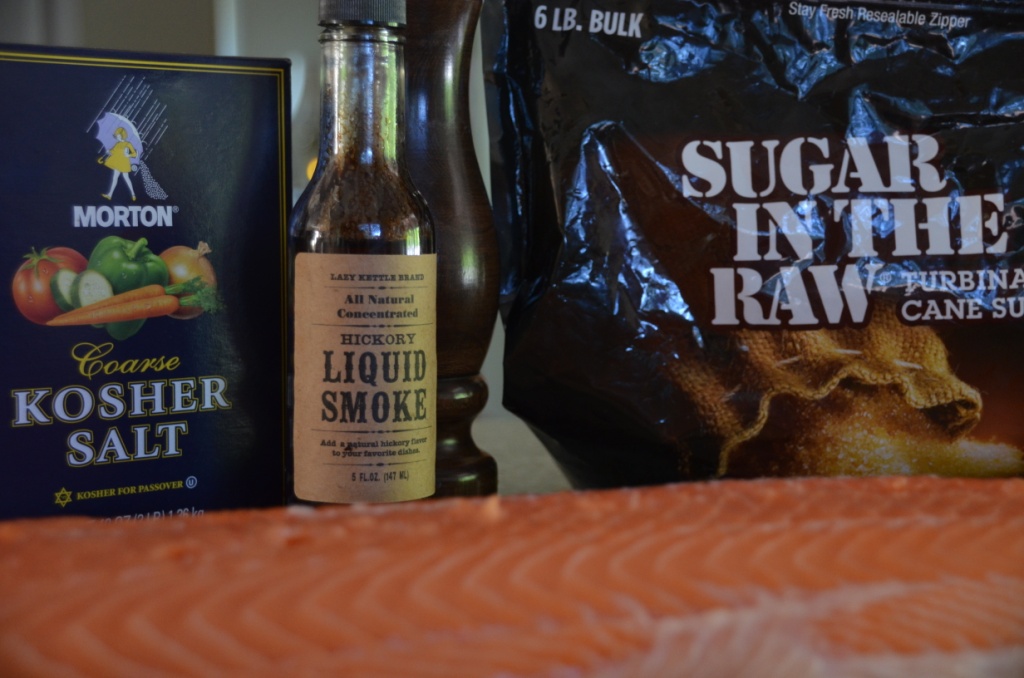 Above you see everything you need – please note the bottle of Liquid Smoke there – available at most of the supermarkets or you can order it online. Few drops will impart smoke flavor on any dish you are making.
Prepare the mix of kosher salt, brown sugar and pepper – feel free to add any other spices here you would want to use, and mix it all up – I do it right in the measuring glass:
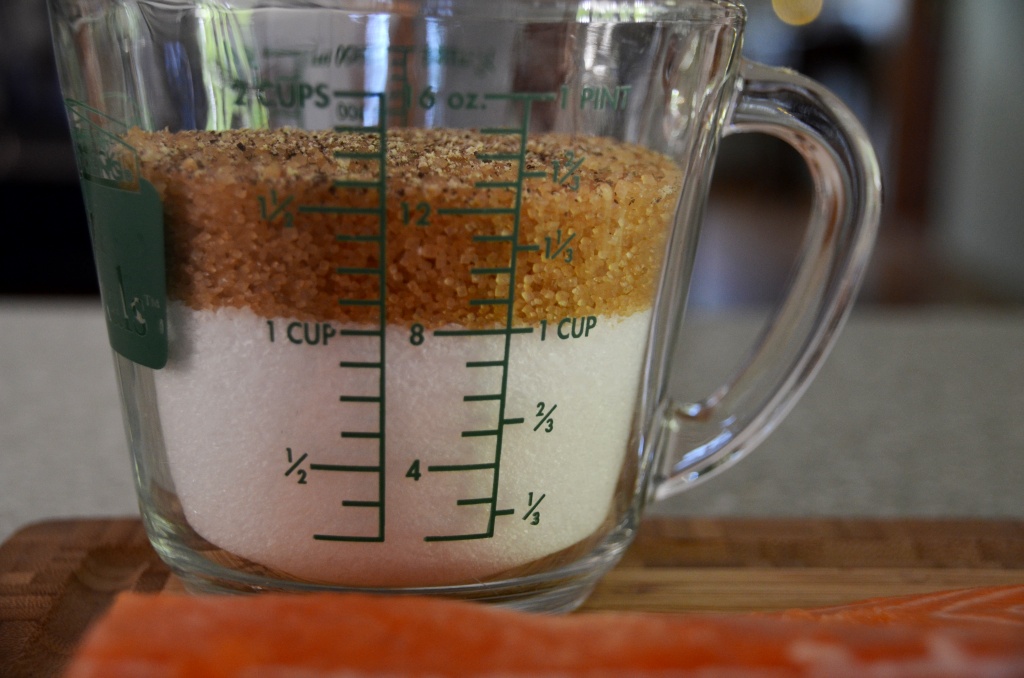 Put a very thin layer of the mix at the bottom of the large glass cooking dish (I’m sure you can use the foil tray as well, but I prefer using the glass tray), and put salmon filet on top:
 Now, completely cover the salmon with the mix, top and sides:
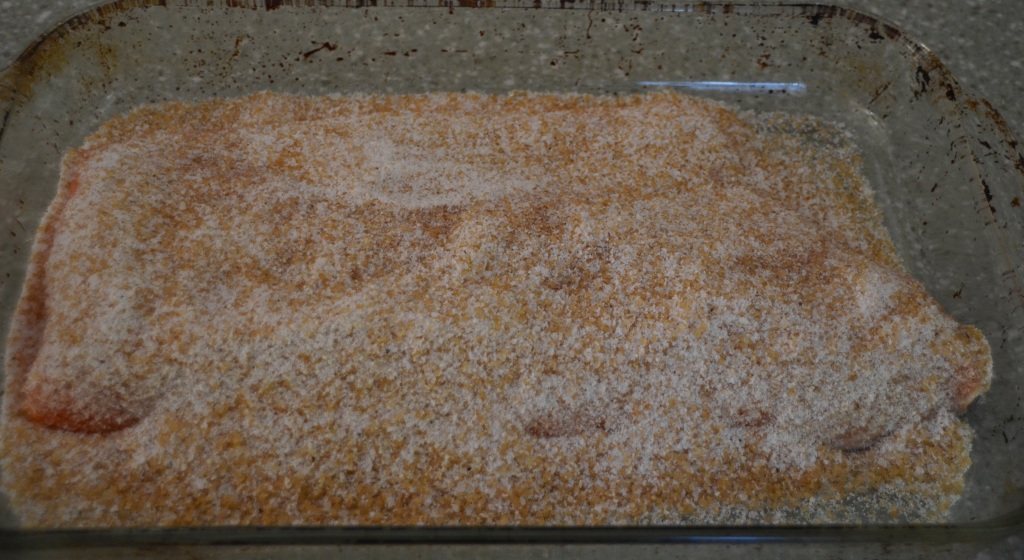 Cover with the plastic wrap and put it in the fridge for 24 hours. The next day, take it out of the fridge, and you will see something like that:
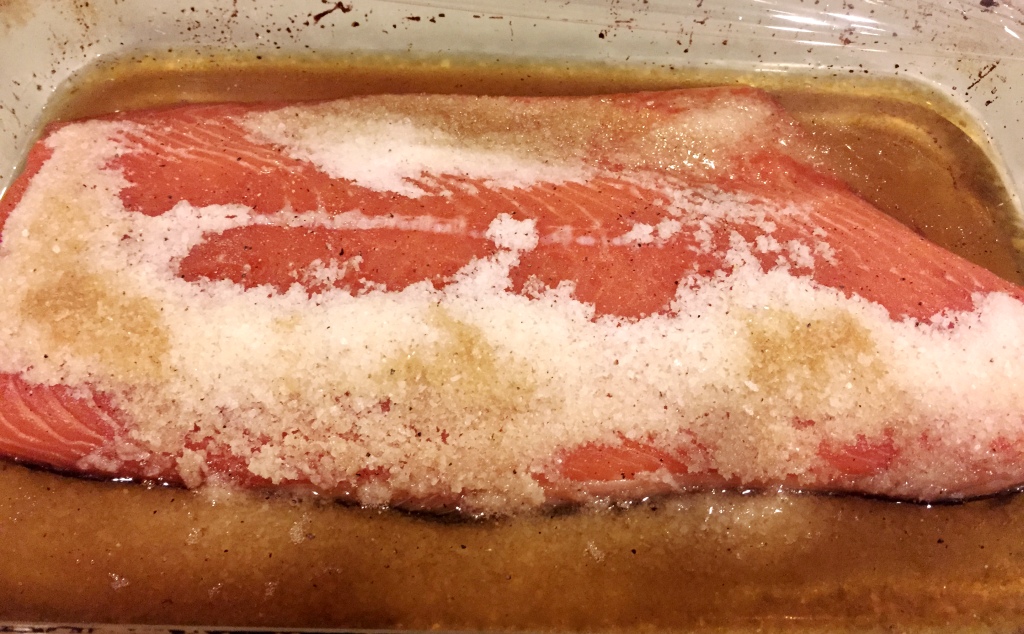 Drain the liquid (as much as you easily can, don’t strain it completely). Technically, salmon is now ready to eat – it is completely cured. From now on, I like to make it “smoked” so I add a few drops of Liquid Smoke all over salmon and around, cover with plastic wrap and put it in the fridge for another 12 hours. Important note – the longer you will keep salmon with the salt, the drier and denser it will become, as it will lose more juice.
After 12 hours, your smoked salmon is fully ready – get it out of the fridge, wash it thoroughly to rid of any salt, and lay it to rest on the board – you can keep it there for an hour or even longer. This is how it will look like:
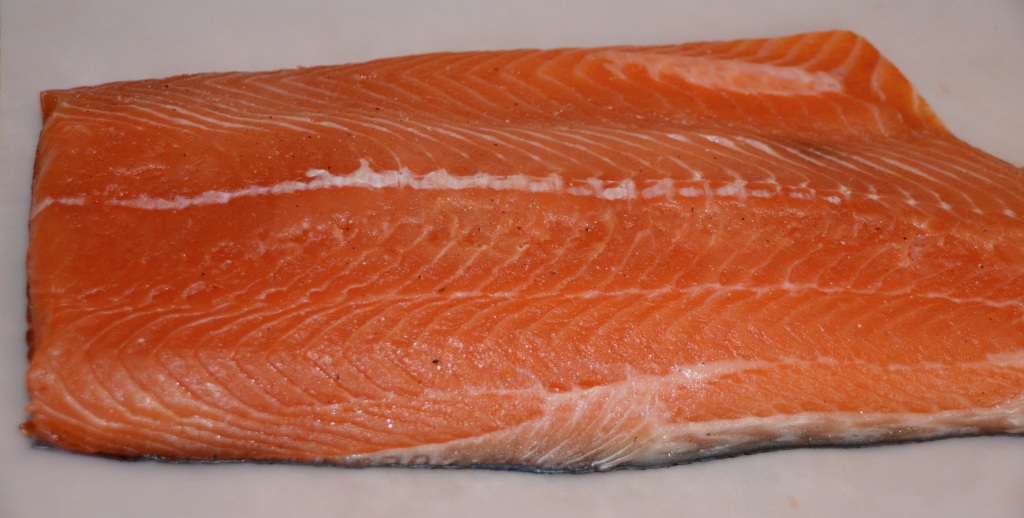 I like to give it even longer rest time if I’m not too hungry, so I would typically wrap it completely into the plastic wrap and put it back in the fridge for a few hours. Salt dries the surface completely, so by letting the salmon rest, it will redistribute the juices so it will become all moist and delicious. Last step – slice and enjoy!
 I would typically slice it off the skin as needed, and keep the rest wrapped in the plastic wrap in the fridge. As it is cured, it will last for a pretty long time – between a week and two for sure. It is also very easy to freeze as it is, right in the plastic wrap – and it can be thawed quickly as needed.
There you have it my friends – a simple smoked salmon recipe. Yes, do that at home!
If you will decide to make it – let me know how it will come out. Cheers!
The Dinner Party Collective – Full Fall/Autumn Menu
A quick update on the fun project I had been involved with – The Dinner Party Collective (TDPC for short). For those of you unfamiliar with TDPC – it is a collaborative project of food and wine bloggers, aimed at creating full dinner menus with focus on seasonal ingredients in both northern and southern hemispheres, and with all the dishes on the menu coming with suggested wine pairings. TDPC is a brain child of Margot from Gather and Graze, which started early in 2015. TDPC was mentioned in the WordPress article in July as one of the 4 food blogs to watch. Earlier in the year, we published a set of Winter and Summer menus.
Now the time has come for the Fall/Autumn and Spring menus. First, the Fall/Autumn menu was fully published, so here are all the links:
Appetizer – Trio of Root Vegetable Dips
Main Course – Beef Bourguignon
All the recipes include wine pairing notes and suggestions from Stefano (Flora’s Table, Clicks & Corks).
Spring menu overview will be coming out tomorrow, with the wine pairings and all the dishes to follow. Happy cooking! Cheers!
Last Bottle Sign Up ($10 credit)




 Talk-A-Vino