Archive
Trust the Rosso
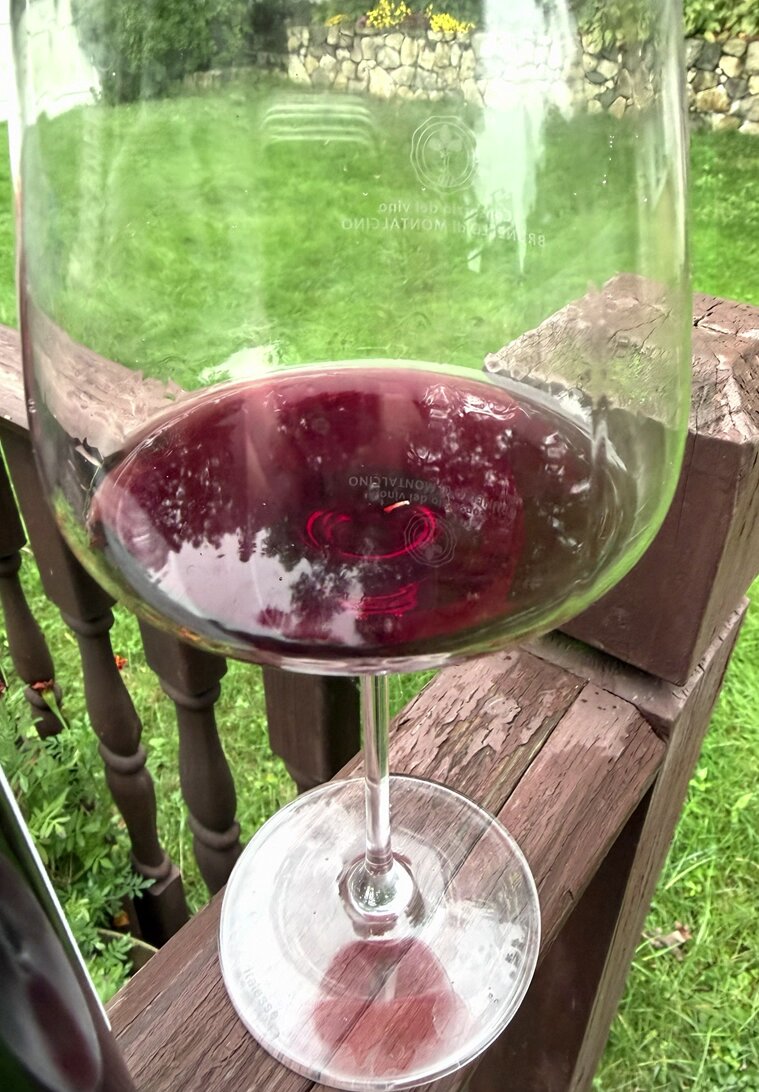 What is the best part of drinking wine?
It is a simple question.
The simplicity of the question doesn’t mean that the answer to that question is simple. Also, it doesn’t mean that there is only one answer to that question. Similar to the subject at hand, wine, which is subjective, the answer to our question is also highly subjective.
While I’m genuinely interested in your answer to this question (and I will be delighted to read it in the comments), let me answer my own question first.
The best part of drinking wine is conversation. It is possible that you were expecting to hear “buzz”, “pleasure”, or something else, but for me, it is a conversation. A conversation that usually everyone can enjoy, and sometimes even agree on things – wine is a great tool for leveling the arguments and finding common ground. And among all subjects, sometimes these conversations are about wine.
Wine is life. For thousands of years, wine was an indelible part of life, and I really hope that it will continue to be for many more thousands. Wine is a reflection of culture, and fully intertwined with culture. So basically, wine can help you talk about anything – but it is also a perfect subject in itself. Such was my experience two weeks ago.
I met for lunch with Gabriele Casagrande, an export manager for Capanna, one of the original Brunello producers in Montalcino. Our conversation went all over the wine world – from kosher Chianti wines to the best Syrah in Tuscany, to Amarone, which you need to go out of your way to find an enjoyable bottle, then to California Cabernet Sauvignon, and then back to Italy. Of course, we discussed how the young generation [supposedly] doesn’t drink wine, then we inevitably got back to the subject of Brunello.
Capanna winery was founded in 1957 by Giuseppe Cencioni, together with his sons Benito and Franco. After Brunello di Montalcino obtained DOC status in 1966, Giuseppe was one of the 25 founders of the Consorzio del Vino Brunello di Montalcino. So obviously, Capanna means Brunello, one of the iconic “3B”s of Italian winemaking, along with Barolo and Barbaresco.
Despite the grandstanding, Brunello is not immune to the problems wine is experiencing today worldwide – consumption is down, and the culture of wine is slowly getting lost, especially with the younger generations. One of the good answers to such challenges is innovation – and Capanna does just that.
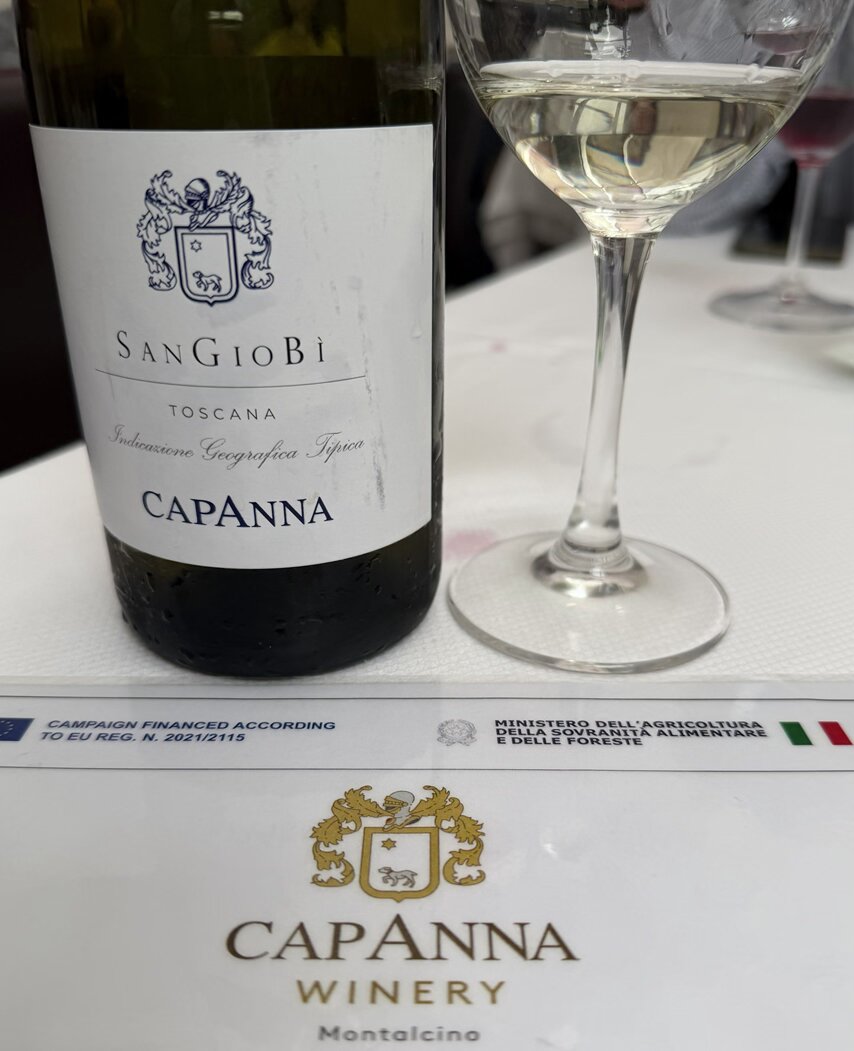
The first wine we tried during lunch was 2024 Capanna SanGioBì Bianco Toscana IGT. To begin with, how many wineries in Montalcino make white wines? I don’t know if Capanna is the only one, but definitely not many. Care to guess what grape this wine is made from? No, it is not made from Tuscany’s darling Vermentino, try again. Well, if you said Sangiovese, you got it! This wine is made from the same grape the Brunello is made from, Sangiovese. The color of the majority of red wines comes from the skin (there are exceptions, such as wines made from the teinturier grape varieties). When you press Sangiovese grapes, you get clear juice. Leave the skins for grappa, and you get a delicious white wine.
The wine was delicious. One of my favorite references to the great white wines is “in a blind tasting I would say it is Chardonnay”. I love Chardonnay in general, but my “textbook reference” expression is the one which has apples, vanilla, lemon, and a tiny bit of butter, all in perfect harmony. And this is what this SanGioBì offered: silky, round, and delightful. Anyone who likes white wine, and especially those who don’t belong to the ABC club, would really enjoy this wine and should really make an effort to find it. Oh yes, and it literally opened up better as it warmed up in the glass – another hallmark of an excellent white wine in my book.
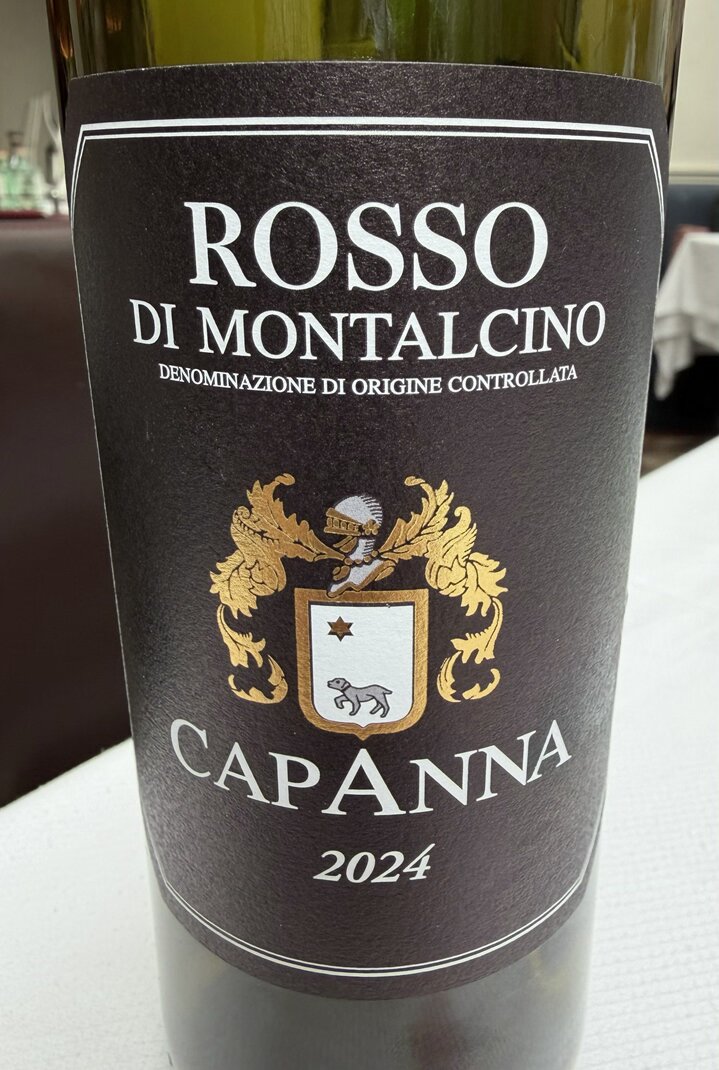
Next, we tried our next wine, 2024 Capanna Rosso di Montalcino DOC, and now it is time to discuss why I’m asking you to trust the Rosso.
Rosso di Montalcino is often misunderstood by wine consumers and misused by the winemakers. Wine consumers look at Rosso as the second-grade citizen, a “poor man’s Brunello”. Winemakers are often the reason for that, as in many instances Rosso is an afterthought, made with grapes that are left over or not suitable for the flagship Brunello.
Considering what I just said, you are probably wondering “what’s up with Trust the Rosso” thing? If winemakers give the wine “second-hand” treatment, why on Earth am I asking you to trust it?
The explanation is actually quite simple. The take on the Rosso is changing in Montalcino, and more and more it is treated as the wine in its own right. While the pricing of the Rosso is quite advantageous, usually at half or less than that of Brunello, this is not the main reason to trust the Rosso. In my opinion, the true value of Rosso is in its consistency and predictability.
When you open a bottle of Rosso that has just been released, you can trust that you will find an easy-to-drink, pop-and-pour wine, which unmistakably comes from Montalcino, but is ready to enjoy right away. Brunello can only be released 5 years after the harvest and has to spend at least 2 years in the oak. As it is usually the case with wines which are aged for this long with and without oak, enjoying them often becomes a matter of luck – sometimes they taste good right away, and sometimes you need to conjure over a decanter for an unknown number of hours to arrive at the wine you are ready to enjoy. With Rosso, your chance of finding pleasure in the glass of wine in front of you is much, much higher.
The 2024 Capanna Rosso di Montalcino is a perfect illustration. The wine is produced from the grapes harvested from the designated vineyard – not an afterthought, but the vineyard which was planted specifically to produce Capanna Rosso. And then… The proof is always in the glass… After the initial pleasure of the first sip of Capanna Rosso subsided, my first reaction was “ohh, this is a dangerous wine”. I define wine as “dangerous” when it is so pleasant and so easy to drink that you find yourself staring at the empty bottom of the bottle much sooner than you care to realize. Beautiful cherries, lip-smacking but light, round and layered, with perfect balance and medium-long finish – dangerous and pleasant. I trusted the Rosso, and Rosso delivered.
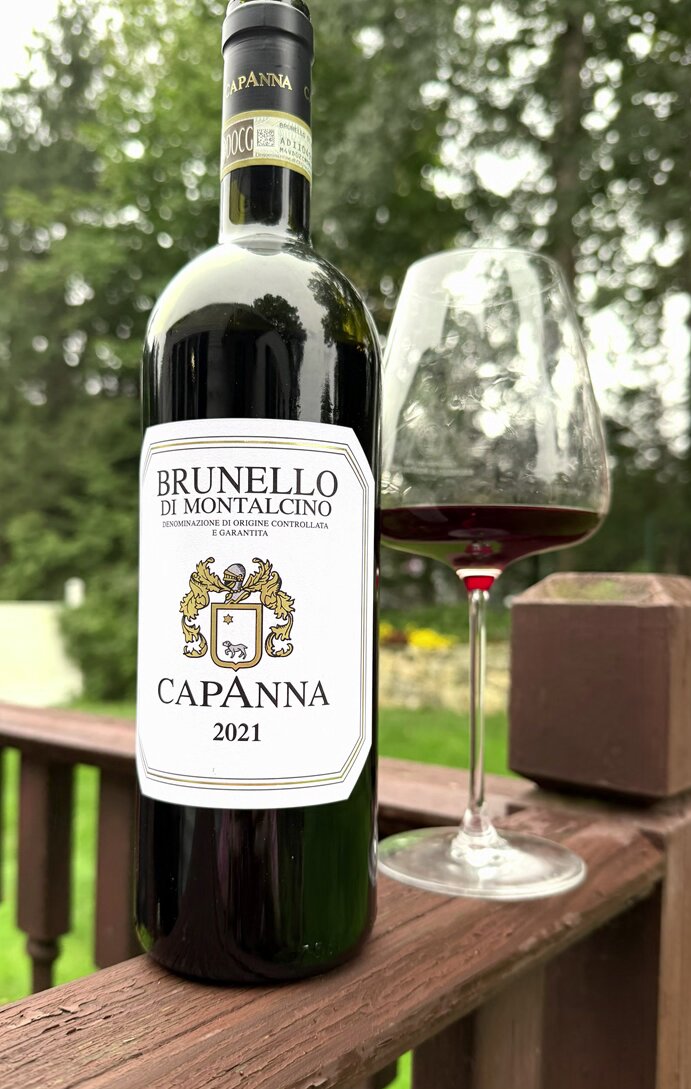
As we didn’t have to open the Capanna Brunello during lunch, I brought the bottle home to try the next day. The 2021 Capanna Brunello di Montalcino DOCG experience was exactly as I mentioned above. Upon opening, the wine was beautiful – succulent cherries, both red and black, violets, a touch of balsamic, intense, beautiful, and delicious. The next day, the wine became somewhat closed. On day 3, the cherry profile became much leaner, somewhat similar to the Rosso, but now the profile was supported by very pronounced tannins – not a bad thing, but yet a different expression. Yes, consumed in one sitting, the 2021 Capanna Brunello would be perfect. If put aside, as many of us do with more expensive bottles, enjoying it in the 2, 3, 5 years can become a subject of your decanter mastery. So I say it again – trust the Rosso.
That’s my story, friends. I’m curious about your take, of course. And by the way, Capanna will turn 70 next year, which is a great cause for celebration, so I’m definitely looking forward to more happy encounters with their wines.
Until the next time…
Last Bottle Sign Up ($10 credit)