Weekly Wine Quiz #114: Grape Trivia – Viura / Macabeo
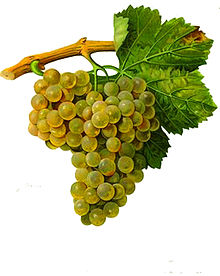
Viura/Macabeo grapes. Source:Wikipedia
The Wine Quiz series is not meant to intimidate. The whole idea here is to have fun and learn something new. When answering the questions, it is fully encouraged to use all available sources of information, including Google or any other search engine. There are no embarrassing answers – the most embarrassing thing is not giving it a try…
Welcome to your new wine quiz!
We are continuing our grape trivia series, and today’s subject is the white grape Viura, also known as Macabeo.
I know what you are thinking – we are going from “not so popular”, like we did with Müller-Thurgau and Pinot Blanc, to practically obscure. You probably want to say “I never heard of the grape and never had any wine made with it!”. Well, let’s see. Have you had any Cava, a sparkling wine from Spain, during the last summer? Macabeo is a part of the blend. How about white Rioja? If you actually never had white Rioja, you have to correct it as soon as possible (go on, run to the store, I will wait here). Look for Cvne Monopole Rioja (100% Viura), the oldest white wine in Spain, produced since 1915, or for any of the R. Lopez de Heredia whites, like Viña Tondonia or Viña Gravonia – those wines might change your view of the world forever (well, the wine world, of course). But – let’s get back to the grape itself.
Viura is the name of the grape used in Rioja (interesting fact: until 1975, there were more white wines produced in Rioja than the reds). The same grape is known in the rest of Spain as Macabeo, and as Macabeu and Maccabéo in Roussillon in France. Viura has a few interesting traits, which make it to stand out among others white grapes. First, it is considered to be resistant to Phylloxera, and it was widely planted in Spain after the Phylloxera devastation. It also can withstand oxidation better than many other grapes, which makes it a favorable variety for the prolonged barrel aging, where some exposure to oxygen is inevitable. At the same time, as Viura grows in the very tight clusters, it needs hot and dry climate to fully ripen, otherwise it is susceptible to mildew and rot – to get the best results the grape often requires extensive pruning and lots of attention in the vineyard. But – good white Rioja is a magnificent wine, with incredible aromatics and delicious bouquet, and can age and gain complexity for decades – it is well worth the trouble! In addition to white Rioja, Macabeo also plays main role in production of Cava, famous Spanish Sparkling wine. And we shouldn’t forget the Roussillon region in France – Macabeo is an important contributor to many different types of wines produced there.
And now, to the quiz!
Q1: Which one doesn’t belong and why:
a. Chardonnay
b. Sauvignon Blanc
c. Trebbiano
d. Verdejo
Q2: True or false: Viura is one of the 10 most planted white grapes in the world
Q3: Wine Spectator calls wines rated in 95-100 range Classic (the highest and the most prestigious category). True or False: there are no Viura/Macabeo-based wines rated in the Classic category
Q4: Which grape is missing: Chardonnay, Macabeo, Malvasia, …, Xarel-lo
Q5: Fill the gaps: If Macabeo is blended with Grenache Blanc and Malvasia, the resulting wine is most likely a ___from_____ ; if Macabeo is blended with Grenache Blanc and Grenache Gris, the resulting wine probably a ___ from ___.
Good luck, enjoy the quiz and your weekend! Cheers!
Wednesday’s Meritage – Wine Quiz Answer, Few Words About Wine Blogging, FLX Riesling #WineChat Tonight and more
Meritage time!
Let’s start with the answer to the wine quiz #113: Grape Trivia – Pinot Blanc.
In the quiz, you were supposed to answer 5 questions about white grape from the Pinot family, Pinot Blanc.
Here are the questions, now with the answers:
Q1: Below is the list of some of the countries growing Pinot Blanc. Sort this list by the area plantings of the Pinot Blanc, from the lowest to the highest:
a. Austria, b. France, c. Germany, d. Italy
A1: Might come as a bit of a surprise, but the correct sequence, based on the 2010 data, is France (3,230 acres), Austria (4,785), Italy (7,715) and Germany (9,675)
Q2: Wine Spectator calls wines rated in 95-100 range Classic (the highest and the most prestigious category). True or False: there are Pinot Blanc wines rated in the Classic category
A2: True. By a very slim margin, but there are 2 Pinot Blanc wines with the 95 rating (there are plenty in the Outstanding, 90-94 range). As a matter of fact, one of those 95 pointers comes from the New World – 2009 Erath Pinot Blanc Dundee Hills Sweet Harvest from Oregon got that “classic” rating in April 2011 issue.
Q3: In Europe, Pinot Blanc was often confused with and often treated during winemaking the same as _______
A3: Chardonnay. Historically, Pinot Blanc was growing side by side with Chardonnay, and was often confused for one. Similar to Chardonnay, it can be made in both unoaked and oaked styles with equal success.
Q4: In California, the grape which was brought in as a Pinot Blanc, in reality happened to be ____?
A4: Melon de Bourgogne, French grape used in the production of Muscadet wines.
Q5: True or False: from 2000 to 2010, worldwide plantings of the Pinot Blanc dropped more (percentage-wise) than the plantings of its sibling, Pinot Gris, have increased.
A5: False. From 2000 to 2010, the plantings of Pinot Blanc dropped by about 15%, while the plantings of Pinot Gris more than tripled worldwide.
When it comes to the results, I’m glad to say that the number of players took a stub at this quiz – but, somehow the quiz happened to be somewhat difficult (I usually miss the difficulty in my own assessment, unfortunately). Nobody was able to answer all the questions correctly, but I would like to acknowledge Next Stop TBD who got correct answers for 3 questions out of 5. Thank you all for playing!
Now, to the interesting stuff around the vine and the web!
Alfonso Cevola, who writes an excellent blog “On the wine trail in Italy”, shared his sad outlook on the wine blogging community with the post titled Wine Blog Death Watch: Two wine blogs that are bright lights in a forest of darkness. Well, it is not all doom and gloom in that blog post. First, Alfonso introduces two new wine blogs which he likes. And may be most importantly, speaking from the 9 years of blogging experience, he also gives an advice to the wine bloggers. His advice is very short and concise, and I would dare to say, literally the best you can get. Alfonso has only six bullet points, so taking just the key items themselves, here is a summary of what he suggests: “Write for yourself. Read great writers. Do not look at stats. Write consistently. Don’t follow the trends. Find your niche.” Touche. I can only add “amen”.
Tonight we will take a deep dive into the world of Finger Lakes Rieslings – the #winechat with 8 producers, 8 excellent wines from the 2013 vintage – join the conversation! The logistics are as usual – at 9 PM eastern, open a twitter client and search for #winechat – from there, the conversation is on, and don’t forget to use hashtag #winechat on all your tweets.
Do you know that when you drink the wine (or any alcohol for that matter), you should have water in between the glasses? It supposed to prevent hungover (some of the latest research suggests that it might not be true, who knows), and water is generally good for you. Some of the creative types designed nested glasses which would simplify this task for you – both wine and water are readily in your hand at any time, wine glass on top of the water glass. You can read about this glasses in the Dr. Vino’s blog post.
Got a bit of time on your hands? Wine Spectator is running an annual wine video contest, and you can help to decide who made the best video. Wine Spectator selected 9 videos as the finalists, so your job would be simple – watch those videos and decide who will be the Grand Prize winner. Here is the link to the page for you to watch the videos and take vote.
And we are done here. The glass is empty – but the refill is on its way! Cheers!
Do You Wine Club?
 What do you think of the Wine Clubs? Do you belong to one, or two or five? Have you in the past? Would you recommend a wine club membership to your friends?
Yes, I know, the subject of the wine clubs was well discussed in the past, and it is hard to say something new here. However, a few months ago, I was asked if I would be interested in receiving a sample from the International Wine of the Month Club, which I accepted with the usual condition – I will write about the wines only if I like them. I tasted the wines a while back, and yes, I liked them – only now I finally found the time to write about it. But – I don’t want just to share the tasting notes and be done with it – I would like to take this opportunity to ponder at the subject of the wine clubs (beer and spirits too for that matter).
My love for the [wine] clubs started the way back, in the middle of 1990s, when I subscribed for the first time to the Beer Across America monthly club. To begin with, the club had a great story of two friends quitting their IT jobs, coming up with the concept and trying to (unsuccessfully) start the business, then literally with the last of their savings creating leaflets and going in Chicago neighborhood door to door, leaving those leaflets in the mailboxes of people in time for the holidays – and seeing the business to pick up. Every month UPS would deliver a box to my doorstep with two six packs of beer – not just any beer, but only microbrewery products, coming from all over the country. Today any wine store carries literally hundreds of selections – but this was 20 years back, and microbreweries very hard to find. Every shipment would also include information about microbrewery, about the particular beer we received, recipes and lots more. I was definitely looking forward to those shipments – you would never know where the next beer would be coming from, and what the story might be behind it, so it was definitely fun.
I think I stayed with that club for about two years – the club changed the concept slightly at some point and went from the regular 0.33 beer bottles to the large format, 22 oz, and those started to accumulate, so I had to stop it as the whole process became somewhat boring.
Since that time I had a few other club experiences. For about year and a half, I was in the D&M Scotch club – this was great, very unique selections, but I just don’t drink enough Scotch, so it started to pile up, and I had to stop it; to be entirely honest, if I would be able to reduce the frequency of the shipments, I would still continue it. A few years back (say 6-7, to be more precise), many newspapers started their wine clubs. I subscribed to the Wall Street Journal wine club, but that experience wore off very quickly, as out of the case of wine, only 3-4 bottles would be somewhat drinkable, so paying about $180 for 4 “okay” bottles was not my idea of the bargain. I wouldn’t recommend the newspaper wine club – the selection there is simply not good.
All in all, I think all the wine clubs are different, and some of them have their place. For majority of the cases, you get a great deal of information with your wine club shipment – and I really like that. Also, for those few bottles which you will be receiving, you get two additional [oenophile-specific] benefits – you don’t need to chose anything, and you have an element of surprise with every “mystery” box you receive. As it was the case with the my sample shipment from the International Wine of the Month Club.
This club offers three different levels of membership – Premier, Masters and Collectors. The difference between the levels is in the price of wine you will be receiving – otherwise, each shipment contains 2 bottles of wine, which can be red and white, or just two reds. The sample I received contained the 2011 Bellingham The Bernard Series Small Barrel S.M.V. from the Masters series, and 2012 Klein Constantia Sauvignon Blanc form the Collectors series, both wines from South Africa.


2011 Bellingham The Bernard Series Small Barrel S.M.V. South Africa (14% ABV, 75% Shiraz, 22% Mourvèdre, 3% Viognier) took one day to open up. Dark, Concentrated, with raspberries and blackberries on the nose, touch of tobacco and earthiness. On the palate, the wine was firm, structured, with cherries and lavender, touch of espresso, good acidity, hint of eucalyptus and sage, well balanced. Long finish with tobacco aftertaste. Drinkability: 8-
2012 Klein Constantia Sauvignon Blanc Estate Wine, South Africa (13.5% ABV, 89% Sauvignon Blanc, 11% Semillon) is produced by the famed Klein Constantia, makers of the iconic Vin de Constance, favorite wine of Napoleon. This Sauvignon Blanc had gooseberry, fresh grass and lemon on the nose, with touch of sweetness. On the palate, the wine had nice zippy acidity, lemon zest, lemon and a touch of freshly cut grass and mineral complexity. It is interesting that this wine also required a day to open up and to develop a balance – from the pop and pour, the wine a was a bit disjointed and sharp, and it became soft, balanced and cohesive on the second day. I believe this wine can age, and it would be interesting to see what would happen with in a few years. Drinkability: 8
Remember I started this post with the question? How about a simple poll – I’m just curious what you think about wine clubs, so here are two questions for you. First, just tell me if you ever belonged to the wine club:
And now, if you did (or still do), how often do you get your shipments?
So, what do you think? Is there a wine club for you out there? Oh yes, before I will forget – wine clubs make perfect gift! I heard the holidays are coming… Cheers!
Prime Time at Washington Prime
 When you come to the new restaurant, first you discover the food. Then drinks and wine. Then ambiance and decor. Then service. Well, yes, all of the above – but in the random order. The experience is somewhat like peeling the onion, only with an element of surprise – you don’t know what your next excitement will be. May be a new dish. Or may be, as I recently had, a creative interior which all of a sudden dawns on you, after you already spent more than hour in the restaurant.
About two weeks ago, we visited new restaurant in Norwalk, Connecticut, called Washington Prime. The restaurant is located on the Washington Street, hence the first part of the name. And for the second part, there can be multiple explanations, but as restaurant is a steakhouse, and it serves only Prime cuts of beef (for the readers outside of the US – Prime is a definition from the US Department of Agriculture for the best quality selection of beef), hence the second part of the name.
We walked into the restaurant, immediately got to our table, and started studying the cocktail selection and got into the conversation with our dining companions. Only an hour into our dinner I had an opportunity to walk around and see how creatively the dining room was decorated, with the grape vines on the ceiling above bar and green plants (yes, artificial, not live) covering the walls in the corridor. It became quire dark when I made the discovery, so the pictures wouldn’t do a justice to the decor, but nevertheless, you will get an idea.


The cocktail list was quite interesting, and it was not easy to make a selection. I went with the Basil Smash (basil, simple syrup, tanqueray 10, lemon just) – nicely refreshing and not overly sweet. Moscow Mule‘s presentation also looked quite interesting. Then, of course, we went for the wine. The wine list overall was interesting and well composed – but it was not easy to make a selection as I always go out of my way looking for value, and it was simply not that easy (lots of selections were priced at about triple retail, and you know that I have a problem with that). For the white, we had a 2012 Martín Códax Albariño, Rias Baixas – simple, food friendly wine with clean acidity and touch of white stone fruit. We also had 2013 Jean-Luc Colombo Cape Bleue Rosé Provence, which was light and loaded with strawberries.For the reds, we started with the 2012 David Bynum Jane’s Vineyard Pinot Noir Russian River Valley – young, smokey, light cherry flavor, good acidity. While this was a nice wine, we felt that it wouldn’t really stand up to our dinner which included steak, so the red wine we chose to stay with until the end of the meal was 2011 Ridge Three Valleys Sonoma County – notes of smokey raspberries, espresso, touch of dark chocolate, all weaved together over a firm structure with some earthy notes – excellent overall.
And now let’s talk about the food. Everything was split into the courses. We started with a few appetizers – Seafood Tower (colossal shrimp, local oysters, little necks, Alaskan king crab leg, Maine lobster, spicy mustard, house cocktail sauce, classic mignionette) and House Slab Bacon (). The bacon more resembled the pork belly than traditional bacon, and literally was melting in your mouth. The Seafood tower was excellent, great selection of fresh oysters and clams.


Our dinner continued with Small Plates. Lobster Bisque (parsley, crème fraische) was very concentrated, with nice flavor. Deviled Eggs (creamy yolk, prime meatball, pickled onions, foie gras powder) were unsuccessful, unfortunately. I love deviled eggs, one of my childhood favorite dishes – and we keep making it almost for each and every party. The deviled eggs served at Washington Prime were way too acidic, with pickled onion been just too much. I think this dish requires some work make it a success. Burrata (creamy slaw, sambal aioli, sesame, pretzel bread) was creamy and satisfying, just as you would expect the Burrata to be.


Poutine (oxtail ragu, house fries, cheese curds, green onions) was an interesting dish. The oxtail ragu was outstanding, with the flavor and texture creating irresistible, homey experience . However, the cheese curd didn’t fully integrate into the dish – at least with my memories of Poutine in Quebec.
Knuckle & Claw (blue cork grits, lobster sauce, tobiko) was okay – yes, I’m not really a big fun of lobster, so the blue corn grits and tobiko were the best components of the dish for me.
Octopus (pickled peppers, duck fat marble potato, pepper emulsion) was to die for. Perfectly cooked, with delicious flavor combination, it was definitely a star dish.
Wings (fried, kimchi sauce, scallions, soy, chilli) were crispy and very tasty (could use a bit less salt).


Finally (after about an hour of eating), the time had come for Salads. First, Prime Wedge (gem iceberg, pickled heirloom tomatoes, bacon, ewes blue cheese, chili, house ranch dressing) was spectacular. I love the Wedge, and I order it quite often – this was the very best Wedge salad I ever had – the bacon, the sauce, the sweetness of the lettuce were just spot on. And our next salad dish, Chop Chop Salad (iceberg and romaine, bell peppers, onion, carrot, provolone, salami, red wine vinaigrette) was also very much on par with the Wedge – fresh, light and delicious, with the very tasty sauce.


And the time had come for Land & Sea.
We were in a steakhouse, so of course there was steak! USDA Prime Steaks – 8 oz filet Mignon, 18 oz Ribeye, 32 oz. Porterhouse (dry aged 28 days) – were all served on the beautiful wooden boards, in its perfectly simple beauty. The selection of steak sauces, which also included spicy mayo and Chimichurri, was served on the side. The steaks were just outstanding, all three of them had a slight difference in texture and flavor, but they were all simply done at the “wow” level.
Representing the “sea” part, first we had Grouper (Carolina gold rice, tomato, asparagus, carrot butter sauce) – if the steak was “wow” dish, this was a double “wow”. I know that expression “melting in your mouth” is abused, nevertheless, this is the only way I can describe this dish – great flavor, and the fish was really melting in the mouth… And then there were Scallops (middlins, corn relish, nicoise olives, hunters sauce), my perennial favorite, done at the textbook quality – “perfectly seared, succulent and sweet” – the best way possible.


You didn’t think that we left without having a dessert, right? Of course not! Italian and New York Cheesecake, a Tartufo and an Ice cream cookie sandwich with cereal milk were all included in the sweet ending of our evening. All were excellent, but the ice cream sandwich with the cereal milk was a standout for me in creativity. In case you are wondering, the cereal milk of the day was Fruit Loops…


Executive Chef Jared Falco came out to check on us many times, and we had an opportunity to discuss the dishes and his approach to making his cooking stand out. All in all, we had a great time.
 That’s all I have for you, my friends. Yes, we had a great evening of food and wine, and the restaurant is definitely worth a visit if you are in a mood for steak, or simply a creative bite of food. Oh yes, and I meant to warn you not to read this post hungry – I guess it is too late now, sorry. Cheers!
I visited restaurant as a guest of the management. All opinions are my own.
Washington Prime
141 Washington Street
South Norwalk, CT 06854
Located at the corner of Washington and Water St.
TEL: (203) 857-1314
http://washingtonprimect.com/

Weekly Wine Quiz #113: Grape Trivia – Pinot Blanc
Pinot Blanc Grapes. Source: Wikipedia
The Wine Quiz series is not meant to intimidate. The whole idea here is to have fun and learn something new. When answering the questions, it is fully encouraged to use all available sources of information, including Google or any other search engine. There are no embarrassing answers – the most embarrassing thing is not giving it a try…
Welcome to the weekend and your new wine quiz!
We are continuing our grape trivia series, and today’s subject is Pinot Blanc.
How many of you can consciously remember that they had a Pinot Blanc wine? Yeah, I thought so (and I’m doing a quiz about it – not very wise, huh?). Well, what else we can expect if the grape is a mutation of a mutation, right? Pinot Noir, proudly presiding over the Pinot family, is a very mutation-prone grape. So first, there was a Pinot Gris, a grey-colored mutation of the Pinot Noir. And Pinot Blanc – yes, you guessed it – is a mutation of a Pinot Gris.
Nevertheless, Pinot Blanc used to be quite popular world wide. In the 1700s, plantings at the famous Domaine de la Romanée-Conti in Burgundy had 20% of the Pinot Blanc – now there are none. Pinot Blanc still allowed to be used in Burgundy in the wines labeled Bourgogne Blanc, but the plantings of Pinot Blanc in Burgundy are practically non-existent. Same story is in Champagne, where Pinot Blanc is allowed to be used, but practically never is. Even in Alsace, where the grape still is widely planted, Pinot Blanc stands in a very interesting position. Alsace is the only region in France where the name of the grape is always put on the label. However, event if the label says “Pinot Blanc”, any of the Pinot family grapes ( including unvinified Pinot Noir, which will produce clear juice), can be used in the Pinot Blanc wine.
One of the major characteristics of the Pinot Blanc is its neutral taste. The grape has good acidity, and the neutral taste allows it to be added to the blends for the body and acidity, and also to be vinified on its own, with and without oak, allowing terroir to shine through. Then in the times when everybody are looking for differentiators, that neutral taste works against the grape. Also, Pinot Blanc grows in the tight clusters, thus it requires dry conditions to avoid the mildew setting in. Looking on all these challenges, it is not surprising that the worldwide plantings of Pinot Blanc are declining. But – the grape is still planted in literally each and every major wine producing country, and don’t worry, it is not going to disappear any time soon, as it is still one of the 30 most planted white grapes in the world.
And now, to the quiz!
Q1: Below is the list of some of the countries growing Pinot Blanc. Sort this list by the area plantings of the Pinot Blanc, from the lowest to the highest:
a. Austria
b. France
c. Germany
d. Italy
Q2: Wine Spectator calls wines rated in 95-100 range Classic (the highest and the most prestigious category). True or False: there are Pinot Blanc wines rated in the Classic category
Q3: In Europe, Pinot Blanc was often confused with and often treated during winemaking the same as _______
Q4: In California, the grape which was brought in as a Pinot Blanc, in reality happened to be ____?
Q5: True or False: from 2000 to 2010, worldwide plantings of the Pinot Blanc dropped more (percentage-wise) than the plantings of its sibling, Pinot Gris, have increased.
Good luck, enjoy the quiz and your weekend! Cheers!
Wineries of New England: Newport Vineyards
 Have you heard the term “tourist winery” before? I didn’t, but now I have. Follow along, I will explain.
Recently, the subject of the wines of 50 states came back into my focus – after tasting wines from Vermont, Colorado, Texas and Connecticut, it was kind of easy to get carried away, right? When we arranged a short weekend getaway with family in Newport, Rhode Island, I decided to check on the wineries on Rhode Island. Yes, the almighty google said, there are a few on Rhode Island, and one of them, called Newport Vineyards, is about 20 minutes away from the downtown Newport. My wife likes to visit wineries, and kids are old enough to sustain at least one winery visit, giving me only a reasonable amount of hard time, so our first destination of the trip was set.
Finding our destination was easy – a long building with clear sign, adjacent vineyards and very substantial parking lot ( I understand they got land, but still). Walked in, waited a bit in the lane and bought a ticket for the tasting ($12 allows you to taste 5 wines, or you can pay $15 if you want a logo glass). The tastings were happening in the multiple locations, both inside and outside. We settled for the tasting bar on the second floor, as the crowd appeared to be smaller than in the other places.
We looked at the list of available wines, and it contained 32(!) selections – white, rose, red, sweet – a substantial number of wines, as you see. When I handed the ticket to the gentleman at the bar, I told him that I have a wine blog and would like to try a few more wines if I can. That solicit really no interest, rather a surprise that I asked to taste more wines, and the answer came “okay, may be one or two, but no more”. The next uncomfortable moment came when after the taste of the first wine I did what I usually do at the wine tasting – I used the spittoon for its intended purpose – and the gentleman almost run over to me from another side of the large bar and said that it is fine to use the spittoon to pour over the leftovers of wine if I don’t want to finish it, but I should use it only for that (he didn’t say directly “don’t spit!”, but my wife helped to translate his rather long tirade about usage of the spittoon into the simple instruction). I would guess that seeing someone spit the wine will make the other guests uneasy (and he also said something about “sanitary”). Anyway, moving along…
Before I will talk about the wines, let me tell you a few things about the winery which I picked up from the back and forth conversation with our pourer (it was back and forth as we couldn’t just stand and talk – he had to serve the other guests as well). The winery was founded in 1988. 70% production are the white wines. Winery makes about 22,000 cases a year, primarily from the estate grapes. The mix of grapes is somewhat eclectic, at least judging by the wines of neighboring Connecticut and Massachusetts – for the whites, in addition to Chardonnay, Riesling, Vidal, Cayuga and Seyval Blanc, the winery also grows Sauvignon Blanc and Pinot Gris. The red grapes include Merlot and Cabernet Franc, which are both pretty standard for New England, but Cabernet Sauvignon and Pinot Noir are not so much. Additionally, Newport Vineyards makes single varietal wine from the hybrid grape called Landot Noir – will talk about this wine later. The soils are heavy clay loam (just as a statement of fact – I can’t tell you how does it affect the taste of the wine).
Here is the part of our conversation which I found most interesting. As you know, I’m a big fan of the aged, older wines, and I’m always looking for an opportunity to taste them. If I can’t taste the older wines myself, at least I would like to hear what the winery staff thinks about aging of their own wines, what was was the oldest vintage they ever tasted, what do they think about aging of the current release. Any and all of my inquiries were met with the stern “we don’t do do it”, “no, I have not”, “I never had”, etc, until the phrase came “we are a tourist winery. We have 50,000 people visiting winery every year, and all of our current releases sell out”. This was definitely a revelation for me. I always associate winery existence with utmost passion, borderline obsession to create great wines just for the art of creation (I understand that winery is a business – wines should be created and sold – don’t grab on this, please) – and I always thought that tourists were an afterthought to the winery’s existence. Now, having heard the term almost as an official statement (of course this is not a statement from the winery), that makes me think – yes, I can come up with more examples of the “tourist wineries”, based on my experiences in Temecula Valley and Connecticut. With that concept in mind, I can now better understand the logic of some of the winery decisions which appear puzzling otherwise.
Talking about learning new things, I also learned about new AVA – Southern New England AVA (SENE AVA), which stretches along the Eastern coast of US from Coastal Connecticut through Coastal Rhode Island, South Coast of Massachusetts and into the Cape Cod and the islands. SENE AVA was defined in 1984, so it celebrates 30 years this year. All together, the wineries form the Coastal Wine Trail (here is the link to the web site).


Let’s finally talk about the wines, shall we? I can tell you that the attitude of our pourer changed as we were talking, so we ended up trying way more than the intended 5+1. One general note about most of the wines we tasted – they all had clear cut, vibrant acidity. I don’t know if this is the result of the “heavy clay loam” soils, but the acidity was very present. Here is what we tasted:
2013 Newport Vineyards Newport Chardonnay SENE AVA ($18) – touch of gunflint, apple and tropical fruit on the nose, vibrant cutting-through acidity, apple on the palate. Drinkability: 7+
2013 Newport Vineyards Vintner’s Select Pinot Gris SENE AVA ($22) -very perfumy, pear, substantial sweetness on the nose, fruit forward on the palate, needs acidity. Drinkability: 7
2013 Newport Vineyards Dry Riesling SENE AVA ($23) – traditional east coast Riesling, touch of honeysuckle on the nose, lucks minerality and complexity on the palate, extremely acidic. Drinkability: 7
2013 Newport Vineyards Vidal Blanc SENE AVA ($15) – nice summer wine. Perfumed nose and shellfish-craving acidity on the palate (Muscadet style). Drinkability: 7
2013 Newport Vineyards Rosé White Merlot SENE AVA ($14) – touch of strawberries on the nose. Very light wine with very strong acidity. Drinkability: 7
2012 Newport Vineyards Rochabeau SENE AVA ($19, blend of Merlot, Cabernet Franc, Cabernet Sauvignon and Landot Noir) – fresh fruit nose, nice acidity, old world style. Drinkability: 7
2011 Newport Vineyards Cabernet Franc SENE AVA ($18) – touch of smoke , green bell pepper nose, touch of cassis on the palate, strong acidity. Drinkability: 7
2012 Newport Vineyards Cabernet Sauvignon SENE AVA ($18) -varietally correct profile on the nose and palate (green bell peppers and cassis). Drinkability: 7
2013 Newport Vineyards Landot Noir SENE AVA ($18) -barnyard on the nose, freshly crushed berries on the nose and palate, very unusual. An extra bonus – a new grape. Drinkability: 7+
NV Newport Vineyards Port SENE AVA ($18) -Nice and elegant, clearly a classic Portuguese style, good berry profile, elegant. Drinkability: 7
There you have it, my friends. Definitely an interesting and learning experience. If Newport is in your travel plans, stop by the Newport Vineyards, I’m sure it will worth your time. Cheers!
Weekly Wine Quiz #112: Grape Trivia – Müller-Thurgau
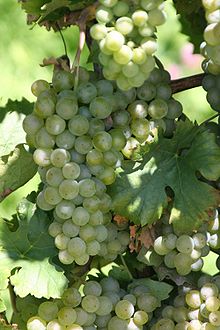
Müller-Thurgau Grapes. Source: Wikipedia
The Wine Quiz series is not meant to intimidate. The whole idea here is to have fun and learn something new. When answering the questions, it is fully encouraged to use all available sources of information, including Google or any other search engine. There are no embarrassing answers – the most embarrassing thing is not giving it a try…
Welcome to the weekend and your new wine quiz!
We are continuing our grape trivia series, and today’s subject is Müller-Thurgau.
Müller-Thurgau is a white grape which was created in 1882 by the Swiss botanist Hermann Müller, who lived in the area called Thurgau, hence the name of the grape. While Hermann Müller thought that he was crossing Riesling with Sylvaner to create Müller-Thurgau, DNA tests of very recent showed that instead of Sylvaner, the second parent was the grape called Madeleine Royale. Riesling, of course, needs no introduction, I would like to mention that Madeleine Royale is known to ripen extremely early, sometimes by the 22nd of July, the feast day of Mary Magdalene (according to Wikipedia), hence the name.
Müller-Thurgau was created to have the great qualities of Riesling, combined with the early ripening ability of ( then thought to be ) Sylvaner. The design worked quite successfully, and resulting grape became quite popular in Germany and many other countries – according to the 2010 data, it was still one of 15 most planted white grapes in the world. Müller-Thurgau is known for its pleasant flavor profile of peaches, apples and pears. The problem with the grape, however, is a low acidity, which generally leads to the flat, flabby wines. This is one of the reasons why Müller-Thurgau mostly used as a blending grapes and rarely becomes the star of its own. However, the grape has worldwide following among winemakers who swear by it and produce interesting wines worth drinking.
And now, to the quiz!
Q1: Which country is not known to produce Müller-Thurgau wines:
a. Australia
b. England
c. Hungary
d. South Africa
e. United States
Q2: True or False: In 2010, plantings of Riesling in Germany were double in size compare to those of Müller-Thurgau
Q3: Wine Spectator calls wines with 90-94 ratings “Outstanding: a wine of superior character and style”. True or False: There are Müller-Thurgau wines rated as Outstanding by Wine Spectator.
Q4: Which one doesn’t belong and why:
a. Kerner
b. Müller-Thurgau
c. Scheurebe
d. Sylvaner
Q5: True or False: There are no sparkling wines produced from Müller-Thurgau
Good luck, enjoy the quiz and your weekend! Cheers!
Sharing the Pleasure – Two Cabernets for the #CabernetDay
Yes, it is a #CabernetDay, and a post about Cabernet wines should be rather appropriate – but somehow, I was on the fence about it, until the AME opened up a little bit… When the wine give you lots of pleasure, why not talk about it? Well, this is how I felt anyway.
Cabernet Sauvignon and Cabernet Franc make some of the very best wines in the world, both when they fly solo, and when assisted by the other grapes. Myriad of love letters err tasting notes, blog posts and articles had been written to those grapes and wines, and hundreds millions of dollars traded hands for the pleasure of owning and drinking the Cabernet wines. Yes, we love our Cabernet wines (even Miles didn’t dare to poop on them). Thus I will not inundate you with another ten (or fifty) interesting facts, and instead will simply share the pleasure I had drinking the wines.
The greatness of the #GrapeDay is in the fact that it helps to select the bottle to be open. It also makes it appropriate to break a special bottle, and so I did.
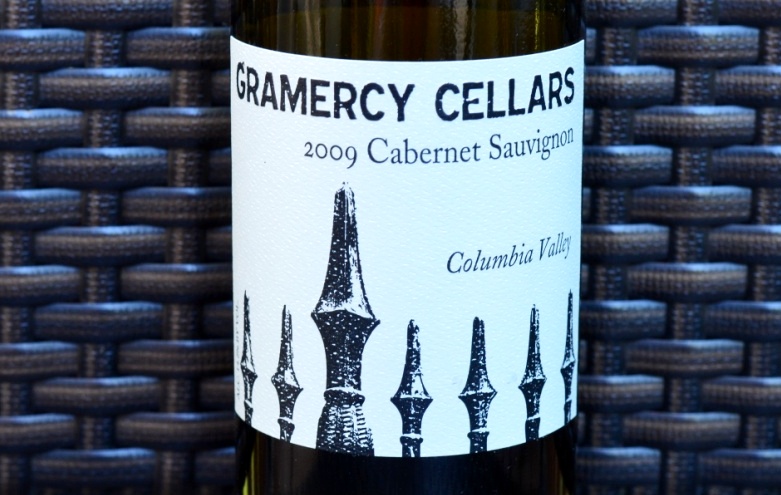
The first bottle opened was 2009 Gramercy Cellars Cabernet Sauvignon Columbia Valley. What makes it special? I had only one bottle, and read some rave reviews advocating giving this wine some time – thus I was waiting for the “special occasion” (thank you #CabernetDay).
I don’t know how this works, but when I think about the wines in the terms of how I would describe them, I get some random analogies at random times. This time my brain decided to go with the athletes analogy. To give you an idea of how this wine tasted, imagine a runner, may be a sprinter – perfectly built slender body, perfectly visible muscles, everything is tightly wound and ready to spring at any moment. A perfectly looking, but minimalist body. That was the impression of this wine – restrained cassis notes, espresso, earth, plums, clean acidity, firm and perfectly structured – a great package all around. (Drinkability:8)
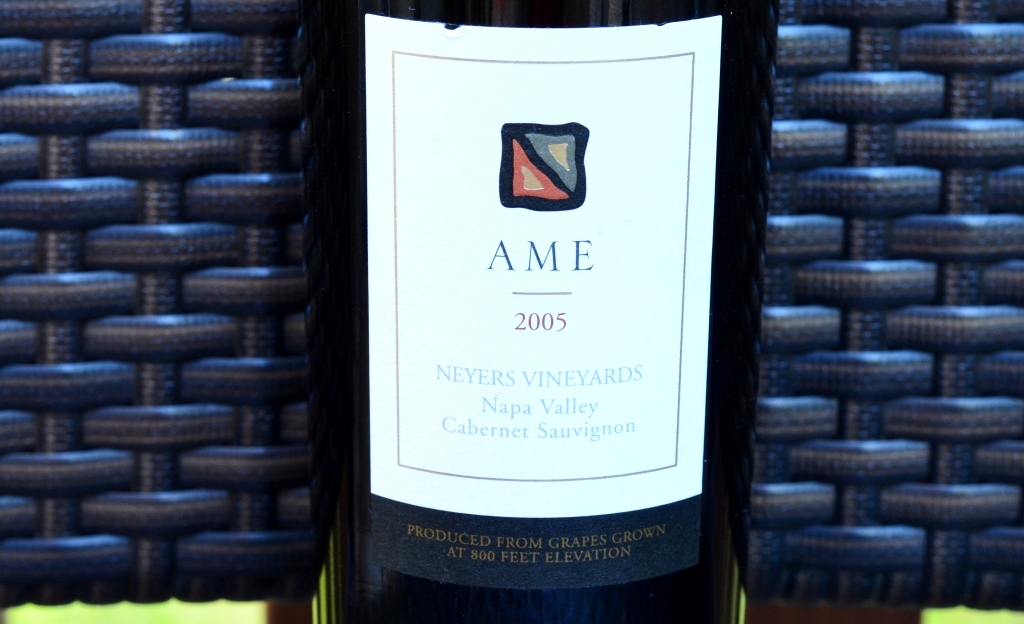
The second wine was 2005 Neyers Vineyards AME Cabernet Sauvignon Napa Valley. What makes it special? I love Neyers wines – their 2003 Cabernet was spectacular, for instance. And I had only two bottles of the AME (I rarely buy wines by the case, so having only two bottles is rather common). I would say that this wine was special even for the Neyers – the AME constitutes first initials of the names of their 3 children – Alexandra, Michael and Elizabeth.
Going to the sports analogy, imagine the same perfectly built athlete, but make all the muscles at least 3 times bigger – still perfect body, no fat, just muscles, but much bigger frame and much bigger muscles. We are not getting to the bodybuilder sizes, but this might be Stallone rather than Schwarzenegger – I hope you got my point.
Delicious open nose of dark fruit, cassis, loads of cassis, eucalyptus, earth. On the palate – so many things happening – cassis, plums, earth, pencil shavings, dark chocolate and espresso combined, clean acidity, perfect balance, firm structure and powerful tannins – a wow wine. (Drinkability:9).
There you have it, my friends – two great wines in honor of #CabernetDay. What is in your glass? Cheers!
Last Bottle Sign Up ($10 credit)




 Talk-A-Vino