Archive
Wednesday’s Meritage – Wine Quiz Answer, [Super] Wine List, and Blogs, Blogs, Blogs…
 Surely these Italian wines will get you talking!
It’s Meritage Time!
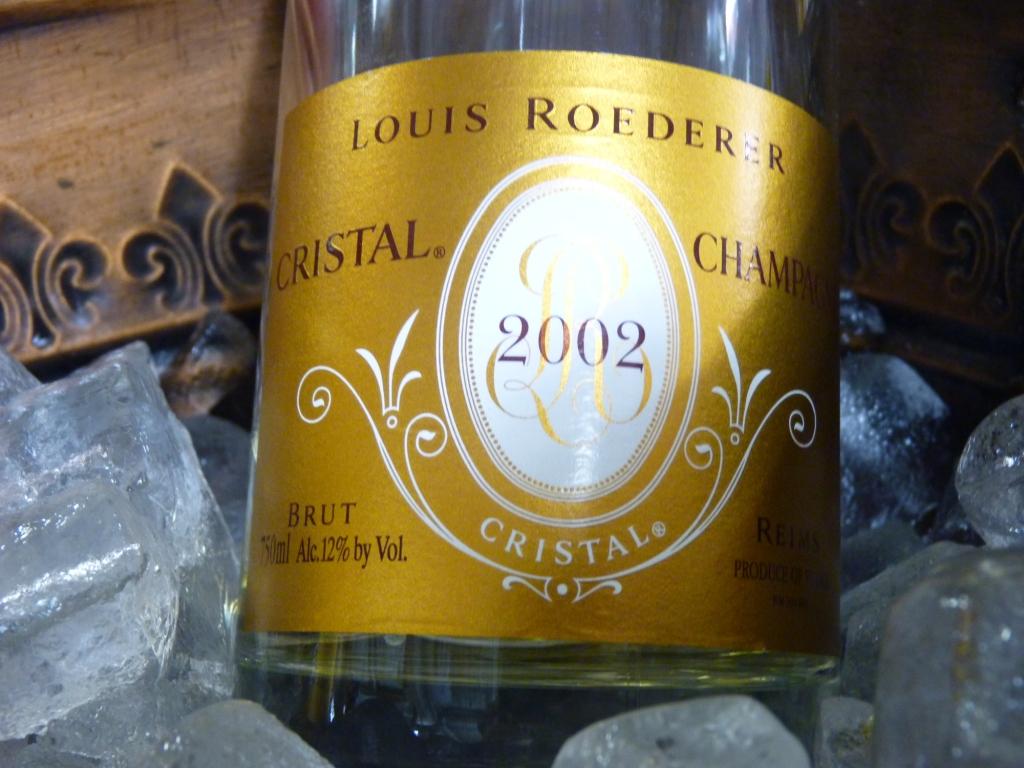 First things first – the answer for the Wine Quiz #24 – Bottles Big, Bottles Small. The list in the quiz actually included names of the wine bottles of the different sizes, only slightly mixed up between the different regions. While some of the bottle names are the same between Champagne and Bordeaux, some of the names are unique and are used only in one region, and not in both. The question was to find “one which doesn’t belong”. While Piccolo (187 ml, or one quarter of a bottle) and Methuselah (6L, equal to 8 bottles) are uniquely used in Champagne, it is Imperial ( also 6L, or 8 bottles) which is one and uniquely Bordeaux, thus the right answer for the wine quiz is “Imperial”. Whomever marked “Imperial” as the right answer, please pat yourself on the back – you got all the bragging rights for the right answer for the wine quiz #24. In case you are curious about all the bottles sizes and their names, here is a Wikipedia link for you.
Now let’s talk about interesting “news and such” I came across during the last few days.
There was (yes, unfortunately “was”, not “is”) a restaurant in Spain, called El Bulli – literally the best restaurant in the world, by the famous chef Ferran Adrià (also one of the best in the world). The restaurant closed last summer, and now, as I learned from Dr. Vino’s blog post, about 10,000 bottles from El Bulli’s wine cellar will be auctioned at Sotheby’s in the near future. Dr. Vino’s blog post lists also a link to the El Bulli’s wine list, but for some reason it didn’t seem to work for me. However – in case you want to see the wine list – here it is, 139 pages of goodness… Drooling is acceptable.
Wine Bloggers Conference, a.k.a. WBC2012, is opening in Portland, Oregon in two days. At that conference, winners of the Wine Blog Awards will be announced. It seems that the subject of the awards is heated up considerably with various bloggers expressing their last minute opinions. You can reserch the subject on your own, but here is the opinion of Joe Roberts (1WineDude) – I recommend checking out the blogs he is referring to – they look quite interesting.
Last, but not least, a few interesting posts from The Passionate Foodie blog. First, here is a advanced notice of the upcoming great food holiday – October is a National Cheese Month! Cheese is definitely one of my favorite (if not The Favorite) foods, and knowing that in October I will have an additional reason to eat it, makes me happy. Also, as The Passionate Foodie writes from Boston, he mentioned that The Cheese Shop of Concord will be celebrating its 45th anniversary on October 6th, by offering a number of cheeses at 1967 prices – if you are into cheese, you still have time to find a good reason to be in Concord, MA on that date (I don’t think I need a reason – I plan to be there).
Also in the same The Passionate Foodie blog, you can find a series of posts about Port, one of the [wrongly] under-appreciated but amazing wines – here are the links for Part 1, Part 2 and Part 3 for you – well worth your time, I think.
That’s all I have for today’s Meritage. Don’t forget – it is always [Wine] [Whisky] Wednesday – pour something good into your glass. Cheers!
Study of Grapes, 152 at a Time
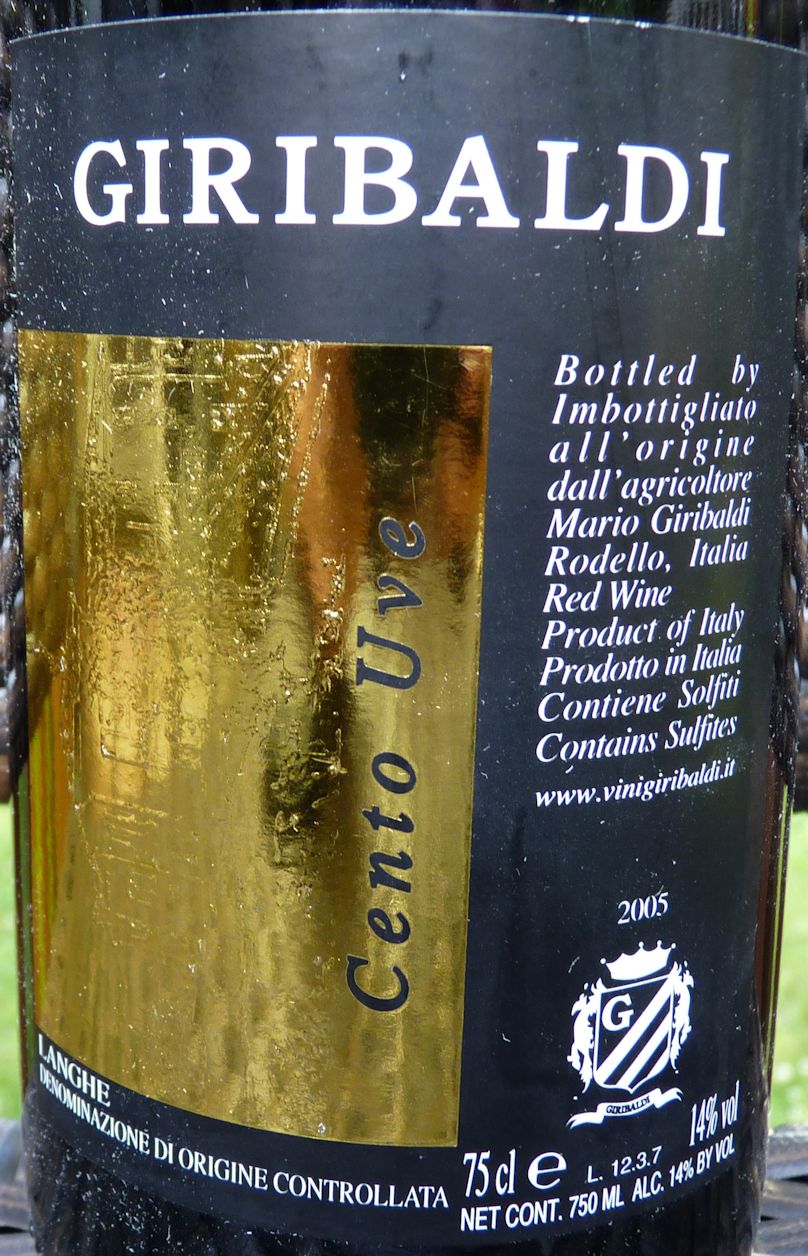 How do you experience 152 grape varieties, all at the same time? Easy. You get a bottle of Giribaldi Cento Uve wine and … voilà!
As you probably know, I’m an enthusiastic member of the Wine Century Club – a virtual club dedicated to the grape adventures. I already talked too many times about virtues of the Wine Century Club, thus I’m not going to bore you with those details again. Instead, let me focus on only one, dare I say it, sacred bottle of wine – 2005 Giribaldi Cento Uve Langhe DOC.
What makes this wine “sacred”? It is made out of 50% Nebbiolo and the other 50% containing additional 151 (!) varieties, so it can really help you to advance in the quest for higher levels of The Wine Century Club membership (except that it doesn’t count towards the first level of membership with 100 varieties). The wine is almost impossible to find in US – except one wine shop in Colorado which actually carries it (if you are interested, the wine is available from The Vineyard Wine Shop, 303-355-8324). When I called the store to order this wine, gentleman who answered the phone, Matt, said that he is quite convinced that they don’t have any wine under such name – after checking his computer, he was surprised more than me by actually finding it. At $60 + $20 for the shipping, this was definitely worth the experience.
Interestingly enough, finding this wine and drinking it was the easiest part – the tough (seriously tough) part was figuring out what grapes I already tasted and what grapes I can actually add to my list. As this is one of the coolest parts of Wine Century Club membership ( figuring out what is what in the grape world), let me explain it with appropriate level of details.
To begin with, the web site for this wine states that it contains 152 varieties. The list of grapes is nowhere to be found on the winemaker’s web site. The only place on internet where you can find the list is at the Indian Wine Academy. Well, list is a list, you say, right? Yes, but not precisely. As I need to properly account for all the grapes I already tasted, I need to go through that list very carefully, line by line. As soon as I started going through the list, I noticed duplications (same grapes listed twice, like Gamay, for instance) – I called it a red flag and decided that the right thing to do is to contact Giribaldi, the winemaker. After 2 or 3 of my e-mails went unanswered, I decided that it is a time to … get an audience support? No, call a friend! And as I happened to have a good friend in Italy, Corrado, I asked him to help me to get to the correct list. This was not easy, but after a few conversations with the winery, he was able to get full description of the wine, including the list of grapes.
Yay? Nope. The list of grapes was … identical to the one published on the site of the Indian Wine Academy! Fine. From here on, I had to figure it out myself. I converted the list to the Excel file, and sorted it alphabetically. Then I had to figure out how to get from 156 varieties listed to the 152 which we know this wine has. It later downed on me that 156 varieties include Nebbiolo and 4 Nebbiolo clones , therefore if we will take all 5 Nebbiolo varieties from consideration we will get to the target number of 151. Whew. Tired of me yet? No? Let’s continue.
Next step was to remove obvious duplicates, then go through the list again. For every grape I didn’t know, I used Internet resources to verify that such a grape exists (i.e., referenced at least once on one or more sites). Here is the good list of references in case you ever need to conduct a search on grape etymology (Italian grapes, if you will):
After all the cleanup, removing duplicates, fixing the spelling and checking the references, I got to the final list of 138 grapes (don’t ask me where the 14 went – let’s keep it a grape mystery), out of which I was unable to find any references for the grape called Michele Pagliari – therefore I’m keeping it on the list, but not counting towards the new grapes. In case you want to see a transition here is an excel file for you – note that is has multiple spreadsheets inside starting from full list. Here is the list of those final 138 grapes.
Legend: letter N next to the grape stands for Nero (red), B is for Bianche (white), Rs is for Rose. Showing in Bold are the grapes which I count as new grapes for my grape count.
| Aglianico N | Michele Pagliari N |
| Albarola N | Montepulciano N |
| Albarossa N | Moscato bianco B |
| Aleatico N. | Moscato giallo B |
| Alicante Bouschet N | Moscato nero di Acqui N |
| Ancellotta N. | Moscato Rosa Rs |
| Arneis B | Muller Thurgau B |
| Avanà N | Nascetta B |
| Avarengo N | Nebbiolo N. |
| Baco Nero N | Nebbiolo ( Bolla) N |
| Barbera bianca B. | Nebbiolo ( Rosè) N |
| Barbera N. | Nebbiolo (Lampia) N |
| Becuet N. | Nebbiolo (Michet)N |
| Bianchetta Tevigiano B | Negrette N |
| Bianchetta Veronese B | Neretta cuneese N. |
| Bombino Bianco B | Neretto di Bairo N |
| Bombino Nero N | Nero Buono N |
| Bonarda Piemontese N | Nero d’Ala N |
| Bosco Nero N | Nero d’Avola N |
| Brachetto N. | Neyret N |
| Bracciola N | Pampanuto N |
| Brunello N | Pecorino N |
| Bussanello B | Pelaverga (di Pagno) N |
| Cabernet Franc N | Pelaverga N |
| Cabernet Sauvignon N | Pelaverga piccolo N |
| Canaiolo B. | Petit Arvine N |
| Canina N | Petit Verdot N |
| Cannonau N | Pigato B |
| Carica l’Asino N | Pignola Nera N |
| Carignano N | Pinot bianco B |
| Catarratto comune B | Pinot Grigio G |
| Catarratto Nero N | Pinot Nero N |
| Chardonnay B. | Plassa N |
| Chatus N | Pollera 1 N |
| Ciliegiolo N. | Portugieser N |
| Colorino Nero N | Primitivo N |
| Cornalin | Prosecco B |
| Cornarea N | Quagliano N |
| Cortese B | Raboso Veronese N |
| Corvina Nera N | Rebo Nero N |
| Croatina N | Refosco da Peduncolo Rosso N |
| Crovassa N | Riesling B |
| Dolcetto N | Riesling italico B |
| Doux d’Henry N | Riesling Renano B |
| Durasa N | Rossese bianco B |
| Durasca (Dolcetto di Boca) N | Rossese N |
| Enantio N | Ruché N |
| Erbaluce B | Sangiovese N |
| Favorita B | Sauvignon Blanc B |
| Franconia N (Blaufränkisch) | Schiava Gentile N |
| Freisa di Chieri N | Schiava grossa N |
| Freisa di Nizza N | Schiava N |
| Gamay N. | Sylvaner Verde B |
| Gargiulo N | Syrah N |
| Grechetto N | Teroldego Nero N |
| Grignolino N | Timorasso B |
| Grillo B | Tocai Friulano B |
| Incrocio Manzoni N | Tocai Rosso N |
| Lambrusca di Alessandria N | Torbato B |
| Lambrusco Maestri N | Traminer aromatico Rs |
| Lumassina N | Trebbiano Toscano B |
| Maiolica N | Uva di Troia N |
| Malvasia di Casorzo N | Uva rara N |
| Malvasia di Schierano N | Uvalino N |
| Malvasia Istriana N | Veltlimer Fruhrot N |
| Malvasia nera lunga N | Verduzzo Trevigiano B |
| Manzoni bianco B | Vermentino B |
| Marzemino N | Vespolina N |
| Merlot N | Zweigelt N |
Wednesday’s Meritage
I can’t believe how fast these Wednesdays are coming – it was only one Wednesday, and now next one is already here…
Anyway, let’s start with the answer for the Wine Quiz #17, which was all about Penguins. I’m glad to see the diversity of opinions regarding that strange critter, known as Tactical Nuclear Penguin. Well, those of you who thought that this name implies a lot of strength were correct! And while the correct answer is … Beer (!), this beer packs a lot of punch, clocking in at 32% ABV. This beer is made by the company called BrewDog, and here is the description directly from the web site:
“This is the worlds strongest ever beer, ever (yes ever).
No Penguins were harmed in the making of this beer; some humans did get very, very cold though. It was worth it.
The Antarctic name, inducing schizophrenia, of this Ÿber-imperial stout originates from the amount of time it spent exposed to extreme cold. This beer was initially double barrel aged for 14 months; maturing in the deep, rich oak of Scottish whisky casks. After this epic maturation the beer was then frozen, then frozen again, then frozen again.”
Now, for the cool news portion: The Capital Grille once again announced The Generous Pour summer wine event. From June 9th until September 2nd, you can try a specially selected group of wines (9 wines total) for $25. The wines are specially selected by Master Sommelier George Miliotes and include Rose, White, Red and Dessert. The Capital Grille is my favorite steakhouse overall, and we had being enjoying this Generous Pour program for two years in a row (here is the link to the post from 2010). Whether you like steak or not, The Generous Pour program is a great value – take a look at the list of wines and judge for yourself. Don’t know about you, but I’m definitely going.
 And for the
 interesting crazy news, I recently came across of a new product, underwear for wine bottles (I’m not kidding, and today is not April 1st) – this product is called Vinderpants – you can read more at this web site, where it is also sold for $9 a piece! That site also contains a video advertizement for Vinderpants (warning: watching that video might be hazardous to your mental health and it might convert you from the wine lover to the wine hater – there, consider yourself warned). I’m really wondering if any of my readers would be willing to spend $9 on this wonder of wine marketing (this is equal to three or four bottles of two buck chuck, depending on which coast you are going to buy it, people), so I’m looking forward to your comments.
That’s all I have for you for today, folks. Cheers!
Wednesday’s Meritage (and the Answer for the Wine Quiz #16)
 Not sure if it will become a permanent feature on this blog, but I want to continue my short “wine news flash” posts on Wednesdays, and even came up with a fancy name for these posts, as you can judge from the title.
First, an answer for the Wine Quiz #16, Father of California Wine: those of you who chose Junípero Serra were … absolutely correct! Under direction of Father Junipero Serra, Franciscan missionaries planted first sustained vineyard at Mission San Juan Capistrano in 1779, and subsequently, vineyards had been planted at another 8 missions. Those plantings had being known as Mission grapes, which dominated California wine industry for about 100 years.
Today is a special Wednesday, which happens once a month in wine bloggosphere – it is so called Wine Blogging Wednesday. To be more precise, today is Wine Blogging Wednesday 78, or as it is abbreviated on Twitter, #WBW78. For 78 month in a row (if I’m not mistaken), special wine theme is selected for a third Wednesday of the month, and everybody are invited to participate and share the experiences. The theme for #WBW78 is called “Get yo Viggy On” (not that I personally like the way it is phrased), and it is dedicated to Viognier, a very interesting white grape originated in Northern Rhone in France. Viognier wines should be widely available – hope it is not too late for you to get a bottle and join the festivities. I plan to report on my experience later on tonight or tomorrow.
For the rest of the interesting wine news, I decided to share only one note, which I came across yesterday, reading Tom Wark’s Fermentation wine blog (if you are not reading his blog – you are missing a lot). I know that some of my readers come from Canada, and I learned from this post that Canada is about to allow direct shipments of wine across provinces. As I believe US wine laws are arcane, I had no idea that Canada wine laws were even worse! I’m glad that this problem is about to be solved for Canadian wine lovers.
That’s all I have for you for now, folks. Cheers!
Weekly Wine Quiz #16: Father of California Wine
Arguably or not, but today California is the most important and best known wine making region in the United States. Starting from the 17th century, many people were obsessed with making wines in California and greatly helped to make it what it is today.
From those many people, however, there was one who is considered to be the Father of California wine industry. As we will celebrate Father’s Day tomorrow, I think it will be very appropriate to acknowledge that person who we have to thank for starting something which became a source of some of the best wines in the world. I would even say that we all have to raise a glass in his honor – but do you know who you have to honor as The Father of California Wine Industry?
As a bonus question, try to name the grape which he was planting. Enjoy your weekend! Cheers!
A Little Bit Of Everything (And Answer For The Wine Quiz #15)
 Somehow I felt like writing a post similar to Dr. Vino’s “sipped and spit” series – but I think his style is inimitable, so I will not even try. However, I will do my best to present random pieces of “wine information” within one short post.
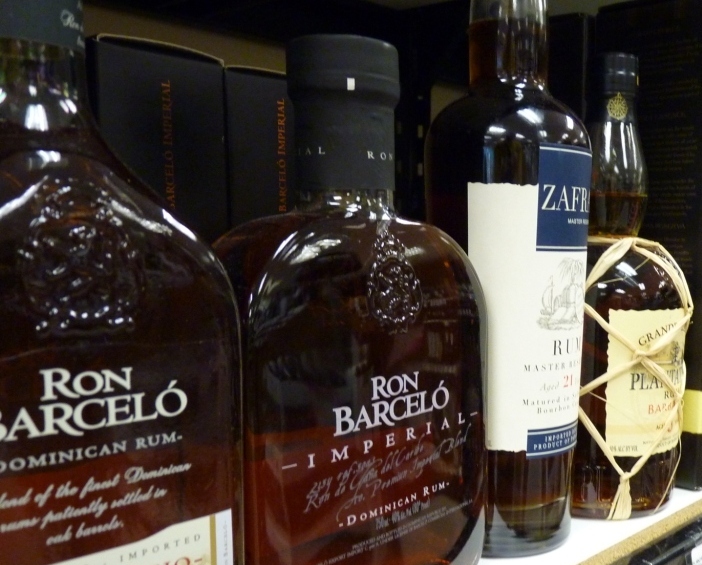
First, an answer for the Weekly Wine Quiz #15: Those of you who chose Rum as their answer are… correct! Rum has a very special place in history, being pirates’ drink of choice, and until recently, a part of Royal Navy’s daily ration. And yes, it was one of the key elements in “slavery triangle”. For more information, you can take a look at the post I wrote for The Art of Life Magazine.
Have you heard of Rudy Kurniawan? In the wine world, and I’m talking about world of serious multimillion dollar auctions and bottles sold for tens of thousands of dollars, he stands akin Bernie Madoff, making and selling counterfeit wines to friends and strangers for at least 5 years or may be even longer. One of the most fascinating stories of the wine crimes was recently covered in great detail in this Vanity Fair article. It is quite long, but if you are into wines, you should read it – definitely until the end, as you don’t want to miss a punchline. I also want to thank Dr. Vino for great coverage of this story in his own blog post.
Looking for some answers for Champagne-related wine quiz at The Drunken Cyclist blog, I came across very interesting Sparkling wine trivia on Gloria Ferrer website. Before you read it in its entirety, try to answer a simple question – how many bottles a day does a riddler turn? You will find the answer at that Trivia link.
Cheers!
Ten Wine Blogs I’m Reading
 In the world of wine, reading is second most important thing next to actually drinking the wines. Yes, of course, you can say that no, visiting vineyards and talking to the winemakers is a lot more important – and I would agree with you, however, it is reading that you can do at any time and a lot more often than actually visiting the wineries – at least for someone like me, where wine is a passion but not a profession.
When it comes to reading, books and magazines and indispensable – and there are hundreds and hundreds of them to read, starting from encyclopedias such as The World Atlas Of Wine by Hugh Johnson and Jancis Robinson, great day-to-day books such as Kevin Zraly’s Complete Wine Course to the Wine Spectator magazine which reviews thousands of wines in every issue.
Then there are wine blogs, like the one you are reading right now. Wine blogs deliver information in much timelier fashion than any books or magazines, and they also express a lot more of the author’s personality in a much more direct way than any book or magazine article – which makes them a great fun to read. I like reading blogs when I get a chance, and generally I come across many different blogs as lots of them are referring to each other (very common practice in blogging world). However, while my blog reading is often sporadic, simply based on available time, there are some blogs which I’m making an effort to at least skim through on the regular basis (using Google Reader) – and this is the list which I would like to share with you. The list below has no prioritization whatsoever, and I add few of my thoughts as to what kind of content you can find in the respective blog.
- 1WineDude – IT-convert Joe Roberts provides great insight into the world of wines. Lots of wines are reviewed using the A to F ratings ( no, I didn’t see a single F yet) as opposed to the popular 100 points scale.
- Fermentation – very interesting blog, covering a lot from the world of law, consumer rights, politics and more – of course all centered around wine.
- Serious About Wine – wants to see lots of new cool label designs? Flip through this blog’s pages, its worth it.
- The Feiring Line – Alice Feiring is a book writer and a blogger with “unique and different” point of view. Love her wine descriptions written directly on the bottle’s label.
- Dr. Vino – one of the best wine blogs overall, lots of interesting information tidbits from the wine world.
- The Wine Economist – Great source of information about wine, lots of stats of all kinds – merlot versus pinot noir consumption in the numbers, most requested wine of the past year and so on.
- The Gray Report – W. Blake Gray writes one of the most insightful and controversial wine blogs – I always love reading his posts. You should judge for yourself, though.
- Vinography – Superblog of wine blogs – lots of information plus a comprehensive list of wine blogs on the Internet
- Steve Heimoff Wine Blog – exactly as it says, a wine blog by Steve Heimoff, a wine writer and Wine Enthusiast magazine’s West Coast Editor. Lots of interesting information, especially as it comes to California wines.
- Paul Gregutt Unfined&Unfiltered – Paul Gregutt is a wine writer and a Northwest Editor for Wine Enthusiast magazine. He writes about wines of Pacific Northwest.
That’s all, folks for my list of ten blogs I’m reading – if you like wine, check them out for yourself. Cheers!
Wines of Georgia: You Have To Experience It To Believe It
 The subject of Georgian wines is not new on this blog – I wrote about Georgian wines on a number of occasions, and those were good occasions, or maybe rather even good surprises (you can find the posts here and here). But after I was lucky enough to attend a Georgian Wine tasting in New York City, I don’t want to talk about Georgian wines in terms of “good surprises” anymore – I think Georgian wines are ready to take a permanent high place in the wine’s “who is who” world.
There were about 60-70 wines presented in the tasting. I didn’t have a chance to taste each and every one of them, but among those I tried, there were no bad wines. There were some which were regular, there were some which were good, there were some which were great, and there were a few which were amazing. I think this is a pretty good lineup for the wines which I would collectively avoid only about a year ago, as those were mediocre at best. There is a definite trend up in the quality of Georgian wines, and I believe a lot of them are ready to meet the discerning palates of wine lovers around the world.
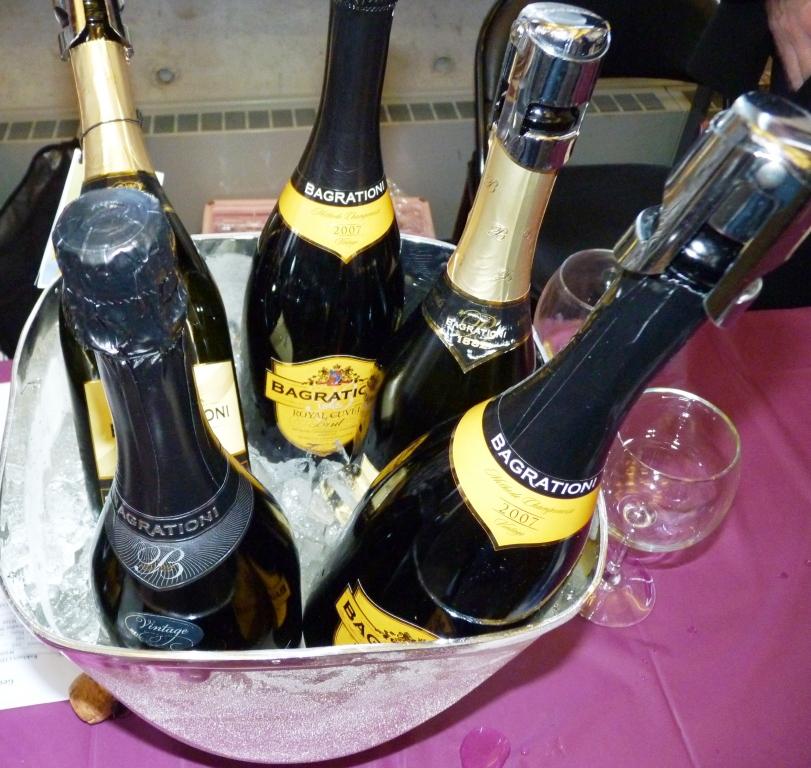
Let me share some of the notes and thoughts, supported by practical examples, of course. I already wrote before about Georgian sparkling wine called Bagrationi. It is produced for more than a hundred years, using traditional Méthode Champenoise. This time I had an opportunity to try four different wines, and they all were very good, but 2007 Bagrationi Royal Cuvee was a standout for me. Medium body, very balanced acidity, very round overall.
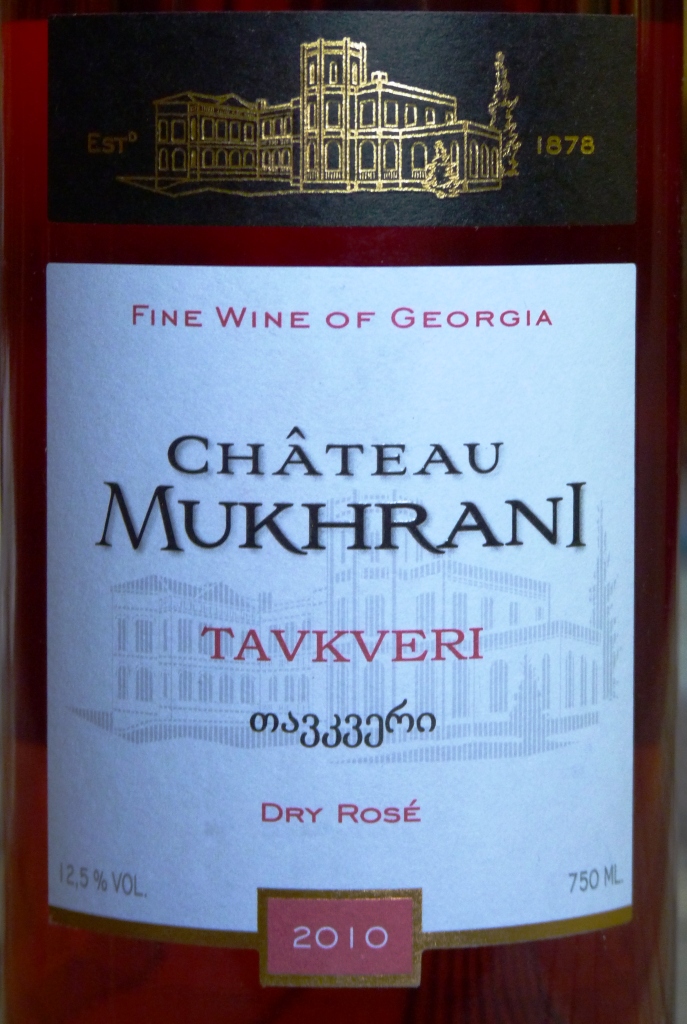 My next personal favorite was the 2010 Chateau Mukhrani Tavkveri Rose. This was one of the number of excellent wines presented by Chateau Mukhrani, and it played to my particular weakness to the Rose wines, especially during summertime. This wine is made out of the indigenous Georgian grape, Tavkveri, one of many other grapes which don’t grow anywhere else (based on information from Wikipedia, there are about 400 varieties growing in Georgia, with less than 40 used for commercial winemaking).
It is not easy to produce a rose wine with a character. Lots of available rose wines from all the different regions are virtually indistinguishable – a little bit of strawberry, and a little bit of acidity, nothing memorable. The Chateau Mukhrani Rose was totally different – lots of concentrated berry flavors, cranberries and sour cherries, all supported by very balanced acidity and a long finish – truly a great Rose.
Another wine from Chateau Mukhrani I have to mention was the 2009 Chateau Mukhrani Shavkapito. Another indigenous grape, Shavkapito, and yet another great tasting wine – good dark fruit expression, very round and layered with smooth and approachable tannins.
The next group of wines I have to mention are the wines made by Pheasant’s Tears and Alaverdi Monastery. What puts these wines aside even in such a distinguished crowd is a very unique method of making wines. Both wineries make wine using qvevri, a clay vessel lined with beeswax, which is used for fermenting and aging the wine. There were a number of wines presented, both red and white, all made using qvevri. The white wines were especially unique, as they sported a deep yellow color, which is typical for really old white wines, but not for white wines which are one or two years old. Most of those white wines also showed quite extensive tannins – without being aged in the oak. All of those characteristics ( deep yellow color, tannins) are coming from prolonged fermentation and aging process which takes place in the qvevri, where grapes are crushed and juice stays in contact with the skins and seeds for a period of up to 6 months. 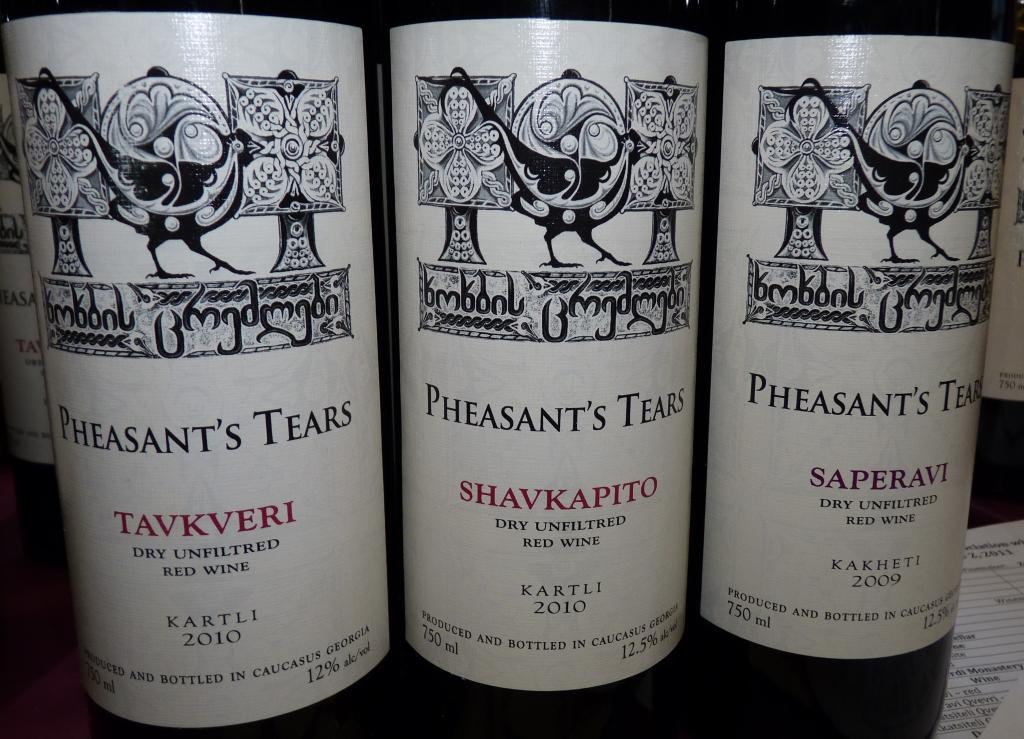 In addition to unique color and tannins, some of the white wines also exhibited Madeira style saltiness, coupled with enough sweetness and acidity to make the overall experience very pleasant. These are really unique wines, and you should try to find them – if you can.
Last but not least are the wines which were my absolute favorite in this tasting – Mukuzani and Saperavi red wines produced by Maisuradze wines.
 Both 2005 Maisuradze Wines Saperavi and 2005 Maisuradze Wines Mukuzani are produced from the Saperavi grape – one of the most popular grapes used in the production of red wines in Georgia. The difference between the wines is that Mukuzani contains only Saperavi grapes actually grown at Mukuzani vineyards. Another difference is the aging time in oak – Mukuzani spent 24 months in oak versus 12 months for Saperavi. Both wines are showing tremendous power and structure, and while Saperavi is more approachable, Mukuzani still needs time in the cellar – it will truly shine after another 10 years (at least) in the cellar. Both wines are excellent and definitely worth seeking.
The bottom line is simple – Georgian wines are ready for the prime time. They need a bit of marketing and a bit of luck, and then we will all have more wines to enjoy. But for now – takes this post to your local wine store, and ask them to get these wines for you – and then let me know what you think.
Last Bottle Sign Up ($10 credit)




 Talk-A-Vino