Archive
Wednesday Meritage #151
Meritage time!
Why don’t we start with the Top 100 wines list – James Suckling Top 100 Wines of 2020. Having created my own top dozen wine lists, I have a lot of appreciation for all the hard work deciding on the best 100 wines from tens of thousands of potential candidates. But I have to say that this 2020 Top 100 list is full of surprises. I will let you do your own analysis, but here are my observations. The top wine of the year is a Pinot Noir from Patagonia in Argentina. The first time you find Californian wine on the list is in position #31. France – #56! Lots and lots of German, Italian and Australian wines in the top third of the list. Really unique and different. I plan to do a bit more analysis once Wine Spectator releases its own Top 100 list on December 14th.
If you are an obsessed wine lover living in the USA, I’m sure you are perfectly familiar with Last Bottle Wines, a great online source of amazing wines sold at value prices. What I recently learned, courtesy of the search engine, that Last Bottle also has an excellent wine education section, called Last Bottle Sediments. You can learn about Burgundy, Riesling, or many other popular wines – all in a concise, well-written manner. There is never enough good wine information, so check this out.
I’m sure you heard already about China imposing tariffs on Australian wines, some in excess of 212% – this is definitely terrible news for the Australian wine industry, and for the worldwide wine market. In case you are trying to understand what is going on there, here is a very good article from the Wine-Searcher, offering an in-depth exploration of the conundrum.
Okay, now – who likes corked wines? Yep, I don’t know too many (any?) wine lovers who do. You know how it goes – you fetch the bottle from the cellar for dinner with special friends. You pull the cork, you pour a little taste, and the first whiff of air from the glass makes you cringe – you smell wet basement. Your well-thought entertainment ideas and joy of sharing a special bottle are all trashed – the wine can go only directly into the drain. Or not? According to the research conducted by French scientists, a plastic wrap of specific qualities can actually remove the cork taint from the wine. Before you sigh with relief, read the article – the experiments were conducted on the wine barrels, using very specific cling wrap – but who knows, maybe your kitchen staple can have a brand new use now…
Last but not least – the grape holiday is coming! This coming Friday, December 4th, we will be celebrating one of the tastiest grapes in the world – Cabernet Franc. Cabernet Franc is one of the main grapes in Bordeaux and California, but Cabernet Franc really has no country borders in its appeal, as there is hardly a wine-producing region, never mind the country, which doesn’t produce a delicious Cabernet Franc wine – Argentina, Australia, Chile, California, Washington, Oregon, New York, Canada, France, Italy, Israel, South Africa – we can go on and on. A few years ago, Lori Budd, who makes delicious renditions of Cabernet Franc in California under the Dracaena Wines labels, founded the Cabernet Franc Day to celebrate the noble grape. Don’t stay aside, join the festivities – get the bottle of your favorite Cabernet Franc, and share your happy moments with everybody.
To finish, a couple of interesting stories from the Wine Spectator. First, here you can read about a special around the world voyage of two barrels of Sherry on board the Spanish ship, to commemorate the 500th anniversary of Ferdinand Magellan’s circumnavigation. This journey should take 12 months and 44,000 miles. Upon return, the Sherry, produced by Gonzales Byass, will be bottled and commercially sold in some quantities, and it is expected to improve due to maritime influences. And here you can read about a special Port release by Taylor Fladgate, to commemorate the release of the 3rd movie in the Kingsman franchise. Special edition Kingsman Port spent about 90 years in the oak barrels, appropriately priced at $3,800, and packaged in a crystal decanter. I’m definitely looking forward to watching the movie when it comes out in February 2021, but as for the Port – Christmas is around the corner, so can I hope for a present from a kind soul?
That’s all I have for you today. The glass is empty, but the refill is on the way. Cheers!
Wine Quiz #129 – Beaujolais Nouveau Edition
 The Wine Quiz series is not meant to intimidate. The whole idea here is to have fun and learn something new. When answering the questions, it is fully encouraged to use all available sources of information, including Google or any other search engine. There are no embarrassing answers – the most embarrassing thing is not giving it a try…
Welcome to your new wine quiz!
Let’s start with the answers to the last quiz #128. In that quiz, you had three sets of items, and for each set, you had to figure out what that set was representing, and which item (or items) didn’t belong. Here are the questions, now with the answers:
Question 1:
Adelaide Hills
Blackwood Valley
Currency Creek
Eden Valley
Hunter
King Valley
Waitaki Valley
Answer: This is a list of Australian wine regions. The item which doesn’t belong is the last one, Waitaki Valley, as this region is located in neighboring New Zealand.
Question 2:
Anjou
Chinon
Jasnières
Orléans
Reuilly
Rully
Saumur
Answer: Most of the items on this list are the wine regions in Loire Valley, except Rully, which is located in Burgundy.
Question 3:
Cayuse
Clos Erasmus
No Girls
Penfolds
Pingus
Vega Sicilia
Answer: This was probably the most difficult one. This is the list of famous producers, which all make wines out of Tempranillo grapes, except Clos Erasmus, a famed Spanish producer in Priorat, which doesn’t make wines out of the Tempranillo.
We didn’t have a lot of players, except Lynn who answered the second question correctly and definitely deserves an honorable mention.
Last Thursday, November 19th, was the third Thursday in November, and thus it was the day to celebrate a brand new Beaujolais Nouveau 2020 release. In honor of that celebration, I have a very simple quiz for you, all about the simple wine, Beaujolais Nouveau:
Question 1: True or False: Beaujolais Nouveau wines can age
Question 2: The ideal serving temperature for Beaujolais Nouveau is
- 46°F to 50°F (8°C to 10°C)
- 50°F to 54°F (10°C to 12°C)
- 54°F to 57°F (12°C to 14°C)
- 57°F to 61°F (14°C to 16°C)
Question 3: True or False: During the first half of the 20th century, Beaujolais Nouveau was released and celebrated in December instead of November.
Question 4: True or False: Nouveau wines (the wines of new harvest) are produced only in the Beaujolais region in France, and not anywhere else in the world.
Good luck, enjoy the quiz and the rest of your weekend! Cheers!
Wine Quiz #128 – Which One Doesn’t Belong
The Wine Quiz series is not meant to intimidate. The whole idea here is to have fun and learn something new. When answering the questions, it is fully encouraged to use all available sources of information, including Google or any other search engine. There are no embarrassing answers – the most embarrassing thing is not giving it a try…
Welcome to the weekend and your new wine quiz!
Our last quiz was about pairings. Pairing is a very important concept around wine, so you were presented with a few of the lists of paired objects, and you had to identify proper pairings. Here are questions, now with the answers:
Question 1: Here is the list of countries and wines which are famous and unique, often made for thousands of years in their respective countries. Can you pair these countries with their wines?
| 1. France | A. Egri Bikaver |
| 2. Georgia | B. Kindzmarauli |
| 3. Greece | C. Malaga |
| 4. Hungary | D. Retsina |
| 5. Italy | E. Vin Jaune |
| 6. Spain | F. Vin Santo |
Answer: France – Vin Jaune, Georgia – Kindzamarauli, Greece – Retsina, Hungary – Egri Bikaver, Italy – Vin Santo, Spain – Malaga.
Question 2: Celebrity wines had been all the rage lately, with more and more celebrities getting into the ownership of the vineyards, wineries, and wine labels. Here is a short list of wines and celebrities behind them – can you create the right pairings here?
| 1. Brad Pitt | A. Avaline |
| 2. Cameron Diaz | B. Armand de Brignac |
| 3. Jay-Z | C. Hampton Water |
| 4. Jon Bon Jovi | D. Maison No 9 |
| 5. Post Malone | E. Studio Rosé |
Answer: Brad Pitt – Studio Rosé, Caneron Diaz – Avaline, Jay-Z – Armand de Brignac, Jon Bon Jovi – Hampton Water, Post Malone – Maison No 9.
Question 3: Many wines today represent blends, a combination of different grapes in different proportions. Some of those mixes and proportions are strictly regulated by the appellation laws – for example, Brunello di Montalcino can only be made from 100% Sangiovese Grosso. Some of the rules are rather well-established practices, such as the use of Petite Verdot in the Bordeaux blends, for color and power. Below is the list of main and supporting grapes – you need to pair them properly and also name the wine or an appellation where such grapes are combined together – again, either by the appellation rules or by common practices.
| Main grape | Secondary grape |
| 1. Montepulciano | A. Grenache |
| 2. Sangiovese | B. Sagrantino |
| 3. Syrah | C. Sangiovese |
| 4. Tempranillo | D. Petitte Sirah |
| 5. Zinfandel | E. Viognier |
Answer: Montepulciano – Sangiovese (Rosso Conero wines in Marche, Italy), Sangiovese – Sagrantino (Montefalco Rosso wines in Umbria), Syrah – Viognier (Côte-Rôtie, France), Tempranillo – Grenache (Rioja, Spain), Zinfandel – Petite Sirah (Turley, Carlisle, and other Zinfandel producers often do that).
Sadly, nobody attempted to answer this quiz, so once again I have to keep all the lavish prizes to myself.
Today we are going to play game of “which one doesn’t belong”. Below are lists of names – for each question, you need to figure out what is common between those names, and then find one item which shouldn’t be on that list. Here we go:
Question 1:
Adelaide Hills
Blackwood Valley
Currency Creek
Eden Valley
Hunter
King Valley
Waitaki Valley
Question 2:
Anjou
Chinon
Jasnières
Orléans
Reuilly
Rully
Saumur
Question 3:
Cayuse
Clos Erasmus
No Girls
Penfolds
Pingus
Vega Sicilia
Good luck, enjoy the quiz and your weekend! Cheers!
Wednesday’s Meritage #150
Meritage Time!
In the last issue of Meritage (#149) we talked about Italian police uncovering the crime ring focused on the production of the fake Sassicaia. While essential in its own right, this should be designated as a child’s play comparing with what’s coming. This week the wine press was overflowing with the news that the most famous wine fraudster of modern time, Rudy Kurniawan, is about to be released from jail. This article on wine-searcher is full of predictions for Kurniwan spreading his wings after deportation and doing again what he does best – making fake wine. I guess we will see, but the lovers of the first-growth and DRC should probably take notice.
Tre Bicchieri Gambero Rosso tasting in New York is one of my favorite wine events to attend – this year, it was the last grand wine tasting I managed to attend before covid took the world under its blanket. I don’t think we will have an opportunity to taste the Tre Bicchieri 2021 winners next year, but at least we can read about them in the Tre Bicchieri magazine. I can give you a few of the interesting stats – for example, 46,000 wines were tasted, 467 wines were awarded Tre Bicchieri, and 1,800 wines received Due Bicchieri Rossi award. You can also read about 12 special awards such as Bubbles Of The Year which went to 2011 OP Pinot Nero Dosaggio Zero Farfalla Cave Privée Ballabio, or Meditation Wine Of The Year which went to 1976 Vernaccia Di Oristano Antico Gregori – Contini. Don’t know about you, but I would loooooove to taste Meditation wine of the year…
When it comes to wine, is 20 years a long period of time or not? Of course, it depends. In today’s world, everything is changing fast, and while particular wine in the bottle might only barely start its aging after 20 years, the same 20 years bring a lot of change to the world of wine and wine culture at large. This article by Richard Hemming MW published at JancisRobinson.com looks into some of the changes in wine production, wine consumption, and more.
You know what time of the year this is, right? Yes, the holidays are coming! While the holidays are great, they also bring with them uneasy questions – presents. Presents are difficult and finding some suggestions always helps. If you have a wine lover in your life (and you probably do if you are reading this), here is one list I can recommend to flip through – you might find some good ideas there.
Last but not least – another grape holiday is almost upon us. On Monday, November 9th, we will be celebrating Tempranillo! Tempranillo is one of my absolute favorites, whether in its Rioja, Ribera del Duero, or Toro rendition – but Tempranillo today is one of the most planted and most popular grapes in the world, so you can look for it well beyond Spain. California, Washington, Oregon, Texas, Australia all produce delicious Tempranillo wines. Get your favorite bottle ready and make sure to share your Tempranillo experiences with the world on November 9th.
That’s all I have for you today. The glass is empty, but the refill is on the way. Cheers!
Jerez – A Tasty Treat and Halloween Candy Solution
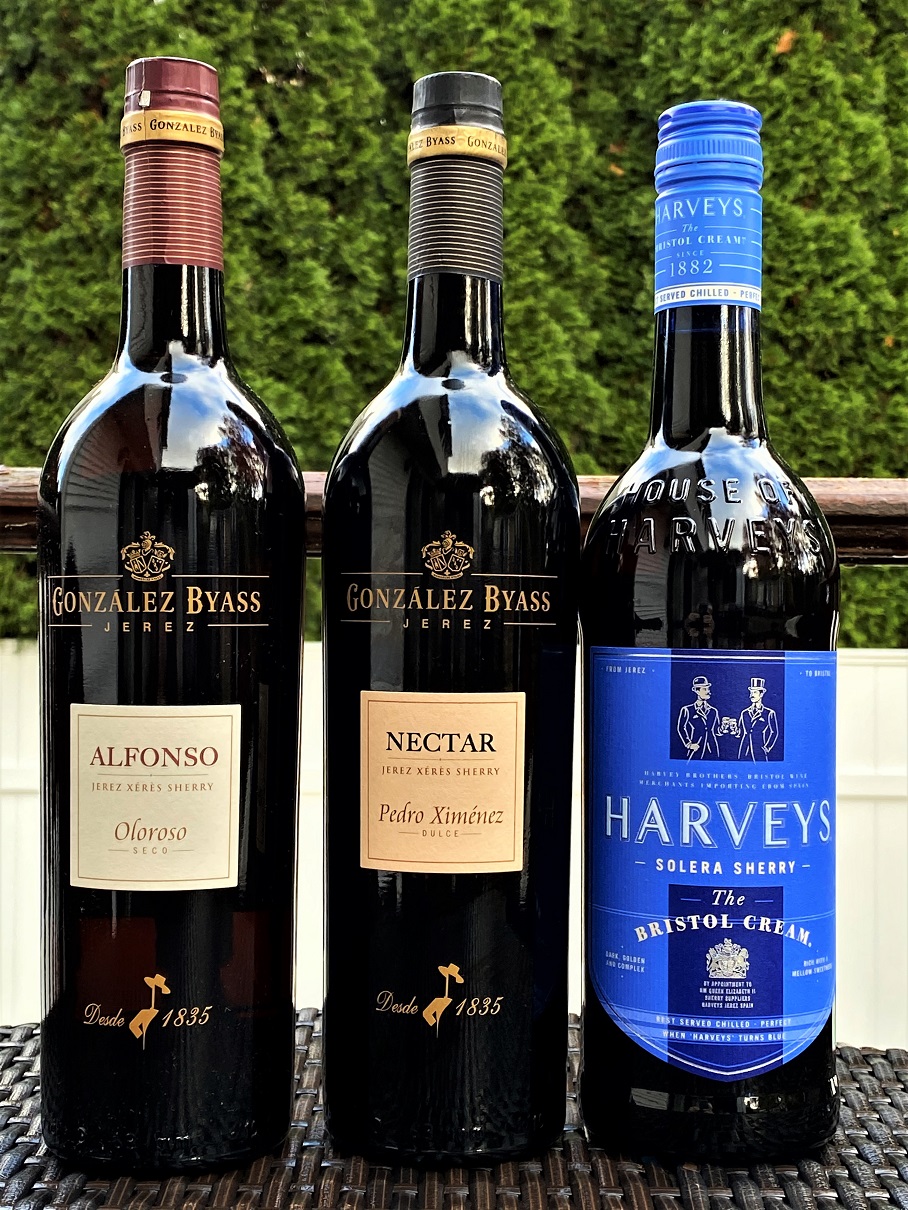 Yes, I know. Halloween is history now, so why am I even mentioning it?
Because I know that those Halloween candies are still lurking around, and will be for a while. And Halloween candy is not something which would make you crave the wine. But it doesn’t have to be that way. There are wines out there which will help you get rid of the candies – with pleasure. What am I suggesting? Let’s talk about Sherry, also known as Jerez.
Jerez wines (officially known as Jerez-Xérès-Sherry) take its name from the town Jerez de la Frontera in Andalusia, Spain, with the grapes coming from the vineyards surrounding the town. Jerez is one of the oldest winemaking regions in Europe, tracing its roots to more than 3,000 years back. Sherry is a fortified wine, and it came to being around the 8th century when the distillation process was invented. As a fortified wine Sherry can be compared to Port, however, the major difference is that Port is typically fortified in the middle of the fermentation process, to preserve the sugars in the wine, where Sherry wines are typically fully fermented, and then fortified, so with the exception of the particular style of Pedro Ximénez, most of the Sherries are dry wines.
There are many styles of Sherry wines, offering various levels of dryness, complexity, and oxidative qualities. Sherry wines are often also produced using the solera method, where the wines of the different vintages or constantly combined and resulting wines might represent a blend of hundred of vintages. The world of Sherry is quite complex, so if you want to read about all the different styles, this Wikipedia article contains a lot of good information.
González Byass started in 1835 in Jerez de la Frontera, in the heart of the Sherry country. Now in the 5th and 6th generation, González Byass is one of the major sherry producers, combining a number of Sherry brands under one umbrella. I had three sherries from González Byass to play with the candies – let me tell you how did it go.

First, the dry wine – Gonzalez Byass Alfonso Jerez Oloroso Seco. As it is a dry wine, it expectedly didn’t work too well with most of the candies, but I found some options:
Gonzalez Byass Alfonso Jerez Oloroso Seco (18% ABV, $25, Palomino 100%, aged for 8 years in solera)
Light amber color
Hazelnuts, sapidity, herbs
Hazelnuts, clean acidity, Rosemary, beautifully complex
Worked best with Payday because of explicit saltiness – not really with Reese’s or KitKat

The bottle on the right is directly from the wine fridge and it is ready to drink – the Harveys letters are blue
I recently wrote about Harveys – after years of personal neglect, this became a gateway wine for me to warm up again to the world of Jerez. As Harveys is quite sweet but not super-sweet, it provided the best pairing option for the majority of candies.
Harveys The Bristol Cream (17.5% ABV, $20, 80% Palomino, 20% Pedro Ximénez, a blend of 7 yo Fino, Oloroso, PX and Amontillado Soleras)
Dark amber color
Light herbaceous nose, a touch of dried fruit
Dried fruit on the palate, good acidity, refreshing
Nice with Reese’s, works well with KitKat, excellent with Payday
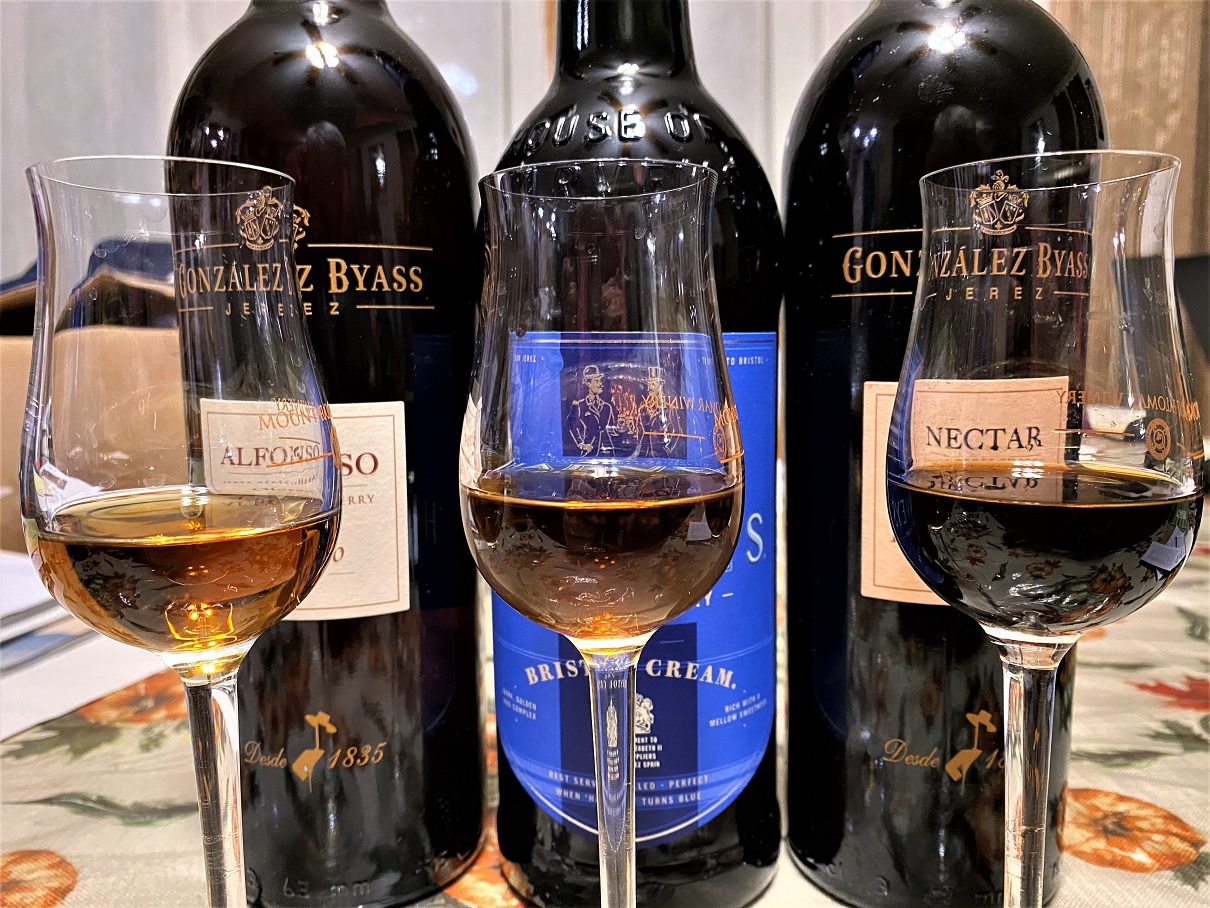
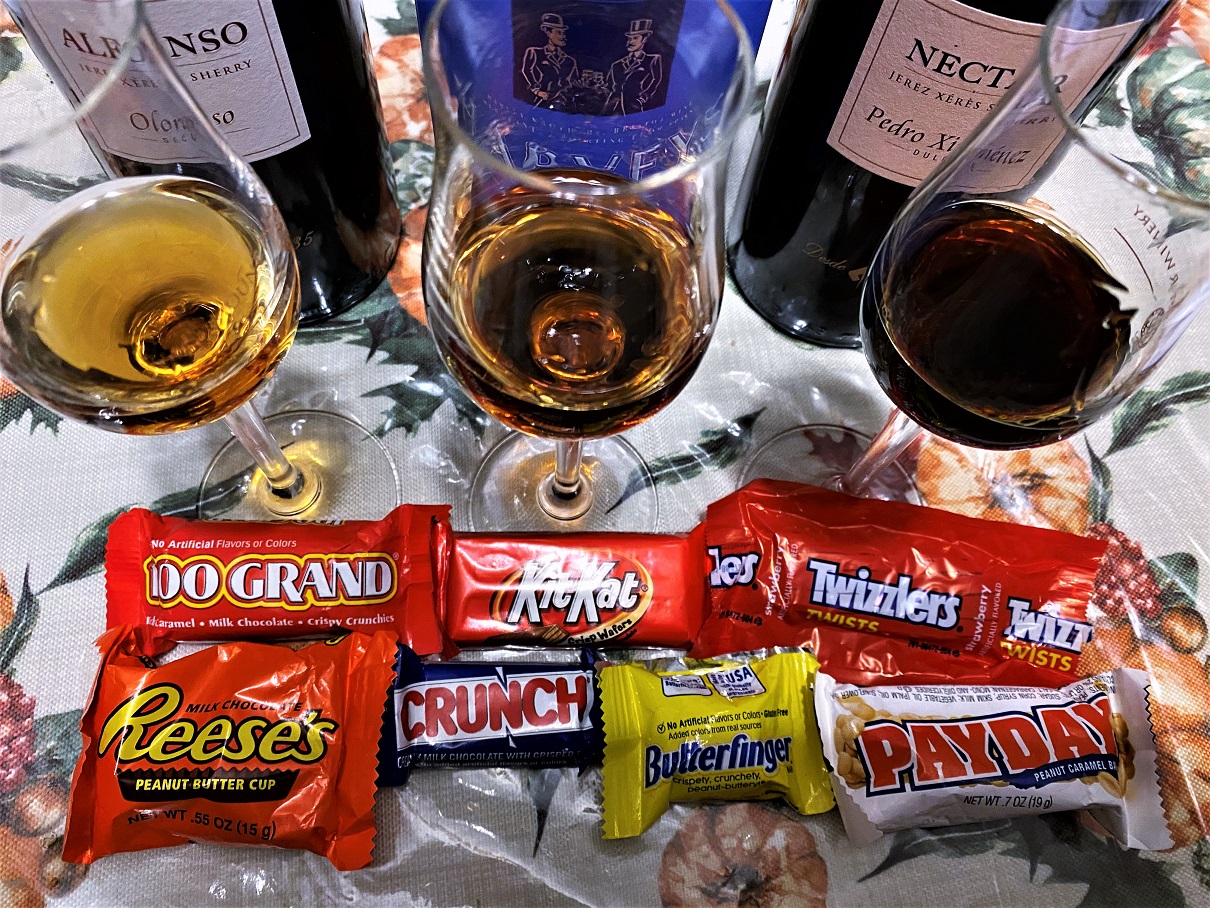
Nectar is seriously sweet wine (residual sugar of 370 grams per liter), but it is nevertheless very balance and delivers tremendous pleasure. The Pedro Ximénez (usually abbreviated as PX) is one of my most favorite dessert wines in general. The Pedro Ximénez grapes are dried on the mats for 2 weeks before pressing, losing 40% of liquid and becoming practically raisins – this explains the depth of color you can see in the picture above.
Gonzalez Byass Nectar Pedro Ximénez Dulce (15% ABV, 25%, 100% Pedro Ximénez, aged for about 8 years in solera)
Very dark amber color, almost black
Dried figs, dates, inviting.
Dried figs all the way, delicious, clean acidity on the finish, perfect balance
Great with KitKat, complements
Excellent with Reese’s, okay with Payday, Butterfinger – not so much
There you are, my friends. Don’t sweat the Halloween candies – pair them with a good Sherry. Or you know what – you can actually dump the candy – Sherry should be enough to keep you happy. Cheers!
Wine Quiz #127 – A Pairing Exercise
The Wine Quiz series is not meant to intimidate. The whole idea here is to have fun and learn something new. When answering the questions, it is fully encouraged to use all available sources of information, including Google or any other search engine. There are no embarrassing answers – the most embarrassing thing is not giving it a try…
Welcome to the weekend and your new wine quiz!
Our last quiz was about finding the item which doesn’t belong – and providing an explanation as to why it doesn’t belong. Here are the questions, now with the answers
Question 1:
Cork taint, Maderization, Mercaptan, Oxidation, Sapidity
Answer: This is a list of the wine faults, with the exception of Sapidity, which is a flavor descriptor, not a wine fault. If you want to learn more about wine faults, here is a good article.
Question 2:
Salta, Patagonia, Jujuy, La Rioja, Atacama, Catamarca
Answer: this is a list of the wine regions in Argentina with exception of one – Atacama. The Atacama is actually a wine region in Chile. In case you want to check this further, here are the links for wine regions in Argentina and Chile.
Question 3:
Madeira, Marsala, Banyuls, Port, Sherry, Sauternes
Answer: These are all fortified wines, and most of them are sweet – with the exception of Sauternes, which is just a sweet wine, but not fortified.
I’m happy to see the increased participation in the quiz, and also happy to say that Jason Brandt Lewis and Dorothy Schuler almost got it right – they both correctly answered questions 1 and 3, but not question 2 – they definitely deserve an honorable mention and a nice glass of wine.
Dorothy mentioned in her reply that the last quiz was very easy. Today’s quiz might be even easier!
Pairing is one of the important concepts around wine. We like to pair wine with food, music, mood, ambiance, and people. So let’s play the game of pairing today. Here are the questions.
Question 1: Here is the list of countries and wines which are famous and unique, often made for thousands of years in their respective countries. Can you pair these countries with their wines?
| 1. France | A. Egri Bikaver |
| 2. Georgia | B. Kindzmarauli |
| 3. Greece | C. Malaga |
| 4. Hungary | D. Retsina |
| 5. Italy | E. Vin Jaune |
| 6. Spain | F. Vin Santo |
Question 2: Celebrity wines had been all the rage lately, with more and more celebrities getting into the ownership of the vineyards, wineries, and wine labels. Here is a short list of wines and celebrities behind them – can you create the right pairings here?
| 1. Brad Pitt | A. Avaline |
| 2. Cameron Diaz | B. Armand de Brignac |
| 3. Jay-Z | C. Hampton Water |
| 4. Jon Bon Jovi | D. Maison No 9 |
| 5. Post Malone | E. Studio Rosé |
Question 3: Many wines today represent blends, a combination of different grapes in different proportions. Some of those mixes and proportions are strictly regulated by the appellation laws – for example, Brunello di Montalcino can only be made from 100% Sangiovese Grosso. Some of the rules are rather well-established practices, such as the use of Petite Verdot in the Bordeaux blends, for color and power. Below is the list of main and supporting grapes – you need to pair them properly and also name the wine or an appellation where such grapes are combined together – again, either by the appellation rules or by common practices.
| Main grape | Secondary grape |
| 1. Montepulciano | A. Grenache |
| 2. Sangiovese | B. Sagrantino |
| 3. Syrah | C. Sangiovese |
| 4. Tempranillo | D. Petitte Sirah |
| 5. Zinfandel | E. Viognier |
I hope you will find this fun, and I’m looking forward to congratulating many winners!
Good luck, enjoy the quiz and your weekend! Cheers!
Champagne, Champagne, Champagne for Everyone!
Yes, I issued the call for Champagne. And no, it is not because of the Friday night, lottery winning, huge job promotion, or an official ending of the COVID-19. Today, October 23rd, 2020 is the official celebration of the bubbles that became synonymous with success and life’s happy moments – today we celebrate Champagne, a quintessential celebration itself.
My appreciation for Champagne came long after wine became an obsession. I grew up drinking sweet bubbles of unknown pedigree under the name of “Soviet Champagne” – who would care about naming rights back then. So the first encounter with crisp, tiny, and ultra-acidic bubbles was not love at first sight. It is interesting that how I can’t name a pivotal wine, but I can easily name a pivotal Champagne – Krug Vintage, I don’t remember if it was 2002, 2003, or 2004, but that encounter with greatness during PJ Wine grand tasting in New York absolutely changed my perspective on the Champagne. And if you care to know, I even have my favorite Champagne of all times – 2002 Pol Roger Cuvee Sir Winston Churchill – pure magic.
Today, sparkling wines are produced everywhere. All countries, all types of grape (sparkling Tannat? no problems. Sparkling Shiraz? of course!), and literally all wineries. There are absolutely stunning bubbles produced in Italy (Franciacorta, Trentodoc), Spain, and the USA (if you ever had Roederer L’Ermitage or late disgorged Gloria Ferrer, you know what I’m talking about). But today, it is all about Champagne, in its pure form.
Champagne also has the capability of bonding the memories – as it is often linked to the special moments, just seeing that bottle of Perrier-Jouët, Cristal, Dom Perignon, or Bollinger can trigger the onslaught of happy thoughts. True, any wine can do this, but Champagne has some special powers.
In recognition of the holiday, I’m offering you a collage of some of my Champagne experiences:
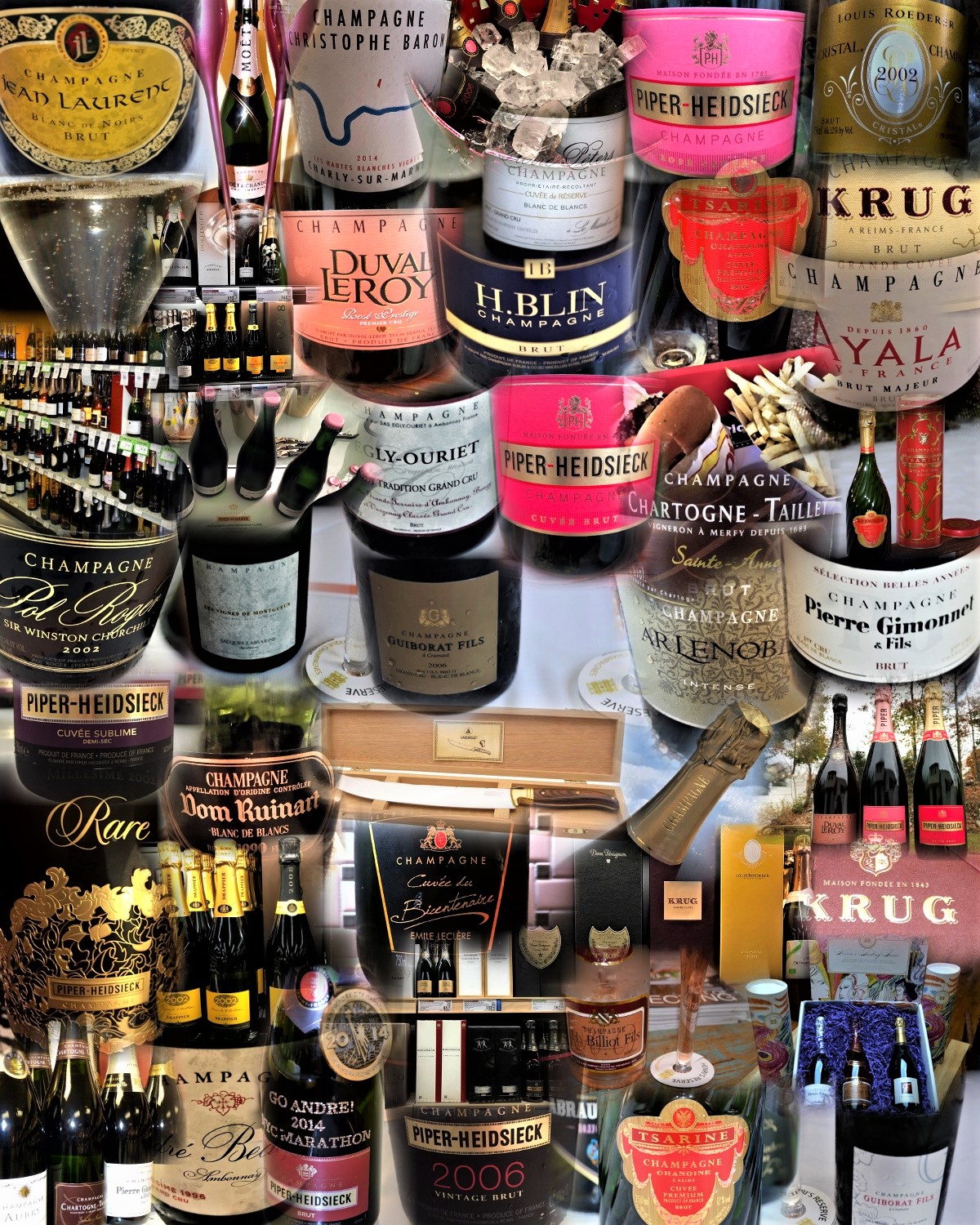
I also can’t miss an opportunity to mention the sabering – opening of the Champagne bottle with a special sword, the saber (hence the name). Sabering has some ground rules and requires basic skills – it can be done with the saber, but it is even more fun to use a random object, such as a wine glass, a stapler, or an iPhone – but this should be a conversation for another time. Sabering or not, but the opening of the Champagne bottle often goes wrong – and I want to leave you today with a little compilation of such, well, accidents.
One of my favorite quotes of all times is not about Champagne, but about life – in the words of the singer Pitbull, “every day above ground is a great day”. Don’t wait for a special occasion – open that Champagne bottle today – as the present should always be celebrated.
Cheers!
Wednesday’s Meritage #149
Meritage Time!
Let’s start with something you already knew, and hopefully, participated in – if not, it is not too late: do you know that October is #MerlotMe month? Way before social media was a thing, one mediocre movie (Sideways, 2004) almost killed Merlot wine sales in the USA. I remember about 8-10 years ago, a friend of mine who has a wine store didn’t have a single bottle of wine with Merlot name on the label at his wine store – nobody would buy it. The situation is much better today, but still, while some of the very best wines in the world – Petrus, Le Pin, Masseto are made exclusively from Merlot, Merlot wines still need everyone’s help to restore its pre-sideways status. You still have time to grab a bottle of Merlot from your favorite producer (need advice? how about L’Ecole No 41 or Duckhorn) and join the celebrations.
Wine can often be considered an art form. For example, Sassicaia, one of the very best super-Tuscan wines Italy has to offer. If you ever had a sip of this wine, you would agree that it is transformational, and might have a similar effect as looking at the beautiful painting. Art forms are often subject to imitations – this is actually a bad choice of the term – counterfeiting is what I’m talking about. At $300+ per bottle, Sassicaia represents a lucrative target for the counterfeiting – and that what some folks in Italy thought too. Italian police were working for more than a year to catch counterfeiting Sassicaia ring in Northern Italy – you can read the full story in the Wine Spectator article.
We grow from the adversities – this is a known fact. The poorer the soil, the harder vines have to work, the better fruit they will bear. When humans have to concur the obstacles, they grow, invent, persevere, and overcome. Humankind at the moment is fighting with the silent, invisible killer, COVID – but looking for the proverbial “silver lining”, we (humans) continuing to move forward, and whatever we invent to deal with the virus, is helping us advance far beyond that singular task. Case in point – dealing with vine diseases, such as powdery mildew. It turns out that the same UV light which is effective against the virus is effective in the fight against powdery mildew. Take the UV light source, put it on the robot tractor, and let it roam the vineyards during the night – problem solved. Or at least the solution looks very promising. For more details, read this article.
The last one for today is not even the news. It is simply a powerful story. An account of the fighting and winning against one of the most powerful forces on Earth – wildfire. This is a terrifying read, but I can’t recommend it highly enough – the story of the Smith family, defending their Smith-Madrone winery and vineyards against the recent Glass Fire, is a must-read in my opinion. You can find it here.
That’s all I have for you today. The glass is empty, but the refill is on the way. Cheers!
Let Your Palate Lead The Way
Wine can be intimidating.
Scrap that.
Wine is intimidating.
I’m always the first to disagree with the exact words I just wrote, but go watch the movie Somm, and tell me if you agree. Don’t have time to watch the movie? Go read about the German wine quality system, and then try to explain it to someone. Yes, wine is intimidating.
And no, it is really not.
If you are on a quest for the world’s most coveted wine expert title, such as the Master Sommelier – thinking of wine will keep you up at night. But if you want to casually enjoy a glass of wine, there is nothing intimidating about it.
Wine is simple. Wine is binary. You either like it or not. There is nothing else to it.
All you need to learn about the wine is to … trust your palate. Let your palate lead the way. It can be unnecessarily difficult, as humans generally are easily intimidated and influenced – “everyone likes it!”, “I paid $100 for this bottle”, “the experts said it was the vintage of the century”, “there were only 500 bottles produced”, yada, yada, yada. And nevertheless, the wine is personable, the wine is individual, it is only you who can tell if you like the wine or not – no matter what anyone else thinks or says. If you will learn to trust your palate, the intimidation will be gone out of wine at that very moment.
The best (and possibly the only) way to deal with this intimidation is through the blind tasting. When you are presented with a random glass of wine, you have no options but just to form your own opinion – swirl, sniff, sip, spit, repeat – say whatever you want, but all the external influences are out. It will be your own palate which will tell you “yeah, can I have more, please”, or “never again”. The value of the blind tasting goes even further than just conquering the wine intimidation – it also helps to deal with preconceived notions. Do you have a friend who keeps saying at every occasion “boy, I hate Chardonnay, how much I hate it”? Now imagine that person praising the delicious wine in their glass, only to find out that that was that exact Chardonnay they thought is the worst wine ever? In the wine world, blind tasting is the ultimate judge and jury, and your palate is all you got to rely on – and thus you have to simply trust it, as you are you.
Learning with and about your palate is not necessarily simple. Yes, you can go to the store, get a bunch of wine and create your own blind tasting – but it might be difficult not to cheat, right? How about leaving that arrangement to the professionals? Cue in the Palate Club.


Palate Club offers an opportunity to learn about your palate through the blind tasting – and then use that knowledge to find the wines which might better match your preferences. The way it works is this. You start by ordering a tasting kit. You can start with the red or white wines, and the cost of the kit at the moment of this writing is $49. The kit arrives neatly packed in the box, with 4 half-size bottles (375 ml) wrapped and numbered.
The next thing to do is to download the Palate Club app on your phone, install it, and create your profile. Once you have done that, you are ready to discover your palate’s wine preference. After you taste the bottle, you need to rate it using the app. The process is very simple as you have to rate the wine between the 1 and 5 stars. Once you rate the wine, you get a page with all the information about that particular wine. Once you will rate all four wines in your set, you will get your initial wine palate profile.


In your palate profile, you will find characteristics such as oak, fruitiness, acidity, and other – along with explanations for the numbers in your palate profile. Every time you will rate another bottle, the values in your profile will change accordingly – what you see below in the picture, are the new values after I rated the wine number 5. Right on your profile page, you will also receive recommendations for the wines to try. As palate Club is a wine club, you can also sign up for the regular wine deliveries which will be based on your preferences.


Blind tastings are always fun – and I never do too well in them. For what it worth, below are my notes and the names of actual wines – you can see that I got ways to go to work on my blind tasting skill:
#1: California Pinot? Plums, smoke, medium to light body. Touch of an alcohol burn (wine: 2014 Pinot Noir Carneros)
#2: Not sure. syrah? Clean acidity, nice round fruit, Rutherford dust, good power. California Cab? (wine: 2015 Côtes du Rhône Réserve)
#3: Chianti? Nice cherries, needs a bit more body. I would rate it 3.5… why is that never a thing? (wine: 2014 Chianti Classico)
#4: California Cab or Cab blend? Dark fruit, baking spices, good acidity, round tannins. A touch of the alcohol burn, similar to the first wine (wine: 2015 Mendocino Zinfandel)


Now, let’s go back to the major point of this post – trusting your own palate to avoid intimidation by the bottle of wine. Would the Palate Club help you reach this goal? In my honest opinion – yes. Of course, the profile which you create has limited value outside of the Palate Club, as outside of the Palate Club nobody rates fruitiness and tannins of the wine on the 100 points scale. However, the fact that you can get your friends together and play with your wines and learn your wine liking and not liking is really something to appreciate and enjoy. Blind tasting holds the ultimate wine truth, and with the palate Club’s help, you can uncover it – and learn a thing or two about your own palate. I think this is a win-win. What do you think?
Wine Quiz #126: Which One Does Not Belong
The Wine Quiz series is not meant to intimidate. The whole idea here is to have fun and learn something new. When answering the questions, it is fully encouraged to use all available sources of information, including Google or any other search engine. There are no embarrassing answers – the most embarrassing thing is not giving it a try…
Welcome to the weekend and your new wine quiz!
Our last quiz was about numbers in wine. What I asked you to do is to figure out the logic (numbers) behind the items listed in the question, where each item has some sort of number associated with it, and then sort those numbers in the required order. Below are the questions, now with the answers:
Q1: Sort the following in the ascending order:
Arbois, Augusta, Douro, Rioja, Vernaccia di San Gimignano
Answer: the above list represents the very first appellations designated in the respective countries. The right order is:
Douro (1756), Rioja (1925), Arbois (1935), Vernaccia di San Gimignano (1966), Augusta (1980)
Q2: Sort the following in the ascending order:
Balthazar, Goliath, Jeroboam, Magnum, Marie Jeanne, Melchizedek, Methuselah, Nebuchadnezzar, Rehoboam, Salmanazar, Solomon, Sovereign
Answer: These are bottle sizes, so the right order is (with the link to the source):
Magnum (1.5L), Marie Jeanne (2.25L), Jeroboam (3L), Rehoboam (4.5L), Methuselah (6L), Salmanazar (9L), Balthazar (12L), Nebuchadnezzar (15L), Solomon (18L), Sovereign (26.25L), Goliath (27L), Melchizedek (40L)
Q3: From January to June 2020, Italy exported the highest amount of wine among all major wine-producing countries, at 577M liters (769M bottles). Sort this list of wine exports per country for the same period of time in descending order:
Argentina, Australia, Chile, France, Germany, Italy, New Zealand, South Africa, Spain, USA
Answer: As you know these are the wine exports, all you needed to do is to find the right source of data. In today’s world, absolute truth doesn’t exist, so my source of information is the Italian online publication called Wine by Numbers, freely available for download. Here is the answer:
Italy 577M
France 455.7M
Spain 345M
Chile 225M
Australia 154.3M
Germany 120M
Argentina 84M
New Zealand 78.3M
South Africa 55.7M
USA 54M
I’m happy to report that we had one player who decided to take this quiz – Jason Brandt Lewis. He correctly answered question #2, so he definitely gets an honorable mention!
Okay, for today’s quiz, let’s play another wine game – what doesn’t belong? Below are three questions. In each question, you will see a list of items that all have a common thread – only one or two (not more than 2) of those items simply don’t belong there. Can you identify what the lists are and what item(s) don’t belong and why? Here you go:
Question 1:
Cork taint
Maderization
Mercaptan
Oxidation
Sapidity
Question 2:
Salta
Patagonia
Jujuy
La Rioja
Atacama
Catamarca
Question 3:
Madeira
Marsala
Banyuls
Port
Sherry
Sauternes
I think today’s quiz is the easiest so far, so I’m looking forward to congratulating many winners!
Good luck, enjoy the quiz and your weekend! Cheers!
Last Bottle Sign Up ($10 credit)




 Talk-A-Vino