Archive
Wednesday’s Meritage – Wine Quiz Answer, #WBW80, #MWWC2, GMO Wines???, Harvest Marathon and more
 Meritage time!
Let’s start with the answer for the wine quiz #69, grape trivia – Viognier. In the quiz, you were supposed to answer 5 questions about the white grape called Viognier.
Here are the questions, now with the answers:
Q1: Viognier stands pretty unique among all white grapes as it is often added or can be added as blending component during the production of the red wines around the world. Do you know the name of the red grape it typically accompanies?
A1: Syrah. Viognier is allowed to be added to the red Syrah wines of Côte-Rôtie (up to 20%), and Shiraz Viognier wines are quite popular in Australia.
Q2: Name the source of essentially the best and most long-living Viognier wines in the world
A2: Château-Grillet. Château-Grillet is so called Monopole, as it is both an AOC and the single winery. Château-Grillet is known to produce some of the best, long living Viognier wines ever. Château-Grillet is surrounded by another Viognier-only appellation, Condrieu, which also makes great Viognier wines, but the answer I was looking for here is Château-Grillet.
Q3: Viognier became so popular in the United States, that one of the states even called it “an official grape of the state”. Do you know which state it is?
a. California, b. New York, c. Texas, d. Virginia
A3: Virginia! In 2011, Viognier was named an “official grape” of the state of Virginia.
Q4: Wine Spectator calls wines rated in 95-100 range Classic (the highest and the most prestigious category). True or False: there are no Viognier wines with Classic rating
A4: False. There is a number of Condrieu wines rated in the range of 95 – 98 (98 so far was the highest rating for Viognier wines)
Q5: Based on DNA research, Viognier has an unlikely cousin in Italy, which is not even the white grape, but red. Can you name that “cousin”?
A5: There is almost always a slight element of controversy with all this DNA research data. According to DNA research information in Wikipedia, Viognier is shown “to be closely related to the Piedmont grape Freisa and to be a genetic cousin of Nebbiolo” – thus both Freisa and Nebbiolo are correct answers here.
We had lots of great answers for this quiz, and we have winners! Considering the absolute precision on the answer for the second question (Château-Grillet), Jeff a.k.a. TheDrunkenCyclist is our Grand Winner today, but both Julian at VinoInLove and Kirsten at TheArmchairSommelier are also the winners of this wine quiz #69. Winners get their due share of unlimited bragging rights, but I definitely want to thank all participants – great job!
And now, to the interesting stuff around the vine and web!
I have few of mostly the reminders for you today.
Today, August 14th – Wine Blogging Wednesday event, #WBW80 – Dry Rosé. There is still some times left to drink Rosé and submit your post! For all the details please click here.
This coming Friday, August 16th – deadline for submission for the Monthly Wine Writing Challenge #2, with the theme called Trouble. You can find all the rules here. There is still time, get your trouble under control and write! Use #MWWC2 hash tag your submission.
Tomorrow, Thursday, August 15th – Last Bottle 2013 Harvest Madness Marathon is taking place! If you like get great wines at unbelievable prices, this event is for you! Starting at 9 AM Pacific time, new wines will be sold at LastBottle web site at neck-breaking speed. Last Bottle model is similar to WTSO – no e-mail announcements, and they don’t even use twitter, so you have to refresh your browser all the time. There is one difference though – there are no minimum quantities to buy to get free shipping. The event will continue for 2 days, and all the wines will be shipped during few weeks after the event. If you are not buying wine at Last Bottle – you really missing lots of great deals. It is free to subscribe to their web site – but if you are not a subscriber and want to become one, send me an e-mail so I will subscribe you – you will get $5 credit (yes, true, and I will get $20, but then of course you can subscribe someone else…).
Last but not least for today is an interesting article by W. Blake Gray which caused my quick and short reaction – WTF?! Seriously? Here is a post in The Gray Report, where W. Blake Gray is talking about an article in Wine Spectator advocating the idea of … noting else but GMO wines! I might be over-reacting, but after reading this article I was split-hair close to canceling my subscription. Well, read it for yourself and let me know what do you think.
That’s all I have for you for today, folks. The glass is empty – but the refill is coming. Until the next time – cheers!
Rosé – Still Misunderstood and Looking for Love?
This Wednesday, August 14th, is the Wine Blogging Wednesday event, where all wine bloggers get the chance to share their thoughts and experiences related to the designated theme. The theme of this upcoming Wine Blogging Wednesday event, or WBW for short, is Rosé – here are the details of the announcement. This is what this blog post is all about.
How often do you drink Rosé? Do you think Rosé is fully understood and appreciated by the consumers en mass? I’m afraid that many wine drinkers still have a notion that Rosé is either sweet, or strictly seasonal, or mostly inferior, or all of the above. I remember being in France about 7 years ago, in November, and ordering a bottle of Tavel in a restaurant. My French colleague gave me a look, and then said sternly “just keep in mind, you are ordering a summer wine” – of course he has an excuse as a Burgundy buff, but still – even in France, people often see Rosé as seasonal wine, not as a wine you can drink all the year around. In the US, yo would rarely find Rosé on the main shelves – they are usually setup on a side, ready to be replaced by the holiday wines, and slowly moving to the “closeout bins” as summer comes to an end.
Many people judge Rosé by the color, which reminds them of White Zinfandel, and think it is a sweet wine. I have seen many people come to taste the wines at the store and refuse the glass of Rosé simply saying “no, thank you, I don’t drink sweet wines”. It really takes time to convince them that the wine they are refusing is actually perfectly dry, refreshing and food friendly – and not only during summer, but all year around.
Having presented this pinkish “doom and gloom” to you, I actually have to admit (happily) that over the past 3-4 years, the situation is changing to the better. Even as a seasonal wine, there is really an abundance of Rosé offered in the wine stores. More and more wineries and winemakers now include Rosé as part of their standard offering, year in, year out. This happens in France, this happens in Georgia, this happens in California, Greece, Italy, Spain, New York and many other places.
The great thing about Rosé is that they are some of the easiest wines to drink – and some of the food-friendliest. Rosé typically has a flavor profile of a light red wine, with strawberries, cranberries and onion peel being some of the main characteristics – it also lacks the punch of tannins as skin, seeds and stems contact is minimized during the winemaking. At the same time, Rosé typically has savory complexity coupled with acidity which is usually a bit less than the acidity of a dry white wine. Overall, it is easy to drink and food friendly – what else do you need from wine? Of course I’m not advocating that the whole world should start drinking only Rosé at this point – but Rosé definitely has its own permanent (not seasonal!) place on the shelves of the wine stores and in your wine cellars.
Let me now give you two great examples of Rosé wines.
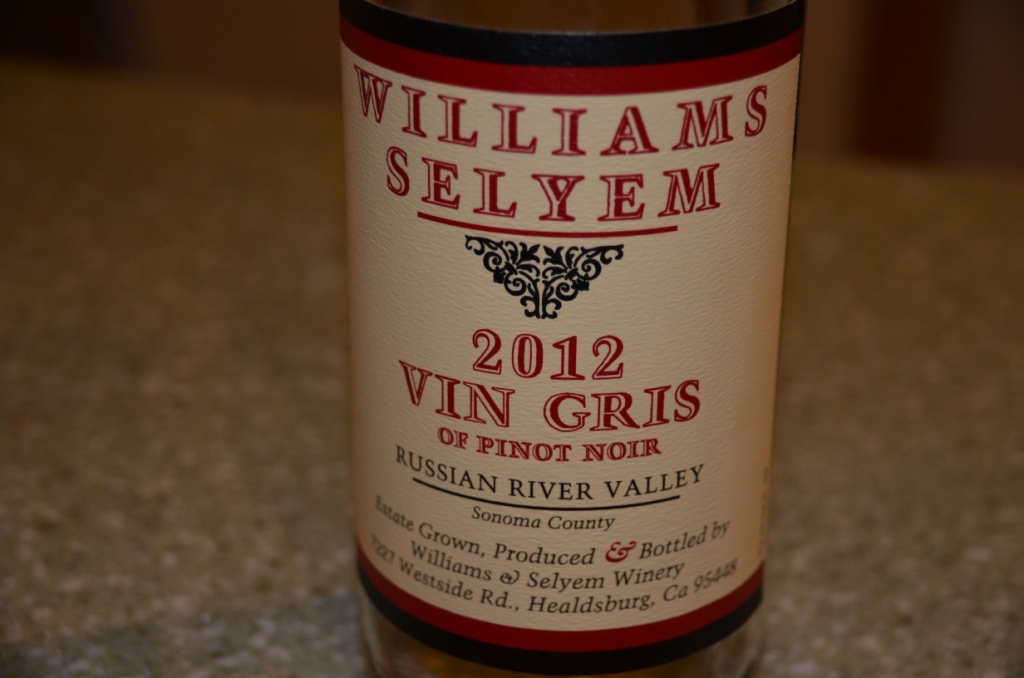
Williams Selyem Vin Gris of Pinot Noir
2012 Williams Selyem Vin Gris of Pinot Noir Russian River Valley (12.9% ABV) – bright concentrated pink color, reminiscent of cranberry juice. Strawberries and cranberries on the nose, same on the palate, lots of strawberries and cranberries, very dry, perfect acidity, very balanced overall and very easy to drink. Drinkability: 8-

Antica Terra Erratica
2011 Antica Terra Erratica Willamette Valley Oregon (13.1% ABV) – another 100% Pinot Noir Rosé. What a treat! Perfectly bright strawberry red in color, nice nose of raspberries and cherries. First the wine opened into a light Pinot Noir, showing some smokiness and earthiness, then evolved into into bright strawberry and onion peel wine, classic Rosé, and then it was gone… Drinkability: 9-
There you have it, my friends. Open a bottle of your favorite Rosé, pour a glass and enjoy – however remember – sometimes Rosé is too easy to drink… Oops, did we just finished this bottle? Cheers!
Wednesday’s Meritage – Wine Quiz Answer, Transportation Challenge Round Up, Cabernet Day, Can We Resurrect #WBW?
 Meritage Time!
Let’s start with the answers for the wine quiz #64, Grape Trivia – Riesling. In that quiz, you were supposed to answer 5 questions regarding Riesling grape.
Here are the questions, now with the answers:
Q1: Riesling is a very popular grape in US and Canada, growing in many regions. Considering the plantings of the Riesling in the regions, can you sort the list below from the biggest area plantings to the smallest?
a. California, b. New York, c. Ontario, Canada, d. State of Washington
A1:correct sequence is Washington, California, Ontario, New York
Q2: Have you heard the term “noble rot”, which is often associated with certain types of Riesling? Can you explain what this term means and to which Riesling wines it is typically applicable (at least in Germany)?
A2: Noble Rot is actually a grape fungus, officially called Botrytis Cinerea, which affects a number of different grapes and leads to subsequent shriveling (drying) of the grapes while on the vine. This drying of the grapes tremendously concentrates sugars, which allows for the grapes to be used in production of the sweetest of all Rieslings – Trockenberenauslese.
Q3: Riesling is known for sometimes developing a specific aroma which has typically nothing to do with the wine – but it is not a fault. Do you know what aroma is that?
A3: Petrol. Believe it or not, but many Riesling wines (in some rare cases, even Riesling wines outside of Germany) can develop this petrol aroma. It is usually perceived only on the nose, and it doesn’t give you a feeling of being at the gas station – it is just a light hint, but when it is present, you can safely guess your wine being Riesling even in the blind tasting.
Q4: Name one major(!) wine producing country which doesn’t produce any Riesling wines.
A4: Spain. Spain is a home to the plenty of wonderful white grapes – but it doesn’t produce any Rieslings at all.
Q5: If you look at the bottle of German Riesling, you will typically see the word such as Kabinett or Spatlese written on the label. Such words typically indicate the level of sweetness you should expect from wine – even though this is not a precise definition, as these words only indicate sugar amount in the freshly pressed grape juice – the level of sugar in the resulting wine can be quite different depending on the way the fermentation is done. Can you sort the following list of these key indicators from the lowest sugar content to the highest?
a. Auslese, b. Berenauslese, c. Eiswein, d. Kabinett, e. Spatlese, f. Trockenberenauslese
A5:The correct line up is Kabinett, Spatlese, Auslese, Berenauslese/Eiswein, Trockenberenauslese (if you need full level of details, you can always go to Wikipedia).
It seems that the first question proved to be most challenging of all, as nobody was able to provide the right answer – as the result, we don’t have a winner this week. At the same time, The Wine Getter and Foxress both get an honorable mention with 4 correct answers out of 5.
Now, to the interesting stuff around the vine and web!
First of all, I want to bring to your attention a roundup of a Monthly Wine Blogging Challenge started by Jeff (a.k.a. The Drunken Cyclist). About a month or so ago, Jeff announced a wine blogging challenge based on the theme, similar to the challenges which are popular among photography bloggers. The first theme was Transportation, and the idea was to write the wine blog post which would relate to the designated theme. 10 wine bloggers participated in this challenge, and you can find links to all the blogs posts in this round up. I think this is a great idea and I hope more wine bloggers will participate next time.
Who remembers the Wine Blogging Wednesdays (#WBW)? Similar to the challenge I mentioned above, the WBW events had a theme, which in the most cases was a grape, a type of wine or a wine region, and they also had a host. The host was typically the one who suggested the original theme, and also it was the host’s job to provide a roundup of all the submitted blog posts. These #WBW events had a very good run of almost 8 years, and there was a dedicated web site which is still somewhat accessible. I think it might be cool to bring the #WBW events back – in case you experienced any of them, feel free to comment – do you think Wine Blogging Wednesday events should be resurrected?
Last but not least – the Cabernet Day is coming! Well, not tomorrow – but August 29th is the day. And you know how it works – the summer will be over in a blink, so it is never to early to prepare for celebration of such a noble grape as Cabernet. Here is the link to the invitation I received for the this Cabernet Day – join the festivities!
That’s all I have for you for today, folks. The glass is is empty – but more Meritage is coming. Cheers!
Thursday Rant–Wine Blogs
Here is the post from the fellow blogger Jeff @ The Drunken Cyclist, with my comment which was left on Jeff’s blog:
You idea of “themes” is exactly what existed in the wine blogging world for many years – this is what was called Wine Blogging Wednesday, or #WBW, where the theme was set once a month with the “host”, and then all would be writing for that theme and the blogs would be posted and summarize. There used to be even a dedicated web site for that – after running for about 80 months, it is now closed : ( But here is a glimpse for you for what it was: http://drinkwhatyoulike.wordpress.com/tag/wine-blogging-wednesday/
Yours truly even participated in a few of the #WBW events, and it was fun. I don’t think we can do it more often than once a month (speaking strictly for myself), but I will be glad to support “Wine Blogger Challenge” if you want to start that movement. We can have a joint “announcement” from all of the supporting bloggers and we will need to promote it on Twitter, but again – you can count me in. And as a show of the support, I’m going to reblog your post on my blog 🙂
Cheers!

I have nothing against wine blogs–quite the opposite, I technically write one, I guess. I also follow several really great blogs and really admire their authors and are inspired by them daily. The problem I have with them is that as a “unit” there is really not much cohesion and at the same time not much in the way of differing viewpoints.
Both could be certainly due to the subject of our blogs: Wine appreciation is rather personal and certainly contextual. I might like a wine simply due to the fact that it tastes good to me. I might like a wine because it was part of an overall incredible experience for me. Another drinker/taster might be drinking the exact same wine in a completely different (or even a very similar) context and have a different opinion of the wine. When you come right down to it, though…
View original post 759 more words
From Wine and Books To Wine In Books
 What do you take your wine with? There are few options, I guess. One (and most obvious) would be food. Another one would be a conversation (wine and conversation – a match made in heaven?). And then there is wine and the book – both get you in the mood, both complement and enhance each other and make the moment special (take your average week as an example – how many times per week you get to enjoy a quiet moment with book and the wine? What, zero? I hear you…).
Sometimes, wine even gets into the book – and I don’t mean by spilling it all over. Today is a Wine Blogging Wednesday #79, dedicated to Summer Reading, Summer Wine. The main question you are supposed to answer in your blog post is “What wine would your favorite fictional character drink?”.
I have two problem with this question – the same way as I can’t name my favorite wine, I can not name my favorite fictional character (there are many). And the second problem? Drinking wine (or any alcohol) is not necessarily a priority, no matter what the character is doing, therefore pinning it down is far from simple.
While I thought of a few different approaches ( including writing of the short essay about a character and the wine), advancing from thinking to the writing was not getting in sync with me. But then I thought of one of my all-times absolute favorite science fiction book. I can’t tell you how many times I read this book while I was growing up – 10, 20, 50 – I have no idea), but every time it was fresh and fascinating. This book was written in 1965 by two brothers, Arkady and Boris Strugatsky (originally in Russian), and it is called Monday Starts on Saturday. It is a science fiction (border line fantasy) book, talking about a research institute where wizards, sorcerers and just researchers work on exploring of the meaning of life (anyone who read the book in the original – I ask for your forgiveness for such a representation of this book). If anyone cares to read it in English, here the link to the full English text – however note that a lot of charm might be lost in translation.
So I decided to do a simple check for what kind of alcohol was mentioned in the book (using the word “bottle” as an anchor and remembering some of the key scenes). Here is the list:
- Wine (generic term, nothing specific)
- Champagne (again, nothing specific)
- Vodka (after all, this is a Russian book!)
- Cognac (with the perfect string attached: “A human might be just an intermediate element of evolution necessary to build a masterpiece of creation – a glass of cognac with slice of lemon” – note that translation is mine).
- Amontillado (pretty good, huh? This type of Jerez was mentioned by the name!)
- Elixir of Bliss (clearly a magical creation, but based on the personal experience, I would approximate it to an extremely old Pedro Ximenez Jerez)
Of course I might be missing something, but I like the list even as it is.
There you have it, my friends. My major point here? No matter what the characters are drinking, wine and books go perfectly hand in hand – hope you can find the time to enjoy both! Cheers!
Wednesday’s Meritage
 And the brand new Wednesday is upon us – and here are [by now the usual] updates for you (by the way – let me know if you like this Wednesday mix, or if I better spend time on something else).
Let’s start with the answer for the Wine Quiz #19 – Wine as Facilitator of Art and Craft. I’m glad to see that my readers are well informed (or have an unfathomable capacity for guessing the right answers) – the price of the Penfolds Ampoule is expected to be set at around $168, 000 (in US dollars) and it will be presented in Moscow, Russia by Penfolds Chief Winemaker, Peter Gago – here is a link to an official press release.
In the “interesting news” department, let me share a few things with you.
- Wine Bloggers Conference 2012, also known as WBC12, will be taking place in about a month in Portland, Oregon (the dates are August 17-19). No, I will not be attending, but I still think this event is worth mentioning (well, may be one day I will convince myself…). In conjunction with WBC12, I would like to bring to your attention this post by Tom Wark in his Fermentation wine blog, where he is helping to collect money for Wine Bloggers Conference Scholarship Fund, which is then used to subsidize attendance of the WBC by individual bloggers (Tom is personally matching all donations for up to total of $500).
- The theme for Wine Blogging Wednesday #79 (Twitter: #WBW79) had being announced, and it is not a simple one in my opinion. This #WBW79 is hosted by BrixChiks, and the theme is “Summer Reading, Summer Wine” (here is the link to the announcement). You are supposed to answer one “simple” question – what would your favorite fiction character drink? I’m not sure if I’m up for the challenge, but – there is some time to think about it. This #WBW79 is taking place on Wednesday, July 25th – go get your book, and make sure your character is over 21 (hmmm, really, I just said that? Would that be necessary?).
- Last, but not least – the never ending debate about cheap wine versus expensive wine and consumers versus wine snobs, wine critics, wine ratings, twist, twist, another twist… just got a new twist in the form of an article in Forbes magazine and response from the wine critic Steve Heimoff in his blog. This is the subject of the endless debates, which I don’t want to casually enter (both sides are perfectly arguable and therefore it is a subject of endless debates without possible conclusion) – but I recommend that you will take a bit of time and read both articles and then … comment below! Let’s have the debate here – after all this is the blog for talking about wine, isn’t it?
This is the end of news and updates. Happy Wine [Whiskey] Wednesday, everyone. Cheers!
One Viognier, Two Viognier
Viognier. A white grape, with more than 2000 years of history, and nearly extinct by 1965 with only 8 acres of plantings left in Northern Rhone – for the full history of the grape you can refer to this article in Wikipedia.
By the way, can you pronounce that “Viognier”? I’m not trying to insult the intelligence of my readers, but this french word is anything but easy. If you need a little help, here is a very short video for you:
If you wonder why are we all of a sudden talking specifically about Viognier (after all, there are other 9,999 grapes supposedly growing in the world), the reason is simple. Yesterday was Wine Blogging Wednesday event number 78, hosted by Frank Morgan from Drink What You Like blog, and the event was dedicated to Viognier, which sprung back to life and now successfully grows pretty much all over the world.
Viognier is no stranger on this blog. Two years ago, I was able to taste Virginia Viognier at Chrysalis Vineyards – it was very good. Then I had probably my best Viognier experience ever at the Lavinia wine store in Geneva – there I tried 2009 Domaine Georges Vernay Condrieu, a classic Viognier from Norther Rhone (it was outstanding with Drinkability rating of 9).
For this WBW78 tasting I had a few prerequisites. For one, I would love to taste Virginia Viognier – but it is not available in Stamford, CT. For the second one, I knew that I don’t want to taste California Viognier. Why? First, about two month ago, I had bad experience at a number of wineries in Temecula Valley in California. Second, there some some advantages in writing this blog post somewhat late – you can refer to the work of others. Please read the description of Rosenblum 2008 Kathy’s Cuvee in the blog post by the fellow blogger Gwendolyn Alley, especially the last part: “…finishes tart and savory yet cloying”. No further comments.
I definitely wanted to have classic Condrieu Viognier – but that is typically not a cheap option. Thanks to the advice of Zak from Cost Less Wines, I ended up with two bottles of Viognier – one from France, and another one from Australia.
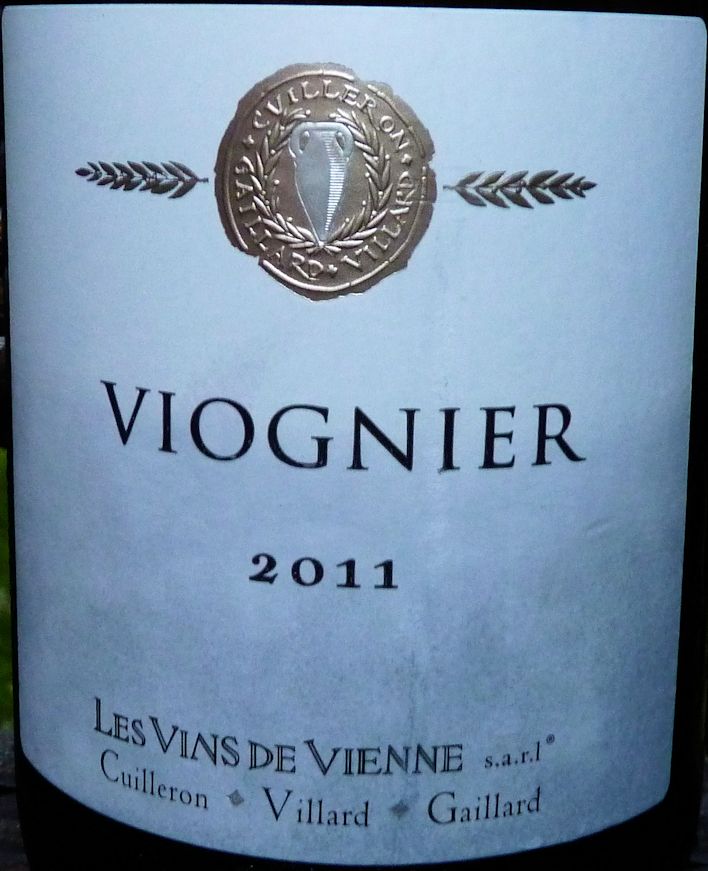
My Viognier #1 was 2011 Les Vines de Vienne Viognier ($19.99, 13% ABV). Interestingly enough, this wine was made in the region surrounding the town of Vienne in Northern Rhone region of France – one of the legends has it that this town (Vienne) gave the name to the grape itself (Viognier). Another interesting fact is that Les Vines de Vienne wines are product of obsession of the three wine makers – read more about it here.
I didn’t plan any dinner or an event around this Viognier tasting, so I decided to pair it with a few random things I could grab from the fridge. But before we will talk about pairing, let’s talk about the wine itself. Here are the tasting notes “in progress”. Nice golden color, beautiful nose of green apple and orange zest. There is clean residual sweetness on the nose. One the palate – touch of sweetness, lemon tartness, golden delicious apple, perfect acidity. As wine opens up, sweetness disappears and acidity kicks in. Perfectly refreshing and balanced, very clean. Drinkability: 8+. Taking into account the results of tasting on the second day, I want to note that it is important not to over-chill this wine. Taken directly from the fridge on the second day, the wine had slightly unpleasant sharpness, a bite, which disappeared as soon as the wine warmed up a bit.
As I said, the food pairings were rather a game than anything thought through and planned. I tried this wine with slow roasted Jalapeno ( our local Fairway had selection of large size Jalapenos, which were a killer after being slow roasted on a grill) – the wine was not enough to remove the heat of Jalapeno (fire hose was more appropriate for that). Wine worked very well with French goat cheese called Crottin de Champcol. It perfectly complemented grilled yellow squash and worked nicely with grilled asparagus.
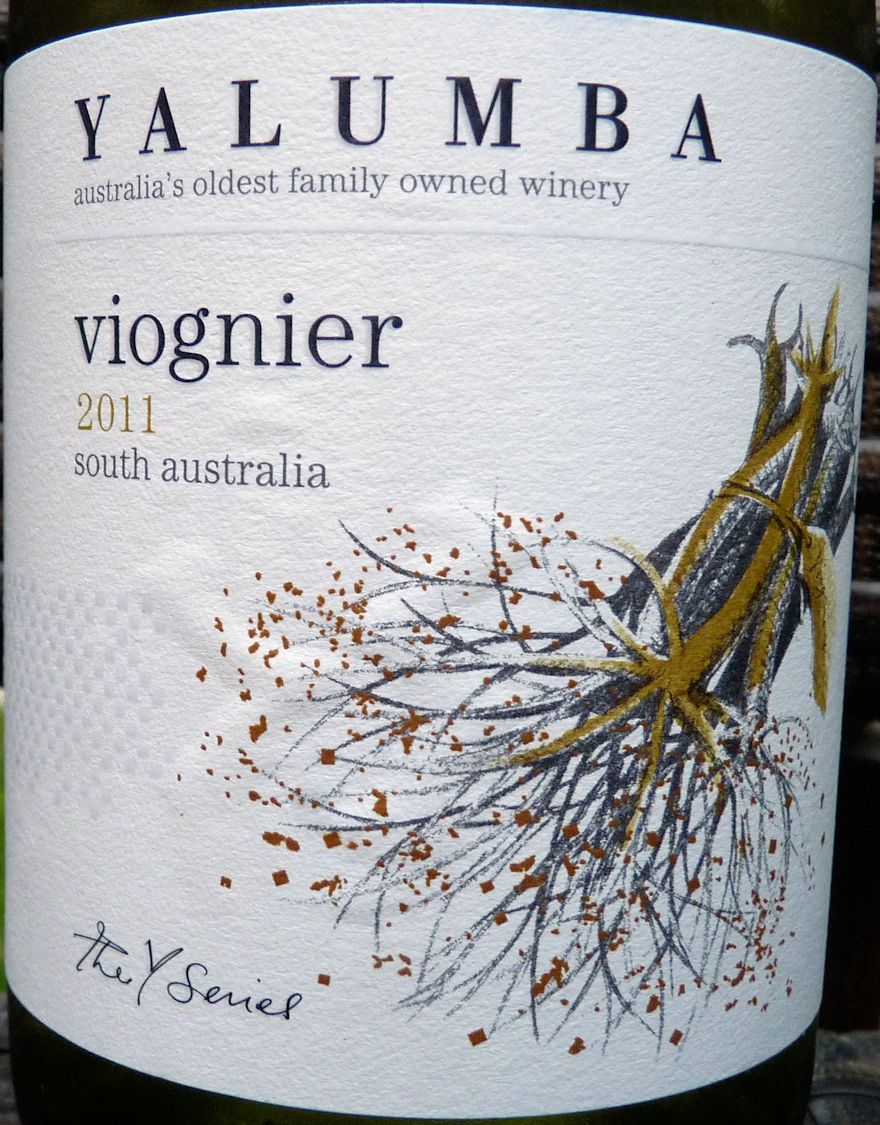 Viognier #2 was 2011 Yalumba Viognier South Australia ($11.99, 13.5% ABV). A touch darker in color than the #1, less bright. Nose of pear, herbs, white peaches and mango, more exuberant than the wine #1, but not to the point of being overwhelming. On the palate, there was more fruit than in the wine #1, but it was predominantly white grapefruit. While the wine was showing round enough, there was not enough acidity. Drinkability: 7.
None of the previous food pairings worked well. With Jalapeno, the wine was showing very acidic. It was too fruity against goat cheese, and didn’t do anything to asparagus, and grilled squash was the only okay pairing for this wine. Still, I think this is quite reasonable wine for the money.
This concludes my report about Viognier experience. I would highly recommend the Les Vins de Vienne Viognier – the wine is definitely worth seeking, especially considering that anything comparable and coming directly from Condrieu will cost you three times more.
So, how about you? Did you have Viognier yesterday? I hope you did, and if you did not… what are you waiting for? You should be on the way to the store now. Cheers!
Wine, Pick Me Up, Please!
 So you had a bad day at work. During the meeting, the boss kept giving you the look, you know, that one. Engineering just informed you that project delivery will be delayed [yet again] by 4 weeks, and you are the one to come up with the third(!) apology/excuse to the customer. And actually, this Sunday you will have to be on the plane, and it will be 3rd week in a row you have had to travel over the weekend and cancel all your plans. Is that bad enough, or do we need to throw in a flat tire and a speeding ticket on the way to work?
Okay, you arrive home in a sufficiently bad mood. Sit down, relax, and maybe put on some nice music (I don’t know about you, but Stan Getz, Frank Sinatra or Tony Bennett will fit the bill for me). Will a glass of wine help to cheer you up? Most probably. But what bottle should you open? If your answer is “the only one I already have”, this post might not help you much…
My wine teacher Kevin Zraly always said that “the wine should give you pleasure“. So another short answer would be “the one which will give you pleasure” – and what we need to keep in mind is that the wine I would enjoy immensely might be completely not your thing. Let’s put this aside, and let’s assume that I actually had a bad day at work. Well, it would be the easiest then to write this blog post empirically and emphatically, but I’m not sure that if I actually had a bad day at work, I would be able to write a good blog post, so … did I lose you yet? Let’s get back to the subject.
Here are three important criteria for selecting the “pick me up” wine. First, it should be an “instantly on” wine. What I mean is that the wine should be ready to drink as soon as the bottle is open. This will effectively exclude lots of big Italian wines, such as Barolo and Brunello, as well as many California Cabs (unless you have something aged to perfection in your cellar and it is actually ready to drink now) – anything which needs decanting or prolonged breathing time should be avoided here.
Then I would suggest that the wine should be familiar. It should be the wine you had before and you know how it will taste like. There is nothing wrong with opening a totally unknown bottle of wine, but – you are in a bad mood already, are you sure it is worth taking chances?
The last factor I want to throw in here – I want this wine to have a great smell. I think the “pick me up” process should start from the very first whiff of your glass, way before you take a first sip. Smell has a great power to transform your mood right away – and the great bonus or a great smell is that you can smell the wine indefinitely as opposed to drinking it.
Oh, wait, there is one more desired feature here – the wine should be good. In other words, it should give you pleasure. In my personal book it means that the wine should be balanced and as an added bonus, have a sense of place.
Let me give you some examples of wines that should be able to improve one’s mood (I’m sure they will work for me).
 2010 Fiction Red Wine Paso Robles by Field Recordings. I talked about this magnificent wine a number of times already in this blog, so let me just quote myself: “First and foremost, it is a smell which doesn’t let you put the glass down. Fresh flowers, meadows, herbs, fresh summer air – it is all captured in the smell of this wine. On the palate, this wine shows bright red fruit, like raspberries and cherries, all perfectly balanced with great finesse. Any time you want to experience a beautiful summer day, reach out to that wine.”
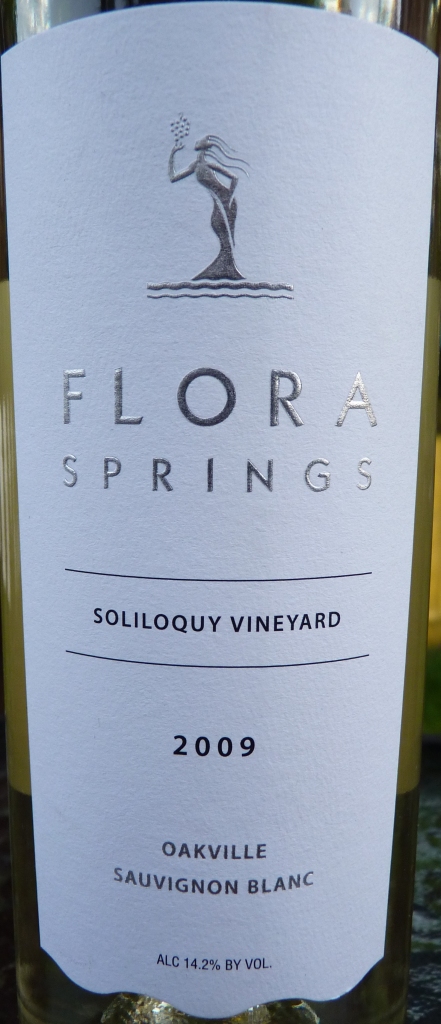 Flora Springs Soliloquy Sauvignon Blanc 2009. “One of the very best California Sauvignon Blanc I ever had. Beautiful combination of traditional grassiness with fruit-forward and finesse. Outstanding!”
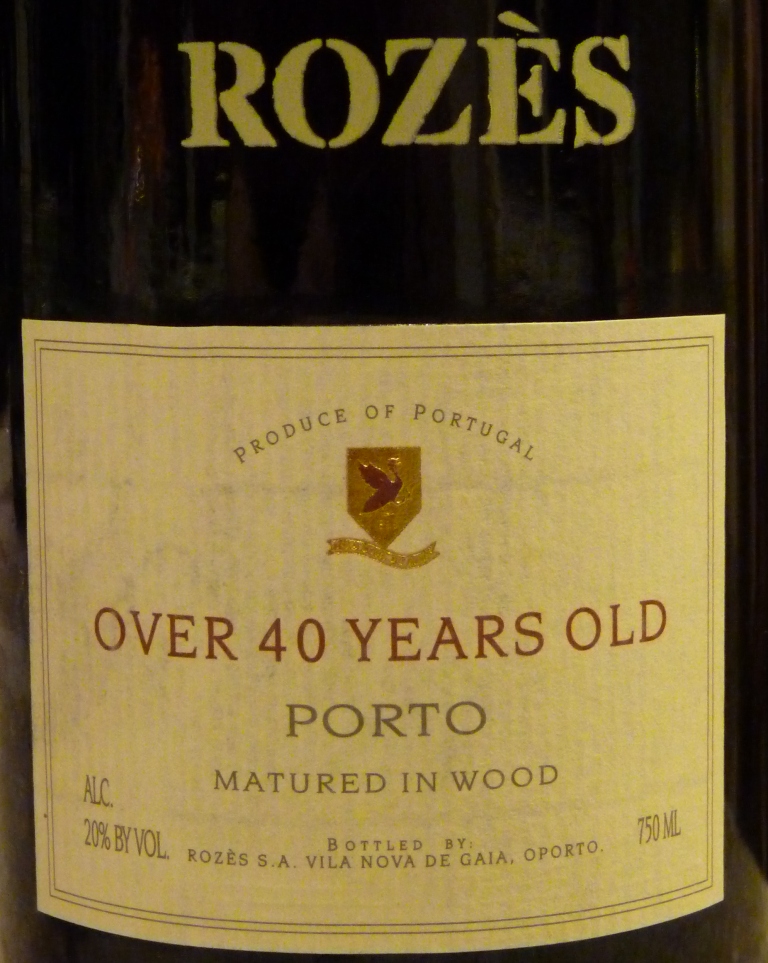 Rozes Over 40 Years Old Port. “My best port ever. I can close my eyes and imagine the smell and taste of this wine – multiple layers, tremendous complexity, and great opportunity to reflect on life when the finish lasts for 15 minutes or longer.”
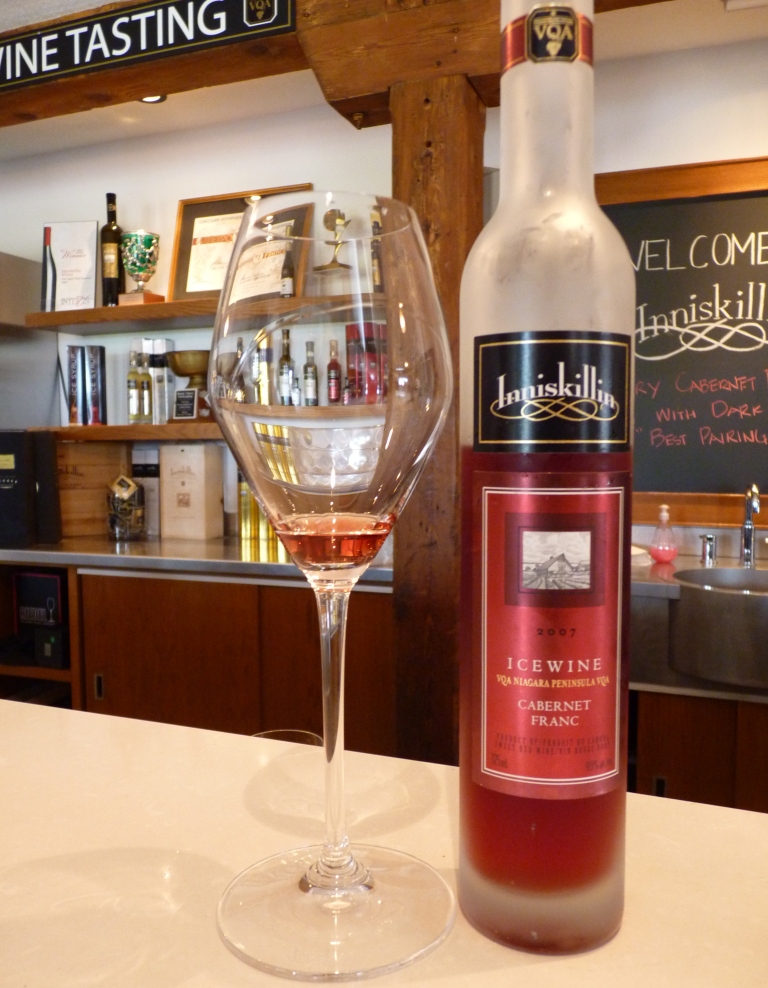 2007 Inniskillin Cabernet Franc Icewine – “This was definitely the best Icewine I ever tried. Light and effervescent (not your usual descriptors for the icewine), with perfect acidity complementing beautiful fruit. A true masterpiece.“
There you have it – I’m sure either one of these wines will greatly improve your mood. However, there is an extremely good chance that any [your personal good] bottle of wine will help too. Besides, having a bad day at work is not at all mandatory to enjoy a glass of wine (or two). Tell me, what will be in your glass today? Cheers!
Seductive Barossa
Today is Wednesday, right? Well, yes, of course, it is already Thursday for half of the world, but at least here, on US East coast, it is still Wednesday. And it is not only #WineWednesday as celebrated all over the Twettersphere, it is also a Wine Blogging Wednesday #76, a.k.a #wbw76, with the theme Barossa Boomerang. In other words, it is all about wines coming from Barossa Valley region in South Australia.
Winemaking history in Australia goes back more than 200 years, of course with ups and downs. From 1990s, Australian wine imports were growing very steadily, with Australia literally becoming a number one wine importer to US around 2005-2006. Australian Yellow Tail was the most popular wine on the shelves of US wine stores. And then…it all went down. The glut of inexpensive but at the same time absolutely indistinguishable wines was one of the reasons for that demise. Of course there were more reasons than that, but this is not the subject of today’s post – however, if you want to read more, here is a very good post by Jancis Robinson. As of late, Australian wines are slowly working its ways up the ladder, but it will take time and dedication to regain the lost positions.
So the theme of today’s Wine Blogging Wednesday should help exactly with that – there are many great wines produced in Australia, and this #wbw76 certainly helps to bring attention to the Australian wines. Barossa wines are somewhat of an easy subject, as there are lots of wines produced in the Barossa Valley, so finding the bottle to open is definitely not an issue. Would the subject be Victoria or Great Perth, it would make the task of finding the appropriate wine a lot more difficult. Outside of sheer availability, another great fact about Barossa region is that it is a home to some of the best and most famous wineries in Australia, such as Penfolds, Henschke, Seppeltsfield and others.
Okay, enough fluff, let’s talk about the wine. When the theme of #wbw76 was announced, I pretty much new only one thing about the wine I’m going to select – it will be a Shiraz. Which one exactly – I had lots of ideas in mind, until two days ago, when I saw 2008 Fetish Playmates Barossa Valley wine on sale at local Bottle King for $8.99. Considering the price and the fact that label looked very inviting, the decision was made rather easily.
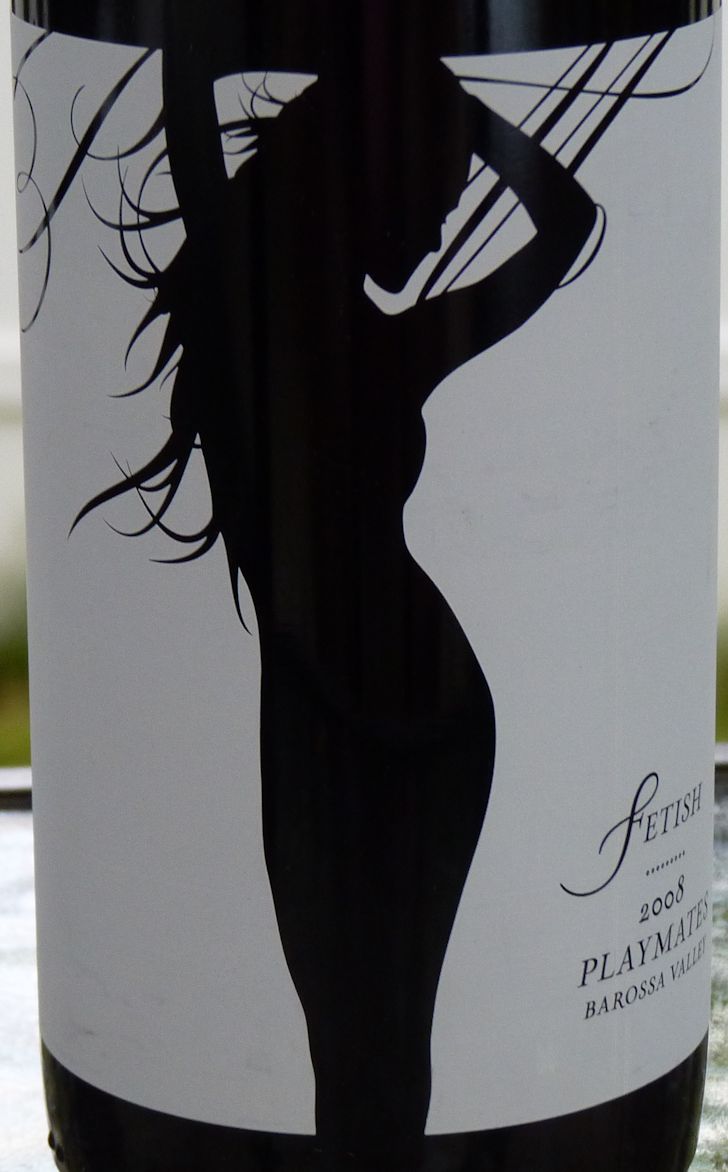
Here are my tasting notes, in quasi-real time: Dark chocolate and blackberries on the nose, slight hint of vanilla. Very round on the palate, showing lighter than expected just by the smell. Touch of spice and wine disappears on the palate, leaving it coated with tannins. Lots of tannins. This wine needs time to allow fruit to develop to support the nose experience on the palate. Very easy to drink… and then this wine grows on you – seductive, escaping and effervescent – if you can say that about red wine. Before you understand what happened, you are looking at the empty bottle – you still want more… but it’s gone.
If you care for a bit of technical detail, this wine is a blend of 80% Shiraz, 10% Grenache and 10% Mataro, ABV 14.5%. Drinkability: 8.
There you have it, folks – great seductive Barossa Shiraz for the Wine Blogging Wednesday. How was your #wbw76 experience? Cheers!
Summing up Wine Blogging Wednesday, Plus Some Surprises
 In my last post about Wine Blogging Wednesday #75, I promised to sum up the experience with my Single – 2007 Mara Pinot Noir Laughlin Road Ranch, Russian River Valley, so here we go.
When I tasted 2007 Mara Pinot Noir about 1.5 years ago (October of 2010, here are the notes), the wine was coming out as big and brooding, with wide shoulders, and tremendous elegance and balance. One and a half years later, the wine took on a lot more subtle expression, coming out in elegant layers. Here are more detailed notes: Blueberries and blackberries on the nose, with a hint of nutmeg. Lots of red fruit on the palate, fresh strawberries and red plums, lots of tannins. More tannins. More tannins. Good acidity, and good balance. Lots of pleasure.
I always like to leave some amount of wine to be tasted at the next day just to see how the wine develops and what might be the aging potential (pumping the air out with Vacuvin) – this is exactly what I did with this wine. It became even more mellow than the day before, but still had lots of tannins in the finish, and perpetual elegance. I think this wine has at least another 8-10 years to reach its peak, so will see how it will develop. All in all, it was a great experience for the Singles night.
 Now let’s talk about the surprises. When I was reaching out for the bottle of Mara Pinot the day after Singles night, I noticed a bottle standing next to it with the Vacuvin rubber cork on top. This was a bottle of M. Cosentino California Ol’ Red – I completely forgot about this wine, which by now was standing there for 6 days. Oops was the first thought – this is going to the dump. It was nice and very drinkable when it was open on Saturday, but now, on Thursday? Also interestingly enough, this wine can’t be any further from Singles which I had the night before – if you remember our discussion about single vineyards, this Ol’ Red wine is made from the grapes coming from the biggest circle – entire California, and to top it off, it is not even a single vintage wine, as it doesn’t have vintage designation on the label.
Well, I have to give a chance to any wine, can’t just dump it – I have to at least give it a try, right? So with the first sip came literally a Wow emotion ( from oops to the wow) – the wine practically didn’t change since Saturday! It was still coming out as nice and complex red. Dark cherries and dark chocolate on the nose, more dark chocolate and cinnamon on the palate, blueberry jam, good tannins and good acidity (Drinkability: 8-). Coupled with the fact that this wine costs $11.99, you get here quite a value. I’ve had a very few wines which would last that long after the bottle was open (well, some of them, like Dunn Cabernet, need 6 days just to start opening, but this is whole another story), hence the nice surprise.
That’s all, folks. Let’s raise the glass to the great surprises in our lives. Cheers!
Last Bottle Sign Up ($10 credit)




 Talk-A-Vino