Archive
The Art Of Italian Wine: Masciarelli
Italian wines are special.
Well, this statement says a lot and nothing at the same time.
Remember, wine is personable and subjective. Everyone has a right to have their own opinion, and that opinion can only be subjective.
What makes Italian wines special? I will allow myself to make a bold claim – Italian wines are distinguishable. At least the well-made Italian wines produced from the core Italian grape varieties. What I’m saying is that when you taste Chianti, Brunello, Nero d’Avola, Montepulciano, Barolo and others, you might not identify the exact wine and the exact producer, but you would be reasonably sure you are drinking an Italian wine.
When you drink wine made from Cabernet Sauvignon or Chardonnay, you might be well able to identify the grape, but the origin of the wine can be equally anywhere in the world – Bordeaux, California, Italy, Spain, Washington, Australia, Chile and everywhere in between can be a source of a great Cabernet Sauvignon. This would be also true for the absolute majority of the so-called international grape varieties – Cabernet Sauvignon, Merlot, Pinot Noir, Grenache, Syrah, Chardonnay, Sauvignon Blanc. But when you taste Sangiovese made in Italy, you might be easily mistaken about the exact region, but you would be reasonably certain you are drinking an Italian wine. An important disclaimer – it would definitely help if this would be a well-made Italian wine.
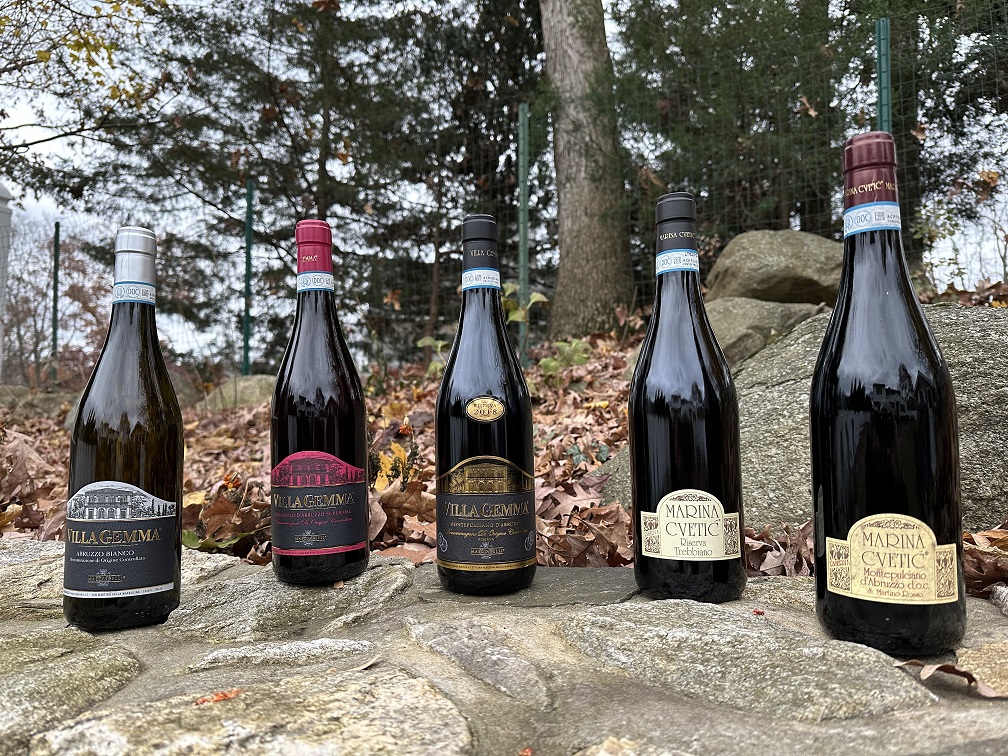
Here is a great example of the well-made, and thus easily recognizable Italian wine – or, rather, wines – Tenute Masciarelli in Abruzzo in Italy.
In terms of “wine time”, Masciarelli is a very young winery, founded in 1981 by Gianni Masciarelli. However, the impact in the wine world is not directly a function of time. Wine has been continuously produced throughout Italy for a few thousand years. In Abruzzo, a province located in central Italy along the Adriatic Sea, Montepulciano is the king. Simple Montepulciano red wines were produced forever in the region, perfectly quaffable, but not really comparable, for example, to the wines of Tuscany. Gianni Masciarelli spearheaded the change in the region, both in grape growing (he introduced the French Guyot training system for vines in the region) and production – he was the first to start using French oak barrels for aging the Montepulciano Abruzzo and Trebbiano d’Abruzzo wines. 1984 saw the first vintage of the Villa Gemma Montepulciano d’Abruzzo, the first of its kind single-vineyard Montepulciano d’Abruzzo wine, which will be celebrating 40 years of production this year.
Today, Masciarelly sustainably produces wines from all 4 provinces in Abruzzo. Annual wine production exceeds 1 million bottles across 7 different lines and 22 wine labels. A few months back, I had an opportunity to review Masciarelli’s introductory Linea Classica – 3 very well-made wines that were not only tasty but easily lasted for 5 days after being open – a testament to quality. Now, I had the pleasure of reviewing the latest releases from two more wine lines – Marina Cvetic and Villa Gemma.
Marina Cvetic line includes 2 of the classics – Trebbiano d’Abruzzo Riserva and Montepulciano d’Abruzzo – the second one is my perrenial favorite, I’m always happy to drink it. Additionally, the Marina Cvetic line includes four of international grape varieties (Chardonnay, Cabernet Sauvignon, Syrah, and Merlot) – however, I don’t think those are available in the US.
Villa Gemma, the winery’s flagship and the oldest produced line, includes three of the Abruzzo’s classics – white blend, Rosé, and Montepulciano d’Abruzzo Riserva.


Here are my notes:
2020 Masciarelli Marina Cvetić Trebbiano D’Abruzzo Riserva DOC (14% ABV, $60, 100% Trebbiano Abruzzese, 20-50 yo vines)
Light golden
A hint of tropical fruit, Whitestone fruit, honeysuckle
Round, clean, fresh, a hint of butter, soft and creamy texture with Meyer lemon finish
8, the wine is a bit aggressive when just opened, don’t over-chill it (I would serve it around 50F) and let it breathe, maybe 30 minutes in a decanter. Will stay fresh in the fridge for a few weeks.
2022 Masciarelli Villa Gemma Abruzzo Bianco DOC (14% ABV, $24, 50% Trebbiano, 30% Pecorino, 20% Cococciola)
Straw pale
whitestone fruit, lemon, clean, inviting
Crisp, clean, good acidity, lemon, expressive minerality, good balance
8, excellent
2022 Masciarelli Villa Gemma Cerasuolo D’Abruzzo Superiore DOC (14% ABV, $24, 100% Montepulciano)
Beautiful cranberry pink
Restrained nose of fresh strawberries, pleasant
Strawberries, cranberries, fresh, bright, excellent acidity, good balance, delicious
8
2019 Masciarelli Marina Cvetić Montepulciano d’Abruzzo Reserva DOC (14.6% ABV, $38, 100% Montepulciano, 15-30 yo vines, 12 months in French oak barrels)
Dark garnet, almost black
Dark cherries, espresso, tar, mocha, medium intensity
Dark cherries, silky smooth with beautifully present tannins, layered, round, well present, delicious.
8+, these are day 2 and day 6 notes, this wine is made of the long haul, was not very enjoyable upon opening, you need to decant it for 2-3 hours or forget it in the cellar for 10-15 years as the least.
2018 Masciarelli Villa Gemma Riserva Montepulciano D’Abruzzo DOC (15% ABV, $98, 100% Montepulciano, 35 yo vines, 12 months in French oak barrels)
Dark garnet, practically black
Black cherries, a hint of a barnyard
Black cherries, cherry pits, silky smooth roll-of-the-tongue texture, good acidity, excellent balance
8+, this is a big wine. It is surprisingly pop’n’pour, but will improve with the cellaring.
Here you are, my friends – wine, a liquid art form, made in Italy.
Do you think that Italian wines are easily distinguishable? What are your favorite Italian wine producers?
Deceptive Simplicity: Masciarelli Linea Classica
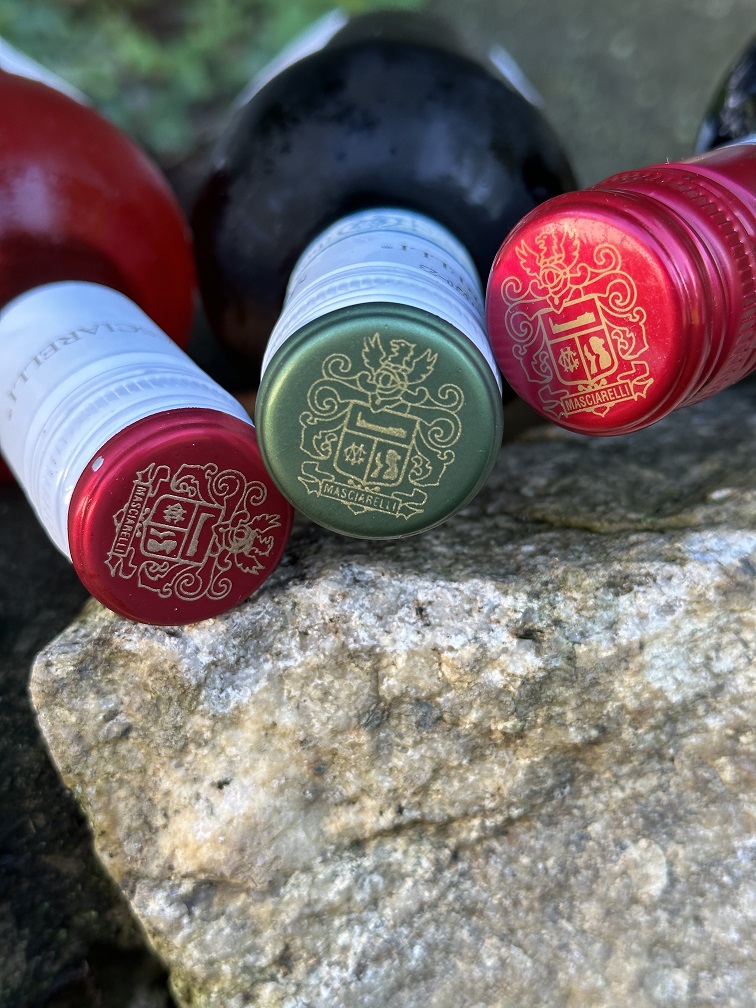 Simple is an interesting word to use around food and wine – there is a lot of dependency on the context.
I love simple recipes – one of my favorite recipes for sauteed eggplant has only 5 ingredients in it, takes 30 minutes to make and the result is consistently delicious. Air-fried salmon bites take less than a minute to prep, consist of only salmon and seasoning, and again, are consistently delicious. Near East couscous takes 5 minutes to make – and it is a perfect side dish every time it is made. When it comes to food, “simple” usually is a good word.
Calling the wine simple requires clarifications, it requires real context. “Simple wine” often means inexpensive, and this is a good thing – as long as the wine tastes good, as long as wine gives you pleasure “simple/inexpensive” is a good word (nobody likes “inexpensive” but crappy). Simple can apply to the label and overall packaging. The wine can also taste simple, and here the truth is in the eye of the beholder – many people prefer simpler-tasting wines so they will not interfere with the food. But if someone is craving complex, thought-provoking, multi-layered wine, “simple” is the last descriptor that someone will be happy about. “Simple wine” has a meaning only in the context.
The interesting part of a “simple wine” designation is that once we call the wine simple based on price and appearance, we make assumptions about the taste. Once we say “simple wine”, we are intuned to take it all the way – assuming that this simply looking wine will be also simply tasting wine.
Can simple packaging and a reasonable price hide the wine of a much grander standing than it appears to be? In other words, can simplicity be deceiving? Of course. Let me present my case to you – a classic lineup (Linea Classica) of wines from Tenuta Agricola Masciarelli in Abruzzo Italy.
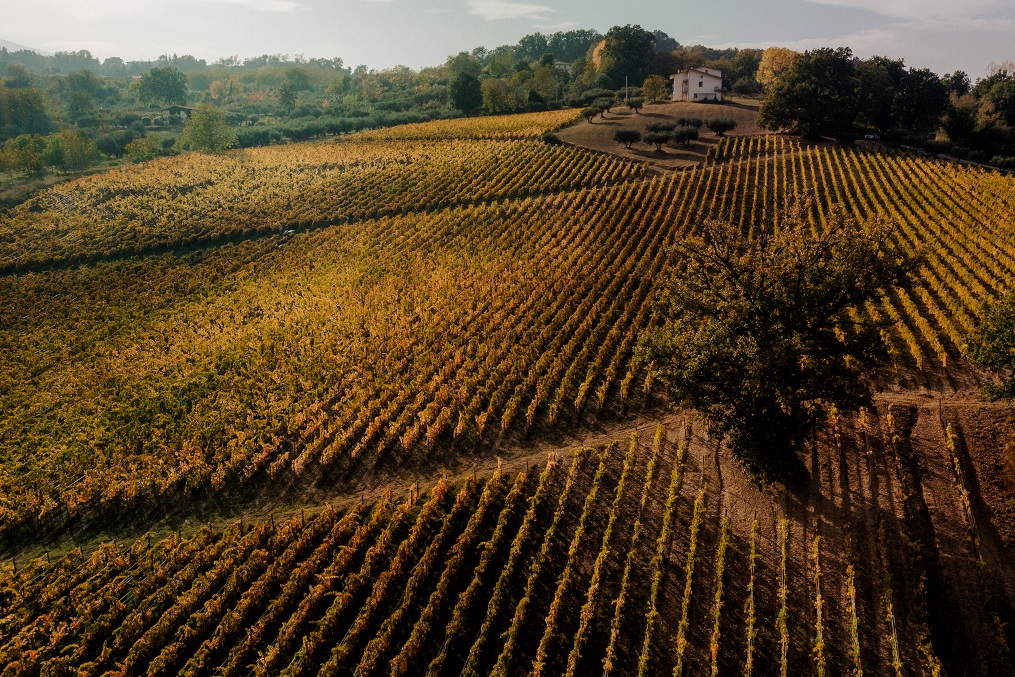
Masciarelli Vineyards. Source: Tenuta Agricola masciarelli
Gianni Masciarelli produced his first vintage of red, white, and Rosé in 1981 from the 5 acres vineyard owned by his grandfather and located near the family house in San Martino in the province of Chieti in Abruzzo. Abruzzo region, located east of Rome along the Adriatic coast is best known for its – here it comes again – simple white and red wines, produced, respectively, from Trebbiano and Montepulciano. From the very beginning, Gianno was convinced that Abruzzo was capable of producing world-class wines. He worked very hard not only in his own winery but pushing forward the whole region. Gianny was the first to introduce a French Guyot training system for the vines and French oak barrels for aging the Montepulciano and Trebbiano wines. By the way, while Trebbiano is a popular white grape that grows all over Italy, Trebbiano Abruzzese is a local ancient Trebbiano clone that is growing only in Abruzzo. Trebbiano Abruzzese has lower yields and produces wines that can age.
Today, Tenuta Agricola Masciarelli is run by Giovanni’s wife, Marina Cvetić, together with their eldest daughter, Miriam Lee Masciarelli. Tenuta Masciarelli is the only winery that owns vineyards in all four provinces in Abruzzo (Chieti, Pescara, Teramo, l’Aquila). The vineyards span 740 acres (300 hectares) and consist of 60 non-adjacent parcels. Masciarelli produces 7 different lines of wines, 4 out of which are exported to the USA. The winery produces about 2.2 million bottles of wine every year that gets exported to 55 countries.
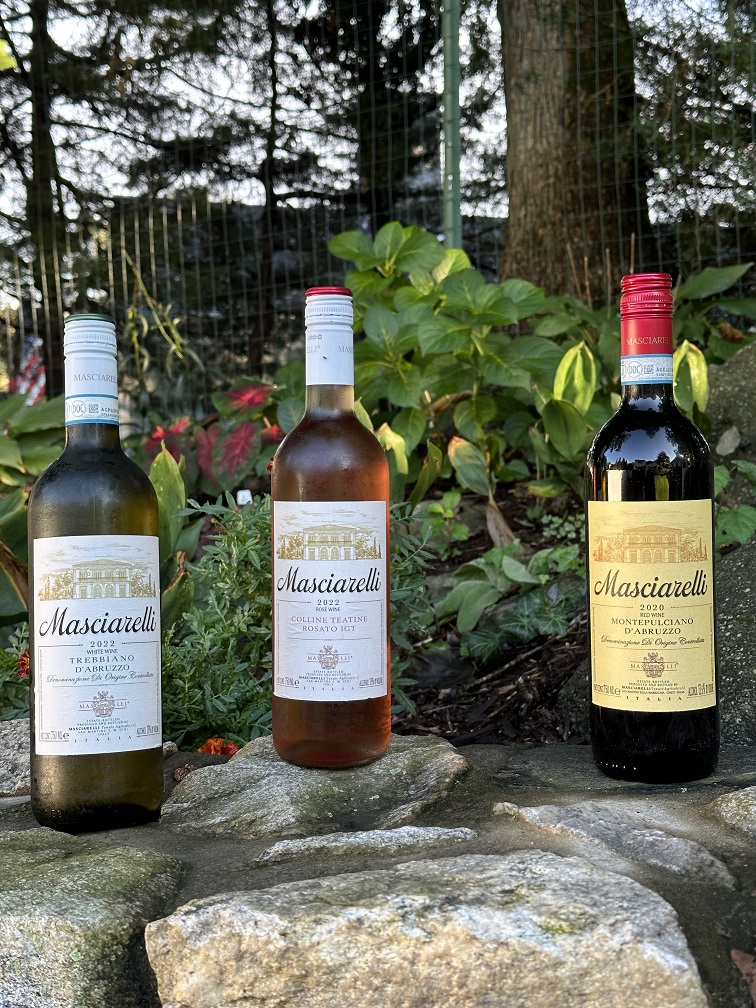 Here are my notes for the Linea Classica wines I had an opportunity to try:
2022 Masciarelli Trebbiano di Abruzzo DOC (13% ABV, $15)
Light golden
Tropical fruit, peach, minerality, medium intensity, inviting
Crisp, fresh, lemon notes, tart minerality, medium long refreshing finish, cleansing acidity, very nice
8-/8
2022 Masciarelli Colline Teatine Rosato IGT (13% ABV, $14)
Beautiful salmon pink
Fresh strawberries on the nose
Strawberries, brilliant fresh strawberries, cranberries, perfect acidity, good mouthfeel presence, crisp and clean finish. Excellent.
8
2020 Masciarelli Montepulciano di Abruzzo DOC (13.5% ABV, $15)
Dark garnet
Earthy, restrained, hint of cherries
Dark tart cherries, succulent, a touch of tobacco, dark, earthy, minerality, good acidity, good balance, medium to full body.
8, excellent
All three wines are unoaked and … yes… simple. At least in their presentation and pricing. But here is the interesting part. You can’t treat them as “simple wines”. Despite being unoaked, all three wines improved on the next day. And the next day. And even the next day. Truth be told, after I just opened and tried the Montepulciano, I was simply upset – the wine was not drinkable. For sure for my palate – green and tart. It became better the next day. And it really blossomed on the third day. In total, I enjoyed this screwtop-capped wine over the 6 days – pouring a glass, twisting the cap back, and leaving it on until the next day on the counter. And the wine kept getting better and better. This is a testament to the quality of this simple wine. And this simple wine can definitely age and it will become better with age. All for under $15.
Simplicity can be deceiving. Don’t take my word for it – try Masciarelli Linea Classica for yourself and let’s compare the notes. Cheers!
Patches of Goodness – Introducing Ferzo
In Italian, Ferzo is a patch of fabric that is stitched together with others to create a sail. Let’s sail together into the world of wine.
Wine lovers are some of the happiest people in the world.
Don’t jump to any conclusions – the happiness starts before the bottle is open, not after the wine is consumed.
How I mean it? Let me explain.
I personally believe that travel is one of the best things people can do as a pastime. You get to experience a different culture, people, food, and lots more. Travel typically requires planning – money, time off work, finding someone to sit with your three dogs, water plants, feed goldfish … you get the picture. A successful trip requires one’s full, undivided involvement, from start to finish – and then it usually ends with happy memories.
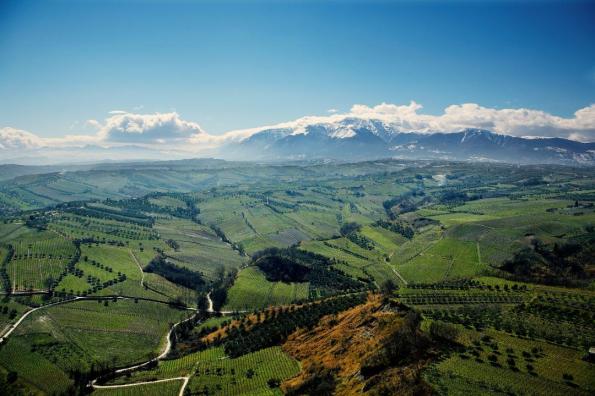
Wine lovers, on another hand, have it easy. It is enough to take a bottle of wine in your hands, and you are instantly transported. Your trip starts with the first look at the label, and then it is only limited by your imagination. The more you learn about the world of wine, the easier such travel becomes. You can instantly immerse into the culture, imagine visiting the vineyard, talking to the people, sitting in the tiny cafe with a glass of wine, just observing life as it happens. Sounds good? Can I take you on a trip right now, right at this moment? Of course, I know you are ready. I’m inviting you to visit Italy, the region called Abruzzo.
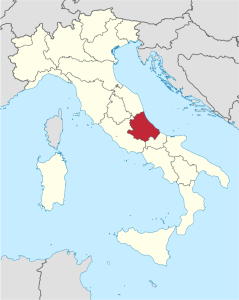 Abruzzo is a region in Central Italy, located along the Adriatic Sea coast. The territory of Abruzzo is about half of the size of the US state of New Jersey. However, the region boasts the biggest number of forests and parks compared to any other region in Italy, and thus sometimes it is referred to as “the lungs of Italy”.
There is nothing unique about winemaking in Abruzzo – it is only about a few thousand years old, on par with the rest of Italy. Well, jokes aside, the Abruzzo region is enclosed in the Apennines mountains, which historically provided natural defenses to the people living in the region – as well as ideal conditions for the winemaking.
Abruzzo wines became known internationally in the 17th century, largely thanks to the Spanish writer, Miguel de Cervantes, who praised the high quality of the region’s white wine, Trebbiano d’Abruzzo – however, today Abruzzo is first and foremost known for its red wine, Montepulciano di Abruzzo, produced from the grape called Montepulciano (try not to confuse it with the wine made in the Montepulciano village in Tuscany, which is made out of Sangiovese).
The wine is made is all four provinces of Abruzzo, however, the province of Chieti has the highest production of the four. While Montepulciano is a “king” of Abruzzo, the white grapes always played an essential role in the region. Today, the focus is shifting past the traditional Trebbiano towards until recently forgotten varieties, such as Pecorino, Passerina, and others.
Codice Citra is the largest winegrowing community in Abruzzo, uniting 3,000 winegrowing families from 9 different communes (wineries), collectively farming 15,000 acres of vineyards. Formed in 1973, Codice Citra had been making wines from the autochthonous varieties – Montepulciano, Trebbiano, Pecorino, Passerina and Cococciola.
With bottling capacity of 20,000 bottles per hour, you can imagine that Codice Citra produces quite a bit of wine. But this is not what we are talking about here. When you make wine year after year, you learn what works and what doesn’t. Little by little, you can identify the parcels of the vineyards, the patches, which produce different, maybe better grapes, year after year. And at some point, you decide – this patch is something special, maybe it deserves to be bottled on its own?


And that’s how Ferzo was born. Single grape wines, made from the plots with the vines of at least 20 years of age, representing the best Abruzzo has to offer – Montepulciano, Pecorino, Passerina and Cococciola. I had an opportunity to taste the line of Ferzo wines, graciously provided as samples by Donna White, and I was utterly impressed with the quality and the amount of pleasure each wine had to offer. Here are the notes:
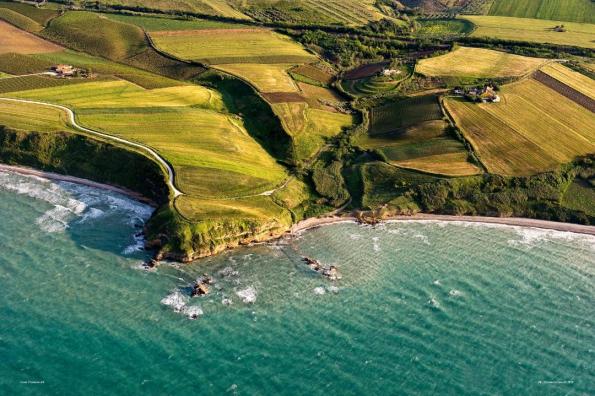
Tale of Two Reds – Are All Wine Lovers Eternal Optimists?
Let’s talk about red wines. And optimism. The connection between the two? You will see – give me a few minutes.
Let’s start from a simple question – how many chances do you give to a bottle of wine? Fine, let’s rephrase it. You open a bottle of wine. It is not corked, or if you think it is, you are not 100% sure. You taste the wine. The wine is not spoiled, but you don’t like it – doesn’t matter why, we are not interested in the reason – the bottom line is that it doesn’t give you pleasure. What do you do next?
Of course, breathing is the thing. You let the wine breathe – you pour it into a decanter, and let is stand – few hours, at least. You taste it again – and it still doesn’t make you happy. Your next action?
Let’s take a few notes here. First, we are not talking about the wine you feel obliged to drink – it is not a $200 bottle, it is not a first-growth Bordeaux – it is an average bottle of wine, let’s say, of $20-$40 value. Second, it is a quiet evening – let’s say, it is you and your spouse, and you have a luxury of opening another bottle of wine to enjoy.
As we said, two hours in decanter didn’t do anything. And another 4 hours didn’t help either. Or maybe you didn’t use the decanter, as you only wanted a glass, and dealing with moving the wine in and out of decanter was not your priority, so the wine was standing in the open bottle. In any case, it is the end of the day, and it is time to go to sleep – and the wine is still not what you want to drink. What is next?
At this point, you got a few options – leave the bottle on the counter, dump it into the sink, put it aside into the “to cook with” section, or pump the air out and see what the next day will bring. Let’s assume you’ve chosen the latter option, but the next day didn’t improve the situation – for how long will you keep trying?


While I’m sending you on the trip down the memory lane (or maybe not), let me share with you my most recent experience. On December 31st, I opened the bottle of 2012 Codice Citra Laus Vitae Riserva Montepulciano d’Abruzzo DOP (14% ABV, $32). I had very high expectations of this bottle for a few reasons. First, the bottle itself is a BAB (for the uninitiated, it stands for Big Ass Bottle – a heavy, thick glass, pleasant to hold, bottle), which always creates high expectations for me. Second, I have high respect to the Montepulciano d’Abruzzo – was surprised with the quality more often than not. Third, I just tasted through the samples of a new line of wines from the same producer, Codice Citra (the line is called Ferzo), four delicious wines, more about it in a later post – obviously, all of this added up to the expectations. Only the first sip delivered nothing but disappointment.
I took a sip of the wine, all ready to say “wow”, and instead the first thought was – “heat damage”? Most prominent note on the palate was stewed fruit, which is definitely a problem for the 6/7 years old wine, clearly meant to have a long cellar life. What happened? Was the wine stored improperly? No way I can pour this to my guests, so put the cork in, pump the air out and let’s see what will happen.
Every day from there on, I would pull the cork out, pour a glass, taste, and sigh. Still, the stewed fruit in various amounts – day three seem to show some improvement only to go back on day 4. Can you see me winding up the drama? What do you expect happened on day 5?
January 4th, I’m pouring another glass, not expecting anything good, but willing to finish the “experiment”, and subconsciously still surprised that BAB didn’t deliver. The first sip extorts “wow” and the thought of “what just happened”? The core of pure, ripe, tart cherries with a touch of a cherry pit, the hallmark of good Montepulciano, is laughing at me. Firm structure, fresh tannins, balancing acidity – the transformation couldn’t have been more dramatic. I thoroughly enjoyed every last drop of that wine, still utterly amazed at how little I understand in the mystery of the wine.


The second wine, which I happened to open a day later, but played with in parallel to the Montepulciano, worked in a very similar fashion. I got the bottle of 2014 Ernesto Catena “Tikal Amorio” Malbec Mendoza Argentina (13.5% ABV, $30) as the present from Chuck Prevatte of Food, Wine, Beer, Travel blog as part of the “Secret Wine Santa” fun originated and run by Jeff Kralik, a.k.a. The Drunken Cyclist. Chuck sent me a bottle with the message that Malbec is his favorite wine, and he was hoping that I will also enjoy his selection.
Okay, so here is another gaping hole in my “I don’t discriminate against any wine” adage – Argentinian Malbec is not my thing. I will gladly jump at Cahors, but given an option, unless I perfectly know the producer and the wine, I will avoid Argentinian Malbec as a generic category (as an example Broquel, Kaiken, Achaval-Ferrer, Trapiche are all on the “good list”). Yes, I will still try the Malbec I don’t know (someone has to eat the broccoli, right?), but only if asked. If you are interested in the reason, it has something to do with the flavor profile – I had a lot of Argentinian Malbecs which lack acidity and have too much of the overripe fruit and baking spices – interestingly enough, that exact flavor profile often wins the “easy to drink” praise among wine consumers.
Anyway, the Tikal Amorio Malbec had a very attractive label and sounded good from the description – the wine was created for the love of the grape and represented a blend of Malbec grapes from 3 different vineyard sites in Mendoza. Besides, it was recommended, so as I was opening the bottle, the thought was a happy “what if…” The first sip, however, brought (I’m sure you guessed it) the “this is why I don’t like the Argentinian Malbec” sigh – flabby fruit, very little acidity, and lots of baking spices. Ooh. I will spare you the day by day description – not much changed over the three days. But on the 4th day… The first sip brought in perfectly ripe blueberries with the core of acidity – nothing flabby, perfect structure, firm, fresh “pop in your mouth” blueberries with undertones of tobacco. The wine beautifully transformed (another mystery), and similarly to the Montepulciano, was gone in no time.
Here it is, my friends, a tale of two reds – and an ode to the optimism, don’t you think? Have you been in a similar situation? What do you do when you discover the wine you don’t like at first sight? How many chances would you give it? Cheers!
Hold The Pizza – I Just Want The Wine: Masciarelli Villa Gemma
At the age of 20, Gianni Masciarelli was helping with the harvest in Champagne. At the age of 26, in 1981, he started making his own wines in the Italian region called Abruzzo. 1984 was the first release of the Villa Gemma Rosso wine, truly a different take on the Montepulciano wines.
Montepulciano is the main grape of Abruzzo (not to be confused with Montepulciano in Tuscany, which is the name of the village where the wines are made from Sangiovese grape). Late in the 20th century, Montepulciano d’Abruzzo became one of the most exported Italian wines – it was dry, it was simple, it was quaffable and, of course, good for pizza.
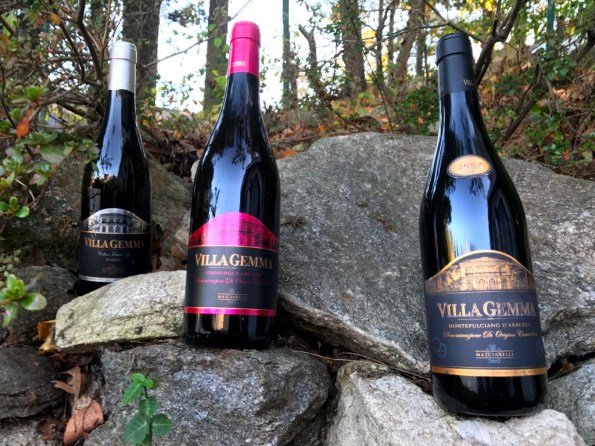
Gianni Masciarelli had his own, pioneer view on how the Montepulciano wines should be made. He introduced the Guyot training system for the vines in Abruzzo. He was the first to start using French oak barrels in the production of Montepulciano d’Abruzzo and Trebbiano d’Abruzzo, showing the world that Montepulciano can go way beyond just a “pizza wine” qualities. Today, Masciarelli estates are run by Marina Cvetic Masciarelli, late wife of Gianni Masciarelli; the vineyards spawn 350 acres and produce about 1.1M bottles of wine across 5 different lines.
Recently, I had an opportunity to taste a few of the wines from the Villa Gemma line, and here are my notes:
2016 Masciarelli Villa Gemma Blanco Colline Teatine IGT (13% ABV, $17.99, 80% Trebbiano d’Abruzzo, 15% Cococciola, 5% Chardonnay)
C: light golden
N: a touch of fresh grass, a hint of white stone fruit, a hint of gunflint, medium intensity
P: crisp, refreshing, crunchy, touch of lemon, slightly underripe peaches, very clean, medium finish
V: 8-, craving food, excellent overall. Trebbiano d’Abruzzo and Cococciola also extended my grape hunting collection
2016 Masciarelli Villa Gemma Cerasuolo D’Abruzzo DOC (13.5% ABV, $14.99, 100% Montepulciano)
C: intense, ripe strawberry pink
N: pure strawberries, fresh, succulent strawberries
P: fresh, tart, restrained, lightweight, clean strawberry profile, good overall balance
V: 8, simply delightful. An excellent Rosé for any time of the year
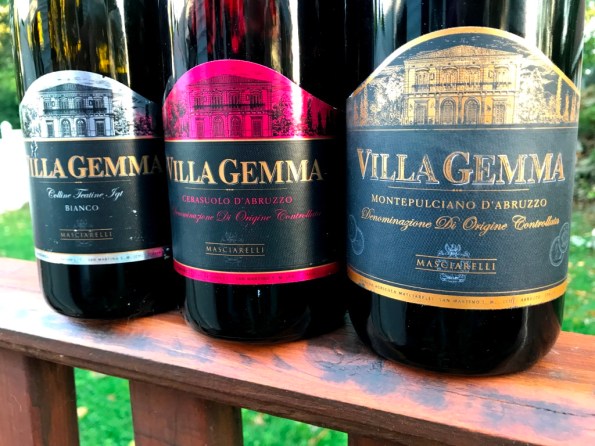
2007 Masciarelli Villa Gemma Montepulciano D’Abruzzo DOC (14.5% ABV, $89.99, 100% Montepulciano, aged 18-24 months in oak barriques, total 36 months))
C: Dark garnet
N: fresh cherries, anis, mint, blackberries
P: soft, generous, round, fresh acidity, touch of leather, cherries and cherry pit, generous tannins on the finish.
V: 8, excellent wine, unmistakably Italian, supremely delicious.
These wines were absolutely delicious in their own right. I seriously don’t know about pizza – you can probably pair anything with pizza, from two buck chuck to the Screaming Eagle and Petrus – but you really don’t have to. These three wines from Masciarelli Villa Gemma would perfectly complement any dinner – appetizers, salads, and mains – these wines pack a serious amount of pleasure. Don’t take my word for it – try them for yourself. The pizza is entirely optional. Cheers!
Last Bottle Sign Up ($10 credit)




 Talk-A-Vino