Archive
Wednesday’s Meritage – Wine Quiz Answer, Wine Blogging Wednesday Returns, New Wine Writing Challenge Announced, And more
 Meritage time!
Let’s start with the answer for the wine quiz #66, Grape Trivia – Chardonnay. In that quiz you were supposed to answer 5 questions about probably most popular white grape in the world – Chardonnay.
Here are the questions, now with the answers.
Q1: Name the producer of the most expensive Chardonnay wine in the world. As an added bonus, please also provide the name of the wine.
A1: Domaine Romanee-Conti (DRC), which is probably the most famous in the world producer of red Burgundy wines also makes a tiny quantity of the white Burgundy in Montrachet. This wine is impossible to find, but if you will, it will set you back by at least $3,000.
Q2: Chablis used to be the bustling Chardonnay producer in France, supplying most of the wine in Paris and beyond, until it came to the severe decline during the beginning to the middle of the 20th century. Do you know what was one of the biggest factors which led to that decline?
A2: The time periods in this question should be slightly adjusted – it should be really late 19th century, not beginning to middle of the 20th. Nevertheless, the quick answer here is … railroad. Until the railroad was built in France in 1850s, Chablis held near monopoly on Parisian wine market, being able to easily supply the wine by the river. Railroads allowed easy access for much cheaper wines of South of France to the lucrative market, which shook Chablis’ dominance. Then there were other factors, such a philloxera, but it all started from the railroad…
Q3: Name 3 main flavor descriptors of the *big* California Chardonnay
A3: Vanilla, butter and oak – read the description of any “big” California chard, and most likely you will find all these words.
Q4: Judgement of Paris of 1976 was instrumental in bringing California Chardonnay onto the world-class wine map. Do you know which California winery we need to thank for that?
A4: Chateau Montelena was the one!
Q5: As with many other grapes, various clones had being developed for Chardonnay, to adapt better for the particular region and/or resulting wine style – for example, there is a number of so called Dijon clones of Chardonnay, which can be used by anyone wishing to produce a classic Burgundy style wine. One of the clones was developed in California in the middle of 20th century, and it is still a very popular choice among many California Chardonnay producers to the date. Can you name that clone?
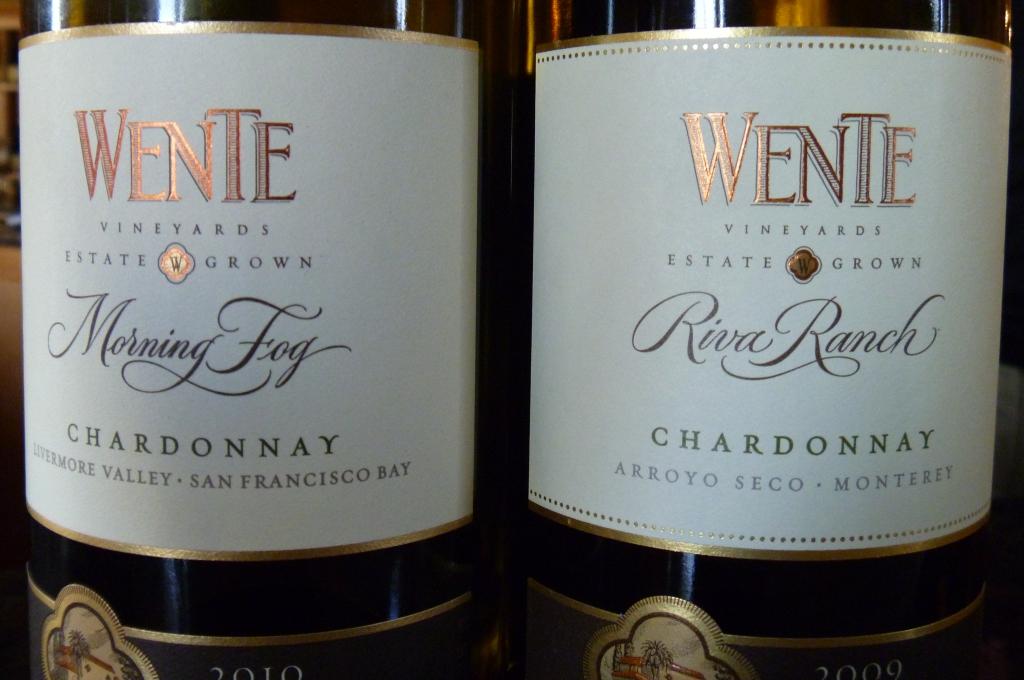
A5: Wente clone. It took about 40 years to create the Wente Chardonnay clone, which became a popular choice among winegrowers in California in the 1940s – 1950s. You can read this article for more details.
Looking at the results of this quiz, I have to tell you that I actually anticipated higher success rate – but it seems that outside of the question 4, which was answered correctly by all, the rest of the questions came up to be rather difficult. We don’t have a winner today, bu the honorable mention goes to Asueba, who correctly answered questions 1 and 4, and was quite close with the answers for the questions 2 and 3.
Now, to the interesting stuff around vine and web!
Well, I don’t even know where to start – lots of interesting things are happening!
First, the newly minted queen of the Wine Writing Challenge, Kirsten, a.k.a. The Armchair Sommelier, announced the new trouble theme for the 2nd Monthly Wine Writing Challenge. Why “trouble theme” you ask? That’s just the name of the theme – Trouble. You can read all the details here, and start getting in trouble. Oh yes, and if you are a creative type, we are also looking for the cool loge for this Monthly Wine Writing Challenge exercise – get your creative juices flowing! The submission deadline is August 17th – summer days are flying fast, don’t get in trouble and don’t miss your chance to steal the crown…
 Now, I have to tell you that Wine Blogging Wednesday is back!!! For those of you who missed it ( which will probably be quite a few people), this was a popular monthly wine blogging exercise. Every month a new theme was announced, like Cabernet Sauvignon, or Viognier, or Single Vineyards and so on, with various bloggers playing role of the host. This was not a competition, but rather a thematic submission with the host producing a summary blog post after the wine blogging Wednesday, or #WBW, would take place. These #WBW events stopped for almost a year – and I’m glad to see them come back. The theme for the Wine Blogging Wednesday #80 (#WBW80) is Dry Rosé, and the #WBW80 event will take place on August 14th. For all the details on the #WBW80 and previous 79 #WBW events, please visit Wine Blogging Wednesday web site.
It is hot. It is the summer. But – 31 days of Riesling event is in full swing! Nothing cools you off better than nice and refreshing glass of Riesling. The 31 Days of Riesling event is going on until the end of July – check the event web site for the participating restaurants, stores and tons of interesting stuff about Riesling.
When was the last time you tasted Chenin Blanc wines? Lettie Teague, the wine writer for the Wall Street Journal, calls Chenin Blanc a “delicious underdog” in her recent article. You might want to read it, and then may be even grab a bottle or two based on her recommendations – you might be in for a delicious surprise, as I was with Field Recordings Jurassic Park Vineyard Chenin Blanc.
Last but not least, I want to bring to your attention a rant by Duff Wines about the way we taste the wines and live our lives. It will worth your time, so I highly recommend it.
That’s all I have for you, folks. The glass is empty – but refill is on the way! Until the next time – Cheers!
Weekly Wine Quiz #66: Grape Trivia – Chardonnay
Chardonnay grapes after harvest, as presented in Wikipedia
Welcome to the weekend!
Here we are, continuing our wine quizzes now with the (dare I say it) most famous white grape – Chardonnay!
Seriously, is there another grape which receives equal amount of attention? Not as a fad, but as a constant center of attention all the time, with new winemakers offering their own personal take on the grape, coming from all over the world, competing for supremacy with producers who boast hundreds and hundreds years of “prior experience”? Is there a winemaking country in the world *not* making wine out of Chardonnay – I doubt so…
Origins of Chardonnay go all the way back to the 12th century, starting (of course, where else) in France in Burgundy region. Today, Chardonnay is one of the most planted grapes in the world with 400,000 acres planted worldwide (and about quarter of that in California alone). Part of such a wide success of the Chardonnay can be attributed to the fact that Chardonnay is very adaptable, and can be successfully grown in various conditions, including climate and soils. Additionally, Chardonnay is very “malleable” in the hands of the winemaker and can be used in variety of styles both with and without oak, and successfully ranging in the expression from sparkling to light and acidic white wines, going all the way to the heavy, big and monumental wines and then continuing on to the dessert wines (Australian “sticky”s come to mind). As you can imagine, such a popularity with the wine makers leads to the overproduction of boring and indiscreet wines, which generates periodic consumer backlash and creation of the self-proclaimed ABC clubs (Anything But Chardonnay). Nevertheless, anyone who had ever experienced great Chardonnay – coming from France, California, Chile, Australia, New Zealand, Italy, Hungary and many other places, will always come back for more.
Now, to the quiz!
Q1: Name the producer of the most expensive Chardonnay wine in the world. As an added bonus, please also provide the name of the wine.
Q2: Chablis used to be the bustling Chardonnay producer in France, supplying most of the wine in Paris and beyond, until it came to the severe decline during the beginning to the middle of the 20th century. Do you know what was one of the biggest factors which led to that decline?
Q3: Name 3 main flavor descriptors of the *big* California Chardonnay
Q4: Judgement of Paris of 1976 was instrumental in bringing California Chardonnay onto the world-class wine map. Do you know which California winery we need to thank for that?
Q5: As with many other grapes, various clones had being developed for Chardonnay, to adapt better for the particular region and/or resulting wine style – for example, there is a number of so called Dijon clones of Chardonnay, which can be used by anyone wishing to produce a classic Burgundy style wine. One of the clones was developed in California in the middle of 20th century, and it is still a very popular choice among many California Chardonnay producers to the date. Can you name that clone?
Good luck, have fun, enjoy your weekend and cheers!
Wednesday Meritage – Wine Quiz Answer, Some Useful Twitter Rules and more
Meritage time!
Let’s start with the answer to the wine quiz #65, Grape Trivia – Sauvignon Blanc. In the quiz you were supposed to answer 5 questions relevant to the Sauvignon Blanc, one of the most popular grapes in the world.
 Here are the questions, now with the answers.
Q1: Name the characteristic smell of (usually French) Sauvignon Blanc wine (hint – it is not the fresh cut grass)
A1: Cat pee, of course! If you don’t own a cat, find a friend who does… Well, you can figure the rest. Or just take my word for it. This is what classic Sancerre smells like…
Q2: Name [probably] the most famous wine in the world which contains Sauvignon Blanc as part of the blend.
A2: Chateau d’Yquem. In this question, I was not looking for the region, I was looking for one specific wine which stands head and shoulders above the rest. And yes, Chateau d’Yquem, the most famous Sauternes in the world, uses 20% of Sauvignon Blanc grapes as part of the blend.
Q3: Which one doesn’t belong and why?
a. Graves, b. Pouilly Fuisse, c. Pouilly Fumé, d. Sancerre, e. Touraine
A3: Pouilly Fuisse is an appellation in Burgundy, which grows Chardonnay – the rest of the appellations grow Sauvignon Blanc.
Q4: One person played a crucial role in making Sauvignon Blanc one of the major California white wines. Can you name that person?
A4: Robert Mondavi with his Fume Blanc wine almost single-handedly put Sauvignon Blanc on the California wine map.
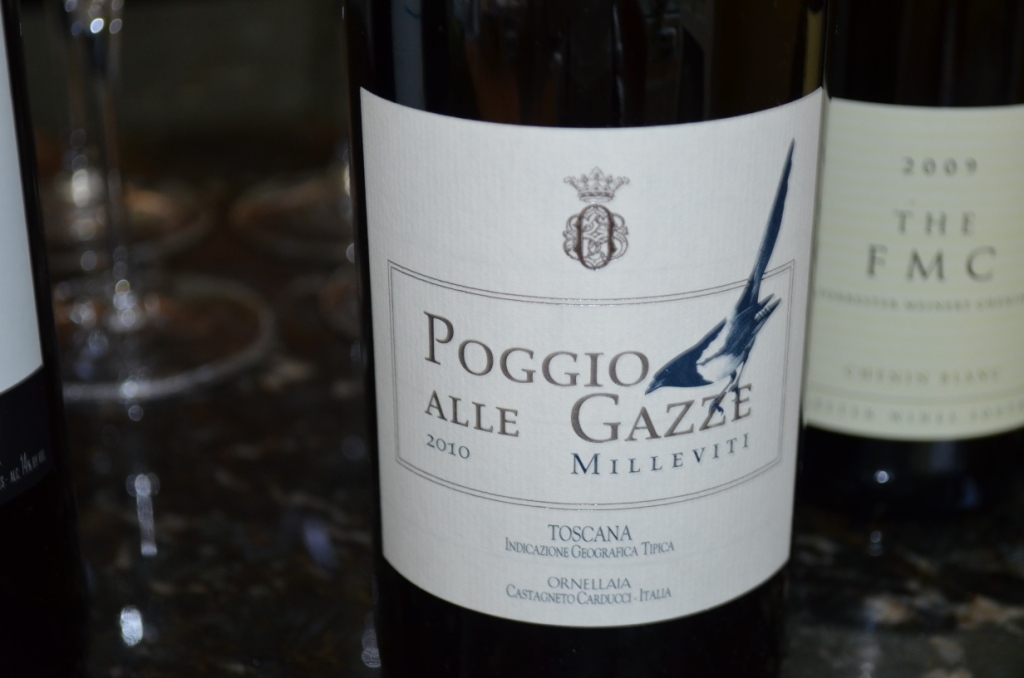
Q5: Below is the list of great Sauvignon Blanc wines and equally great producers. Do you know which producer made which wine?
| 1. Alteni di Brassica | a. Mara |
| 2. Poggio alle Gazze | b. Peter Michael |
| 3. White Grass | c. Campo di Sasso |
| 4. L Apres Midi | d. Ornellaia |
| 5. Mount Nelson | e. Gaja |
A5: The correct answer is 1e, 2d, 3a, 4b, 5c.
I’m glad to report that we do have a winner this time! Jeff, a.k.a. The Drunker Cyclist, got all 5 questions correctly! He gets unlimited bragging rights as a prize. Barbie gets an honorable mention for really pushing her point through (and she was right in what she was saying, however, it was still not the right answer – read the comment chain in the original post). Actually, I would like to acknowledge all the people who made an effort to answer the quiz – VinoInLove, WineAndHistoryVisited and EatWithNamie – please keep trying, there will be more quizzes to answer!
Now, to the interesting stuff around the vine and the web.
Quite honestly, I don’t have a lot to share. I guess it is the heat wave on East Coast. Or just me being pathologically lazy. Or something else. No matter. So the only interesting post I want to bring to your attention is the one by W. Blake Gray, where he explains the 6 rules he applies to Twitter. It actually makes perfect sense, but I can’t say, unfortunately, that I follow the same 6 rules. Well, read it for yourself and then decide – again, I think those rules make a lot of sense.
And yes, it is too hot, so I don’t have much else to share with you. Hope the heat wave will pass soon – 102F is way (way way way) past my liking.
Stay cool, drink something refreshing and cheers!
Weekly Wine Quiz #65: Grape Trivia – Sauvignon Blanc

Sauvignon Blanc grapes, as presented in Wikipedia
Welcome to the weekend!
We are continuing our white grapes explorations with this new wine quiz. In the spotlight – Sauvignon Blanc.
Sauvignon Blanc is definitely one of the major white grapes in the world. Literally every wine-producing country is making wines out of the Sauvignon Blanc – France, New Zealand, Chile, California, Italy and many others produce wine in variety of style – from unoaked, light, perfectly summery wines to the barrel-aged, round wines with lots of substance and going all the way to some of the best in the world dessert wines.
Sauvignon Blanc originated in Bordeaux, and spread out around the world in the 19th and mostly in the 20th century. The interesting fact is that while Sauvignon Blanc universally retains its acidity and some fresh cut grass notes, the resulting wines are definitely unique based on the region where the wine is made. French Sauvignon Blanc boast fresh cut grass and acidity, both Chile and New Zealand have lemon/lime/grapefruit as cornerstone of their flavor profile. Sauvignon Blanc wines in US typically show those fresh cut grass notes, but have a lot more fruit all around. Italy at the same time is taking Sauvignon Blanc to the totally new level of expression which have to be experienced. All in all, Sauvignon Blanc produces wines worthy every bit of attention.
Now, to the quiz!
Q1: Name the characteristic smell of (usually French) Sauvignon Blanc wine (hint – it is not the fresh cut grass)
Q2: Name [probably] the most famous wine in the world which contains Sauvignon Blanc as part of the blend.
Q3: Which one doesn’t belong and why?
a. Graves
b. Pouilly Fuisse
c. Pouilly Fumé
d. Sancerre
e. Touraine
Q4: One person played a crucial role in making Sauvignon Blanc one of the major California white wines. Can you name that person?
Q5: Below is the list of great Sauvignon Blanc wines and equally great producers. Do you know which producer made which wine?
| 1. Alteni di Brassica | a. Mara |
| 2. Poggio alle Gazze | b. Peter Michael |
| 3. White Grass | c. Campo di Sasso |
| 4. L Apres Midi | d. Ornellaia |
| 5. Mount Nelson | e. Gaja |
Good luck, have a great weekend and cheers!
Wednesday’s Meritage – Wine Quiz Answer, Transportation Challenge Round Up, Cabernet Day, Can We Resurrect #WBW?
 Meritage Time!
Let’s start with the answers for the wine quiz #64, Grape Trivia – Riesling. In that quiz, you were supposed to answer 5 questions regarding Riesling grape.
Here are the questions, now with the answers:
Q1: Riesling is a very popular grape in US and Canada, growing in many regions. Considering the plantings of the Riesling in the regions, can you sort the list below from the biggest area plantings to the smallest?
a. California, b. New York, c. Ontario, Canada, d. State of Washington
A1:correct sequence is Washington, California, Ontario, New York
Q2: Have you heard the term “noble rot”, which is often associated with certain types of Riesling? Can you explain what this term means and to which Riesling wines it is typically applicable (at least in Germany)?
A2: Noble Rot is actually a grape fungus, officially called Botrytis Cinerea, which affects a number of different grapes and leads to subsequent shriveling (drying) of the grapes while on the vine. This drying of the grapes tremendously concentrates sugars, which allows for the grapes to be used in production of the sweetest of all Rieslings – Trockenberenauslese.
Q3: Riesling is known for sometimes developing a specific aroma which has typically nothing to do with the wine – but it is not a fault. Do you know what aroma is that?
A3: Petrol. Believe it or not, but many Riesling wines (in some rare cases, even Riesling wines outside of Germany) can develop this petrol aroma. It is usually perceived only on the nose, and it doesn’t give you a feeling of being at the gas station – it is just a light hint, but when it is present, you can safely guess your wine being Riesling even in the blind tasting.
Q4: Name one major(!) wine producing country which doesn’t produce any Riesling wines.
A4: Spain. Spain is a home to the plenty of wonderful white grapes – but it doesn’t produce any Rieslings at all.
Q5: If you look at the bottle of German Riesling, you will typically see the word such as Kabinett or Spatlese written on the label. Such words typically indicate the level of sweetness you should expect from wine – even though this is not a precise definition, as these words only indicate sugar amount in the freshly pressed grape juice – the level of sugar in the resulting wine can be quite different depending on the way the fermentation is done. Can you sort the following list of these key indicators from the lowest sugar content to the highest?
a. Auslese, b. Berenauslese, c. Eiswein, d. Kabinett, e. Spatlese, f. Trockenberenauslese
A5:The correct line up is Kabinett, Spatlese, Auslese, Berenauslese/Eiswein, Trockenberenauslese (if you need full level of details, you can always go to Wikipedia).
It seems that the first question proved to be most challenging of all, as nobody was able to provide the right answer – as the result, we don’t have a winner this week. At the same time, The Wine Getter and Foxress both get an honorable mention with 4 correct answers out of 5.
Now, to the interesting stuff around the vine and web!
First of all, I want to bring to your attention a roundup of a Monthly Wine Blogging Challenge started by Jeff (a.k.a. The Drunken Cyclist). About a month or so ago, Jeff announced a wine blogging challenge based on the theme, similar to the challenges which are popular among photography bloggers. The first theme was Transportation, and the idea was to write the wine blog post which would relate to the designated theme. 10 wine bloggers participated in this challenge, and you can find links to all the blogs posts in this round up. I think this is a great idea and I hope more wine bloggers will participate next time.
Who remembers the Wine Blogging Wednesdays (#WBW)? Similar to the challenge I mentioned above, the WBW events had a theme, which in the most cases was a grape, a type of wine or a wine region, and they also had a host. The host was typically the one who suggested the original theme, and also it was the host’s job to provide a roundup of all the submitted blog posts. These #WBW events had a very good run of almost 8 years, and there was a dedicated web site which is still somewhat accessible. I think it might be cool to bring the #WBW events back – in case you experienced any of them, feel free to comment – do you think Wine Blogging Wednesday events should be resurrected?
Last but not least – the Cabernet Day is coming! Well, not tomorrow – but August 29th is the day. And you know how it works – the summer will be over in a blink, so it is never to early to prepare for celebration of such a noble grape as Cabernet. Here is the link to the invitation I received for the this Cabernet Day – join the festivities!
That’s all I have for you for today, folks. The glass is is empty – but more Meritage is coming. Cheers!
Weekly Wine Quiz #64: Grape Trivia – Riesling
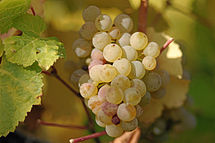
Ripe Riesling Grapes, as captured in Wikipedia
Welcome to the weekend and your new wine quiz!
And the moment you’ve being waiting for is here – as promised, we are switching to the white grapes! For the next 10 or so quizzes, we will be talking about white grapes. And we are starting with nothing less than the Riesling!
Riesling is one of the major white grapes (that “major” list typically includes Riesling, Sauvignon Blanc and Chardonnay) with long and somewhat turbulent history. The first official mentions of Riesling appear 1400s in Germany and then Alsace. From there, Riesling had been growing in popularity for the long time, about 100-120 years ago even surpassing red Bordeaux wines both in price and demand. Unfortunately, with prolonged wars and also subsequent Germany’s focus on quantity instead of quality in the middle of 20th century, Riesling lost its leadership position and currently is engaged in the uphill battle to regain its old popularity.
Overall, Riesling is considered to be very terroir-driven (similar to Pinot Noir), which you can easily see just by trying, for instance, German, Australian and Alsatian Rieslings side by side – you might perceive them as completely unrelated wines. Substantial acidity makes Riesling very food friendly (it is one of the most versatile white wines) and also allows it to age for a very long time – even 100 years would not be unheard of. Riesling is quite popular world-wide, growing in pretty much all major wine producing countries and slowly but steadily increasing both in terms of production and acreage.
Let’s get to our quiz, shall we?
Q1: Riesling is a very popular grape in US and Canada, growing in many regions. Considering the plantings of the Riesling in the regions, can you sort the list below from the biggest area plantings to the smallest?
a. California
b. New York
c. Ontario, Canada
d. State of Washington
Q2: Have you heard the term “noble rot”, which is often associated with certain types of Riesling? Can you explain what this term means and to which Riesling wines it is typically applicable (at least in Germany)?
Q3: Riesling is known for sometimes developing a specific aroma which has typically nothing to do with the wine – but it is not a fault. Do you know what aroma is that?
Q4: Name one major(!) wine producing country which doesn’t produce any Riesling wines.
Q5: If you look at the bottle of German Riesling, you will typically see the word such as Kabinett or Spatlese written on the label. Such words typically indicate the level of sweetness you should expect from wine – even though this is not a precise definition, as these words only indicate sugar amount in the freshly pressed grape juice – the level of sugar in the resulting wine can be quite different depending on the way the fermentation is done. Can you sort the following list of these key indicators from the lowest sugar content to the highest?
a. Auslese
b. Berenauslese
c. Eiswein
d. Kabinett
e. Spatlese
f. Trockenberenauslese
Good luck, enjoy and have a great weekend! Cheers!
Weekly Wine Quiz #63: Grape Trivia – Malbec
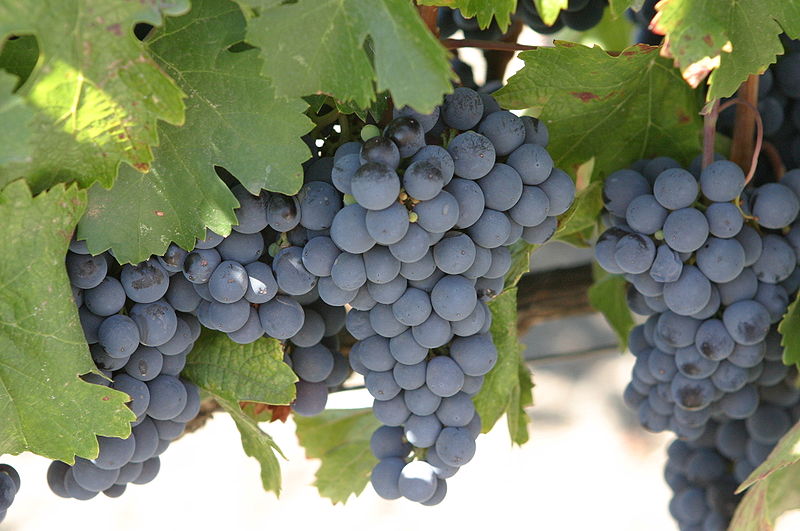
Malbec grapes, picture from Wikipedia
Welcome to the weekend and your new wine quiz!
Believe it or not, but we are still continuing the Grape Trivia series, and our subject for today is Malbec.
Malbec has one of the most dramatic fates out of many other red grapes, going from being one of the most popular among royal families and even the Pope, to becoming literally non existent. Today it is mostly grown in Argentina (50,000 acres) and France, but winemakers experiment with Malbec more and more all over the world. Use of Malbec ranges from being one of the five noble grapes in Bordeaux (but rarely being a star of the blend) to the single grape wonderful wines of Argentina.
Malbec grapes are black in color and have thin skin, however capable of accumulating a very substantial amount of tannins. Malbec is unfortunately prone to various grape diseases and viticultural hazards, such as frost, mildew and others. But the grape worth the effort as it can produce some of the most versatile red wines, ranging from very soft and approachable to the tannin monsters requiring long ageing. Now, to the quiz!
Here are the questions:
Q1: Explain the meaning of the name Malbec.
Q2: In France, Malbec is known under a number of different names, used in the different regions. Can you name at least two of those “other names”?
Q3: About 200 years ago, Malbec was widely planted in France, and it was considered to be one of the major grapes. Two events lead to severe decline in plantings and almost disappearance of Malbec as a grape of any importance. Do you know what events were those?
Q4: Some of the best Malbecs in the world come from Argentina. The quality of Malbec grapes in Argentina is also often associated with high altitude at which grapes are growing. Do you know what is the highest altitude of Malbec vineyards at the moment?
A: 1,500 feet
B: 5,000 feet
C: 7,000 feet
D: 3,000 feet
Q5: In its best times, Malbec was the grape made into so called Black Wine, very popular among Royal families. One Royal family went as far as even associating health benefits with consumption of Black wine. Now, do you know what Royal family was that and where the Black Wine was made?
Have fun, have a great weekend and cheers!
Wednesday’s Meritage – Wine Quiz Answer, Wine and Pregnancy, Impossible Food and Wine Pairings?, Don’t Diss The Chardonnay
 Meritage time!
Let’s start from the answer to the Wine Quiz #62, Grape trivia – Nebbiolo. In the quiz, you were supposed to answer 5 questions about Italian grape called Nebbiolo. Here are the questions, now with the answers:
Q1: Explain the meaning of the name “Nebbiolo”
A1: The name “Nebbiolo” comes from the Italian word nebbia, which means “fog”, by association with foggy hills of Piedmont.
Q2: In one of the regions outside Piedmont, the wines are produced from Nebbiolo grapes in the style of Amarone – with grapes drying on the straw mats before they are pressed. Can you name that region?
A2: Valtellina in Lombardy. I was lucky to attend a special seminar on Sfursat di Valtellina Nino Negri wines where I learned for the first time about this type of production (here is the link to my post). There was also a mention of Nebbiolo-based Recioto wines from Veneto – as this was really an experimental effort by one of the winemakers, I can’t count that as a right answer.
Q3: True or False: Blending is not allowed for any of the wines produced from Nebbiolo grape in Piedmont region.
A3: False. While blending is prohibited for Barolo and Barbaresco wines, it is allowed in Ghemme and Gattinara (however, many winemakers prefer to make wines with 100% Nebbiolo grapes).
Q4: White grape used to be such a traditional blending partner for Nebbiolo that it was sometimes called White Barolo. Do you know the name of this grape?
A4: Arneis. Arneis was a popular blending partner for the Barolo wines in the past, and that gave it a name of White Barolo.
Q5: In the blind tasting setting, the wines made out of Nebbiolo can be very distinguishable even before you take a first sip. Do you know what is this distinct feature of Nebbiolo wines?
A5: Orange hue. It is very indicative feature of Nebbiolo wines, especially as they gain any amount of age. You can also distinguish young Barolo by tremendous amount of tannins ( typically), but that is only a feature of particular style of wine and not the grape, and it is whole another story.
There were lots of responses this time! We have two winners (drum roll, please): VinoInLove and Mika ( no web site) get unlimited bragging rights. Also Stefano, Jeff TheDrunkenCyclist and Oliver TheWineGetter all get honorable mention with 4 correct answers out of 5. Thank you to all participants! We have one more red grape to cover for now, and then we are switching to whites. Oh yes, you can start guessing now, what will be this last red grape – you will find out if you are right or not on Saturday.
And now, to the interesting stuff around vine and web!
First, I want to bring to your attention an interesting article about wine and pregnancy from Vinography blog. I don’t know if there are right and wrong here, my personal theory that everything is good in moderation – and any good thing taken out of proportion can and will become your enemy. Still, it is an interesting read, and don’t miss the comments section.
Now, two of the bloggers I follow posted “impossible food and wine pairing” questions. Dr. Vino asked about pairing of wine with anchovies, and the TheArmchairSommelier had a very interesting question about pairing of the summer salad (which contains among other ingredients watermelon, blueberries, honey and feta), which sounds delicious by itself, but presents a substantial challenge of finding the right wine. Visit both blogs and offer your advice, if you will – of course if you want to comment here, I will be very happy to have the discussion in this blog.
Last but not least – a murder story and the warning to those who diss the Chardonnay, as presented by W. Blake Gray – read it here, it is short…
This is all I have for you – the glass is empty. But refill is coming, as usual – and don’t forget that today is Wine and Whiskey Wednesday (like you need a reason to drink, ha). Cheers!
Sometimes One “Wow” Is Not Enough
If you are a regular reader of this blog, you perfectly know by now that I have a tendency to get overly excited in my reviews (and if you are not a regular reader and just came across accidentally, you know it now). It is entirely possible that you also noticed that I have a soft spot towards Field Recordings wines. Based on this preamble, you probably figured out that I plan to talk about a wine from Field Recordings.
The wine which had me completely blown away a few days ago was 2011 Field Recordings Jurassic Park Vineyard Chenin Blanc Santa Ynez Valley (13.1% ABV). Opened the bottle, poured in the glass, sucked the air – and was blown away. Complex, multi-layered aromatics, which each smell showing slightly differently, and my emotional response (or rather, vocal), rotating between “wow” and “omg” with each and every breath. White stone fruit, apricots, fresh flowers, endless meadows – all coming separately, but together. Andrew Jones, the winemaker at Fields Recordings, is clearly the master of aromatics with his wines. Pretty much any of his wines I tried, have mind-boggling, intense aromatics – here is my post about red wine call Fiction by Field Recordings, read it for yourself.


The palate didn’t disappoint as well. Bright, open, succulent white fruit, more continuing that an apricot theme, with the touch of vanilla and apple, no sweetness whatsoever. Definitely a Chardonnay-like experience, except it is not chardonnay at all! Firm structure, refreshing acidity – each sip of the wine is begging not to stop – just one more sip, pleeease? Drinkability: 8+
The words don’t do this wine enough justice. Your best bet is to find this wine and to taste it. And yes, it is okay to repetitively “wow” all the way through. Cheers!
Last Bottle Sign Up ($10 credit)




 Talk-A-Vino