Archive
Daily Glass: Of Wonderwall and Unwooded Pinot
How can you tell when blogging is becoming an addiction? When you drink great wine, you think about it in the terms of the blog post. And when you are not producing that blog post for whatever reason, you become upset and feel incomplete…
I don’t want to feel incomplete – who does? And to avoid that feeling, let me tell you about few great wines I experienced recently.
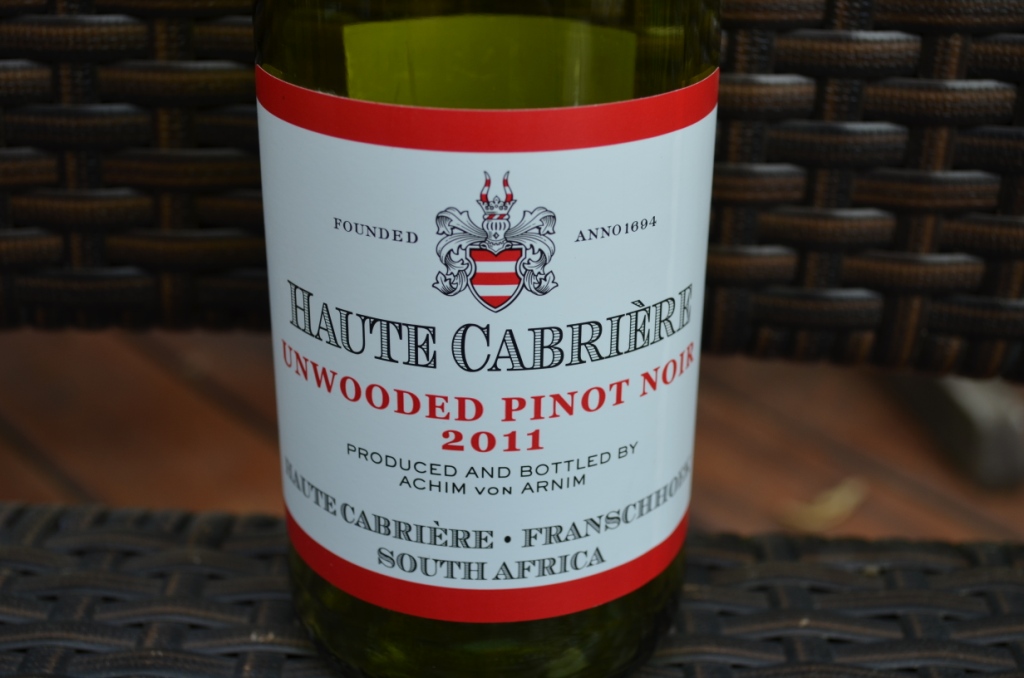 Last week, when it was hot and not crazy rainy as today (did someone up there forgot to turn off the faucet?), I walked into the wine store and told Zak that I’m in the mood for a nice bottle of Rosé. “Here”, he said handing me a bottle, “you have to try this”. Okay, I’m ready to try whatever Zak hands me with such a conviction. 2011 Haute Cabrière Unwooded Pinot Noir Franschhoek South Africa (12% ABV, $15.99) didn’t look like a Rosé, but hey, the proof is in the glass.
And what a proof it was! Light ruby color, the nose of strawberries, cranberries and onion peel (classic Rosé, huh?) – same on the palate – perfect substance, perfectly refreshing body – nothing wimpy, nothing sweet, only refreshing, light and exciting wine. This wine is produced by Achim von Arnim, whose blog is called Sun Soil Vine Man – which is also a motto of his winery. Tasting this unwooded Pinot Noir, I can say that his simple model works quite well. Drinkability: 8-
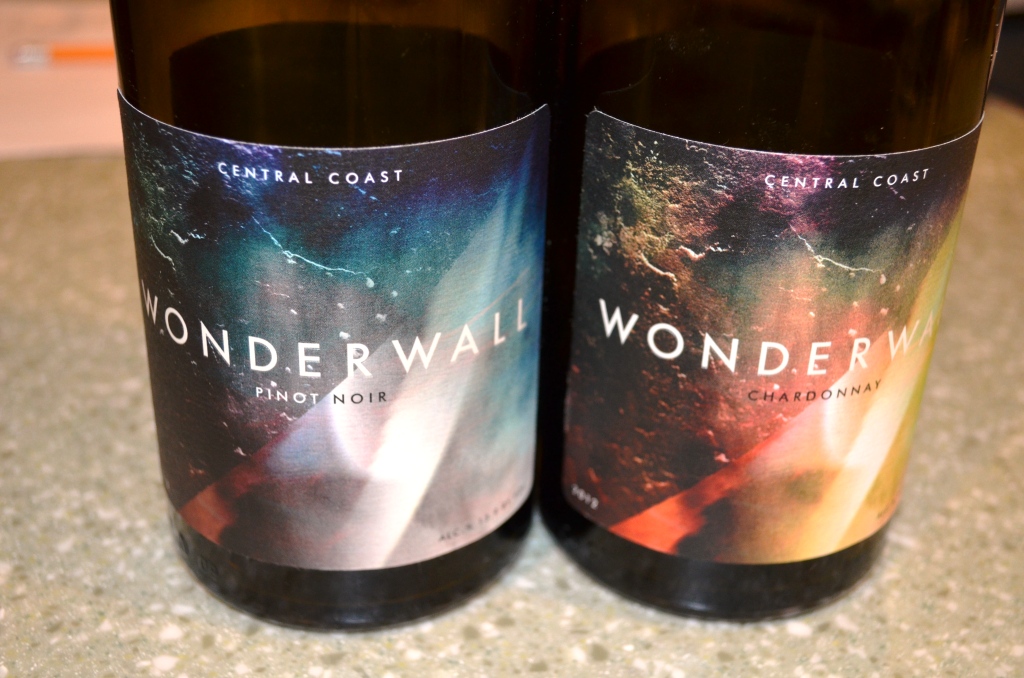
And then there was Wonderwall. First I tried 2012 Wonderwall Chardonnay Central Coast (14.9% ABV, $22/$17.60 for catalog members). These Wonderwall wines are produced by Andrew Jones, the winemaker behind Field Recordings wines, which I discussed many times in the blog – and of which I’m a big fun.
What is amazing about many Field Recordings wines is aromatics. Once you pour the wine into the glass, you simply can’t put it down – but not drinking, only smelling, and smelling and smelling. Some wines transform with their taste, and some just with their aromatics. Bright and beautiful fruit on the nose – together with fresh flowers. I experienced similar aromatics with some of the best Albarino wines – but not with California Chardonnay. Good amount of fruit on the palate, but tame, more controlled, balanced and perfectly weaved around acidity. When the bottle was finished (much faster than I would want to, unfortunately – this was my only bottle) – I smelled the bottle and it showed vanilla and touch of butter – but it was too late. I wish I had another bottle to try it at least in 3-4 years – oh well, may be someone will. Drinkability: 8
Then I had 2012 Wonderwall Pinot Noir Central Coast (13.9% ABV, $22/$17.60 for catalog members). To describe it in a few words, I would put it like this: from nose to palate – classic California Pinot Noir. Violet, cherries and hint of smokiness on the nose, cherries, cranberries and tart blackberries on the palate, all moving and evolving. On the palate, this wine is somewhat elusive, and it gives you a different perception with every sip. On the second day it showed bright, clean and assertive fruit, with mouthwatering acidity – you really want to give this wine some time (I will not, as again this was my only bottle). Drinkability: 7+
Before we part, I have to cite for you the words written on the back label of the Wonderwall wines:
“I’m unsure if it has been me, the grapes or the vineyards. There
has always been a barrier between me and the wine I wanted.
Finally, I have broken through the wall.”
That’s all I have for you, folks. And I feel better already. Cheers!
Daily Glass: Wine Happenings – Georgian Wines, New French Discoveries, Australia Grand Experience and more
Every week (or almost every week) I think that I should start writing a summary post similar to what Jeff at therunkenccyclist does so well – once a week he produces a summary of the wines he had during the past week (here is an example of his recent post), which I think is a great way to round up your experiences.
My “Daily Glass” designation was supposed to be [almost] a daily summary for me, but as you know, things don’t always work in life as we think they should. Nevertheless, the week which is ending today was very “wine eventful” hence I’m sharing those wine happenings with you.
Let me start from 2005 Domaine Lafage El Maset Cotes du Roussillon. I got it at Last Bottle Wines during their last “madness” sale. At $8, you really have nothing to lose, right? Wine arrived about 3 weeks ago, looking good – inviting label, heavy bottle, good punt at the bottom – overall looks quite solid. Before opened the bottle, I went to look for information online – and I didn’t find much except a number of notes on Cellar Tracker, all looking very peculiar. Looks like people had very sporadic luck with this wine, with only one bottle out of three being drinkable, and another claim of one out of 10 (!).
First thing I didn’t like when opened the bottle was the cork. You see, I love real corks (yes, I had my share of corked wines – but this is not the subject of this post). I’m completely okay with screwtops – I would be surprised to see a screwtop on the bottle of DRC, but in general, I get it – and it makes it easier to open a bottle, especially when you travel. But the type of corks I have a problem with are plastic and synthetic corks. They are hard to pull out, and just look very artificial – they just don’t belong to the wine world, in my opinion. Besides, somehow I think that they have the worst impact on aging ability of the wine .


This wine was closed with red plastic cork ( you can see it in the picture). Okay, moving along. It is 8 years old wine, how about pop and pour? Pour, swirl, sip – ouch! The feeling of biting into a freshly cut tree brunch. Bitterrrr! My wife had her taste, put the glass down, and politely said “I think it should breath a little first”. Okay, got a decanter, pour half of the bottle in. By the way, the interesting fact is that after that first bitter sip, the wine stayed in my mouth with a very long and rather pleasant (!) finish – probably for the next 10+ minutes. Two and the half hours later… I wish I can tell you the wine magically transformed – no, it became only somewhat better. Dark fruit appeared, tannins became mellower, but the wine was not together – there was no harmony there.
We finished the bottle next day, and it still didn’t improve much more – may be it needed more time? I’m not sure, but I have one more bottle, which I plan to give a little time – will see what will happen. But I also have to tell you that I had one of the most surprising pairings with this wine – as you can guess from the picture, this wine paired excellently (I’m serious) with … cherry preserve! They were literally meant for each other – take a spoon of cherry preserve, sip of this wine – perfect! I never thought of wine and preserve together before – may be I should try it more often? This wine will stay unrated for now, as it is very hard to put a handle on this experience.
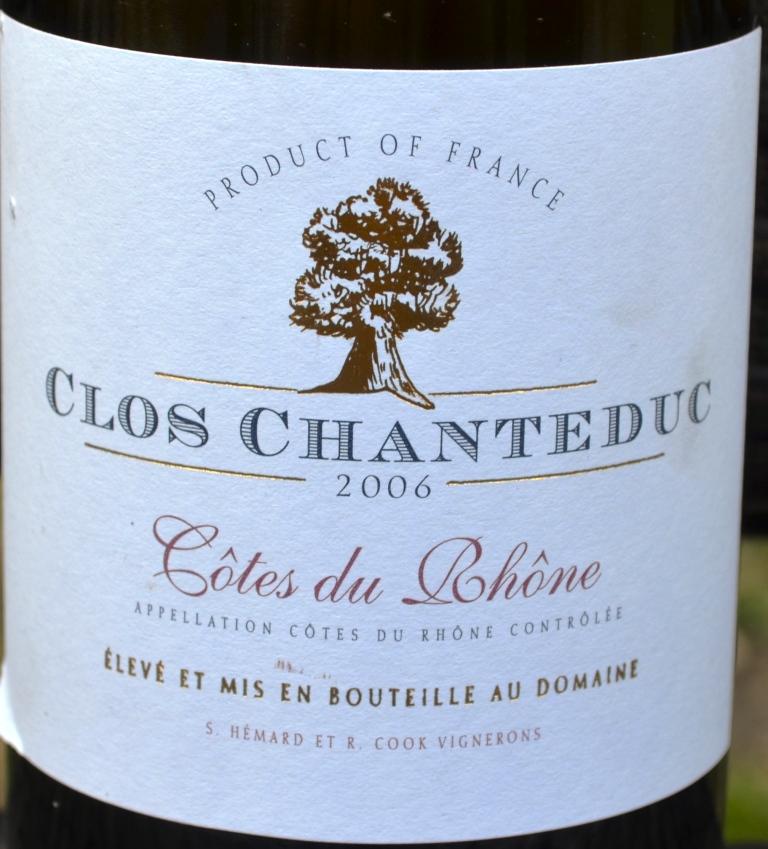 Next wine was also sourced from the Last Bottles – 2006 Clos Chanteduc Cotes Du Rhone. I was unable to find good information on this 2006 vintage, current available vintage of this wine is 2010, but I would assume that the composition stayed about the same, so it should be Grenache/Syrah blend (2/3 Grenache, 1/3 Syrah), a classic Rhone blend. The wine is associated with Patricia Wells, a well known chef living in France. While looking for information about this wine, I found an interesting post about 2009 version in the blog called Wayward Wine – here is a link for you, it is a good reading. Getting back to this 2006 wine, it was rather a typical Cote du Rhone – soft, supple, good mid-palate of plums and cherries – but may be too soft and too supple, it was missing a wow factor. Drinkability: 7.
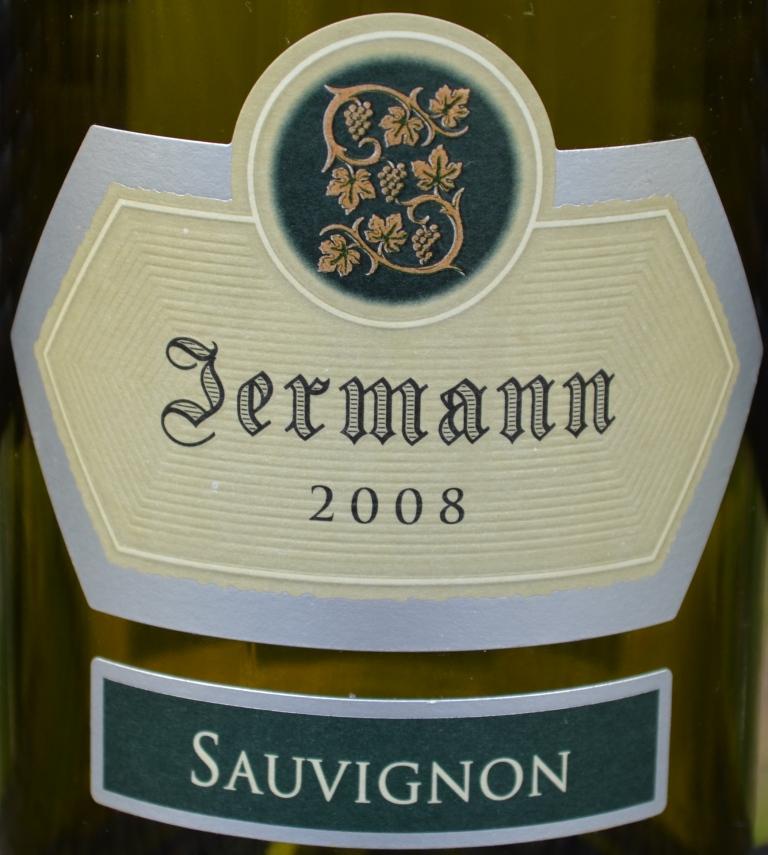 The next wine I want to mention is 2008 Jermann Sauvignon Blanc Venezia Giulia IGT. Jermann is one of my all time favorite Italian producers – I don’t think I tasted any wines I didn’t like from Jermann. This Sauvignon Blanc was closed with screwtop, and the wine is 5 years old – but it came out clean and round on the palate, with perfect amount of white fruit, some herbal notes, perfect minerality and acidity – very enjoyable by itself and with the food. Drinkability: 8-
Now, let’s get to the subject of this post and talk about Georgian and new French wines I discovered. Last Friday I stopped at the tasting at Fairway Market in Stamford, where Michael from importing company called Corus was presenting new Georgina wines. There were four wines included in the tasting, three of them definitely standouts.


2012 Marani Mtsavane is made out of 100% of indigenous Mtsvane grape – very dry, more reminiscent of Muscadet than anything else, with cutting acidity. Will be perfectly refreshing wine for the summer day, also will be very appropriate every time you will decide to serve oysters. Drinkability: 7+
2005 Wine Man Mukuzani – this wine is made out of 100% Saperavi grapes, also grown in one single place – village of Mukuzani. This wine is made by David Maisuradze, who makes amazing wines – here is my post mentioning couple of his wines I tasted before. When I took a first sip, my first thought was about dramatic difference this wine had with the 2005 El Maset I just had a few days ago (both wines are from 2005) – silky smooth, perfect dark fruit, cherries, blackberries, round tannins and balancing acidity – overall, a wine of perfect harmony. Drinkability: 8
2009 Wine Man Kinzmarauli – Kindzmarauli is one of the most famous Georgian wines. Because it was so famous before, you can’t even imagine the amount of fake insipid concoction which arrived to US about 10-15 years ago, knowing that Russian ex-patriots will buy anything under that name. When people realized that they had been doped, the wine lost its appeal and now have to slowly work up its reputation. Kindzmarauli is also made out of 100% Saperavi grapes, but it is semi-sweet. The fake Kindzmarauli wines had nothing but the sugar in them. When you taste this 2009 Kindzmarauli, you actually first get the perfect dry grape underpinning, and then the residual sweetness comes in. Excellent wine to serve with cheese – I think it might even beat Port when served next to Stilton. Drinkability: 8-
Now, for my French discovery – it might not be a discovery for you, but it is a new line of wines which are just being imported to Connecticut. The wines are made by Domaine Laroque in the area called Cité de Carcassonne, a part of Langueoc-Rossillion (Cité de Carcassonne has a status of IGP).


2012 Domaine Laroque Sauvignon Blanc Cite de Carcassonne – in a blind tasting, I would definitely say that this is a restrained version of New Zealand Sauvignon Blanc. Perfectly bright, with hint of grapefruit and lemon zest, refreshing, uplifting – make sure you have enough on hand for your summer entertainment – or you will deal with some upset guests. Drinkability: 8-
2012 Domaine Laroque Rose de Cabernet Cite de Carcassonne – nice, clean Rose, good amount of strawberries, good acidity. Drinkability: 7
2011 Domaine Laroque Cabernet Franc Cite de Carcassonne – this was a “wow” wine. Cabernet Franc is one of my favorite single-grape wines, which are so hard to find. This is two notches up most of the Loire stuff – I guess it is much closer to the best of Bordeaux and Calidornia – prefect dense red fruit, good minerality and herbs, firm structure, supple tannins and overall very balanced. This is what I call a “dangerous wine” – once you start drinking it, it is almost impossible to stop. Drinkability: 8
Are you tired of me yet? Okay, good – I have two more wines to tell you about.
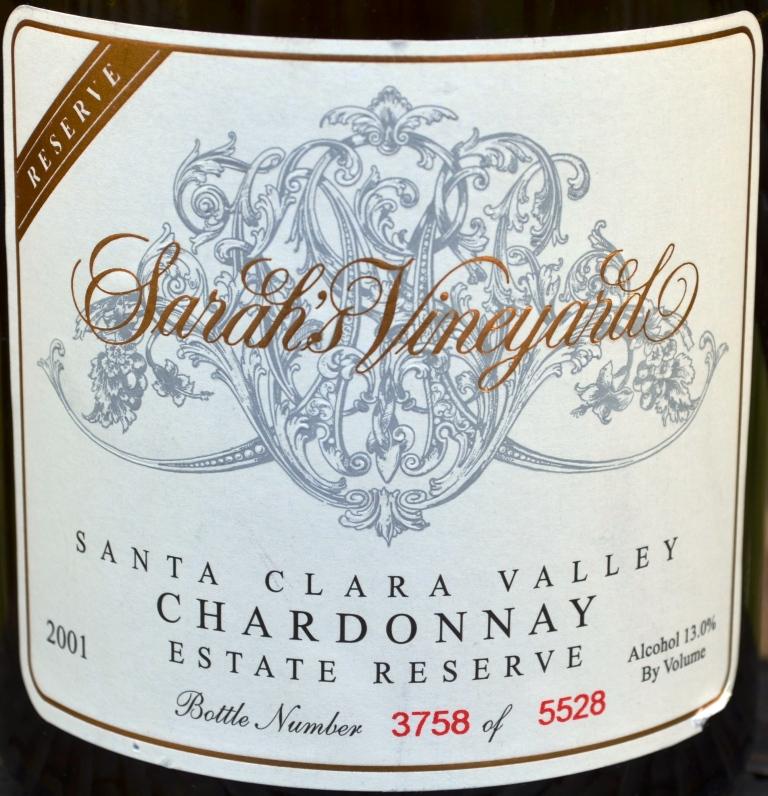 2001 Sarah’s Vineyard Chardonnay Estate Reserve Santa Clara Valley – I got it as Bin Ends in Massachusetts last year. The unfortunate part – this wine was past prime. Well, it was more like a nice sherry – dark yellow color, nicely oxidized. I was able to finish the bottle, but this was not an amazing experience by all means. Mostly you could taste almonds, and that was about all you could find on the palate. I will not rate this wine as it would be simply not fair.
Last, but not least at all – an amazing Aussie experience.
1999 Grant Burge Shadrach Cabernet Sauvignon South Australia – from the very first smell, the expectation was that a “wow” wine is ahead. Perfect dark fruit on the nose, a whiff of chocolate. And the very first sip confirmed that “wow” – blackberries, cherries and cassis, dark chocolate, cocoa, eucalyptus, touch of roasted flavors, perfectly firm and structured. Pronounced acidity, supporting tannins – all perfectly balanced. This was an outstanding glass of wine (it was my one and only bottle, sigh). By the way, you should read an interesting story behind the name of this wine – I don’t want to retype it, hence the picture of the back label below.Drinkability: 8+


That’s all I have for you for today. What was your best wine experience of the week? Have a great week ahead and cheers!
Re-post: Best Hidden Secrets Of The Wine World: Wines of Languedoc
During 2011 I wrote a number of posts for the project called The Art Of Life Magazine – of course talking about my favorite subject, wine. The project closed and even web site is down, but as I still like the posts I wrote, so I decided to re-post them in this blog. Also, in that project, posts were grouped into mini-series, such as “Best Hidden Secrets” you see here – I will continue re-posting them from time to time.
Also note that the series was written for a slightly different audience – I hope none of my readers will take offense in the fact that sometimes I’m stating the obvious…
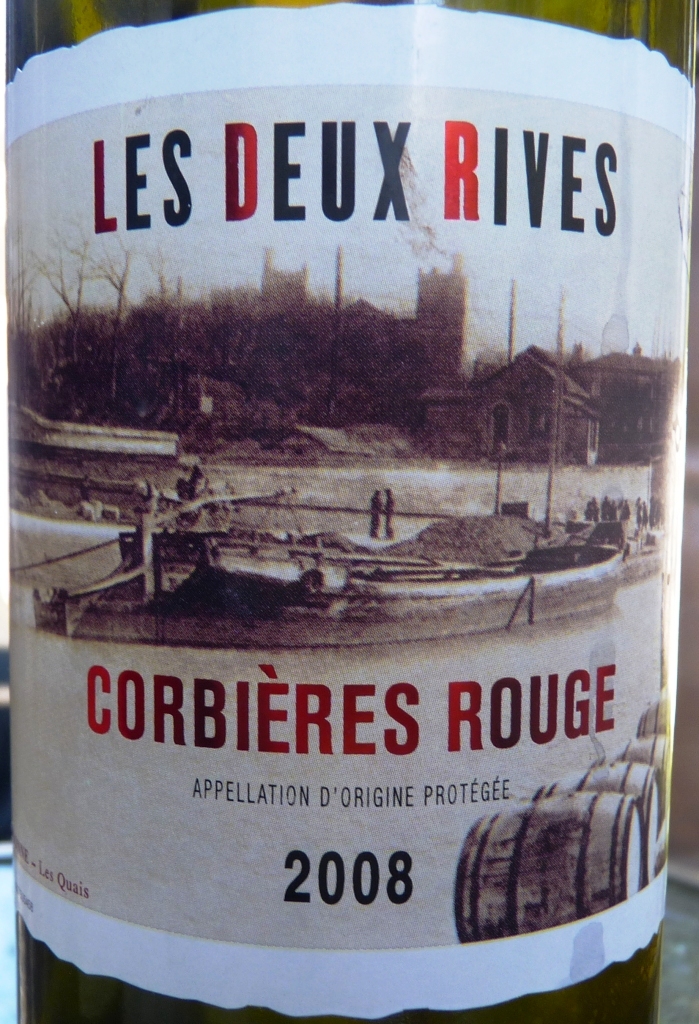 Continuing our “Best Secrets” series, we are going to … France again. However, we are going all the way down south, to the region called Languedoc-Roussillon (in most of the cases it is simply call Languedoc).
Why France again, and moreover, what is so special about Languedoc? First, don’t worry, we are just getting started in our “experiences” journey, we will be going all over the world, I promise. Now, to answer the question “why Languedoc”, let me simply give you some facts. Languedoc-Roussillon is single biggest wine making region in the world! It also produces one third of all the wines made in France. I think this is not bad for the beginning.
One of the great things about Languedoc wines is that while many other regions in France are strictly limited in the grape varieties used in the winemaking in that particular region, Languedoc is not. All white wines from Burgundy are made out of Chardonnay, and all the reds are from Pinot Noir. Red Bordeaux are predominantly made out of Cabernet Sauvignon and Merlot grapes – yes, with the addition of some other grapes, but in any case you will not find any wine which proudly specifies Bordeaux on the label and made out of Pinot Noir or Syrah. Languedoc is different – a lot more grapes can be used in the wine production throughout the region. Red wines can be made out of Cabernet Sauvignon, Merlot, Syrah, Grenache, Mourvedre, Cinsault and Carignan, whites can be made out of Chardonnay, Sauvignon Blanc, Chenin Blanc, Marsanne, Roussanne, Viognier, plus many other red and white grapes can be used in the wine production (for more information about the region, you can always look into Wiki page).
If you are surprised that you didn’t know about Languedoc wines before – don’t be, I’m sure you had Languedoc wines unknowingly. How come? A lot of it is in the labels. Have you seen “Vin de Pays d’Oc” on the labels of wine you were drinking? “Vin d Pays” literally means “Country wines” – level of quality which is one step above “vin de table” table wines, but less than level of AOC wines. But if Vin de Pays can be used with many wines, when you see “d’Oc” added to that it squarely points to Languedoc (last two letters of the region’s name) – if you think about it, I’m sure you had those wines before. There are other well known appellations within Languedoc, such as Corbieres, Minervois and St. Chinian, plus a number of other lesser known appellations. I want to point out that we already discussed one of the Languedoc wines in this “secrets” series of posts when we talked about French Sparkling Wines. That Blanquette de Limoux is produced in the Limoux appellation which is part of the Languedoc region (by the way, if you still didn’t give that Blanquette de Limoux a try, you should do it quickly!).
So what is so “secret” about Languedoc wines? Languedoc is one of the most dynamic wine making regions in France – new appellations created, rules are changing. Languedoc winemakers have more freedom to create, and they are making more and more of the high quality age-worthy wines. And because those wines are not as well known to the public as many others, they happen to represent a great value. Let me give you few examples.
 Let’s start with white: 2009 Domaine de L’Olivier Chardonnay Pays d’Oc. If you like Chardonnay, this is the wine to try. Very nice and very clean, great fruit expression – tropical fruits, touch of grapefruit, all with balancing and refreshing acidity and barely noticeable tannins. Great wine which delivers a lot of pleasure. To put things even in a better prospective I would like to note that retail price of this wine is about US $10 – you would have to get to the $30-$40 price range for Burgundy or California to achieve the same level of experience.
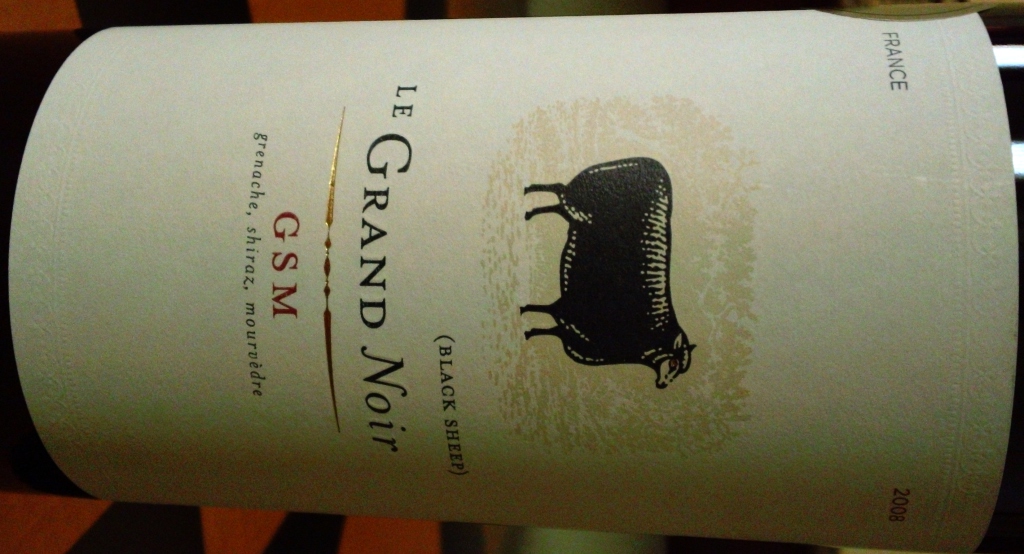 Another example – 2008 Black Sheep Le Grand Noir GSM blend from Minervois. As label suggests, this wine is made out of Grenache, Shiraz and Mourvedre grapes (which is a classic combination of the Rhone grapes). Again with the price tag of about US$10, this is a great deal. Very soft and gently layered fruit, soft tannins are present, but unobtrusive. Good acidity complements this wine well, delivering nice and pleasant experience. Again, considering the price, this is the wine to look for.
Now that you learned yet another secret, it is time to put that knowledge to the practical use. Did you have Rioja wine yet, or may be tried some second label? Now you know about Languedoc wines, so “to do” list just got longer. Go find the bottle and experience this wine tonight – and let me know if your experience was worth reading this article. And just to tell you about what’s ahead, the next time we will talk about something else – will take a break in the secrets series. For now I can only tell you that this “something else” is quite rare and almost forgotten – and I will tell you more the next time we meet…
Second Look – Wines of Cameron Hughes
Have you heard of Cameron Hughes? About three years ago, his name was one of the most mentioned in the wine and even general business press. In the 2009-2010, when the US economy was down, he created a business where he managed to take the wines which many wineries had no ability to sell, bottle them under his name and successfully sell – of course at a fraction of the price. Cabernet Sauvignon which winery had no ability to sell for $85, he was successfully selling for $18 – well, I guess you are not surprised. The small caveat was – you could never know what actual wine it was, as all of his dealings were protected under very strong non-disclosure agreements.
Why second look? Back in 2010, I tried some of his wines, and after failing to fall in love 3 or 4 times, I simply decided that I’m done trying. Two days ago, walking into Cost Less Wines in Stamford, I found a line of Cameron Hughes wines being tasted:

Do you think I could pass a free tasting? Even with my preconceived notion of Cameron Hughes wines, a free tasting is a free tasting, right?
Let me pause for a second and ask – do you think I liked any of the wines? Did I like 0, 1, 2, 3 or 4?
Okay, got an opinion? Let’s move on and see if you got it right.
2010 Cameron Hughes Lot 270 Sauvignon Blanc Russian River Valley ($10.99, 13.2% ABV)- from the first smell, this was a perfect beginning – bright, citrusy, fresh on the nose, with the same notion supported on the palate – grapefruit, lemon peel, white apple, perfect acidity – somewhat similar to New Zealand Sauvignon Blanc but more delicately weaved. This wine was close to Honig Sauvignon Blanc or Mara White Grass – but a bit cheaper then either one of those. Here is the link for the full info on Cameron Hughes site. And you probably got the idea that I liked the wine.
2010 Cameron Hughes Lot 314 Chardonnay Atlas Peak Napa Valley ($14.99, 14.2% ABV) – very nice vanilla on the nose, light and not aggressive – continuing with fresh balance of vanilla and white apples on the palate, light touch of oak, very remote hint of butter and may be some addition of papaya – very balanced, and very pleasant. Here is the link. And yes, you are right, I liked that one too.
2009 Cameron Hughes Lot 304 Meritage Napa Valley ($11.99, 14.5% ABV) – this wine is a blend of 64% Cabernet Franc, 23% Merlot, 9% Cabernet Sauvignon, 4% Petite Verdot. Very delicate red fruit aroma on the nose, nothing overboard, no jammy burnt fruit which is often associated with inexpensive California reds. Black currant, mint and eucalyptus on the palate, soft tannins, good acidity, overall very balanced. Yes, that is 3 out of three (and here is the link).
2011 Zin Your Face Zinfandel California ($16.99, 14.4% ABV) – this wine proudly advertizes itself right on the front label as “Spicy Jammy Yummy”. It has all the classic aromas on the nose – blueberries, blueberry pie, blackberries, the same profile is repeated on the palate – but it is too watery, it doesn’t have a supportive body density and power, and as the result appears somewhat sweet. While it is a well made wine, it is not the wine of my style. As the end result, we are staying with 3 out of 4 (here is the link).
As you can see from the notes, you can call me a convert – these are definitely the wines to buy, and they offer an excellent QPR for everyday drinking. I’m glad I stopped by, overcame my predisposition and can now put Cameron Hughes wines into “to drink” category.
If you have your own experience with Cameron Hughes wines or become a convert on something – please share it here.
Until the next time – cheers!
Re-post: Best Hidden Secrets of The Wine World: Wines of South Africa
During 2011 I wrote a number of posts for the project called The Art Of Life Magazine – of course talking about my favorite subject, wine. The project closed, but I still like the posts I wrote, so I decided to re-post them in this blog. Also, in that project, posts were grouped into mini-series, such as “Best Hidden Secrets” you see here – I will continue re-posting them from time to time.
Also note that the series was written for a slightly different audience – I hope none of my readers will take offense in the fact that sometimes I’m stating the obvious…
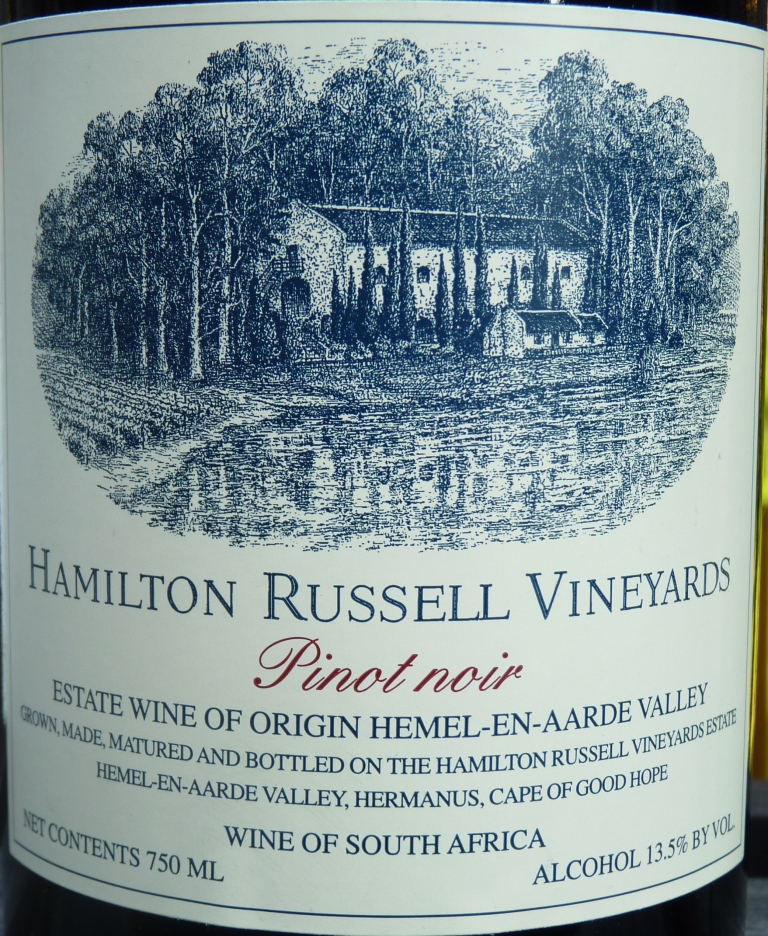 Continuing the subject of “secrets” of the wine world (you might remember our past conversations about Rioja, Second Labels, Georgian Wines and more), let’s talk about wines of South Africa. If you are asking why South African wines should be considered a “hidden secrets”, please read below.
As one would rightfully expect, history of South African wines is tightly intertwined with history of South Africa as a country. Winemaking in South Africa started in 17th century, and for the long time, South Africa was making dessert wines, some of them still famous, like Constantia. Most of the wines were exported into United Kingdom. Similar to the most of the winemaking world, South Africa experienced Phylloxera epidemic in the 19th century, and lots of vines had to be replanted. The 20th century was marked by the political issues – as apartheid was a bad problem for the South Africa, the institute of wine regulations by KWV also became a limitation for the wine industry. Combination of the KWV restrictions with boycott of the South African goods, including wines, as a means to fight apartheid regime, lead to South African wines staying largely non-existent for the wine lovers around the world. With collapse of apartheid the situation changed, and then KWV monopoly was also broken, which lead to the great advances in the South African wine making. If you want to read more about the history of
A number of different grapes are used in winemaking in South Africa. First we need to mention Chenin Blanc, which is still one the major white grapes used in wine production (it is also known locally under the name of Steen). Similar to the Loire valley, where Chenin Blanc is shining, it makes whole range of wines in South Africa, starting from very dry and acidic, and going all the way up to the dessert wines. Next we need to mentioned Pinotage, which is unique grape, produced and cultivated only in South Africa. Pinotage is a cross between Cinsault and Pinot Noir grapes, and has a number of strange characteristics, such as being reminiscent of liquefied rusty nails in the glass. Then whole bunch of international varietals are also planted (amount of those plantings is increasing), and it includes Chardonnay, Cabernet Sauvignon, Shiraz and many others.
 So why are we placing South African wines into the “secrets” category? Once you will try [good] wines from South Africa, chances are you will be blown away. It is important to note that South African wines are new world wines masquerading as an old world – which makes blind tasting with South African wines very challenging.
As our tradition goes, let’s open a bottle or two, and let’s talk about the wines. First, 2008 Hamilton Russell Pinot Noir. This wine is simply amazing – very restrained and polished, with beautiful restrained fruit, lots of smokiness and earthiness on the palate. This wine shows off as a classic Burgundy, and only when you look at the label you experience almost a shock – this wine is from South Africa, last place one would expect to produce classy Burgundy (you can read about our blind tasting experience here).
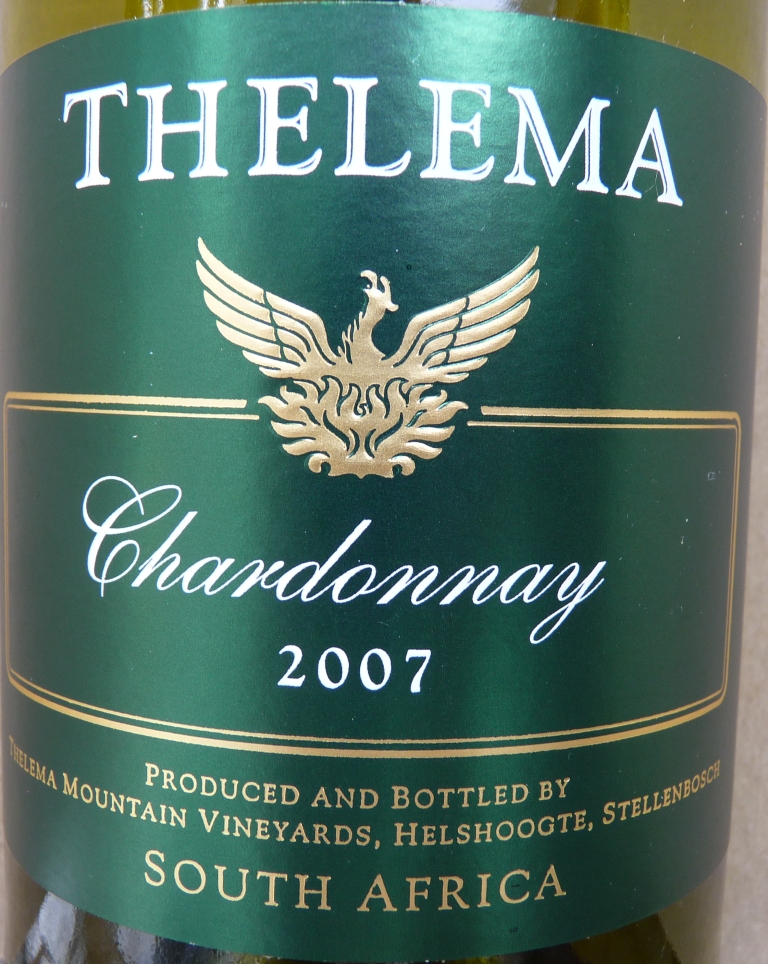
Then comes 2007 Thelema Chardonnay, again, very reminiscent of beloved White Burgundy – restrained, with balanced fruit, hint of butter and vanilla on the palate and good tannins – very elegant.
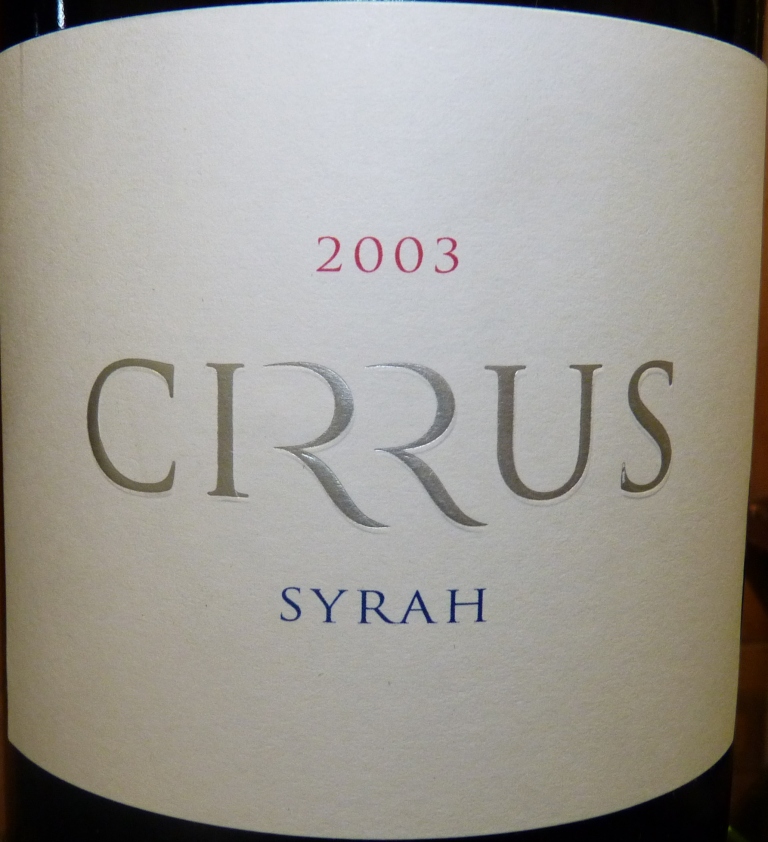 Last I would like to mention 2003 Cirrus wine – a predominantly Shiraz ( 96%) with addition of small amount of Viognier (4%). On the palate, this wine mostly represents liquid smoke, but it really comes alive in a glass, with excellent tannins, toned down fruit and perfect acidity, well balanced.
I don’t know if I manage to convince you in the “secrets” status of South African wines. But if you will think about it, either way you have to find a bottle of South African wine – to either agree or disagree with me. Look for the one we talked about here – and judge it for yourself. Cheers!
Second Dozen (And Some) of 2012
 Anywhere you look, people are summing up their experiences for the year which will become history in the mere 5 days. “The best thing I did last year”, “the best thing I ate”, “the best trip I took”, “the best picture” and so on and so forth.
This very blog is not an exception to that “the best thing I had” phenomenon. I have my top dozen wines summarized for 2010 and 2011, and now it is time for 2012. But I have to tell you that this year I have an issue. Last two years I managed to identify precisely 12 wines I wanted to include in my “Top” list. This year, it appears that I tasted so many great wines, that I feel that the limit of 12 is too constraining – hence this post, where I will share with you the second dozen (or more) of wines which caused an “aha” moment, and stirred my memory and emotions. In the other words, these are the wines which I would gladly (very gladly) drink at any time. As usual, all the wines will be linked to the original posts in case such post exists, and I will provide pricing information where I can. Here we go.
26. 2011 Walnut Block Wines ‘Collectables’ Sauvignon Blanc, Marlboro, New Zealand ($11.99). In general, I like New Zealand Sauvignon Blanc – may be I had a few that I didn’t really care for, but for the most of the cases I really enjoy that fresh in-your-face acidity with bright fruit underpinning and fresh cut grass. This wine happened to be single best New Zealand Sauvignon Blanc I had last year, perfectly matching the description I just provided.
25. 2012 Flat Creek Estate Winery Viognier, Texas ($NA) – that experience of drinking literally just blended wine was first and unique, and the wine was excellent. I will be very happy to get a bottle of the released 2012 Flat Creek Estate Viognier and compare the notes.
 24. Domaine Ste. Michelle Cuvee Brut NV ($10.99) – one of the best sparkling wines I tasted throughout the year. It is perfectly brut, perfectly acidic and perfectly balanced. I really want to see this wine in the blind tasting, against any of the $30-$40 Champagne – so many people will lose their bets, swearing that they just tasted a perfect glass of Champagne, and finding out that it was a domestic sparkler. Next time you see it on the shelf – do me a favor, pick up a bottle and let me know what you think (you can thank me later).
23. 2010 Anakena Indo Sauvignon Blanc, D.O. San Antonio Valley, Chile ($15) – A perfect Sauvignon Blanc for my palate. Beautiful fruit and acidity combination, a touch fruitier than NZ Walnut Block, but absolutely refreshing.
22. 2005 Giribaldi Cento Uve Langhe DOC ($75) – Very much Barolo-like (no wonder – 50% of the grapes are Nebbiolo), but they didn’t use for nothing 152 grapes to produce this wine – this is a very perfumy Barolo, with a lot of floral notes. No, I didn’t taste all those grapes by themselves, but sheer number of grapes (152) used in production of this wine is enough to put you at awe.
21. 2009 Craggy Range Te Kahu Hawkes Bay, New Zealand ($25) – Craggy Range is an area in New Zealand which became a source of the great wines, and it also know for the cost of land being dirt cheap about 30 years ago, and becoming absolutely unaffordable nowadays. This wine is an excellent Bordeaux blend, except that you don’t need to wait for 15-20 years before you can enjoy a glass – you can just open and pour. Perfect fruit and perfect balance – if you didn’t try this wine before, and you like Bordeaux style, you just owe it to yourself to find the bottle and enjoy it.
20. 2008 Torres Atrium Merlot, Penedes, Spain ($26 in the restaurant) – this was total surprise – the wine was suggested to us in a restaurant in Florida, as previous two choices were unavailable. We didn’t have much expectations – until the first sip. Dark fruit, soft, supple and round, perfect acidity, long finish. The second surprise came when we saw the bill – I never had a wine of this quality in the restaurant for $26. My only issue – this wine is only available for restaurants, and even my friend Zak who owns wine store, can’t get this wine. If you can – send me a note…
19. Abrau-Durso Semi-Dry NV, Russia ($12.99) – Never heard of this wine until this year, and it appears that this is a very old Russian “Champagne” house which was supplying sparkling wines for Tzar. Didn’t have much expectations before trying this wine – and it was delicious. Touch of sweetness, perfectly refreshing and supple – this actually will be the sparkler I plan to pour to ring the New Year in.
18. 2009 Wente Small Lot Petite Sirah, Livermore Valley, California ($35) – Wente Small Lots Grenache was #6 on my Top 2011 list. This year I opened Petite Sirah – an absolute beauty, silky smooth, dark fruit, perfect acidity and tannins, very balanced. It is unfortunately only available from the winery or through the club, but if you are in the area, don’t miss it.
17. 2009 Sant’Elena Pinot Grigio, Friuli, Italy ($18.99) – Yes, I’m a wine snob – as the result, Pinot Grigio is typically not the wine which would be served in my house. And Pinot Grigio is usually not the wine I would include into any of the “high regad lists”. Except when it is truly outstanding. And this wine is exceptional. Yes, it is called Pinot Grigio – but this is only due to the grape used in production of this wine. Otherwise, this is an “orange wine” – dense, concentrated, with dark white fruit, very complex and thought provoking.
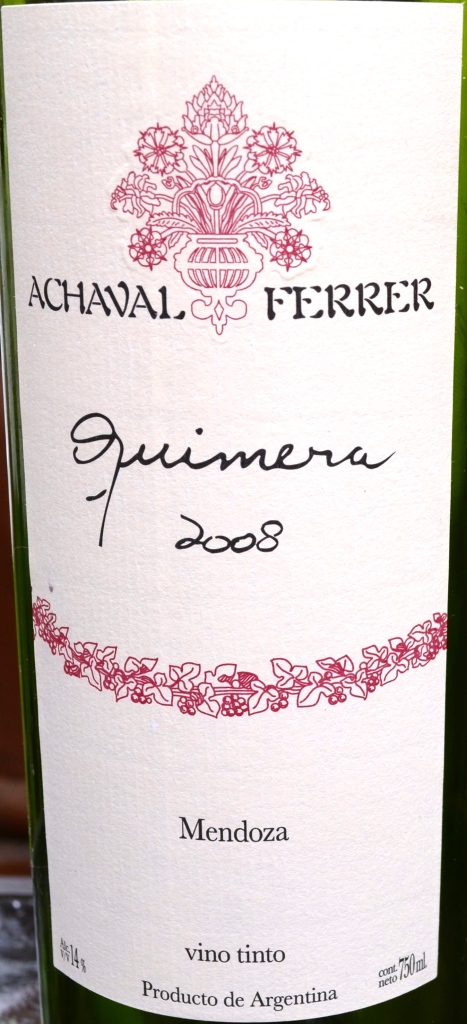 16. 2008 Achaval-Ferrer Quimera Mendoza, Argentina ($24.99) – I wanted to try wines of Achaval-Ferrer for a very long time, but they are not exactly affordable on a given day. Thanks to WTSO ( who else?), I was able to get few bottles of this Bordeaux blend called Quimera, and boy, was that a great wine. Dense and powerful, with lots of dark fruit, very delicious. And – it will definitely improve with time, so I’m glad I still a few bottles left.
15. 2009 Beaulieu Vineyard Reserve Tapestry Red Blend Napa Valley ($60) – it seems that I discovered so many worthy great Bordeax blends this year, from all the different regions. Yet this BV Tapestry squarely hold place on its own – dark, robust, classic, with all the cassis and eucalyptus flavors you want, it rolls on your tongue and delivers pleasure, as you expect your wine to do.
 14. 2006 Laetitia La Colline Pinot Noir, Arroyo Grande Valley, California ($24.99) – I can’t believe I didn’t put this wine into the top dozen. When you take a sip of wine, it usually generates a reaction. It can be “hmm, this is nice”, “hmm, I should let it breathe”, “hmm, I need some food”, “hmm, now I need steak”. And then there are wines where you reaction has no hmms in it, it is “I need a refill now, before this deliciousness is all gone”. This Laetitia La Colline Pinot Noir is exactly that type of wine – round and delicious from the get go, you just want you rglass to last for long, very long time.
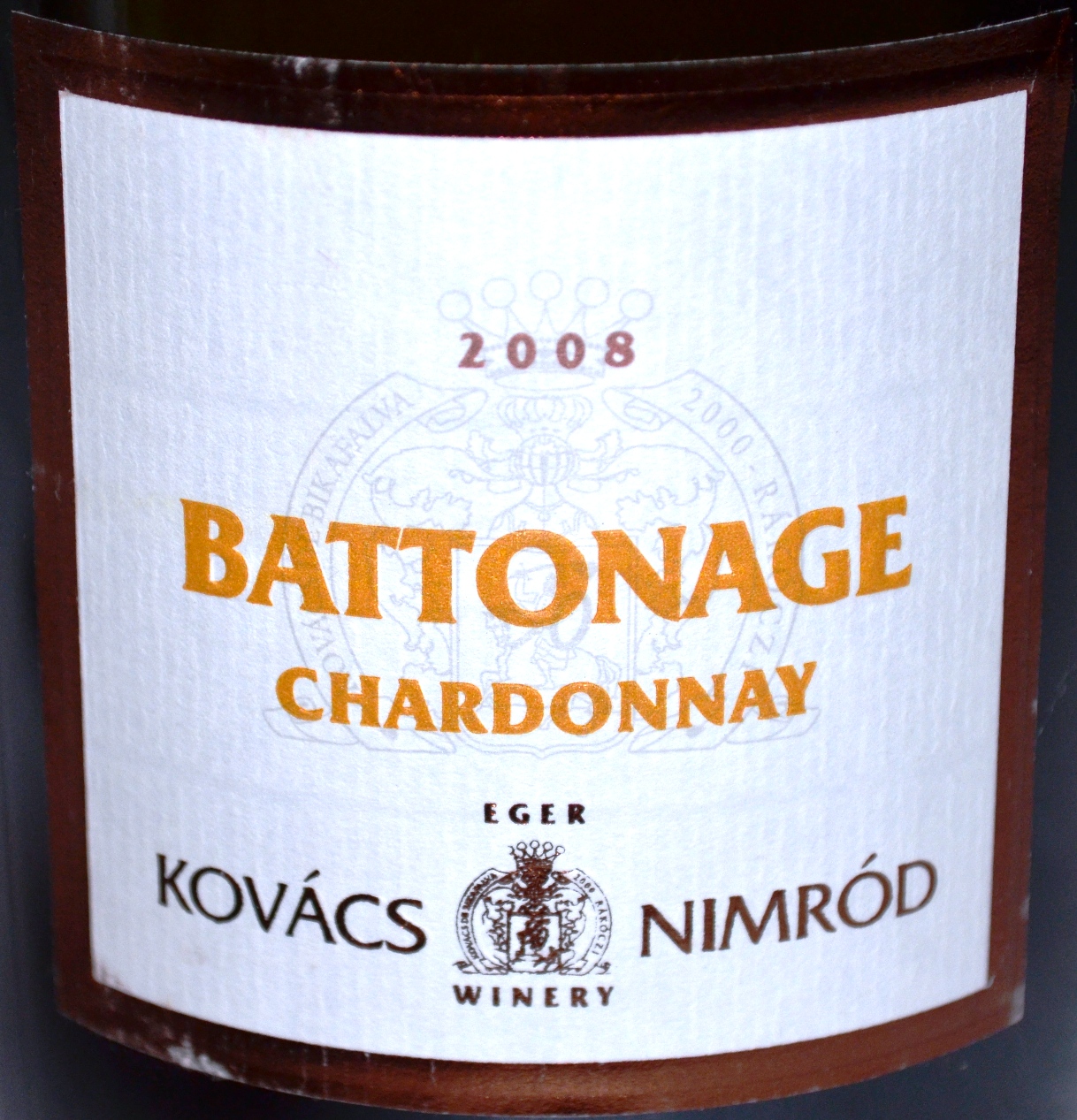
13. 2008 Kovacs Nimrod Battonage Chardonnay, Eger Winery, Hungary ($20.99) – I love Chardonnay – and I so rarely get to enjoy it, unfortunately. I don’t have any deep cellars of Burgundy, and a lot of wineries in California and outside are trying to make Chardonnay to taste like Pinot Grigio – beats me. Luckily, not this Chardonnay from Hungary. This wine greets you the nose with vanilla and butter, and perfectly supports that round package on the palate – more vanilla, more butter, toasted oak, golden delicious apples – just the Chardonnay I want to drink.
That’s all for today, folks – will be happy to hear your thoughts. Have you tried any of the wines above? Did you like them? And yes, my Top Twelve of Twelve is coming out very soon. I’m not going to spoil a surprise for you, but I’m sure you will find my Wine of the Year choice a bit unusual (if you want to guess, write your ideas down in the comments section). Cheers!
Weekly Wine Quiz #31 – A Guessing Game: Ultimate Challenge, Part 1
To finish off the wine reviews quiz series, today we are following the steps of the previous two wine quizzes (#29 and #30), only now going to the next level: you will need to match 5 reviews and 5 wines. Actually, that “finishing off” will separate into two separate quizzes – one for white wines and one for reds.
Here are your grape choices:
A. Chardonnay
B. Chenin Blanc
C. Sauvignon Blanc
D. Savagnin
E. Viognier
Here are the reviews. Just to make it a bit easier, note that all the reviews are for single-grape wines.
1. “Gently kissed with toast, giving the core of white peach, lemon and chamomile a broader frame of lightly toasted brioche and paraffin. A suave echo of flint chimes through the finish in this lovely rendering of the toasty style.”
2. “An enticing, lemony white that is both aromatic and rich on the palate. Apple and mineral notes combine with the lemon flavors that glide to a lingering finish”
3. “This has weight and depth but remains stylish, with ginger and glazed pear notes in reserve while persimmon, green almond and piecrust notes lead the way. Lovely cut on the finish keeps the ginger edge echoing. Should develop nicely in the cellar”
4. “Extremely rich and generous, with ripe, opulent peach, nectarine, apricot and tangerine flavors that are woven together on a full, lush body with smoke, spice, cedar and mineral details and a juicy acidity.”
5. “Intensely minerally and smoky, with a blanket of acidity behind the apple, sea salt and anise flavors. The long finish is bracing and powerful.”
Please provide the answers in the form of A1, B2 etc. Bonus question – provide country of origin for each grape/review combination. Double bonus – in addition to country, provide more precise appellation, like Finger Lakes, Oregon, etc (doesn’t have be exact, but it should be more narrow that the whole country).
Have fun, good luck and have a great weekend! Cheers!
Crus of Beaujolais, Year 2011 – Part 2
I like sequels, Well, in the movies – sometimes, not so much. But when it comes to the writing, whatever you forgot to say in the first part, you can say in the second, and feel good about it, claiming that this was the intent from the get go.
What I didn’t mention in the first post about great tasting of Georges Duboeuf 2011 Beaujolais portfolio is that red Beaujolais make one of the best red wines for summer – they are typically light in alcohol (if you noticed, 13% ABV was the most for all wines mentioned in the first post), and they also taste the best when they are slightly chilled. Considering how hot this summer is across pretty much the whole US territory, I hope this will help you to find a good red wine for the hot day, because sometimes it just have to be red.
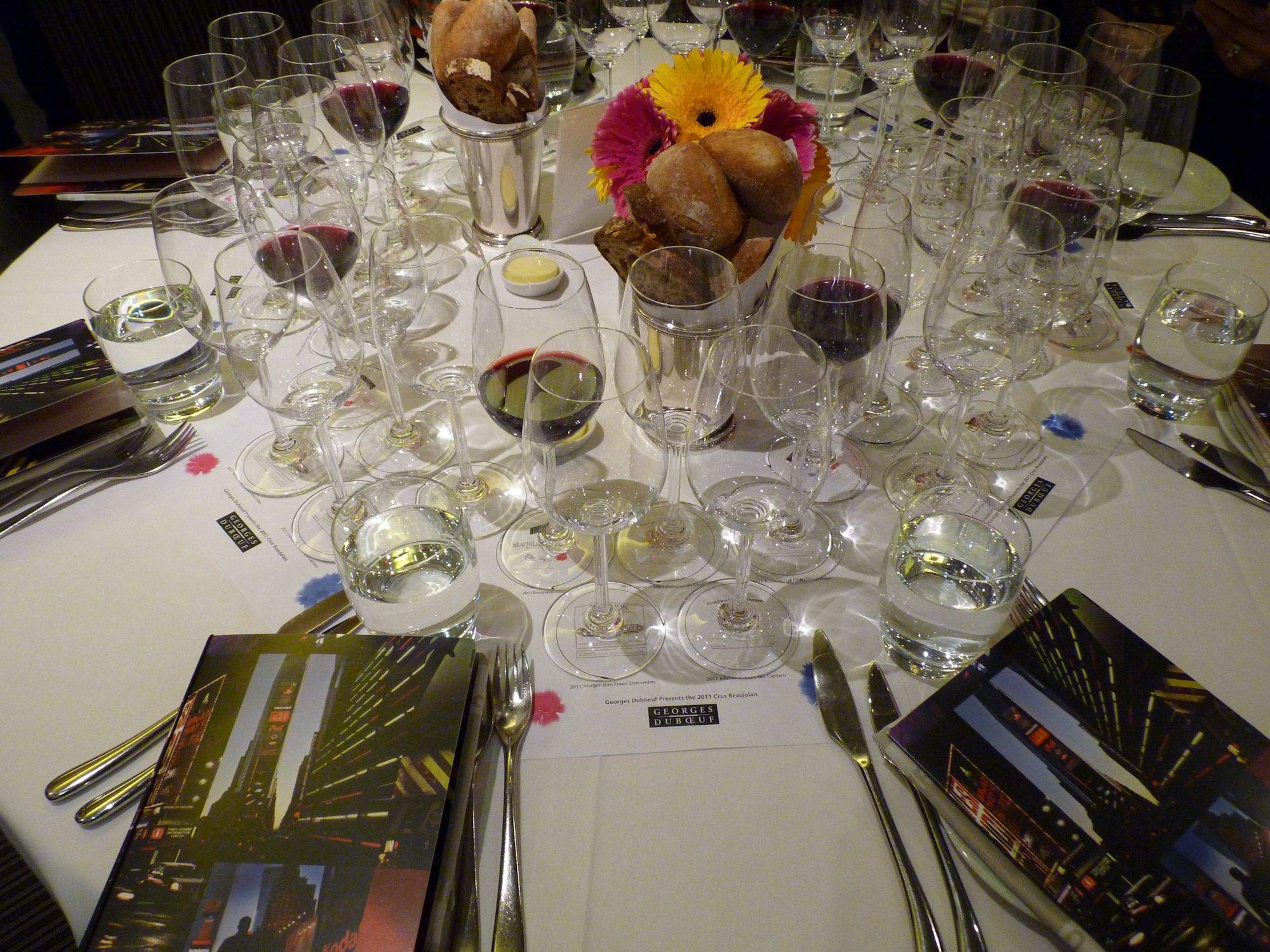
In the first post, I described a self-guided part of tasting. That tasting was followed by the lunch, both of which (tasting and the lunch) taking place at db Bistro Modern, one of the restaurants of the famous chef Daniel Boulud.
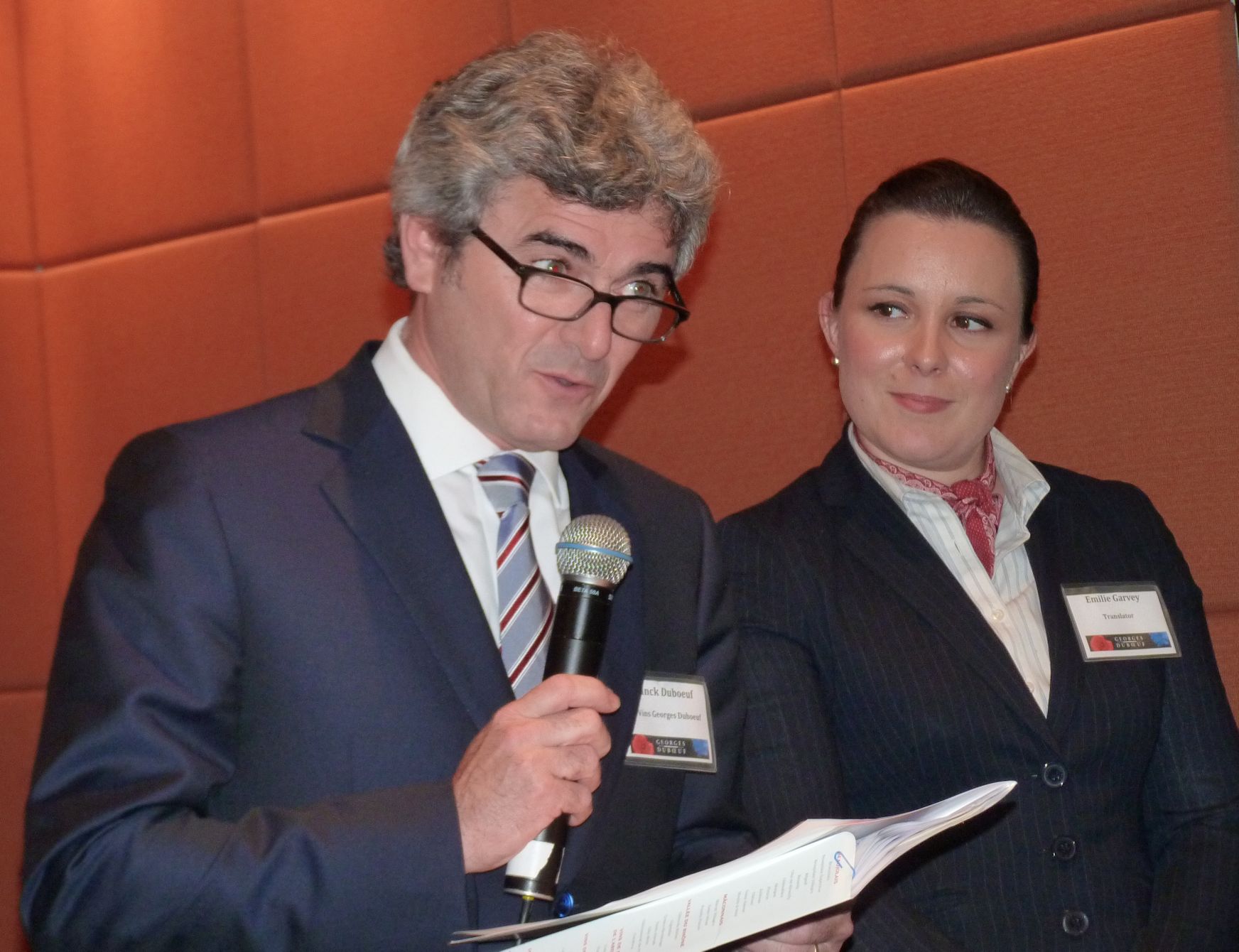
Georges Duboeuf opened the event with presentation of 2011 vintage. Here is my best effort transcript of what he said (remember, I’m not a professional journalist, I’m only pretending): “2011 was a great year. Budding started in April, then flowering started in June, and then harvest started August 22nd and lasted for two weeks. Some areas experienced periods of drought. Overall, grapes reached very good level of ripeness. 2005 and 2009 (considered best in a very long time) were good, but 2011 might be even a little bit better than 2009. Throughout the vintage, there are lots of black cherry and earthy notes.”

After Georges Duboeuf’s presentation, the first dish was served – “Legumes du Marche” – Young Garden Vegetables, Fromage Blanc Dressing, Lavender Honey Vinaigarette.
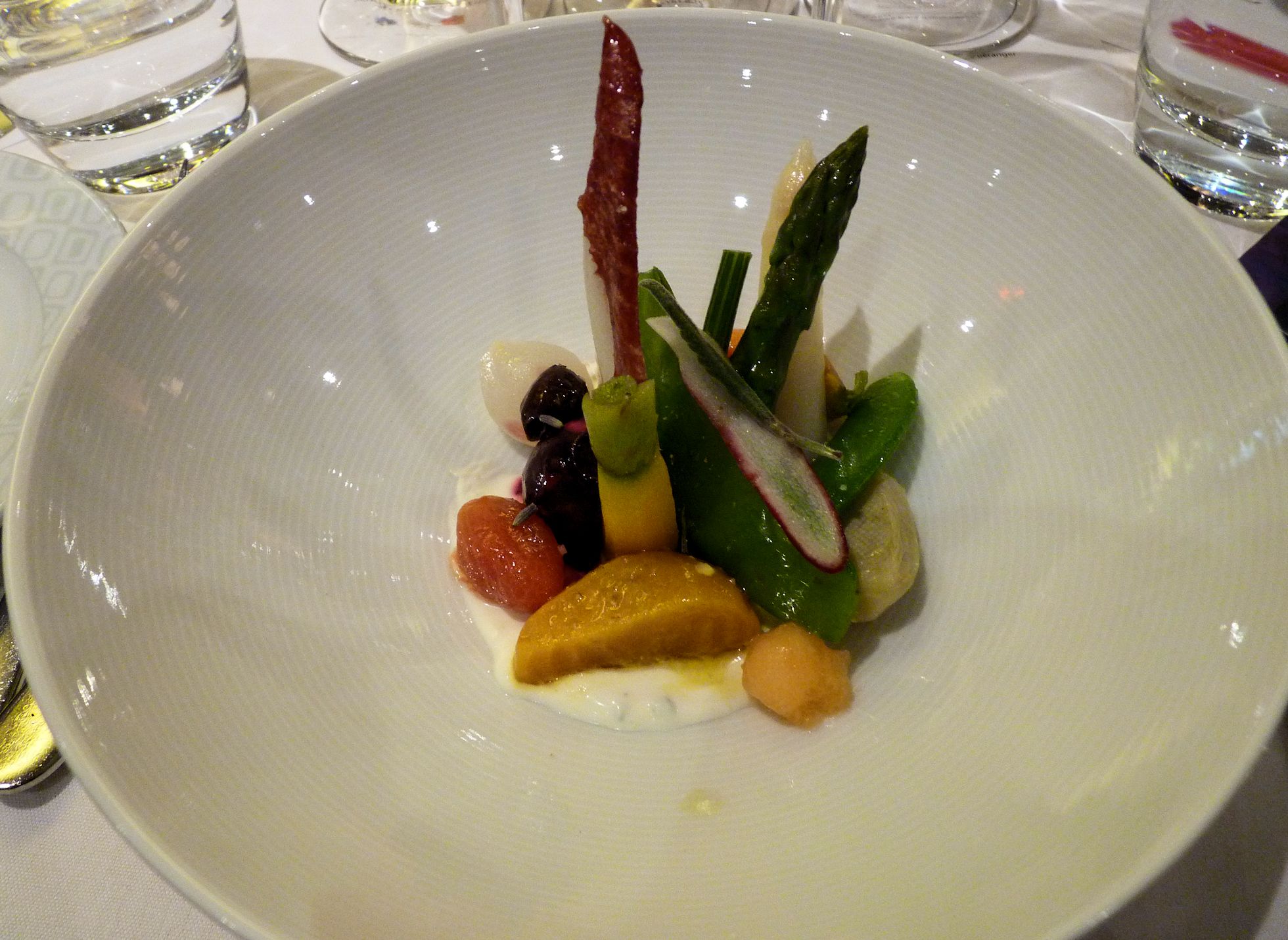
This dish was paired with 2011 Georges Duboeuf Beaujolais-Villages, and it worked together very well by wine complementing soft and earthy flavors of the vegetables.
Next, Frank Duboeuf presented two white wines, Macon-Villages and Pouilly-Fuisse (please see detailed note below). He said that 2011 was equally good year for both whites and the reds, which is a very rare situation. I didn’t take the detailed notes though, as I was preoccupied with parallel discussion at the table and delicious pairing of wine and food ( bad journalism : ( )
White wines were served with the next course, Seafood Risotto – Black Sea Bass, Scallops, Squids, Cockles, Fennel, Tomato Confit “Fumet” Emulsion.

Pouilly-Fuisse worked perfectly well with risotto, which was a unique experience for me. Creaminess of risotto cancelled out some sharpness of the chardonnay, creating next level of experience.
For the next course, Georges Duboeuf presented two red wines, Morgon and Julienas. He described Morgon as having “violet, cassis, kirsch on the nose, same flavors on the palate. A lot of structure. This wine will age very well”. Regarding Julienas, he said that “it is a very special wine, it has great personality. 2011 was a lot like 2009. This particular wine had the biggest success over the last 5-6 years. It was very critical to expand the vineyard (by 4 acres) for the success of this wine. This is a very noble wine with great aging potential. The wine was bottled a week before, right before the event”.
These two reds accompanied the last course of the meal – Duo of Beef – Braised Short Ribs, Beef Tenderloin, Spring Vegetables, Sauce Bordelaise.
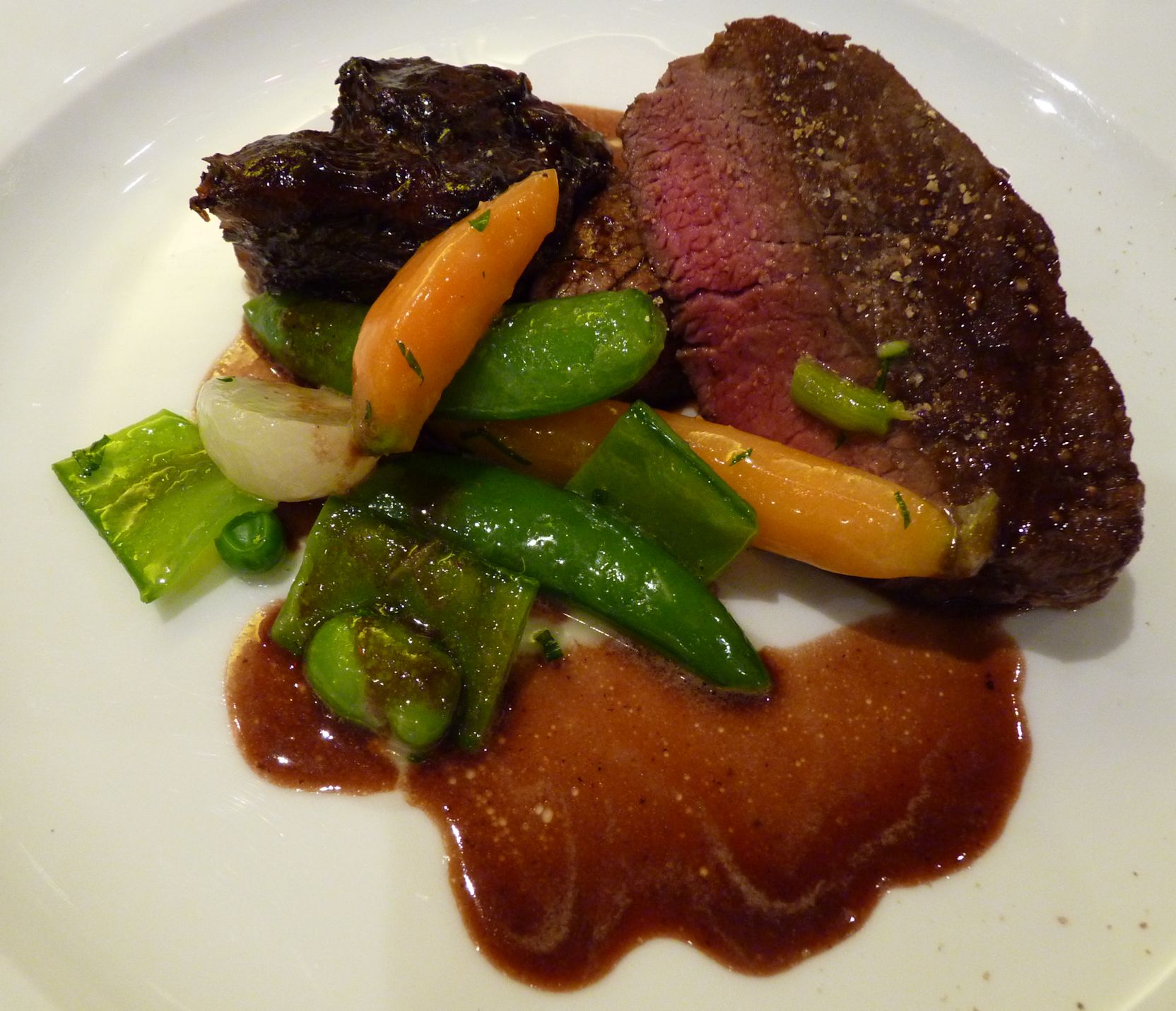
I have to tell that while both food and wine were delicious in its own right, they didn’t work together, so the pairing was not successful by not elevating the whole meal to the next level. But I also have to admit that both food and wine really didn’t bother each other too much – they were really two absolutely parallel experiences without a merge or a collision (which is often the case when wine and food don’t work together).
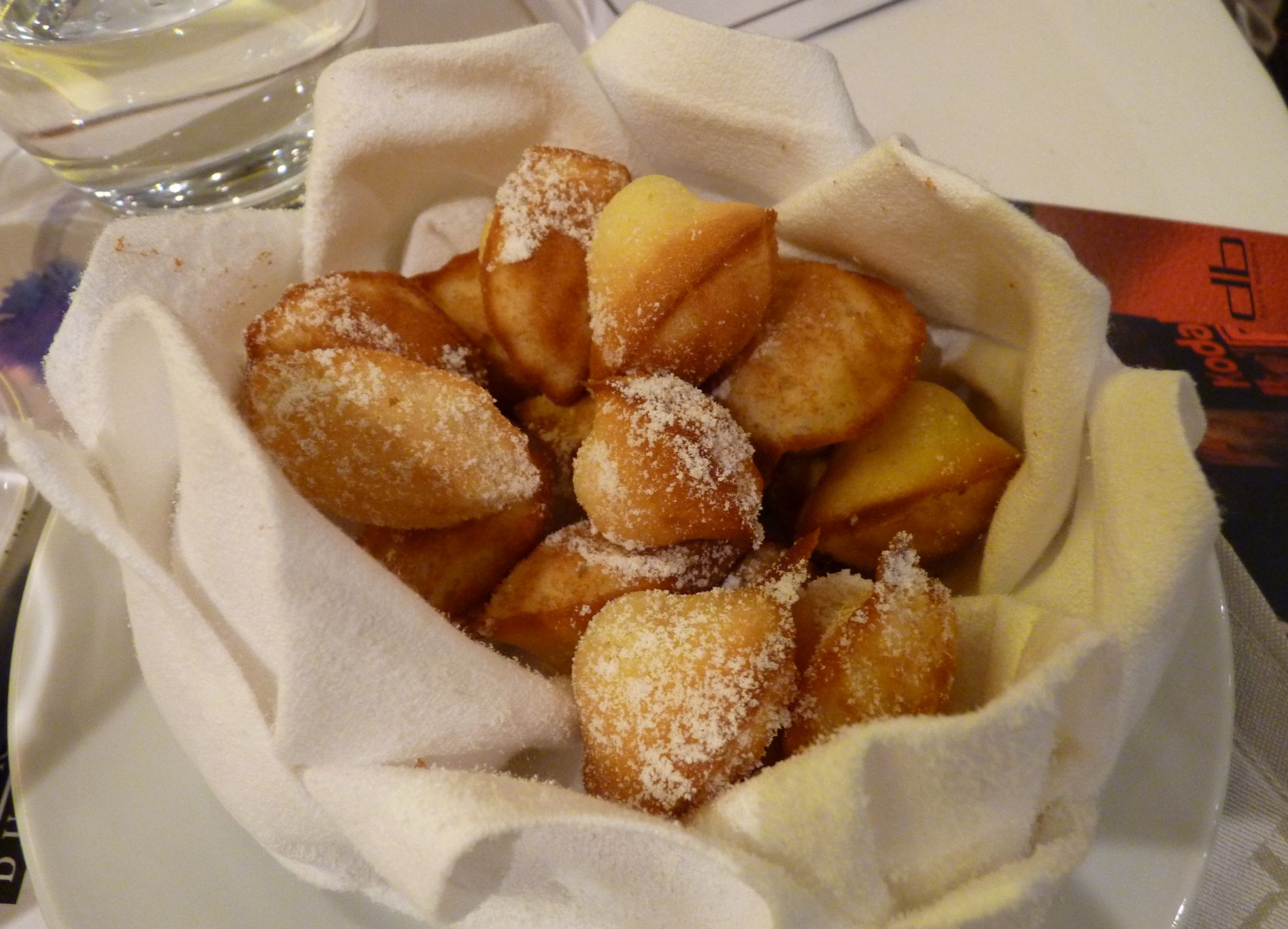
And then…there was a dessert, which was delicious and not paired with any wines (I also have no idea how this little cookies should be called, but it was very hard to stop eating them).
Here are the detailed notes for the wines:
2011 Georges Duboeuf Macon-Villages Domaine Les Chenevieres, Maconnaise, France (100% Chardonnay, SRP: $13.99, 12.5% ABV, 5000 cases produced) – Very nice, hint of hazelnut and citrus on the nose, good fruit, good balance, good acidity, hint of white apples, touch of vanilla and touch of oak on the palate. (Drinkability: 7+)
2011 Georges Duboeuf Pouilly-Fuisse Domaine Beranger, Maconnaise, France (100% Chardonnay, SRP: $17.99, 13% ABV, 3500 cases produced, 1200 imported) – this wine comes from the best area, the actual town of Pouilly-Fuisse. This wine had more pronounced chardonnay qualities than the previous wine – vanilla, touch of citrus and oak notes, excellent balance. (Drinkability: 8- )
2011 Georges Duboeuf Beaujolais-Villages, Beaujolais, France (100% Gamay, SRP: $9.99, 12.5% ABV) – very nice, good balance, a little tartness on the palate, but good overall. (Drinkability: 7)
2011 Georges Duboeuf Morgon, Domaine Jean Descombes, Beaujolais, France (100% Gamay, SRP: $15.99, 13% ABV) – good acidity, fresh fruit, light, soft, a bit too grapey to be great – but should improve with time. (Drinkability: 7)
2011 Georges Duboeuf Julienas Chateau des Capitans, Beaujolais, France (100% Gamay, SRP: $18.99, 14% ABV) – excellent depth, good power, good body, excellent balance. (Drinkability: 8)
All in all, it was one great event, both in the information and experience. Summer is still on, my friends – go find a bottle of Beaujolais to kick it off after a long day. And make an extra effort to find one of Georges Duboeuf wines – it will well worth it. Cheers!
Thanksgiving Experiences
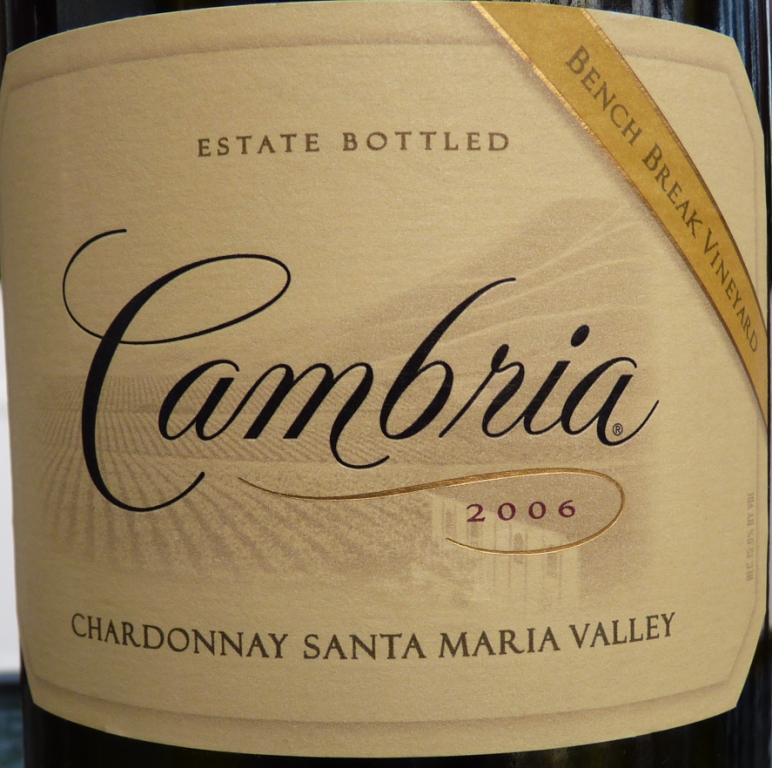 In the last post I outlined the number of wines which we wanted to taste during Thanksgiving dinner – now it is time to report on what was great and what was not.
There was nothing new with both Beaujolais Noveau compare to the previous report – except this time I remembered to chill both of them (light wines, such as Gamay and Pinot Noir usually taste better when slightly chilled). Chilling improved the taste of George’s Duboeuf, but I still like 2010 better.
The real highlight of the lineup was 2006 Cambria Bench Break Vineyard Chardonnay from Santa Maria Valley – it was beautifully balanced, with hint of vanilla, literally unnoticeable oak, hint of white apples and perfect acidity. One word to describe this wine is Elegance – it was perfectly elegant, reminiscent of Peter Michael chardonnays which are definitely my all times favorites.
2009 Cazar Pinot Noir was very appropriate at the Thanksgiving table with its bright cranberries and very good balance. One wine which didn’t happen to work for me was 2009 Turley Old Vines Zinfandel – I understand that it was opened prematurely, but still I was expecting more from it (I have to also mention that it didn’t fully opened even after three days – I guess actual aging in the cellar is in the cards for this wine). Bodegas Hidalgo Triana Pedro Ximenez worked very well with the dessert full of nuts, such as Pecan Pie – layered complexity and nutty profile, complemented by good acidity were essential attributes of this wine.
As this is a Thanksgiving post, I have to mention the turkey. Last year our choice was Turducken (chicken inside of duck inside of Turkey), which was very tasty, but required quite a bit of preparation work. This year we decided to do a smoked turkey, which required mush lesser amount of prep time and effort – here are the pictures for you, before and after:

This turkey spent four hours in the charcoal smoker and 4 hours in the oven. The result was moist and delicious bird with lots of smoky flavor. Another dinner highlight was cranberry sauce, which was modeled after Bobby Flay’s recipe – however, it was modified to exclude sugar. If anyone is interested in recipes, I will be glad to share – please drop me a note.
This completes my Thanksgiving 2011 report – until the next time, cheers!
Thanksgiving Wines
Please let me be unique and different and write a blog post about Thanksgiving wines (duh – I meant let me pretend that hundreds of bloggers and wine writers didn’t cover the subject yet as broad as possible). In essence, I’m not planning to offer you any advice. I think the variety of tastes, favors and simply palate preferences at Thanksgiving table is way to wide to be able to do any essential wine and food pairing. Therefore, I would say that there are no limitations to what wines you should have on your table – you simply have to be able to enjoy them with or without food. As far as this blog post is concerned, as I said, I’m not going to offer any advice – I will simply tell you what I have in plans for the thanksgiving meal and why. I will list here way more wines than we will be actually able to consume, but hey, more is better than less, right?
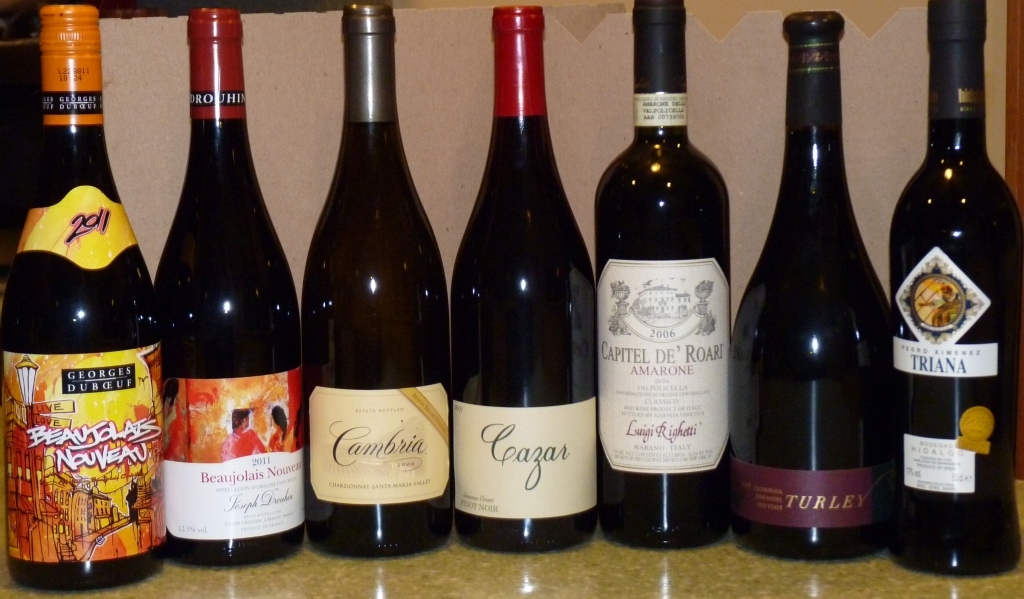
You can definitely start with sparkler, but as I don’t have one ready, 2011 Beaujolais Noveau will do just fine. Why? It should be slightly chilled (let’s say to under 60F), then it is quite refreshing with all the red fruit and mouthwatering acidity – good way to get ready to Thanksgiving meal.
Chardonnay is a must, preferably one from US. Why? Because Chardonnay is one of the great American wines, producing very good results in all different areas from California to Long Island. I would recommend Chardonnay which was aged in the oak barrels and has some butter, vanilla and toasted oak – not the stainless steel-fermented one, which often tastes indistinguishable from Pinot Grigio. My personal choice is 2006 Cambria Bench Break Santa Maria Valley – this is one of my favorites since I tried that at The Capital Grill, and I’m curious to see how it is developing (I still have few bottles left). Besides, I don’t have Peter Michael as my allocation didn’t come through yet.
The next wine is a 2009 Cazar Sonoma Coast Pinot Noir. Why? 2009 was a great year for California Pinot Noir, and this particular wine is simply meant for the Thanksgiving table with all the fresh and juicy cranberries and perfect acidity. I simply see this wine being great with turkey and many other dishes.
Amarone? Of course. Why? Simply because Amarone is one of my favorite wines, and every time we drink it, it is a special occasion. 2006 Luigi Righetti Capitel de Roari Amarone della Valpolicella is one of the simpler versions of a great wines ( also inexpensive compare to what Amarone typically costs), so I’m curious if it will work with the meal at all.
There can’t be Thanksgiving celebration without Zinfandel on the table. Why? Zinfandel is unique grape which doesn’t grow anywhere else outside of United States (with the exception of the close relative, Primitivo, which grows in Italy). Zinfandel has a unique flavor profile with lots of fresh berries and lots of power on the palate, which should bode well with the festive Thanksgiving meal. 2009 Turley Old Vines Zinfandel from Napa Valley is simply one of the great California Zinfandels, and I’m glad we will be able to share a bottle (it is not easy to get).
Time for desert. I’m selecting Bodegas Hidalgo Pedro Ximenez Triana. Why? First of all, this is the very old wine – as Jerez is made using Solera method, with new wines constantly blended with the older ones, this wine started at around 1750, so it can definitely serve as historic reference to the great holiday. And the second reason – this wine simply tastes phenomenal. I already wrote about it in one of the previous posts – the richness and the balance of this wine should really be experienced by any wine lover.
Will we drink all of these wines? Probably not. Will there be other wines on Thanksgiving table? You bet. Of course I will report on all the wonderful food and wine experience once the holiday is over, but for now I will be glad to hear what wines do you plan to have on your table.
That’s all, folks. Happy Thanksgiving and Cheers!
Last Bottle Sign Up ($10 credit)




 Talk-A-Vino