Archive
Crus of Beaujolais, Year 2011 – Part 2
I like sequels, Well, in the movies – sometimes, not so much. But when it comes to the writing, whatever you forgot to say in the first part, you can say in the second, and feel good about it, claiming that this was the intent from the get go.
What I didn’t mention in the first post about great tasting of Georges Duboeuf 2011 Beaujolais portfolio is that red Beaujolais make one of the best red wines for summer – they are typically light in alcohol (if you noticed, 13% ABV was the most for all wines mentioned in the first post), and they also taste the best when they are slightly chilled. Considering how hot this summer is across pretty much the whole US territory, I hope this will help you to find a good red wine for the hot day, because sometimes it just have to be red.
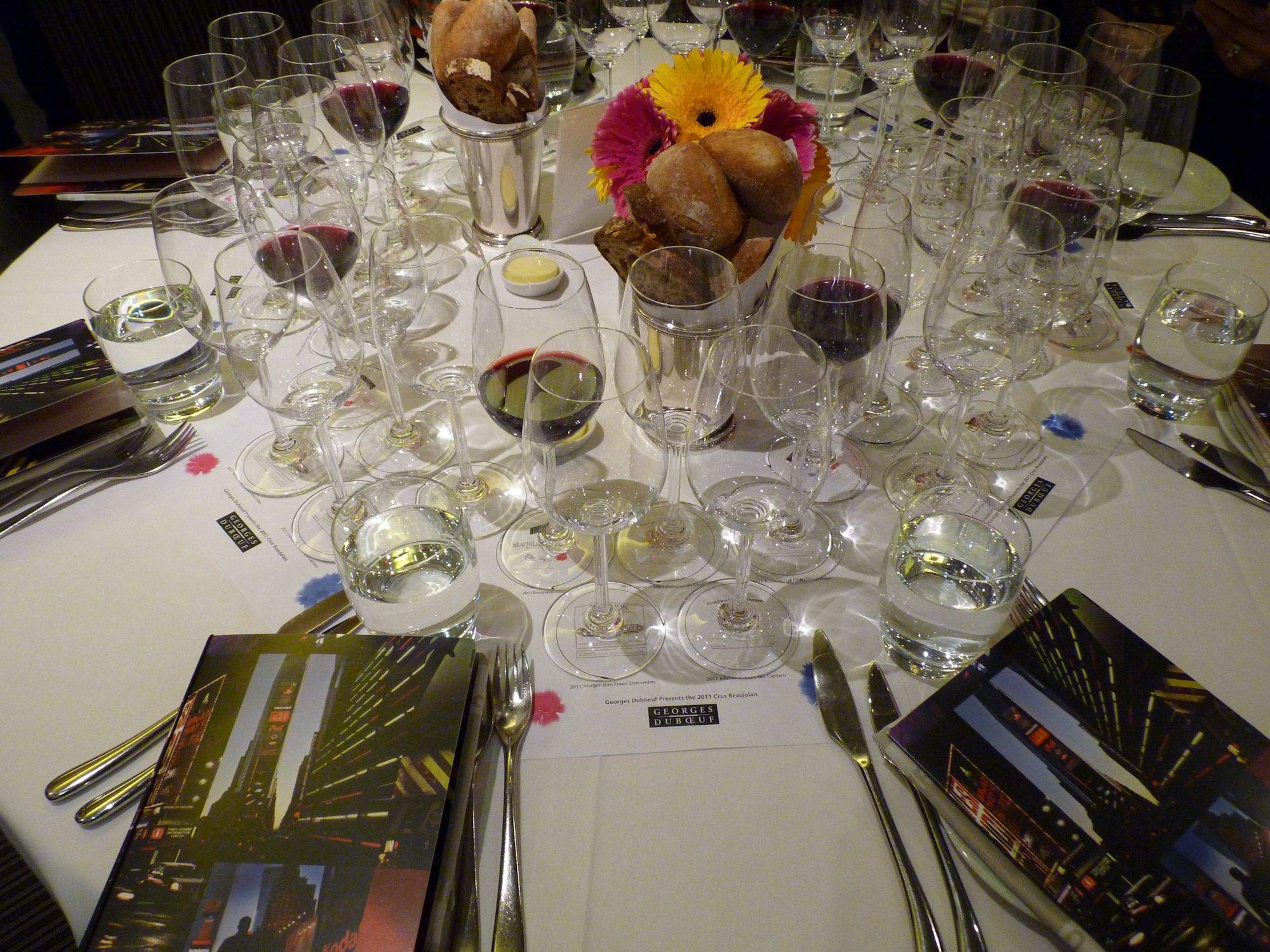
In the first post, I described a self-guided part of tasting. That tasting was followed by the lunch, both of which (tasting and the lunch) taking place at db Bistro Modern, one of the restaurants of the famous chef Daniel Boulud.
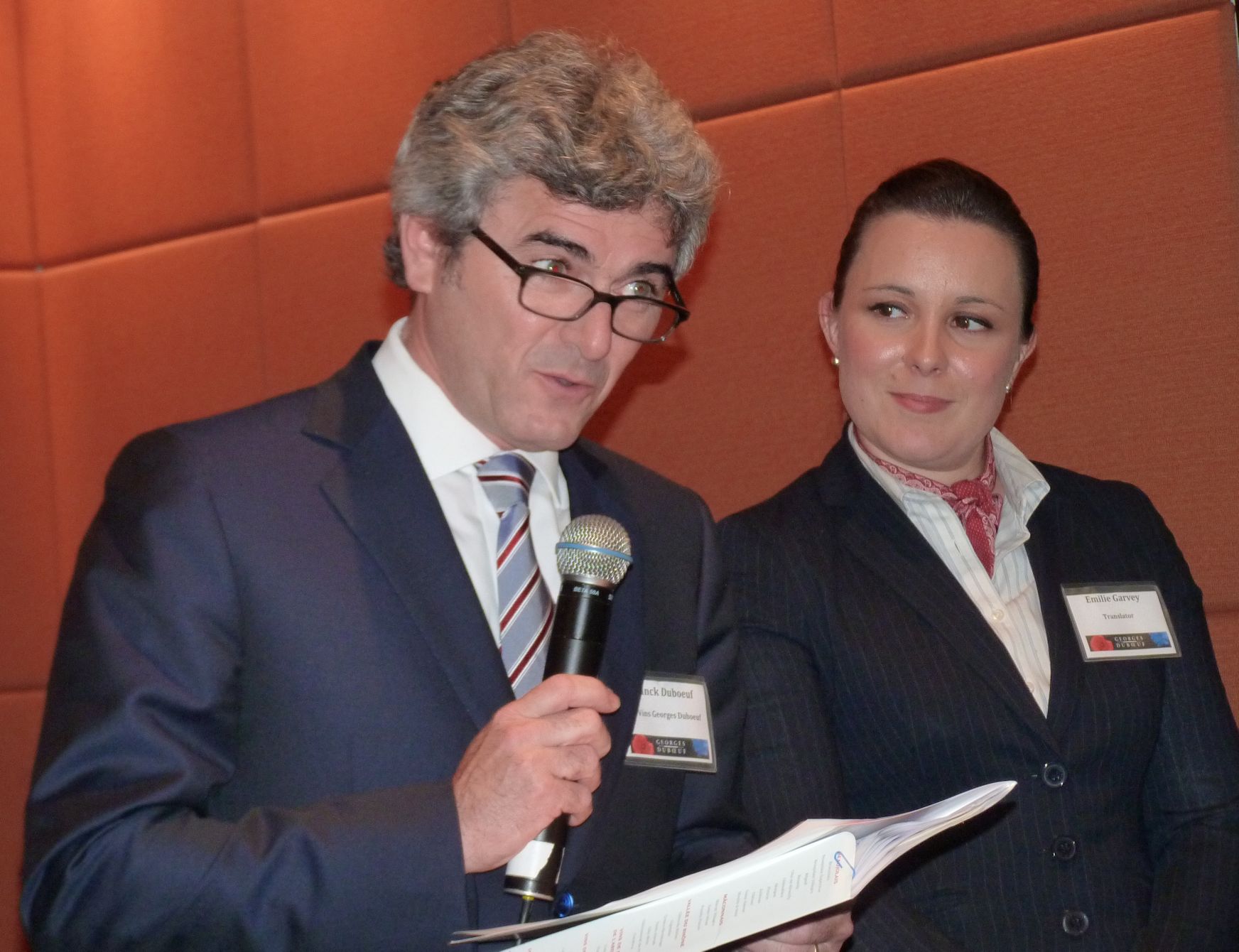
Georges Duboeuf opened the event with presentation of 2011 vintage. Here is my best effort transcript of what he said (remember, I’m not a professional journalist, I’m only pretending): “2011 was a great year. Budding started in April, then flowering started in June, and then harvest started August 22nd and lasted for two weeks. Some areas experienced periods of drought. Overall, grapes reached very good level of ripeness. 2005 and 2009 (considered best in a very long time) were good, but 2011 might be even a little bit better than 2009. Throughout the vintage, there are lots of black cherry and earthy notes.”

After Georges Duboeuf’s presentation, the first dish was served – “Legumes du Marche” – Young Garden Vegetables, Fromage Blanc Dressing, Lavender Honey Vinaigarette.
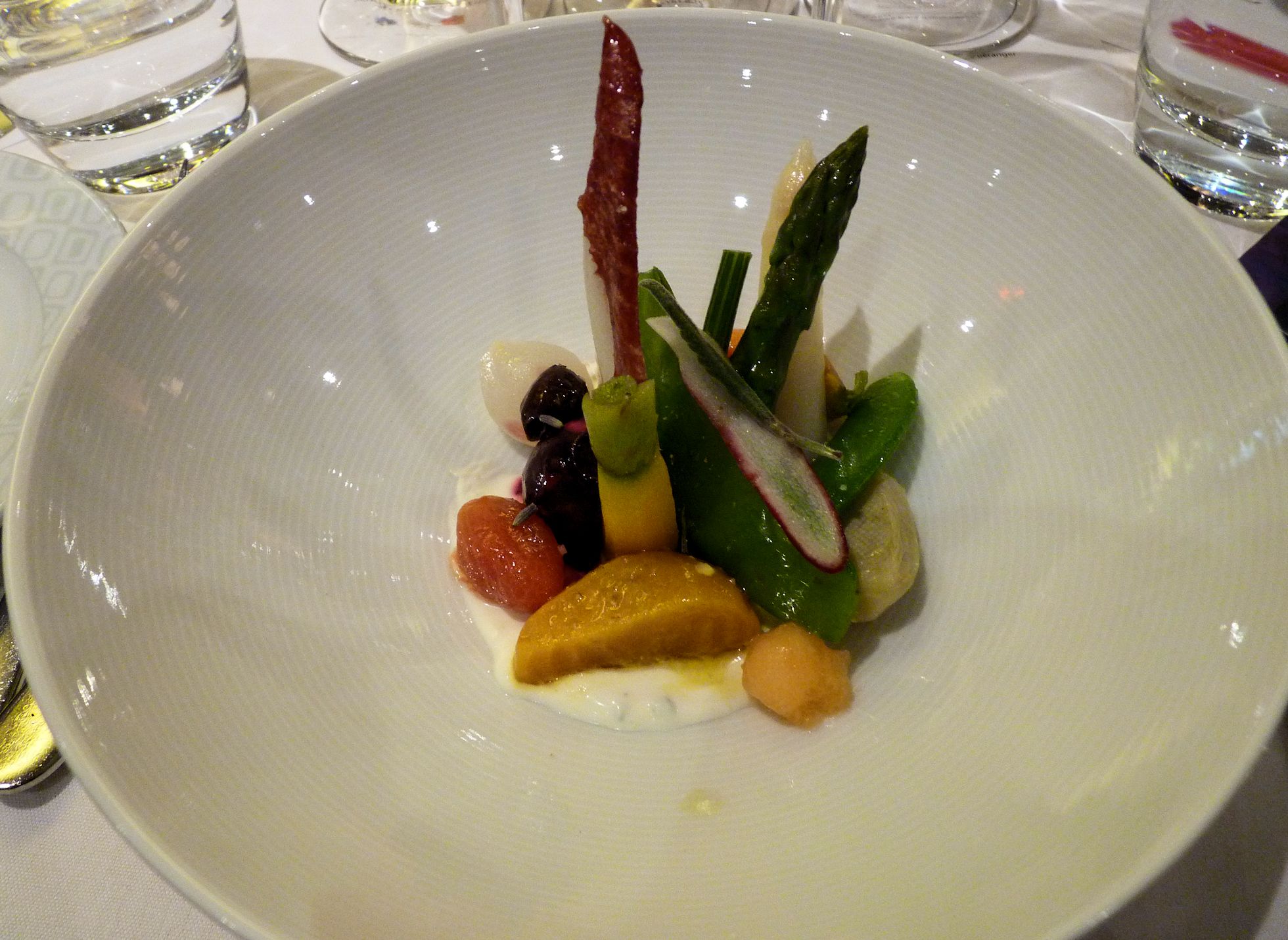
This dish was paired with 2011 Georges Duboeuf Beaujolais-Villages, and it worked together very well by wine complementing soft and earthy flavors of the vegetables.
Next, Frank Duboeuf presented two white wines, Macon-Villages and Pouilly-Fuisse (please see detailed note below). He said that 2011 was equally good year for both whites and the reds, which is a very rare situation. I didn’t take the detailed notes though, as I was preoccupied with parallel discussion at the table and delicious pairing of wine and food ( bad journalism : ( )
White wines were served with the next course, Seafood Risotto – Black Sea Bass, Scallops, Squids, Cockles, Fennel, Tomato Confit “Fumet” Emulsion.

Pouilly-Fuisse worked perfectly well with risotto, which was a unique experience for me. Creaminess of risotto cancelled out some sharpness of the chardonnay, creating next level of experience.
For the next course, Georges Duboeuf presented two red wines, Morgon and Julienas. He described Morgon as having “violet, cassis, kirsch on the nose, same flavors on the palate. A lot of structure. This wine will age very well”. Regarding Julienas, he said that “it is a very special wine, it has great personality. 2011 was a lot like 2009. This particular wine had the biggest success over the last 5-6 years. It was very critical to expand the vineyard (by 4 acres) for the success of this wine. This is a very noble wine with great aging potential. The wine was bottled a week before, right before the event”.
These two reds accompanied the last course of the meal – Duo of Beef – Braised Short Ribs, Beef Tenderloin, Spring Vegetables, Sauce Bordelaise.
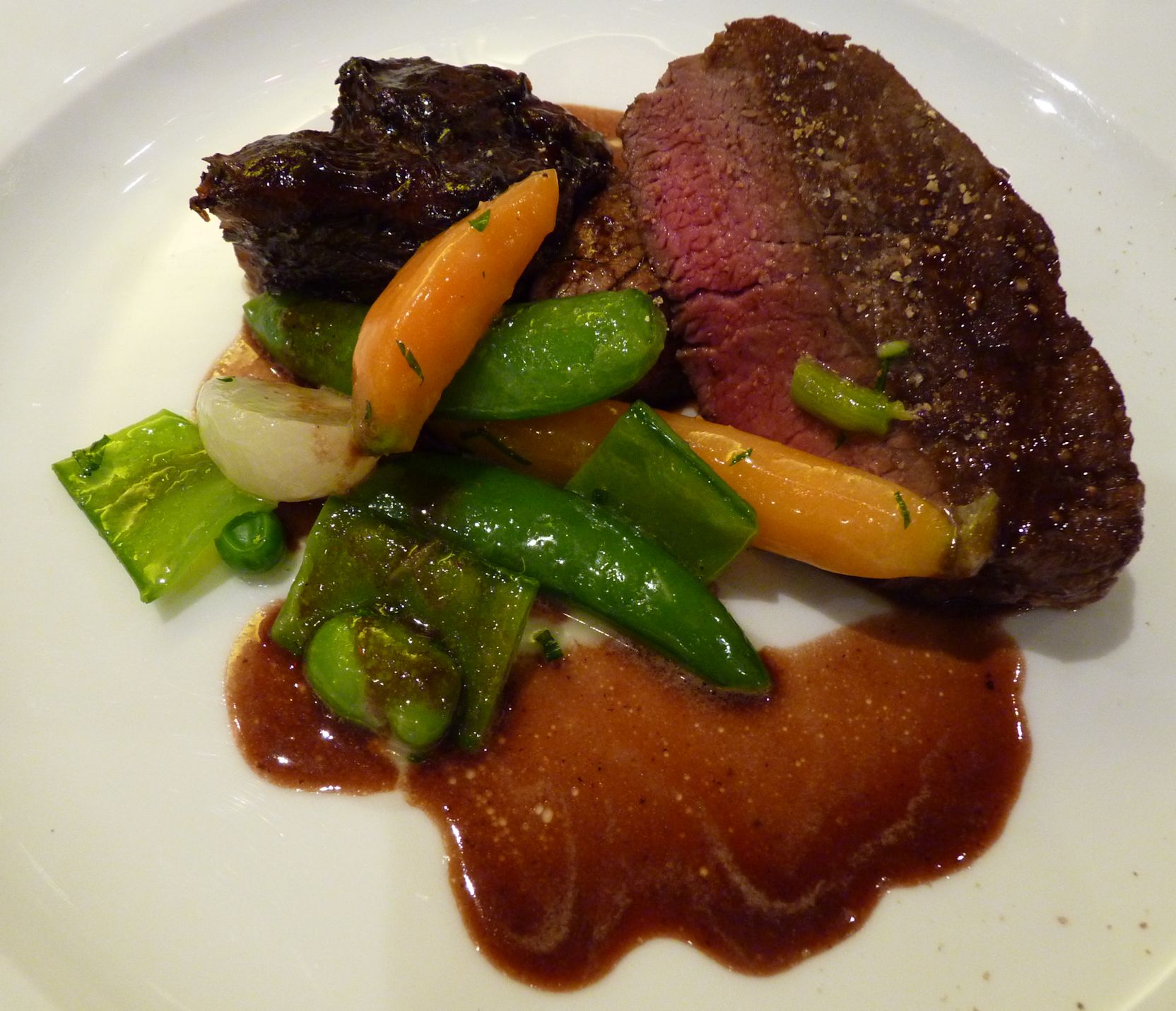
I have to tell that while both food and wine were delicious in its own right, they didn’t work together, so the pairing was not successful by not elevating the whole meal to the next level. But I also have to admit that both food and wine really didn’t bother each other too much – they were really two absolutely parallel experiences without a merge or a collision (which is often the case when wine and food don’t work together).
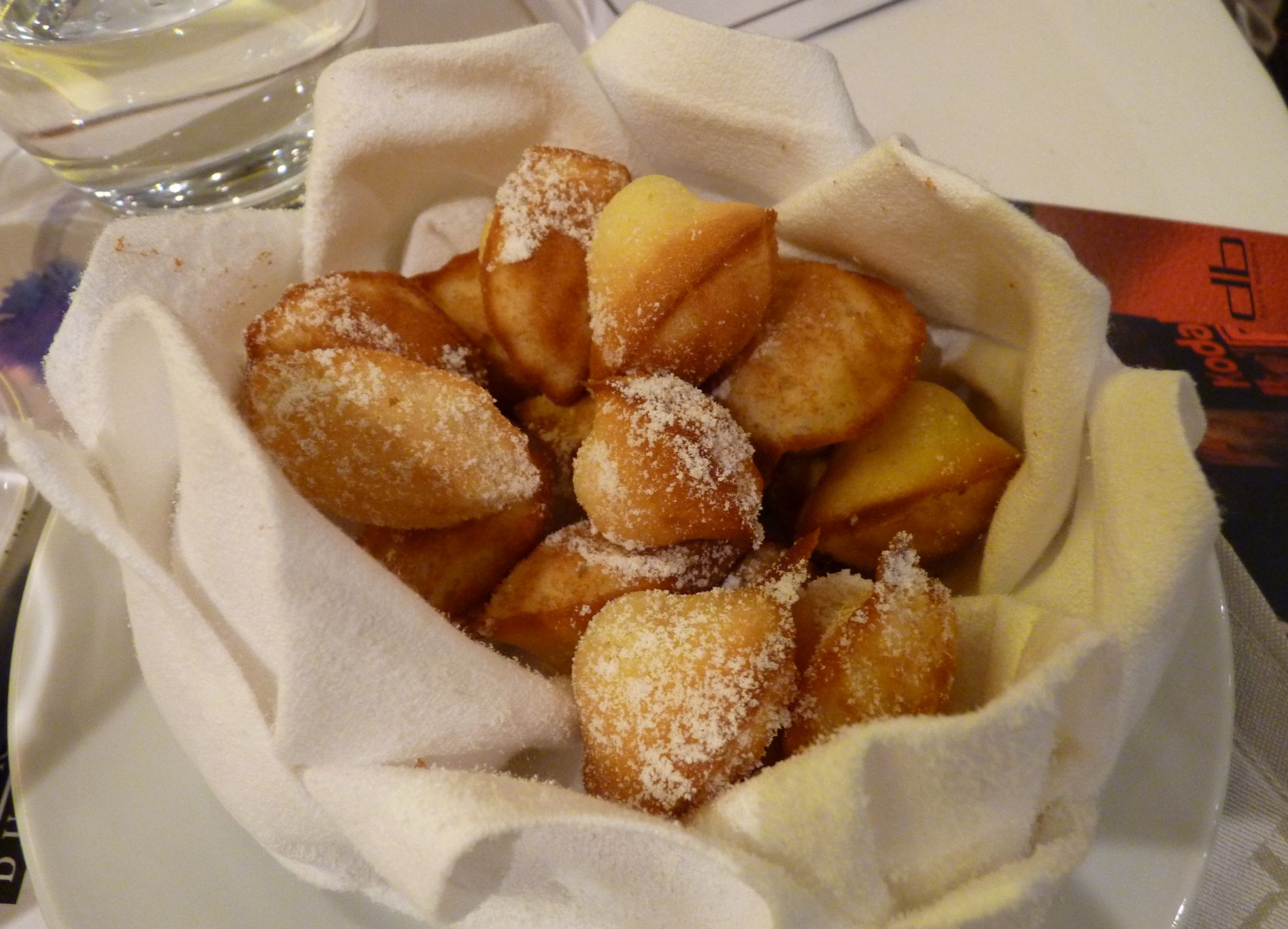
And then…there was a dessert, which was delicious and not paired with any wines (I also have no idea how this little cookies should be called, but it was very hard to stop eating them).
Here are the detailed notes for the wines:
2011 Georges Duboeuf Macon-Villages Domaine Les Chenevieres, Maconnaise, France (100% Chardonnay, SRP: $13.99, 12.5% ABV, 5000 cases produced) – Very nice, hint of hazelnut and citrus on the nose, good fruit, good balance, good acidity, hint of white apples, touch of vanilla and touch of oak on the palate. (Drinkability: 7+)
2011 Georges Duboeuf Pouilly-Fuisse Domaine Beranger, Maconnaise, France (100% Chardonnay, SRP: $17.99, 13% ABV, 3500 cases produced, 1200 imported) – this wine comes from the best area, the actual town of Pouilly-Fuisse. This wine had more pronounced chardonnay qualities than the previous wine – vanilla, touch of citrus and oak notes, excellent balance. (Drinkability: 8- )
2011 Georges Duboeuf Beaujolais-Villages, Beaujolais, France (100% Gamay, SRP: $9.99, 12.5% ABV) – very nice, good balance, a little tartness on the palate, but good overall. (Drinkability: 7)
2011 Georges Duboeuf Morgon, Domaine Jean Descombes, Beaujolais, France (100% Gamay, SRP: $15.99, 13% ABV) – good acidity, fresh fruit, light, soft, a bit too grapey to be great – but should improve with time. (Drinkability: 7)
2011 Georges Duboeuf Julienas Chateau des Capitans, Beaujolais, France (100% Gamay, SRP: $18.99, 14% ABV) – excellent depth, good power, good body, excellent balance. (Drinkability: 8)
All in all, it was one great event, both in the information and experience. Summer is still on, my friends – go find a bottle of Beaujolais to kick it off after a long day. And make an extra effort to find one of Georges Duboeuf wines – it will well worth it. Cheers!
Story Of A Beets Salad
I have to admit – I’m very impartial to the beets salad. Not any beets salad, but Roasted Beets salad. I can’t tell you why. May be it has something to do with the name – “roasted”… “beets”… “salad”. May be my body simply lacking the nutrients which can be found in the roasted beets, and sends the subliminal message”you want this…”. Don’t know. But every time I see a roasted beets salad on the menu in a restaurant, there is a very good chance I will order it.
Interestingly enough, while at home we make many dishes out of beets (beets is one of the staples of the Russian cuisine I’m accustomed to), recipes for those dishes call for beets to be boiled. At the same time, I believe roasting of the beets keeps flavor and sweetness locked in and concentrates it, where in case of boiling it gets all diluted. Roasting also preserves the color – just look at the picture if you want proof.

So for the first time ever, I decided to make a roasted beets salad with goat cheese, grapefruit, baby arugula and pistachio nuts. Before I get to the details, I would like to mention the source of my inspiration for this dish – it was appetizer called “Study of Beets” which I had at the Pinot Café in Los Angeles – you can the story here. That “study of beets” gave me an idea for combination of the ingredients.
Talking about ingredients, for this salad you would need:
- 4 large beets
- 1 large grapefruit
- 3 ounces (or less) of goat cheese
- 1 tablespoon of olive oil
- pinch of sea salt
- half a cup of pistachio nuts
- about half a cup of baby arugula or any similar greens. Note that baby arugula here is not the main ingredient, it works almost like a spice with its mild bitterness, and you can even skip it if you want.
Start from roasting beets at 400F for about an hour or until tender. When roasting the beets, you can play with flavor. I put beets in foil with addition of liquid smoke (don’t wrap it tight, or they will boil) – as a result, beets had nice hint of smokiness. Once ready, let beets to cool off, then peel and slice – size of slices is entirely up to you.
Put sliced beets in the bowl, sprinkle (very sparingly!) with sea salt (I recommend sea salt as it also adds textural sensation) and add a tablespoon of olive oil. Add goat cheese (break it up in little pieces by hand). Add completely peeled grapefruit, also broken in pieces, and then baby arugula. Reserve few pistachios, crumble the rest and add it to the salad. Mix everything gently together, put in the bowl and garnish with reserved pistachios. Serve and enjoy!
 What about the wine, you’re asking? Of course there should be wine. I didn’t have a chance to test the exact combination, nevertheless I would suggest that good Sauvignon Blanc would work well here. Lets narrow down that “good Sauvignon Blanc” – I would actually suggest 2009 Hyde Vineyards Selene Sauvignon Blanc from Carneros to pair with this dish.
To tell you the truth, I love New Zealand Sauvignon Blanc, Sancerre (classic Sauvignon Blanc wine from France) and Chilean Sauvignon Blanc. However, 9 times out of 10 I would avoid California Sauvignon Blanc – lots of them are high-alcohol soulless concoctions. Now, this Selene Sauvignon Blanc – WOW! Probably the best California Sauvignon Blanc and one of the best I ever had from any region.
Grassiness, acidity, fruit – all comes together in a very balanced package with nice finish. Beautiful wine (Drinkability: 8+). I have no doubts this wine would work very well with the beets salad, and I will prove it to myself next time – or wait for you to tell me.
Thanksgiving Wine Pairings
 As promised, this is follow up post to compare Thanksgiving expectations with experiences.
When it comes to the food, the star of our table was dish called Turducken. First time I read about turducken in the late nineties in the Wall Street Journal. Since then we made it a few times for Thanksgiving. The dish is somewhat labor-intense, but absolutely delicious when done right. The word turducken comes from the fact that the dish consists of partially deboned turkey, with fully deboned duck going inside of turkey, and then deboned chicken going inside of a duck. The idea of enclosing birds into each other during cooking is not new, it had being done in Europe for centuries. Turducken specifically is considered to be originated in New Orleans – and one of most popular cooking styles for it is Cajun.
The process of preparation starts from deboning of chicken, duck and then turkey (turkey is only partially deboned with legs and wings left untouched). Next very important step is brining. As critical as it is for smoking, brining helps to retain the moisture in the meat during long cooking time. Brining typically takes 12 hours, so you need to plan your time accordingly.
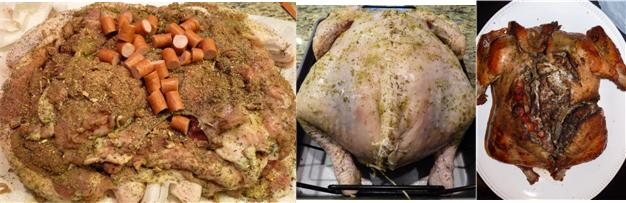
After brining, the process of preparation starts from laying down the turkey, adding spices (or stuffing) on top, then putting in the duck, repeat spices again and then chicken, plus you can put any desired stuffing as the last layer (we used smoked sausages in our case). The next step is to sew the turkey together and place it in the oven for about 5 – 6 hours. The resulting bird is very moist and flavorful, and – may I add – very easy to carve.
So what about wine? Turducken and all the side dishes, such as yams, pumpkin and wild rice stuffing, are very flavorful, so it is hard to tell apriori which wine will work the best – therefore it is an opportunity to experiment. We tried Joseph Drouhin Beaujolais Nouveau – this wine was completely lost next to turducken. Next one was Claraval, Spanish Grenache/Tempranillo blend – this wine well complemented the variety of flavors.
 The winner was Serradenari Barolo 2005. It was decanted for 3 hours prior to the dinner (as always suggested for classic Barolos), and the wine showed beautiful layers of fruit and earth, which worked very well with turducken and other dishes at the table.
Of course we shouldn’t forget about desert. No, there was no pumpkin pie at the table. Yes, it is violation of the tradition, but when nobody likes the dish, it is hard to justify getting it on the table. Instead, Pecan pie is one of traditional staples of the sweet portion of our Thanksgiving dinners:
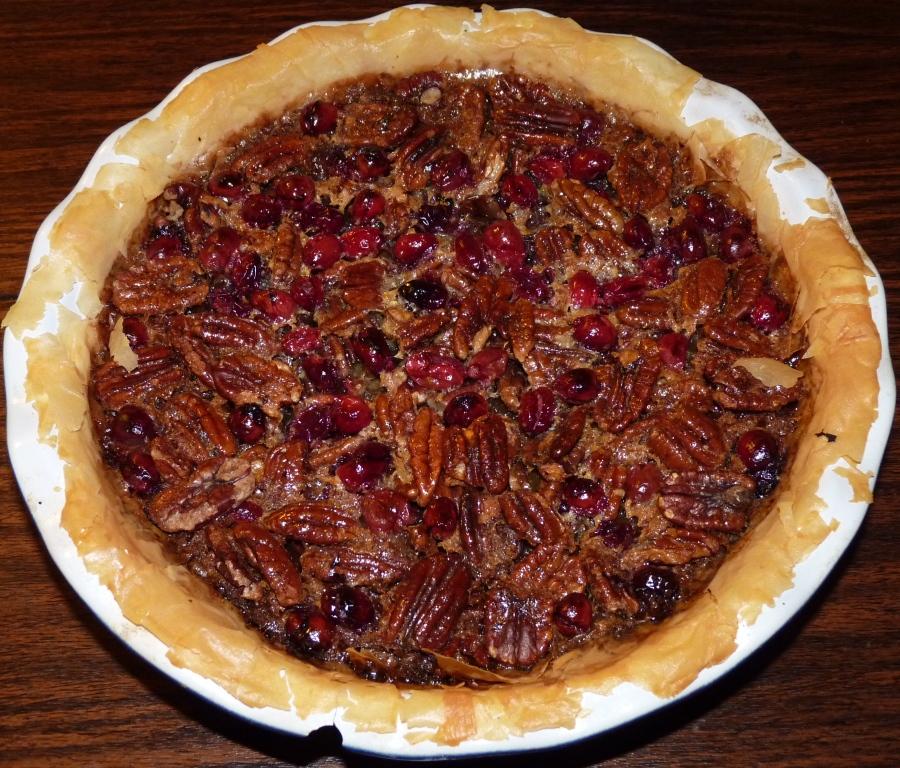 You are saying that coffee or tea would be the best match for such a dish? You are right, however, there are some exceptions here. We were lucky to have Rivesaltes 1936,
 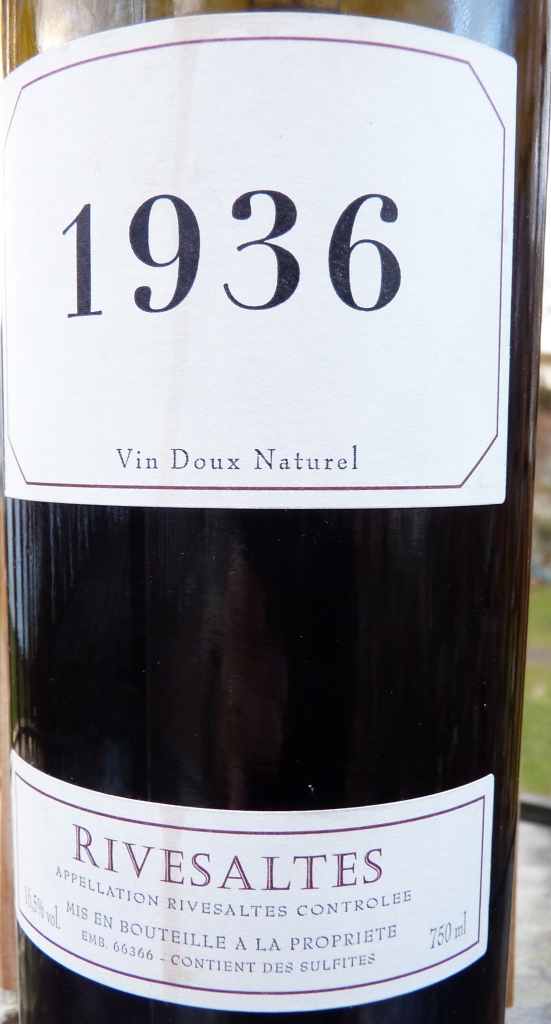 a desert wine produced in Roussillon region in South of France (courtesy of my friend Zak). This is a natural sweet wine, made out of Grenache grape and produced in the same style since 13th century. This wine has luscious layers of nuts, honey, cloves and other spices, without overpowering sweetness of many of the ice wines. It drinks as a very light wine (despite high alcohol content) and perfectly complements many different deserts.
So, I told you what was on our Thanksgiving table. Now, I would love to know what was your most memorable dish and wine?
Expectations: Thanksgiving Dinner
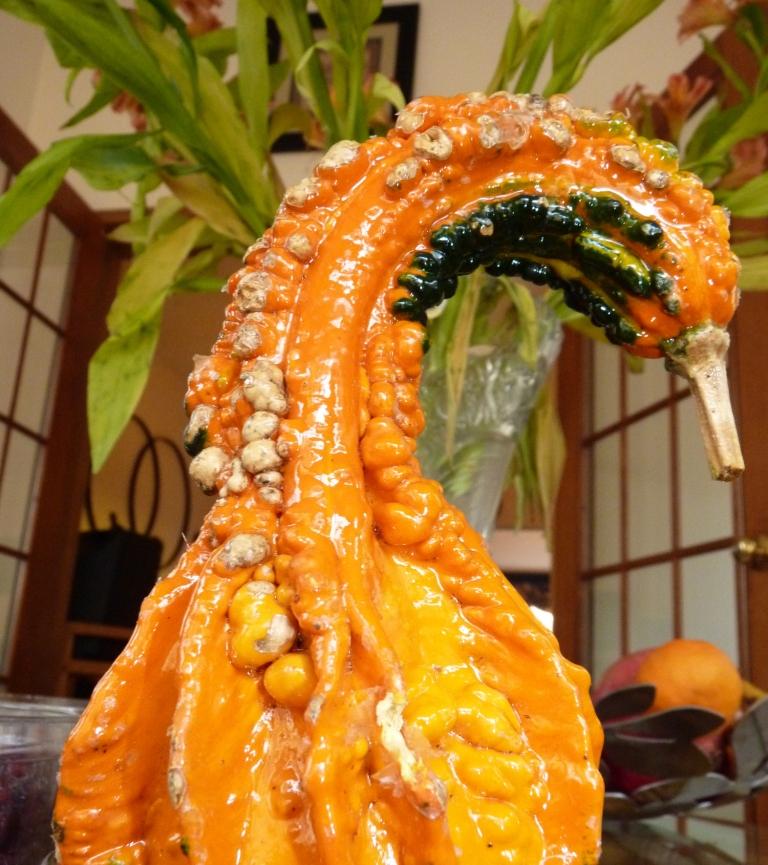 Thanksgiving day – friends, family, lots of food and wines. Culinary delight is definite part of the holiday – every possible ( and impossible) web site is full of new recipes to try and recommendations on what to serve.
I would love to write the blog post right after the dinner – but this would be literally impossible, as desire to sleep after a big meal will interfere. Therefore, let me just share my quick expectations. The staple dish for tonight is turducken – chicken inside duck inside turkey, all de-boned, of course, except turkey legs and wings. That is already in the oven and holds a big promise of the tasty meal ( pictures and details – in the later posts). There will be a lot more of traditional fall flavors – squash, pumpkin, sweet potatoes – all taking part in the feast.
Variety of flavors is expected of the food, and it is hard to tell which wine will work the best. Therefore, when in doubt – experiment! We plan to have Beaujolais Nouveau ( Joseph Drouhin), Barolo, Zinfandel and Claraval (Spanish red). Which one will pair the best? Hopefully one of the wines on the table. And if not – wine program for tonight also includes Rivesaltes 1936 and Bruichladdich 12 – expectations, expectations…
What will be on your table tonight?
Until later – Happy Thanksgiving!
Experiences: Chef’s Tasting Dinner at Hotel Fauchere
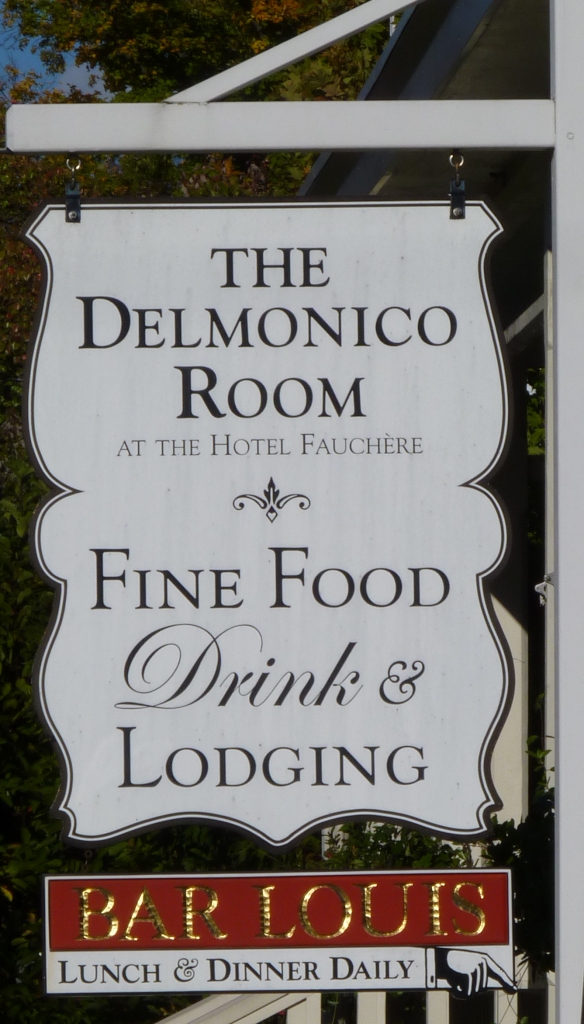 This is the last post in the series about our experiences at Hotel Fauchere in Milford, PA ( previous two posts can be found here and here). Have to warn you upfront – if you thought that there are too many photos in my posts, this one will be extreme – there are way too many pictures I want to share. Here we go…
Culmination point of our weekend getaway was chef’s tasting dinner, long anticipated and planned for. The dinner took place at The Delmonico Room at Hotel Fauchere – for historic reference behind the name and relationship with The Delmonico Room in New York, you can click here. Anticipated is fine, but what’s up with planning? Considering love of wine in the group, we decided to take upon the pairing of the tasting menu by ourselves. For the tasting and pairing experience, this was a good decision, for the service part – not so much. Not that I can really complain about service, all the plates, decanters, glasses and silverware were flying around properly, but the service was delivered in the stark contrast with “everybody smiling” (if you read my previous posts), I would say it was delivered with the stone face. There can be some objective reasons to that ( we brought our own wine, therefore I guess we questioned the level of wine service)… Anyway, let’s talk about food and wine
So we had 7 course tasting menu with two very small “single byte” dishes at the beginning and in the middle of the dinner. Menu focus was on the local, seasonal and fresh ingredients, and I think mission was accomplished quite well. We selected 7 different wines to pair with the dishes – 4 whites, 3 reds.
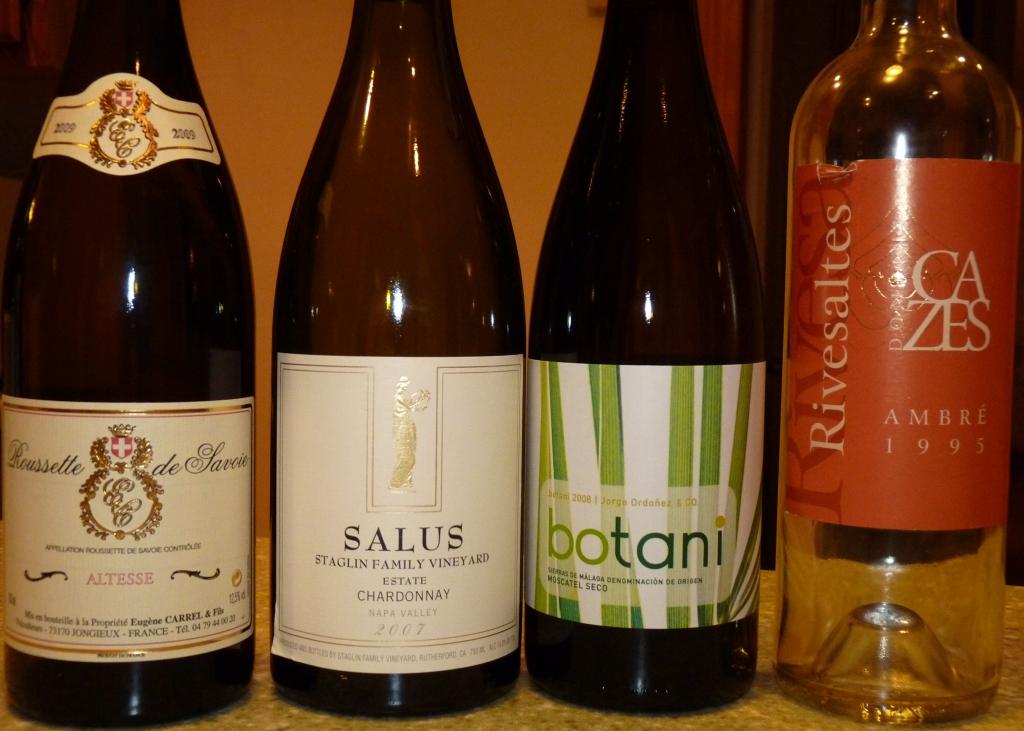 Here are the four whites:
2009 Domaine Eugene Carrel & Fils Rousette de Savoie Altesse, France
2007 Staglin Family Vineyards ‘Salus’ Estate Chardonnay, Napa Valley
2009 Jorge Ordoñez Málaga Botani Sierras de Màlaga
1995 Domain Cazes Ambré Riversaltes Languedoc-Roussillon
We made a lot of good decisions with this set – but more about it later.
And here are the three reds:
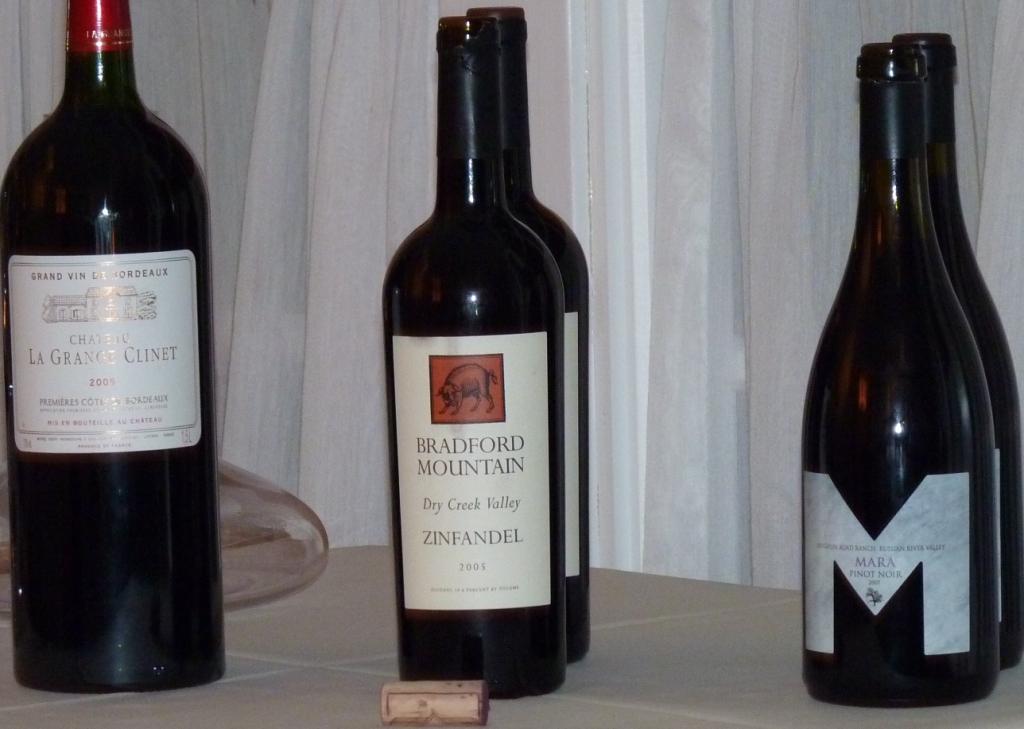
2007 Mara Pinot Noir Laughlin Road Ranch, Russian River Valley
2005 Bradford Mountain Zinfandel Dry Creek Valley
2005 Chateau La Grange Clinet Premier Cotes de Bordeaux
This was also a great selection, all worked very well with food – so lets get some details.
The first dish in tasting was Tortelloni A La Zucca (Seared Diver Scallop, Black Walnut, Sage Butter). Wine pairing – Rousette de Savoie Altesse.
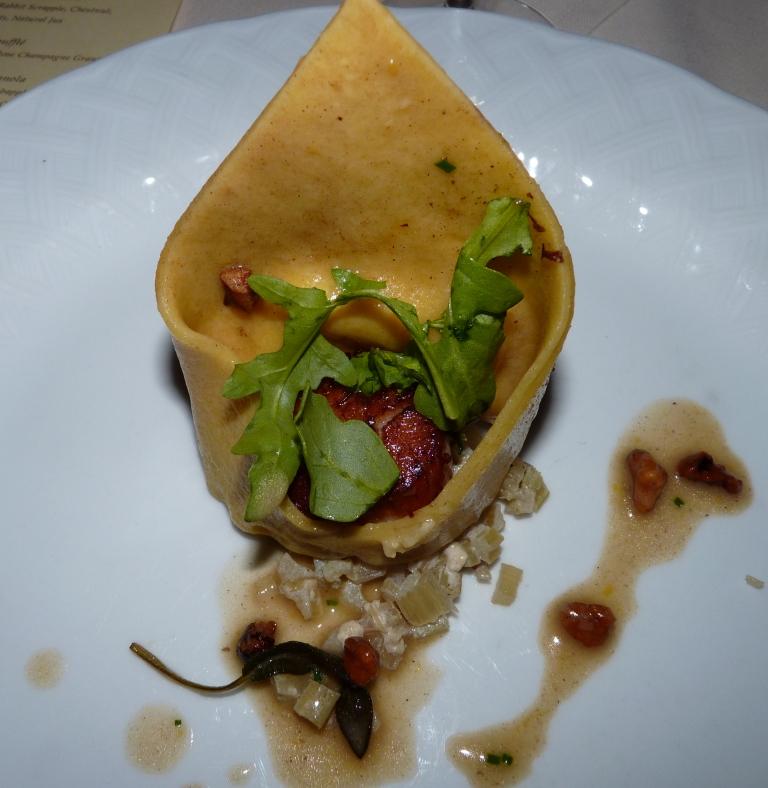 I would honestly question composition of the dish, as pumpkin tortelloni didn’t do anything to the scallop, tortelloni looked almost as a presentation piece. At the same time, wine worked very well with all of the components in the dish – apple, leeches and earthiness worked well with pumpkin filling, and wine had enough fruit and acidity to complement scallop. One important thing to mention here – with this wine I was able to make a progress in the treble journey, as Altesse is a grape from Savoie which I never tasted before. Color me happy – 273.
The next dish was Foie Gras De Canard (Porcini Mushroom, Brussles, Pear, Pomme Maxim). Wine pairing – Staglin Salus Chardonnay.
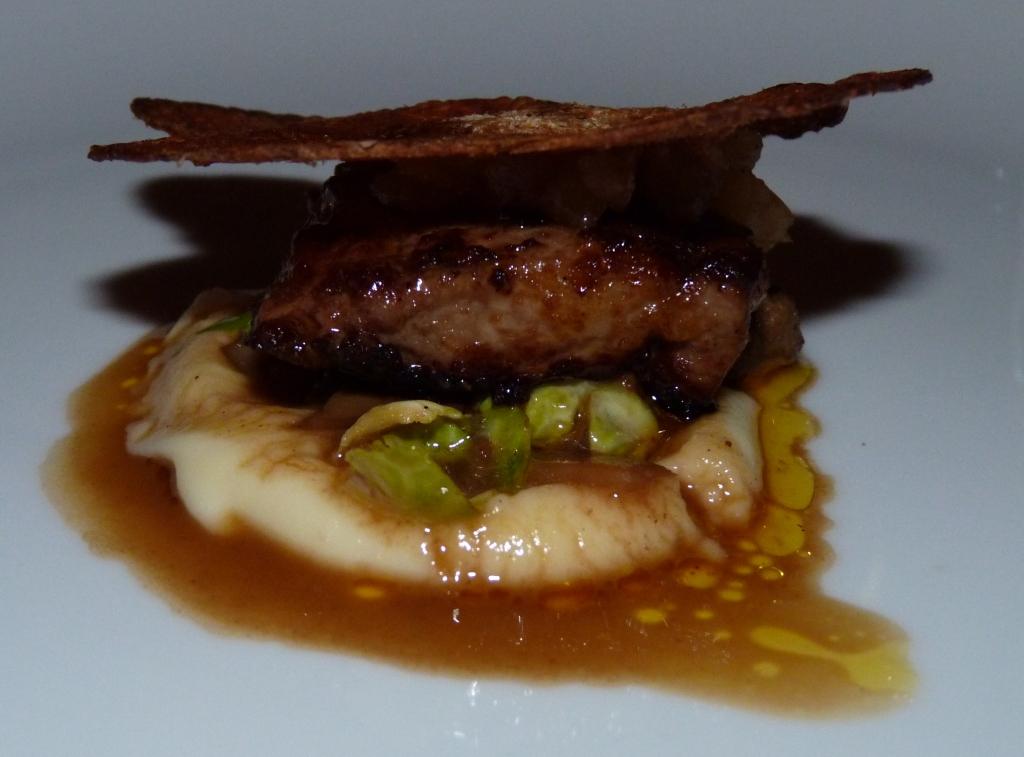 As we didn’t miss a single pairing ( pat on the shoulder), at least in my opinion, I will omit redundant [great pairing] in front of each description.
Salus is produced by Staglin Family, one of California cult wine producers from Napa Valley (Staglin Family Estate Cabernet Sauvignon 2007 just got WS 98 rating). Salus was one of the most beautiful chardonnays I tasted lately. Vanilla, butter, caramel, toasted oak and acidity of the wine worked perfectly with heavy but creamy texture of the foie gras.
Next dish was Roasted Black Sea Bass (Caramelized Sunchoke, Garden Chard, Cabernet Franc Emulsion). Wine pairing – Mara Pinot Noir.
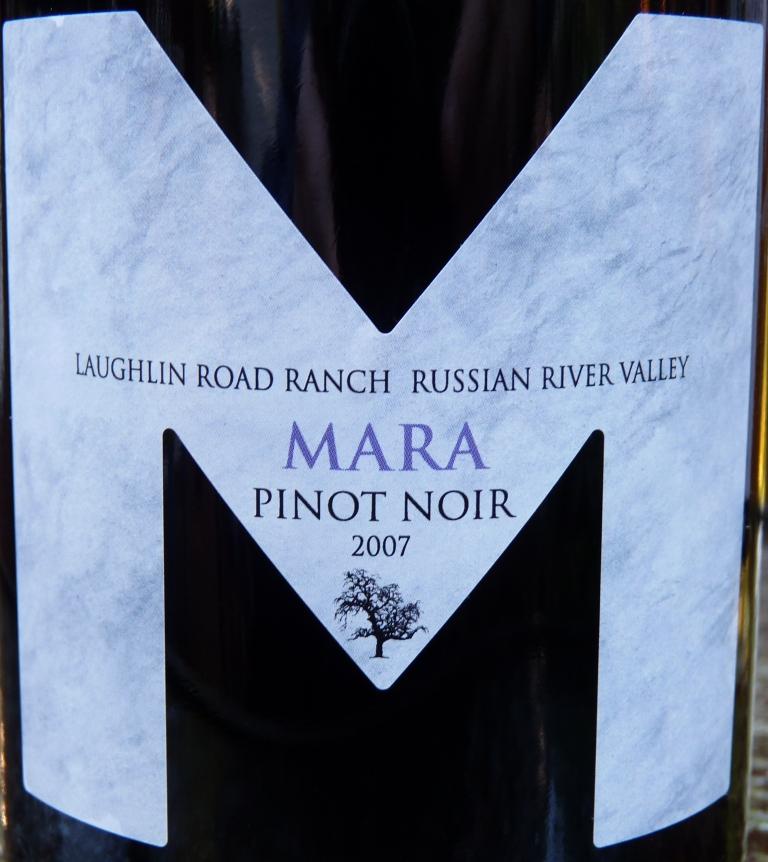 In case you wonder, there are actually two reasons why there is a wine label above instead of picture of the dish:
1. It was one of the best versions of Roasted Sea Bass I ever had. So, by the time I realized that I didn’t get a picture of the dish, it was too late.
2. And I guess it was also too late because everybody got carried away after taking a sip of Mara Pinot Noir.
Mara Pinot Noir was really a centerpiece of the tasting. “Oh my god” was major phrase at the table after the first sip of the wine. I don’t think that wine should be described in terms of color, fruit and acidity. This wine should be described in terms of opulence and decadence it cast upon the table. “Total and absolute balance” would be the right way to put it. Anyway, if you can find a bottle, you should experience it for yourself ( about 250 cases total production). In my “drinkability” ratings it is defnitely a 9+.
Next dish: Sautéed Squab (Confir Potatoes, Red Peppers, Serrano Ham). Wine pairing – Bradford Mountain Zinfandel.
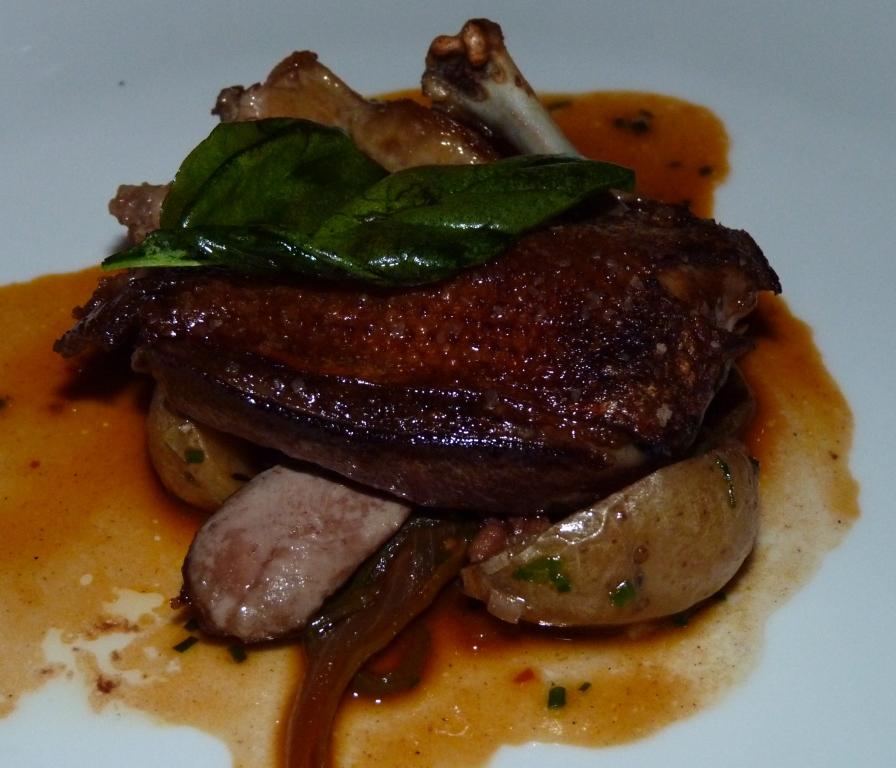
Deep earthy and gamey flavors of the dish ( tasted almost like a fried liver), were complimented well by spices and acidity of the wine. This was definitely a good combination.
Following on, major entree: Duo of Farm Raised Rabbit (Bacon Wrapped Loin, Rabbit Scrapple, Chestnut, Garden Carrots, Natural Jus). Wine pairing – Chateau La Grange Clinet Premier Cotes de Bordeaux.
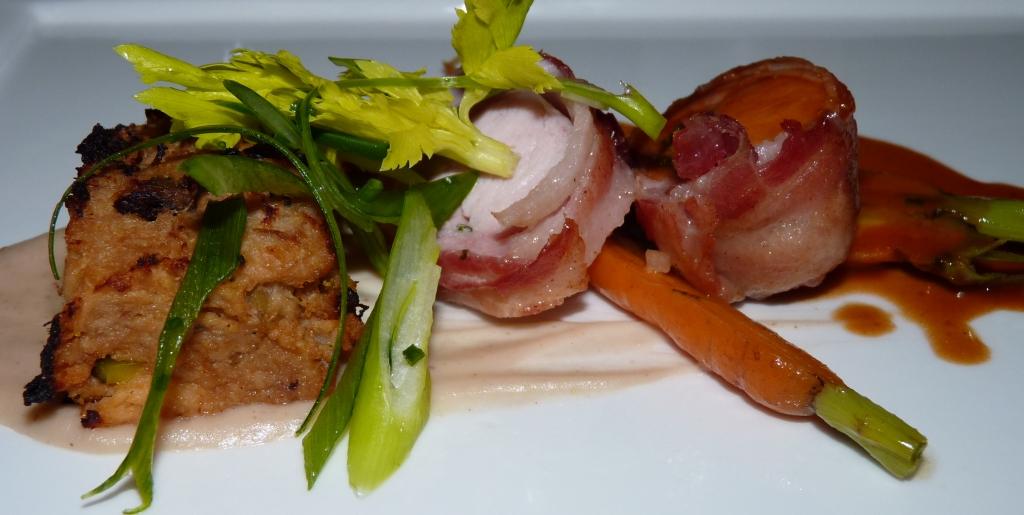 Bordeaux had being nicely decanted, so it was open enough in time for this dish being served. Coming from magnificent 2005 vintage, this wine can be drunk right now, but will improve with some time in the cellar. The wine worked well with the flavors of the dish – combination of tender, a bit gamey loin and fresh garden vegetables was well complemented by dark fruit flavors in the Bordeaux.
And now it is time for desserts: Cheese Soufflé (Pinot Noir Must, Grape Aspic, Rose Champagne Granite). Wine pairing – Botani Sierras de Màlaga.
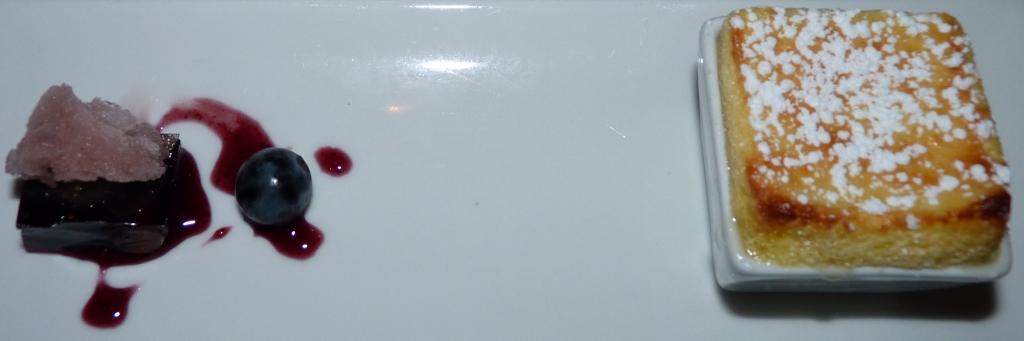 I discovered Botani Muscat at the dinner at The Capital Grille. This wine delivers incredibly bright acidity and fruit combination, every sip feels like it is full of live. That acidity was instrumental in this pairing. The wine worked quite well with both Granite and Souffle components of the dessert.
And last, but not least, one more dessert: Gala Apple and Granola (Apple Jack Caramel, Foraged Crabapple Confit, Cinnamon Gel, Pecan Brittle, Mulled Cider Ice Cream). Wine pairing: Ambré Riversaltes.
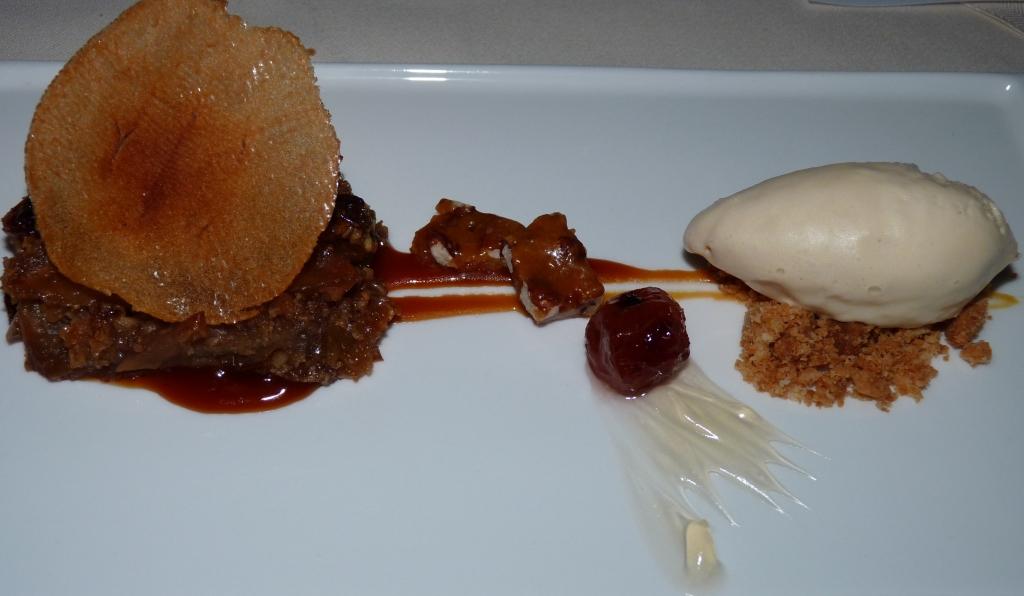 If Mara Pinot Noir was best of tasting, then this was the most interesting wine. This wine, made out of White Grenache, is made in the Solera style – it spent 7 years in the open tubs, developing delicate flavors. Ambré Riversaltes exhibited fresh and balanced flavors of toasted apple and caramel, which perfectly worked with “apple many styles” flavors of the dessert.
That’ s all, folks – it is time to conclude the report on the Hotel Fauchere experience. All in all, we had a great time, and will gladly do it again. The life journey continues…
Hotel Fauchère
401 Broad St
Milford, PA 18337
(570) 409-1212
http://www.hotelfauchere.com

The Story of an Apple Cake
Don’t worry, this will not be a story about apple wine. At the minimum, it will be about food and wine. So the weather was beautiful, and the apple-picking trip (almost an annual tradition in the fall) was inevitable, especially considering the free weekend day. Our favorite place to pick apples is Lyman Orchards in Middlefield, Connecticut. This place never disappoints – apples are good and abundant, and getting them off the trees is a lot of fun.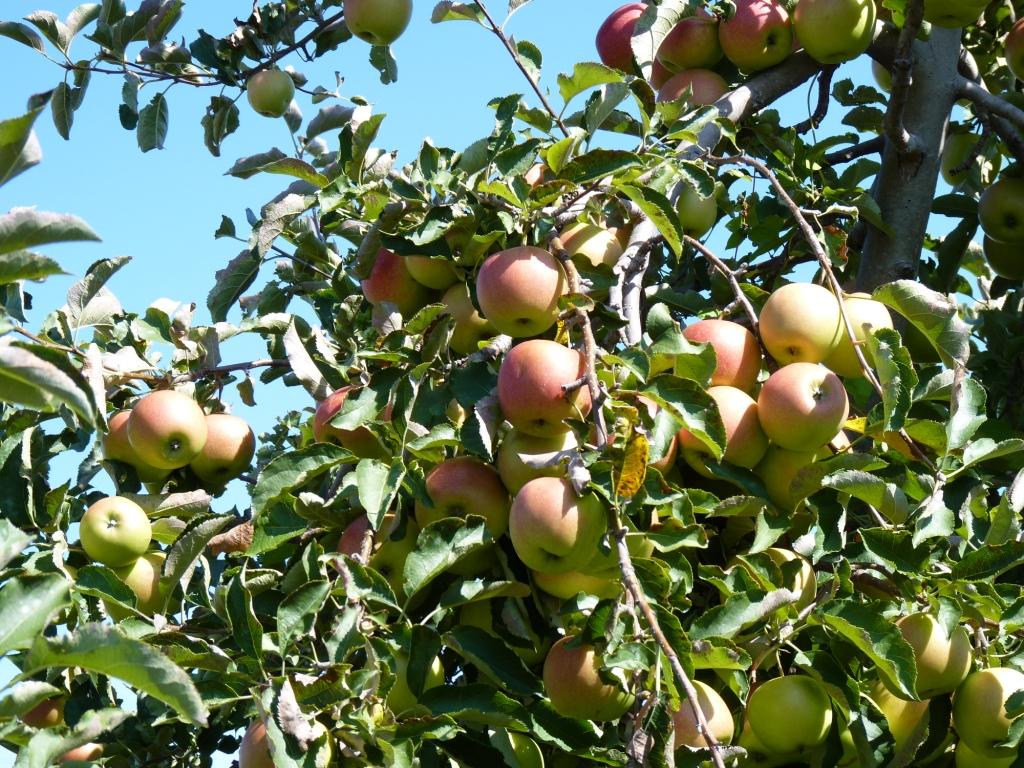 Once you have a lot of apples, what do you do? No, not wine. And for me – not an apple pie either. I don’t really like liquid pies, so my personal preference is an apple cake. How do you make an apple cake? Actually, quite easy. Here is the recipe:
4 apples (Granny Smith is the best as they are usually sour enough to stand against sweet dough)
3 eggs
1 cup of sugar
1 cup of flour
Cinnamon ( by the taste).
Butter to grease the pan
Bread crumbs
Core and peel the apples, and slice them thin. Make the dough: blend eggs first, then add sugar, and then flour. Make sure you end up with liquid and consistent dough. Meanwhile, preheat the oven to 425F.
Grease pan with butter and cover with bread crumbs. Bread crumbs should cover the bottom and walls of the pan. Remove excess bread crumbs. Your pan should look like this:
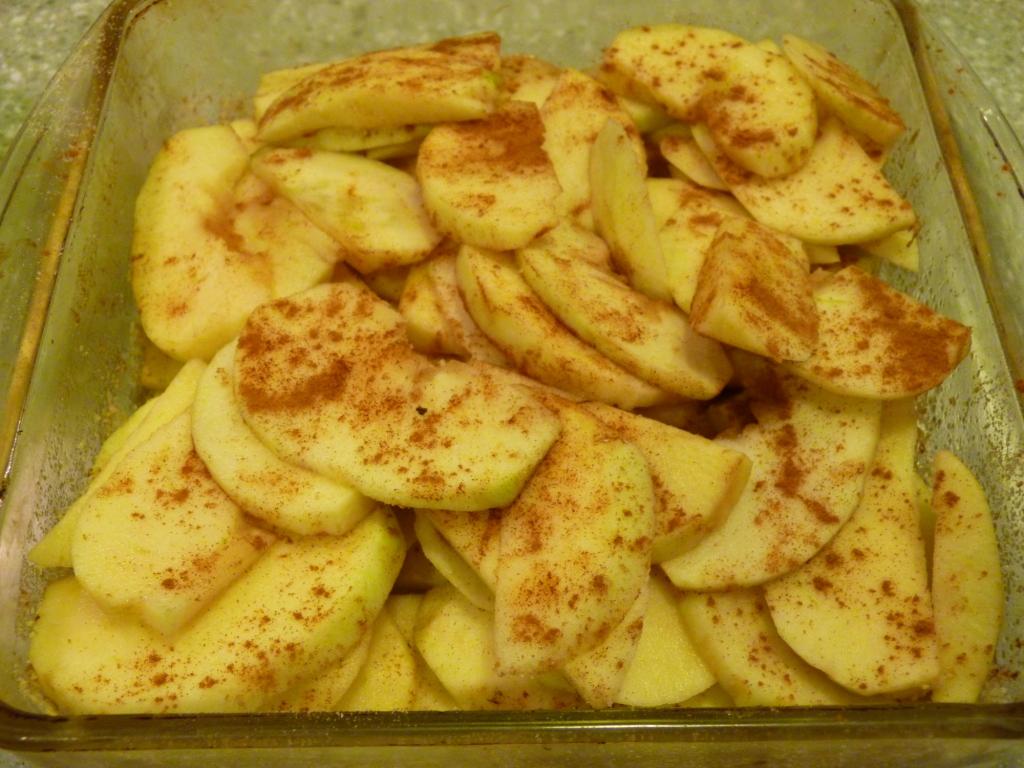
 Then, put sliced apples into the pan and sprinkle them with cinnamon (the amount of cinnamon goes by the taste):
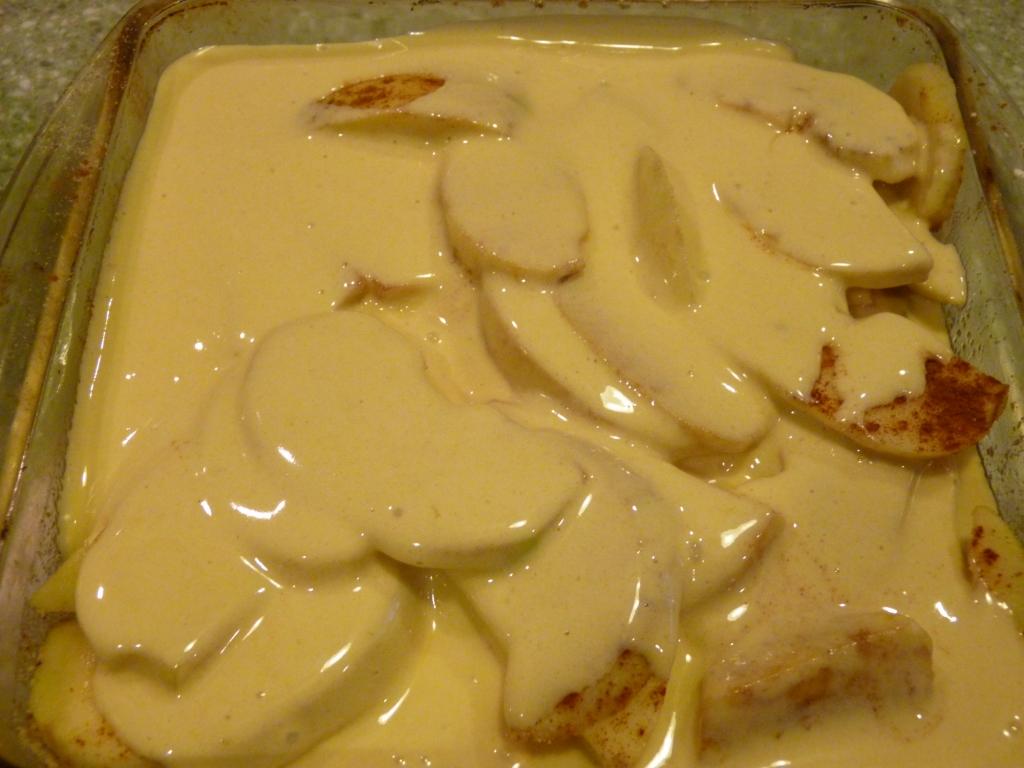
The dough goes on top:
And then the pan goes in the oven:
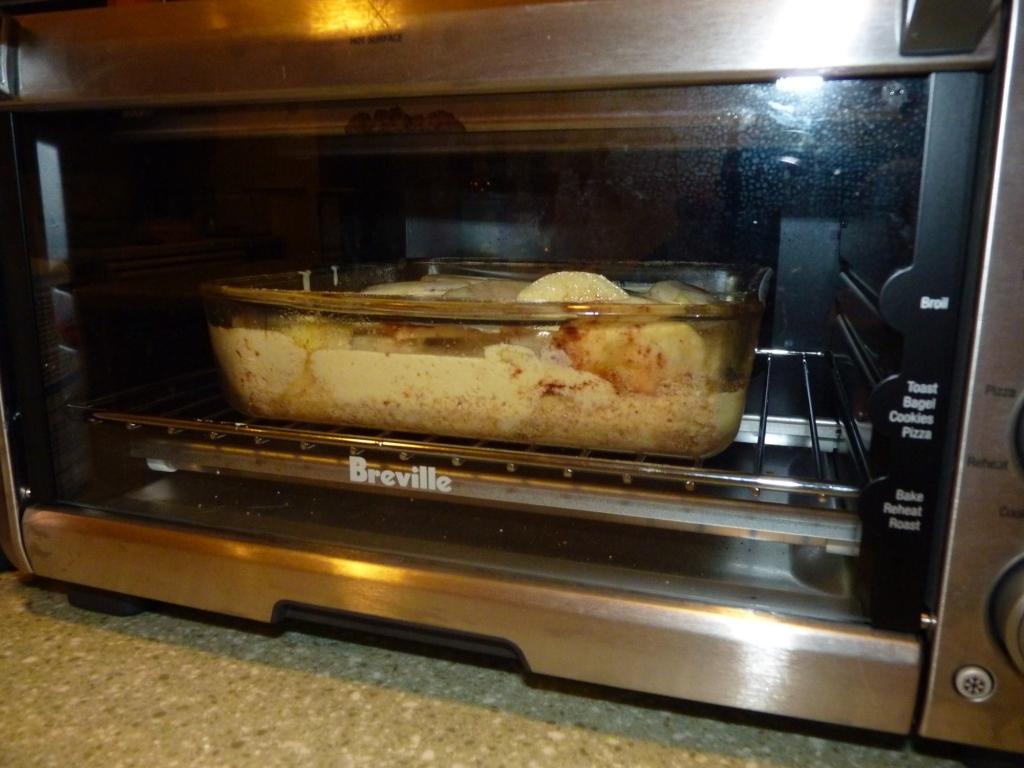
Bake it first for 15 minutes at 425F, then reduce the heat to 375F and continue for another 45 minutes or until the top is brown enough (you can check readiness with a wooden toothpick). DO NOT OPEN the oven until the end – you have to let the cake rise. At the end of the process, you end up with this:
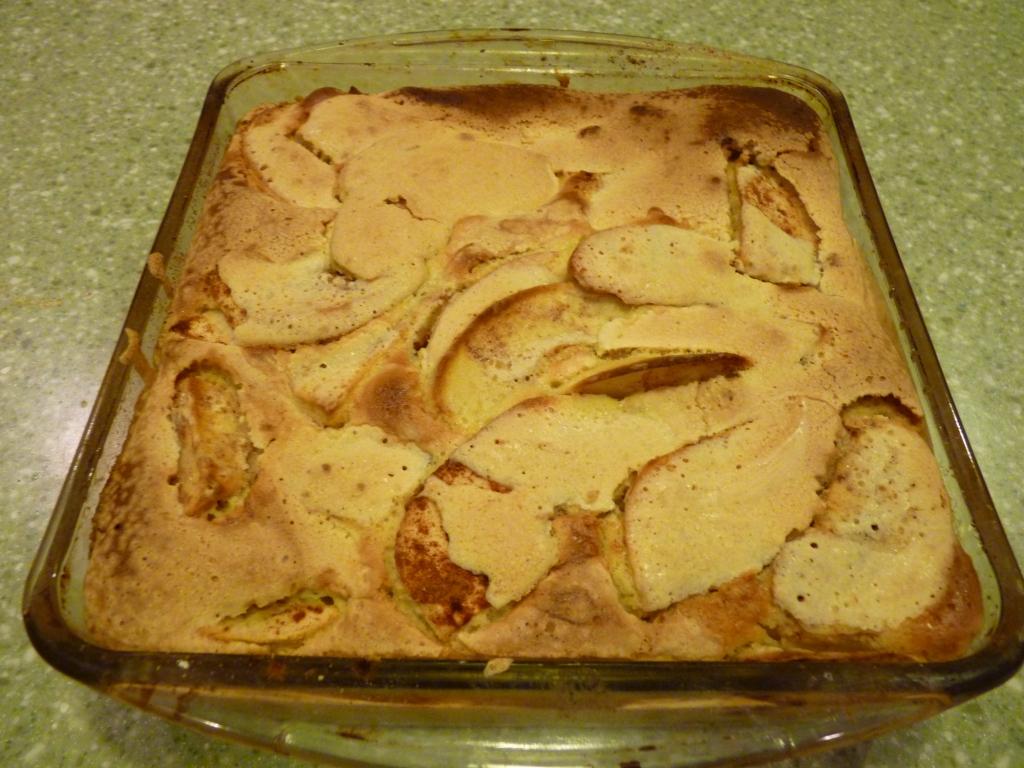
And this is the look inside:

Yep – Yummy!
Do you think this post is about food only? No, of course not. Yes, you can have this cake with ice cream, coffee, and/or tea. But this blog is about wine, so how about it? 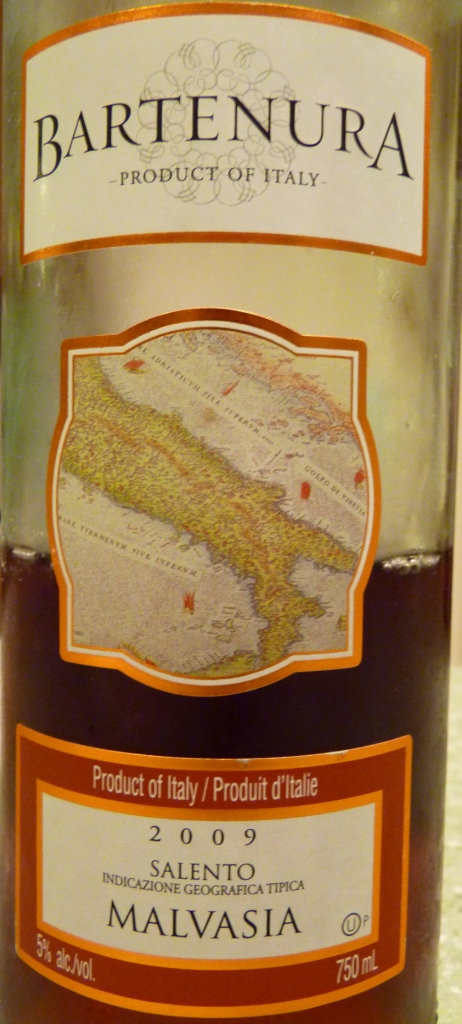 I’m glad to report that Bartenura Malvasia Salento IGT 2009 from Italy, a sweet, lightly fizzed wine worked quite well with that apple cake, complementing each other.
Here we are – tasty and very simple cake ( takes about an hour from start to finish) and simple easy wine – all together equal to a great and enjoyable evening.
Cheers!
P.S. By the way, what would you pair the apple cake with?
Daily Glass: Great Red, Interesting White and Amusing Pairings
Let me start with a little disclaimer. When I use the word “interesting” in conjunction with food, typically it’s a bad sign. I use that word really to say “well, yes, it is probably not that bad… but I don’t like it!”. The reason I need the disclaimer is that this is how I would describe white wine called Conundrum – interesting. 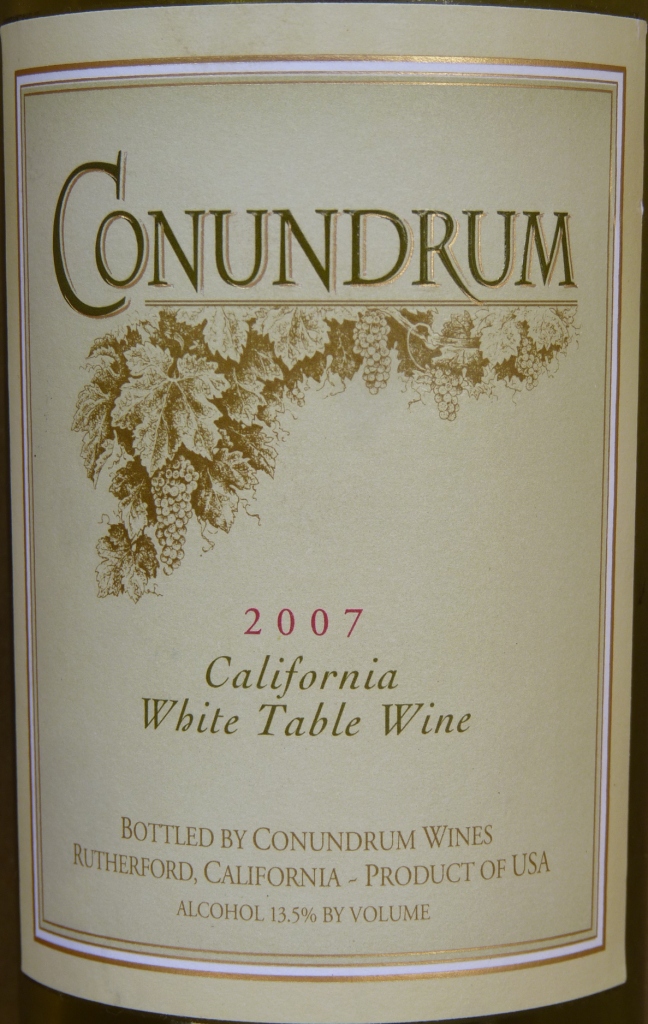 The wine is made our of 5 different grapes, all grown in California, with the different proportions every year. The grapes are Sauvignon Blanc, Semillon, Chardonnay, Muscat Canelli and Viognier, all blended together of course. So the bottle we had over the weekend was from 2007, had being rated 88 by Wine Spectator in the May 2009 issue. The wine is extremely aromatic, with fresh flowers, honey, white peaches and pear on the nose. But my challenge was that all those great aromatics on the nose where not integrated with the rest of the flavors on the palate, so the wine was not balanced – and hence the “interesting” disclaimer comes to play. This is the second time I fail to fall in love with this wine ( feel kind of bad, as wine gets a lot of great reviews) – but the great thing about wine is real unpredictability – every year is a different year! As I do have a bottle of 2008, I will definitely make another attempt, but for now, the verdict for 2007 is…
Drinkability: 7-
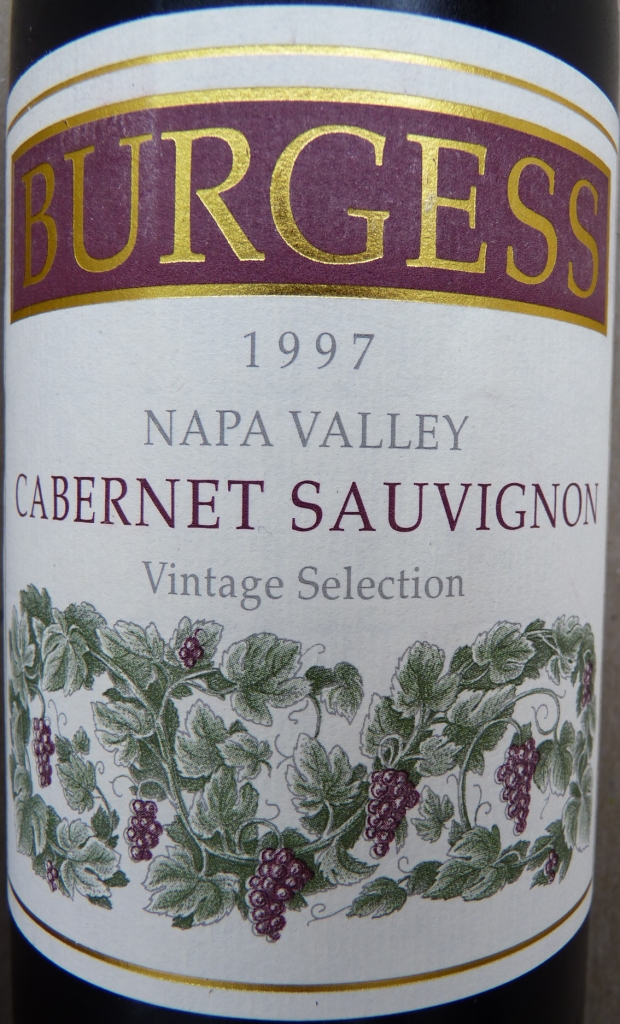 Now, let’s talk about different experience. Burgess Cellars had being making wines in California since 1972. One thing which I find very interesting (ok, just to be very careful – here “interesting” is a good thing ), is a Library program, started ion 1980, where the wines would age at the winery before being released to the market. So this weekend we had a chance to try Burgess Cellars Cabernet Sauvignon Vintage Selection 1997, which was recently released (and I have to thank Wine Till Sold Out for an opportunity to get it at a great price, $24.99). As I’m referring to Wine Spectator ratings in this post, this wine had a rating of 90. Also, if anyone is curious, this wine consists of 80% Cabernet Sauvignon, 11% Cab Franc and 9%Merlot. Now, in the terms of my “pleasure”-centered ratings, this was a great wine – it had a layered complexity with dark fruit, such as black currant and blackberries, hint of earthiness, eucalyptus and cedar, all supplemented by fresh acidity and round tannins. The wine is ready to drink now, but will continue to evolve for another 5-7 years, and I’m looking forward to that experience.
Drinkability: 8
Now, talking about amusing pairings – of course chocolate and red wine is a classic combination, what’s so amusing, right? Take a piece of a good dark chocolate, glass of Cab or Syrah, and you practically 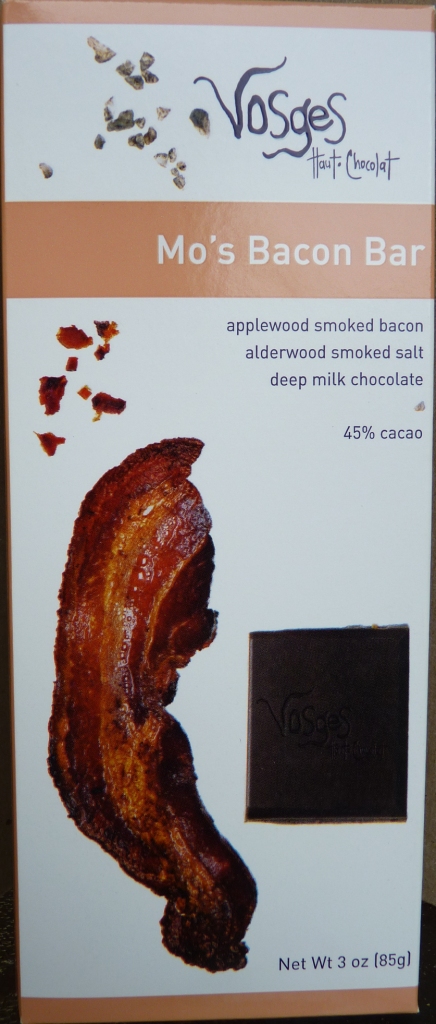 guaranteed a good time (I have to note that I usually fail to identify with Port and chocolate, which is also considered classic, but doesn’t work for me). Now, if your chocolate is called Mo’s Bacon Bar made by Vosges Chocolate, the story get’s more interesting – can you dream of such combination on your own? May be not? Mo’s Bacon Bar is a milk chocolate (45% cocoa) with addition of tiny pieces of applewood smoked bacon and applewood smoked salt – and it effectively tastes like that, each and every element is noticeable and surprisingly well integrated together. So this chocolate is fine by itself, now what about wine pairing? It actually did work quite well with the Burgess Cab! I would think that the reason for the tasty pairing is in the ability of Cab to work well with the steak, so it was cutting through the fatty component of the bacon and bringing in fresh acidity to the total combination. In the interest of full report, we also tried the same chocolate with nice LBV Port ( Quinta do Infantado LBV 2000), and the pairing didn’t work all that well – but there is always next time…
So here is your call for action for today: be amused, try something new – and make sure to share your experience!
Last Bottle Sign Up ($10 credit)




 Talk-A-Vino