Archive
Can Wine Tasting Be Double Blind?
 Can wine tasting be double-blind? You think this is a misnomer, right? Let me explain myself. The basic premise of the “blind” wine tasting is that the taster has no idea what is he or she is dealing with, and by using swirling, sniffing, gargling and any other techniques should identify grape (or grapes), the place where the wine was made, and ideally the producer and the year. For the example of amazing blind tasting I have to refer you to the movie Bottle Shock (if you are into wines, definitely worth watching).
In general, tasting wines 100% blind is rare. What I mean is that even in the case of the blind tasting, there are some limiting factors which help you to identify the wine. For instance, when the wines are tasted blind for Wine Spectator ratings, usually the territory and a year and well known (and the goal of the tasting is simply to rate the wines as good and bad, not to identify grapes and producer). Even when I was tasting the wines for the Certified Sommelier exam (for more info – see About section), it was known that there will be no Pinot Grigio in the glass and grape choices would be really limited.
So what would I call a double-blind wine tasting? I was asked to taste home made wine and provide my opinion. I was asked a number of times and couldn’t refuse. I do call this double-blind – all I know is that the wine is made at home of someone leaving in Connecticut, and I don’t even know if it is made out of grapes or may be berries? Of course the whole purpose of this exercise was only to say whether I like the wine or not (no need to identify producer and the year 🙂 ), but who doesn’t want to play detective in such a case? Yes, I want to guess the grapes, and I want to guess it right!
While sharing my detailed tasting notes is really useless, as absolute majority of my readers will never taste this wine, I would like to still share a short summary. First and foremost, I did like it! I honestly don’t classify myself as a wine snob – I would gladly drink two buck chuck, as long as it tastes good. But I had a lot of home-made wines before – they are all sweet concoctions, mostly made out of fruit with addition of powerful alcohols – so they really have nothing to do with actual grape wines. This wine actually looked, smelled and tasted good, so here my notes, for what it worth:
Color: dark garnet.
Nose: wine opened with freshly squeezed berries, like raspberries and blueberries, complemented by lime zest.
Palate: very nice fruit (again raspberries, blueberries, ripe plums, some tropical fruit – very unusual for red wine), complemented with vibrant acidity and good tannins.
As you can see, it is a description of a very nice wine – and it was very nice indeed. So was it perfect? Well, it took me some time to realize what this wine was lacking. It was lacking place. There was no notion of terroir, no earth and no minerals. This wine can be from anywhere (and being made in Connecticut, it definitely is). Again, the wine was very drinkable, and a lot of commercially made wine have no notion of place whatsoever – but I think this is something to note when tasting the wine, so here it is.
What would you put as a grape(s) under such description? My top guess is Zinfandel, and if not, my next guess is Syrah. I don’t know the right answer, and I promise to share it – once I will find out.
And as I mentioned before – blind tasting is fun! Get your friends together and play the wine detectives game – I guarantee you a great time!
Pinot Noirs Battle – Let the Best (but Most Unexpected) Win
 When tasting the wine, there is a lot of factors that will affect the perceived taste ( like/don’t like). Some of those factors are objective, like temperature (chill the wine, and some flaws will disappear), and some of the factors are rather subjective, like your mood. I want to talk about another factor that is hard to categorize, but it can greatly affect what we think about wine. It is one and the same factor that comes in many forms – label, producer, cost, rating, and wine critic at the end of the day. Of course, there are exceptions to this rule, there are the best of us who can simply disregard all the known facts, and simply taste the wine for what it is. However, the majority of us (myself definitely included), will be influenced by what we know. Ah, Robert Parker rated this wine 93, it must be really great… This bottle of wine cost $100 – it must be great…
Well, there is a good way to eliminate this factor – it is called blind tasting. Considering this is summer, we decided to try a lighter red grape in the blind tasting format – so we chose Pinot Noir. The great thing about Pinot Noir is that it is grown in many different regions, and while the grape is the same, the wines from the different places will taste quite differently.
How do you run a blind wine tasting? Very easily. Each person brings a wine bottle in the paper bag and then opens it. All the bags are assigned random numbers. Then the wines get poured into the glasses which are standing on the mat with the numbers. Voila! Now all the wines can be tasted and independently assessed – no intimidation by any of the factors we mentioned above – in the glass they all look [almost] the same (oh, boy, I can be bitten up by professionals for such a lame claim, but oh well…).
We had 6 Pinot Noirs and went through them one by one, assessing the color, smell, and taste of each, exchanging thoughts ( like “I think this is California” or “I can’t smell anything”), but not enforcing opinions. Here are my short notes as we went along (you can actually see the picture of all 6 wines and then see how funny my notes are):
#1: New world, too much alcohol – 2006?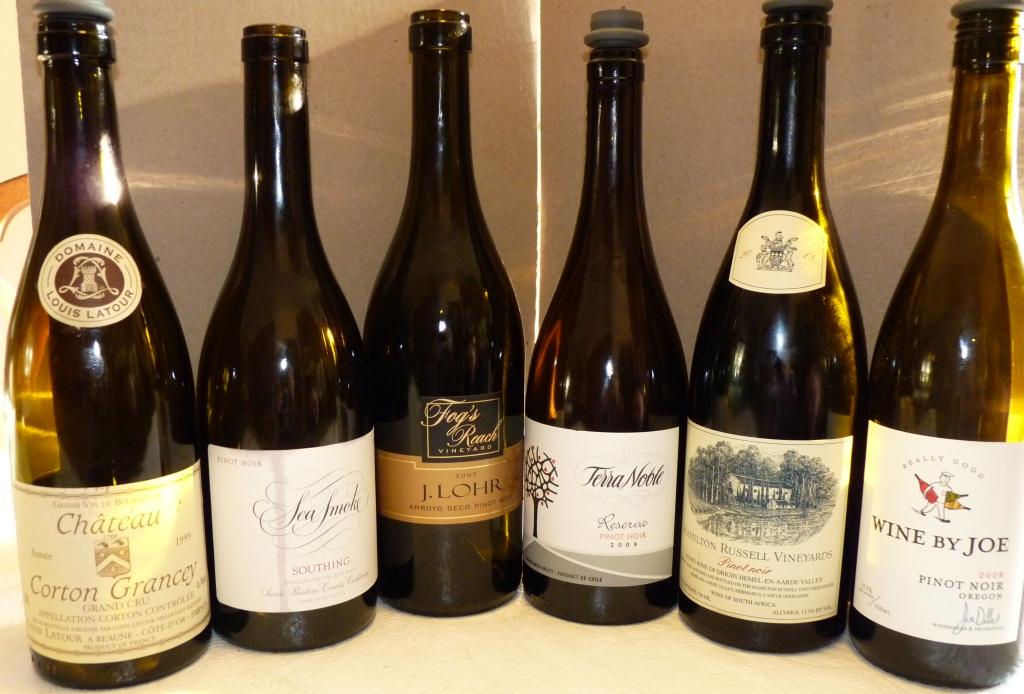 (Actual wine: Chateaux Corton Grancey 1999, Grand Cru Corton, France)
#2: New World, California, 2007/2008? (Actual Wine: Sea Smoke Southing 2007, Sta. Rita Hills, California)
#3: Not bad, needs time, Chile? (Actual wine: J. Lohr Fog’s Reach Pinot Noir 2007, Arroyo Seco, California)
#4: Bright acidity, fresh fruit, Oregon? (Actual wine: Terra Noble Pinot Noir Reserva, 2009, Casablanca Valley, Chile)
#5: Classic – perfect smoky nose (Actual wine: Hamilton Russell Pinot Noir 2008, South Africa)
#6: Young and reminded of Monastrell. Very nice (Actual wine: Wine by Joe Pinot Noir 2008, Oregon)
Once we tried all 6 wines, it was time to tally it up and proclaim the winner, after which all the wines were revealed out of their bags. I would think that considering the title of the post, you already guessed that something unusual is coming. True, though for me it was way too unusual. So the two winning wines were tied up – #3 and #5, both got the same number of votes. I can understand wine #3, J. Lohr Fog’s Reach Pinot Noir from Monterey County, California. California is known as the place for Pinot Noirs, especially with the help of the movie Sideways. But wine #5, which I thought had all the traits of the classic Burgundy – please tell me honestly, how many of you heard of ( never mind trying) Pinot Noir from South Africa?! Of course, there are great wines from South Africa – Cabernet Sauvignon, Shiraz, Chenin Blanc, Chardonnay, but Pinot Noir? And nevertheless, wine #5 was Hamilton Russell Pinot Noir from South Africa.
So here you have it – blind wine tasting, which removes all the intimidation and decision influencers, and leaves you one on one with the wine in a pure and honest fashion. No hints “oh, that should be good because…”, no pretension. Of course, there can be flaps. Wine #1 was spoiled (probably oxidation), so it should really be excused from the judgment. At the same time, wine #2, Sea Smoke Southing, would probably be a winner, simply because it is a cult Pinot, and it costs $80+ – if you can find it. And yet in the blind setting, it didn’t generate much response. Of course, there is always a happy chance that none of us has a sophisticated palate – but at the end of the day, the definition of the “best wine” is simple – it is the one which YOU consider the best, so I think we shouldn’t worry about it.
To conclude – get your friends together and try blind tasting one day – you might be surprised, but you will not be disappointed! Drink the wine, and have fun doing that :).
Cheers!
Last Bottle Sign Up ($10 credit)





