Archive
Fun With Numbers – Analyzing 2024 Top 100 Lists
 Do you like numbers?
Do you like to play with numbers?
I do – so let’s have a bit of a [almost traditional] fun with wine numbers. I’m talking about analyzing the Top 100 lists from the major wine publications.
Top 100 is one of the most anticipated and coveted topics in the wine world. There is a lot of anxiety and activities surrounding the Top 100 lists. Wineries proudly put their Top 100 “membership” on the bottles; publications, such as Wine Spectator, create a lot of drama, slowly unveiling their Top 100 selections over a week; wine stores are anxious to get and offer as many of the Top 100 selections as possible; consumers get an extra reason to buy the Top 100 wines as their greatness had been established by the experts. So let us take a closer look at the Top 100 Wines of 2024 lists from the major publications and compare them side by side.
The majority of the wine publications present their Top 100 lists, many of the publications even offering a multitude of Top 100 lists – for example, James Suckling publishes separate Top 100 lists for most of the major wine countries; Wine Enthusiast offers Best Buys, Cellar Selection and Enthusiast 100 lists. As I have done in the past, for this comparison I’m using Top 100 lists from James Suckling, Wine Enthusiast, and Wine Spectator. For the Wine Enthusiast, I’m using the Enthusiast 100 list. Also note that while James Suckling and Wine Enthusiast 2024 Top 100 list links are specific to the year, Wine Spectator has one link for all top 100 lists from 1988 until 2024 (going through those is a fun exercise in itself).
Now, let’s discuss the particulars.
Wine of the Year
Let’s start with the Top wines of 2024. Out of the 3 top wines, 2 are reds and one is sparkling – not very surprising as red wines dominated the top 100 lists at all three publications. James Suckling’s Top wine of 2024 was the 2015 Bertani Amarone della Valpolicella Classico (JS100, $125). Wine Enthusiast’s Top wine of 2024 was the 2013 Roco RMS Brut Delayed Disgorgement 10-Year Sparkling Willamette Valley (WE98, $125). Lastly, the Wine Spectator Top wine of 2024 was the 2021 Viña Don Melchor Cabernet Sauvignon Puente Alto Puente Alto Vineyard Chile (WS96, $175).
Regions
Here is how the three Top 100 lists stuck up when it comes to the wine regions of the world:
| Region | JS | WS | WE |
| Argentina | 6 | 3 | 4 |
| Australia | 5 | 3 | 3 |
| Austria | 4 | 1 | 3 |
| California | 12 | 26 | 37 |
| Canada | 3 | ||
| Chile | 6 | 4 | 2 |
| China | 1 | ||
| France | 18 | 16 | 14 |
| Georgia | 1 | ||
| Germany | 12 | 1 | 1 |
| Greece | |||
| Hungary | 1 | 1 | |
| Israel | 1 | ||
| Italy | 26 | 20 | 13 |
| New York | |||
| New Zealand | 4 | ||
| Oregon | 5 | 5 | |
| Portugal | 4 | 5 | |
| South Africa | 1 | 1 | 2 |
| Spain | 6 | 6 | 3 |
| Uruguay | |||
| Washington | 3 | 4 | 3 |
I purposefully left all regions that were included in the previous years so you get a better picture. As you can see James Suckling’s list was dominated by Italian wines. Wine Spectator had a penchant for California, but not as much as the Wine Enthusiast, where almost 40% of the Top 100 wines came from California. New entrants compared with the previous years were the wines from Georgia and China.
Wine Types
Here is the comparison classified by the wine types:
| Type | JS | WS | WE |
| Dessert | 3 | 1 | 2 |
| Fortified | 2 | 1 | 1 |
| Red | 60 | 67 | 68 |
| Rosé | 1 | 2 | |
| Sparkling | 2 | 2 | 8 |
| White | 33 | 28 | 19 |
As you can see, red wines dominated all of the lists. The last time I did this comparison back in 2021, and compared to that table I had to add a row for the fortified wines. I’m happy to see that all 3 Top 100 lists included at least one fortified wine. Also, Wine Enthusiast included a good number of sparkling wines, with most of them coming from Oregon out of all places (and those will be even harder to find than Champagne due to a very limited production).
Ratings
Ratings continue to be radically different between all three lists. James Suckling ratings don’t go lower than 97, and Wine Spectator’s top rating was 98 with only a single showing.
| Rating | JS | WS | WE |
| 100 | 20 | ||
| 99 | 58 | 1 | |
| 98 | 17 | 1 | 3 |
| 97 | 5 | 8 | 13 |
| 96 | 6 | 19 | |
| 95 | 12 | 16 | |
| 94 | 19 | 16 | |
| 93 | 17 | 22 | |
| 92 | 11 | 8 | |
| 91 | 10 | 2 | |
| 90 | 16 |
I don’t know why there is such a disparity in ratings, but that makes this comparison even more interesting.
Prices
Prices are always an interesting subject, and the presentation of the prices was different this year among all 3 lists. Wine Spectator had prices for all wines included in the description – I can only assume those are suggested retail prices. James Suckling had no prices listed but instead had prepared links for the Wine Searcher to retrieve a current market price for each wine – which makes sense as many of these wines might be on the market for a while and might command premium even before they were included in the Top 100 lists. Wine Enthusiast had prices listed for most of the wines, and also had buying links for all of the wines that were tailored to a specific source – some to Wine.com, some to Wine Searcher.
In the Wine Spectator’s Top 100, the most expensive wine was priced at $375 (MSRP). 19 wines on the list were priced at $100 or higher. The least expensive wine was only priced at $12 (#49 on the list). There were 6 wines on the list priced under $20, a very reasonable number. The top 10 wines, if you could find and buy them all at once, would cost you $1,032.
The most expensive wine on James Suckling’s list was priced at $407 (market price). Only 37 wines were priced at less than $100, which makes 63 wines to be priced above $100 – again, keep in mind that these are market prices according to wine-searcher, so YMMV. The least expensive wine and the only one under $20 was priced at $17, however, interestingly enough, it was wine #2 on the Top 100 list. The top 10 wines combined would cost you $677.
Lastly, the Wine Enthusiast’s Top 100. The most expensive wine was also the most expensive among all 3 lists, priced at $612. 33 wines were priced above $100, so 67 wines were priced at less than $100. The least expensive wine and the only one under $20 was priced at $19 (wine #35, price from wine-searcher). The top 10 wines would cost you $1,100.
Conclusion
I was happy to see lots of familiar – not just familiar, but rather, favorite – producer names sprinkled across the lists. Turley Zinfandel as #14 on Wine Spectator’s list, Carlisle Zinfandel as #21, San Felice Chianti, Calera, Elena Walch; Lopez de Heredia and Cayuse Bionic Frog on the James Suckling list; Inniskillin Cab Franc Ice Wine and Wente Vineyards on the Wine Enthusiast list. I’m sure you will find lots of familiar names too.
I hope you are having as much fun looking through the data I presented here as I had compiling it. There is nothing to be concluded from this exercise, but I find it fun. If you think there is any other data you would like to see as part of this analysis – I will be happy to oblige.
Enjoy!
Fun With Numbers – Analyzing 2021 Top 100 Lists
Whoosh…
It is the last month of the year already – do you believe it? There are very few facts left in this life – time moving in one direction is still one of them.
The arrival of December means that it is the time to look back at the year which is about to bid adieu, and reflect. For example, on all the wines, good and bad ones. And maybe rate them, right?
I know that many of the true wine aficionados scoff at the bare idea of the wine ratings, especially those coming from major wine publications – I’m not talking about wine collectors who live and die by those. Top wine lists are usually equally ignored by those passionate wine lovers. I, however, appreciate all of the scores and top lists as a reference – and also the numbers I can play with.
At this point, all major wine publications produced their Top 100 wine lists – some even multiple Top 100 lists, such as James Suckling with Top 100 wines of Chile, France, Spain, New Zealand, and all other major winemaking regions… That means a lot of numbers to digest and dissect – not something I can pass. I set out to waste spend a good amount of time to convert Top 100 lists from James Suckling, Wine Enthusiast, and Wine Spectator from all the different formats into a set of excel files which then can be compared – and now I can report on my findings.
As I already mentioned, there are multitudes of Top 100 lists available from these wine publications – for this analysis, I used the Top 100 lists from Suckling and Wine Spectator, and Top 100 Cellar Selections from Wine Enthusiast – this one is the best match for the two other lists, unlike The Enthusiast 100 or 100 best buys. All the lists are produced based on the rating of more than 20,000 wines by each publication during 2021 (25,000 by James Suckling and 22,000 by Wine Enthusiast). Some publications also considered wine production volume and availability as an important decision factor.
Wine of the Year
Let’s start with the Top wine of 2021. It is interesting that out of these 3 top wines, 2 were whites – not something you see very often, but at least both whites were Chardonnays. James Suckling’s Top wine of 2021 was the 2020 Kumeu River Chardonnay Kumeu Mate’s Vineyard New Zealand (JS100, $73). Wine Enthusiast Top wine of 2021 was the 2018 Ramey Hyde Vineyard Charodnnay Carneros (WE100, $70). Lastly, the Wine Spectator Top wine of 2021 was the 2018 Dominus Estate Napa Valley (WS97, $269). Whether you like it or not, but Chardonnay and Cabernet Sauvignon clearly ruled the world in 2021…
Regions
In all three top lists, there was somewhat lesser diversity than in the lists from last year – 4 countries/regions present in the 2020 lists were absent in 2021. Here is the summary for you in the form of the table:
| Region | JS | WS | WE |
| Argentina | 5 | 4 | 1 |
| Australia | 7 | 4 | 2 |
| Austria | 2 | 1 | 3 |
| California | 18 | 24 | 20 |
| Canada | |||
| Chile | 5 | 2 | 2 |
| France | 22 | 17 | 25 |
| Germany | 12 | 2 | 4 |
| Greece | |||
| Hungary | 1 | 1 | |
| Israel | |||
| Italy | 15 | 23 | 17 |
| New York | 1 | 1 | |
| New Zealand | 3 | 3 | 2 |
| Oregon | 2 | 4 | 5 |
| Portugal | 1 | 3 | 6 |
| South Africa | 1 | 1 | 2 |
| Spain | 5 | 7 | 4 |
| Uruguay | |||
| Washington | 1 | 4 | 5 |
I purposefully didn’t remove the countries from last year’s lists so it is easy to see which are missing. Overall, there were not too many surprises. The US, France, and Italy dominated all 3 lists. It is interesting to note a good number of wines from Portugal in the Wine Enthusiast list, as well as good showing by Oregon and Washington in Wine Enthusiast and Wine Spectator lists. The biggest surprise for me might be a relative weakness of Chile’s presence across lists and literally negligible showing by South African wines.
Wine Types
I don’t believe I paid much attention to the types of wines on the Top 100 lists last year – I built a comparison table though this year:
| Type | JS | WS | WE |
| Dessert | 2 | 1 | 5 |
| Red | 72 | 65 | 72 |
| Rosé | 2 | ||
| Sparkling | 3 | 5 | 6 |
| White | 23 | 27 | 17 |
I classified all wines as dessert, red, Rosé, sparkling, and white. Port and sweet Riesling wines (BA etc.) were classified as dessert. As you can see, red wines rule the world. While the Wine Enthusiast list includes no Rosé, at least it has a good showing of dessert and sparkling wines, which makes perfect sense. I honestly believe we should see more of the Rosé wines in the Top 100 lists, but oh well… Also wondering when we are going to see skin-fermented wines on the Top 100 lists – unless I missed something this year.
Ratings
Ratings this year are radically contrasting between different lists. James Suckling’s list doesn’t have any wines with ratings less than 98. And Wine Spectator’s list has no wines with 100 ratings, only one wine with 99 rating, but 12 wines with the rating of 90:
| Rating | JS | WS | WE |
| 100 | 25 | 9 | |
| 99 | 45 | 1 | 7 |
| 98 | 30 | 3 | 10 |
| 97 | 6 | 12 | |
| 96 | 2 | 17 | |
| 95 | 18 | 12 | |
| 94 | 14 | 17 | |
| 93 | 14 | 10 | |
| 92 | 10 | 5 | |
| 91 | 20 | 1 | |
| 90 | 12 |
Both James Suckling and Wine Enthusiast lists have a substantial showing of 100-rated wines – either the wines are getting better and better, or the critics are getting more and more lenient – still, 25 wines with 100 rating is very impressive.
Prices
This might be one of the most interesting and most irrelevant parts of the top 100 wine lists information – and analysis. It is interesting because of course, wine aficionados what to know “how much”. It is irrelevant because the majority of these wines can’t be acquired due to limited availability and high demand – everyone wants to drink “best wines”. Nevertheless, let’s talk about prices.
The wines on James Suckling’s list are ranging from $1,723 per bottle (most expensive) to $24 for the least expensive. Only 45 wines are priced at less than $100. You will need to spend whopping $23,595 to acquire all 100 top wines and $2,108 on the Top 10 wines. It is important to note that prices are not included on the James Suckling Top 100 list – each wine has a link to the wine-searcher page which lists the price according to the wine-searcher’s algorithm.
Wine Enthusiast Top 100 list wines are priced from $780 to $20. 65 wines cost less than $100, and 28 wines are less than $50. You will need to spend $11,061 to acquire all Top 100 wines and $1,047 on the Top 10. Wine prices are included on the Wine Enthusiast list, but I’m not sure how they were sourced, as some of the wines are priced at $222 or $343, which can’t be MSRP pricing.
Wine Spectator’s list happens to be the least expensive overall, with only $6,194 needed to acquire all top 100 wines. Top 10 will set you back by $1,444. The wines are ranging in price from $309 to $13. 85 wines are priced at less than $100, and 68 wines are less than $50.
Conclusion
I hope you are having as much fun looking through all the data as I had compiling it. There is nothing to be concluded from this exercise, but I find it fun. If you think there is any other data you would like to see as part of this analysis – I will be happy to oblige.
Enjoy!
The Curse and Mystery Of The Top 100 Wine Lists
 Lists and numbers – who doesn’t like that? We, humans, are all about lists, we like to sort things out – to-do lists, shopping lists, “best” lists, “best of the best ” lists, Top 10 lists, Top 100 lists. No area of people’s interest is immune to the lists – and of course, the world of wine is no exception – come to the end of the year, and you are guaranteed to see lists and lists of the lists, ranking wines, wineries, regions, winemakers, what have you.
I don’t know how much attention you are paying to the top wine lists. Talking about myself, I like to ponder at the Top 100 lists, especially the one produced by Wine Spectator – not because it is any better or different than the others, but simply because I had been a subscriber for a long time, and it formed more into a habit. My main interest is to see what wines can I recognize, and then to play with the data a bit – countries, prices, grapes. I’m a number junkie. It is always fun to organize numbers in a few different ways, no matter if it means anything or not, and so the Top 100 lists present a good opportunity to conduct such a “research”.
Before we delve into the numbers, let’s talk about the Mystery. What is mysterious about the top 100 wine lists? I would say most everything? How the wines are chosen? How wine #1 is decided? According to the information on the James Suckling web site, they select the top 100 wines out of the 25,000 wines tasted throughout the year. How do decide on 100 out of 25,000? Do you run a separate list of potential candidates throughout the year, or do you sit down at the end of the year and try honestly recall the most memorable wines of the year? What role the ratings play?
Here is what Wine Spectator says on the subject: “Each year, Wine Spectator editors survey the wines reviewed over the previous 12 months and select our Top 100, based on quality, value, availability and excitement”. I like the “excitement” part, this is how I decide on my top dozen wine of the year. The other two publications I studied with Top 100 lists don’t talk about their methodology, they just talk about the content of their lists.
So here are some stats we can gain from looking into the details of the Top 100 lists.
Wine Spectator:
Wine Spectator offers two lists – the regular Top 100 Wine and Top 100 Value Wines, which includes wines priced under $25 (you can find all the lists here). I didn’t spend time with the top value list, so all the numbers below are related to the Top 100 list:
- Distribution by country: France – 23, California – 22, Italy – 21, Spain – 7, Australia and Oregon – 5 each, Chile and Portugal – 3 each, Austria, Germany, New Zealand, and Washington – 2each, Argentina, Israel, and South Africa – 1 each
- Distribution by the wine type – 74 reds, 21 whites, 1 Rosé, and 4 Sparkling.
- Prices – most expensive – $197, least expensive – $13. 14 wines are priced above $100, 13 wines are in the $75 – $99 range, 11 wines are in the $50 to $74 range, 27 wines are priced in the $25 – $49 range, and 35 wines are in the $13 – $25 range.
- Ratings: the top score is 98, the lowest is 90. There is only one wine on the list with a rating of 98, 6 wines have a rating of 97. The ratings of 96, 95 and 94 are assigned to 14 wines each. 11 wines have a rating of 93, 10 wines each have ratings of 92 and 91, and 20 wines have a rating of 90.
- Wine Spectator’s top wine of the year 2019 was 2016 Château Léoville Barton St.-Julien with a rating of 97 and priced at $98.
Wine Enthusiast:
Wine Enthusiast produces not one, but 3 Top Wine lists – Top 100 Wines, Top 100 Best Buys, and Top 100 Cellar Selections – these links will allow you to retrieve PDFs for each list. General notes on Wine Enthusiast site say that more than 24,000 wines are tasted during the year and afterwards condensed into the 3 Top Wine lists. Note that Wine Enthusiast Best Buys list covers only wines under $15. Focusing on the Top 100, I did a limited analysis, using the data already provided in the PDF file:
- Distribution by country: California – 18, Italy – 17, France – 16, Australia, Oregon and Spain – 5 each, Argentina, Chile, Portugal and Washington – 4 each, Austria and Germany – 3 each, NY State and South Africa – 2 each, Georgia, Greece, Israel, Uruguay and Virginia – 1 each
- Prices – most expensive – $114, least expensive – $16. Only one wine is priced above $100, the majority of the wines are less than $50 with an average price of $33.
- Ratings: the top score is 99, the lowest is 90. There is only one wine on the list with a rating of 99, 3 wines are rated at 98, 5 wines have a rating of 97, 8 wines are rated at 96. Most of the rated wines fall in the 91-93 range (55 wines)
- Wine Enthusiast top wine of the year 2019 was NV Nino Franco Rustico Brut Valdobbiadene Prosecco Superiore with a rating of 94 and priced at $20.
James Suckling:
This one is the most exclusive Top 100 club in a number of ways. First, you need to be a subscriber to see any wine details. Second, all the wines on the Top 100 list are rated 98-100 points. This is the only stats available from the James Suckling Top 100 Wines website: “We have 41 100-point wines in the list and another 35 with 99 points. The rest of the wines scored 98 points. All the wines were produced in quantities of 300 cases or more.”
Let’s leave James Suckling Top 100 list aside and talk about Wine Spectator and Wine Enthusiast lists. The makeup of both lists is quite similar when it comes to the countries – California, France, and Italy represent at least half of the Top 100 wines (2/3 in case of Wine Spectator list). Where the list differ quite a bit is in the pricing – 14 $100+ wines on the Wine Spectator list versus only 1 on the Wine Enthusiast. But the biggest difference to me is the Wine #1 – Grand Cru Classé versus Prosecco. Okay, call me a snob or whatever you want, but I’m really missing the point of the Wine Enthusiast choice. To my defense, I can only say one thing – I tasted this wine. Nino Franco Rustico is a nice Prosecco, and but it is really, really far away from the memorable, exciting wine. Here you go – another case of the wine list mystery.
I also wanted to talk about the “curse” of the Top 100 wine list, for sure when it comes to the one from the Wine Spectator. As soon as the wine makes it on that list, it instantly becomes unavailable. Adding to the mystery side, it is a mystery to me why an average wine consumer puts such a value on the Top 100 list nomination. But talking about availability, are we looking at the scalping phenomenon in the works? Buy bulk and resell for a quick buck? This is annoying, and it is a real problem for the wine retailers who can’t find enough of those top wines to offer them to consumers. It also gets worse every year – a friend of mine, who has a wine store in Stamford, was able to assemble about 40 Top 100 wines to offer to his customers last year – this year he will barely make it to 20.
There you have it my friends – a deeper look into the mystery (and curse) of the Top 100 wine lists. Do you pay attention to those? What do you think of this year’s top wines? Do you see any trends? Cheers!
Wednesday’s Meritage – Wine Quiz Answer, Wine Spectotor Top 100, Perfect Holiday Gift Solution, and more
 Meritage time!
First, let’s start with the answer for the wine quiz #82, grape trivia – Gamay.
In the quiz, you were supposed to answer 5 questions about red grape called Gamay. Here are the questions, now with the answers:
Q1: Gamay is closely associated with every third Thursday in November. Can you explain why?
A1: Beaujolais Nouveau is coming into town! While Beaujolais Nouveau was always the first wine of the harvest to be delivered to the restaurants and shops in Europe, in 1985 the phenomenon became more organized, settling on the third Thursday of November to make the new release available.
Q2: Carbonic maceration is an important method in production of wines made out of Gamay. Can you briefly explain what is carbonic maceration and how does it helps here?
A2: Carbonic maceration is a process where the grapes in a sealed tank are subjected to the flow of CO2, which start fermenting the juice inside of the whole grapes before they will be crushed. The resulting wine becomes fruity with very low presence of tannins. This process is particularly used inproduction of Beaujolais Nouveau and other Beaujolais wines. For more information, please refer to Wikipedia article.
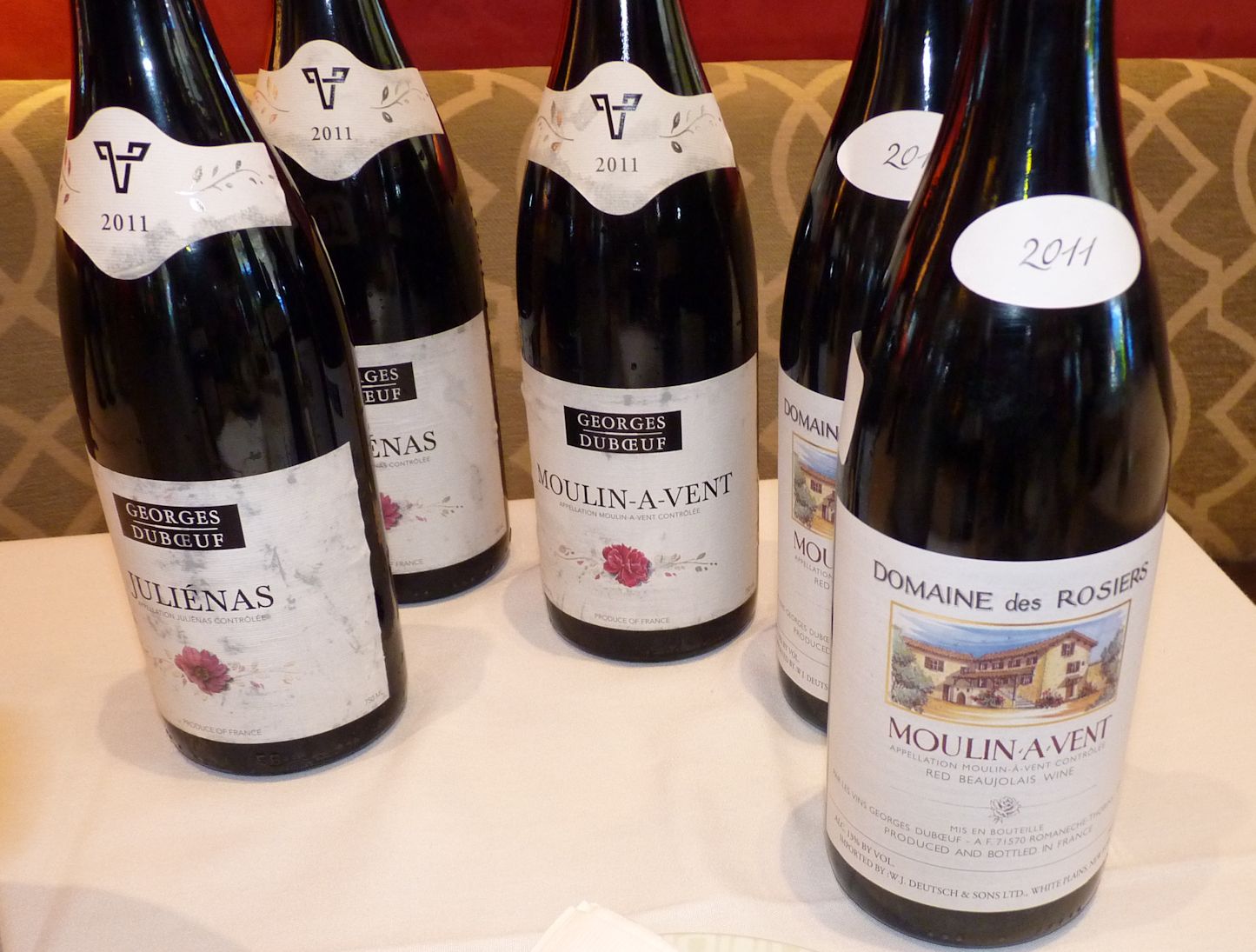
Q3: Fill in the blanks: In Beaujolais, Fleuri is considered to produce the most ___ wine, and Moulin-à-Vent produces the most ___ wines.
A3: In Beaujolais, Fleuri is considered to produce the most feminine wine, and Moulin-à-Vent produces the most masculine wines. Feminine and Masculine are the descriptors typically used by wine professionals to describe the wines of Fleuri and Moulin-à-Vent wines.
Q4: Which one doesn’t belong and why:
a. Brouilly, b. Côte de Brouilly, c. Côte Chalonnaise, d. Juliénas, e. Régnié
A4: c. Côte Chalonnaise. The other four names are part of Cru de Beaujolais ten villages, but Côte Chalonnaise doesn’t belong there (it is an AOC in Burgundy).
Q5: True or False: Beaujolais Nouveau wines can be aged for a few years before consumption.
A5: False. The whole point of aging the wine is to wait for it to develop further in the bottle and become more enjoyable. Beaujolais Nouveau is meant to be enjoyed right away and should be consumed by May of next year – it doesn’t improve in the bottle.
So for the winners, Jeff the drunken cyclist continues his winning streak – he got correctly 5 out of 5, including the difficult question #3. Great job, Jeff – unlimited bragging rights are yours! I would like to also acknowledge Wayward Wine,Whine And Cheers For Wine and Eat with Namie who all correctly answered 4 questions out of 5. Well done!
Now, to the interesting stuff around the vine and the web!
On Monday, November 18th, Wine Spectator published their Top 100 list of Wines. Yes, I know, many dismiss the whole notion of Wine Spectator ratings and Top lists as closely associated with the advertizement dollars spent with publication. True or not, but I still have a lot of respect to Wine Spectator and definitely curios to see their “top wines” list. As Wine Spectator celebrates 25th anniversary, they whole web site is open to the public (typically it requiressubscription). I would highly recommend that you will take advantage of this opportunity and explore the site which has a great wealth of wine information. Also, here is the link to the WS Top 100 wines of 2013. I have to admit that I’m happy with Wine Spectator’s choice for the wine of the year – 2004 Cune Rioja Imperial Gran Reserva. In general, Cune Imperial makes great wines, and I think it is an excellent choice for the wine of the year.
Thinking about holiday gifts? Does your list include any wine lovers? If yes, you are in luck, but you will need to act quick. On December 2nd, WTSO will conduct a Gift Marathon (full info can be found here). As a traditional WTSO Marathon, there will be no announcements of new wines. But each wine will come gift packaged, with one bottle and two varietally correct Riedel glasses in the box. Most importantly – free shipping on each package (no minimums), and each packaged can be shipped directly to your gift recipient – this is the best part! Prices start from $44.95 per box (free shipping). I think this is a deal not to be missed, so point your browser to WTSO on December 2nd and happy hunting!
You know Wine-Searcher is a great resource for finding the wines online and comparing the prices. Are you curious what the other people looking for on the wine-searcher? Here is an interesting article, which tells you what the consumers in America are looking for. Based on the article, looks like most of the times people are looking for red Bordeaux blends – which makes sense, as there are a lot more Bordeaux blends produced nowadays. Anyway, for your own analysis and lots more data, take a look at the article.
When you make dinner, how often do you think about what wine should be opened for the food you are serving? Sometimes the pairing can be quite difficult, so I have no problems taking my food and wine separately. But when you hit the mark and the wine and food “work” together, it becomes the whole new level of experience. To help you in this process of pairing food and wine, here is the link to the web site I recently came across – I think it has a lot of good suggestions. Take a look – you might be able to pleasantly surprise yourself and your guests during your next dinner.
That’s all I have for you for today, folks. The glass is empty – but refill is on its way. Until the next time – cheers!
Wednesday’s Meritage – Wine Quiz Answer, Tempranillo Day, Beaujolais Nouveau Coming Up, The Widow Who Reinvented Champagne, and more
 Meritage time!
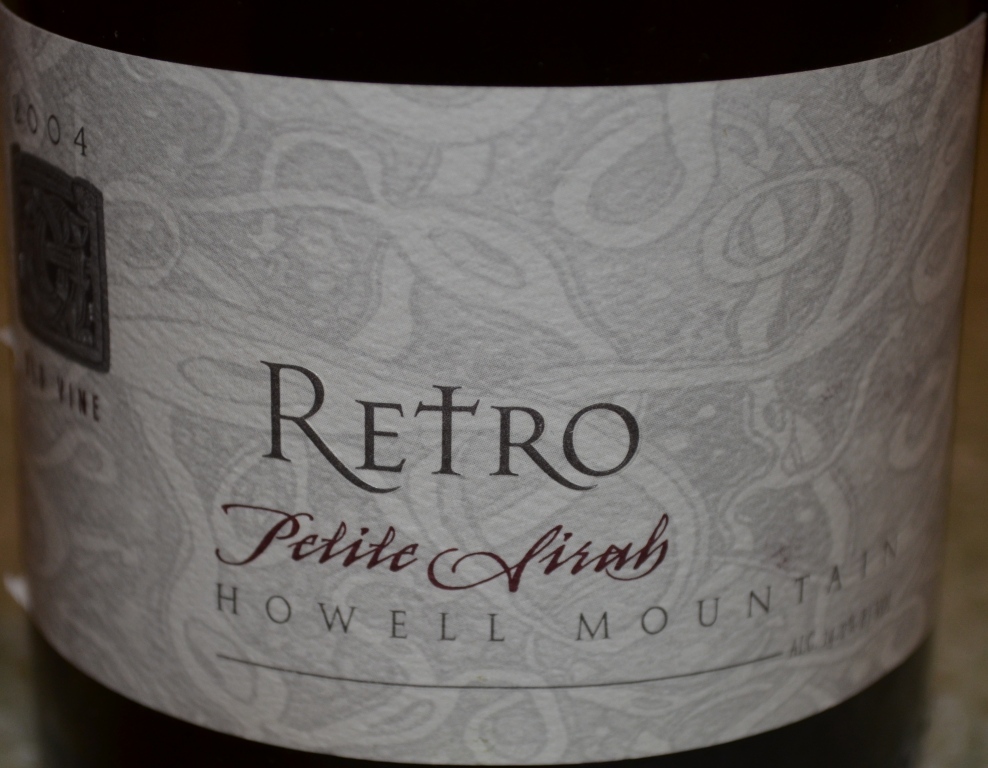
First, let’s start with the answer for the wine quiz #81, grape trivia – Petite Sirah.
In the quiz, you were supposed to answer 5 questions about a red grape called Petite Sirah. Here are the questions, now with the answers:
Q1: Name the grape: In California, Petite Sirah is a popular blending addition to ___?
A1: Zinfandel. You can find a small percentage of Petite Sirah (5% – 10%) in many Zinfandel bottlings
Q2: When it comes to the wines in the United States, there is an interesting similarity between the Petite Sirah and Primitivo. Can you explain?
A2: The similarity comes from the fact that both Petite Sirah and Primitivo were the part of the same request to the TTB (government organization in charge of labeling), to allow the use of Durif interchangeably with Petite Sirah, and Zinfandel with Primitivo. It is interesting to note that contrary to the information in Wikipedia, which says that both requests were never resolved, it appears that Durif is officially recognized as a synonym to Petite Sirah, while Primitivo and Zinfandel are not – you can find the complete list of the approved names through the link to the list of approved grape names in this US government document.
Q3: Which one doesn’t belong and why:
a. Arizona, b. Illinois, c. New Mexico, d. New York, e. Texas
A3: d. New York – there is no Petite Sirah wines produced in New York (at least in the meaningful quantities).
Q4: In the bad, rainy growing season conditions in California, Petite Sirah can be a savior – can you explain why and how does it help?
A4: As the Petite Sirah is mildew resistant and provides supple tannins, color, and structure, in the bad years it can be added to Cabernet Sauvignon, Merlot, and other wines to improve the quality.
Q5: What love has to do with the Petite Sirah?
A5: “P.S. I Love You” is a consortium dedicated to the promotion of Petite Sirah wines.
Talking about the results, the drunken cyclist continues his winning streak, so he gets ( again) the prize of unlimited bragging rights. Well done!
Now, to the interesting stuff around the vine and the web!
First of all, tomorrow, November 14th, is an International Tempranillo Day! Tempranillo, the noble grape of Spain and Portugal, and the rising star of Texas is a source of many wonderful long-living wines, and it is definitely the grape worth celebrating. TAPAS, the society of producers and advocates of Tempranillo, lists a number of events celebrating the grape. But you don’t even need to go anywhere to celebrate the Tempranillo – just grab a bottle, maybe of Magnificent Rioja (but really, any Tempranillo wine will do), pour, smell, sip and enjoy!
Now, the next Thursday, November 21st, is the third Thursday in November. Do you know what it means? Yes, you are right – Beaujolais Nouveau! Every third Thursday in November, the young Beaujolais wine of the same year’s vintage, called Beaujolais Nouveau, is becoming available in all the wine stores around the world. It is not just the wine – Beaujolais Nouveau also means celebration and fun. Don’t forget to get the bottle and join the festivities!
I’m sure you know that classic Champagne with the yellow label on it – Veuve Cliquot, which would literally translate into a “widow Cliquot”. But do you know the role the Barbe-Nicole Cliquot Ponsardin, the actual person behind that label, played in pretty much enabling the whole Champagne industry to exist, and for the mere mortals to be able to afford a bottle of Champagne? Barbe-Nicole’s perseverance and her invention of the riddling were some of the key elements in making Champagne into what we readily enjoy today. Here is an article for you which is definitely worth reading – it is somewhat long but very fascinating and will be well worth your time. And you might even complement the reading with the glass of Champagne in your hand – it will be very appropriate.
The last piece I want to bring to your attention is Wine Spectator’s Top 100 wines of 2013 list, gradually exposed at the rate of a few wines per day at the Wine Spectator web site. There are various contests taking place right now to predict the Wine Spectator Wine of the Year 2013, including the one which Wine Spectator runs by itself. So far the Wines #10 – #7 had been revealed, and more wines will be announced every day finishing with the Wine of the Year on Friday, November 15th. The full top 100 list will be published on Monday, November 18th. Looking at the 4 of the top 10 announced so far, I can only say that I’m a bit surprised. One of the selection criteria for the Top 10 is affordability – with the wines #10 and #9 priced at $135, and wines #8 and #7 priced at $120, I feel like I missed the memo about a substantial increase in my salary, as those prices are definitely outside of the “affordable” realm, at least in my book. Also, as “availability” is another factor, highly allocated Quilceida Creek (wine #10) makes it also an interesting choice. I plan to come back to this subject next week when the full Top 100 list will be announced – but any of your comments meanwhile will be most welcome.
That’s all I have for you for today, folks. The glass is empty – but the refill is on its way. Until the next time – cheers!
Last Bottle Sign Up ($10 credit)




 Talk-A-Vino