Archive
Special Tasting Report: Trione Winery
A few month ago I got an email from Trione winery offering me a gift. Not just any gift – wine. Free wine. Words “free” and “wine” put together sound almost magical for the anyone who drinks wine daily (I refuse to take the calculator out – don’t ask). But the word “free” in the email usually means danger. After careful consideration, and actually looking at the winery web site, I decided that it was not a scam or phishing attempt, so I answered that I would be happy to get a free wine. The only caveat in the follow up response was that they can only ship wine to the limited number of states. Connecticut not included (of course). But New York was. And so my friend Emil became a recipient for the wine.
When Emil called me that he got the wine, he mentioned that the box looks very small. Well, okay – it is what it is – free wine, whatever the package is. And then some time later, the package made it to my house. A small black box, probably half of the shoebox in size. But there was actually wine inside. And this is how it looked like:
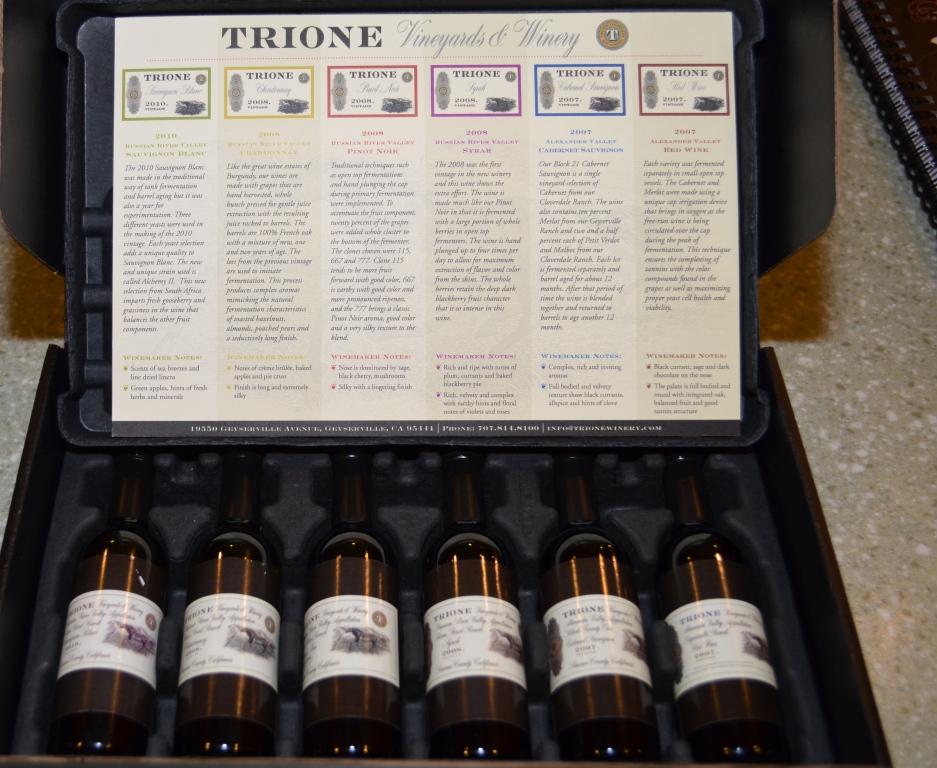
Trione Winery, which I never heard of before, is a new venture of Trione family who was growing grapes in Sonoma for 35 years. Here is what you can read on the front page of their web site:
“For over three decades, the Trione family has raised premium grapes that have been the foundation of many award-winning wines. Now we bring our grapes to you in wines bottled under our own label, Trione Vineyards & Winery. It is the culmination of our family’s long commitment to Sonoma County.”
Here are few more views for you (just trying to build up the anticipation here):


Another interesting detail – it appears that this tasting set consisting of the tiny bottles is actually a concept called Tasting Room. While web site provide literally no information, the card enclosed with the package explained the concept:
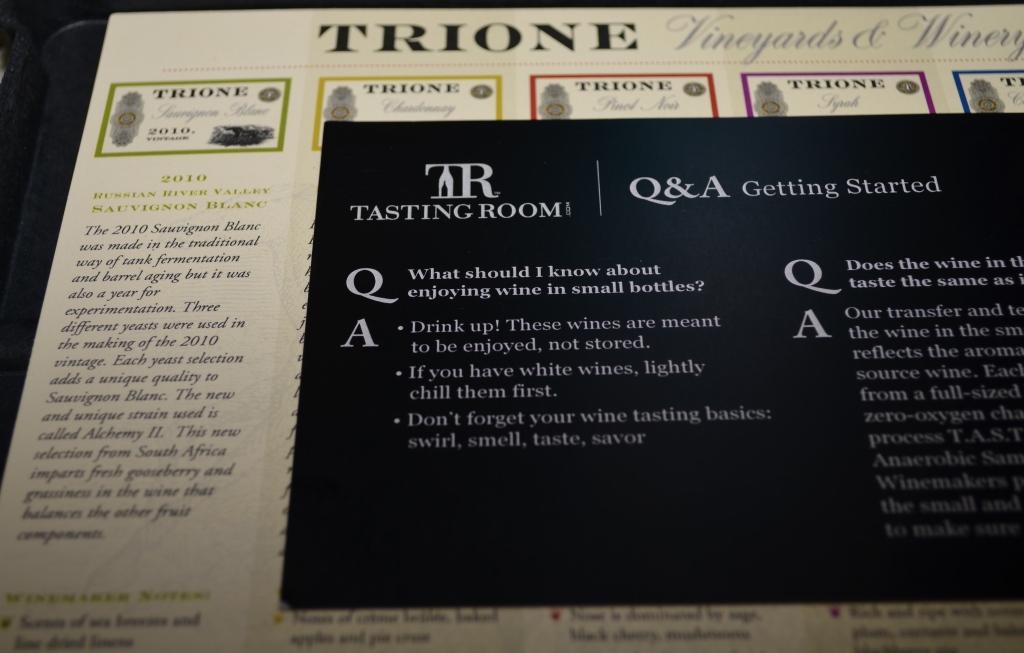
The wines are bottled in the small bottles using special technology which preserves all specifics of the wine, so it is exact same wine which will go into the regular bottles. The only exception – the wine in small bottles is not intended for aging (as you can imagine), so as the card says – drink up!
And with this, let me share my tasting notes. Well, not only mine – in majority of the cases we drink wine together with my wife, especially when we are looking at the interesting and unusual experience – so I’m including her tasting notes too.
2010 Trione Russian River Valley Sauvignon Blanc (14% ABV) – “Pear Grove” my wife said. Some fresh grass on the nose with a bit of grapefruit, but mostly earthy and herbaceous, Earthy and herbaceous on the palate as well, lots of residual acidity, but not “in-your-face”. Food friendly. Interesting. Drinkability: 7+
2010 Trione Russian River Valley Chardonnay(14.3% ABV) – nice butter on the nose, vanilla. Nose is very promising, but palate is not good, very acidic, no fruit, kind of flat. I’m sure it needs time or at least different serving temperature, therefore it is not rated.
2008 Trione Russian River Valley Pinot Noir (14.2% ABV) – Nice nose of dark fruit, tobacco, touch of roasted meat flavor. Nice palate of dark fruit, raspberries, plums, tobacco, pencil and sage undertones. Good palate, good balance. Very good overall. Drinkability: 8-
2008 Trione Russian River Valley Syrah (14.8% ABV) – Wow color – very dark, intense, almost black. My wife’s notes were “oh, this is good” , “great potential”, “very promising” (disclaimer – my wife loves Syrah, probably her favorite wines). Dark roasted fruit, silky smooth, perfect balance, perfect acidity, cherries, earthy notes. Definitely very promising. Very good overall. Drinkability: 8-
2007 Trione Alexander Valley Cabernet Sauvignon (14.5% ABV) – absolutely beautiful nose – perfectly classic, with mint and blackcurrant – textbook flavors. Coffee showed up later on the nose. Wife’s notes: “overpowering , but very yummy”. Big, powerful, silky smooth, noticeable tannins – but excellent balance. Touch over-extracted on the palate, but only in terms of power, not sweetness. Needs time. Drinkability: 8
2007 Trione Alexander Valley Red Wine (14.5% ABV) – Dark chocolate, coffee, blackberries on the palate, nice complexity. Beautiful, round and open fruit. Needs time. Drinkability: 8-
As you can see, it was a very enjoyable experience (it’s too bad that the bottles were that small) – next time you see Trione wine in the store, don’t just stand there, grab a bottle…
That concludes my special tasting report, folks. Until the next time (hopefully someone will send me good and free wine soon) – cheers!
Disclaimer: the wine was provided by Trione Vineyards and Winery free of charge. All opinions are my own.
Weekly Wine Quiz #32 – A Guessing Game: Ultimate Challenge, Part 2
And yet another Saturday is here, and, of course, a new quiz. It will be the last one (at least for now) in the Guessing Game series (previous three can be found here: #29, #30, #31). As promised, this one is about red grapes, but we will kick it up a notch – you have 7 grapes to match with 6 reviews – one grape is there just for fun, but in my opinion, it easily could’ve been for real. So here are your grapes:
A. Cabernet Sauvignon
B. Malbec
C. Merlot
D. Nebbiolo
E. Pinot Noir
F. Syrah
G. Zinfandel
And here are the reviews:
1. “complex, yet subtle, with blackberries, minerals and berries. Full-bodied and very velvety, with lovely rich fruit, with chocolate and berry character. Very long and refined. A joy to taste.”
2. “aromas of tar and smoke, with very pure, concentrated blackberry and spice notes underneath mark this exotic, seductive red. Silky and complex, it caresses the palate. It needs a little time to absorb the oak, but this is long and has great potential.”
3. “a seductive red, drawing you in with its pure cherry and floral aromas and flavors, then capturing you with the silky texture and harmonious profile. Stays fresh and elegant, with a long, ethereal finish.”
4. “still tight, with a wall of mocha and raspberry ganache covering the massive core of fig fruit, hoisin sauce and plum cake notes. This is extremely dense but remarkably polished, with a long, tongue-penetrating finish that drips of fruit and spice laid over massive grip.”
5. “delicious stuff; not huge, but impeccably balanced, nuanced and tremendously long and pure. It’s a cascade of currant, blueberry and plum fruit shaded on one side by subtle, toasty oak, on the other by hints of minerality and exotic spice. But it’s the elegance and the length that make this a winner.”
6. “torrent of blackberry, boysenberry and bittersweet ganache notes. But there’s exceptional drive and focus here as well, with a great graphite spine driving through the spice- and floral-infused finish. A stunner for its combination of power and precision.”
For an extra credit, try to figure out the country of origin for the wine in the reviews.
Good Luck! Have a great weekend and drink well! Cheers!
Color Me Happy
Why? Very simply, in one word – Anticipation. Anticipation is a big part of enjoying the wine. I can’t speak for everyone, but for me anticipation starts when the bottle is in my hands. Before I can actually hold that bottle, it is just a dream – I can dream of drinking DRC or Screaming Eagle one day, but this will only be a dream, a big “theory”. Once I hold the bottle, the dream is over – in a good sense, as this is when anticipation starts. This is “IT” – now it is practically possible, not theoretically, so now you can start planning that special moment – even if it will take place 10 years from now, but you know that barred all unforeseen circumstances, you will experience that bottle.

Case in point – 2008 Alban Patrina Estate Syrah Edna Valley. Why? Alban was one of the very first wineries in California which started producing “Rhone-style” reds (and I really like Rhone wines). Alban wines are almost impossible to get (it’s being already more than two years since I registered for the waiting list to get on the mailing list) and they are very highly regarded by all those who was able to try them. So now, thanks to the Wade’s Wines, I’m a happy owner of the wine I was dreaming about.
Hello, anticipation. Yes, color me happy! Cheers!
Wine, Aged Beautifully
 Let’s talk about aging. No, that’s not what you think – not people aging and not the world problems with the aging populations. Let’s talk about the aging of the wine. By the way, it appears that second time in the row I’m taking upon the popular subject – in the previous post we were comparing the wine glasses (post can be found here), and now the wine aging.
With all due respect (based on this phrase, my friend Kfir would tell you right away that I’m about to blast something), I completely disagree with the majority of the popular opinion on the subject of wine aging. Open a wine book, read a wine blog, or ask a question on Quora, and for the most part, you will get an answer that 95% of the wines are not supposed to be aged and should be consumed within a year or two from the release date.
Based on my personal experience, I disagree with this viewpoint. I can’t put a percentage or a quantity on it, but I believe that well in excess of half of the wines produced in the world (not by the volume, but by the variety of the actual wines) can age very well for 5 to 10 years – and “age well” means “to improve with age”. My biggest problem with the aging of the wines is … space. If you want to drink aged wine, you either need a lot of space, or you need [typically] lots of money, as most of the aged wines increase in price. If you have a cool and dark area with constant humidity, you can buy wines as they are released. store them and enjoy them later as they evolve and mature. Otherwise, you need to have money and a reputable source of the aged wines (improper storage conditions will ruin any wine in no time). Once you solved your space problem, the rest is easy.
How easy is that? How can we know if that bottle of wine will age well – read: improve with age? There are way too many factors affecting the aging of the wine, and being able to predict age-worthiness of the wine (age-worthiness means that wine will evolve and taste better in the future) is more art than science. As an example, Matt Kramer, one of my favorite wine writers identifies age-worthy wines using characteristic of the mouth-feel, a mid-palate weight of the wine in the mouth. Here is my take on the subject. First, yes, of course, some of the wines are meant to be aged – for instance, Beaujolais Noveau is released in November and should be consumed by May of next year. Outside of the wines which are designated by winemakers as “do not age”, the majority has some aging potential. I believe the biggest dependency here is on the winemaker and what she or he wants to achieve with particular wine – if wine is well made, there is a good chance that it will also age well.
Some wines are helped by their “DNA” – under which I mean from what grape and where in the world the wine is made (of course good/bad year matters too). California Cabernet Sauvignon expected to [typically] reach maturity at around 13 years. Bordeaux easily ages for 30-50 years. Syrah-based wines, whether from Australia or France, can live for 50 years. Many 50-years old Riojas are fresh and vibrant as being just made. But “DNA” alone is not enough – wine should be well made in order to age well.
If you are still reading this post, I guess you might be tired by now by this prolonged escapade into the wine aging, and you might be wondering why, why is all that wine aging might be important? Well, I can’t answer this question. At least not before you will find the wine with a little age on it, which will blow you away. Yes, it is an acquired taste. But once you will actually acquire that “mature wine” taste, this is what you are going to crave, I guarantee you.
 Let me share some recent and exciting discoveries. Let’s start with 1995 Flora Springs Chardonnay Napa Valley. This wine is made out of 100% Chardonnay. While the nose was not very expressive, the level of complexity of this wine is unimaginable. Yes, considering dark golden color, this wine might well be past prime, and without that “acquired taste” for the aged white wine, you might be even upset after the first sip. This wine was exhibiting notes of vanilla which almost moved up to some sort of the almond paste, still showing some acidity. Next are savory notes, almost to the level of saltiness, which was increasing the complexity even further. The wine was in a very stable shape as it tasted the same on the second day as well. Will this wine evolve further? Who knows – but I would be very happy to taste this wine again in five or maybe ten years. Drinkability: 8
 The next wine is 1992 Domaine de Thalabert Crozes-Hermitage from France. Crozes-Hermitage wines are made primarily out of Syrah, typically with a very small addition of Marsanne and Rousanne grapes. As we mentioned before, Syrah wines age quite well, and this was an excellent example of the well-aged Syrah wine. This wine was very playful and soft, with lots of red fruit on the nose and on the palate, very good acidity and a good level of tannins. This wine probably will continue evolving for the next five to ten years, and again I will be glad to help you share the bottle later on – if you will have one. Drinkability: 8-
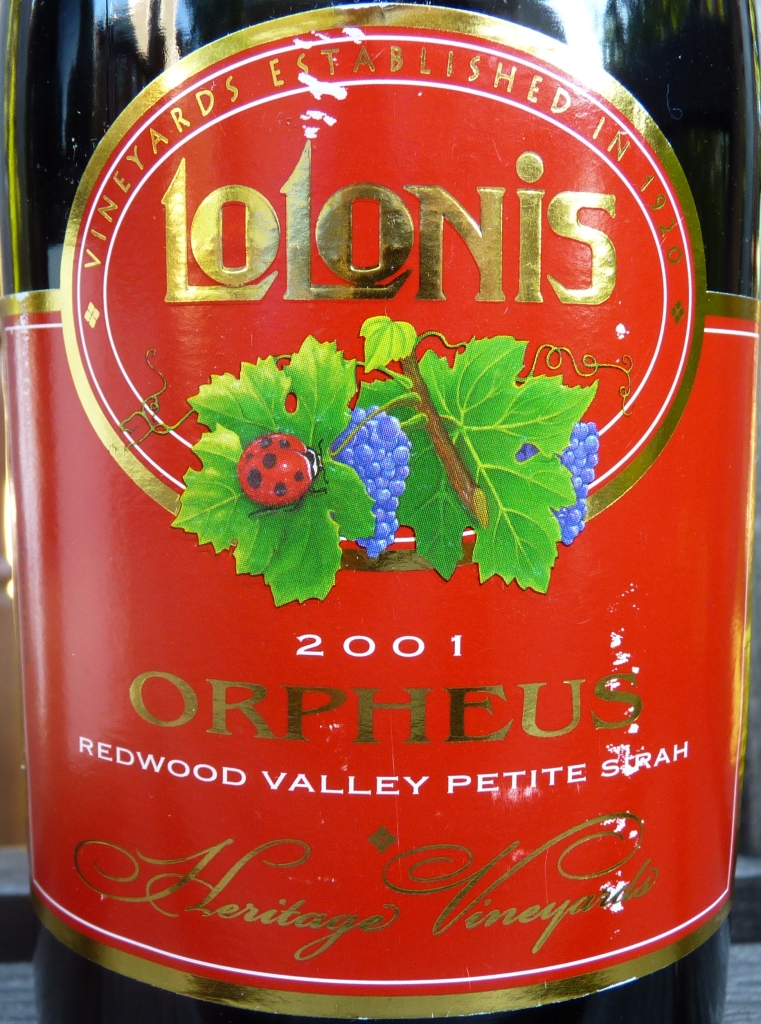 Going back to California, 2001 Lolonis Petite Sirah Redwood Valley. In short – outstanding. This 10 years old wine was completely fresh and beautiful. It is made from organically grown Petite Sirah grape. The wine showed perfect dark fruit, good acidity, full body, excellent tannins, and perfect overall balance. This wine might be evolving for the next 10-20 years – again, the trick will be to find it.
Drinkability: 8+.
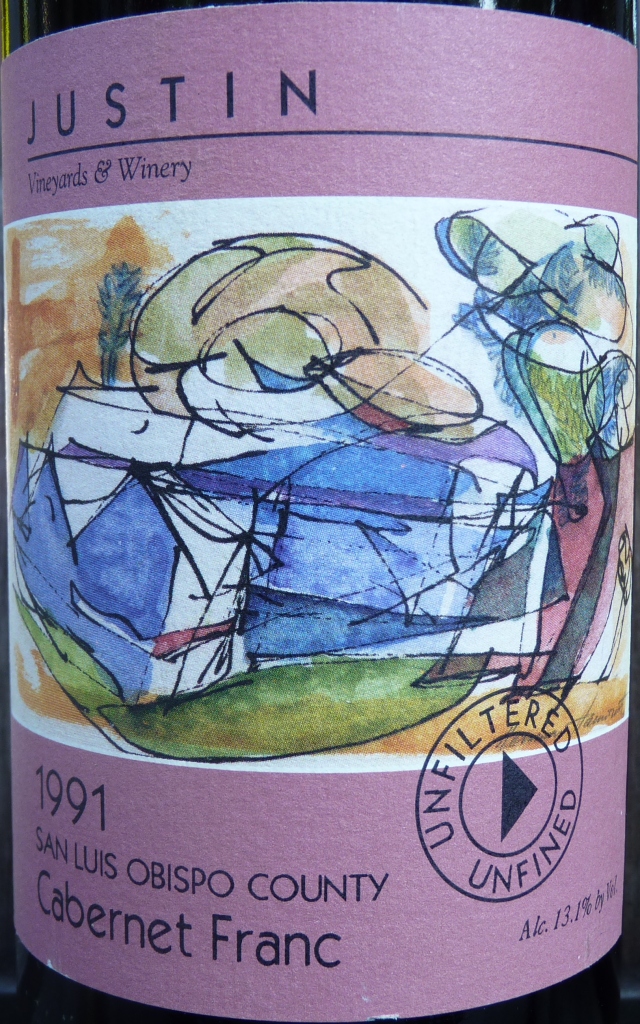
Last, but not least, 1991 Justin Cabernet Franc, San Luis Obispo County. This was the “wow” wine, that exact mind-blowing one. First, while I like Cabernet Franc wines, I had no idea they can age so well. I can literally guarantee that in the blind tasting format, very very few people would be able to guess the age of this wine. Deep garnet color, not a hint of age (no brownish overtones at all). Perfect fresh fruit, soft and luscious, a perfect balance of tannins and acidity. This wine was the oldest in the tasting, and it was definitely the best of tasting. Considering how good it was now, I can’t even guess how much time it has left – but I would be very glad to find a few more bottles to be “wowed” again in the future. Drinkability: 9-
One note before we conclude – this was a rare case of someone doing all the hard work, and me enjoying the results – I got all wines from Benchmark Wine Company and each one of them had been less than $20.
Don’t know if you got the desire to seek well-aged wines – I hope you will one day. For now, I can only wish upon myself, my family, all my friends and all of you, my readers, to age as beautifully as this Justin Cabernet Franc does. Cheers!
Stew Leonard’s Wines: Meeting Winemaker Chester Osborn
 A few times lately I have come across blog posts talking about too many wines on the shelves of the stores and poor consumers being intimidated and having troubles to find what they want. Quite honestly, I find this annoying – I believe convincing consumers that they should be intimidated is the wrong thing to do. Why am I annoyed with this? Very simple. Today, you need a very few things to navigate the world of wine and feel comfortable. One is desire to learn (if someone doesn’t want to learn, it makes no sense to complain that one can not). Learning about wines simply means trying them and making an effort to remember what you like and what you don’t. Another helpful thing – finding a good wine store.
There are quite a few good wine stores where I live – I do plan to write a separate blog post (or may be a few) covering some of those in more detail. One of such good wine stores is Stew Leonard’s Wines in Norwalk, CT. What makes the wine store “good”? It is easy to navigate, it has helpful and knowledgeable personnel, and it is helping you to learn about wines. You got all of that at Stew Leonard’s Wines – easy to navigate, helpful staff and great education. What do I mean by education? When it comes to wines, education consist of learning about wines and tasting them. One of the ultimate forms of “education” then is when you can learn from the best and taste excellent wine – and did I mention that it is usually free? Yep, it is free and available, almost every Friday and Saturday, again, thanks to the folks at Stew Leonard’s Wines. Every Friday and and Saturday, you can come to the store for the wine tasting, and if you are lucky – you will also learn from the winemaker, as it was the case last Friday, September 24th , when Chester Osborn, winemaker of the famed Australian winery, d’Arenberg, was presenting his wines.
d’Arenberg produces quite a few different wines in the McLaren Vale region in the South Australia, of course with Shiraz being a star grape. Five different wines were presented at the tasting. First, Lightly Oaked Chardonnay – it is actually very nice and simple, with clear fruit and light oak expression. Then comes The Stump Jump 2008, which is also should be known at GSM. GSM stands for Grenache, Shiraz and Mourvèdre, and it is a blend modeled after wines from Southern Rhone. It is also interesting to note that Friday, September 24th was the First International Grenache Day which was proudly stressed by Chester holding up the bottle of GSM. Stump Jump is a very nice and approachable wine with great and powerful fruit expression. The next wine was classic The Footbolt Shiraz 2007 (Footbolt actually was the name of the horse), nicely showing spicy bouquet of MacLaren Vale’s shiraz (need my rack of lamb wit that one). And then the flagship Dead Arm Shiraz 2006 – great wine which will need another 15-20 years to be enjoyed fully, very earthy and dense, drinkable now, but boy, will it evolve! In case anyone wonders, the Dead Arm has nothing to do with human body parts – the name is related to the grapevine disease, which can kill part of the plant, producing “dead arm”, or a “dead branch” – in this case the grapes on the surviving part have very high flavor concentration.
And last wine presented was Sticky Chardonnay – beautiful desert wine, made from Chardonnay grapes, exhibiting honey and white peaches notes, all with nice minerals, acidity and green apple bite. At $9.99, the wine of such quality is a pure steal. All in all, it was a pleasure meetings Chester d’Arenberg Osborn, learning from him and experiencing his wines.
To complete the story, I would like to include a picture of the great folks from Stew Leonard’s Wines, including Stew Leonard Jr. himself:
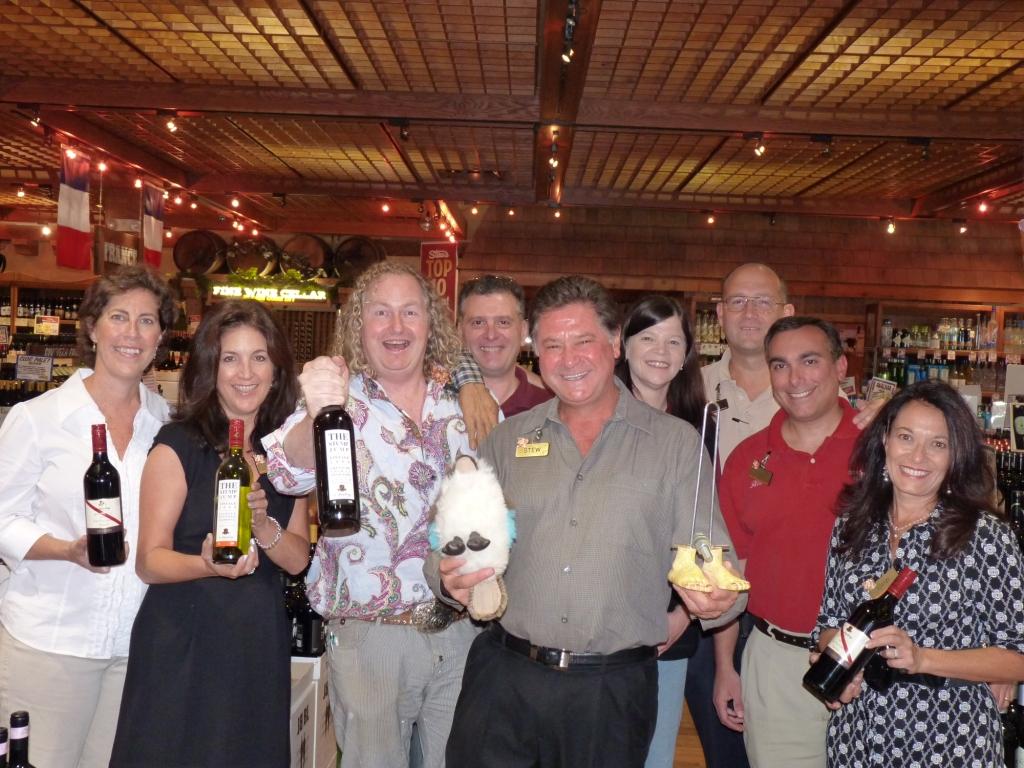
Going back to where we started – it is not difficult to learn about wines today – all you have to do is make an effort. As one of my teachers was saying, when the student is ready, the teacher will come…
Is There Too Much Of A Good Thing?
 Assuming you like wine ( otherwise, I don’t think you would be reading this blog), what would you say of a prospect of trying many hundreds of wines in a day ( about 5 hours, to be precise)? I would think at first you would get excited, right. Now, let’s do some simple math – let’s say you will be tasting 500 wines, 1 oz each… will make it equal to 20 (!) bottles of wine. Don’t think that sounds appealing anymore? This is where the bucket with romantic name “spittoon” comes to the rescue (I’m sure many of you are appalled now – what, spit wines?! No way!) – but this is what the professionals have to do. So why is all this talk about professionals and wasted wine? Simply because that this past weekend, thanks to my friend Zak, an owner of Cost Less Wine and Liquors store in Stamford, I was able to join him in the “trade-only” wine tasting events run by two of the Connecticut wine wholesalers, Wine Bow and World Wide Wines.
Believe it or not, tasting wines in such quantities is a hard work. Of course nobody tastes 50o wines in the row – spitting or not, but your palate gets really tired from tasting and tasting and tasting, and while I’m looking only for the fun component of such an event, people in the trade have to actually make business decisions – getting right wines for the store or a restaurant is a border line between success and failure. Luckily, this hard work is associated with pleasure, so enough of the sad picture – no need to take pity. Yes, it is a great opportunity to try an amazing variety of wines, a lot of them being simply great wines, and for me personally it was also an opportunity to make progress in the treble journey ( which I did), but I will report on this in the next post.
 It is impossible ( and probably pointless) to write about all the great wines – but I would like to mention a few highlights. First, among the Cabernet Sauvignon, Neyers Ranch Conn Valley Cabernet Sauvignon 2003 and 2006 were simply outstanding, with pure Cabernet expression of black currant, chocolate and hint of eucalyptus, all beautifully balanced. Ladera Vineyards Cabernet Sauvignon, Napa Valley, Lone Canyon and Howell Mountain were all between excellent and outstanding – again, with beautiful and clean California Cabernet expression at its best. It is also worth mentioning that all of these wines are quite accessible with retail prices at $30 – $60 per bottle. Few more personal highlights among the reds were Morgan Monterey Syrah 2007 (less than $20 retail), amazing 100% Syrah demonstrating all the “textbook” Syrah spicy qualities, and then couple of Zinfandels, Bradford Mountain Dry Creek and Bradford Mountain “Grist” by C. Donatiello Winery, both from 2005.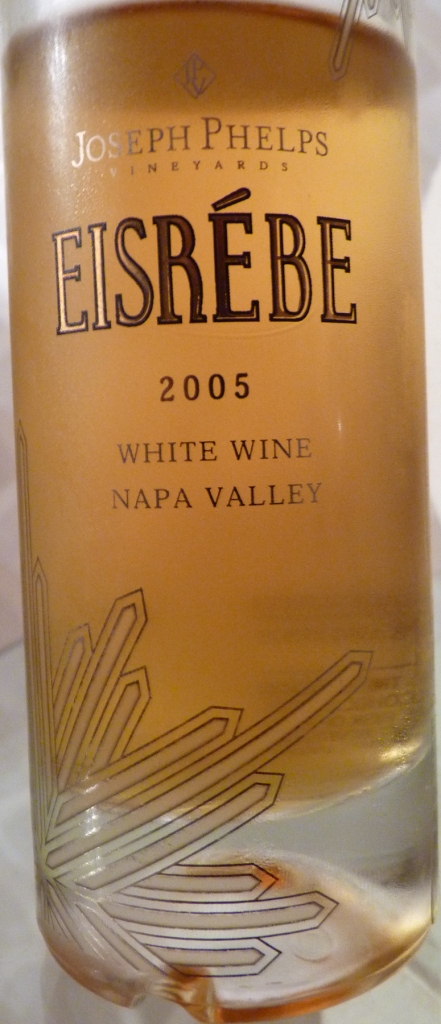
There were a lot of great white wines, but I would like to mention only one, again as personal favorite – the wine called Eisrebe by Joseph Phelps. This is desert wine made from the grape called Scheurebe ( that was a nice surprise for my “treble journey”), and it is done in the style of the Ice wines, except that as there is no chance for the grapes in California to naturally freeze at -8C, special cryogenic methods used to achieve “ice” wine result. The wine had an amazing balance of the white fruits, honey and ripe comice pears with refreshing acidity, so it was not overpowering the palate. Amazingly enough to me, this wine was also perfectly complementing wide variety of desserts, which is not very common from my experience.
All in all – it was a great fun, and I have to conclude that when it comes to the wine tasting, there can be no too much of a good thing (well, a “good thing” is an important hint here), and therefore I will gladly repeat it at any time.
Cheers!
Daily Glass: Arnoux & Fils Gigondas Vieilles Vignes 2007


Gigondas is a small appellation in Southern Rhone in France, which produces the wines somewhat similar in style to the famed Chateaneuf du Pape.  Absolute majority of the wines are red, and main grape is Granache (up to 80% in the final wine based on AOC laws), with Syrah and other grapes adding up. Grenache is a very versatile red grape, used in a wide range of wines all over the world.
Considering that Robert Parker gave 2007 vintage in Southern Rhone a 98 rating ( of course this rating is generalized for the whole region and nobody expect all the wines to achieve the same rating), I had good expectations for this wine as well ( as I had already a number of great generic Cote du Rhones from 2007 vintage). Unfortunately, that didn’t play out. The problem with this wine was related to alcohol. Yes, yes, the wine is alcoholic beverage, duh, of course. But it is the balance which I’m looking for in wine. While at 14.5% ABV it doesn’t stand out in today’s wine world as super-loaded, somehow the alcohol in this wine was not integrated at all. Burning sensation of alcohol was overpowering all other smells on the nose, and burning sensation of alcohol was absolutely prevalent on the palate, even on the second day. While it was possible to catch a glimpse of leather and pepper, which is a characteristic of Southern Rhone wines, this wine didn’t achieve great deal of balance. So the rating is:
Drinkability: 7-
Well, I guess I have to keep trying…
Daily Glass: 2008 Block 2 Syrah by B2 Cellars
Just to finish the story on 2007 Cameron Hughes Cabernet Sauvignon Lot 140 – I did try that wine over the next two days, with expectation that as the wine will age in the open bottle (of course the bottle was not standing open, the air was removed using one of my favorite accessories, Vacu Vin Pump. Unfortunately, aging process didn’t help the wine to become balanced – alcohol, tannins and fruits all were standing on their own, refusing to meld. Therefore, the 7- is the final word on that wine. And now, let’s talk about totally different wine experience.
2008 Block 2 Syrah by B2 Cellars, Horse Heaven Hills, Washington
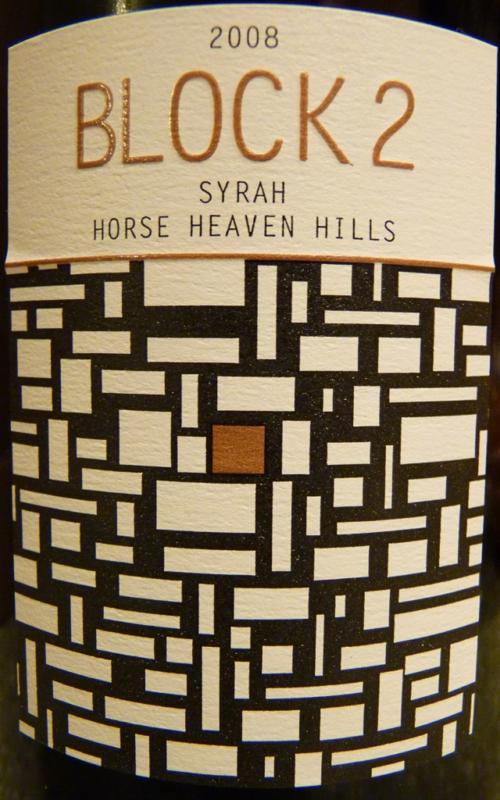 Syrah wines from Washington have almost cult status for me. They are usually quire rare in the stores in new Jersey and Connecticut, where I usually buy the wines, they are typically are somewhat on a pricey side, at the same time they usually taste great. I got this one as I was intrigued by the description in the Stew Leonard’s wine store in New Jersey, which said that it was an amazing find and the wine which typically cost $70 is offered at $19.99. So I decided to give a try. And I’m glad to report I was very happy I did! After my expectations were set, I also decided
 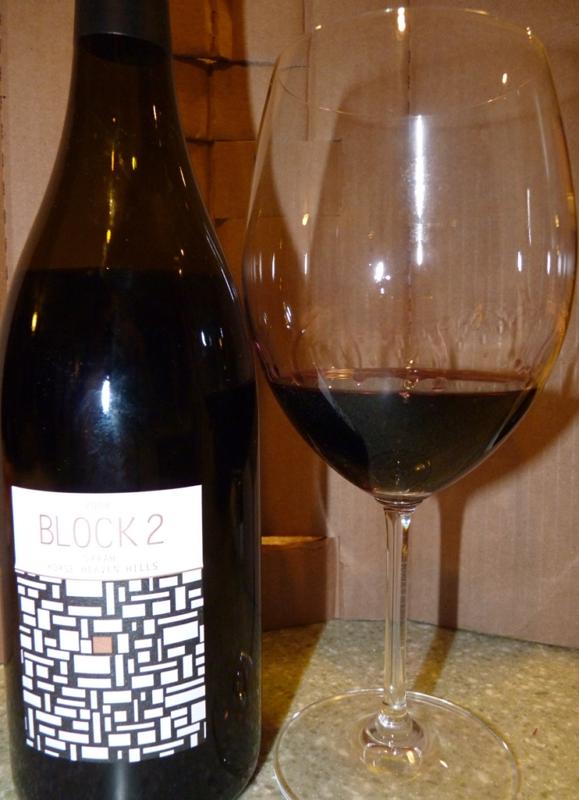 to use an appropriate Syrah glass, which you can see in the picture. The wine was great from the get go. It opened up with a beautiful nose of white pepper, leather and tobacco ( all characteristics of the good Syrah wines). On the palate, the wine was as beautiful, with all the same aromas complemented by earthiness, acidity and soft round tannins (needed some time to breathe first), very balanced. This wine is perfectly drinkable now, and will improve of the next 5-10 years ( or may be more – I still keep experimenting with my level of success in prediction of age-worthiness of the wines – but I would love to set this experiment up and report back in 5 and then in 10 years :)). All in all, Block 2 Syrah happened to live up to the store description and my expectations, which doesn’t happen all that often. And now, the verdict:
Drinkability: 8
Get a case for yourself and enjoy!
Last Bottle Sign Up ($10 credit)




 Talk-A-Vino