Archive
Daily Glass: Double Lucky, Coast to Coast
Wine is meant for sharing.
How do you share the wine? Well, that depends.
Of course, everyone knows the best way. Get together around the table. Open the wine. Pour into glasses. Sip, savor, enjoy the conversation.
This is the best way. But sometimes, it is not the easiest way. For example, when one person lives on the East Coast and another on the West Coast. What is the best way to share the wine then? Yes, nowadays, it is easy to speak with your friends no matter where they are – and not only talk, but you can see each other too, that’s a given. But still, how do you share the wine?
If you are lucky, you both might have the same bottle of wine. And you can be even double-lucky – especially if you have the right bottle, such as No Girls Double Lucky #8.
Talking about all the luck(s), there are a few here at play. Both my friend Wendy and I had the same bottle of wine available to us. Moreover, we had the bottle from the same vintage – 2019. Now, barring all the bottle variations, we were basically sharing the exact same bottle of wine – never mind 2,500 miles apart, as Wendy lives in Seattle.
Double Lucky wine was released during the pandemic, in 2021, and I was lucky enough not only to get a bottle of the inaugural 2017 vintage (all people on the No Girls mailing list received a bottle of Double Lucky for free), but also to attend a zoom call with Christophe Baron, the creator and owner of Cayuse wines and of the Cayuse “side branches” such as No Girls, Horsepower and others, and Elizabeth Bourcier, the winemaker – you can find my detailed impressions here. If you will read that post, you will find out that I was rather torn on the 2017 vintage.
2018 Double Lucky fared a lot better in my book, and it even made it to the Top Two Dozen of 2022 as wine number 19. And now, the 2019.
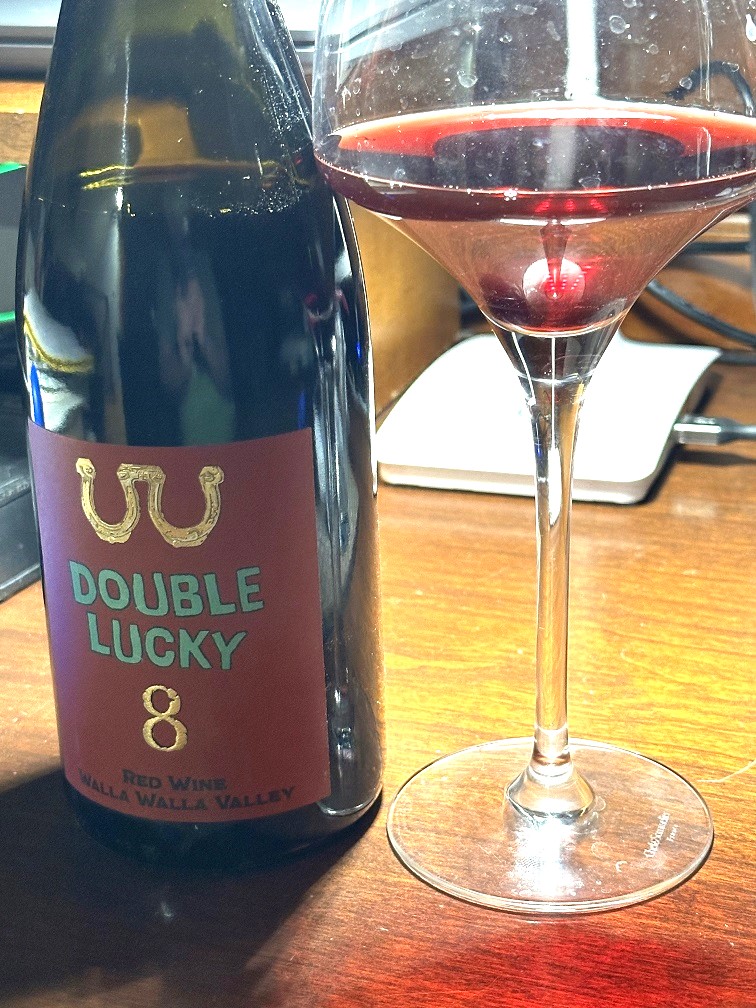
The 2019 No Girls Double Lucky #8 Walla Walla Valley (13.7% ABV, 34% Grenache, 33% Syrah, 33% Tempranillo, 21 months in neutral French oak) had a playful color, going from dark garnet to the crimson red, depending on the lighting. On the nose, on the first whiff, you can only talk about the rocks – the wine has a really profound minerality. Next, there is a hint of barnyard – just enough for those who like it, and we managed to agree with Wendy that we both love that little (or even not so little) funk on the nose – it makes the wine all the better (don’t talk to me about Brett). And then there were some cherries also present on the nose.
On the palate, the wine was all so interesting. We spoke with Wen for about 2 hours (wines, politics, families, popcorn, more wines – you know, just two friends catching up), and during these 2 hours, the wine kept changing. At first, the wine showed green bite, like chewing on the little branches of the wood (Elizabeth Bourcier is a big fan of whole cluster fermentation, and while it sounds wonderful, every time I hear the term, I almost cringe). After about 20 minutes, the green notes were gone, and the wine just had sweet cherries, olive tapenade, and rocks, lots of rocks. About an hour later, taking another sip, I suddenly discovered my beloved pepper! I love peppery notes of Syrah, this is an absolute hallmark in my book, so the wine definitely made me happy – and of course, it evoked memories of Michel Chapoutier Mathilda Shiraz, one of the most peppery Syrah renditions I ever tasted.
All in all, it was a great evening of wine and conversation – a double lucky we might even say, pun intended.
Never mind the distance – open a bottle and call your friends.
Until the next time – cheers!
Double Lucky Number 8
Luck.
An interesting term.
Luck is extremely subjective, personable, and relative. There are many definitions of luck, starting with the cliche one “when preparation meets opportunity” – not sure how that would apply for example, in the case when the brick is accidentally falling off the roof of the building and missing your head by the quarter of an inch. Or when you win the lottery. When you miss your train and meet the love of your life – what kind of luck is that? Okay, let’s not get hung up on the research of the true meaning of “luck” as this is not the goal of this post.
Last year, 2020, can hardly be called a “lucky” year. Quite on contrary, for 99.9% of people living today, this was probably the unluckiest year of their lives to date (who knows what the future hold). Or was it? Yes, we lost the ability to travel, eat out, enjoy the concerts, and socialize with friends. And yet many of us who kept our jobs managed to pay off debt (Americans paid off the record of $83B in credit card debt), invest into their homes (the price of lumber doubled in certain markets in the USA, due to very high demand), and even get well on the path to early retirement. And those of us obsessed with wine even got access to the wines we couldn’t dream of before (thanks to the restaurants not buying those wines anymore), and meet lots and lots of winemakers who happily visited our houses – via zoom. Everything has its silver lining.
A few months ago I got an email from Cayuse, saying that I will be getting a bottle of wine called Double Lucky #8 – a free sample, plus there will be a special zoom with the winemakers to introduce the new wine. Cayuse, and all of the “sister” wines – No Girls, Horsepower, Hors Categorie – are super-allocated (never mind expensive), so the free bottle sounded very lucky.
The wine arrived a few days ago. A beautiful bottle that solicited an array of thoughts. Cayuse wines are better with age – 2017 is clearly too young to be enjoyed now. Also, I love sharing the wine – so what should I do – to open or not to open? I decided that as this will be a unique opportunity to taste this wine together with the winemakers, I should just open the bottle and go with the flow. But also do it in a smart way – open a few hours in advance and decant it – which I did.
I remember reading an article by W. Blake Gray, the wine writer and a critic I respect very much, who mentioned that Cayuse wines might be the best wines made in the USA. Ever since then, tasting Cayuse wines became a dream, which required more than 10 years of waiting to get on the mailing list. Obviously, meeting Christophe Baron was a similar dream, which materialized thanks to pandemic and zoom.

Our zoom session was moderated by Owen Bargreen, the wine critic from Washington, with Christophe Baron and Elizabeth Bourcier, the winemaker, talking about all of the wines produced by Cayuse – well, that is not exactly correct. As introduced by Christophe Baron, it is all the wines produced by Bionic Wines, the new overarching brand, which includes Cayuse, No Girls, Horsepower, Hors Categorie, and Champagne Christophe Baron.
It is all about the rocks (Cayuse is derived from Cailloux which means stones or rocks in French). If I would give you a cliff note on what Christophe Baron does, it would sound something like “he finds the great location, establishes new vineyard, and makes new wine” – really, this is the story behind various Cayuse wines, No Girls, Horsepower…
Everything at Cayuse is done in full respect and harmony with nature – all the vineyards are farmed biodynamically since 2002 – the only biodynamic winery in Washington. As Christophe put it eloquently during the webinar, Mother Nature is the Master, and we are all her servants – it is Mother Nature who produces the grapes, and the winemaker needs to covert those into the wine, hence the utmost respect and attention to producing the wines in full harmony with nature.
We talked about all the wines under the Bionic wines umbrella, how they came to being (remember, new vineyard – new wine), and what is the philosophy behind them all. Almost at the end of the session (the time flew unnoticed, all thanks to the incredible energy and enthusiasm of Christophe), we finally talked about 2017 Double Lucky #8, a blend of Grenache, Syrah, and Tempranillo, the same three varieties which comprise No Girls offering. Double Lucky is Elizabeth Bourcier’s project, from start to the finish – her idea, her execution. She wanted to create the wine similar to Cotes du Rhône – simple and approachable from the get-go, a sort of Cotes du Walla Walla if you will. Was she successful? Let’s talk about it.

When I poured the wine at first, it literally jumped out of the glass. I call Cayuse wines “liquid rocks” – Double Lucky was no exception, with granite, iodine, and smoke being prevalent both on the nose and on the palate. The wine was definitely drinkable, though not for the faint at heart – if you like massive wines, you would be pleased. 2 hours in a decanter made the wine more mellow, shifting the balance towards some cherries and herbs. For my palate, the wine continued up and down until it was gone.
Elizabeth shared her winemaking philosophy, which includes whole cluster fermentation and use of the stems, as stems “give the wines freshness” in her own words. I’m rather cautious about both – I guess my palate is overly sensitive to the tannins extracted from the stems – I perceive them as “green” tannins, which are unpleasantly bitter, and thus I’m generally not a fan. So I don’t have a strong opinion on Double Lucky #8, and while the wine is influenced by Cote du Rhône, it will last for the next 10–20 years, unlike Cote du Rhône wines, which typically have only a few years to be enjoyed, so I would definitely mark it as “needs time” right now. One more parallel with Cote du Rhône – those wines are usually inexpensive – and Double Lucky will be the cheapest wine in Bionic Wines portfolio, at $44 when it will be officially released next winter as part of the No Girls wines release. While the wine is a blend of Grenache, Syrah, and Tempranillo, there are no exact proportions, as the blend will change every year. I can only guess Grenache makes the majority of the blend, given Elizabeth’s propensity for use of Grenache as she does in her own sought-after wine, La Rata.
I have to tell you that while the zoom is exceptional, it is hard to keep attention all the time. As the result, I don’t know if it was just me, but I didn’t really get the real story behind the intriguing name (Double Lucky) and the meaning of #8. Was that the blend #8 which became the winning one? Was the idea behind this wine associated with some lucky moment? I would love to know, but I have no idea. Hopefully, someone will be luckier than me and we will learn the story behind the name.
Was that a lucky break drinking Double Lucky and listening to Christophe Baron? Oh yes, it was. I wish all of us lots and lots of luck, whether we are prepared for it or not.
Last Bottle Sign Up ($10 credit)




 Talk-A-Vino