Archive
Wine Videos: Don’t Do This At Home, Kids
Last week we compared wine video commercials from some of the major Champagne brands (in case you missed that post, you can find it here). Today I’m not asking you to rate the videos. Just watch and learn… or not (one of the videos is definitely giving me an urge to actually try it at home). In these videos you will see how professionals deal (meaning: open) with champagne bottles. This method of opening the champagne bottle is called sabering, and if you never heard of it before, just watch the videos (you can also read about some history of champagne sabering here).
First one is showing champagne bottles being opened in a rapid succession to achieve a world record:
The second video shows how sabering can be done with just a regular glass instead of a sword. While it looks easy and effortless in this video, make no mistake – it does require good amount of skill.
If you will be brave and try it at home, let me know how you will make out! Cheers!
Wine Videos: Big League Sparklers Showdown
Continuing the “sparklers” theme, I want to offer you three commercials from the big league Champagne.
First, a commercial for Veuve Clicquot:
I’m not sure if the next video is really a commercial, it looks more as a tribute by Dom Perginon to Andy Warhol – but in any case it is a wine video:
And last but not least is a commercial for my all times favorite Champagne – Krug:
What the verdict is going to be? Any preferences? Cheers!
Weekly Wine Quiz #11 – Bubbles, Big and Small
 It seems that my wine quiz #10 was a failure, as there were only 3 responses. Oh well – I wanted to make it “somewhat” difficult, but crossed the border into “very” difficult. Today’s quiz will be nothing like that.
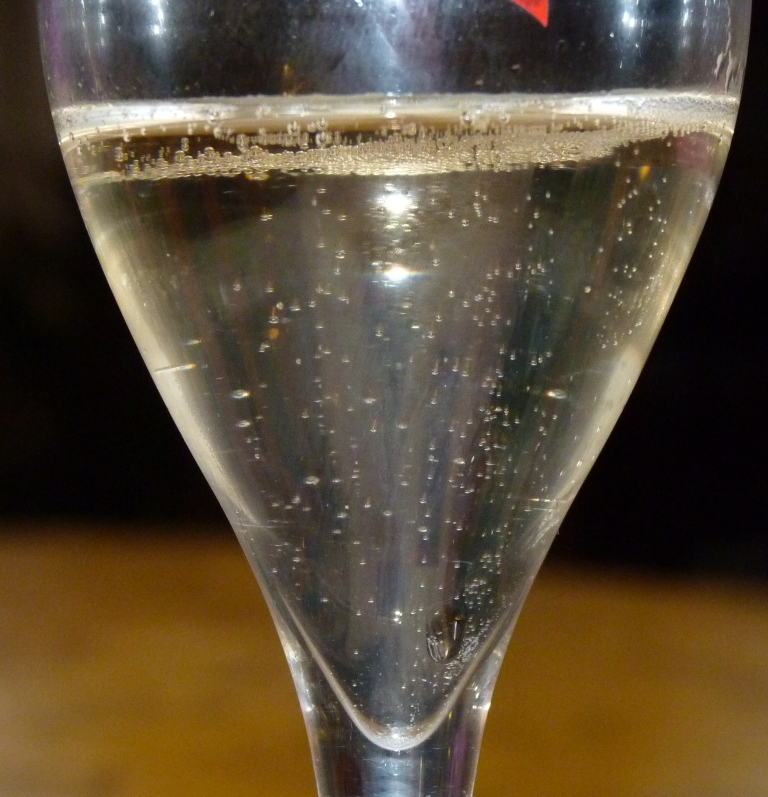
Tomorrow is the Mother’s Day, which is a good reason to open a bottle of champagne (not that we need a special reason for that). Once the celebration liquid is in the glass, did you ever sit still looking at that glass and adoring the chains of tiny bubbles coming up, up and away?
Today’s test will require you to brush up high school or may be even college math curriculum, including Algebra 10, Trigonometry 12, Calculus 15 and …wait, don’t close this page – I’m only kidding. Today’s quiz will not require any math skills whatsoever, but you should put on your best guessing game (yes, check your answer with Google, please – but only after you will vote in your answer).
And the question is: how many bubbles are in a bottle of Champagne? Of course your answer should be only approximate, if you think it is 500,000 or 900,000, chose 700,000 from the list below, it should work just fine. Of course you can use the empirical approach and actually open the bottle of champagne and count all the bubbles, but you better be a very, very fast counter. Good Luck!
No matter what you answered, and sparkling or still, but don’t forget to open a great bottle tomorrow to celebrate Mom! Cheers!
Valentine’s Day Food and Wine Experiences
 For many years already Valentine’s Day became our “home” holiday. What I mean is that we are not going to the restaurant – instead, we attempt to create the best possible experience at home. This past Valentine’s Day our attempt was quite successful. First, there was a Champagne. Ahh, what so special, say you, a sparkling wine? Well, we don’t drink Krug every day – Krug is our “special” sparkling wine, as both me and my wife fell in love with it 3 years ago, and nothing beat that ever since.
It was Krug Grand Cuvee Brut NV. Beautiful effervescent nose, with only a hint, a whiff of toasted apple, yeast and fresh bread – the same lightness on the palate, with perfect balance of fruit and acidity. Yes, I know, I fail to give you a critic-worthy description with lots of different elements of soil, the fruit and more – so you will need to take my word for it – this is The Champagne. Once you try Krug…well, you will continue to appreciate many other sparkling wines, but Krug will be the one you will crave. And if you care for my rating, I will put Drinkability at 9+.
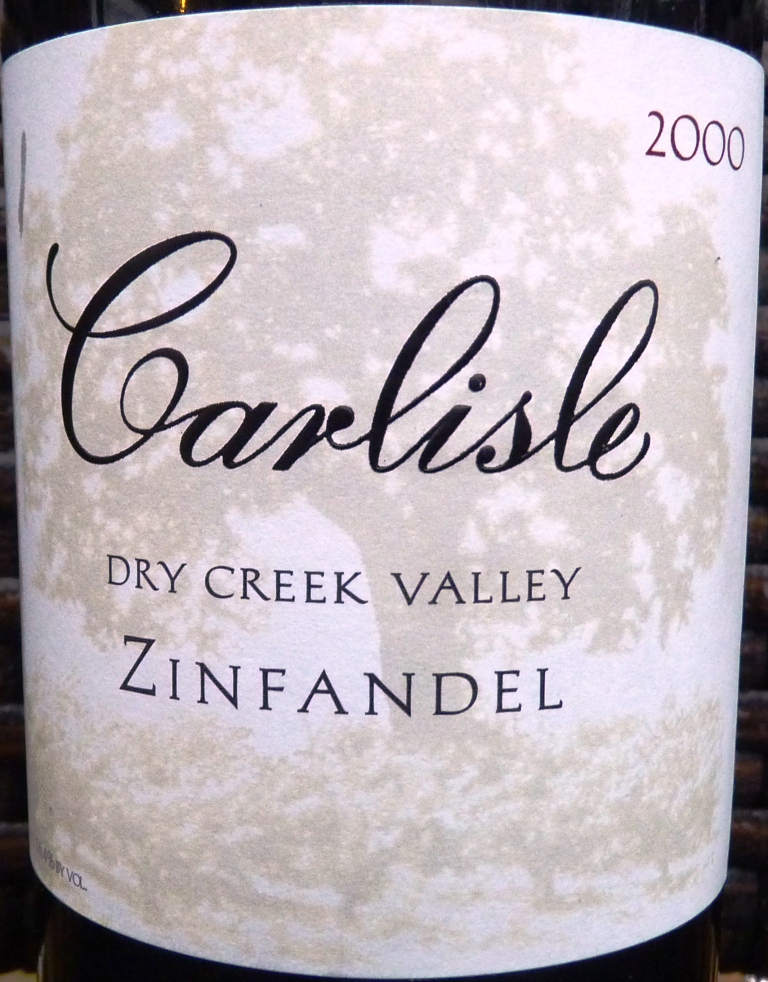 Believe it or not, but Krug was only the beginning of amazing wine experience. The next wine blew me away in many senses. First, it was a realization of a dream. For the long time, I wanted to try Carlisle Zinfandel – consistently high ratings in Wine Spectator, great reviews – many factors contributed into making Carlisle Zinfandel an object of desire. I signed up for the waiting list for the mailing list, I asked around – all to no avail. Then a few month ago I saw a bottle on the Benchmark Wine Company’s web site, priced at about $30 – voila, I got the bottle. Now I just needed special occasion.
Special occasions are easy, right? Valentine’s Day is special enough for us, so the bottle of 2000 Carlisle Zinfandel Dry Creek Valley was opened. The description? One word – “wow”. Beautiful nose of red fruit and smoke (raspberries and blueberries plus a hint of smokiness, to be more precise). Perfect balance of fruit, tannins and acidity on the palate – more playful fruit, eucalyptus, cedar box, spices, tobacco – all components are playing together to deliver an amazing experience.
Here is one interesting note for you. Carlisle web site has a table which is called Drinkability Chart, which lists all the different wines from the different vintages and ideal drinking window for those wines. According to that chart, optimal drinking window for this particular Zinfandel was 2002 – 2005. Well, what can I tell you? If you got a bottle of Carlisle which you think is undrinkable – send it my way, and I will thank you profusely. And just to show you how much I loved this wine, I have to tell you that this is the first time I put Drinkability of wine at 10-! Here is the link to my ratings page – you can judge for yourself.
As you can see, the wines were great – but there was also food. This year we decided to do a Rack of Lamb. Rack of Lamb is a dish which we typically enjoy in the restaurants (especially in French Canada), but it is not that difficult to make at home (once you overcome the sticker shock of a good rack of lamb).
I need a lot of rosemary with my rack of lamb – and this is what we did. A little bit of fresh pepper, and lots of fresh rosemary – with addition of some fresh sage as well. Here is the rack of lamb ready for the oven:
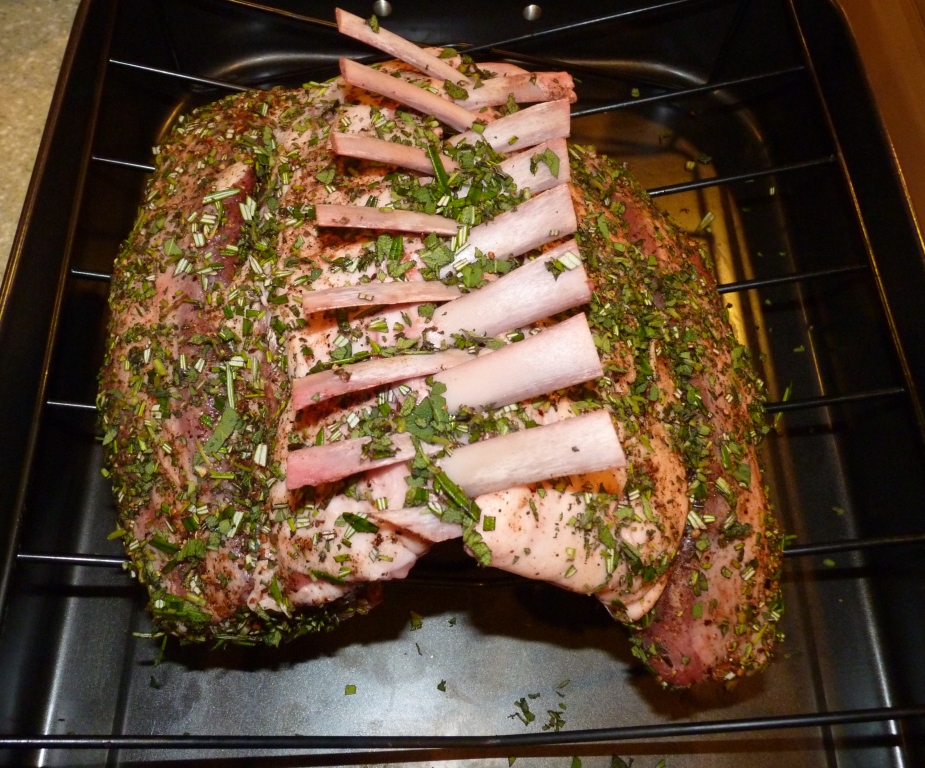
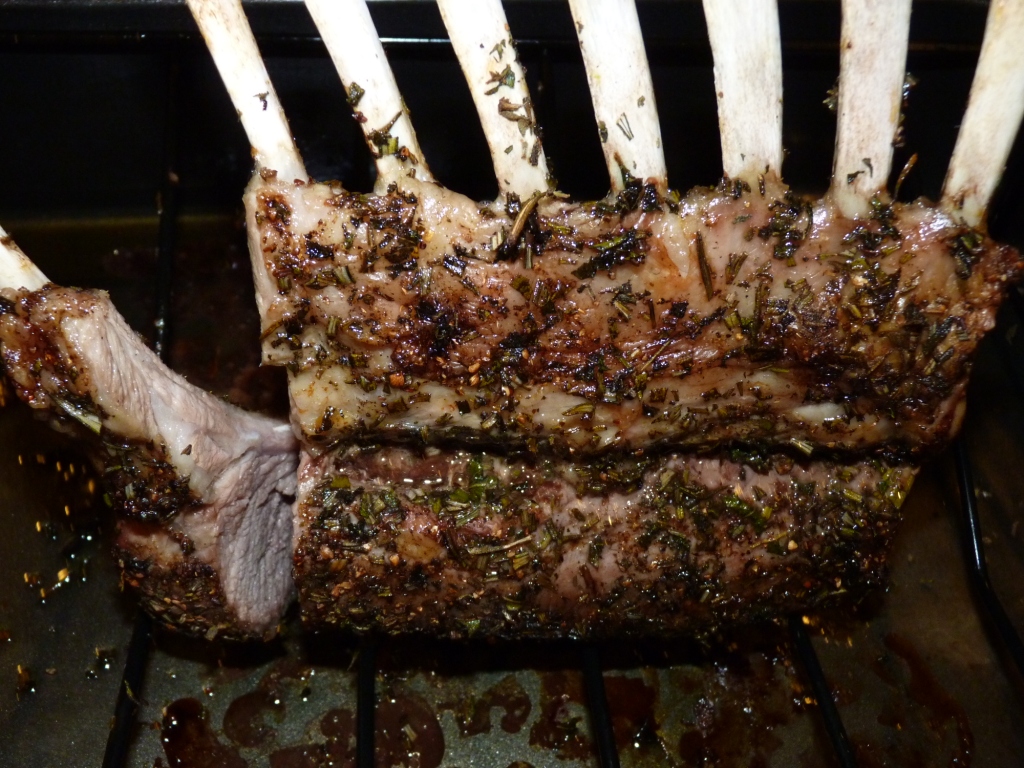
There are couple of techniques which I started using lately when it comes to roasts – and I like the results so far. First one is preheating oven to 500F – temperature is lowered one roast is put in, but it is enough to develop a nice crust. The second one is not using any salt until the roast is done ( so only using finishing salts) – the rationale here is that salt is draining juice out of the meat so it is better to be put on at the last stage. So far I had being very happy with an outcome using these simple rules. After 40 minutes in the oven ( 500F to start, then lowered to 400F), here is the final result:
And here is plated version:

Yes, I know, I should work on presentation – you don’t have to tell me that. But the taste was great, and lamb also paired quite well with the Carlisle Zinfandel – to double the pleasure!
That’s all, folks, for our wonderful Valentine’s Day food and wine experience. It will be hard to beat it next year, so I can only wish tat the next year will be not any worse than this year.
Cheers!
What Is In The Bubbles? – 2011 Version
Yesterday I shared with you my perspective on sparkling wine from 5 years ago. What happened in the past 5 years in the world of bubbly? Champagne is still a Champagne, as invented hundreds years ago, right? I would like to summarize the differences in two words: diversity and abundance.

Of course nobody invented Cava, Prosecco, Sekt or Cremant in the past five years – those sparkling wines had been around for hundreds of years. But never before were sparkling wines so abundantly available in United States – lots of them of a great quality and finesse, rivaling Champagne in taste and even more certainly, in price (average price of Champagne increased by about $5-$10 per bottle, depending on the brand and the actual wine store).
Diversity is another phenomenon in the world of sparkling wines – each and every category of the sparkling wines, including Champagne, has a lot more brands and styles widely available in many wine stores. Talking about Champagne, have you heard of Growers Champagne five years ago? I’m sure you did, if you are in the wine trade, but very unlikely if you are not. As we discussed before, majority of the Champagnes is produced by few big Champagne houses. For the most cases, those Champagne houses are not growing their own grapes, they are buying them from the growers. Some of the growers are also started making Champagne, which can be very distinctive and of a very good quality – I mentioned my experiences with Growers Champagnes a number of times before (you can find old posts here and here). Also increasingly available French sparkling wines made outside of Champagne appellation – they are often called Cremant and you can easily find Cremant de Alsace, Cremant de Bordeaux, Cremant de Bourgogne, Cremant de Jura, Cremant de Loire in many wine stores around you.
Going outside of France, more and more sparkling wines are made all over the world. While Italy, Spain, Germany and US where always on the bubbly’s map, during the last couple of years I was able to taste sparkling wines from Argentina, Australia, Georgia (Georgian Sparkling wine, called Bagrationi, was our favorite wine during blind tasting, beating out classic Champagne and many other – you can read about it here), South Africa, Switzerland and Uruguay. Next to this geographic diversity is number of grapes used nowadays for production of the sparkling wines. Traditional Champagne, as well as many of the Cremant wines and sparkling wines made in US and Italy, are made out of Chardonnay, Pinot Noir and Pinot Meunier – however, in addition to this short list I tried sparkling wines made out of Chasselas, Chinebuli, Gamay, Malbec, Shiraz and Vidal (here is the post). A number of sparkling wines were also made using natural and biodynamic methods – I had a number of outstanding French sparkling wines made from Gamay (here is the post). If you are interested in this particular category ( natural Sparkling wines), I would highly recommend checking PJ Wine web site, which boasts excellent selection.
No matter what you are celebrating, there is always a special bottle of sparkling wine waiting for you. There is also nothing wrong with celebrating just another day. But considering that tomorrow is a New Year, make sure you have a good supply of the bubbly – no matter where it is from or what grape it is made out of, it is guaranteed to make your moment special. Happy New Year! Cheers!
What Is In The Bubbles? – 2006 version
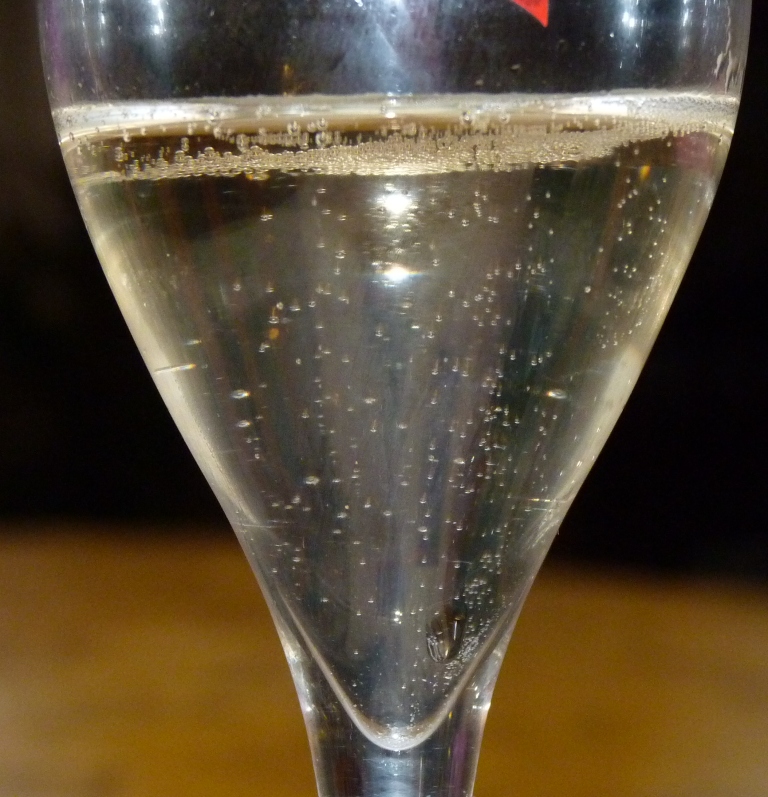 In the past, I wrote a few wine articles for one of the local newspapers here in Stamford – Stamford Times. As right now it is a champagne times all over the place, I thought this post about bubbly, written in 2006, still make sense. So here it is in its entirety, and I will give you 2011 perspective in the next post. Happy reading!
What is in the bubbles?
What is one type of wine a lot of people will be reaching for very shortly? If you said “champagne” – you are right. If you said “sparkling wine” – you are right too. As New Year rapidly approaching, one of the traditions of celebration is having a glass of “bubbly” with the toast to the health and happiness in the arriving year. Where this tradition is coming from is hard to tell, as ever since champagne was invented, it very quickly became a symbol of celebration – a new ship, a new house, a wedding and all other significant events all call for champagne on the table.
Let’s take a look at the history – what is champagne and where did it come from? As many other prominent discoveries of the past, the discovery of champagne is largely a result of an accident. Champagne as we know it came from France, and as majority of other French wines, the name of the region where the wine is produced became the name of the wine. Champagne region is located in the northern part of France. One of the characteristics of that region is cool weather – the mean annual temperature is only slightly above 50°F, just a minimum necessary to allow grapes to ripen.
At the same time, the advantage of the cooler climate is that it allows grapes to ripen slowly, thus gaining more flavor and adding complexity. When grape juice is becoming a wine through the process called fermentation (by adding yeast to the grape juice), constant temperature is very important for the overall success. If the temperature drops too low, the fermentation would stop. Once the temperature rises, if there is any residual yeast left, fermentation will start again. If the wine is already bottled, this so called secondary fermentation will take place inside the bottle. Those wonderful refreshing bubbles, which we adore so much in our champagne, is nothing but carbon dioxide, which is a normal byproduct of fermentation process. If takes place during first fermentation, all carbon dioxide will go out in the air. At the same time, when secondary fermentation takes place in the closed bottle, the carbon dioxide has nowhere to go, thus it stays in the bottle and becomes a wonderful fizz we all enjoy. Thus thanks to the Champagne’s weather helping to “spoil” bottled wine, and someone’s imagination, we received a gift of great taste called champagne. Who was that “someone”?
History often calls a French monk, Dom Perignon, an inventor of the champagne. In the late 17th century, Dom Perignon was a cellarer at the abbey of Hautvillers, near Epernay in Champagne. Dom Perignon also was a great winemaker, who mastered making practically a white wine from the black grape ( Pinot Noir). He also advanced the art of blending ( mixing wines from different vineyards and/or vintages) to produce wine of consistent qualities. Blending is one of the cornerstone processes in making of the champagne. Interestingly enough, Dom Perignon worked hard to prevent the fizz in wine, which was at a time considered a sign of the poor winemaking. Nevertheless, the name Dom Perignon literally became a synonym of the great champagne. It is also suggested that there is a famous phrase which belongs to him – “Come quickly! I am tasting stars! – he said at the first sip of champagne.
Let’s talk about some of the characteristics of the champagne. First, there are 3 types of grapes used in champagne’s production – chardonnay, Pinot Noir and Pinot Meunier. Next, there are 2 main categories of champagne – non-vintage (usually the letters NV are added to the name) – blend of wines from the different vintages, and vintage, when only wine of single vintage is used. There are usually only few vintage years in a decade, so the majority of the champagne consumed is a non-vintage ( NV) variety. One more classification is based on the types of grape used in the blend – most of the champagne are a blend of different grapes, but if only Chardonnay grapes had being used, the champagne will be called Blanc de Blancs, and if only Pinot Noir is used, the champagne is called Blanc de Noir. Lastly, there are different levels of sweetness found in champagne, which is also put on the label: if the label says “Brut”, it is very dry, Extra Dry – less dry, Sec – sweeter, Demi Sec – medium sweet, Doux – sweet. Interestingly enough, most of the champagne produced before 1850 was sweet. Majority of champagne produced today falls into brut or extra dry categories.
Similar to the other wines from France, there are thousands producers making champagne. At the same time there are currently 26 Champagne Houses, known as Grand Marques – they are making most of well known champagne in the world. Some of the most popular names from that group include Bollinger, Charles Heidsieck, Krug, Moet & Chandon, Mumm, Perrier-Jouet, Salon, Tattinger and Veuve Clicqout. Is there champagne made outside of France? Of course, but it is not called champagne. In majority of the cases, only the wines produced in the Champagne region in France are called champagne. Sparkling wines, which are produced using the same winemaking techniques, are made in the different parts of the world – Cava in Spain, Sekt in Germany, Spumante in Italy, Sparkling wines in California. Some of the well known sparkling wines producers in California include Korbel, Schramsberg, Iron Horse, Mumm Cuvee Napa.
How champagne is served? It is served cold, best temperature being in the range of 43°F – 48°F. Most appropriate glasses for champagne are flute- or tulip-shaped. Do not serve champagne in the wide open glasses – this only leads to champagne going flat in no time, losing all of it’s refreshing fizz.
What is champagne served with? First, champagne makes great aperitif – great way to start an evening with friends. When it comes to food, similar rules apply as for matching any other wine and food. Champagne represents light and refreshing wine, thus it would be best paired with similar type of food, meaning being light. Shellfish, oysters, seafood, poached salmon all would do great. Also sushi is definitely not to be forgotten. And, yes, of course, the classic combination – Champagne and Caviar.
As John Maynard Keynes said, “my only regret in life is that I did not drink more Champagne” – let’s not make this mistake! Get the friends together, open the bottle of bubbly, and celebrate – New Year, new child, a new beginning! Happy New Year! Cheers!
Celebrating Global #ChampagneDay
Yesterday the world of wine social media celebrated 2nd Global Champagne Day, honoring one of the most special beverages – French Champagne. Here is how we celebrated it:
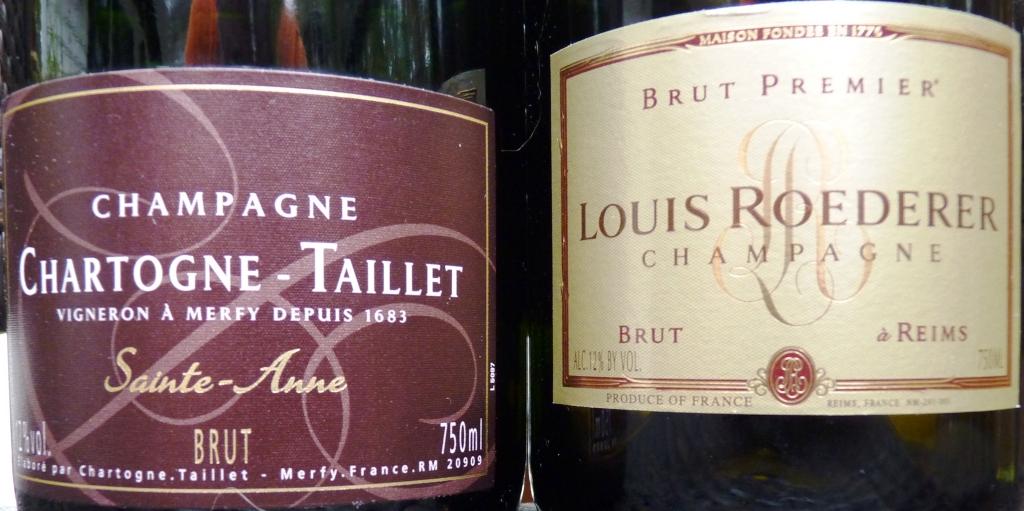
Louis Roederer Brut Premier NV was good, but not special in any way – nice fresh creamy bubbles, good acidity (Drinkability: 7). Louis Roederer makes one of the most famous Champagne in the world – Cristal, but this one of course was a standard non vintage version.
Champagne Chartogne -Taillet Cuvee Sainte-Anne, a growers champagne, was outstanding – yeasty, with a lot of fresh bread and toasted apple notes, refreshing and complex at the same time – this was not a simple thirst quencher, but a thought provoking wine. (Drinkability: 8).
How did you celebrate the Celebration Wine?
First [Wine] Discovery of 2011 – Non-Vintage Champagne Can Age (and Improve!)
 I like Champagne. I think this is a true statement. However, I wouldn’t say that I love Champagne. What do I mean? Simply put, for my personal taste, there is not much going in Champagne glass. Wine (which I love), typically has a lot happening in the glass – fruits, tannins and acidity, long lasting finish, all changing in a glass as wine breathes, all changes in the bottle over the few days as it was opened. Champagne, once in the glass, can only lose its bubbles and freshness, but will not challenge your palate after a while.
Well, to be completely honest, there are Champagnes which I love. Until this New Year day, I was under impression that those were only vintage champagnes, which can become alive in the glass. This New Year day, we happened to open a bottle of G.H Mumm Carte Classique, which was laying at the bottom of the wine cabinet for about four years. We opened that bottle and … it was amazing! It had all the traits of the vintage champagne. Deep golden color, extensive aromas of yeast and fresh bread, full body – everything which I like in Champagne was there. The plan was to compare classic Mumm Champagne with Mumm California sparkling version, Mumm Napa Brut Prestige. Mumm Napa is very good… by itself, but it paled next to the aged G.H Mumm. I’m glad to start New Year with such a great discovery – and hope for many more.
Just I’m writing this, I realized – all the good things have their dark side. Now I need more cellar space and more time – to age my Champagnes appropriately…
Celebrate! Celebrate! Let’s Open Some…
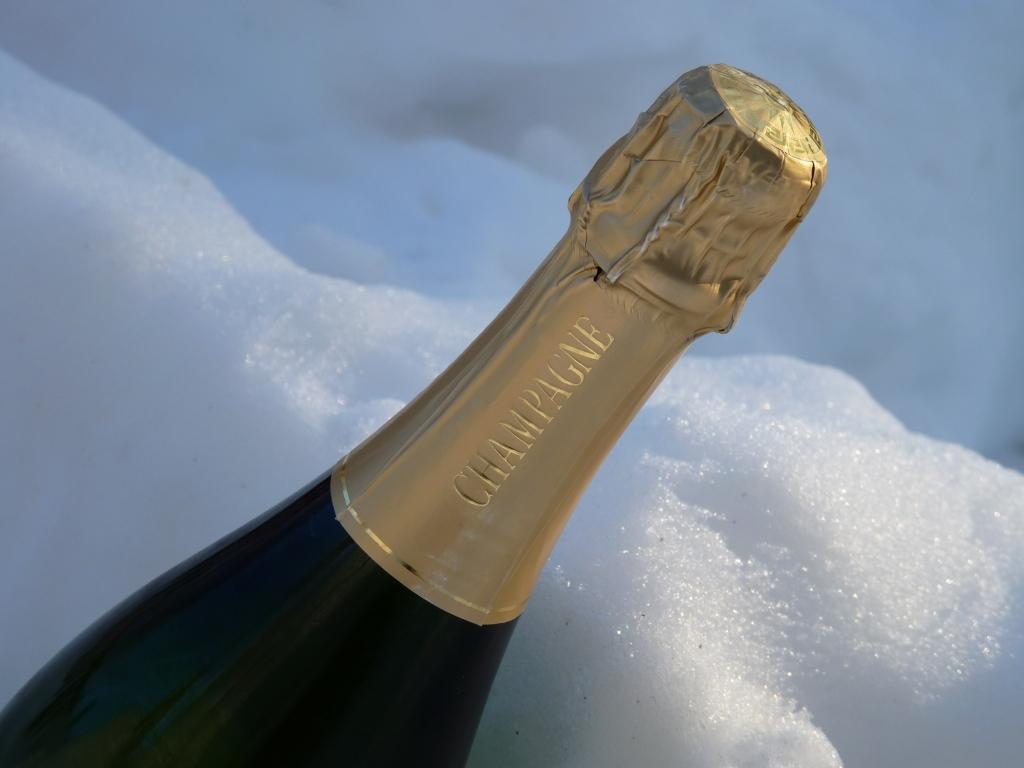 Champagne! Of course, Champagne. No celebration is complete without the toast of “bubbly” – New Year’s arrival, wedding anniversary, winning of the Grand Prix, christening of a new ship, and many other occasions, big and small are acknowledged with Champagne.
Champagne is a very interesting subject in general, but even more so when New Year’s arrival is around the corner. You can find articles and blog posts about Champagne everywhere – here is a good example, post by Dr. Vino. Well, let’s join the conversation about Champagne.
Champagne is a wine which belongs to the group of so called “sparkling wines” – the wines with many tiny bubbles (there are at least 49 million bubbles in a bottle of champagne – feel free to count yourself if you don’t believe it). As many other things in life, discovery of Champagne is a combination of accident and luck – on a very primitive level, not fully fermented bottle of wine was frozen, then temperature rose, fermentation restarted (this time, in a bottle) – voila, you got a bottle of Champagne.
Well, small clarification will be appropriate – Champagne is both a wine and a place – in France, of course, where else. Are Champagne and Sparkling wine synonyms? No. Any Champagne is Sparkling wine, but not any sparkling wine is Champagne. Only sparkling wines produced in Champagne region in France using so called méthode champenoise can be called Champagne. All other sparkling wines produced outside of the Champagne region, even using the same method, can only be called Sparkling Wine.
Let’s play a little game which we will call “what is in the name”. Champagne only comes from Champagne, what about about other sparkling wines? Today sparkling wines produced everywhere, from wide variety of grapes and at ever increasing pace. Only this year I had sparkling Malbec (very good) and sparkling Shiraz (don’t do it). In United States sparkling wines are produced in California (lot’s of good wines), Oregon, New Mexico (surprisingly good), New York and many other states. Traveling through the world, a lot of sparkling wines have their own names. Let’s see if you will recognize some of them:
Prosecco – sparkling wine from Italy
Sekt – sparkling wine from Germany
Cava – sparkling wine from Spain
Cremant – sparkling wine from France (Cremant d’Alsace, Cremant de Bourgogne, Cremant de Loire, Cremant du Jura and many others)
Blanquette de Limoux – comes from Limoux in Languedoc, France with the claim of being the first Sparkling Wine, before Champagne became Champagne.
Champagne is endless subject – no way to cover it in the short blog post. Let’s stop our world tour right here, and let’s talk about the celebration “at hands” – New Year 2011. What bottle are you going to open to celebrate arrival of the New Year? How about a little dream? Again, you said? True, just a few days ago I wrote a post about the wines to dream of. Something was missing in that post, I think – and that “something” is … Champagne! There was no Champagne mentioned in that list. So we need to fix it. And if you need a Champagne to dream of, I have only one recommendation – Krug.
 If you wonder why I so focused on one and only one Champagne, I can tell you – I had a chance to try it, and I was blown away. At the PJ Wine Grand Tasting event in November 2009, Krug 1996 was served among others, no doubt excellent Champagnes (Veuve Clicquot Rose, Dom Perignon 2000, …). I made a mistake – pretty much fatal, as it appeared – to start tasting from the Krug 1996. I had vintage champagnes before, and never really appreciated them. Krug 1996 was something else – with richness of freshly baked bread, nutty and creamy, fine-tuned refreshing acidity, ultimately balanced – it was incredible. All the Champagnes in that tasting, with pedigree or not, literally tasted like water next to Krug 1996. Yes, this wine is expensive (about $300+, you can check the price here), but it worth every penny – and worth dreaming about. And if you need to expand your Champagne dream list, you can find a lot more recommendations here.
There are few days left before we will toast new hopes, new dreams, new desires with the New Year 2011. No matter what will be in your glass, I wish for your wildest dreams to become reality. Raise your glass To Life, and keep dreaming!
Tasting Series At Cost Less Wines – Part 1, Grown Up Champagne (Growers Champagne, It Is)
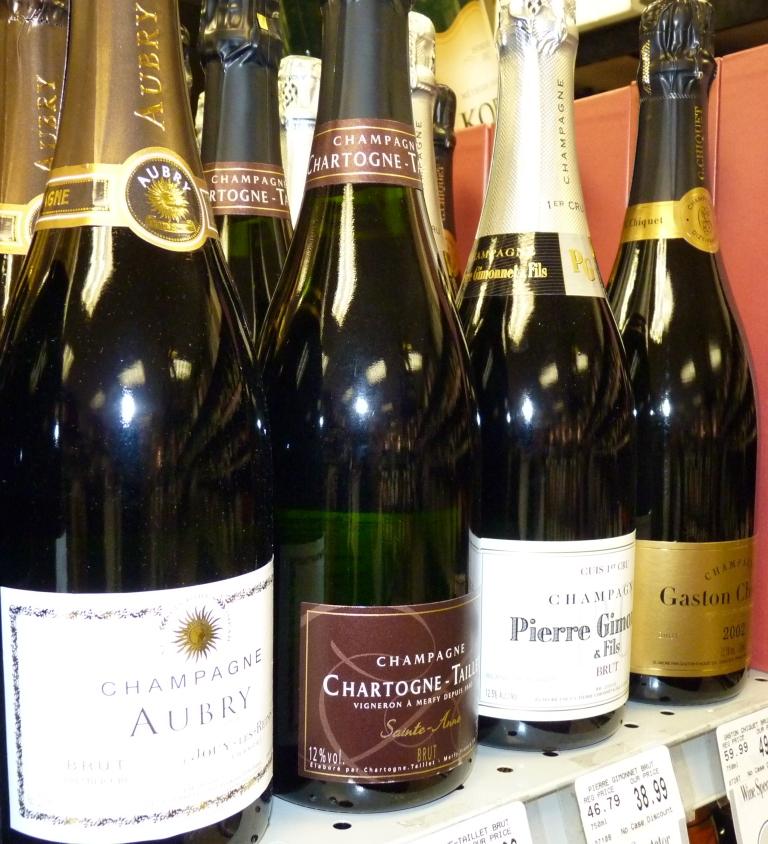 Holidays are great (hmmm, that’s a deep and original thought, huh). On one side, life gets really hectic – too many things to do, and not enough time. On another side, it is a special time, and people do special things. Wine is important part of any celebration, so holiday times are rich with great wine experiences. Particularly, starting from last Thursday, there were different wine tastings at Cost Less Wines in Stamford, which will continue until the end of this week. And if you are looking for special experiences – you don’t want to miss any of them (I know, it is Monday already – but better to start late than never!).
Thursday was a special day for the Champagnes. Indisputable king of any celebration, and ten times so for the New Year – Champagne requires no introduction. There are many many other similar wines, which are called “sparkling wines” as a group – but this is not the subject of this blog post, as it was not the subject of the wine tasting. Talking about Champagne, a number of familiar names comes to mind – Moët & Chandon (makers of famous Dom Pérignon), Louis Roederer (makers of Cristal), Taittinger, Veuve Clicquot – but we will not be talking about them here.
As wine overall is getting more popular in US, year after year, more of the interesting wines are becoming available here. In regards to Champagne, there is a growing phenomenon called Growers Champagne. All the Champagne names mentioned above belong to so called Champagne Houses. Champagne Houses do not grow their own grapes – they source their grapes from the whole Champagne region, and then blend the grapes to achieve particular taste profile, specific for each individual House. When it comes to the Growers Champagne, all the grapes are by the winery, which then makes the Champagne wine – only 5% of the grapes can come from outside to be eligible for “Growers Champagnes” designation. Growers Champagnes had being around from the beginning of actual commercial Champagnes, but only in the last 5 years or so, such wines became known in the United States. Before we talk about tasting, just one last note – you can recognize Growers Champagne by initials RM, which stands for Récoltant-Manipulant, which can be found on the label. Traditional Champagnes are typically designated as NM, Négociant-Manipulant. If you want to read more on the subject – wikipedia, as usual, provides great wealth of information.
Let’s talk about the tasting. There were 4 Growers Champagnes represented in the tasting: Chateau Aubry, Chateau Chartogne – Taillet Saint-Anne, Champagne Pierre Gimonnet & Fils and Champagne  Gastone Chiquet 2002. The first one, Chateau Aubry was a bit all over the place – yes, it was sparkling wine, but I didn’t get much pleasure out of it. The next 3 delivered different experience. Chateau Chartogne – Taillet had nice yeasty nose and aromas of brioche and fresh bread. Chateau Pierre Gimonnet had nice clean nose and good refreshing acidity – totally different ffrom the previous one, it was still warmly inviting and asking to take another sip.
The best in tasting, however, was Chateau Gaston Chiquet 2002, the only vintage champagne in this tasting. Light and effervescent, medium to full body wine, showing its pedigree with aromas and taste of apples and fresh bread – definitely very nice bubbly (should we also mention great QPR at $50/bottle?).
Great wines, great experience. It would be very interesting to compare the Growers Champagnes with the other sparkling wines – I’m sure you can see the the blind tasting working its way in here. But don’t wait for me – experiment, try something new – find the bottle of Growers Champagne and tell me if it will brighten your Holidays. And just to give you a hint – we are traveling from France to Scotland with the next post…
Last Bottle Sign Up ($10 credit)




 Talk-A-Vino
