Archive
Celebrate Pinot Noir!
And just like that, I almost missed International Pinot Noir Day, the celebration of one of the most popular red grapes in the world.
Pinot Noir is definitely one of the most popular, even though great Pinot Noirs are mainly limited to only four countries and regions – Burgundy, Oregon, New Zealand, and California – unlike Cabernet Sauvignon and Merlot, which definitely win the popularity contest worldwide, growing successfully absolutely everywhere. Of course, you have Pinot Nero from Italy, Spätburgunder from Germany, Blauburgunder from Austria, Pinot Noir from Australia, Chile, and Argentina, but those rarely take your breath away.

Most popular or not can be contested, but Pinot Noir without a doubt makes the most expensive wines in the world. You can check it for yourself using this “Most expensive wines” page but at the moment of writing (August 18, 2023), Domaine Leroy Musigny Grand Cru is listed by wine-searcher for $43,869 per bottle, which I believe is more than the whole index of the most expensive Cabernet Sauvignon wines on the same day. I really can’t tell if wine can be worth this much to someone to drink it, but hey, it is a free world.
Pinot Noir is definitely a big subject in this blog. I decided to check on some numbers to see how Pinot Noir would stand up against other grapes. In terms of overall mentions, Pinot Noir is the second red grape with 378 posts mentioning it (Cabernet Sauvignon is ahead by almost 100 with 477 posts mentioning it). However, when it comes to tags, Pinot Noir has the highest number of posts, 79, tagged with “pinot noir”, well ahead of any other grape. This is important simply because the tag is matching the content of the post, so at least 79 posts are dedicated to Pinot Noir.
This shouldn’t come as a surprise as Pinot Noir is one of the central subjects of this blog, starring in the series of the Oregon winemakers’ interviews called Stories of Passion and Pinot. The series contains more than 25 articles, highlighting the “passion for the finicky grape” as I typically like to present it through the series of conversations with winemakers who got bitten by the Pinot Noir bug and never looked back. Whether you like Oregon Pinot Noir or not, I still recommend that you would get a glass (or two, or three) of your favorite Pinot Noir ready and go read some stories.
While I love Pinot Noir, I do have one gripe – the price. You can find an amazing Rioja for under $20. You can definitely find a nice Grenache, Sangiovese, or Syrah in that price range. Heck, you might even get lucky with Cabernet Sauvignon or Bordeaux blend. But with the exception of Chile, there is literally no such thing as a drinkable Pinot Noir in the under $20 range. I can’t refer much to Burgundies, but anything tasty from New Zealand’s Central Otago or Marlboro is pushing $40, and all delicious Oregon Pinot Noirs now really sit north of $50. California might offer some exceptions, but I’m not aware of a drinkable sub-$20 California Pinot Noir. Not that I’m complaining here, just stating the obvious.
As today’s celebration caught me off guard, I didn’t have many options to choose from. I have a few random burgundies which I need to look for and think about, nothing from Oregon or New Zealand, leaving California as a primary hope. I remembered that I should have a California Pinot somewhere as it was recently gifted to me, so I was quickly able to locate the 2017 Etude Fiddlestix Vineyard Pinot Noir Santa Rita Hills (14.1% ABV).
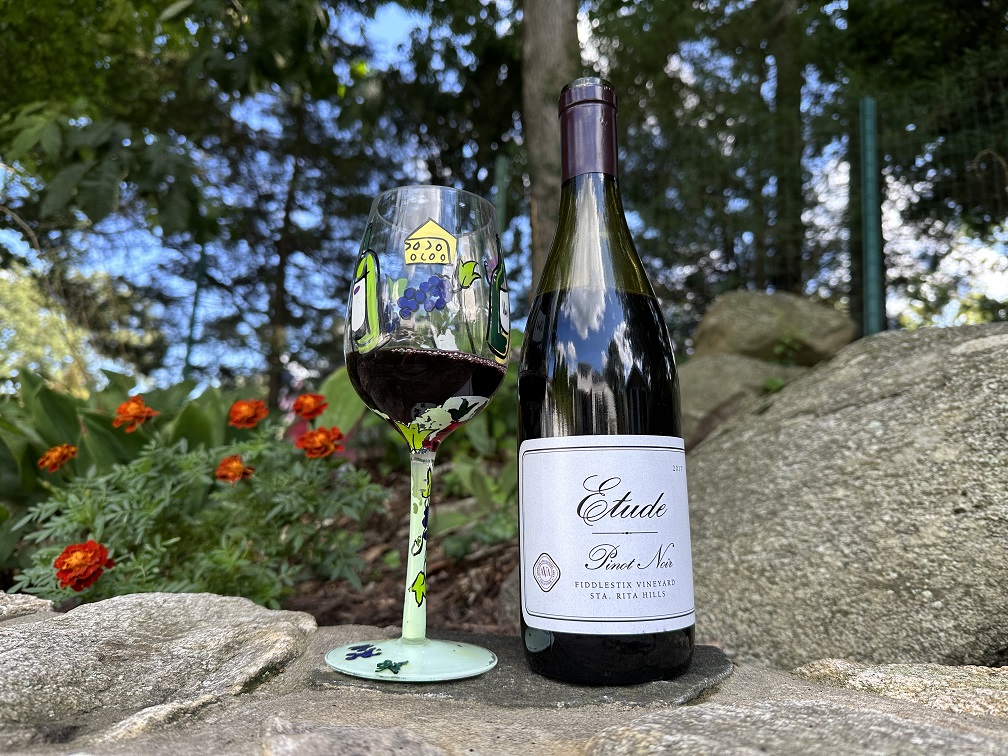
I know the name of the producer – Etude, but I don’t think I had tasted their wines before. Turns out this wine was a very appropriate choice for the Pinot Noir Day celebration, as Etude was founded in 1982 in Carneros in California in a quest to produce world-class Pinot Noir. I love this quote I found on Etude’s website from the founder and winemaker Tony Soter: “Pinot Noir is the most appropriate vehicle with which to study wine growing, precisely because of its demanding nature but also because of its delicacy and transparency. Make no mistake it is a humbling pursuit, but when it’s right, Pinot Noir is a glorious and moving thing. It is in the pursuit of that experience that we all work.” This is a perfect summary of the nature of Pinot Noir that also helps to explain what makes it so good when it is good. Etude produces more than 20 designation-specific Pinot Noir wines – they might be a perfect candidate for the Passion and Pinot series, even if the winery is located in California.
So how was the wine you might ask? In a word, delicious. Dark, unctuous fruit on the nose and the palate, a hint of vanilla, mocha and dark chocolate, nicely layered with perfect structural presence but not overpowering, perfect acidity and perfect balance. An excellent celebratory wine.
There you are, my friends. Another grape holiday just passed by. Hope you had an opportunity to celebrate, and if not – every day is a perfect day to have a glass of Pinot Noir. Until the next time – cheers!
Celebrate Pinot Noir!
Celebrate Pinot Noir!
Another grape holiday is upon us. This time we celebrate none less than Pinot Noir.
None less, huh? Is Pinot Noir so unique and special? Well, you be the judge.
Pinot Noir is the grape behind the world’s most expensive wines. While there are 10 or so major red grapes (Cabernet Sauvignon, Cabernet Franc, Merlot, Pinot Noir, Sangiovese, Tempranillo, Syrah, Grenache, Zinfandel, Nebbiolo), the ultimate supremacy crown can only be decided between Pinot Noir and Cabernet Sauvignon. Yes, it is bad to use money as a measure of influence, but it is one of the “objective” characteristics of wine in the free market. According to the Wine-Searcher lists of most expensive wines (by the way, there is a new feature on this blog – a new page Most Expensive Wines allows you to see always current list of most expensive wines for a select number of grapes and regions), red Burgundies (made out of 100% Pinot Noir) on average are 12 times (!) more expensive than Cabernet Sauvignon wines
Pinot Noir might be the most versatile red grape out there. Unlike most other red grapes, it produces a full range of wine styles. Let’s see.
White wine? Check. Pinot Noir Blanc is increasingly popular in Oregon and not only. Remember, the juice of Pinot Noir is clear, so it is not a problem to produce white Pinot Noir.
Sparkling wine? Triple check, I guess. Champagne Blanc de Noir is very often made from 100% Pinot Noir grapes and needs to introduction to wine lovers.
Rosé? Check. An increasingly popular addition to the repertoire of any Pinot Noir producer, in Oregon, California, and beyond.
Red wine? Well, duh. No check needed – first and foremost, Pinot Noir is a king of red wines.
Sweet/dessert? This is the only category that is still more an exception than the norm, but if you will look, you will have no problems finding late harvest Pinot Noir wines or Port-style Pinot Noir wines.
See – the whole range of wine styles. You can easily pair a whole dinner, from oysters to fish to steak and then dessert with Pinot Noir wines – try that with Cabernet.
One more unique fact about Pinot Noir is that it is practically never blended with any other grapes, with the exception of Champagne/sparkling wines. There can be lots of Pinot Noir clones mixed together – some of the producers grow 20 clones and more – but still, those are just clones. Of course, there are 100% Cabernet Sauvignon wines out there, but this is far from being the norm.
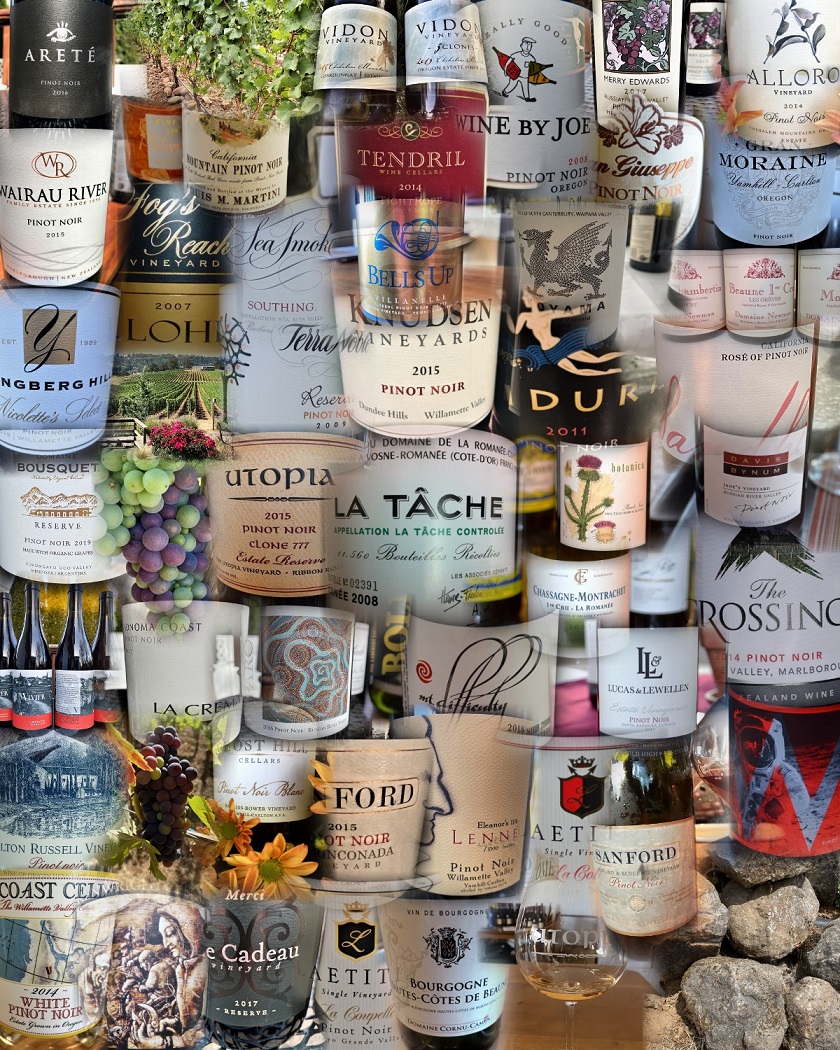
Pinot Noir is featured frequently on this very blog. As I was preparing this post, I decided to look at some statistics. It appears that Pinot Noir is the second most frequently mentioned red grape on the blog, with 356 posts related to the Pinot Noir (Cabernet Sauvignon is mentioned in 445 posts). It is interesting that Chardonnay is mentioned in the 357 posts, literally identical to Pinot Noir.
But it is not just the mentions – there are many memories associated with Pinot Noir.
I love saying that blind tasting is the best arbiter of the wines – in a blind tasting, it is just you and the liquid in the glass, nothing else influences your impression of the wine. It seems that our Pinot Noir blind tasting took place only yesterday – I was literally shocked to see that this post is 12 years old – the tasting took place in August of 2010. Who couldn’ve thought that 2008 Hamilton Russell Pinot Noir from South Africa would be our group’s favorite wine, beating grand cru Burgundy and cult Californian Pinot? I still have a bottle of that wine and I’m looking forward to experiencing the 12 years of evolution.
Another favorite Pinot Noir memory is the 1966 Louis M. Martini California Mountain Pinot Noir – an accidental $25 buy that ended up being a transcendental experience tasting the 48 years old wine from the Cabernet Sauvignon producer who is absolutely not known for the Pinot Noir wines.
And then there are lots and lots of memories of not only the wines but also of the people, passionate Pinot Noir winemakers, acquired through the work on the Stories of Passion and Pinot, an ongoing series of posts dedicated to Oregon Pinot Noir producers and Oregon Pinot Noir wines.
Did I prove my point? Is Pinot Noir the true King of Grapes? I don’t know. But for sure it is a grape worth celebrating. Cheers!
Last Bottle Sign Up ($10 credit)




 Talk-A-Vino