Weekly Wine Quiz #82: Grape Trivia – Gamay

Gamay grapes
Source: Wikipedia
The Wine Quiz series is not meant to intimidate. The whole idea here is to have fun and learn something new. When answering the questions, it is fully encouraged to use all available sources of information, including Google or any other search engines. There are no embarrassing answers – the most embarrassing thing is not giving it a try…
Welcome to the weekend and your new wine quiz!
We are continuing our grape trivia series, with the focus again on the red grapes, and today’s subject is Gamay, also called Gamay Noir, and fully officially a Gamay Noir à Jus Blanc.
Gamay is a purple-skinned grape, taking its name from the village of Gamay, located south of Beaune in France. Gamay is considered to be a cross between Pinot Noir and ancient white grape called Gouais Blanc. First mentions of Gamay go all the way back to the 14th century, so it had being around for a while.
Gamay grapes have thin skin, and have a tendency to overproduce, creating the grapes with very high level of acidity and low sugar, which often results in the production of lightly colored and quite acidic wines. The overproduction and high acidity were the reasons for the Gamay being literally outlawed and pushed out of Burgundy by the royal rulers at the end of 14th century, to give way for much rounder Pinot Noir. As the result, Gamay mostly settled in Beaujolais area, where it became the major red grape variety. Gamay is used in Beaujolais to produce a wide range of wines, starting from the famous Beaujolais Nouveau, the wine produced within 6 weeks of the harvest – young, grape-y and quaffable, but usually not very exciting; and then going to the Cru Beaujolais ( there are 10 villages in Beaujolais, which have this status), which can be dense, concentrated and age-worthy.
In addition to Beaujolais, Gamay is also growing in Loire region, where it is often blended with other local grapes such as Cabernet Franc and Cot ( Malbec) and it is used to produce both red and Rosé wines. The Rosé from Loire are typically a lot fruitier than the ones from Provence. Gamay is also successfully grown in Switzerland, especially in the area around lake Geneva – it is often blended with Pinot Noir there. Outside of France, Gamay is planted in the number of regions, such as United States and Italy, but it doesn’t produce much of the well known wines. Interestingly enough, a world renowned wine writer and critic, Jancis Robinson, was raving about Gamay wines produced by Sorrenberg of Beechworth in north east Victoria, Australia – she mentioned that it might be “one of the most exciting Gamays I have ever tasted”.
And now, to the quiz!
Q1: Gamay is closely associated with every third Thursday in November. Can you explain why?
Q2: Carbonic maceration is an important method in production of wines made out of Gamay. Can you briefly explain what is carbonic maceration and how does it helps here?
Q3: Fill in the blanks: In Beaujolais, Fleuri is considered to produce the most ___ wine, and Moulin-à-Vent produces the most ___ wines.
Q4: Which one doesn’t belong and why:
a. Brouilly
b. Côte de Brouilly
c. Côte Chalonnaise
d. Juliénas
e. Régnié
Q5: True or False: Beaujolais Nouveau wines can be aged for a few years before consumption.
Good luck, enjoy the quiz and your weekend! Cheers!
Celebrate Tempranillo!
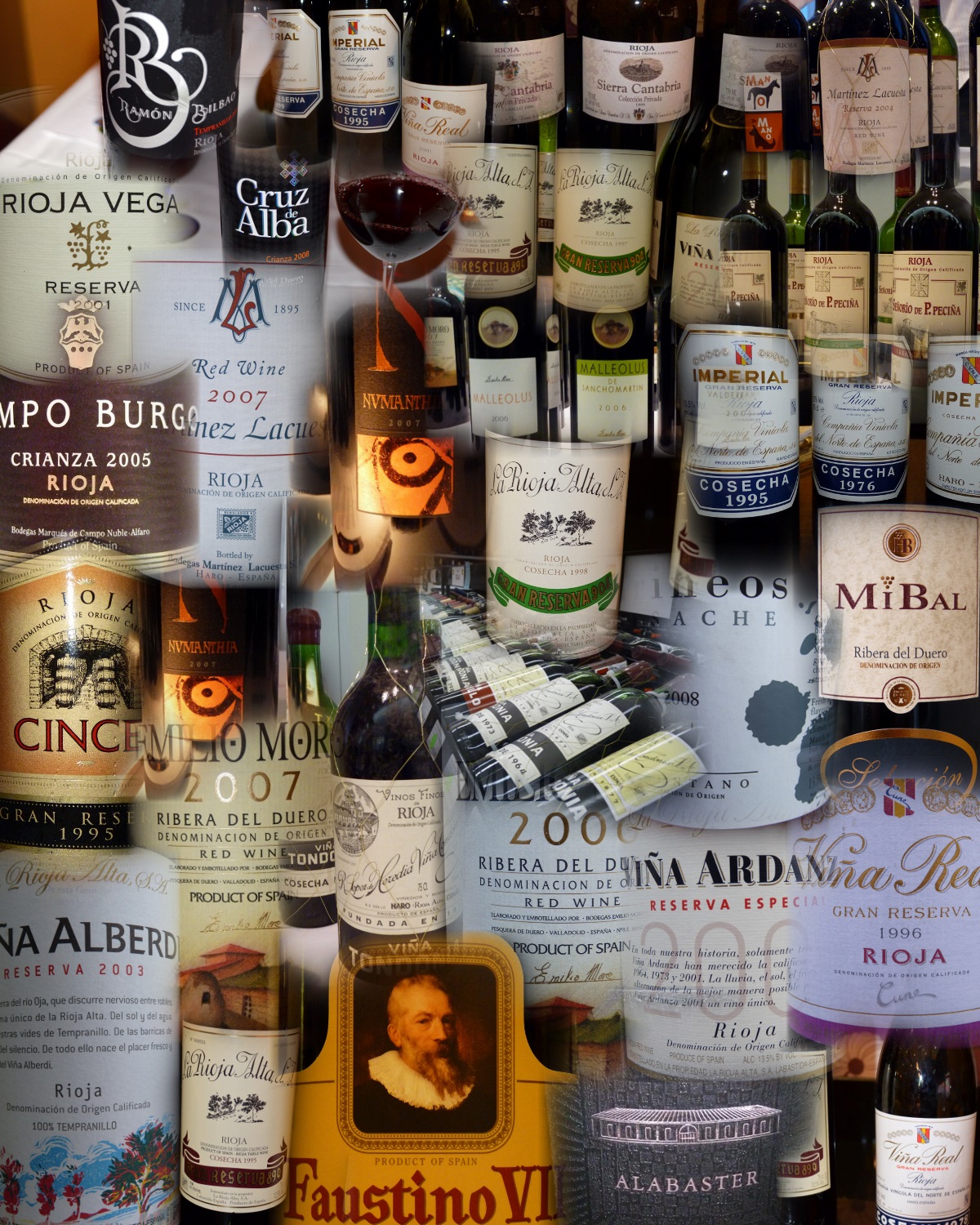 Today is an International Tempranillo Day 2013!
Tempranillo is an indigenous grape originated in Spain (by the way, do you know that Spain has the biggest area of grape plantings in the world?), with more than 2000 years of history. It is black, thick-skinned grape, capable of surviving temperature swings of Mediterranean climate, with very hot days and cool nights. Name Tempranillo comes from Spanish word temprano, which means “early”. Tempranillo typically ripens two weeks earlier compare to many other grapes. Tempranillo also one of the most widely planted red grapes in the world, with about 500,000 acres planted world-wide.
Tempranillo grapes are naturally low in acid and sugar content, so they often rely on blending partners to complement on both. Flavor profile of Tempranillo typically includes berries, leather (so famous in Rioja wines) and tobacco. Most famous Tempranillo wines come from Spain, from Rioja and Ribera del Duero regions, but Tempranillo is successfully growing in many other regions, including Portugal, California, Texas (up and coming star), South Africa, Australia and others. It is also interesting to note that Tempranillo is known under lots of different names (and as such, can throw some curve balls to The Wine Century club aficionados) – it is known in Spain as Tempranillo, Tinto Fino, Ull de Llebre, Tinto de Toro (this grape actually has clonal differences, similar to Sangiovese/Sangiovese Grosso), Cencibel and many others. It is known in Portugal as Tinta Roriz, Aragonez and Tinta Aragonez. But for the rest of the world it is simply known as Tempranillo.
So what is so great about Tempranillo? It has a few qualities which squarely set it on the line with the bets of the best in the wine world.
First, it has a great affinity for oak – Tempranillo wines can age and improve for the very long time in the oak barrels, and the resulting wine will pick up subtle nuances and complexity from that oak.
Tempranillo wines are very good at ageing. Best Tempranillo wines will rival best Bordeaux and Burgundy when it comes to improving with age and maintaining its youthful character. I have a first-hand account I can share with you – here is my experience with 1947 Rioja Imperial.
Last but absolutely not least in my book – Tempranillo wines are affordable! You can drink absolutely fabulous wines in the price range of $20 to $50, occasionally going into the $80+ – can you say the same about California Cabernet, or Burgundy, or Bordeaux? Not really… But with Tempranillo wines you do have this luxury. Of course there are Tempranillo wines which will cost $600+, but those are the exception, not the norm.
So what Tempranillo wines should you be drinking today, or any other day for that matter? I would love to give you a variety of recommendations, but come to think of it, I can only mention a few names coming strictly from Spain. There is nothing I can tell you about about Portuguese Tempranillo wines, as Tinta Roriz is typically blended with other grapes to produce Port. And while Tempranillo wines are made in Texas, California, Oregon, Washington and probably other states in US, most of those wines are available only at the wineries and rarely leave state limits.
But – when it comes to Tempranillo from Spain, I got favorites! Let me give you a few names of the producers – all the recommendations are personal, as I tasted many of their wines.
Rioja: La Rioja Alta, Bodegas Muga, Vina Real, Lopez de Heredia, Cune Imperial
Ribero del Duero: Emilio Moro, Vega Sicilia, Hasienda el Monsterio, Bodegas Alion
Toro: Teso La Monja, Numanthia
DO La Mancha: Bodegas Volver (one of the singularly best wines money can buy for around $15)
So I think it is the time to have a glass wine. Before we part let me leave you with a few interesting resources:
A vintage chart of Rioja wines, going all the way back to the 1925
A general vintage chart of Spanish wines, starting from 1992
A map of Spanish wine regions
And we are done here. Ahh, before I forget – Tempranillo Day now has a permanent spot in the calendar! It will be celebrated every second Thursday in November. Have a great Tempranillo Day and cheers!
Wednesday’s Meritage – Wine Quiz Answer, Tempranillo Day, Beaujolais Nouveau Coming Up, The Widow Who Reinvented Champagne, and more
 Meritage time!
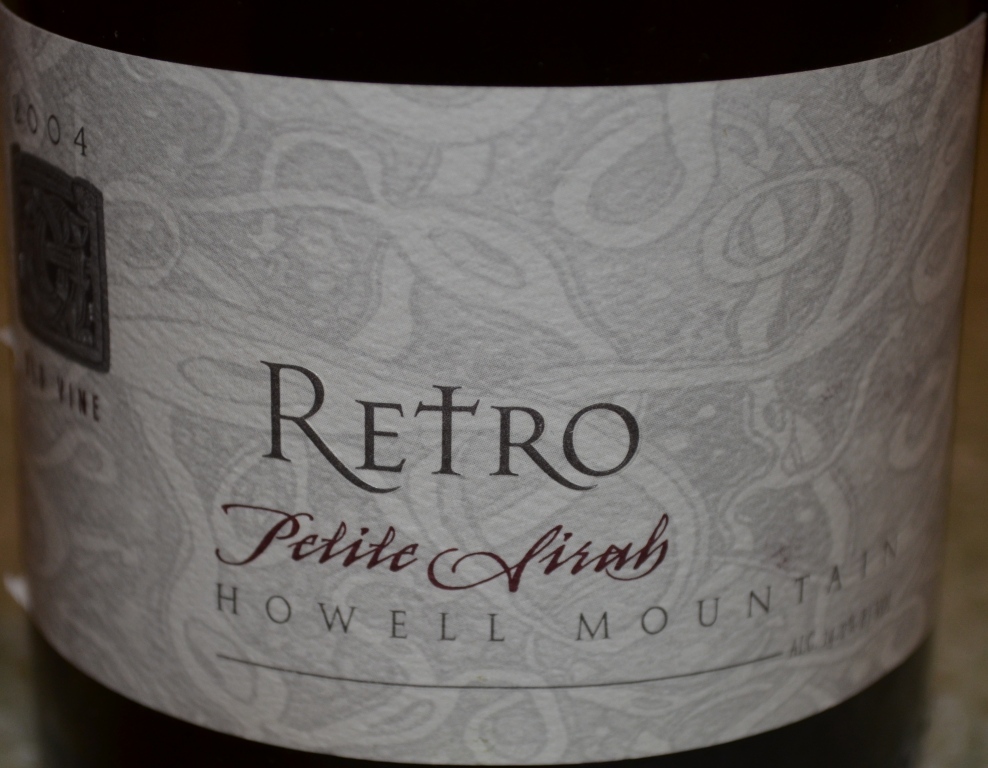
First, let’s start with the answer for the wine quiz #81, grape trivia – Petite Sirah.
In the quiz, you were supposed to answer 5 questions about a red grape called Petite Sirah. Here are the questions, now with the answers:
Q1: Name the grape: In California, Petite Sirah is a popular blending addition to ___?
A1: Zinfandel. You can find a small percentage of Petite Sirah (5% – 10%) in many Zinfandel bottlings
Q2: When it comes to the wines in the United States, there is an interesting similarity between the Petite Sirah and Primitivo. Can you explain?
A2: The similarity comes from the fact that both Petite Sirah and Primitivo were the part of the same request to the TTB (government organization in charge of labeling), to allow the use of Durif interchangeably with Petite Sirah, and Zinfandel with Primitivo. It is interesting to note that contrary to the information in Wikipedia, which says that both requests were never resolved, it appears that Durif is officially recognized as a synonym to Petite Sirah, while Primitivo and Zinfandel are not – you can find the complete list of the approved names through the link to the list of approved grape names in this US government document.
Q3: Which one doesn’t belong and why:
a. Arizona, b. Illinois, c. New Mexico, d. New York, e. Texas
A3: d. New York – there is no Petite Sirah wines produced in New York (at least in the meaningful quantities).
Q4: In the bad, rainy growing season conditions in California, Petite Sirah can be a savior – can you explain why and how does it help?
A4: As the Petite Sirah is mildew resistant and provides supple tannins, color, and structure, in the bad years it can be added to Cabernet Sauvignon, Merlot, and other wines to improve the quality.
Q5: What love has to do with the Petite Sirah?
A5: “P.S. I Love You” is a consortium dedicated to the promotion of Petite Sirah wines.
Talking about the results, the drunken cyclist continues his winning streak, so he gets ( again) the prize of unlimited bragging rights. Well done!
Now, to the interesting stuff around the vine and the web!
First of all, tomorrow, November 14th, is an International Tempranillo Day! Tempranillo, the noble grape of Spain and Portugal, and the rising star of Texas is a source of many wonderful long-living wines, and it is definitely the grape worth celebrating. TAPAS, the society of producers and advocates of Tempranillo, lists a number of events celebrating the grape. But you don’t even need to go anywhere to celebrate the Tempranillo – just grab a bottle, maybe of Magnificent Rioja (but really, any Tempranillo wine will do), pour, smell, sip and enjoy!
Now, the next Thursday, November 21st, is the third Thursday in November. Do you know what it means? Yes, you are right – Beaujolais Nouveau! Every third Thursday in November, the young Beaujolais wine of the same year’s vintage, called Beaujolais Nouveau, is becoming available in all the wine stores around the world. It is not just the wine – Beaujolais Nouveau also means celebration and fun. Don’t forget to get the bottle and join the festivities!
I’m sure you know that classic Champagne with the yellow label on it – Veuve Cliquot, which would literally translate into a “widow Cliquot”. But do you know the role the Barbe-Nicole Cliquot Ponsardin, the actual person behind that label, played in pretty much enabling the whole Champagne industry to exist, and for the mere mortals to be able to afford a bottle of Champagne? Barbe-Nicole’s perseverance and her invention of the riddling were some of the key elements in making Champagne into what we readily enjoy today. Here is an article for you which is definitely worth reading – it is somewhat long but very fascinating and will be well worth your time. And you might even complement the reading with the glass of Champagne in your hand – it will be very appropriate.
The last piece I want to bring to your attention is Wine Spectator’s Top 100 wines of 2013 list, gradually exposed at the rate of a few wines per day at the Wine Spectator web site. There are various contests taking place right now to predict the Wine Spectator Wine of the Year 2013, including the one which Wine Spectator runs by itself. So far the Wines #10 – #7 had been revealed, and more wines will be announced every day finishing with the Wine of the Year on Friday, November 15th. The full top 100 list will be published on Monday, November 18th. Looking at the 4 of the top 10 announced so far, I can only say that I’m a bit surprised. One of the selection criteria for the Top 10 is affordability – with the wines #10 and #9 priced at $135, and wines #8 and #7 priced at $120, I feel like I missed the memo about a substantial increase in my salary, as those prices are definitely outside of the “affordable” realm, at least in my book. Also, as “availability” is another factor, highly allocated Quilceida Creek (wine #10) makes it also an interesting choice. I plan to come back to this subject next week when the full Top 100 list will be announced – but any of your comments meanwhile will be most welcome.
That’s all I have for you for today, folks. The glass is empty – but the refill is on its way. Until the next time – cheers!
Grand Simplicity – Gene & Georgetti Steakhouse in Chicago
Located in the River North District of downtown Chicago, Gene & Georgetti Steakhouse opened its doors in 1941. The restaurant had been open for 72 years – in such a dynamic culinary environment as Chicago, I think it really means something – very few restaurants survive for 6 month after they open, never mind the 72 years.
It is now became customary for me to check the reviews and opinions of the people prior to visiting the restaurant. All three sources I’m generally using (Yelp, TripAdvisor and Urbanspoon) had a consensus of 3.5 to 4 stars out of 5, based on 250+ reviews – this is solid enough in my book. Interestingly enough, recent reviews on Yelp were ranging from “Best steakhouse in the World” to “dated” and “How dare these people are to bring A-1 Steak sauce to my table”. Of course I had no choice but to find out by myself (ahh, it is such a hard work – eating in the restaurant, right? 🙂 )


As you walk through the door, you can see right away – this restaurant has a character. It is not trendy metal/leather/glass/wood type of place. Dark wooden paneling, classic red chairs, soft lighting.
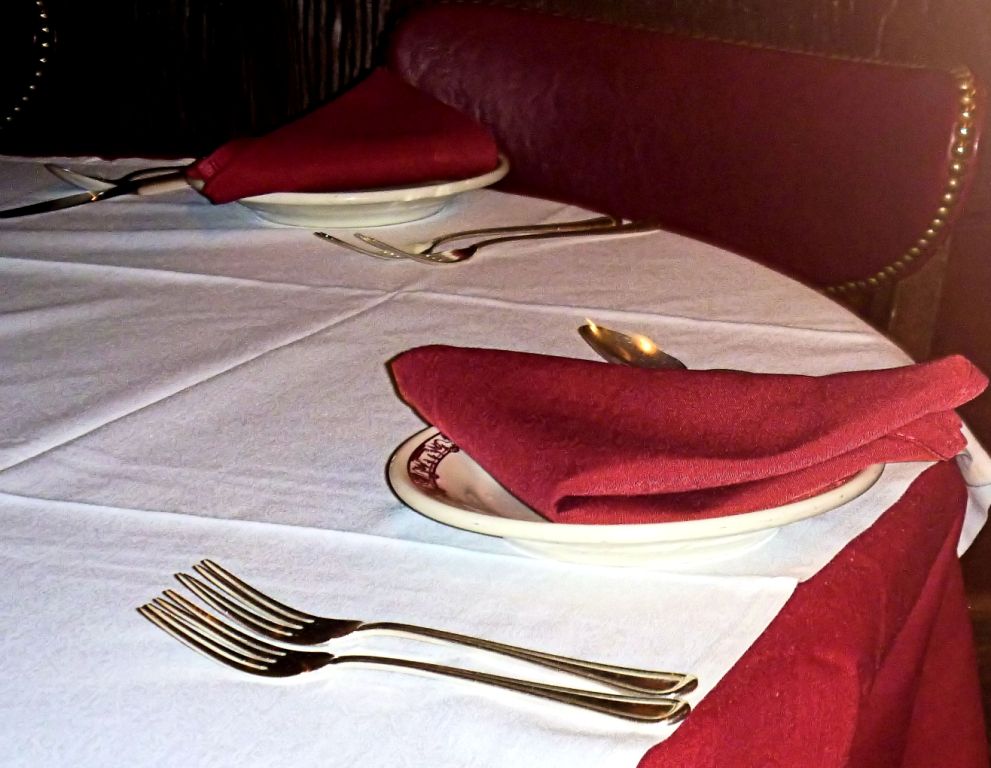 We were escorted to our table, and presented with the simple menu (two pages) and, of course, the wine list. As you know, wine is important to me, thus the content of the wine list is definitely of the high interest – both selection and prices. Gene & Georgetti’s wine list is mostly focused on California with some minor international presence – the selection is decent, and the prices are mostly okay. Yes, the selection can be a bit more diverse, and some of the prices can be also improved, but nevertheless, we were able to find a good bottle to drink with the dinner – 2010 Clos du Val Cabernet Sauvignon Napa Valley. At $64, this is about 2.5 times retail, which is definitely a reasonable price for that wine in rather an upscale restaurant.
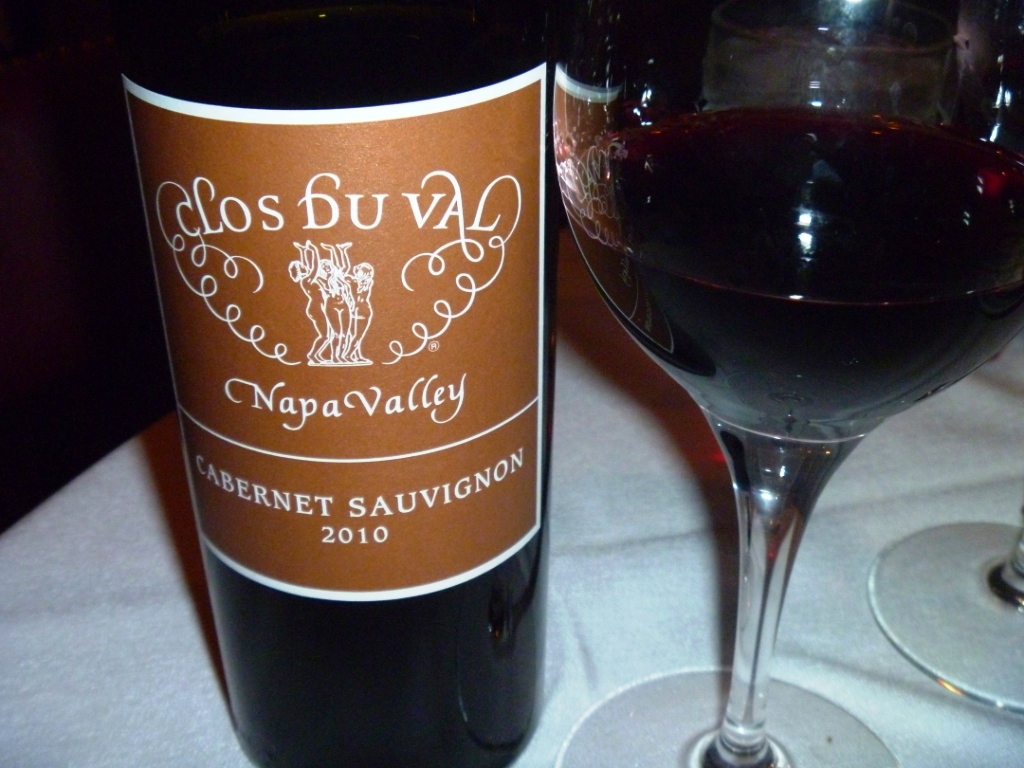
Clos du Val Cabernet Sauvignon
This 2010 Clos du Val Cabernet Sauvignon Napa Valley (13.5% ABV) had dark garnet color, inviting nose of red fruit. The wine needed a little bit of time to breathe in the glass, then it showed the typical cassis, a bit of chocolate and some plums on the palate, medium to full body, soft tannins, nice acidity and overall good balance – definitely worked well with our dinner.
The bread basket appeared first – a nice piece of baguette and the variety of bread sticks – all fresh, with very tasty crust, just “hard enough”.

Bread! (sorry, we ate a lot before I took a picture)
We started with the Fried Ravioli appetizer, which was served with the meat sauce:

Fried Ravioli with Meat Sauce
Simple, perfectly fried, very tasty and comfortable – making you literally feel like you are having a home-made meal, just at your family dinner table.
Next was the salad – fresh, crunchy iceberg lettuce with the Beefsteak tomato. I don’t know where the restaurant gets their tomatoes from – but this was probably single best piece of tomato I had in many years – absolutely perfect, fleshy, juicy and outright delicious.
For the dinner, which is served somewhat of a “family style” – with the sides to share – I ordered bone-in filet mignon (you don’t see those on every menu), and my dining companion went for the T-bone. We had sides of fries and grilled asparagus. I asked my steak to be made medium-rare plus – and so it was, with reddish center, perfect crust on outside, good till the last bite. I like also the way this beautiful hulk of meat was served – by itself on the plate, no sauce, no sides, no nothing – just a perfection, a grand simplicity of the great piece of meat. The potatoes looked and tasted as the real home fries – this is how I remember my dad would make home fried potatoes, many many years ago. This was definitely one great meal.
Try to guess – did we have dessert or not? Yes, good guess – you saw the size of that piece of meat – dessert was completely out of consideration.
The important thing to mention – service. The service was one of the best – very attentive but not overly intrusive. The dirty plates were picked up as soon as they were available, clean utensils showed up just in time – it was the work of many people, perfectly orchestrated.
There you have it – our experience at Gene & Georgetti. This is definitely a restaurant which is unique and different – the ambiance, the food, the service. If Chicago is in your plans, and you like good piece of meat – the address is below, measure it up for yourself. Cheers!
Gene & Georgetti Restaurant
500 N Franklin St
Chicago, IL 60610
Phone: (312) 527-3718

Indifferent, Okay and Spectacular
Over the last few days, I had a few of the “accidental tastings”, which I would like to share with you. Oh yes, and if you are wondering about the title of this post – read on.
It is not the wine we will be talking about today – instead, it is the other type of “liquid pleasures”. Well, actually, not even one”type”, but a few – Tequila, Scotch and Whiskey!
I have to admit, I don’t drink tequila all that often. When I do drink it, I don’t do shots (as I don’t see a point of pleasure in a quick gulp of an alcohol) – as wine, scotch or cognac, I like to sip and enjoy it slowly.
Tequila DeLeón is definitely not something to look at lightly. I would say that in the overall image presentation, starting from the bottle itself (take a look below – that top is so heavy, it can be literally used as a weapon), to the web site and all the marketing materials, Tequila DeLeón is an attempt to bring out the tequila, shall we say it, of Rémy Martin’s level, and not just any Rémy Martin, but all the way to the top – Louis XIII de Rémy Martin.
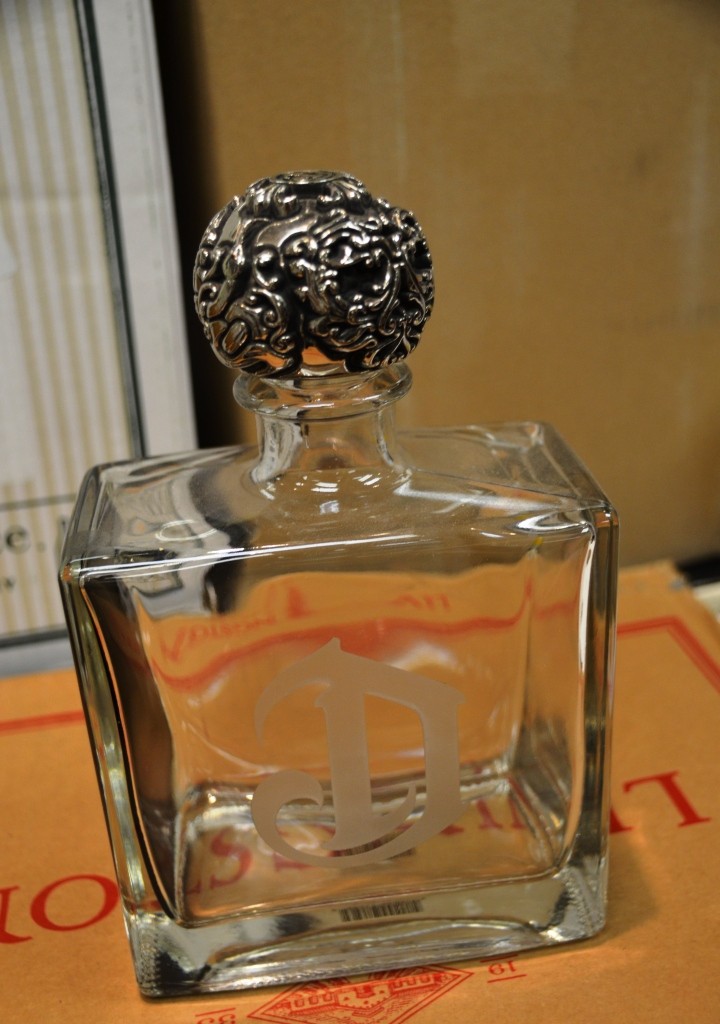
Tequila DeLeón bottle
I had an opportunity to taste through the full line of Tequila DeLeón, starting from the tequila blanco, which is unpretentiously called Diamante, to the Louis XIII-like Leóna. Below is the complete list with the descriptions and suggested retail prices (sorry for the quality of the picture, but I hope you will be able to see enough – or go to the web site for more info):
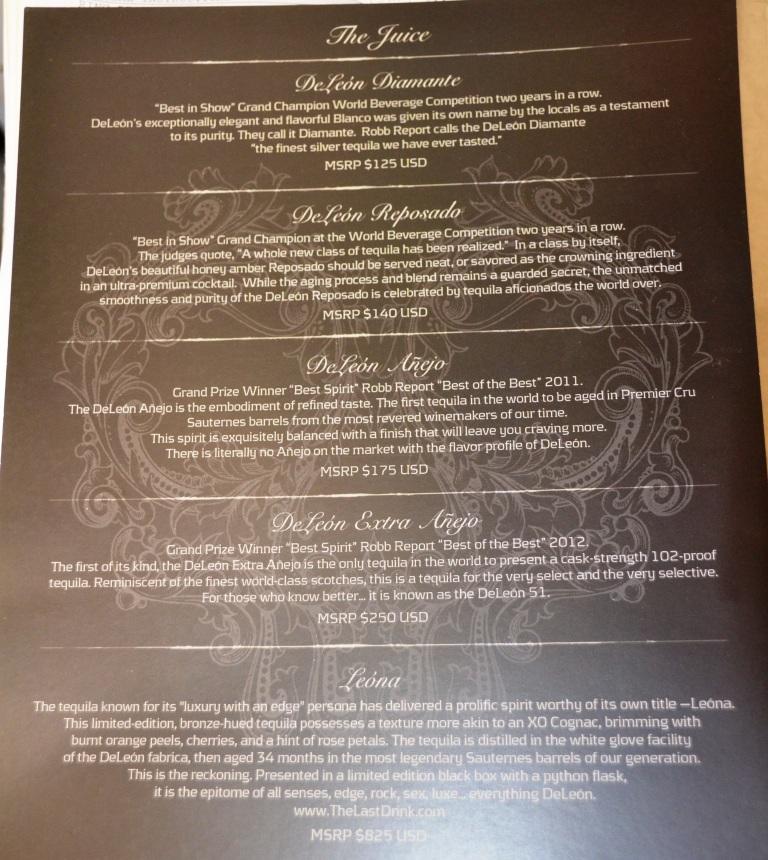
Tequila DeLeón The Juice line
Here are my notes:
DeLeón Diamante – touch of sweetness, the classic Agave notes of tequila are very muted, viscous mouthfeel.
DeLeón Riposado – nice herbal profile, had some lightness and touch of spiciness. One of my favorites.
DeLeón Añejo – mind you, this tequila is aged in the used Sauternes oak casks, and not just any Sauternes, but venerable d’Yquem. Interesting palate, but not smooth enough, some rough edges.
DeLeón Extra Añejo – very nice, excellent flavor profile, some spiciness, very good depth. Probably my favorite – which is not surprising, considering that it is compared with the Scotch in the official description.
DeLeón Leóna – this is simply overdone. It has a lot of oak. A LOT. Oak is the only thing I was able to taste.
Now, if we look at the prices, which are ranging from $125 for Diamante to $825 for Leóna, this is where Indifferent part of the post’s title comes into a play. I would gladly take Chinaco and Don Julio for the sipping tequila blanco any day (both are under $50), and I never tasted Añejo better than my favorite Tres Generaciones ( also under $50). I appreciate the art of the Tequila DeLeón, and yes, if you need to impress, go for it; meanwhile, I will have another sip of Chinaco.
So you know what left me indifferent. Now, for the Okay part, I tasted through a group of Scotches. Here they are:
MacPhail’s Collection Highland Park 8 years old – very nice! hint of smoke, perfect balance, touch of sweetness.
MacPhail’s Collection Glan Grant 10 years old – herbal notes, smooth, nice acidity, very good.
Mortlach 15 years old – nice and simple, but somewhat one-dimensional.
Old Pulteney 21 years old – nice, very complex, interesting nose, spicy profile – excellent overall.
Glenlivet 21 years old – okay, so it is a scotch, but it doesn’t do anything for me.
The Macallan 21 years old – least interesting of all. Just boring…
Based on the notes, you can probably see why this is just “okay”. But if you like Scotch, I would definitely recommend the Highland Park 8 and Old Pulteney 21 – those are worth seeking out.
And now, let’s talk about Spectacular. I was given to taste (blind) four different spirits, one by one, and the most I could say after each one was “wow”. They were one better than the other. Zak was looking at me patiently, waiting for me to guess what they were. The first one, I said, was a grappa. The second? Bourbon. The third? No idea – absolutely unusual profile. The fourth? May be a Rye? Then he put 4 bottles on the table, one by one. Here they are:
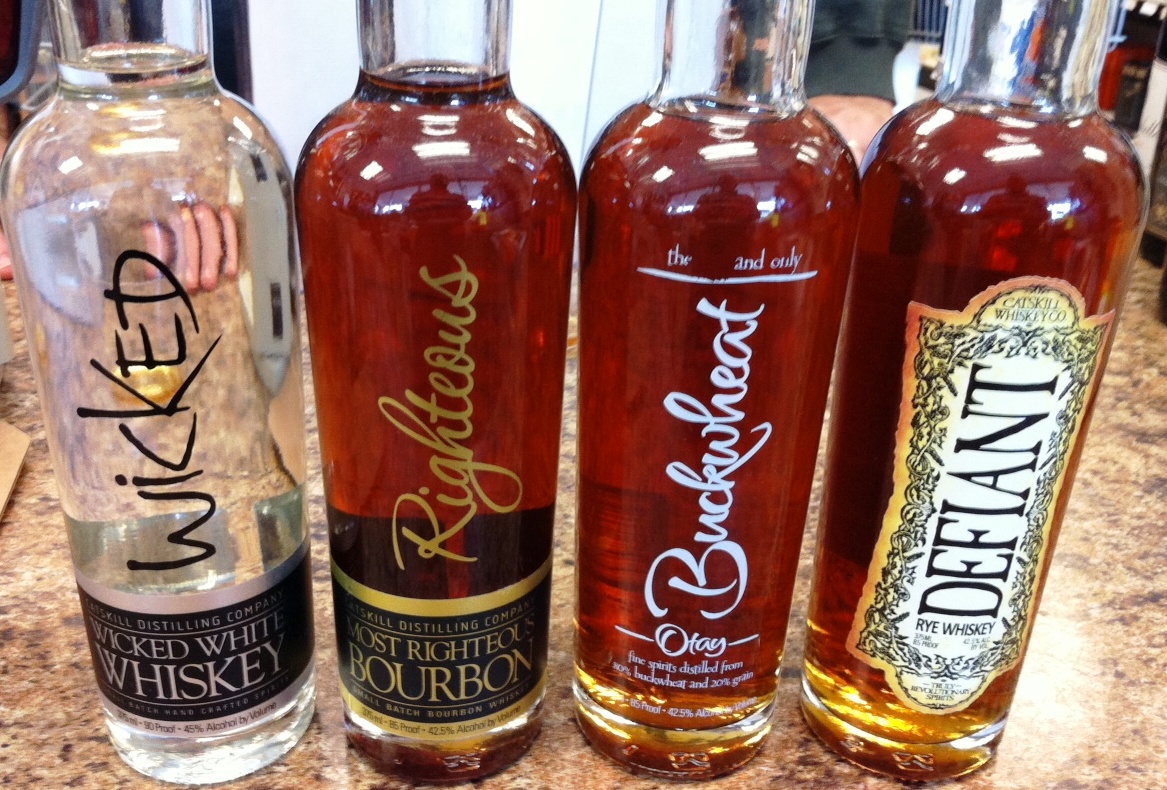
Catskill Distilling Company Spirits Collection
When I saw what they were, I had to say “wow” one more time. All of the spirits were produced about 90 miles away from my house, in the town of Bethel, New York . It is amazing how far the local New York producers went. You probably read my rave review of Hudson Distillery – I will definitely make an effort to visit Catskill Distilling Company when I will have a chance. Here is what I tasted:
Wicked White Whiskey – this is six-grain (corn, wheat, buckwheat, rye, smoked corn, malt), un-aged whiskey. Absolutely spectacular nose and flavor – complete impression of delicate single-grape grappa with round sweet fruit and all around delicious. You have to taste it to believe it.
Most Righteous Bourbon (70% corn, 20% rye, and 10% malt) – round, clean, caramel, butterscotch, all perfectly balanced together. One of the best bourbons I ever tasted.
One and only Buckwheat (80% buckwheat, 20% small grains) – unique and different. Nose is absolutely unusual, reminiscent of sun flower oil. Viscous, roll-of-your-tongue delicious concoction. Great complexity, another drink you have to taste to believe it.
Definat Rye – a very classic Rye, with a touch of sweetness, but otherwise dry palate, some spiciness and good acidity.
All four spirits are reasonably priced ( from $19 to $38) and definitely highly recommended.
There you have it, my friends – my story of indifferent, okay and spectacular. Enjoy the rest of your weekend and cheers!
Weekly Wine Quiz #81: Grape Trivia – Petite Sirah

Petite Sirah in Bloom. Source: Wikipedia
The Wine Quiz series is not meant to intimidate. The whole idea here is to have fun and learn something new. When answering the questions, it is fully encouraged to use all available sources of information, including Google or any other search engine. There are no embarrassing answers – the most embarrassing thing is not giving it a try…
Welcome to the weekend and your new wine quiz!
We are continuing our grape trivia series, with the focus again on the red grapes, and today’s subject is Petite Sirah.
Petite Sirah was created by the French botanist François Durif as a result of accidental cross-pollination between Syrah and little known Rhône varietal called Peloursin. To honor its creator, the grape was originally known under the name of Durif, but Petite Sirah happened to stick as a name, so it is a rarity to the see the name Durif on the bottle. While discovered in France, the grape is literally non-existent there, and it is growing primarily in United States, Australia and Israel, with the number of other countries starting to experiment with it.
Petite Sirah came to the United States at the end of the 19th century, but it is only recent that its popularity started to increase rapidly. Just to give you some numbers, in 2002 in California there were about 2,000 acres of Petite Sirah planted, and 62 producers made wine from it. In 2013, the plantings increased more than 4 times, to more than 9,000 acres, and about 1,000 producers joined the suite, bringing the total number of Petite Sirah producers in California to more than 1,060. At the same time, most of the Petite Sirah production is small, typically a few hundred cases, which explains why you see only a very limited number of Petite Sirah wines in the stores.
Petite Sirah (and the name Petite here relates to the size of the grapes) produces small dark-skinned berries, with very high skin to juice ratio, thus bringing a lot of tannins to the resulting wines. But it is not only tannins – Petite Sirah often shows quite an exuberant fruit, with blueberries and raspberries being in the forefront. One important feature of the Petite Sirah grapes is resistance to the mildew, which definitely helps, especially when it rains during the harvest. Petite Sirah is used both for blending and, increasingly, on its own, where it makes very concentrated, powerful and long-living wines, capable of ageing for a few decades or more.
And now, to the quiz!
Q1: Name the grape: In California, Petite Sirah is a popular blending addition to ___?
Q2: When it comes to the wines in the United States, there is an interesting similarity between the Petite Sirah and Primitivo. Can you explain?
Q3: Which one doesn’t belong and why:
a. Arizona
b. Illinois
c. New Mexico
d. New York
e. Texas
Q4: In the bad, rainy growing season conditions in California, Petite Sirah can be a savior – can you explain why and how does it help?
Q5: What love has to do with the Petite Sirah?
Good luck, enjoy the quiz and your weekend! Cheers!
Axial Vinos – Spanish Wine Intro
A while ago I got an email from the Axial Vinos marketing, informing me that two of the Spanish wines from Axial Vinos portfolio had been recently added to the Trader Joe’s wine selection. I was also asked if I would accept a sample of the wines. As you might now, I have a difficult relationship with the samples – I don’t actively solicit them, and I consider each request individually. To be entirely honest, I had less than a handful of requests for sending the samples, and so far I didn’t reject any. I don’t have a strong criteria for rejection, it would probably have to be something like a Crane Lake of Sutter Home, for me to say “no, thank you”, but nevertheless, that makes me feel better.
As the wines which were offered to me were Spanish wines, which are some of my favorites in the world, of course I said “yes, please”. A few weeks later, the wines arrived, and then I had an opportunity to taste them – and now I would like to share my impressions with you.
Before we get to the wines, a few words about Axial Vinos. It appears that Axial Vinos is an export company, which works with the wineries in different regions of Spain, where it sources all of their wines. Axial Vinos portfolio includes more than a dozen of different wineries, located in all the leading regions, such as Ribera Del Duero, La Rioja, Penedes and others.
Now, let’s talk about the wines. From the get go, I really liked the packaging:
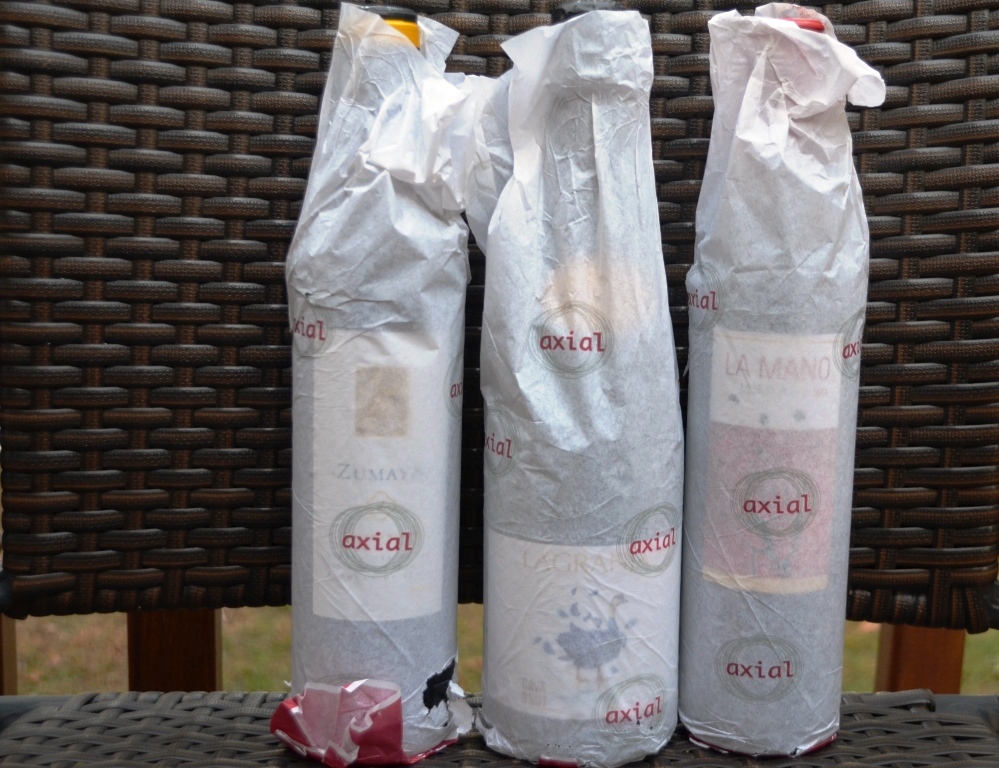
You know, this additional layer of paper, wrapped around the bottles, enhances an element of mystery. Wine in the bottle is always a mystery, this is what makes it such fun – you really don’t know what is there, behind the cork, so your imagination can run wild, simply based on all the visual cues – the shape of the bottle, the label, the capsule. Here you can’t clearly see even those details, so the mystery multiplies.
But of course the next step is to unwrap the bottles (and admire the labels):
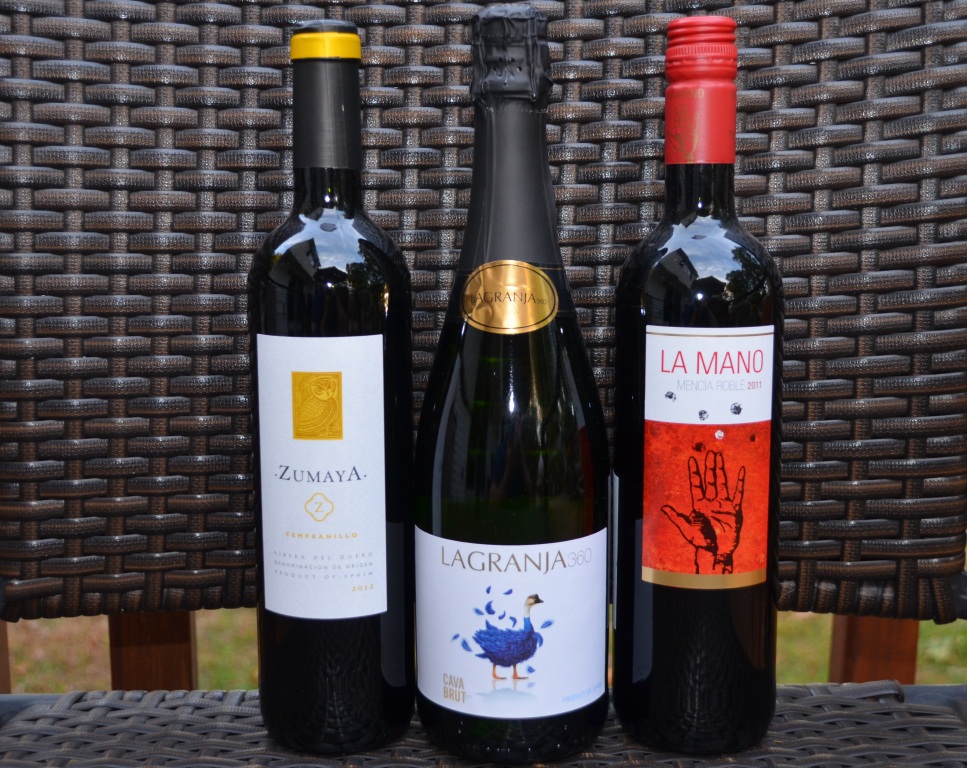 Okay, so we are done looking at the bottles, let’s talk about the content.
2012 Zumaya Tempranillo Ribera del Duero DO (13.5% ABV, 100% Tempranillo) – nice and simple, food friendly wine. Hint of dark fruit on the nose, some blackberries and espresso notes on the palate. Tannins are soft and light, good acidity, good balance. Easy to drink. Drinkability: 7
2011 LA MANO Mencía Roble Bierzo DO (13% ABV, 100% Mencía) – what I like about Mencía-based wines as a whole is energy. Somehow all the Mencía wines I tasted to the date have this universal bright and uplifting character. This wine had nice, freshly pressed juice on the nose with the prevailing aromas of the fresh cherries. Similar cherries/plum profile on the palate, simple, clean, medium body, round dark fruit, easy to drink. Drinkability: 7+
NV La Granja 360 Cava Brut (11.5% ABV, 70% Xarel-lo, 30% Parellada) – simple and elegant, perfectly refreshing, just a touch of sweetness, good acidity, very balanced overall. Drinkability: 8-
All in all, this 3 wines can serve as a perfect introduction into the wonderful world of Spanish wines. To all the lucky people who can buy their wines at Trader Joe’s (Trader Joe’s in Connecticut doesn’t sell wines, so I’m not one of them), I highly recommend not to miss on all these wines. Considering that the Turkey Day is coming, I believe all three wines will pair quite well with the Thanksgiving feast, and I’m sure you will not break the bank to get them. If you will try or have tried these wines already – let me know what do you think.
That’s all I have for you for today, folks. Enjoy your Friday – and the weekend is coming! Cheers!
Wednesday’s Meritage – Wine Quiz Answer, #MWWC5 Theme, Not Really [Wine Shortage], Australian Wine and more
 Meritage time!
First, let’s start with the answer for the wine quiz #80, grape trivia – Mourvèdre.
In the quiz, you were supposed to answer 5 questions about white grape called Mourvèdre. Here are the questions, now with the answers:
Q1: Name two grapes, most famous blending partners of Mourvèdre.
A1: Grenache and Syrah. GSM is the best known blend with M standing for Mourvèdre. The G stands for Grenache, and S is for Syrah (Shiraz).
Q2: Wine Spectator calls wines rated in 95-100 range Classic (the highest and the most prestigious category). True or False: there are no Mourvèdre-based wines rated in the Classic category
A2: False. A number of Domain Tempier wines from Bandol have 96 rating from the Wine Spectator.
Q3: Fill in the gaps: The oldest, continuously producing Mourvèdre vine is located at ___ Vineyard in ___, and it is about ___ years old.
A3: My answer: The oldest, continuously producing Mourvèdre vine is located at Hewitson Old Garden Vineyard in Barossa, Australia, and it is about 160 years old – here is my source of info. Of course I understand the “the oldest” claims are tough to prove – I’m sure few other producers claim the same. But the age (160) and general location (Barossa, Australia) seems to be generally correct.
Q4: Explain potential origins for all three names of the grape – Mourvèdre, Mataró and Monastrell
A4: Let me actually quote my answer directly from this source: Mourvèdre “first became established in Cataluña where it took on the names Mourvèdre (after Muviedro, the Moorish name for the city of Sagunto, near Valencia) and Mataró (after Mataró in Cataluña). In Cataluña the grape was grown by monasteries, leading to the name Monastrell (from the Latin monasteriellu) in that region”.
Q5: True or False: France plantings of Mourvèdre far exceed the plantings in Spain (no tricks here – Mourvèdre and Monastrell are used interchangeably, you have to assume it is the same grape).
A5: False. Plantings of Mourvèdre in Spain are about 6 times of the plantings in France.
So today we have a grand winner, the drunken cyclist, who answered all 5 questions correctly. We also have a winner, the winegetter, who answered all 5 questions mostly correctly, with the slight discrepancy on the question 3 – but nevertheless, they both get the grand prize of unlimited bragging rights. I also want to acknowledge my blogging friend Patty P’s 2013 photo project who was answering the questions for the first time – she answered the first question correctly, and I really like her take on the question #4. Great job!
Now, to the interesting stuff around the vine and the web!
I have a few interesting things for you. First, congratulations to the winner of Monthly Wine Writing Challenge #4, Anthony Davies, who writes the blog Confessions of a Wine Geek. Anthony just announced a theme for #MWWC5, which is Feast (very timely, considering Thanksgiving in the US, where it is all mostly one giant feast). Here is the link to the blog post with all the rules.
Now, I’m sure you read or heard somewhere about impending wine shortage. As the wine is ever increasing in popularity and demand all over the world, you would imagine that the report from the good source, showing for how many millions of cases demand exceeds the supply, will be picked up all over the news. And it was. Only the thing is that the numbers are numbers – question is what you do with those numbers. So in case you panicked (or were just amused), I have a very good article for you to read – it is written by W. Blake Gray, and it explains in good detail that no, you don’t need to stock up on wineand you will still find the good bottle to drink at the price you will be willing to pay.
Next post I want to bring to your attention is about Australian wines. It is a pity that selection of the Australian wines in the wine stores is not anything it used to be, as Australia makes a lot of great wines. This article, written by Mike Veseth at The Wine Economist, is talking about the work Australian winemakers are doing to restore the image of the Australian wines and squarely put them back to the wine stores and the cellars around the world.
Last but not least for today is an interesting open letter written by Alder Yarrow of Vinography to the United Kingdom. Turns out that association of Wine and Spirits Wholesalers of America is offering its help to the good people of UK, suggesting that they know how to protect public from the dangers of unregulated wine market (oh, horrors, free commerce!), which seems to be of concern to the people in UK. In case you don’t know, it is the US wholesalers who you have to thank for monopolistic pricing and draconian shipping laws in many of the states, and overall inability of wine consumers to get the wines they want. So Alder’s open letter to the United Kingdom is definitely worth reading, it is hilarious – here is the link where you can find it.
That’s all I have for you for today, folks. The glass is empty – but refill is on its way. Until the next time – cheers!
Fall Colors – Stamford, 2013
This fall was so dry and warm – you can’t even think of comparing it with the fury of 2012. It is only now, over the last couple of weeks, the colors became amazing ( and it is November!). Don’t know what is the reason, but prevailing colors this fall are yellow and gold. Of course we have our fair share of red, but gold is the theme.
You can consider this a sequel to the post I did last year – and for no other reason, but for your viewing enjoyment, here are the Fall colors of 2013 – just by walking around my neighborhood. Enjoy and cheers!


Indian Cuisine Deep Dive, At Aladin Indian Bistro in Norwalk, CT
 Do you know what is curry? Well, may be you do, but it appears that I didn’t. To be more precise, I thought I knew – and I didn’t. Anyway, the explanation is coming down below – keep reading and looking at the pictures.
Aladin Indian Bistro located at the busy intersection in Norwalk, CT, literally around the corner from one of the best food stores in the area, Stew Leonard’s. Despite the busy intersection part, there is plenty parking in the back, which definitely helps. I don’t know about you, but when I’m thinking about going to the restaurant, parking is probably one of my very first concerns – I need to know if I will be circling around the busy street for half an hour or not, so again, I’m talking about important stuff here.
The Aladin’s interior is nicely appointed, with wood and leather, with enough space between the tables, and comfortable and inviting lighting.
 As we got situated at our table, the neverending array of food started to appear. First, it was Papadum, the thin crisp flatbreads, made out of yellow lentil flour right at the restaurant – very tasty on its own and with the sauces. By the way, as I consider this visit more of a personal learning of the Indian cuisine, I will include here the links to the relevant articles on Wikipedia – here is the one for Papadum. We were also served a trio of accompanying sauces – Mint sauce, Braun Tamarind sauce and Onion Vinegar relish – all worked very well with papadum.


Our first dish was Spiced Sea Bass Pakoda (Sea Bass Fritters. Chili Yogurt sauce) – tender pieces of fish, deep fried in a special batter. This dish was quite successful in texture and had very mild spicy profile. I also really liked the presentation. By the way, continuing our education here, Pakoda ( often spelled as Pakora) is the common name for the deep fried snack in India and other Asian countries – here is your link to Wikipedia to learn more.


Next dish was Artichoke-Scallion Pakoda (Roasted eggplant Tamarind aioli). Unfortunately, it was really dry and chewy – it looks pretty, though.

Artichoke-Scallion Pakoda
Ahh, almost forgot – of course we were drinking wine. The wine list at Aladin is small, but I found it to be quite appropriate for the type of cuisine the restaurant is serving. There is a good selection of the both light whites and reds, also the prices look quite reasonable. Overall we had 3 different wines during the course of a dinner. For the white, we had 2011 Chateau Ste. Michelle Saint M Riesling, Pfalz, Germany – very nice, simple, some honeydew notes on the palate, with a good amount of acidity and touch of sweetness, very refreshing – and most importantly, working quite well with practically all the dishes. Our first red was 2012 Gougenheim Malbec, Mendoza, Argentina – simple red, with some good acidity and light raspberries profile. Later on we switched to the 2012 900 Grapes Pinot Noir Marlborough, New Zealand – nice Pinot Noir profile, with some plump cherries both on the nose and the palate, may be a touch too sweet, but working well with the dishes.
Our dinner continued with the trio of Chicken Kebabs – done in three different styles, all pieces perfectly tender, moist and juicy. When I cook myself, I generally avoid chicken kebab, as I typically have a hard time trying not to dry it out. The kebab which we were served, was probably one of the very best I ever had.

Chicken Kebab
The next dish was probably one of the most favorite in the group – it is probably enough to say that we asked for the refill a couple of times. The dish was Karari Bhindi (Crispy okra with red onion, cilantro and green chili), as we called it a “crispy okra salad” – a perfect combination of spices and crunchy texture, very tasty.


Appearing next were a few dishes. Bagar Dal (yellow lentil flavored with cumin, curry leaves, fresh garlic and dry chili) was very tasty, and so was Rogan Josh Traditional (Goat with tomato curry with a hint of Yogurt):


Just to go on with our overall theme of learning, here is the link for Dal (a thick stew made out of dried legumes) and Rogan Josh – an aromatic lamb or goat-based stew. I don’t get to eat goat all that often, so it was an interesting experience and overall a very tasty dish.
Next up – Signature Lamb Dampak (tender Lamb cubes cooked in a sealed copper vessel) – this was a bit more familiar than the previous dish, very flavorful and aromatic, perfectly going over the jasmine rice, an excellent dish overall:


And then we had bread! Well, if you are familiar with the Indian cuisine, you know that I’m talking about Naan. It is generally served hot, and it is one of my very favorite types of bread you can get in the restaurant. It perfectly accompanies all of the stew-like dishes, and it literally melts in your mouth. We went through quite a few baskets of Naan, as you can never get enough of it.


Remember I asked you if you know what curry is? This was the question which Chef Roy, the Executive Chef and Owner of Aladin, asked us during one of his appearances:

Chef Roy talking to some of our dining crew
I felt that the question is probably not as straight-forward as it seemed, but nevertheless, my answer was “of course! it is a spice!”. Well, this is exactly where I was wrong. Curry is a way of cooking with multitude of spices, but not the spice on its own! There all sorts of curry spices, all widely used in the cooking throughout the Asia, and they often share some common ingredients, like coriander and cumin, but overall, all those curries are different depending on the country and the dish which they will be used for. Apparntly “curry spice” as a nomenclature, was created a few hundred years ago, to sell a common blend of spices to the Westerners, as Asian-style cooking was becoming popular in Europe. And again, I have to refer you to the Wikipedia if you want to learn more.
Just to share my personal learning with you, I also learned that coriander is a seed of… cilantro! I love cilantro in everything, and I use coriander quite often, especially when it comes to the Fall cooking (roasted butternut squash soup is one example) – but I had no idea they are related! Live and learn…
Anyway, there are still a few dishes worth mentioning. We had Tawa “Surf n Turf” (combination Tandoori kebab platter of meat and seafood), very tasty:


There were more dishes, but I honestly lost track at that point of what was what, so here are the pictures (but I remember that everything was tasty!):


And, of course, the desert! Traditional Rice Pudding, nice, creamy, may be a touch too sweet for my taste, but still very refreshing after such an extensive meal:

Rice Pudding
All in all, this was an excellent “deep dive” into the world of the Indian cuisine, very unique and different. And as usual, the last thing left to do is to thank Chef Roy and his staff for the excellent meal and great education. Cheers!
Disclaimer: I attended the dinner as a guest of management. All opinions are my own.
Aladin Indian Bistro
36 Westport Ave
Norwalk, CT 06851
Phone: (203) 939-9040

Last Bottle Sign Up ($10 credit)




 Talk-A-Vino