Archive
Wine = Art
 The title of this post is not misleading. I plan to talk about wine as an art form, which is the way I look at it. Why all of a sudden? Couple of articles, both great in its own right (I mentioned both in the Meritage post a week ago), prompted this blog post, despite my claim that I’m not going to enter this debate. I don’t know why is that, but I have a habit of saying “No” where deep inside, as soon as I finish my full and long “no” sentence I already know that, “oh it will be a yes”. Anyway, this blog post is not about me, it is about wine, so let’s get closer to the subject.
In case you didn’t have a chance to read those two articles, they were both on the beaten up (badly beaten up, I have to say) subject of cheap wines versus expensive wines. The first article, published in the Forbes magazine, provided a number of illustrations to the fact that…there are many factors affecting perceived taste of wine – temperature, label, feel of the moment, critics’ opinion, rating and many more (I’m not going to cite a full article here – it is well worth reading if you are into the wine world). I believe that one of the points of the article was to suggest that for the most of us, we can’t distinguish between cheap and expensive wines anyway, so why bother – drink any wine, be happy (I’m oversimplifying, I know).
Then Steve Heimoff took the subject close to his heart and went on to explain that there is a very big difference in taste between $15 and $150 bottles of Napa Valley Cabernet Sauvignon, that more expensive wine is always better than the cheap wine and that the the whole premise of Forbes article in Steve’s words is “man bites dog” attempt at a cheap publicity.
Let me take step aside and explain the meaning of the concept “wine = art”. When you are at home, take a look around you. I would make a safe assumption that for absolute majority of people, your home is decorated in one way or the other. You might have pictures and photos on the walls, statues big and small, flowers live and not, little (or big) mementos and many other things which surround our lives with only one purpose – to give us pleasure, set the mood or may be create lasting connections between time and memories. Taking pictures as the simplest example, they can be your kids’ pictures, copies of the works of the famous artists, works of the completely unknown artists or may be they are actual original paintings. Those pictures can be mass produced and acquired at the neighborhood convenience store for $4.99. But they also can be acquired after a long battle at the auction, where you had to put down $4.9 million to beat another guy and get that painting you always dreamed of.
Now, when was the last time you read an article telling you that you are not supposed to buy any works of art more expensive than $19.99, because you are not capable of understanding the difference between $19.99 and $199 pictures? Or when was the last time you read an article telling you that expensive painting is always better than cheap print? I can bet I’m giving you a very taxiing memory-combing exercise which will yield no results.
 So my question is – why wine is treated in any different way than any other works of art? Read (or talk) about the wines, read about vineyards and places, read about wine makers, grape growers, oenophiles, wine collectors – what do you get out of that reading or talking? Passion, obsession, emotions, feelings. We eat because we have to, but we drink wine because we want to, because of its ability to resonate with our beings, to create emotional response. This is my premise of “wine = art” statement. I believe that wine is a form of the renewable art, which also has a pretty unique advantage compare to a simple painting, for instance. Whatever you see on the painting will be exactly the same in 10 years or in 50 years. It will create different emotions on a different day, of course – but it will not change in principal. At the same time, even the simplest wine will change in the bottle. For better or worse, but it will change. Last weekend we shared a bottle of 1997 Toasted Head Cabernet Sauvignon/Syrah blend (probably $9.99 or less) – believe it or not, but this wine was outstanding – it evolved, it had beautiful fruit, great balance and nice finish. It was memorable, it solicited emotions, it created mental staples for that particular moment. If this is not art, I don’t know what is.
Where am I going with this? I don’t believe cheap versus expensive is a meaningful or useful argument for the wine world. Yes, there are many reasons for the wine to be expensive – best quality grapes with very low yield, state of the art facilities, manual processes, need for aging before release, market demand, reputation and many many other factors define the price and can drive it very high up. But if you will exclude snobbery, arrogance and blissful ignorance, price is simply one of many factors which affect your buying decision – nothing more and nothing less. Yes, $150 bottle will taste different than $15 – but can we say “better”? If someone is a Pinot Grigio drinker (and enjoys it very much), will you be able to prove to him or her that $150 Cabernet Sauvignon is really better that $15? I want to see that happening. When it comes to wine, “better” is a difficult category, as the definition of the best wine is 100% personal – the best wine is the one which tastes best to you. Yes, critics matter, ratings matter – but only as a reference, as food for thought.
Wow, did I bore you to death? I truly hope I didn’t – I think this post was brewing for a very long time, slowly ripening to the point of wanting to get out. These are my true feelings, this is how I see the wine world, and “wine = art” makes it so fascinating for me.
Is this arguable? Of course (comments section is down below and only a click away). I don’t pretend to possess the absolute truth – but “wine = art” makes me open a bottle of wine with hope and excitement. No matter what anyone said about that bottle, how much it costs or what the rating is – I hope you will enjoy it and I hope it will create a special memory, a special moment – just for you. Cheers!
Crus of Beaujolais, Year 2011
(this self-rant doesn’t belong to this blog post, but I have to let it out of the system. I don’t understand how this works – this post was supposed to be out more than a month ago – the event was great, and the content was very clear in my head – nevertheless, it took soooo long to actually write it. Sometimes, the road from the head to the paper medium is all so twisty, not straight at all. The things are not what they appear… But I think we can proceed now.)
 When you hear the word “Beaujolais”, what is the first thing which comes to mind? Beaujolais Noveau? Yes, me too. At the same time, Beaujolais is a large wine producing region, in area much bigger than Burgundy which it is technically considered to be a part of. And of course there is a lot more wine produced in the Beaujolais region than just a Beaujolais Noveau, a celebratory wine of a new vintage.
At the beginning of June, I was lucky enough to be invited for the tasting of the 2011 portfolio of wines of Georges Deboeuf. Georges Deboeuf is one of the largest and well-known wine merchants in France. He is credited with literally single-handily creating the Beaujolais Noveau phenomenon and often is called the “King of Beaujolais”. I also think that his success with Beaujolais Noveau, both wine and celebration of the new vintage with pleasant but very simple grapey wine, appearing in the stores all over the world always on the third Thursday in November, is also an enemy of serious Beaujolais wines, which can be absolutely fantastic – but this can be a subject for a whole different post, so let’s talk about the portfolio tasting of 2011 Georges Duboeuf Beaujolais wines.
 No, wait. Before we talk about the wines presented in the tasting, let’s take a quick look at Beaujolais wine region. Beaujolais region is located to the south of Burgundy. Red wines constitute absolute majority of wine production in Beaujolais, and Gamay is pretty much the only grape used in the production of that red wine (with small plantings of Pinot Noir been phased out little by little). White wines are produced from Chardonnay with Aligote been also allowed, but overall production of white wines is miniscule. Three levels of wines are produced in Beaujolais – Beaujolais, which allows usage of the grapes from the whole appellation – these wine should generally be avoided; Beaujolais-Villages, which are better quality wines, and so called Cru wines (top level). There are 10 Crus in Beaujolais – Brouilly, Côte de Brouilly, Chénas, Chiroubles, Fleurie, Juliénas, Morgon, Moulin-à-Vent, Régnié and Saint-Amour. In general, Beaujolais wines are considered simple and easy (and thus work well with wide variety of food), and also have lesser aging potential than, for instance, the wines of neighboring Burgundy (however aging is usually defined by the talent of winemaker more than anything else). Now that you know all the theory of the Beaujolais wines, let’s talk about tasting.
The tasting was organized by CRT/Tanaka and I would like to thank Caroline Helper (@ForgetBurgundy) for invitation. The tasting took place at DB Bistro Moderne in Manhattan, and it was split into two parts – self-guided tasting of 12 different newly released wines from Georges Duboeuf portfolio (some wines on the list were denoted as barrel samples, as they were just bottled a week before the event), following by organized lunch. Little bites of food were served during the self-guided tasting, and I had an opportunity to try a famous Daniel Burger (with foie gras inside!) – and it was absolutely delicious.
Here I will share with you my notes from the self-guided tasting – description of the lunch, where both Georges and Frank Duboeuf presented their wines, will make up a separate post (ahh, I hope it will not take me another month to write it!). Of course I can’t leave you with just notes, so you will also see some pictures.
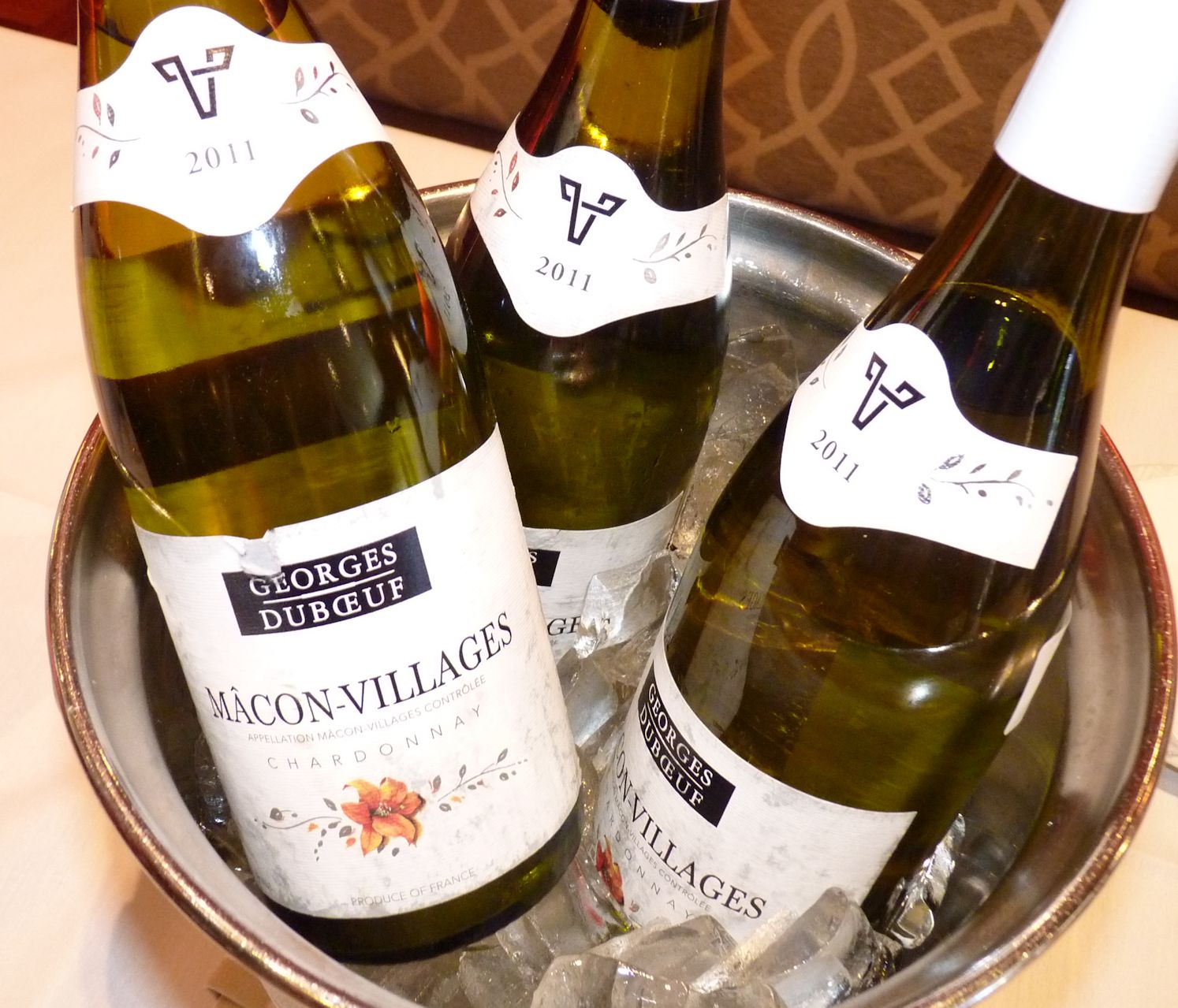
2010 Georges Duboeuf Macon-Villages, Maconnaise, France (100% Chardonnay, SRP: $12.99, 13% ABV) – Crisp acidity, interestingly nutty nose, hint of green apple, very mineral on the palate, with hint of limestone (Drinkability: 7)
2011 Georges Duboeuf Pouilly-Fuisse, Maconnais, France (100% Chardonnay, SRP: $19.99, 13% ABV) – green notes on the nose, lime zest, light, effervescent and crisp on the palate, with a hint of tropical fruit, very refreshing (Drinkability: 8- )
2011 Georges Duboeuf Beaujolais-Villages, Beaujolais, France (100% Gamay, SRP: $9.99, 12.5% ABV) – Fresh fruit nose, very tannic, more fruit and tannins on the palate, with tannins literally reaching Barolo levels. Needs time and may be different temperature (Drinkability: 6 at the moment, but this wine needs to be reassessed)
2011 Georges Duboeuf Chiroubles, Beaujolais, France (100% Gamay, SRP: $13.99, 13% ABV) – plums, acidity out of balance, tamed red fruit on the nose, tannins on the second taste (Drinkability: 6+)
2011 Georges Duboeuf Brouilly, Beaujolais, France (100% Gamay, SRP: $14.99, 13% ABV) – tart cherries on the nose and palate, more balance than the previous wine, but still lacking a bit (Drinkability: 7- )
2011 Georges Duboeuf Brouilly Chateau de Nervers, Beaujolais, France (100% Gamay, SRP: $15.99, 12.5% ABV) – closed, not balanced, all over the place – fruit, acidity, tannins are not harmonious (Drinkability: 6+)
2011 Georges Duboeuf Morgon, Beaujolais, France (100% Gamay, SRP: $14.99, 13% ABV) – very nice nose with open fruit, too dry on the palate, very tannic, needs more fruit (Drinkability: 7- )
2011 Georges Duboeuf Fleurie, Beaujolais, France (100% Gamay, SRP: $15.99, 13% ABV) – good fruit, ghood acidity, reasonably balanced (Drinkability: 7)

2011 Georges Duboeuf Fleurie Domaine des Quatre Vents Beaujolais, France (100% Gamay, SRP: $18.99, 13% ABV) – very nice! Round fruit on the nose and the palate, very good balance (Drinkability: 8- )
2011 Georges Duboeuf Julienas, Beaujolais, France (100% Gamay, SRP: $14.99, 13% ABV) – pleasant nose, good acidity, but fruit is closed (Drinkability: 7)
2011 Georges Duboeuf Moulin-a-Vent, Beaujolais, France (100% Gamay, SRP: $15.99, 13% ABV)- fresh fruit on the nose, lacks substance on the palate, needs more power – this wine is red like white (Drinkability: 7)
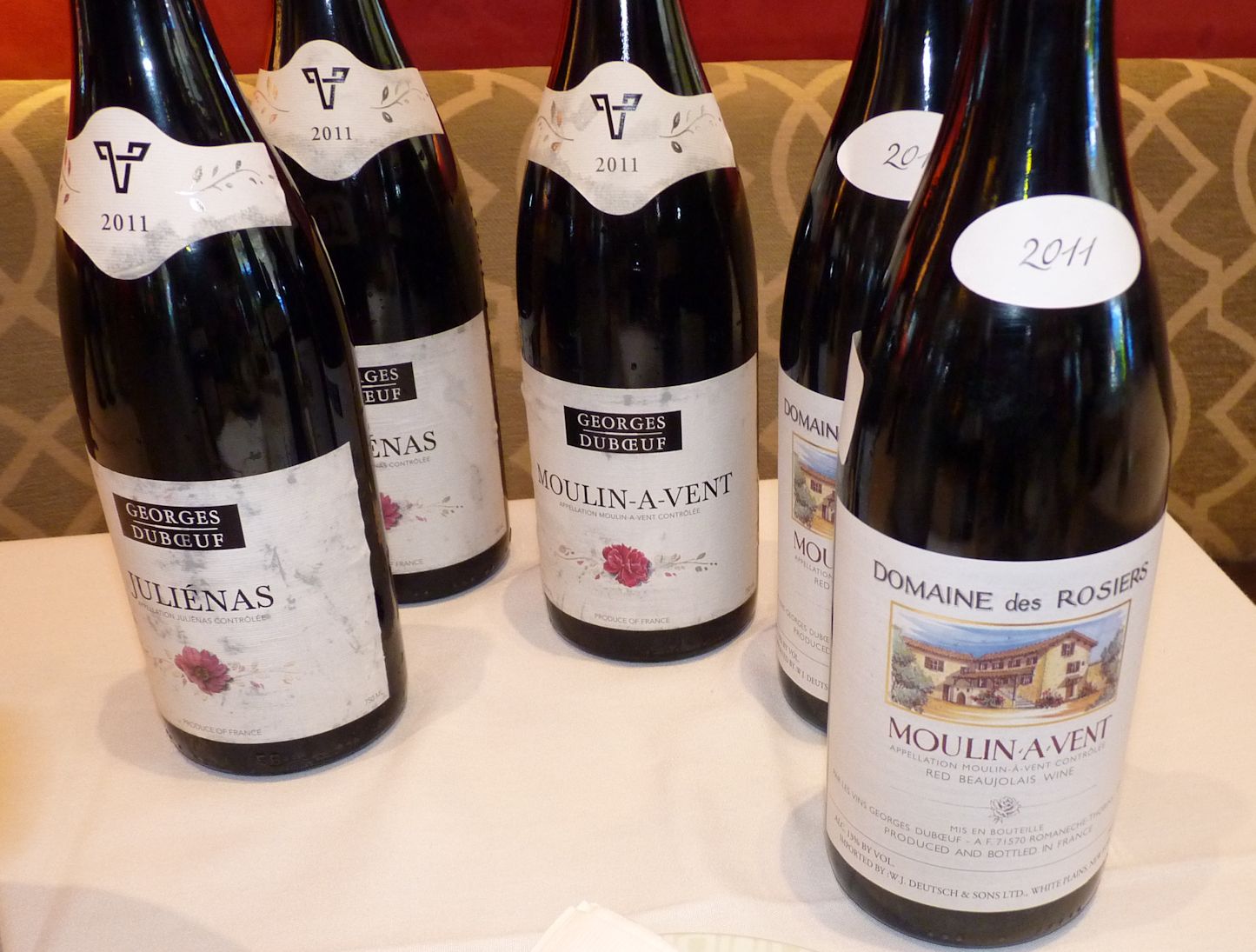
2011 Georges Duboeuf Moulin-a-Vent Domaine des Rosiers, Beaujolais, France (100% Gamay, SRP: $17.99, 13% ABV) – very nice, beautiful color, good fruit on the nose, hint of minerality and spices, good red fruit, plums and raspberries on the palate. Best of tasting. (Drinkability: 8- )
In the end of the day, all the wines were showing very well, and if you think about QPR, all the wines were great values. Make no mistake – some of these wines are in a very limited production (especially all the Domaine-denoted wines), so you will need to make an effort to find them. But – it worth the reward!
That’s all for my first part of the report, folks. Until the next time – cheers!
Father’s Day Escapades
 This Father’s Day was one of the best ever, so I decided to share with you some of the experiences – as you can imagine, mostly in the form of the pictures.
The day started with the cards from the kids – this is always a great beginning. Then the weather gradually changed from overcast to a beautiful clear sunny day with just the right temperature (don’t know what is your idea of a great summer temperature, but for me 75F and a light breeze is almost ideal). From there on, there was great food, great wine and … some interesting new experiences.
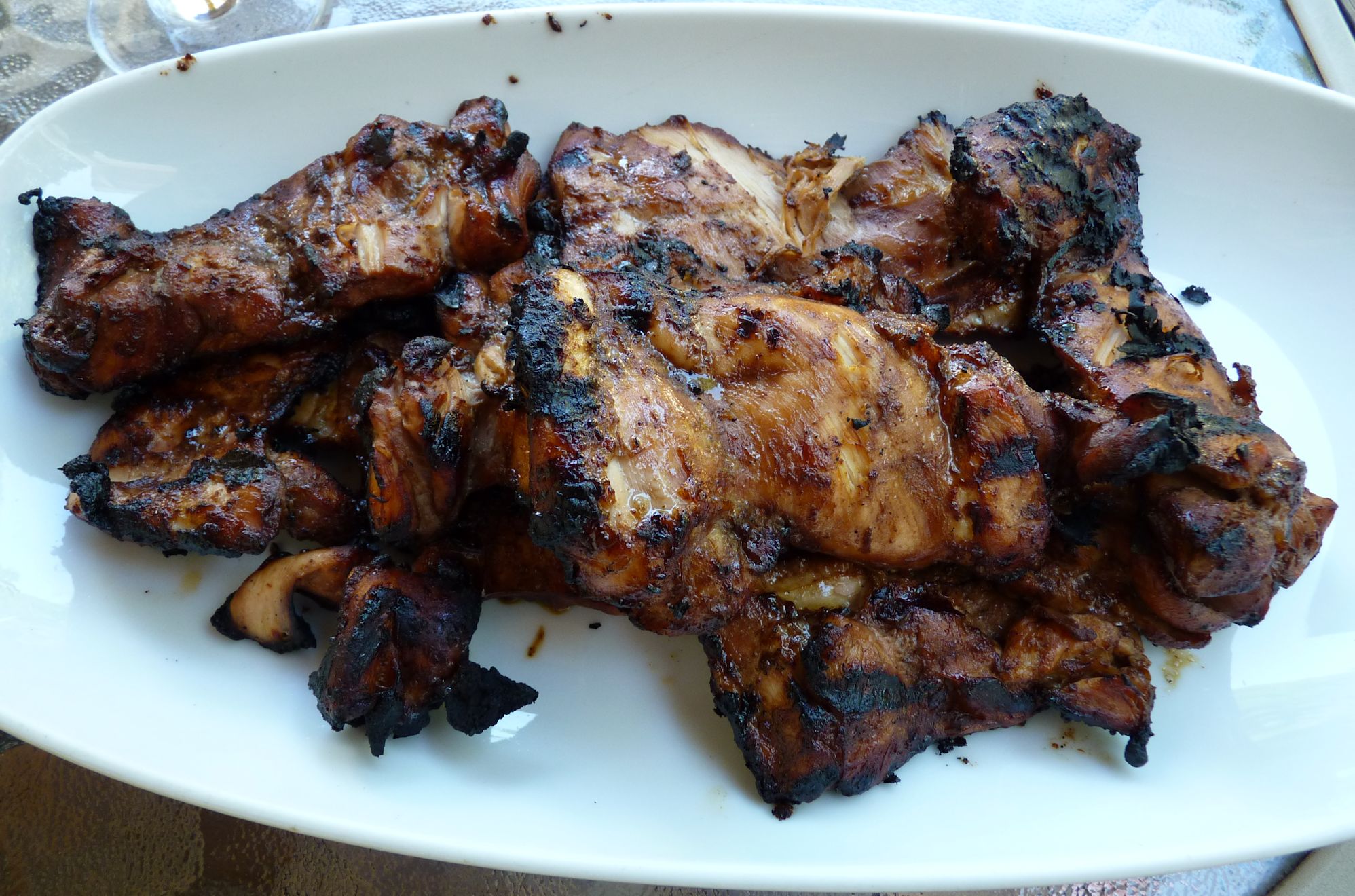
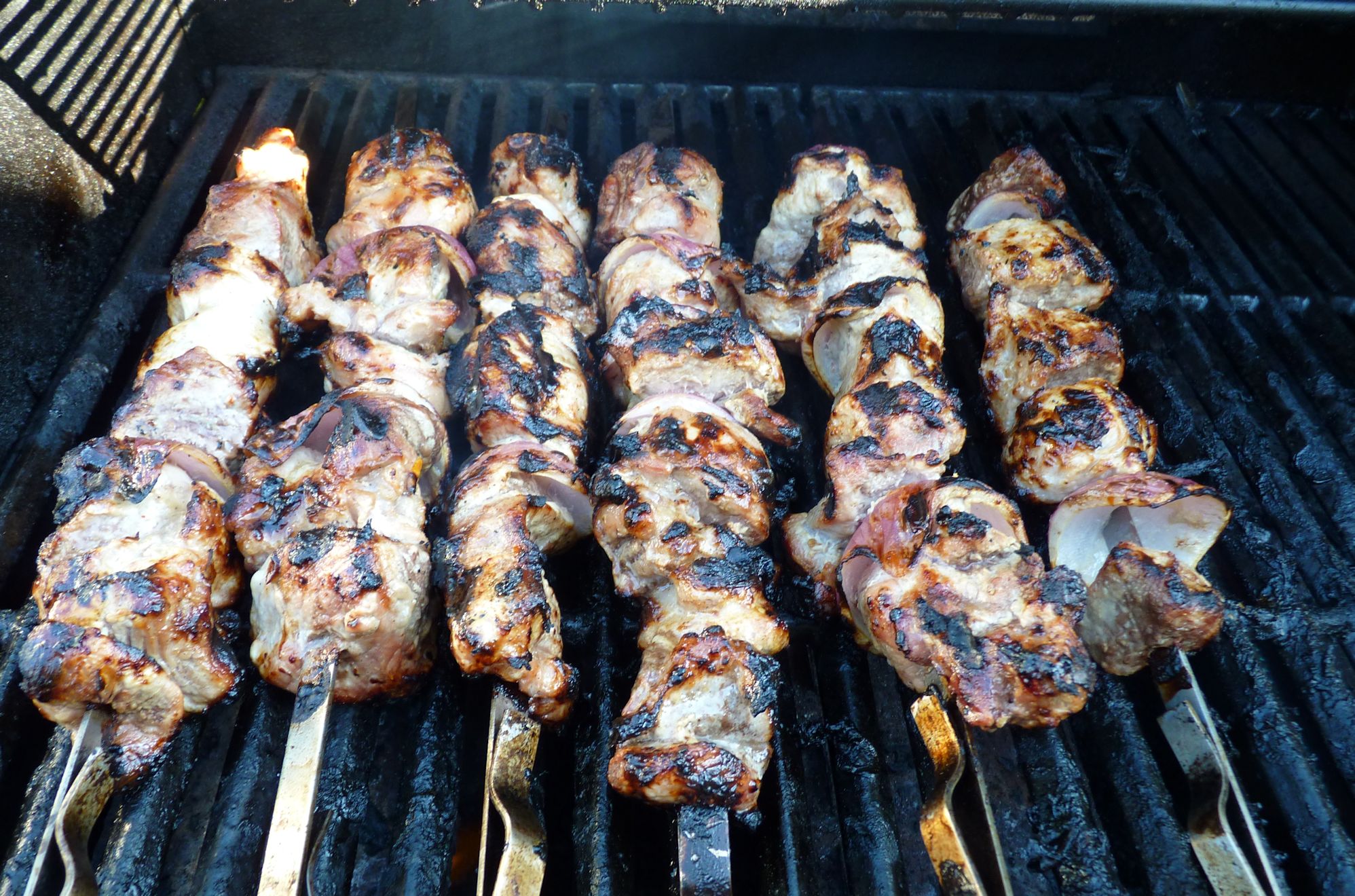
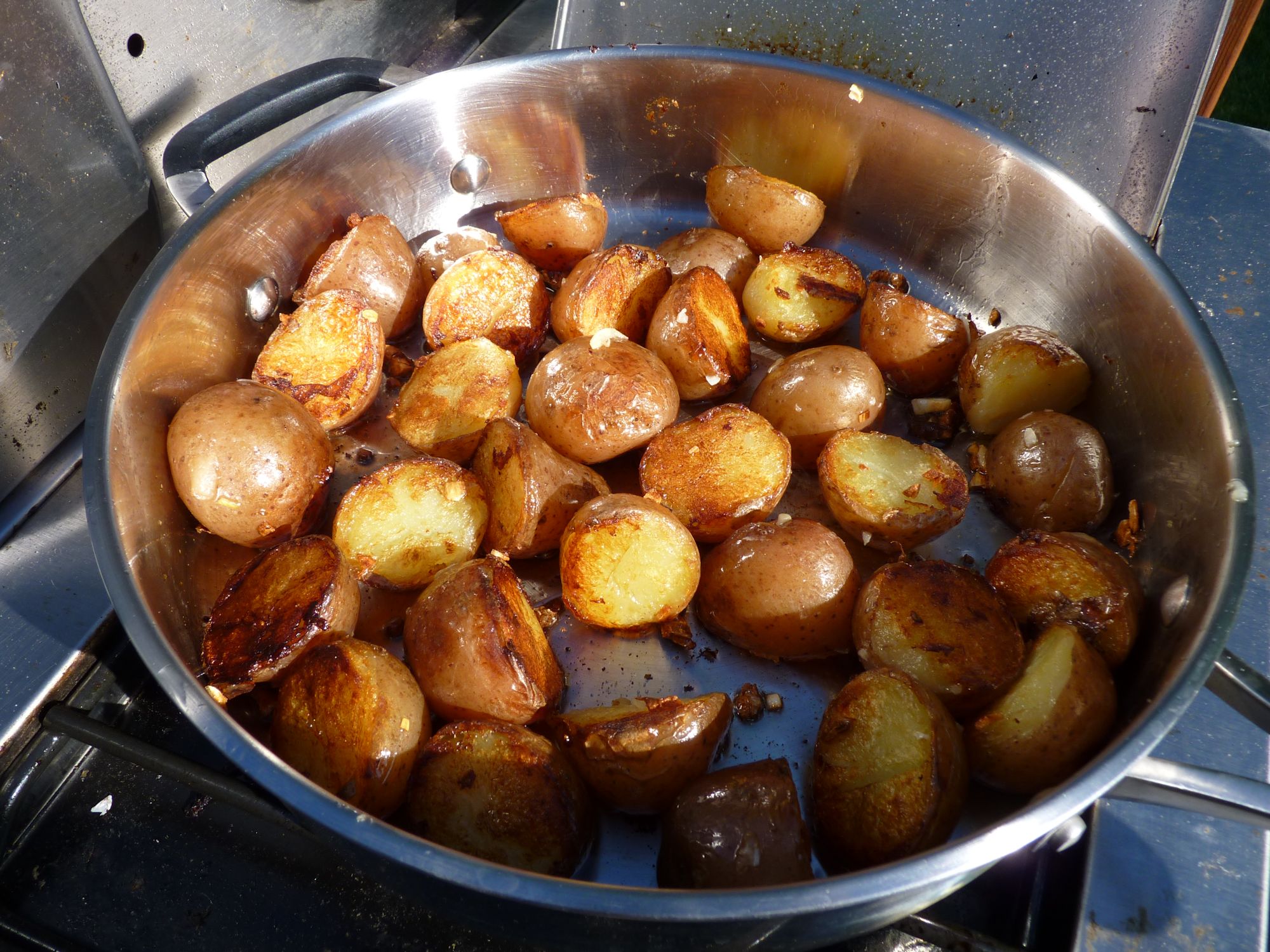
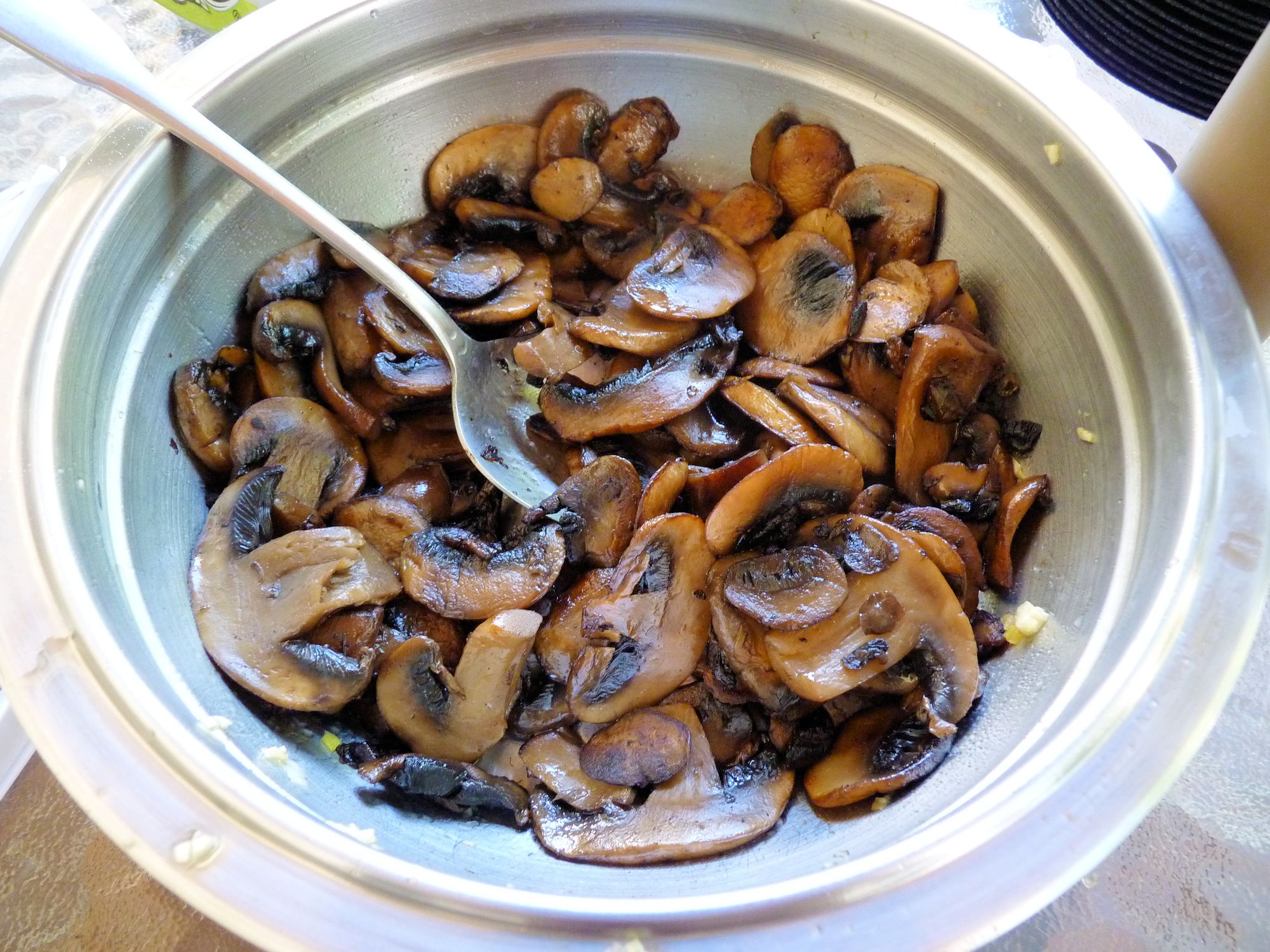
Here are few pictures to give you an idea about cooking (well, yes, not so much cooking, mostly grilling).
Grilled chicken tights:
Kebab, on the grill:
And the same kebab, off the grill:

I don’t know why, but potatoes fry the best on the side burner of the grill (we have electric stove in the kitchen):
And then mushrooms… I don’t know about you, but I’m ready to eat mushrooms any time and any day:
Enough about the food. Let’s talk about the drinks now.
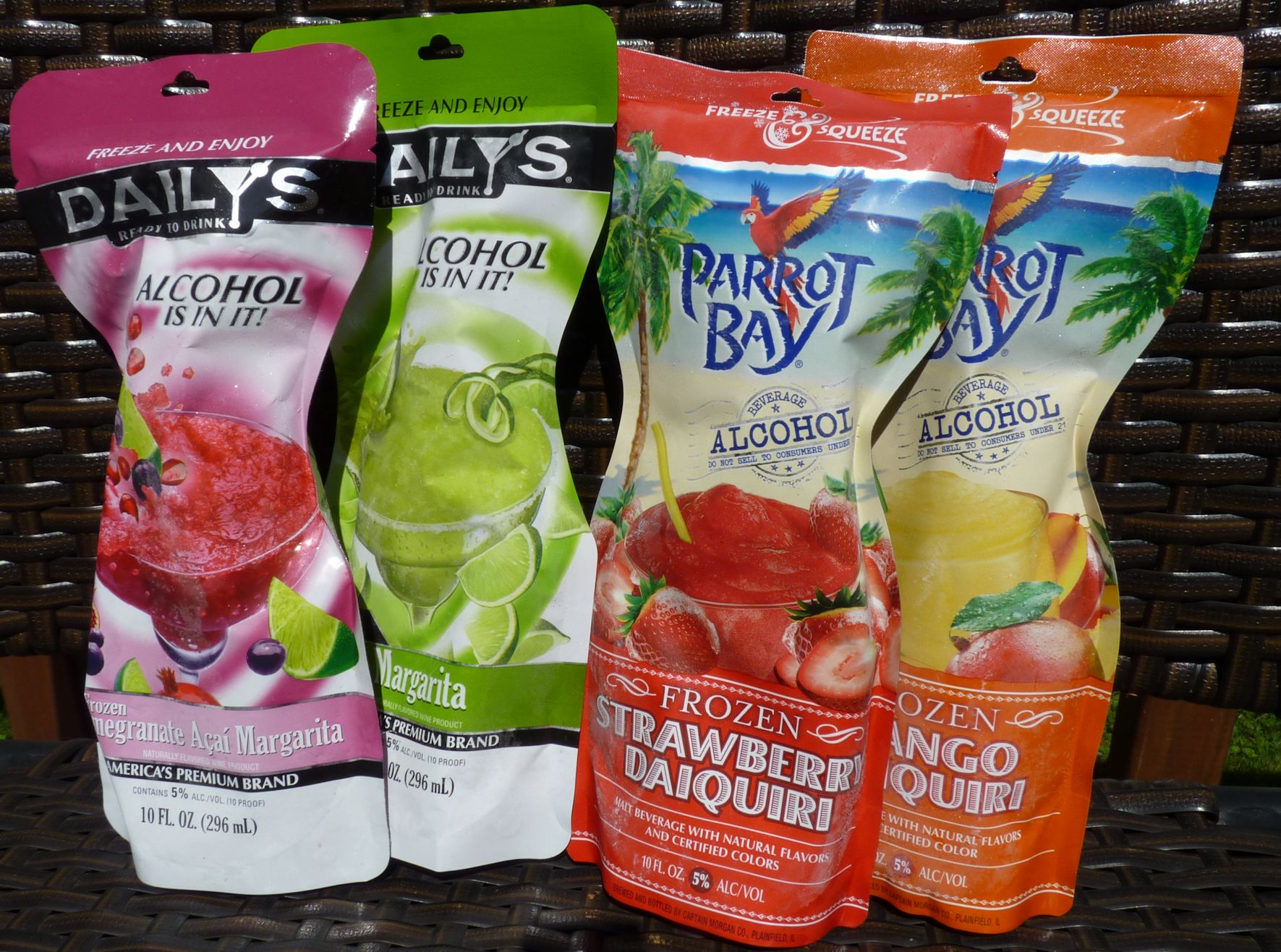
First, we had some [very lazy] cocktails. Just take it out from the freezer, squish in the glass and voila! 8 different flavors are available in the store – and Mango Daiquiri was the best out of the four we tried:
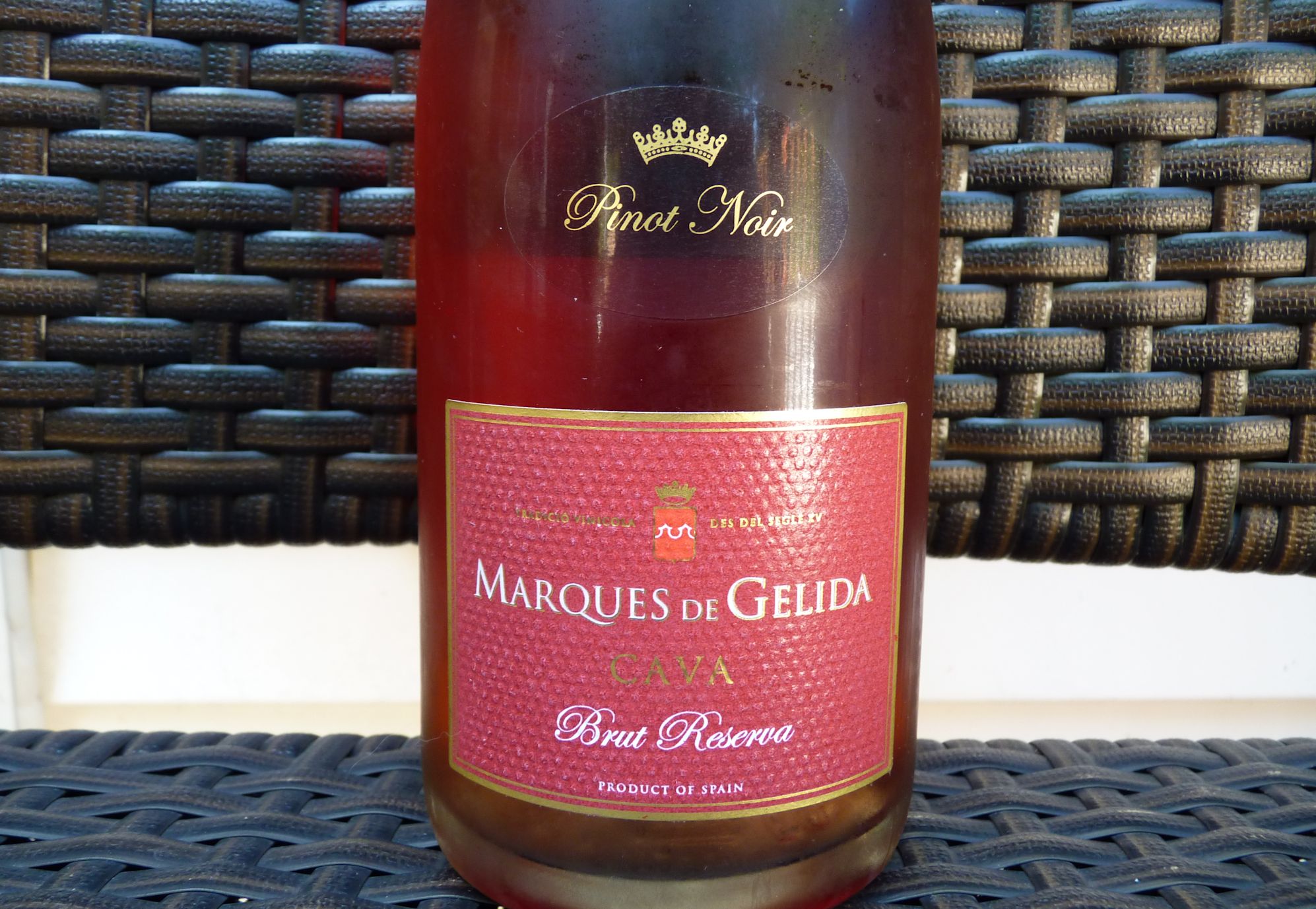
Then we switched to Champagne – errr, Sparkling wine. We had Marques de Gelida Cava Brut Reserva, which is Rose (Pinot Noir based) – very nice, round, medium bodied and refreshing (Drinkability: 7+) :
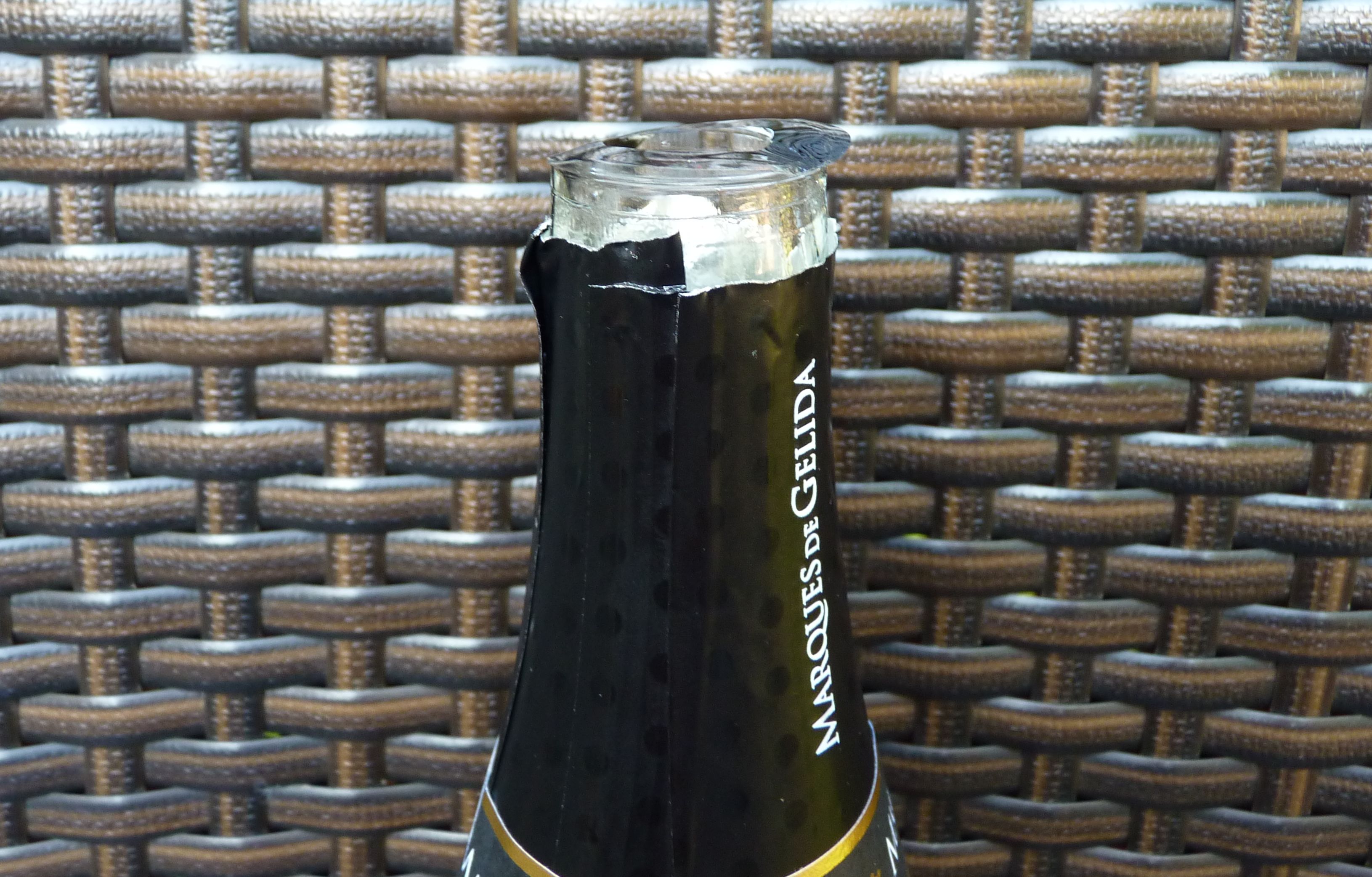
The best part about this sparkling wine was… opening of the bottle. Despite the fact that I told you not to saber a bottle of Champagne at home, I decided to ignore my own recommendation and try to saber the bottle (you should know that deep inside I’m a 10-years old, masquerading as an adult). Sabering was an absolute success, as I managed to do it from the first attempt. I have even a short video of that process, but it will require time to process, so for now, I can only show you some pictures which will illustrate what happened. Here is the top of the bottle:
And here is the very top of the neck – the glass top was completely separated during the opening, cork and glass together:

The only problem is – Sabering was so much fun, now I want to do it again!
Then we had a very nice red – 2009 Cave de Tain l’Hermitage Crozes-Hermitage Les Hauts de Fief (13% ABV, $17.99)- earthy nose with some roasted notes, same on the palate – deep concentrated ( but not jammy) fruit, great acidity, touch of spices, round tannins, very balanced (Drinkability: 8).
Then we had scotch – 41 years old Lonach Glendarroch (from Highlands, distilled in 1967) – absolutely amazing. I can’t even try to describe complexity of that scotch here – it will take a few tasting sessions to figure that out (my wife said that it was by far her favorite scotch ever):

Now last, but not least – my Father’s day present – 2005 Giribaldi Cento Uve, Langhe, Italy:
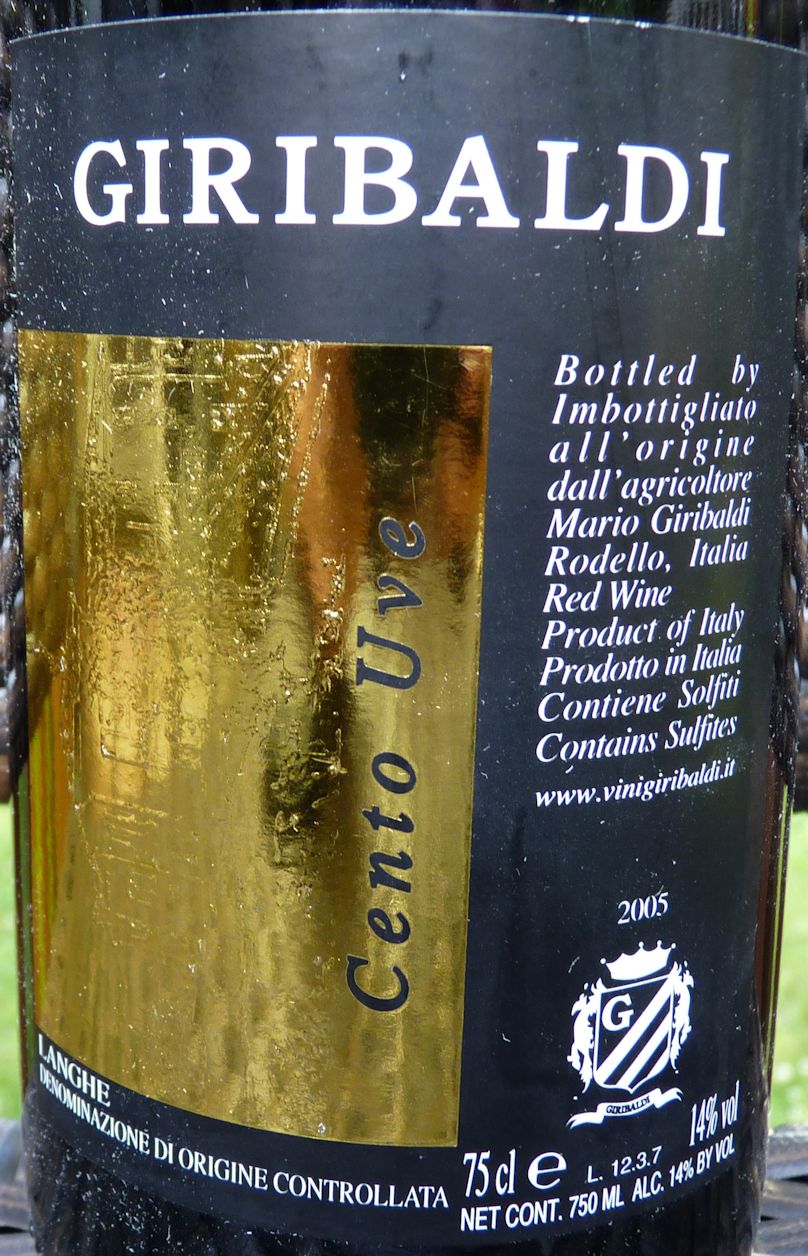
In case you are wondering what’s so special about this wine: it is made out of 152 grape varieties (you can read more here), so it will mean a serious progress of my grape count.
That’s all folks. I’m very happy with my Father’s day. How was yours? Cheers!
Wine Century Club 7th Anniversary – Celebrating Grape Geeks Around The World
 As you already know from my previous post, last Saturday grape geeks all over the world celebrated 7th Anniversary of the Wine Century Club. Based on the current count, total of 179 different grape varieties were tasted by people participated in the festivities. This number can and will be adjusted based on some people reporting at the later time. You can find detailed report here.
Celebrating this kind of events needs a company (how many bottles can I open otherwise?), so I was lucky enough to be invited to the friends’ house for dinner, so we had an opportunity to drink a few bottles of wine. In no particular order, here are some notes for the wines we tried.
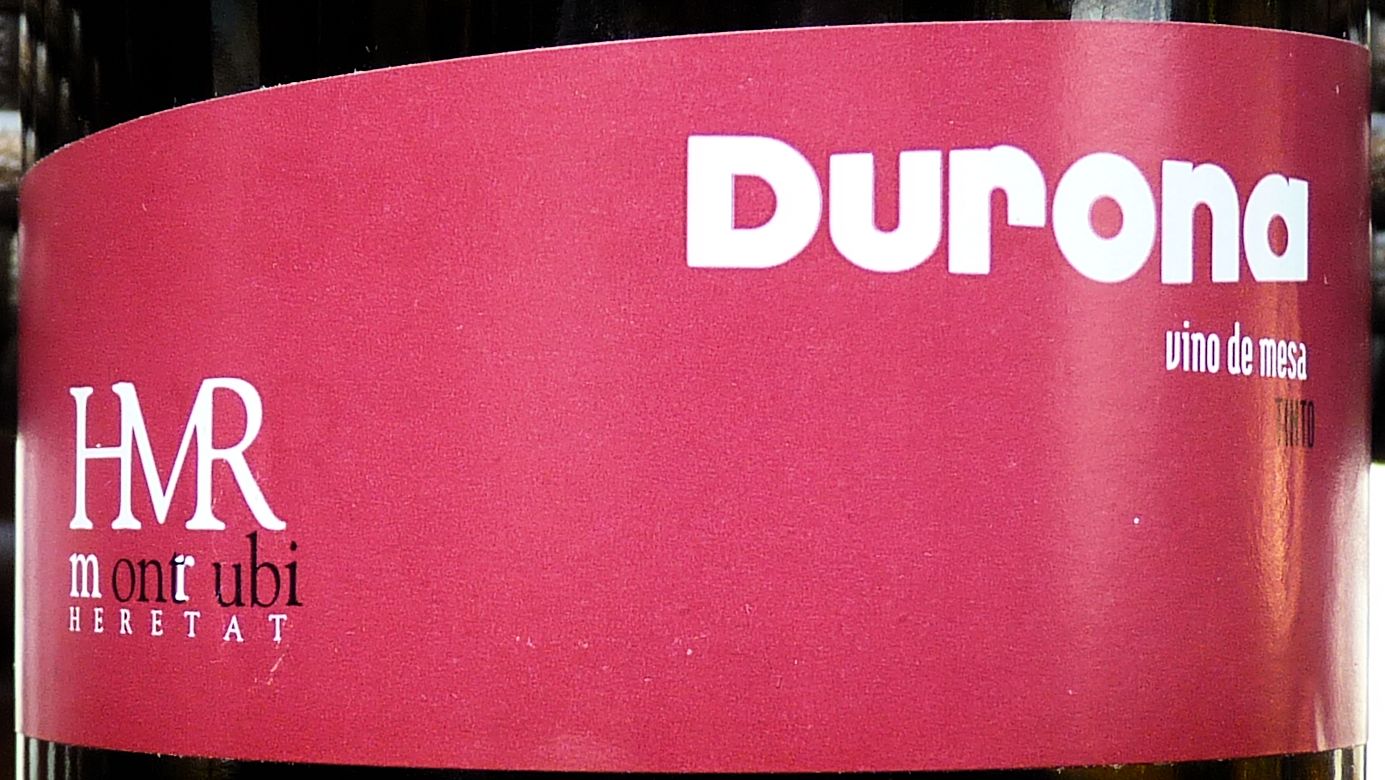
Let me start with 2004 Heretat Mont-Rubi Durona from Spain (13.5% ABV) – I got this wine from Wine Till Sold Out, and I really wanted to try it for a while, especially due to the fact that I never had one of the grapes in this wine, Sumoll. This red wine is a blend of 30% Sumoll, 20% Cariñena, 20% Garnacha, 20% Syrah and 10% Merlot. It had a very interesting herbal nose of sage and may be some oregano ( lightly hinted), and some nice red fruit on the palate, medium body, well balanced with pronounced tannins – I think it can still age for a while. Drinkability – 7+.
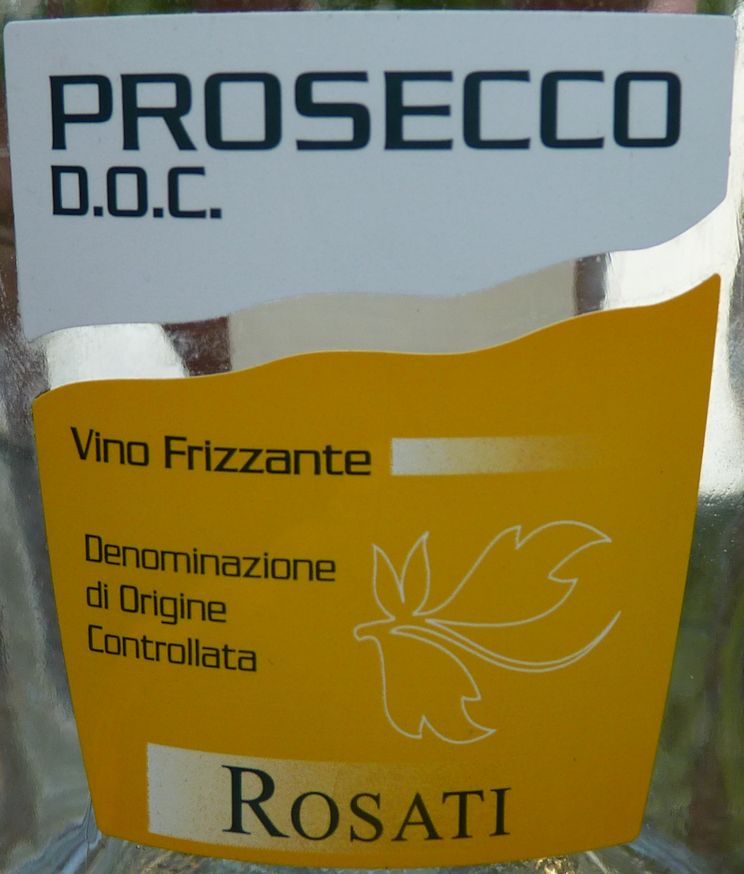 To tell you the truth, we actually started dinner from this light and simple NV Rosati Prosecco DOC (11% ABV) – it was rather a typical Prosecco, soft and round on the palate, with good acidity, drinkable but not exiting or thought provoking (Drinkability: 7-). This wine was of course made out of Prosecco grapes, which are also known as Glera.
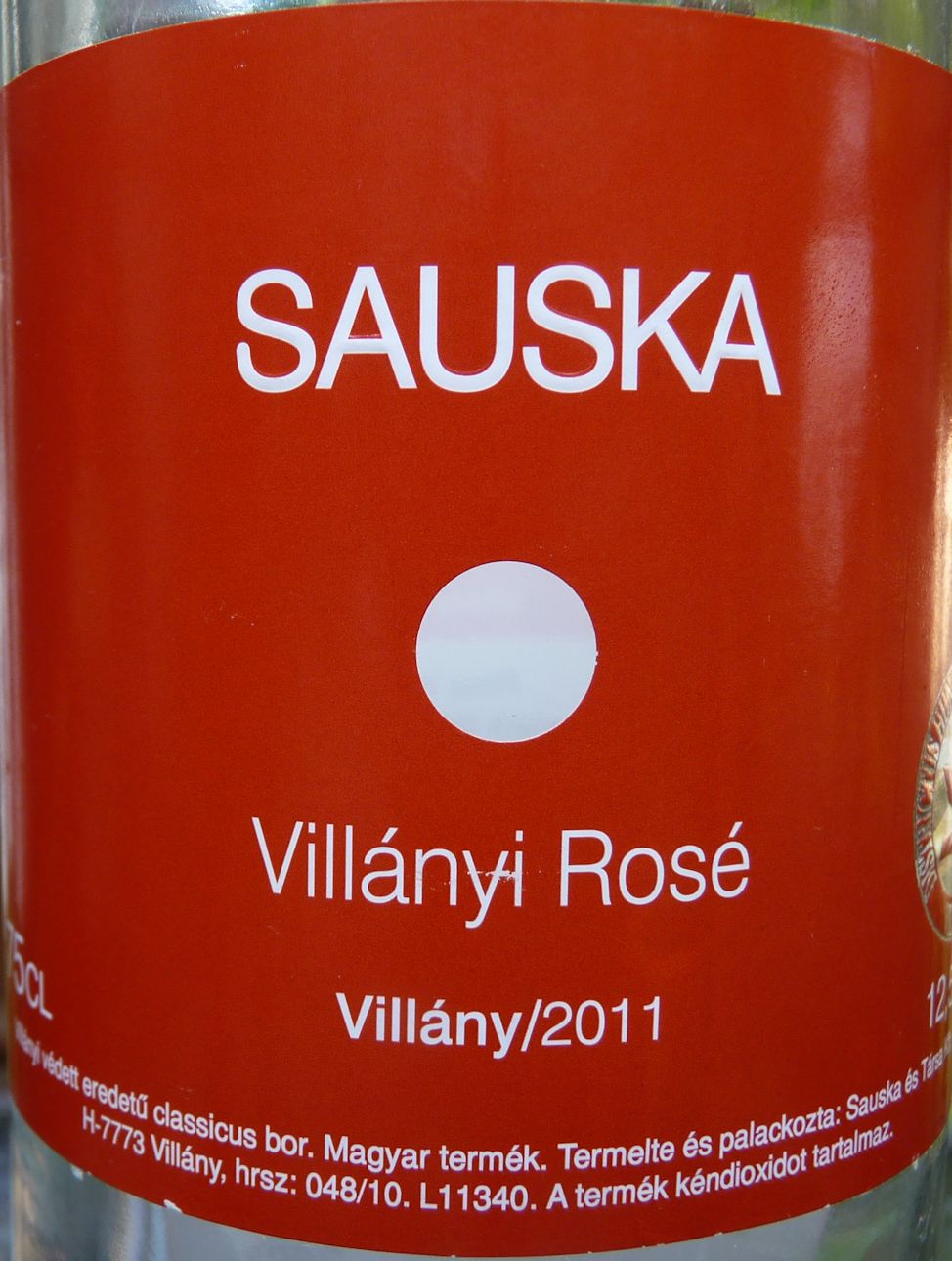 What can be better on a hot summer day than … yes, you are correct – Rose? Not much. Rose as a category is a perfect summer wine, enough refreshing but also having a substance which some of the white wines are lacking. This 2011 Sauska Villanyi Rose from Hungary (12.5% ABV) is a blend of 35% Blaufrankisch, 30% Merlot, 10% Cabernet Franc, 10% Cabernet Sauvignon, 8% Syrah and 7% Pinot Noir. This wine had lots of cranberries both on the nose and the palate, medium body, very refreshing acidity – yes, just perfect match for the summer day. Drinkability: 7+
 The next wine was 2009 Calina Cabernet Sauvignon, Valle del Maule, Chile (13.5% ABV). This wine was somewhat typical of Cabernet Savignon, with the green notes and hint of black currant. It was soft and drinkable, however after being open for a while, the wine developed quite a bit of sweetness, which is definitely not the best characteristic in my book of wines. Drinkability: 7-
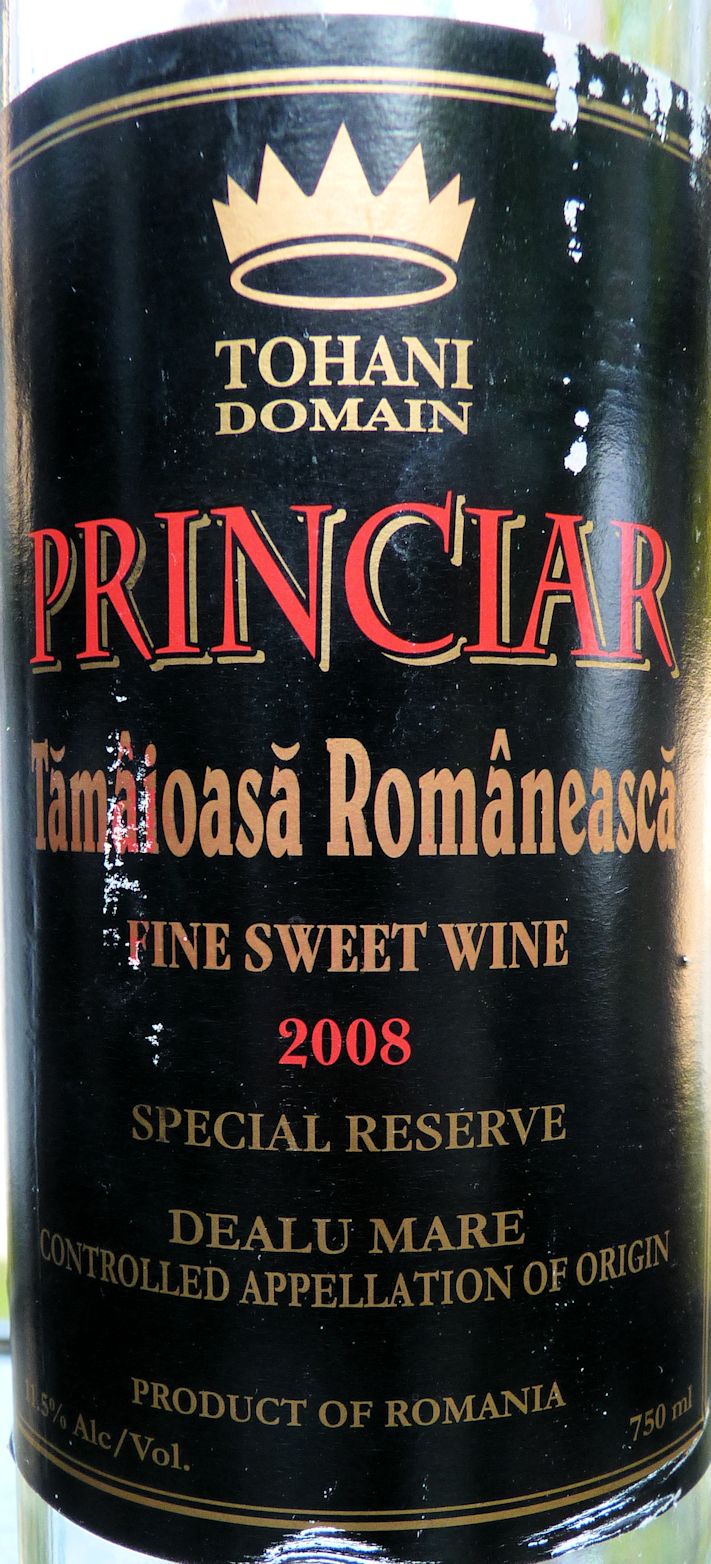 Last, but not least was 2008 Tohani Domain Princiar Tamaioasa Romaneasca, Romania (11.5% ABV). To tell you the truth, I bought this wine just for the new grape, Tamaioasa Romaneasca, as in a lot of cases sweet wine of unknown pedigree are cloyingly sweet. This wine was definitely a great surprise – hint of white peaches on the nose, fresh and delicious white fruit on the palate, good acidity, very balanced – definitely great wine for the money ($11.99). Drinkability: 8-.
We also had NV Ramos Pinto Collector port, which was outstanding – reasonably (not overly) sweet with the hint of smokiness – definitely a very good port. The reason I don’t mention it in the same way as all other wines is that I was unable to find the exact grape composition for this wine, outside of the statement that indigenous Portuguese grape varieties had being used.
This is it for now, folks. 12 different grapes, 2 new grapes for my grape count (Sumoll and Tamaioasa Romaneasca). Journey continues – hop on! Cheers!
Weekly Wine Quiz #8 – Do You Know Your AVAs?
Saturday has come, so is the time for our weekly wine quiz. Before we get to the quiz itself, just a little update – based on the “popular demand” (okay, I don’t know if it was popular, but I got couple of requests), the answers for the weekly wine quiz will be provided in a few days after the quiz was published (probably Tuesday or Wednesday of the following week). And if that doesn’t make everyone happy – we can change it again.
Now, the subject of today’s quiz is something which is called AVA – American Viticultural Area, which is similar to the french concept of AOC. AVA designates the certain region as having unique terroir and unique grape growing and wine production requirements. If you remember an example with circles from Singles Night Out blog post, all AVAs are enclosed into one another – California includes Central Coast, Mendocino, Napa Valley, Sonoma Valley and more, all of which are AVAs in their own right. And then there are more smaller AVAs definied within a bigger one, such as Howell Mountain, Diamond Mountain and Yountville all being sub-regions of Napa valley.
Now, for the task at hand, below is a list of “smaller” AVAs. They all belong to one and the same bigger AVA, except one. And the question is: which one doesn’t belong?
Enjoy your weekend! Cheers!
Weekend Wine Happenings
This past weekend was filled with different wine events, which I want to share with you. First and foremost – arrival of the No Girls wine. No Girls wine is made by Christophe Baron, the wine maker behind Cayuse – one of the cult wineries from Washington state. What is so special? No Girls wine is available only through the mailing list. If you ever dealt with winery mailing lists you probably know that before you get on the mailing list, first you spend time on the waiting list for the mailing list. It took more than two years for me to move from waiting list to mailing list with Turley, makers of the great Zinfandels. I think for more than 3 years I’m still on the waiting list for Alban, Cayuse and Carlisle. With No Girls wine, despite the fact that I signed up literally on the same day as the offer came in, initially I got an e-mail that I didn’t make the mailing list, with the follow up e-mail in a couple of month saying that I got an allocation.
Hence the excitement and anticipation associated with arrival of No Girls wine – 2008 Grenache and Syrah from La Paciencia vineyard in Walla Walla. I can’t tell you anything about the wine itself – I plan to give it some time first. However, even packaging alone can make you excited – and to explain what I mean, here are few pictures for you.

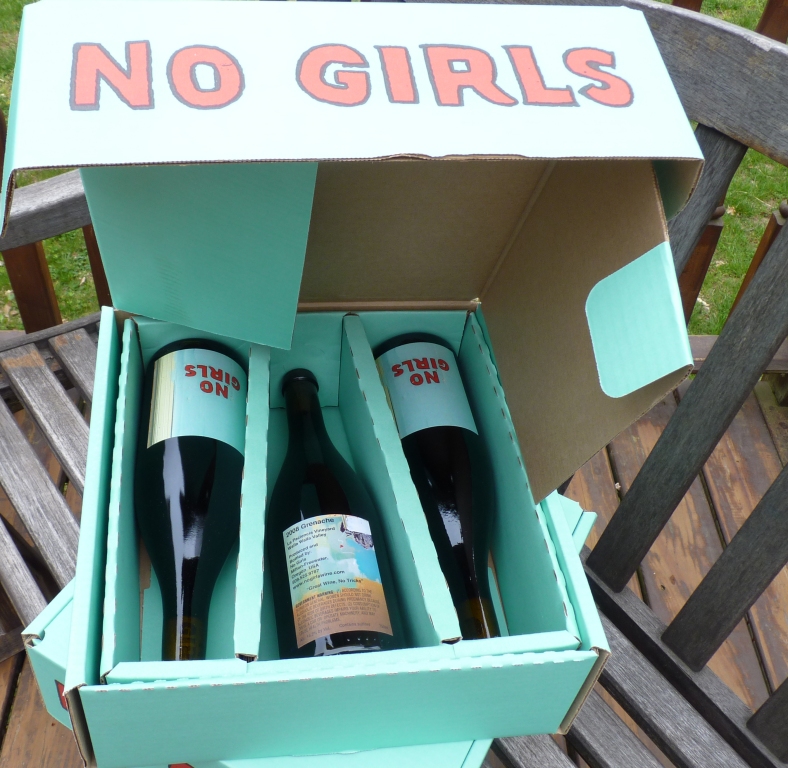

Very bright and clever – what do you think?
Now, on the subject of the wines I actually tasted over this weekend, there were few I wanted to talk about.
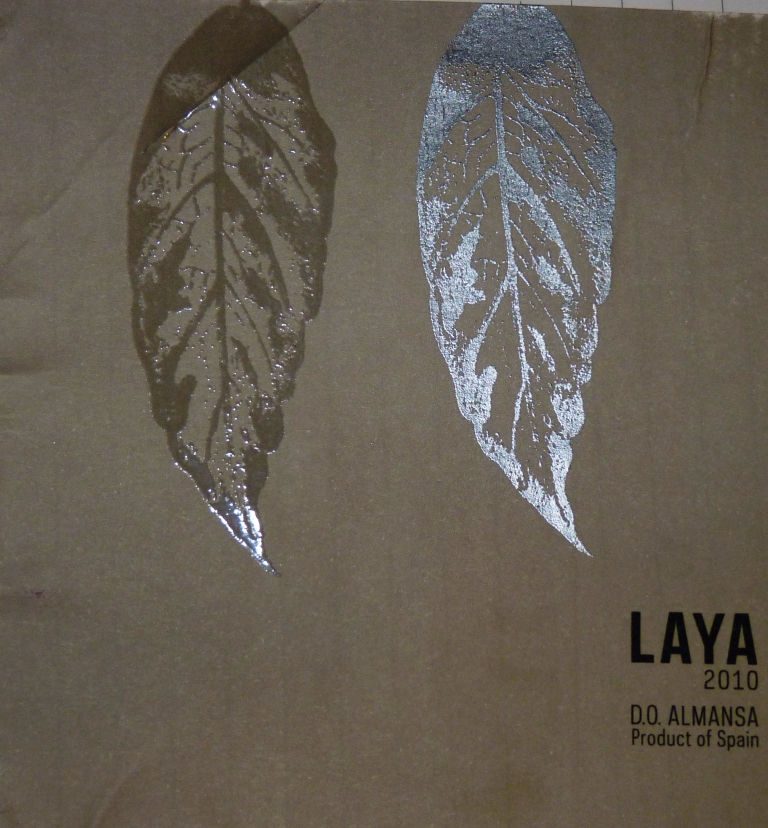
First one is a Spanish wine 2010 Laya D.O. Almansa (14.5% ABV). This wine is a blend of Garnacha (70%) and Monstrell (30%). When you open the bottle and take a first sip, it comes out very grapey and young. It took this wine 3 days to develop a nice undertone of richness, with some ripe red fruit, a touch of spices and smokiness. Considering the price ($7.99) this is a great everyday wine (Drinkability: 7+).
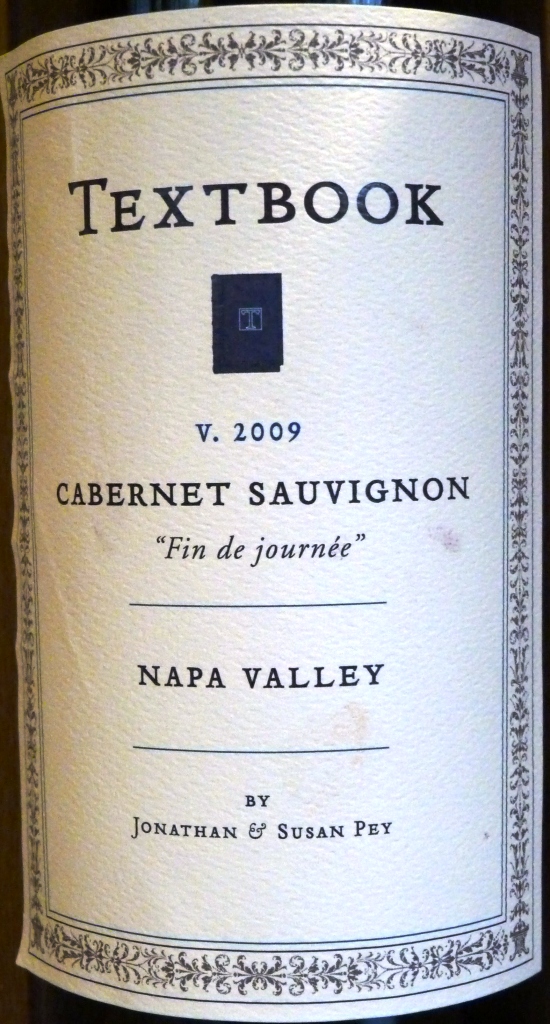 Next one is a 2009 Textbook Cabernet Sauvignon Fin de journee Napa Valley (14.5% ABV). I had this wine for a few months, waiting for the right moment to try it and building up expectations – somehow the name “Textbook” caused a lot of warm expectations, especially with the back label promising a “textbook Napa Cabernet”. The wine had a nice nose of the dense black fruit, not too jammy, but present. On the palate, the fruit grew together with nice tannins and silky texture, only to somehow stop short of delivering the “oompf”. Almost like watching the golf ball slowly rolling after the putt “almost, almost, almost, ahh”. Signature black currant was almost there, but didn’t really show up in its clean beauty. Don’t get me wrong – for a $20 Napa Cab, this was a good wine, but it had to battle my inflated expectations… and lost. Drinkability: 7+.
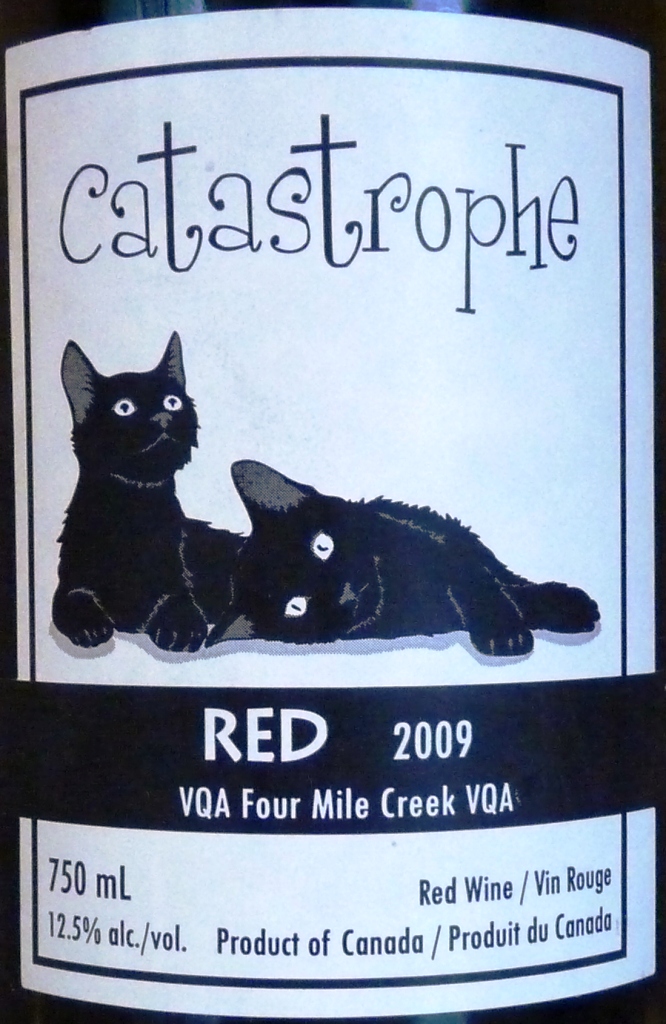
Last but not least was 2009 Catastrophe Red Cattail Creek Estate Winery, Four Mile Creek VQA, Canada (12.5% ABV). We brought this wine back from Canada after the last year’s trip. It is a blend of Gamay Noir, Merlot and Cabernet. On the nose, it has a bright red fruit. On the palate, there is more red fruit, such as sour cherries, hint of earthiness, good clean acidity, very balanced. Medium body and very easy to drink. This wine also would be a great food wine – too bad, I only brought one bottle back. Drinkability: 8-.
That’s all folks. Don’t forget that April 25th is a Wine Blogging Wednesday, with the theme “Barossa Bumerang” – find a bottle of Barossa wine from Australia, enjoy it, and write a blog post or at least leave a comment here. Have a great week! Cheers!
Weekly Wine Quiz #7 – Where In The World Am I?
One more week passed by, and here we go again – new wine quiz for you.
In the last week’s quiz you had to identify region which is not making wines from Pinot Noir grape. Correct answer is Beaujolais – while it is neighboring the Burgundy, one of the world’s best regions for Pinot Noir, Beaujolais wines are made out of grape called Gamay.
Now, this week’s quiz will be somewhat tricky, I think. Please take a look at this picture:
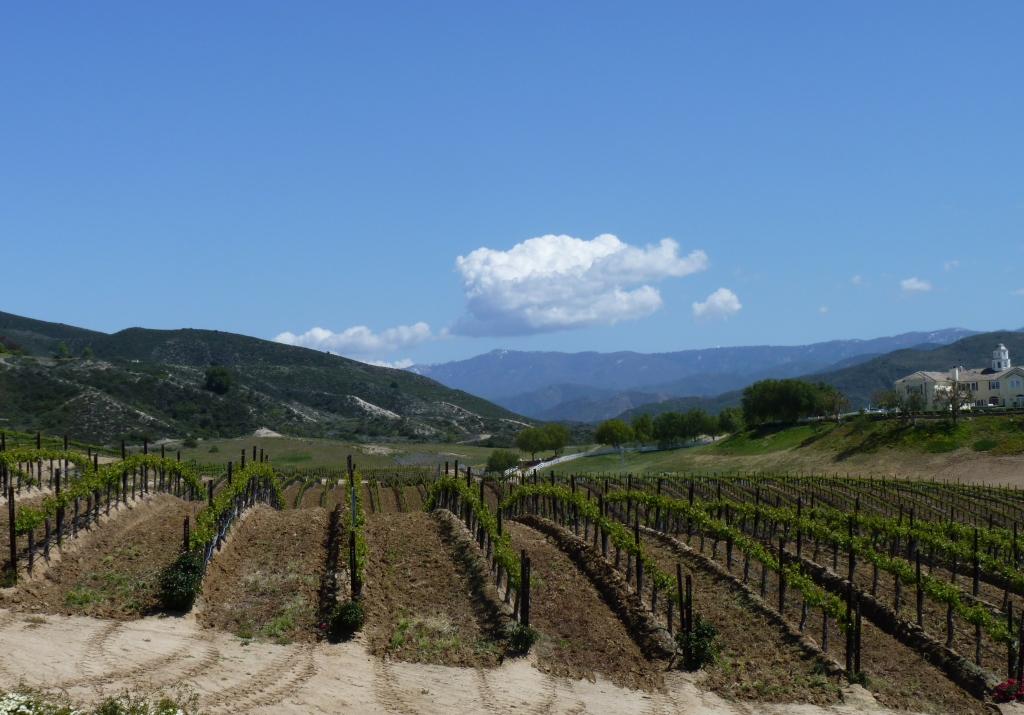
Can you guess where this picture could’ve being taken? Your possible choice are listed below…
Happy weekend and have fun! Cheers!
Across: Grape, Starts With “O”, 6 letters
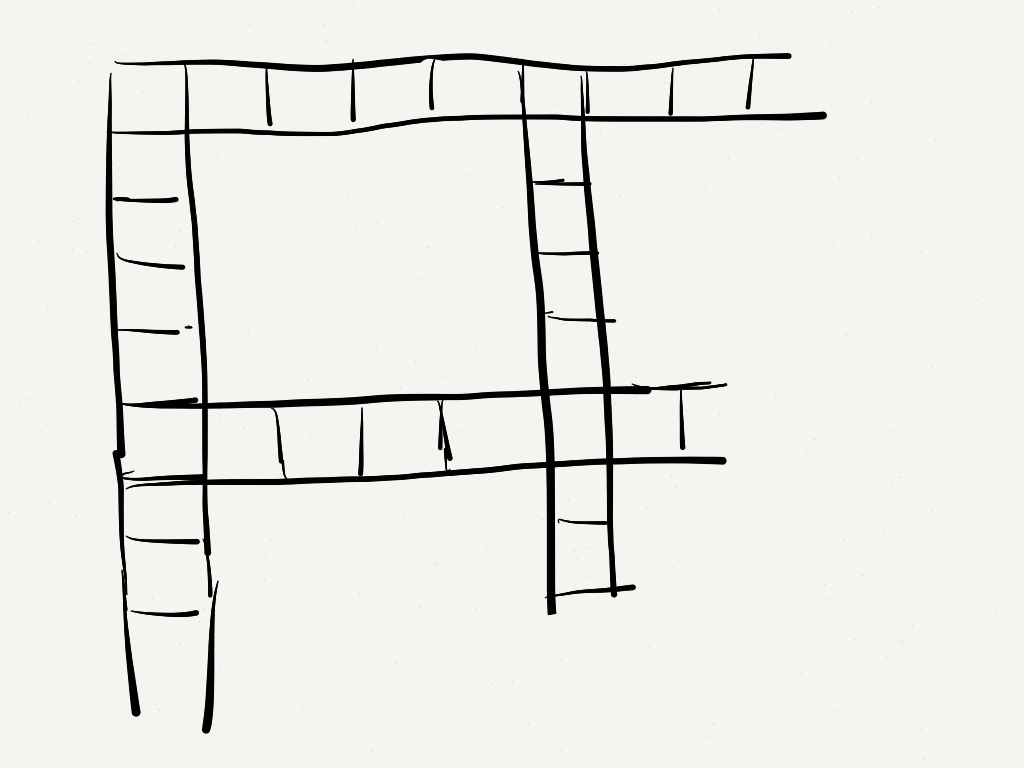 We like puzzles. We like those little challenges, which are innocent but give us a sense of fight, achievement and winning. Here is a little puzzle for you – let’s see how well do you know grapes. Please name a grape which starts with ”O”, 6 letters. I will give you couple of minutes, take your time. Done? What it is? I’m sure some of you could’ve known it, but I honestly think that majority would not.
I don’t want you to feel discouraged. There are about 8,000 different grapes in the world (or more), and about 1,600 of them are used in winemaking, so chances of knowing all of them by a one person are slim to none. Okay, so what is my point, you ask?
The whole point of this little puzzle exercise was to show you an opportunity. An opportunity for an exciting journey and discovery of new experiences. This is an easy journey, which doesn’t require months of planning and tons of special equipment. You can start it any day by joining Wine Century Club. You can download an application, check-mark at least 100 grapes you tasted in your life (doesn’t have to be single grape wines – all blends are perfectly ok), and voila – you can become a member.
I started this journey about 4 years ago. It was relatively simple to get to the first hundred grapes. By the time I received the certificate, I found out that the club now has a new level – Doppel, which requires tasting of 200 grapes. New challenge, great! I started a new journey which was not as simple, and … yes, you got it right – by the time I got to the 200 grapes mark, Treble and Quattro levels appeared! I got to the Treble mark last year, and it was quite hard – had to start including clones in order to get there. But – if you are a ”life traveler”, your arrival to a specific place only means an opportunity to start going to the next destination – so I kept on going.
Just to make myself clear – the point of all this “wine century” journey is not collecting accolades or feeling unique and special. Not at all. The whole point of this journey is a discovery. I can’t tell you how many amazing wines I tried along the way – if you are looking to expand your “grape universe” and collect new experiences – this is definitely what you can achieve with this exercise of purposefully seeking new grapes and unknown bottles.
Trying to reach the ”Quattro” I decided that this shouldn’t be set as a hard task, definitely should be enjoyed more and taken easier than before. I don’t call it a ”quattro journey”, I do very limited updates, and only keep the total grape counter, which you can see at the top of the page if you’re reading this post on the web site.
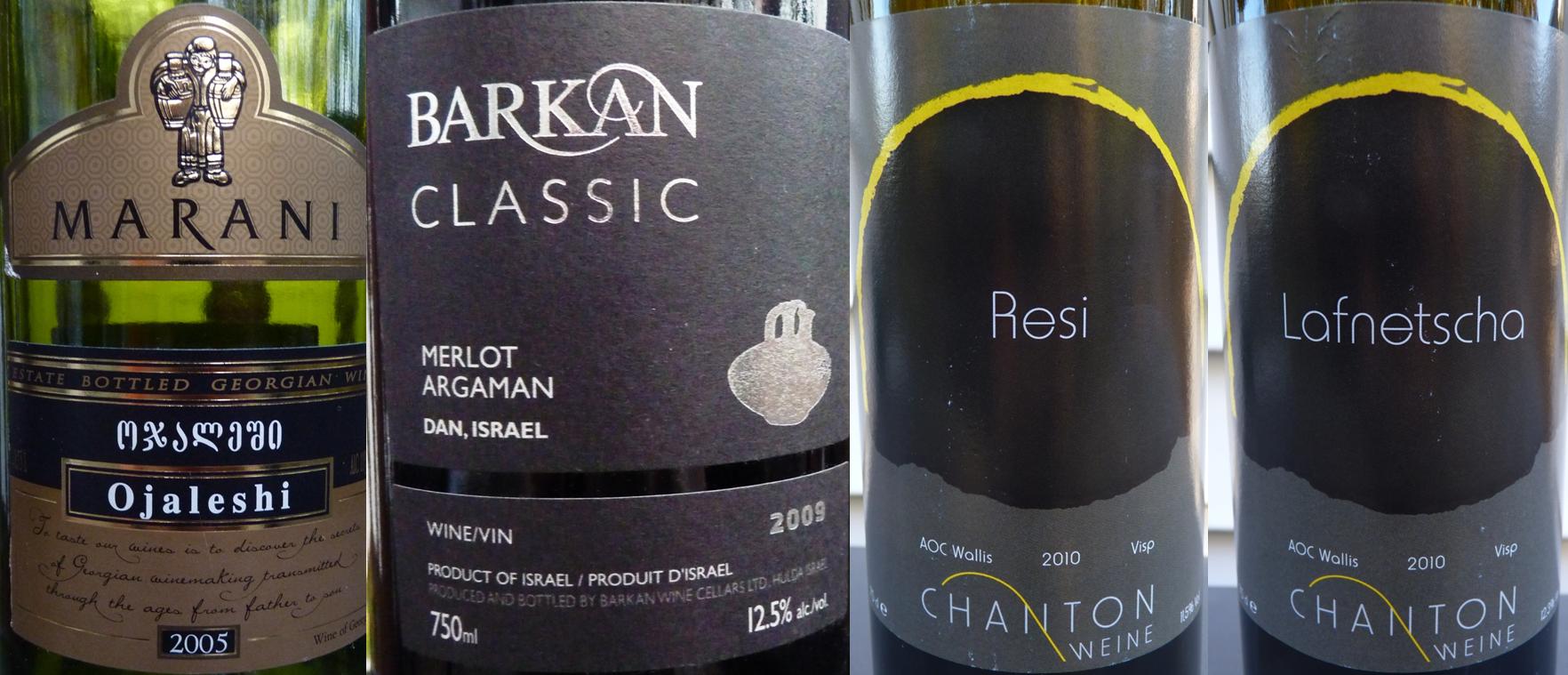
Nevertheless, it seems to be a good time to provide and update and change the grape counter, as I tasted a number of new wines (read: grapes), at Michael Skurnik tasting and not. First, an answer to the puzzle. The name of the grape which starts with ”O” and consists of 6 letters is Ortega – it is used in Germany and produces wines similar to Riesling. Overall, here are 10 new grapes to add the list:
Resi – 2010 Chanton Weine Resi Visp Wallis AOC, Switzerland
Vidiano – 2010 Alexakis Vidiano, Greece
Malagousia – 2010 Alpha Estate Axia White, Greece
Clairette Rose – 2010 Châteauneuf-du-Pape Blanc ‘Cuvée Speciale Vieilles Clairettes’
Doña Blanca – 2009 Godelia Bierzo Blanco, Spain
Bacchus – Château de Briat Armagnac, ‘Hors d’Age’ NV
Folle Blanche – Château de Briat Armagnac, ‘Hors d’Age’ NV
Ortega – 2006 Anselmann Trockenbeerenauslese Ortega. Pfalz, Germany
Ojaleshi – 2005 Marani Ojaleshi, Georgia
Agraman – 2009 Barkan Classic Merlot Agraman, Israel
And here are some pictures for you:
In case you want a head start on the project, I decided to share the list of grapes and reference wines – you can find a full table here. Note – if “reference wine” is empty next to the grape, it means I didn’t try that grape yet (example: Picpoul Noir). Conversely, if you got a suggestion for me as to where I can find an appropriate wine, I will be very appreciative…
That’s all for now, folks. Look for that unknown bottle on the shelf – who knows, you might find your best wine experience ever. Cheers!
Must Try Wines
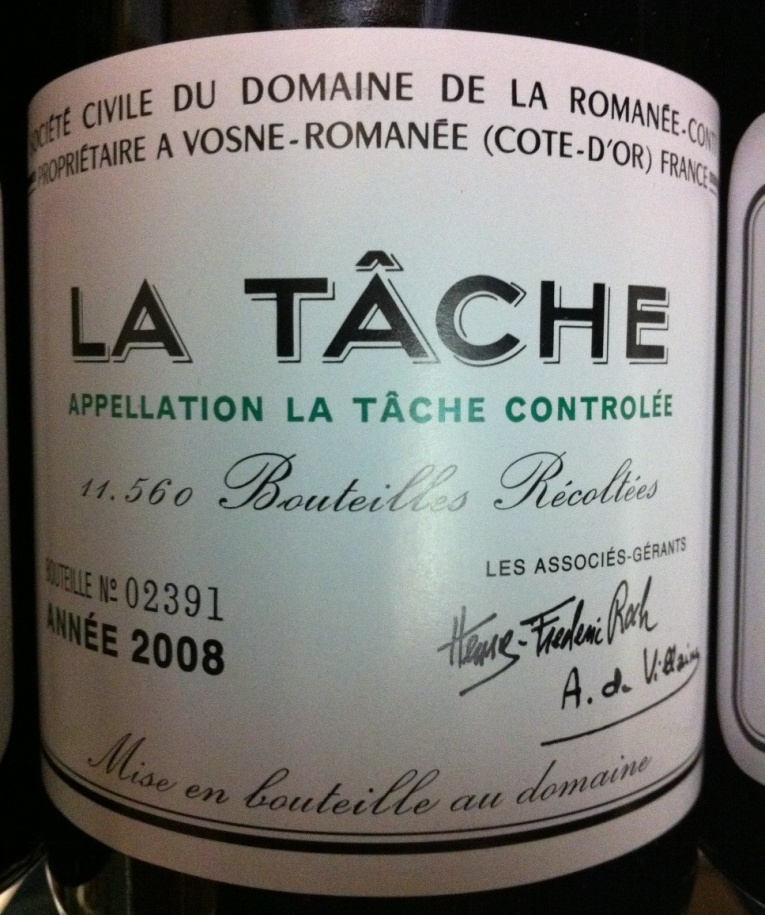 It is not so simple to talk about ”must have experiences” – as we move on in life, the idea of ”must have” can be changing dramatically, taking something which was considered divine to something you can literally despise.
Our experiences are personal, and they have value within our view, our picture of the world. This is true pretty much for everything, but this is ultimately true when it comes to food and wine. If someone is strictly a white zinfandel drinker, convincing him or her that this Chateau Latour is a good wine would be an impossible task. Therefore, does it make sense to come up with the list of ”must try wines”? I believe so. This doesn’t have to be a ”must try” list for everyone, but this is rather a personal belief based on the present relationship with the wine world. By reading books, blogs and magazine articles, talking to people (twitter conversations included), and then doing more reading, talking and thinking (and drinking!!!), this list came by as my personal reflection. These are the wines I would like to experience at least once – nothing more and nothing less.
Few notes about the list. First, it is built by country, and then sub-regions. The primary idea behind including most of the wines you can see on the list is their reputation, which is based on what I read and heard. Yes, the majority of the wines in the list are super-expensive, but this just a consequence of their reputation, I guess. Considering that, I also included possible substitutes for some of the wines – some of the substitution suggestions are based on the official (and semi-official) ”second labels” (here’s a link to the post I wrote for The Art Of Life Magazine on the subject of the second labels) – for instance, all of the Bordeaux First Growth have their official second label wines (some of them even have third labels now). Some of the other suggestions are simply based on geographic proximity and ownership – for instance, Chateau Hosanna is located next to the famed Chateau Petrus and both are owned by the same owner, Christian Moueix.
And few more points. If you want to get that list in the form of a PDF file, here is the link for you. If you are interested in my logic as to why particular wines and wineries are there – I will gladly explain, just ask a question. If you think there are other wines I should include in the list, let me know – I will greatly appreciate the suggestions. However, if you think that I’m wrong and some of the wines shouldn’t be on this list – well, tough luck – the is my personal list, and this is the way I see it at the moment.
Without further delay, here is the list. Cheers!
|
Country/Region |
Potential Alternative |
| France | |
|
Champagne |
|
| Krug Clos du Mesnil | Krug Grand Cuvee NV |
| Krug Clos d’Ambonnay | |
| Salon Le Mesnil | |
|
Bordeaux |
|
| Chateau Latour | Les Forts de Latour |
| Chateau Lafite Rothschild | Carruades de Lafite Rothschild |
| Chateau Mouton Rothschild | Le Petit Mouton |
| Chateau Haut Brion | Le Clarence de Haut-Brion |
| Chateau Margaux | Pavillion Rouge |
| Chateau Cheval Blanc | Le Petit Cheval |
| Chateau Petrus | Chateau Hosanna |
| Chateau Le Pin | |
|
Burgundy |
|
| DRC Grand Cru Échezeaux | |
| DRC Grand Cru Richebourg | |
| DRC Grand Cru La Tâche | |
| DRC Grand Cru La Romanée-Conti | |
| DRC Grand Cru Montrachet | |
|
Sauternes |
|
| Chateau d’Yquem | |
|
Northern Rhone |
|
| E. Guigal Cote Rotie La Landonne | |
| E. Guigal Cote Rotie La Mouline | |
| E. Guigal Cote Rotie La Turque | |
| Chateau Grillet | |
|
Southern Rhone |
|
| Chateau Beaucastel Chateauneuf du Pape Hommage a Jacques Perrin | |
| Pegau Chateauneuf du Pape Cuvee da Capo | |
| Italy | |
|
Piedmont |
|
| Gaja | |
| Bruno Giacosa Barbaresco Riserva Asili | |
| Bruno Giacosa Barolo Riserva Falletto | |
|
Tuscany |
|
| Ornelaia Masseto | |
| Antinori Solaia | |
| Tenuta San Guido Sassicaia | Tenuta San Guido Guidalberto |
| Ornelaia | Le Serre Nouve, Le Volte |
| Valdicava Brunello di Montalcino Riserva Madonna del Piano | |
|
Veneto |
|
| Giuseppe Quintarelli Amarone | |
| Spain | |
|
Rioja |
|
| 1964 Lopez de Heredia “Viña Tondonia” Gran Reserva Rioja | |
|
Ribero Del Duero |
|
| Vega Sicilia Unico | Valbuena 5° |
| Bodega Dominio de Pingus | |
| US | |
|
California |
|
| Bryant Family | DB4 |
| Colgin Family | |
| Harlan | Maiden |
| Screaming Eagle | Leviathan |
| Sine Qua Non | |
| Alban Vineyards | |
| Saxum | |
|
Washington |
|
| Cayuse | |
| Quilceda Creek | |
| Portugal | |
| Taylor’s Scion Very Old Port | |
| Australia | |
|
Barossa Valley |
|
| Penfolds Grange | |
| Seppeltsfield 100 year old Para Vintage Tawny |
Summing up Wine Blogging Wednesday, Plus Some Surprises
 In my last post about Wine Blogging Wednesday #75, I promised to sum up the experience with my Single – 2007 Mara Pinot Noir Laughlin Road Ranch, Russian River Valley, so here we go.
When I tasted 2007 Mara Pinot Noir about 1.5 years ago (October of 2010, here are the notes), the wine was coming out as big and brooding, with wide shoulders, and tremendous elegance and balance. One and a half years later, the wine took on a lot more subtle expression, coming out in elegant layers. Here are more detailed notes: Blueberries and blackberries on the nose, with a hint of nutmeg. Lots of red fruit on the palate, fresh strawberries and red plums, lots of tannins. More tannins. More tannins. Good acidity, and good balance. Lots of pleasure.
I always like to leave some amount of wine to be tasted at the next day just to see how the wine develops and what might be the aging potential (pumping the air out with Vacuvin) – this is exactly what I did with this wine. It became even more mellow than the day before, but still had lots of tannins in the finish, and perpetual elegance. I think this wine has at least another 8-10 years to reach its peak, so will see how it will develop. All in all, it was a great experience for the Singles night.
 Now let’s talk about the surprises. When I was reaching out for the bottle of Mara Pinot the day after Singles night, I noticed a bottle standing next to it with the Vacuvin rubber cork on top. This was a bottle of M. Cosentino California Ol’ Red – I completely forgot about this wine, which by now was standing there for 6 days. Oops was the first thought – this is going to the dump. It was nice and very drinkable when it was open on Saturday, but now, on Thursday? Also interestingly enough, this wine can’t be any further from Singles which I had the night before – if you remember our discussion about single vineyards, this Ol’ Red wine is made from the grapes coming from the biggest circle – entire California, and to top it off, it is not even a single vintage wine, as it doesn’t have vintage designation on the label.
Well, I have to give a chance to any wine, can’t just dump it – I have to at least give it a try, right? So with the first sip came literally a Wow emotion ( from oops to the wow) – the wine practically didn’t change since Saturday! It was still coming out as nice and complex red. Dark cherries and dark chocolate on the nose, more dark chocolate and cinnamon on the palate, blueberry jam, good tannins and good acidity (Drinkability: 8-). Coupled with the fact that this wine costs $11.99, you get here quite a value. I’ve had a very few wines which would last that long after the bottle was open (well, some of them, like Dunn Cabernet, need 6 days just to start opening, but this is whole another story), hence the nice surprise.
That’s all, folks. Let’s raise the glass to the great surprises in our lives. Cheers!
Last Bottle Sign Up ($10 credit)




 Talk-A-Vino