Archive
Daily Glass: Value Wines Project – E.Guigal Cotes du Rhone
 Continuing the value wines explorations, the next wine is 2007 E. Guigal Cotes do Rhone ($10.99 at the same Bottle King). E.Guigal is a very good producer making great wines in both Northern and Southern Rhone. While I keep dreaming of La Landonne (1985 vintage – Wine Spectator 100 points, many wines are rated at 99), regular E. Guigal Cotes du Rhone wines are typically quite good as well.
2007 was one of the greatest vintages in Cotes du Rhone, and it is showing through many different wines. This particular 2007 E. Guigal Cotes du Rhone wine (87 rating from Wine Spectator) showed off quite well. Dark ruby color, with good nose of red fruit, extremely concentrated on the palate. Even on the second day, the initial layer of soft fruit was intercepted by aggressive cherry pit spice with undertones of pepper, slowly mellowing down to a nice wine.
This wine needs time to fully open up, so it can safely spend a few years in the cellar. At this point, I would give this wine Drinkability rating of 7 – but again , this might improve quite rapidly.
So far we have 2 good wines under $11.99 – and this story will be continued…
Daily Glass: Value Wines Project
 It is great when your wine budget is unlimited – no doubts. But this is typically not the case. Are you destined to drink bad and boring wines in such a case? I believe the answer is no – and to test it, I decided to try different wines with only one common characteristic – none of them should cost more than $11.99 for regular size bottle.
Finding good wines in this price range is not easy – there are only some regions which will deliver decent wines in that category. For instance, I wouldn’t look for Californian wines – in that price range I find many wines literally indistinguishable and boring. Same with Chile and Australia. Don’t get me wrong – there is plenty of great value wines coming from Chile, Australia or California – but you really have to cross that $12 border line.
Where do you look for value? I believe Portugal, Italy and France can provide what we are looking for, so – here I go. To implement this project, I went to Bottle King store in Glen Rock, New Jersey, which is a part of Bottle King chain of liquor stores. Bottle King has great selection of reasonably priced wines from Portugal, Italy, France and of course many other regions. I got there a number of wines in the $3.98 to $11.99 range, which I will be reporting on in this series.
First wine in the series happened to be 2009 Ciconia, an Agarones/Syrah/Touriga Nacional blend from Alentejano region in Portugal, priced at $6.98. The wine had beautiful dark purple color. On the nose, it had a scent of fresh red berries, with the touch of pepper. On the palate it was nice young wine, a bit jammy at the beginning with red and dark fruit and hint of pepper and leather coming in the second wave. The wine had good acidity and a bit sharpness on the edges, which should mellow out as it will age. Definitely excellent wine for the price. Should be good with food, and should cellar nicely for another 3-4 years (or at least I think so). I will put Drinkability at 7+.
Pretty good for the beginning – I can only hope that the next bottle will be as good or better. Don’t worry, you will be the first to know…
Daily Glass: Emilio Moro 2007
 I was planning for a completely different post today. And then I saw a bottle of 2007 Emilio Moro Ribera del Duero. It was not possible to resist – I loved 2006, great wine, so getting a first sip of 2007 was extremely appealing.
Power. Fruit. Layers. Tannins. More Tannins. It will be a great wine – but it needs time. When you take a first sip, the wine is literally aggressive – there is tremendous concentration of tannins. This wine supposedly was aged in French and American oak – judging from the “tannin attack” concentrated right in front of the tongue, I would think it was mostly new french oak barrels – of course, this is only my opinion, not a fact.
When the wine has such level of concentration and tannins, it creates an interesting pairing with something sweet, like jam (of course chocolate and red wine is a classic pairing). I tried this wine with Sarabeths Strawberry Peach spreadable fruit, and it was delicious. And after about three hours, this wine managed to release itself a bit from the tannins hold, and started showing some fruit – but boy, does it need time… At present, I will give it drinkability of 8.
I also want to share my … I guess, frustration, with many of the wines from 2007 vintage. There is a claim of “greatness” associated with 2007 vintage, at least in a few regions – California Cabernet and Rhone wines from 2007 defined across the board as literally “vintage of the century”. I didn’t see similar claim regarding Rioja and Ribero del Duero wines, but 2007 is still regarded as good. And I find striking similarities in the taste of 2007 California cabs, Cote du Rhone and now Ribera del Duero – they all share this initial aggressiveness, which takes hours and sometimes days to mellow out. And at the same time, I find 2006 from exact same regions to have the same power and finesse, but a lot softer and more approachable.
Well, the time will tell. For now, I just need more space in my cellar, to store those 2007s… To Patience – friend and a suitor of a wine connoisseur!
Top Dozen Wines of 2010
 One more year is passing by, becoming memories. As the closing bell nears, we often like to count good things which happened during that year. After reading the post by Joe Roberts, where he talks about his ten most interesting wines of the year, the idea for this post was born.
Here we go – a dozen of wines which made special memories throughout the 2010. Are these the best ever wines I had? No. Are these the best wines of 2010? Not necessarily. Why is there a dozen? After going through my records, I simply counted 12 wines I want to reflect upon. A lot of these wines were covered in the prior posts – I will give you links and prices if I have them. And I will explain why I felt so special about these wines. And – I will make an effort to sort the list. Prioritizing memories and experiences is hard, but I will do it nevertheless – may be just to get a good chuckle later on. And now, without further delay…
12. Haut Charmes Sauternes 2007 ($17). One of the best Sauternes I ever had – clean, balanced, with white peaches and honeysuckle on the palate. Few reasons to be in the “Top Dozens” – legend has it is declassified Chateau D’Yquem, plus great QPR for the Sauternes.
11. Cambria Bench Break Chardonnay 2006, Santa Maria ($25). For the first time in a long while, California Chardonnay tasted like California Chardonnay – lots of vanilla, butter and toasted oak on the palate, extremely balanced at the same time. Real Chardonnay as opposed to wimpy white wine without identity.
10. Hamilton Russell Vineyards Pinot Noir 2008, South Africa ($40). Totally unexpected – amazing Pinot Noir from South Africa (!). Profoundly Burgundian style, with tremendous finesse and balance. Great QPR. Worth seeking – if you like Pinot, you will enjoy it immensely.
9. Flora Springs Soliloquy Sauvignon Blanc 2009 ($18). Literally the best California Sauvignon Blanc I ever had. In general, I love French, New Zealand and Chilean versions, and ignore California Sauvignon Blancs. However, this wine you can not ignore – beautiful combination of traditional grassiness with fruit forward and finesse. Outstanding!
8. Visp Chantone Eyholzer Roter 2008 ($26). Swiss wines are great – it is unfortunate that they literally can’t be found in US. I’m lucky to be able to experience the Swiss wines – and this particular red is probably the best Swiss wine I ever had. Playful, balanced, easy to drink and thought provoking – good till the last drop.
7. Domaine de Granajolo Corse Porto-Vecchio 2009 (€12). Best Rose wine I had in 2010. Nuf said.
6. Domaine de Torraccia Niellucciu 2009, Corse Porto-Vecchio (€11). Accidental find in the wine shop in Paris (while hunting for the new grapes) – amazing. Playful, balanced and inviting – pure pleasure in the glass.
5. Chateau Hosanna 2003, Pomerol ($100). One of the best Bordeaux wines ever. Very approachable now, and will be amazing in another 20 years.
4. Jamesport Petit Verdot 2006, Long Island ($100). One of the biggest surprises of the year – having only bad experience with 100% Petit Verdot wines from Australia, this wine was absolutely pleasantly unexpected. Luscious , silky smooth, concentrated wine – no edges or rough corners. Lots of pleasure.
3. Satrapezo Saperavi 2006, Georgia ($28). This wine completely changed my perception of Georgian wines. Georgia was a birthplace of winemaking, but tasting Georgian wines until recent was saying that the art is lost. This wine changed that. Perfectly balanced and restrained, with earthiness, fruit, acidity and tannins coming to play as a team. Great wine, and great value.
2. Rozes Over 40 Years Old Port ($90). My best port ever. I can close eyes and imagine the smell and taste of this wine – multiple layers, tremendous complexity and great opportunity to reflect on life when the finish lasts for 15 minutes. Find this wine and experience for yourself.
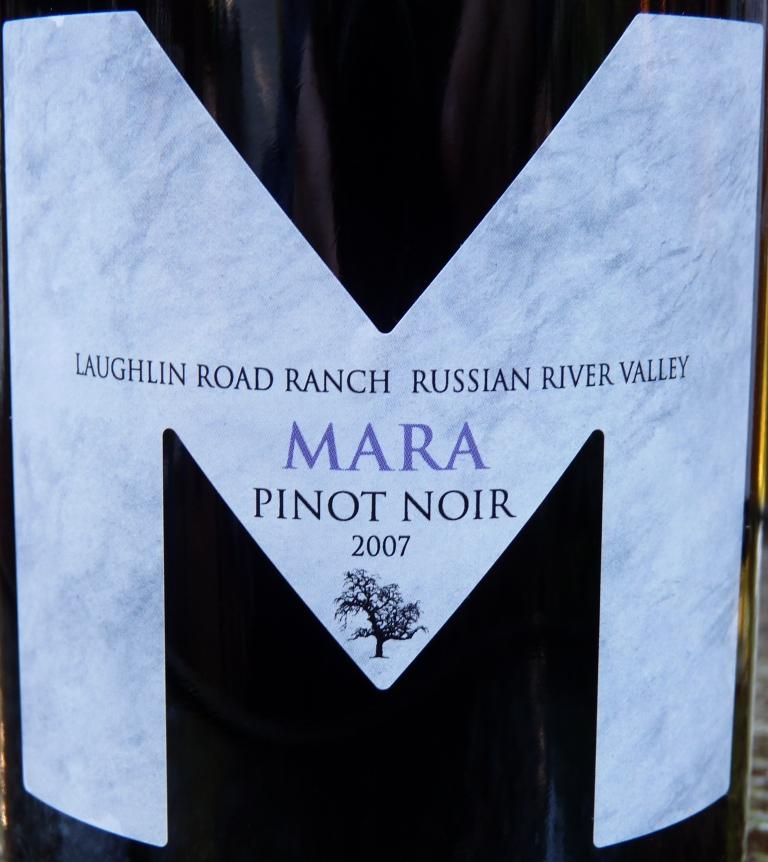
1. Mara Laughlin Road Ranch Pinot Noir 2007, Russian River Valley ($45). Incredibly balanced, silky smooth wine, very powerful and round. Alcohol content is 15.6%, and it can’t be noticed unless you read the label. Great wine now, will improve with some cellar time. Find it if you can.
There were many other wines worth mentioning, and I did my best throughout the year to cover them. The wines in this group delivered special experiences – that’s why they listed here. That’s all, folks – for this post. I will be glad to hear, however, about YOUR special wines and wine experiences from 2010. Speak up – now is the time!
The Wines To Dream Of
 What do you think I plan to talk about? No, we are not going to talk about “best in the world wines” – we did it before, and that discussion is closed for now. In general, does it make sense to dream about some particular wine? There is such an abundance in each and every wine store, what’s that dreaming is all about? Well, first, it is a special time of the year – Holidays, Friends, New Year resolutions, new hopes and new desires – so a little dreaming is appropriate, right? Second, reality is often made out of things which were dreams before. Wine is as good of a material for the dreams as any other object – once you have an opportunity to taste, to experience the wine which YOU will deem “amazing”, it will give you a happy memory you can always come back to. And that is the great quality of the great experiences – they serve as an object of desire, and once achieved, they become a staple for the happy state of mind.
How one can come up with the list of “dream” wines? There are multiple ways to go about it, but for now, let’s just use wine ratings as a reference. More specifically, let’s use wine ratings from the major wine publications – Wine Spectator and Wine Advocate. Both use 100 points rating systems, with 100 being an absolute top rating (many other wine publications use the same 100-points scale). And if we are dreaming, let’s aim high – let only look at 100 point wines.
I can safely assume that you know perfectly well by now my approach to the wine ratings – you are The One who has final say on the wine – good or bad. However, when I look at 100 points ratings from magazines which rate tens of thousands of wines per year, I believe the 100 points represent some higher level of truth. Such ratings are not assigned left and right. If you will search on the Wine Spectator web site, you will find only 73 wines rated at 100 points – so I think this is something we can rely on. To connect the dreams with the reality, at least a little bit, I used one of the recent e-mails form Benchmark Wine Group, which listed available 100 point wines:
Chapoutier Hermitage Le Pavillon 2003 ~ WA100
Chateau d`Yquem 2001 ~ WA100, WS100
Domaine Romanee-Conti La Tache 1990 ~ WA100
Guigal Cote Rotie La Landonne 1999 ~ WA100, WS98
Guigal Cote Rotie La Landonne 2003 ~ WA100, WS98
Guigal Cote Rotie La Mouline 1983 ~ WA100
Guigal Cote Rotie La Turque 2003 ~ WA100, WS98
Jaboulet Hermitage La Chapelle 1978 ~ WA100, WS99
Jaboulet Hermitage La Chapelle 1990 ~ WA100
La Clusiere St. Emilion 2000 ~ WA100
La Mission Haut Brion 1982 ~ WA100
La Mission Haut Brion 2000 ~ WA100
Lafleur 1982 ~ WA100, WS99
Le Macchiole Messorio 2004 ~ WS100
Margaux 1990 ~ WA100, WS98, IWC98
Mouton Rothschild 1982 ~ WA100
Mouton Rothschild 1986 ~ WA100, WS99
Rieussec 2001 ~ WS100
Screaming Eagle Cabernet Sauvignon 1997 ~ WA100
Shafer Cabernet Sauvignon Hillside Select 2002 ~ WA100
Taylor Port 1992 ~ WA100
Valdicava Brunello di Montalcino Riserva Madonna del Piano 2001 ~ WS100
If you are interested in prices, you should check them out on the Benchmark Wine Group web site. Just to give you a range, the cheapest wine in this list is Rieussec at $154 and the most expensive is Domaine Romanee-Conti at $4200.
Will this wines be really amazing? Who knows? Are they worth seeking and dreaming about? You bet. Don’t know about you, but my wish list is ready! Keep on dreaming…
Tasting Series At Cost Less Wines – Part 3, Grand Tasting
 This is the third and last post in the series about tasting events at Cost Less Wines and Liquors. Usually, the word “grand” assumes something of a substantial size, right? With “only” four wines being presented at the tasting, can we really call it “grand”? Yep, judging by the quality of the wines, this event is nothing but the “grand tasting”.
There were four wines in the tasting. The first was Pommery Champagne Grand Cru 1996. It was beautiful, mature “vintage champagne”, which tasted nothing like the regular non-vintage stuff – tremendous level of complexity with nuts and fresh bread presented on the palate in a very concentrated fashion. I have to stress though that vintage champagnes are an acquired taste. My first reaction about 6 years ago was “oh, my, what happened here? People can’t drink that”. And now – yes, just bring it on…
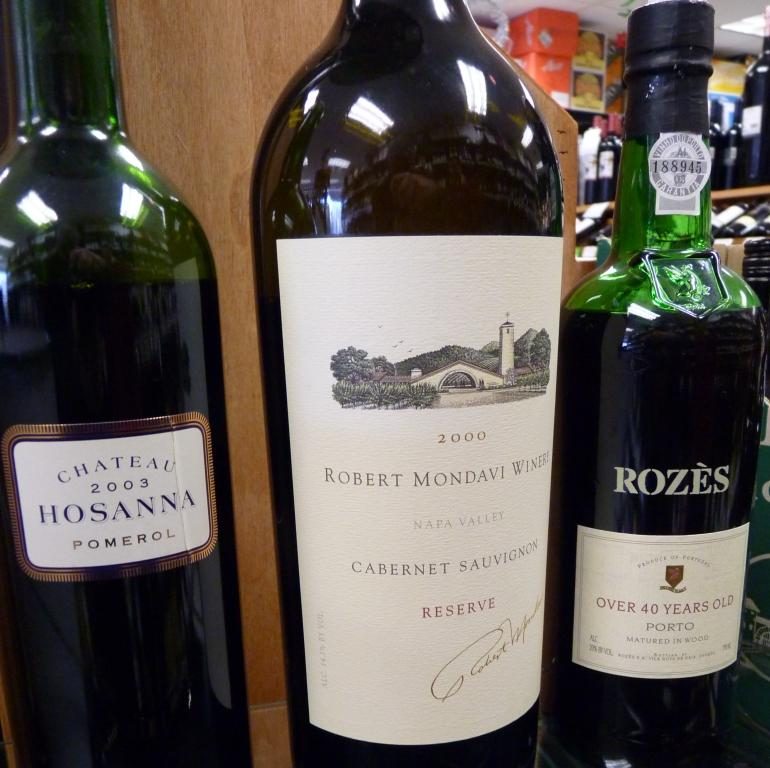
The next wine was Chateau Hosanna 2003. I was warned by Zak (owner of Cost Less Wines) that I would taste something special – I didn’t even expect how special this wine was. This wine comes from the Pomerol region in Bordeaux, and the property is literally bordering legendary Chateau Petrus which makes some of the world’s best (and most expensive) wines. Pomerol wines are Merlot-based, and Chateau Hosanna is a blend of 70% Merlot and 30% Cabernet Franc. This wine was simply amazing. Tremendous balance of fruit, freshness, acidity and tannins, all arranged in the multiple layers with the long finish. The finish was so powerful that it came through even the next wine! This was one of the best wines I tasted in 2010, and I would give it Drinkability rating of 9.
The next wine was also not too shabby – Robert Mondavi Cabernet Sauvignon Reserve 2000, poured from the magnum (actually it was decanted). This was good clean Cabernet Sauvignon, with all classic Cabernet traits – a hint of eucalyptus and black currant, nice and clean. The only problem was – it was no match to Chateau Hosanna, which came right through at the finish (the order of wines was switched later on).
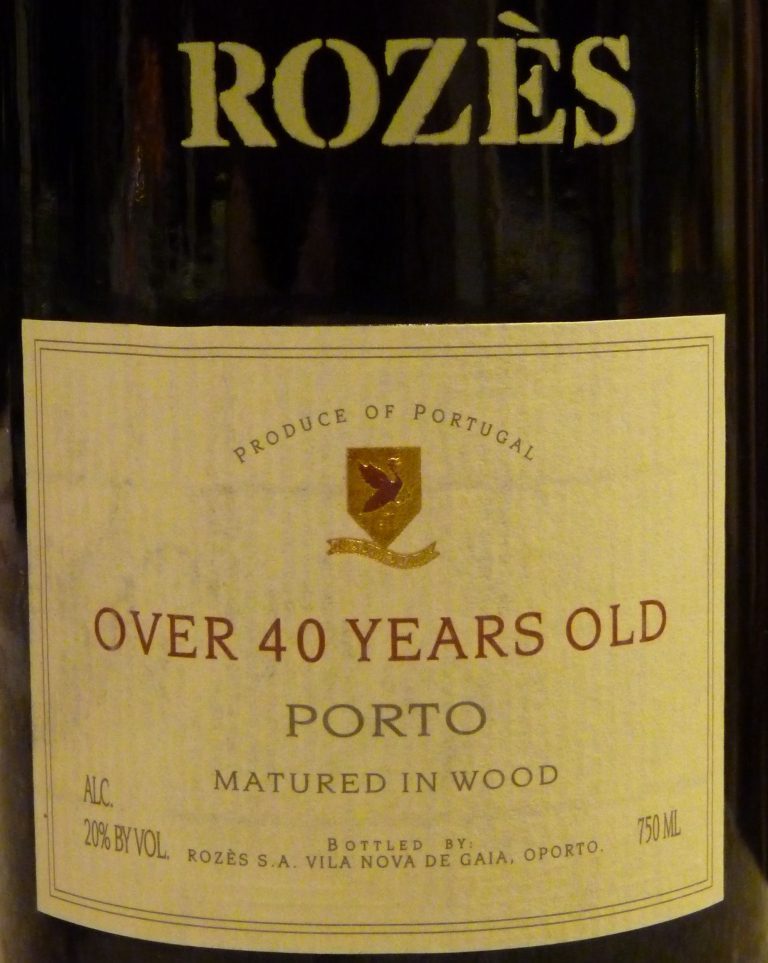 Last but not least – Rozes Over 40 Years Old Port. Generally, I can drink port wines, but it would not be something I would crave – if other choices of dessert wines would be present, like late harvest wines or Sauternes, I would gladly go with those. Anyway, this was true until now… This Rozes over 40 years old Port was unbelievable. I can’t even describe the nose – I can only tell you that it is impossible to let go of a glass. You really don’t want to drink that wine – all you want to do is smell, and smell, and smell. Tremendous. I can’t do justice to that smell by trying to describe it. Once you finally convince yourself to give it a taste, it matches your expectations from the smell. Mature, layered, with honey, nuts and spices, but not overly sweet and not overly alcoholic, very, very balanced. And finish? I can only tell you that this wine stayed in my mouth for the next 15 minutes… Drinkability – 9+. No more words are needed. Find this wine – you will not regret it.
Last thing I want to mention – all the wines represent great QPR. Vintage Champagne at $50, Mondavi Reserve Cabernet at $125, tremendous Bordeaux at $100 and 40 years old Port at $90 – these are great values for the wines of such quality and they shouldn’t be missed. And for me – great wines, great experience – makes me happy!
When Was The Last Time You Had Georgian Wine?
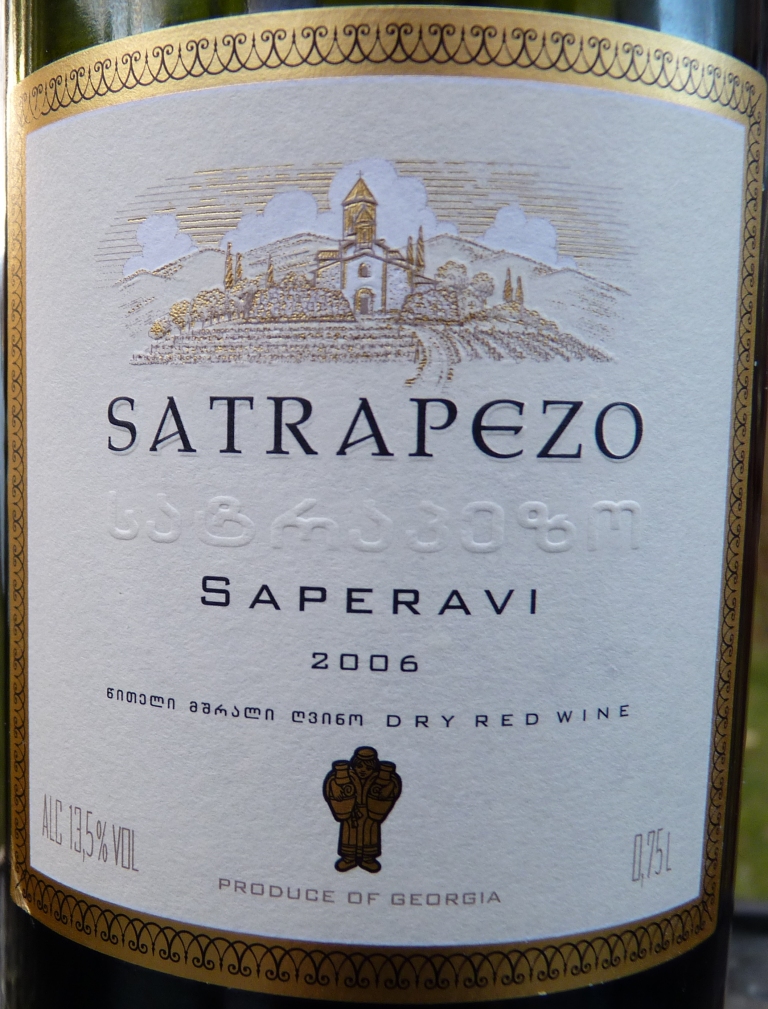 Let me repeat the question – when was the last time you had wine from Georgia? I don’t mean one of the US states down south, I mean the Georgian Republic, the country bordering Russia in South Caucasus. I would expect that for some of you the answer will be “long time ago”, and for many others – never. And this is rather expected, but now is the time to change that.
Based on many sources, Georgia is regarded a birthplace of the winemaking. It is considered that winemaking in Europe goes back 5,000 years. Winemaking in Georgia seems to have a little edge over that with start at around 7,000 years ago. While we appreciate historical references, we are drinking the wines now, so the current state of affairs (I mean, of course, winemaking) is a lot more of interest.
Georgia’s wine industry had been through some rough times, starting with Prohibition attempt in former USSR during the 1980s. After Georgia became an independent country, there was a quick turnaround – for profit, it is. A lot of bad wines were produced in Georgia, and even more false Georgian wines were produced outside of it, to take advantage of historical value recognition of the Georgian wines. Luckily, as capitalism is taking hold in Georgia for good, there is a similar change in the Georgian winemaking, with honest people coming back to make honest wines and restore the “pride of the land”.
Seeing (oops, sorry, I meant tasting) is believing. Tasting the wine called Satrapezo, made from one of the Georgian authentic grapes, Saperavi, completely changed my perception of the Georgian wines, which I was definitely avoiding for a while. This wine is produced at the winery called Marani. Marani is really focused on making great wines, and it is showing in this flagship wine. Beautiful deep garnet color, layers of concentrated fruit (old world mature style, nice and gentle) and silky smooth tannins, balanced with good acidity and a very long finish. This is the wine to enjoy,…and enjoy, …and enjoy. In terms of Drinkability, this is definitely a 9.
 Another example was (totally unexpected to me) sparkling wine called Bagrationi. Made from three authentic grapes ( yay, Treble Journey advance!), Chinebuli, Tsitska, and Mtsvane, this wine had all the classic champagne traits – yeasty nose, hint of apples and fresh bread on the palate, dry and refreshing.
There are a lot more of Georgian wines to discover and enjoy. I’m glad to add Georgia to my personal wine map – and I highly recommend for you to do the same. Go find a bottle of Georgian wine and enjoy the results of 7,000 years of winemaking history!
Swiss Wines and Treble Journey Advance (#278 – #282)
 Last couple of weeks brought a breakthrough in the Treble Journey with adding 11 new grapes, plus 5 more grapes available for tasting. The Treble 300 looks a lot more within the reach than before.
This breakthrough was mainly made with Swiss and Georgian grapes – and I would like to cover each group individually.
It is very difficult to find Swiss wines in US, so it really helps to have friends in the right places. I had an opportunity to try this quite unique wines with the help of my friend Patrick, who once again brought me a few bottles.
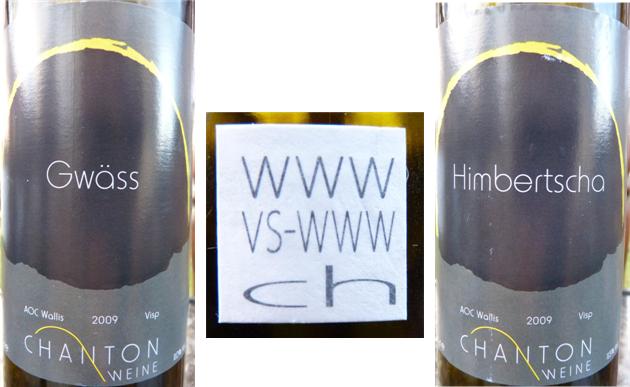
All the wines came from Chanton Visp in the region called Wallis. All three grapes are in the very scarce supply in Switzerland and the wines have very limited production. The first white wine was made from the grape called Gwass. Very dry and almost expressionless (I would call it bone-dry, but without acidity), this wine worked quite well with various Swiss cheeses which were accompanying our tasting.
Second white wine was made from the grape called Himbertscha. This wine was very different from the first one, with good tropical fruit expression on the palate, but without any unpleasant sweetness. Very nice and balanced, it would be perfect wine for the summer day (minor problem – good luck finding this wine in US). I would put drinkability of this wine at 8.
Last but not least in this group was red wine made out of grape called Eyholzer Roter. It is interesting to note minimalistic approach in labeling of this wine – the label is a tiny piece of paper ( half- an-inch by half-an -inch) with web address on it, and even more, this is web site of the ISP, and not of the winery itself. Despite the strange labeling, the wine was absolutely gorgeous – smooth and very playful, with perfect balance of tannins, fruit, earth and acidity, very easily drinkable (bottle ended too fast for some unknown reason…). This was definitely an 8+ wine – and needless to say that I would be very happy to find this wine in US…
Two more grapes are in the mix here. One is a white grape called Avesso, and it was a part of the blend in Portuguese wine called Famega Vinho Verde – simple summer wine with good acidity (it was begging for seafood). Another one was red grape called Monemvasia, which was part of the blend in the wine from Greece called Paros Moraitis Reserve 2006 – bone dry red wine, with some hint of fruit, and very pleasant overall – I would dare to say that this was if not The best, then at least one of the best Greek red wines I ever tried.
Five new wines, five new grapes, and getting closer to the Treble status.
But – it is the time to conclude the Treble Journey report for now, and Georgian wines will be next.
Beaujolais Nouveau 2010 – Live Blog
 What’s up with the “live blog”? No, I don’t plan to show the live recording in the Gary V. style (for those unfamiliar with Gary V. – please go to the Wine Library TV site, I promise you will enjoy it). For all of my posts so far, I don’t write them at the same time as I taste the wine or visiting the restaurant. Yes, I might take some notes, but all of the writing is still done later on, mostly based on the memory (yes, I make an effort to memorize the experience).
However, today is a special day for many wine lovers across the globe. In the 1970s, the tradition started in France, in the appellation called Beaujolais, to celebrate the first wine produced from the harvest of the same year. What was the French national event in the 1970s, now became a worldwide celebration, which always takes place on the third Thursday in November, and today is the day.
Beaujolais red wines are made from the grape called Gamay, and the wines are produced in the style of the neighboring Burgundy (which are made from Pinot Noir), but typically are lighter and don’t age that well.
When it comes to the Beaujolais Nouveau, this wine is made in 6 weeks after the harvest, so it is really light and fruity wine which is not supposed to age (should be consumed by May of the following year). Also, similar to the Pinot Noir wines, Beaujolais wines should be served slightly chilled (about 55F).
Therefore, considering such a special day, I’m writing this blog as I actually try the wines, starting with the opening of the bottles – and this is why I called this blog “live”. I can also tell you that last year, even before I tried the wines from 2009, I read somewhere that they supposed to be very good wines, so I was already influenced as I was trying the wines (read my previous post if you are curious why is that). This year, I have no expectations whatsoever, except the knowledge that these are young wines and they will taste accordingly to the very young age.
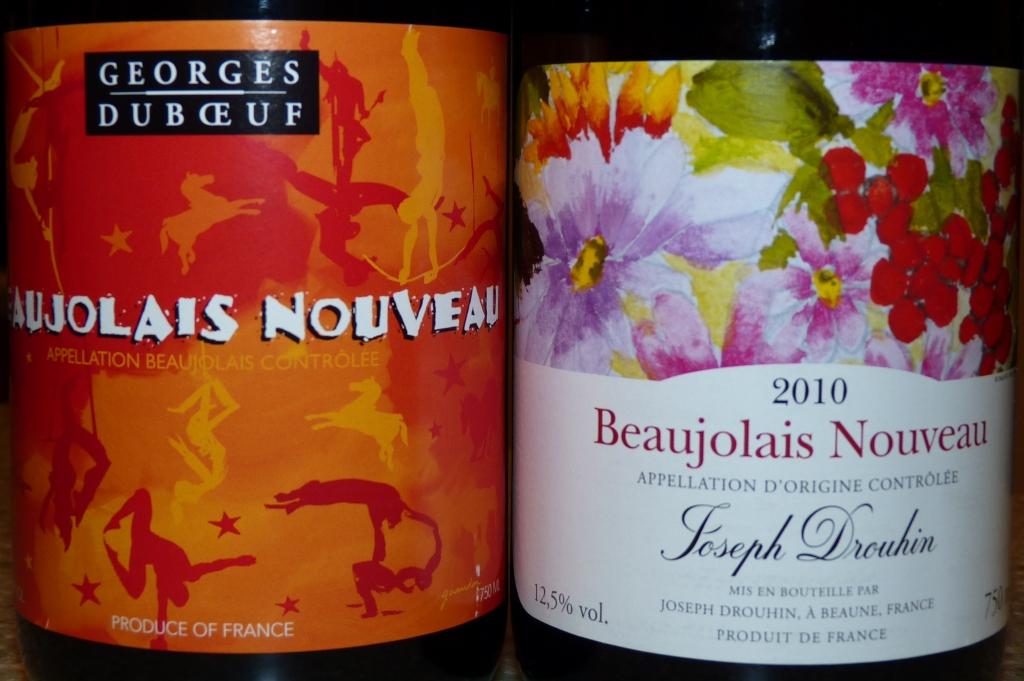
I decided to try Beaujolais Nouveau from two very famous French producers – Georges Duboeuf and Joseph Drouhin. The first producer, Joseph Drouhin used regular cork, and Duboeuf used synthetic one, both corks specifically imprinted for 2010 Beaujolais Nouveau. From the moment the bottles opened, Joseph Drouhin exhibited tremendous aroma of a fresh grape coming strongly right from the bottle, and for Duboeuf the same aroma was also noticeable, but less prominent. From here on, let’s diverge and talk about two wines separately.
Georges Duboeuf. Beautiful very intense dark garnet color. Nose is very solid, doesn’t have any off flavors which are common with very young wines. Cherries and raspberries are noticeable on the nose. With the first sip comes first surprise – the wine has very noticeable tannins. I don’t remember ever tasting the tannins in the Beaujolais Nouveau wines – wonder if this is the style of Duboeuf, but in any case that was a surprise – rather a good one, however. In addition to the cherries I can pick up some plums on the palate, all complemented by good acidity. This wine can be perfectly enjoyed by itself, but will also work very nicely with the wide range of lighter dishes or mild cheese. Considering the price of about $10 per bottle, this wine has great QPR.
Joseph Drouhin. The color is nearly identical – nice deep garnet. Nose is similar to Duboeuf, again without any off flavors. In addition to cherries I would say that there is a hint of strawberries, and again to my surprise, I would probably add a hint of white pepper to that bouquet, which is not something I would typically associate with Gamay grape. On the palate, I would dare to say that this wine has more flavor. I practically don’t pickup any tannins, but instead, there is a great amount of nice supple fruit (again, cherries, plums, raspberries) and very refreshing acidity – oops, and now tannins are coming in approximately 30-40 seconds after the sip of wine. Wow! If the first wine was good, this one is even better – and again, amazing QPR at $11/bottle.
Well, what can I tell you? There is a general sentiment among wine industry professionals that quality of the wines is becoming better and better every year. Tasting these two wines today, I can not agree more. I clearly remember a number of years ago tasting Beaujolais Nouveau with the only one afterthought – “please, I don’t want to ever touch this wine again, and… is it okay to pour the rest of this bottle down the drain?”. My experience this year is totally different. These wines are excellent, and if you didn’t do it yet, you have to go and buy a few bottles… and enjoy! In terms of drinkability, I would rate Duboeuf at 8-, and Drouhin at 8. And, yes, I know it is late, but I need another glass…
Taste Of Wine – Engineering Approach
 You might be baffled by the title of this post, but I promise to explain. I even expect that it will make sense in the end and will not be boring. No, this post will not be talking about kinds of machinery necessary to properly taste wine. Wine, in its seeming simplicity, has a mystic aura surrounding it. Perceived taste of wine is definitely one of the areas where mystery of wine unfolds – and this is what I want to discuss.
Quite frankly, blog post by W. Blake Gray “Why expensive wines taste better: Psychology 101” prompted me to think about subject of taste of wine, and the factors which affect the perceived taste. Being a computer engineer by education, I like to use an orderly approach when a phenomena needs to be analyzed. But wine has nothing to do with computer engineering you contend? True, but it doesn’t mean that we can’t use some interesting tools to put the thoughts in order. As a side note, I want to mention that I have experience successfully using engineer approach in totally non-engineering subjects – in college, together with my friend Alexander (Sasha) we converted whole semester course of philosophy into block-charts, one night before exam. It worked!
Please relax – there will be no block-charts or algorithms in this post. For putting the thoughts in order I would like to use tool from the Mind Mapping category, called FreeMind – you can find it on internet, and if not – send me a message and I will help. This tool allows you to put your thoughts in order, and then do the analysis. How? Let’s see. So here is the group of factors which affect the perceived taste of wine (good/bad, tasty/disguising and so on): Organoleptic (smell, color, taste and so on), Tools which can alter the taste, Expectations and Environment – note, that these are only my thoughts, though. Here is the same – but in the format of the mind map:

What are this “Expectations”, or what does “Environment” means, and do I include screwdriver into the “Tools” and why, you may ask? Let’s add one more level of details and then talk about it. So here is the expanded picture:

Now, there is a lot more we can talk about. Let’s start with expectations. There is a lot of factors which might influence our opinion about the wine by setting our expectations prior to opening the bottle. Do Ratings affect perceived taste of wine? You bet! “Robert Parker gave this wine 97 rating, I’m sure it should taste amazing”. “This wine is rated at 95 by Wine Spectator – I’m sure it will taste great!”. And then it does not – for you personally, it doesn’t. And there is nothing wrong with you – may be you are just in bad mood, or may be this magnificent Cabernet Sauvignon from Napa Valley simply doesn’t work well with Chinese sweet and sour chicken, or may be this is just not the wine you like. Those critics who rated the wine 95 points have to be objective ( this is their job), but you, consumer, don’t have to – like/don’t like is the best rating (we will discuss this in the future).
Where the wine was made (“I love the wines from Napa”, “German wines are the best in the world”…), who made it (“ahh, it is Petrus”, “oh my, this wine is made by Screaming Eagle”) and the price (“I paid $100 for this bottle!”, “yeah, I only paid $10 for this bottle”) – all will (or at least, might) influence the perceived taste. Do other people opinions affect our expectations? Absolutely. What about books, articles and advertisements? Yep, most definitely. However, it is very important to note that the more you learn about wines, and by learning I mostly mean trying different styles of wines coming from different regions, the less “affecting” these factors become.
Will the temperature affect the taste of wine? Of course. Will proper (or improper) decanting affect taste of wine – yes, in many cases. Some of the factors, such as decanting, might affect the taste in the two different ways – one is simply aesthetics, with the expectations are set with the sheer “wow” factor of the proper decanting, and another one is a physical effect, by allowing the wine to “breathe” , open up to reach the optimum flavor profile (yes, there is more to the decanting, but this is not what this post is all about).
We can go and discuss the factors one by one for a long time – it will make this post very long – and probably equally boring. But as we have an advantage of playing with the mind map, let me simply give you more food for thought – here is fully expanded version of this mind map. Remember, it is just a momentary snapshot of your thought process, and it is as fluid as thoughts themselves:
 Before we conclude, I would like to touch on of the important factors which is hiding there in the “Environment” group – blind wine tasting. Of course there are different levels of “blindness”. When you taste the wines as part of the Master Sommelier exams, you have no information about the wine, outside of what you can see, smell and taste. In many other cases, you know only a small piece of information – for instance, tasting the wines during the Windows of the World Wine School classes, we knew the region (Bordeaux, California…), but nothing beyond that. Why it is important to taste the wine blind? It eliminates most of the influencing factors which get in the way of you establishing very simple relationship with the glass of wine you have in your hand – I like it, or I don’t.
Well, I think it is enough for this post. I would love to hear from you – was it boring, was it interesting, am I totally off in my thought process. If you want more information on the mind mapping – I will be glad to send you links. If you want the mind map file for the Taste of Wine – drop me a note, I will be glad to send it to you. And most importantly, tell me your wine tasting stories – and keep learning about the wines!
Last Bottle Sign Up ($10 credit)




 Talk-A-Vino

