Archive
Finally, I’m a Convert
Yes, this will be a post about the wine – what did you think I will be writing about? I completely changed my perception of one wine region, so convert or not, but this is what this post is all about.
Don’t know about you, but when I visit the wine region and wineries in it, I generally come with certain set of expectations, a perceived notion if you will. These perceived notions usually are very opposite and have no middle ground. Perceived notion number one – visiting many wineries, I generally expect to find a lot of wines which I will like, and a few which I will not care for. This would be true for many wine regions in California – Napa, Sonoma, Santa Barbara – but not all of them (for instance, Temecula is not included in that list). Perceived notion number two – I will not care for the most wines I will be tasting, but if I’m lucky, there might be a few wines which I will like. Connecticut wine region would be a good example of this second group – but we will talk about it later in a separate post.
Of course both of this perceived notions are founded based on the prior experience with the wines of the region, both at the winery and outside. It is easy to build – just visit a few wineries, where you don’t like the wines, or buy a few bottles in the store which you will not care for, and that’s enough to label the whole region as “not my thing”. Once the perceived notion is born, it is very hard to overcome and change. I agree that this sounds very shortsighted, but this is how we are [very commonly] wired – try something once, don’t like it (think about first time your mom forced you to eat broccoli), and you might be set in your “unlove” for life. This “tried this, didn’t like it, never again” type of attitude is never practically helpful around food and wine, as it prevents us from having great experiences. This perceived notion is hard to get rid of – but not impossible if you are willing to take an “open mind” approach – try and try again, until a specific experience will trigger the change.
Okay, done with the philosophical intro, let’s get to the conversion details. The region I finally changed my view on is Finger Lakes. During multiple visits over the few years, I kept trying and trying new wineries, only to come up to the same resolution every time – “nope, not my wine” – and that included even Riesling, which is considered the signature wine of the Finger Lakes region. Then I discovered wines of Fox Run and Dr. Konstantin Frank, which created a crack in my preconceived notion. The Finger Lakes #winechat I took part of in May, made the crack wider. But what made me to change the whole perception were the wines of Villa Bellangelo.
Villa Bellangelo is a small producer, located in a close proximity to the Seneca Lake. The family owned winery produces a number of different Rieslings, as well as Chardonnay, Gewurztraminer, Merlot and other wines. About two month ago, I received a sample set of wines form the Villa Bellangelo, 5 bottles of Riesling and a bottle of Chardonnay. As I mentioned in some other posts, while samples sound great (“yay, free wine!”), to me they are more challenging to deal with than the regular wines I buy. I would not crack a sample bottle just casually in the evening – I need to make sure I can give it my undivided attention and spend time with the wine – thus it often takes me quite some time to find the right opportunity. Finally, the moment presented itself and I opened the first bottle of Riesling. Pour, sniff – delicious, take a sip – wow. Clean and beautiful Riesling, perfectly fitting my definition of “classic Riesling”. Next bottle, then next – all 5 Rieslings and the Chardonnay delivered lots of pleasure, sip after sip, bottle after bottle. 6 out of 6? I think this is very convincing performance, hence the title of this post and yes, the change in the perceived notion.


For what it worth, here are the notes on all 6 wines:
2012 Villa Bellangelo Dry Riesling Finger Lakes (12.3% ABV, $19) – Color is lighter than straw pale. On the nose, great Riesling aromatics, classic, honeysuckle, pear, fresh apple. palate is dry, clean, great acidity, very light, green apple, super-refreshing, present minerality, short finish. A wine of a great quality. Drinkability: 8-/8
2013 Villa Bellangelo Dry Riesling Seneca Lake Finger Lakes (11.3% ABV, $19) – Beautiful nose of the white stone fruit, hint of honeydew sweetness. Perfectly balanced on the palate, crisp acidity, minerality, touch of green apple. Excellent overall. Drinkability: 8
2012 Villa Bellangelo Semi-Dry Riesling Finger Lakes (11% ABV, $19) – Nice straw color. Pleasant nose of white apples and touch of apricot. Palate exhibits good acidity, good balance, hint of sweetness and white stone fruit. This wine is showing better once it warms up a bit (not straight from the fridge), which I find interesting. Drinkability: 8-
2013 Villa Bellangelo Semi-Dry Riesling Finger Lakes (10.8% ABV, $N/A) – Open nose of apricot and white peaches. Palate has nice level of sweetness, supported by good acidity. Very refreshing and a pleasure to drink. Drinkability: 8-/8
2012 Villa Bellangelo 1866 Reserve Riesling Finger Lakes (11% ABV, $32) – This wine is a dedication to the Dr. Byron Spence, who in 1866 planted 20 acres of the sloping western hills of Seneca Lake with the wine grapes. This vineyard is where the Villa Bellangelo makes their best wines from, hence the 1866 in the name of the wine.
The wine had a beautiful light golden color. Classic Riesling nose, with honeysuckle, white peach, apricot, all very subdued and delicate; touch of minerality. On the palate, apricot notes together with a touch of the apricot pit bite, touch of white apple, clean and vibrant acidity, present minerality, perfect balanced and nice complexity on the finish. Drinkability: 8/8+
2012 Villa Bellangelo Chardonnay Finger Lakes (13.8% ABV, $20) – Outstanding. Perfect Chablis-like, complex nose – minerality, distant hint of gunflint, touch of fresh apple. Palate is clean, balanced, with white apple and vanilla notes, vibrant acidity. Drinkability: 8
There you have it, my friends. One winery, which finally did it for me. Now Finger Lakes is squarely on my “yes, I love those wines” list. I don’t know what is your opinion about Finger Lakes wines, but if you were like me, find some Bellangelo wines and see if they will make you a convert. Cheers to the great wine discoveries!
#winechat Finger Lakes Wine Tasting – An Interesting Experience with Happy Ending
Here we go again – another #winechat experience. Lots of wines and lots of talking – with your fingers. The subject of this #winechat – wines of Finger Lakes region in New York.

Finger Lakes is a picturesque area in the upstate New York, very close to Canada, consisting of multiple lakes – technically, Finger Lakes consists of 11 lakes, but most of the people will be able to name only 3 or 4. Outside of being a popular tourist destination, Finger Lakes is actually one of the very first wine making areas in the US – the first winery was established in 1836, and by now the region has well over a hundred wineries.
Despite such a long history, the wines of the Finger Lakes region are still considered up and coming. For the most of the cases, consumers might be familiar with Finger Lakes Riesling, a bit of Gewurztraminer and some of the Icewine, with the Finger Lakes wines mostly available only in New York and some of the neighboring states. As of late ( last 2-3 years) the situation is slowly changing for the better, both in regards to quality and availability of the Finger Lakes wines. It is also important to note that the improvements I’m talking about concern both white and red wines, with the wineries such as Fox Run, Ravines and Charles Fournier delivering full spectrum of wines worth drinking and talking about.
When I got a note about #winechat dedicated to the Finger Lakes wines, I was hesitant at first regarding my participation. The reason was simple. Yes, the quality of the Finger Lakes wines is improving. However, about 4 years ago, when my daughter was going to Ithaca college, located right by the Seneca lake, I visited few of the nearby wineries, and was quite disappointed with the wines I tasted. Therefore, the prospective of tasting bunch of wines and not being able to write anything about them, was rather daunting. After the internal back and forth, I decided okay, let’s give it a try, and signed up for the #winechat. A few weeks later, the box arrived, containing the 8 bottles – 3 different Rieslings, 3 Chardonnays and 2 Gewurztraminer. From the whole set, I only recognized the name of Dr. Konstantin Frank as a producer I heard of before ( I never tried Gewurztraminer which was included in the tasting set).
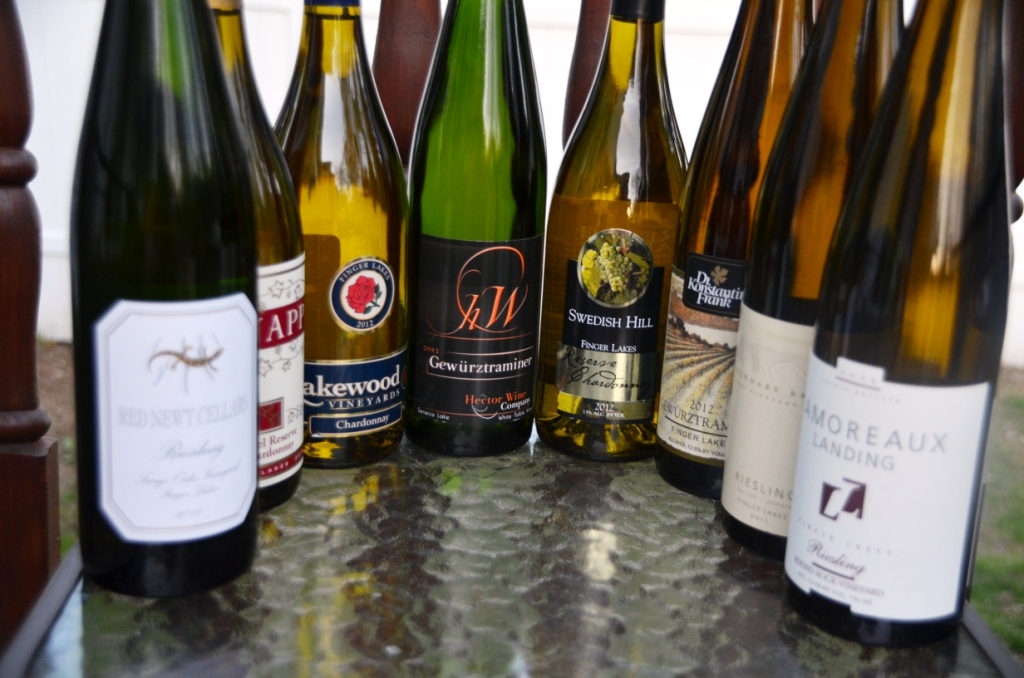
About a week later, it was the time to taste the wines. I freed up the space in the fridge and put all the bottles in to get them ready.
Talking about an “interesting experience”, let me explain what I mean (yes, I know – somehow, when you read “interesting”, you don’t expect anything good). The #winechat usually starts at 9 PM. But of course it would be quite challenging to taste 8 wines in the real time, take notes, and support many simultaneous “finger” conversations at the same time. Therefore, I decided to start an hour before, so I would have enough time to taste all the wines in the thoughtful fashion. I invited my friend Zak to share the tasting with me. We started from the Rieslings, then moved on to Chardonnays, and finished with Gewurztraminers. The first Riesling was okay, but then everything went downhill – the wines were simply from the series “nothing to write home about”, with the exception of Dr. Konstantin Frank Gewurztraminer – that was one and only highlight of the tasting. We kept looking at each other with Zak in disbelief, as this was definitely not expected from the set specially selected for the tasting. Needless to say, at the end of the tasting (I managed to participate in the chat, albeit not as enthusiastically as I normally would), I was rather disappointed. And I had 8 wines to finish or dump. What I decided to do, is to put them aside, and give them another chance, one by one. I used the gas canister (not sure I had much gas left though) to replace the air in all the bottles and put the corks back. One bottle went into the fridge, and the rest were standing, waiting for their term.
Now, for the really interesting part. The next day or a few days later, all, yes all the wines (okay, exclude Dr. Konstantin Frank from here, as it was good from the beginning) tasted better! I couldn’t believe it, and I couldn’t understand it – but they did. Better fruit, better balance, softer, smoother – all of them. Well, thinking about it, the Rieslings only improved a little bit or not at all, but the improvement was very noticeable for all Chardonnay wines. Giving it another thought, I think I’m finally starting to “get it”. When I open a bottle of wine, taste it and decide that it is not ready because it is too tight and closed, I’m generally not surprised, I ofthen expect it, and I put it aside to give a day or a few to open up without any commotion. In case of this Finger Lakes tasting, I had multiple wines opened at the same time, and especially all of the Chardonnays had the nice oak treatment, thus required time to open up – this is not my typical case, hence the issues I had. So bottom line is that I was [again] humbled around wine, and still have lots to learn. Well, not the worst problem to have in life, isn’t it?
I will let you decide how “interesting” my experience was. Below you will find tasting notes, both the initial ones, and those I added after re-tasting the wines in a few days.
Here we go:


2012 Red Newt Cellars Tango Oaks Vineyard Riesling (11.5% ABV)
C: practically clear
N: Initially: golden delicious apples, a bit grassy; 2/3 days later: white fruit
P: Initially: high acidity, not enough fruit, tropical fruit, mango; 2/3 days later: white flowers, hint of sweetness on the palate with nice acidity and addition of minerality.
V:nice, simple, 7/7+; Final: 7+/8-
2012 Lamoreaux Landing Wine Cellars Round Rock Riesling (12.7% ABV)
C: practically clear
N: Initial: candied walnuts, Later on: light, delicate, good white fruit
P: Initial: white fruit with grassy notes, minerality; Later on: a distant hint of Petrol, clean and fresh acidity, elegant, well balanced.
V: Initial: 7+, Final: 7+/8-
2011 Boundary Breaks Riesling Reserve #198 (8.9% ABV)
C: practically clear, almost transparent
N: Petrol (hint of)! white fruit, apricot, honeysuckle.
P: sweet (spatlese or may be even auslese level), needs more acidity, but not bad
V: needs savory food, 7/7+


2012 Knapp Barrel Reserve Chardonnay (13% ABV)
C: straw pale
N: Initially: closed, practically nothing. Later on: nice apple notes, touch of vanilla, pleasant and inviting.
P: Initially: touch of pineapple, white apples, neutral – drinkable, but not fully enjoyable. Later on: nice, cutting acidity, backbone of white fruit, touch of herbal bitterness, but quite round and refreshing. Minerality on the palate, like a limestone. Medium finish,
V: 7, Final: 7+/8-
2012 Lakewood Vineyards Chardonnay (13,9% ABV, 617 cases produced)
C: straw pale
N: Initially: minerality, pretty closed otherwise. 3 days later: very classic nose, with vanilla and toasted oak, nice and clean.
P: Initially: flat, malolactic obvious, touch of vanilla. After 3 days: excellent flavor concentration, good acidity, butter and vanilla, medium to full body, good balance.
V: initially: 6-, final: 7+/8-
2012 Swedish Hill Winery Reserve Chardonnay (13% ABV)
C: straw pale
N: Initial: hint of gunflint, minerality, white fruit. Later: Vanilla and oak, very inviting, with Chablis-like gunflint
P: Initial: oak, vanilla, flat, needs more acidity fruit, opened up reasonably , improved with time, butterscotch, still needs more acidity; 3 days later: great concentration of vanilla, apple and butter, nicely balanced with very persistent depth.
V: 7+, Final: 8-


2012 Hector Wine Company Gewurztraminer
C: Golden color
N: Initial: Beautiful, concentrated fruit; Later: Very pleasant nose of tropical fruit with some spiciness – guava, mango.
P: Initial: Lots of green notes, bitter, biting, not balanced. After 3 days: bitterness subsided, with only a hint left.
V: 6, Final: 7-
2012 Dr. Konstantin Frank Vinifera Wine Cellars Dr. Frank Gewurztraminer (12.5% ABV)
C: golden
N: beautiful fruit, inviting
P: perfect balance, fresh fruit, touch of spiciness, best of tasting
V: 8-
There you have it, my friends. To tell you the truth, I had a different take on the events in the tasting initially, but I’m glad I was able to figure it all out. And this story did have happy ending, as practically all the wines showed very well. Lessons learned – be humble, and give your wines a chance [to breathe].
Before we part, I would like to thank Finger Lakes Wine Alliance for providing the sample for review. Cheers!
Wines, Wines, Wines
A couple of weeks ago, an interesting (concerning, rather?) thought came in – this is the wine blog. I’m doing my best to keep you entertained and informed, with all the weekly quizzes and potpourri wine news (a.k.a. Wednesday’s Meritage), but I don’t do enough of the core wine blogging stuff – namely, the wine reviews. No, I don’t have a plan to address this radically – say, but introducing a new weekly topic or so. But during the past month, I had quite a few wines worth talking about, so this is exactly what I’m going to do – write a post to review those wines. Well, yeah, I guess you are already reading this very post… The usual warning – there will be pictures,… many pictures…
It is still summer, so let’s start with super-quaffable Prosecco. It is not even Prosecco, it is pretty much a complete cocktail in the bottle. The wine is made by Mionetto, a well known Prosecco producer in Valdobbiadene region in Italy.
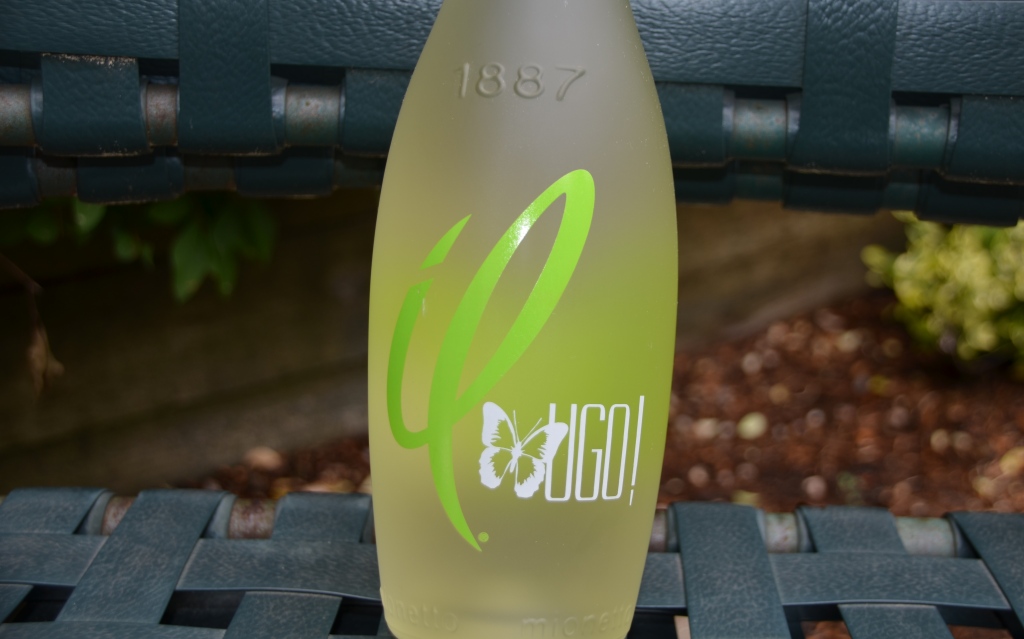
Mionetto Il Ugo
Mionetto Il Ugo, a blend of Prosecco with elderflower blossoms and wildflowers – bright and uplifting on the nose, touch of sweetness with a charismatic bitterness and enough acidity – it is so refreshing, you don’t want to put the glass down. Yes, I know, the purists will disagree – but this is an outstanding wine in my book. Drinkability: 8
Now, a couple of value wines for your consideration. These wines come from Chile under the brand name of the Beach Kite. While you can’t find this information on the wine label, Beach Kite is presumable affiliated with 90+ Cellars. 90+ Cellars has a similar model of operation to Hughes Wines and Oriel (at least the two that I’m familiar with), which is: find good wines which well-known wineries have a hard time selling, bottle under your own private label, and sell for the reasonable price at around $20. Beach Kite seems to be more of a “second label” to the 90+ Cellars wines, considering the price of $7.99 per bottle. But – don’t judge the wine by its price.


2012 Beach Kite Sauvignon Blanc Central Valley Chile (13% ABV) had herbaceous nose, and zesty grapefruit on the palate, a bit more restrained compare to the typical New Zealand Sauvignon Blanc, but still fruit forward next to Sancerre. Refreshing, with good acidity. Drinkability: 7
2012 Beach Kite Pinot Noir Central Valley Chile (13% ABV) – simple, round, good red fruit on the nose and the palate, touch of plums, good acidity – perfect sipping wine for a hot summer day. Drinkability: 7
Next I want to talk about few wines, sorted by the grape.
Riesling
While this is not how I rate the wines, but I would say that I had two Rieslings which were outstanding, and one which was … just spectacular.
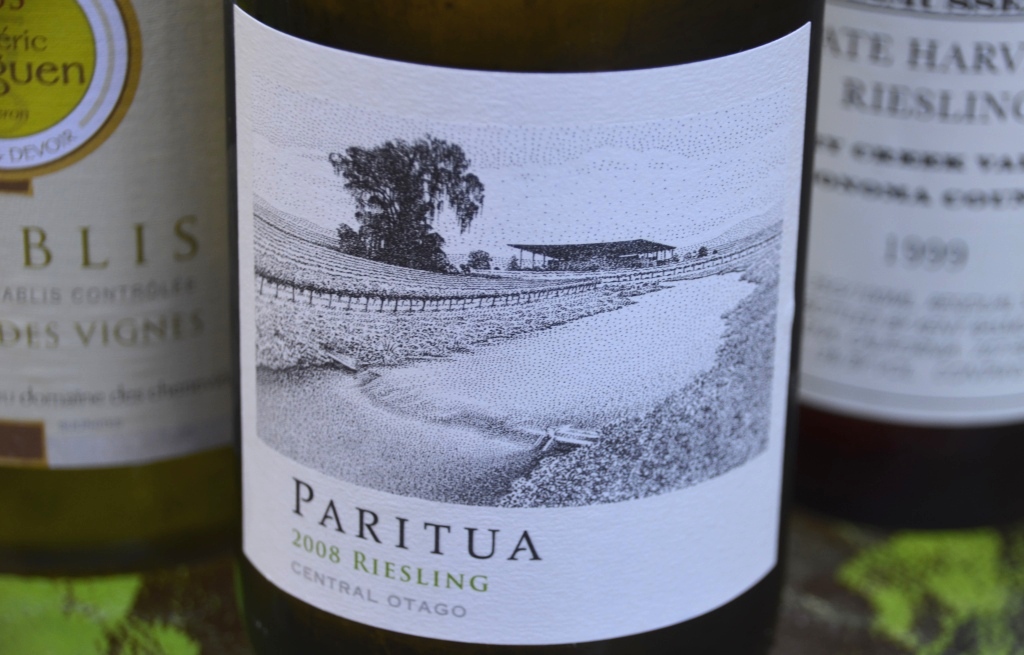
Paritua Riesling Central Otago
2008 Paritua Riesling Central Otago New Zealand (11.5% ABV). I got this wine for $6/bottle at Last Bottle Wines. I was questioning myself a bit when placing an order for this wine, as I never heard of Riesling from Central Otago – a region in New Zealand known for their world-class Pinot Noir, but not Riesling. I’m glad I took my chances and got this wine, as it was outstanding. Perfect ripe peach flavors on the nose with the hint of petrol (yes, I know some people are not very happy about this flavor, but I personally love it). Very delicate on the palate, with some honey and apricot notes, perfect acidity and very restrained sweetness. This New Zealand Riesling would rival many of the German Rieslings at Kabinett level. One night we had it with Thai food, and [as expected] it paired perfectly. Drinkability: 8


2005 Eitelsbacher Karthauserhofberg Riesling Spatlese Mosel-Saar–Ruwer (9% ABV) – what I value the most in Riesling (any Riesling) is balance. My sweet tooth is not any smaller than the one any sweets lover would have out there. But I can’t take bottomless sweetness in the wine – I need acidity to come and play it supportive and refreshing role right next to the sweetness. This Riesling is perfectly balanced, with excellent acidity – and showing no signs of age. Just had an interesting revelation – may be I should replace my “drinkability” ratings with “quaffability”, as this wine was not just drinkable, it was perfectly quaffable. Anyway, I digress. This is not the first Riesling I had from Eitelsbacher Karthauserhofberg – and it seems to be a very interesting winery – but I need to refer you to the Riesling expert Oliver TheWinegetter if you want to learn more. Here is a link to the comment Oliver left on one of my previous posts where he is talking about this winery. Drinkability: 8+

Kurt Rasmussen Late Harvest Riesling
1999 Kurt Rasmussen Late Harvest Riesling Dry Creek Valley (13%ABV) – I’m not sure I can do justice to this wine trying to describe it. In a word – spectacular. Liquid viscous dark gold in the glass, honey, honeydew, caramelized pecan, apricot notes all over, both on the nose and the palate – and perfectly balanced (I’m know I’m abusing this one), with still bright supporting acidity. Drinkability: 9
Next up – Gewurztraminer
To be honest, I don’t drink Gewurztraminer all that often. I find a lot of Gewurztraminer wines to be all over the place in terms of taste – many of them have wonderful nose, but then on the palate the wine often doesn’t appear to be “together”, it shows up quite disjointed. But – not this wine.
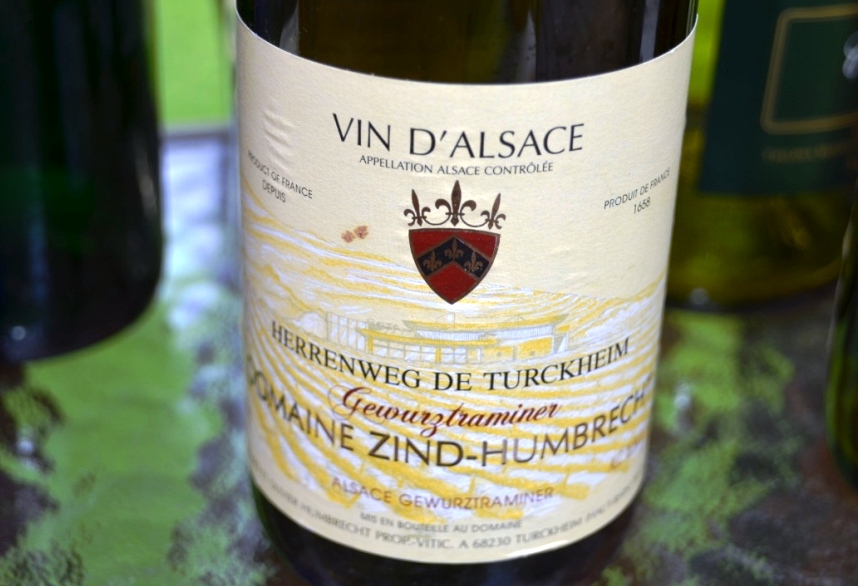
Zind-Humbrecht Gewurztraminer
Domain Zind-Humbrecht is one of the best producers in Alsace, probably best known for its Pinot Gris wines. Just to put things in perspective, 36 wines of Domain Zind-Humbrecht have classic ratings from Wine Spectator (95-100), including perfect score 100 point 2001 Pinot Gris. Well, this is not the wine I’m talking about here.
2002 Domaine Zind-Humbrecht Herrenweg de Turckheim Gewurztraminer Alsace (15.5% ABV) – I got two bottles of this wine at Bottle King in New Jersey on a big sale for about $20 each – this wine typically retails for $60 or so. I had a bottle few years back, and was not impressed. So when I pulled this bottle out, I was not expecting much ( it was more like “yeah, let’s free some space in the wine fridge”). My, was I wrong! In one word, I have to use again my abused wine definition of the day – spectacular. Dark golden color, beautiful nose of candied apricot, perfect honey tones on the palate, fresh acidity, more candied apricot, perfectly balanced. Drinkability: 9
Food break
Tired of wine? Let’s make a short break for some food pictures. First, I promised to Food and Wine Hedonist that when I will make Elotes according to his recipe, I will share my impressions. Elotes is Mexican street food which is essentially a grilled corn with spicy mayo and Cotija cheese – this is precisely what I did and it was tasty! For the recipe, use the link above, and here are the pictures:


Yes, I continue admiring my “mangal”, a special charcoal grill – here are few pictures for your drooling pleasure:


You know what – I think this is enough for one post. Let’s stop here. In the next post – Chardonnay, Cabernet Franc, Pinot Noir and may be something else.
To be continued…
Wednesday’s Meritage – Wine Quiz Answer, Transportation Challenge Round Up, Cabernet Day, Can We Resurrect #WBW?
 Meritage Time!
Let’s start with the answers for the wine quiz #64, Grape Trivia – Riesling. In that quiz, you were supposed to answer 5 questions regarding Riesling grape.
Here are the questions, now with the answers:
Q1: Riesling is a very popular grape in US and Canada, growing in many regions. Considering the plantings of the Riesling in the regions, can you sort the list below from the biggest area plantings to the smallest?
a. California, b. New York, c. Ontario, Canada, d. State of Washington
A1:correct sequence is Washington, California, Ontario, New York
Q2: Have you heard the term “noble rot”, which is often associated with certain types of Riesling? Can you explain what this term means and to which Riesling wines it is typically applicable (at least in Germany)?
A2: Noble Rot is actually a grape fungus, officially called Botrytis Cinerea, which affects a number of different grapes and leads to subsequent shriveling (drying) of the grapes while on the vine. This drying of the grapes tremendously concentrates sugars, which allows for the grapes to be used in production of the sweetest of all Rieslings – Trockenberenauslese.
Q3: Riesling is known for sometimes developing a specific aroma which has typically nothing to do with the wine – but it is not a fault. Do you know what aroma is that?
A3: Petrol. Believe it or not, but many Riesling wines (in some rare cases, even Riesling wines outside of Germany) can develop this petrol aroma. It is usually perceived only on the nose, and it doesn’t give you a feeling of being at the gas station – it is just a light hint, but when it is present, you can safely guess your wine being Riesling even in the blind tasting.
Q4: Name one major(!) wine producing country which doesn’t produce any Riesling wines.
A4: Spain. Spain is a home to the plenty of wonderful white grapes – but it doesn’t produce any Rieslings at all.
Q5: If you look at the bottle of German Riesling, you will typically see the word such as Kabinett or Spatlese written on the label. Such words typically indicate the level of sweetness you should expect from wine – even though this is not a precise definition, as these words only indicate sugar amount in the freshly pressed grape juice – the level of sugar in the resulting wine can be quite different depending on the way the fermentation is done. Can you sort the following list of these key indicators from the lowest sugar content to the highest?
a. Auslese, b. Berenauslese, c. Eiswein, d. Kabinett, e. Spatlese, f. Trockenberenauslese
A5:The correct line up is Kabinett, Spatlese, Auslese, Berenauslese/Eiswein, Trockenberenauslese (if you need full level of details, you can always go to Wikipedia).
It seems that the first question proved to be most challenging of all, as nobody was able to provide the right answer – as the result, we don’t have a winner this week. At the same time, The Wine Getter and Foxress both get an honorable mention with 4 correct answers out of 5.
Now, to the interesting stuff around the vine and web!
First of all, I want to bring to your attention a roundup of a Monthly Wine Blogging Challenge started by Jeff (a.k.a. The Drunken Cyclist). About a month or so ago, Jeff announced a wine blogging challenge based on the theme, similar to the challenges which are popular among photography bloggers. The first theme was Transportation, and the idea was to write the wine blog post which would relate to the designated theme. 10 wine bloggers participated in this challenge, and you can find links to all the blogs posts in this round up. I think this is a great idea and I hope more wine bloggers will participate next time.
Who remembers the Wine Blogging Wednesdays (#WBW)? Similar to the challenge I mentioned above, the WBW events had a theme, which in the most cases was a grape, a type of wine or a wine region, and they also had a host. The host was typically the one who suggested the original theme, and also it was the host’s job to provide a roundup of all the submitted blog posts. These #WBW events had a very good run of almost 8 years, and there was a dedicated web site which is still somewhat accessible. I think it might be cool to bring the #WBW events back – in case you experienced any of them, feel free to comment – do you think Wine Blogging Wednesday events should be resurrected?
Last but not least – the Cabernet Day is coming! Well, not tomorrow – but August 29th is the day. And you know how it works – the summer will be over in a blink, so it is never to early to prepare for celebration of such a noble grape as Cabernet. Here is the link to the invitation I received for the this Cabernet Day – join the festivities!
That’s all I have for you for today, folks. The glass is is empty – but more Meritage is coming. Cheers!
Weekly Wine Quiz #64: Grape Trivia – Riesling
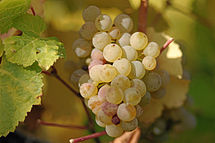
Ripe Riesling Grapes, as captured in Wikipedia
Welcome to the weekend and your new wine quiz!
And the moment you’ve being waiting for is here – as promised, we are switching to the white grapes! For the next 10 or so quizzes, we will be talking about white grapes. And we are starting with nothing less than the Riesling!
Riesling is one of the major white grapes (that “major” list typically includes Riesling, Sauvignon Blanc and Chardonnay) with long and somewhat turbulent history. The first official mentions of Riesling appear 1400s in Germany and then Alsace. From there, Riesling had been growing in popularity for the long time, about 100-120 years ago even surpassing red Bordeaux wines both in price and demand. Unfortunately, with prolonged wars and also subsequent Germany’s focus on quantity instead of quality in the middle of 20th century, Riesling lost its leadership position and currently is engaged in the uphill battle to regain its old popularity.
Overall, Riesling is considered to be very terroir-driven (similar to Pinot Noir), which you can easily see just by trying, for instance, German, Australian and Alsatian Rieslings side by side – you might perceive them as completely unrelated wines. Substantial acidity makes Riesling very food friendly (it is one of the most versatile white wines) and also allows it to age for a very long time – even 100 years would not be unheard of. Riesling is quite popular world-wide, growing in pretty much all major wine producing countries and slowly but steadily increasing both in terms of production and acreage.
Let’s get to our quiz, shall we?
Q1: Riesling is a very popular grape in US and Canada, growing in many regions. Considering the plantings of the Riesling in the regions, can you sort the list below from the biggest area plantings to the smallest?
a. California
b. New York
c. Ontario, Canada
d. State of Washington
Q2: Have you heard the term “noble rot”, which is often associated with certain types of Riesling? Can you explain what this term means and to which Riesling wines it is typically applicable (at least in Germany)?
Q3: Riesling is known for sometimes developing a specific aroma which has typically nothing to do with the wine – but it is not a fault. Do you know what aroma is that?
Q4: Name one major(!) wine producing country which doesn’t produce any Riesling wines.
Q5: If you look at the bottle of German Riesling, you will typically see the word such as Kabinett or Spatlese written on the label. Such words typically indicate the level of sweetness you should expect from wine – even though this is not a precise definition, as these words only indicate sugar amount in the freshly pressed grape juice – the level of sugar in the resulting wine can be quite different depending on the way the fermentation is done. Can you sort the following list of these key indicators from the lowest sugar content to the highest?
a. Auslese
b. Berenauslese
c. Eiswein
d. Kabinett
e. Spatlese
f. Trockenberenauslese
Good luck, enjoy and have a great weekend! Cheers!
Last Bottle Sign Up ($10 credit)




 Talk-A-Vino