Archive
One on One with Angelina Jolie and Brad Pitt, The Winemakers
Do you really think I managed to get face time with Angelina Jolie and Brad Pitt? Or at least a Skype interview? A phone call? Yeah, none of the above, you are correct. But – as it was announced a while back, they joined the ranks of celebrity winemakers with the release of their first wine from Château Miraval, a property in Provence, which they acquired a few years ago – and considering that they both participated in the tasting and selection of the final blend, I think the title of this post stands as appropriate. Well, yes, they didn’t make the wine all by themselves – they got some serious help by partnering with Marc Perrin of Château de Beaucastel in Châteauneuf-du-Pape, so the wine officially lists Jolie-Pitt & Perrin on the back label.
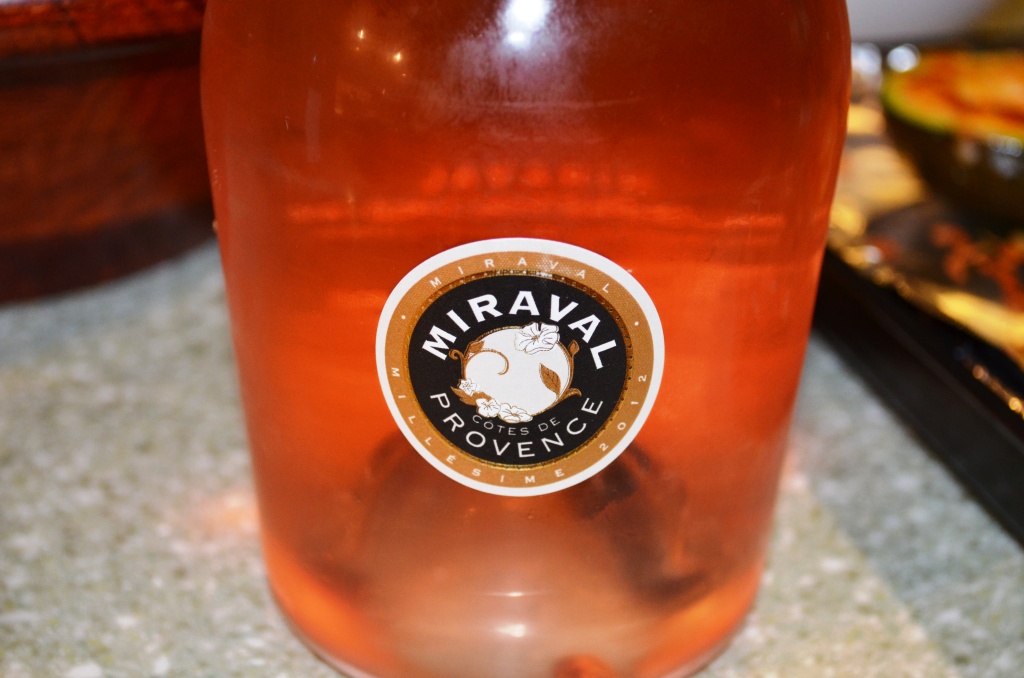
Miraval Rosé
Before we will talk about the wine, I want to mention that Château Miraval has very interesting history – in the 1970s, it belonged to the famous jazz musician Jacques Loussier, who converted the chateau into the recording studio. Many famous musicians, such as Pink Floyd, Sting and others, used that studio to produce their albums.
Now, let’s get to the wines. While celebrity status of winemakers is nice, in the end of the day, I care about content of my glass. So in this particular case, I wanted to have some frame of reference – of course in the form of another wine. As Miraval Rosé comes from Provence, I wanted to compare it with another Provence Rosé. Looking at the wide range of Rosé available, my eyes stopped at the label. Whispering Angel. I think I heard it somewhere. And it is from Provence. Problem solved – I got my second Rosé, and the battle (okay, it is only two, so let’s call it a mini-battle) of Rosé was set.
Then I found out that I have chosen well. It appears that Whispering Angel Rosé was a hit of 2012, and it was literally impossible to get it last year. Thus it was very interesting to see how the two will fare, and how the arrival of the Miraval might affect the cult status of the Whispering Angel.
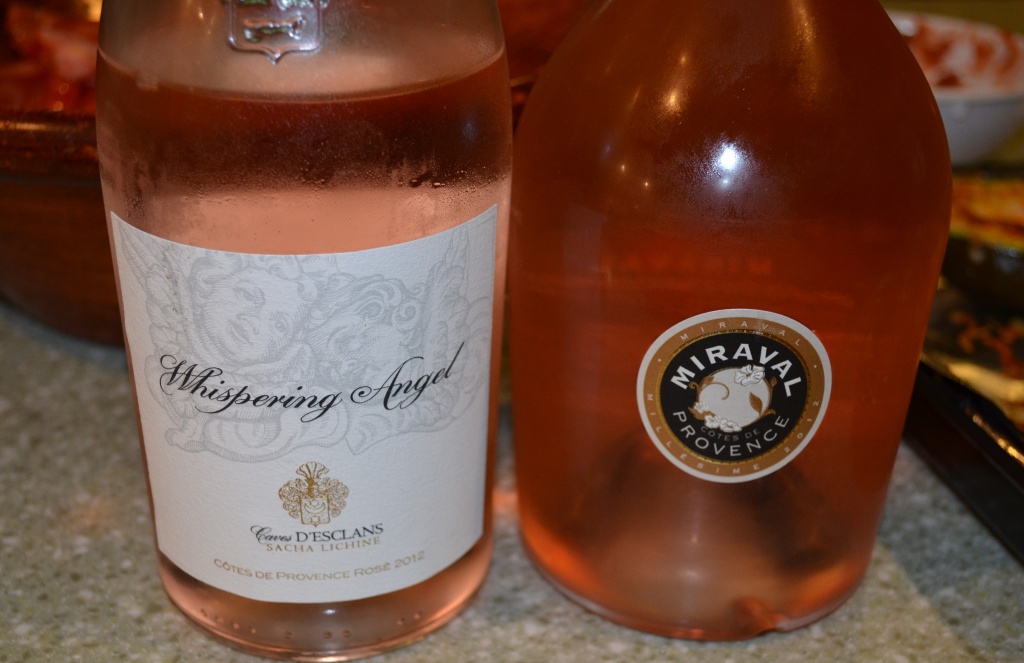
Whispering Angel and Miraval side by side
Now, before we get on to the wines themselves (didn’t I say it already? yes I did, sorry for the interruption once again, but please read on), I need to let out a little rant. When I visit a winery’s web site, I’m doing it because I’m looking for information. Information for me includes history of people, story of the winemaker, information about vineyards, but most importantly, I want to know about the particular wine made at that winery. I want to know what grapes went into the wine, how the wine was made, what winemaker thinks about wine, and so on. Anything and everything which winery is willing to share about the wine, I’m willing to read, but (ahh, my finger is dancing above the Caps Lock key – I’m not going to press it only because I really respect you, my readers, but read rest of this sentence in the loud voice) – I’m not looking to read four praising quotes from the different sources and none, zero, nada, zilch of any actual information about the wine. The wine I’m talking about here – Whispering Angle. 4 quotes on the web site – and no wine information to be found anywhere. Yes, some of those quotes are wine tasting notes from the critics – but you don’t even know what vintage is being described. Yes, I do find it very annoying. End of the rant.
Now, let’s [finally] get to the wines. Here are the two wines side by side:
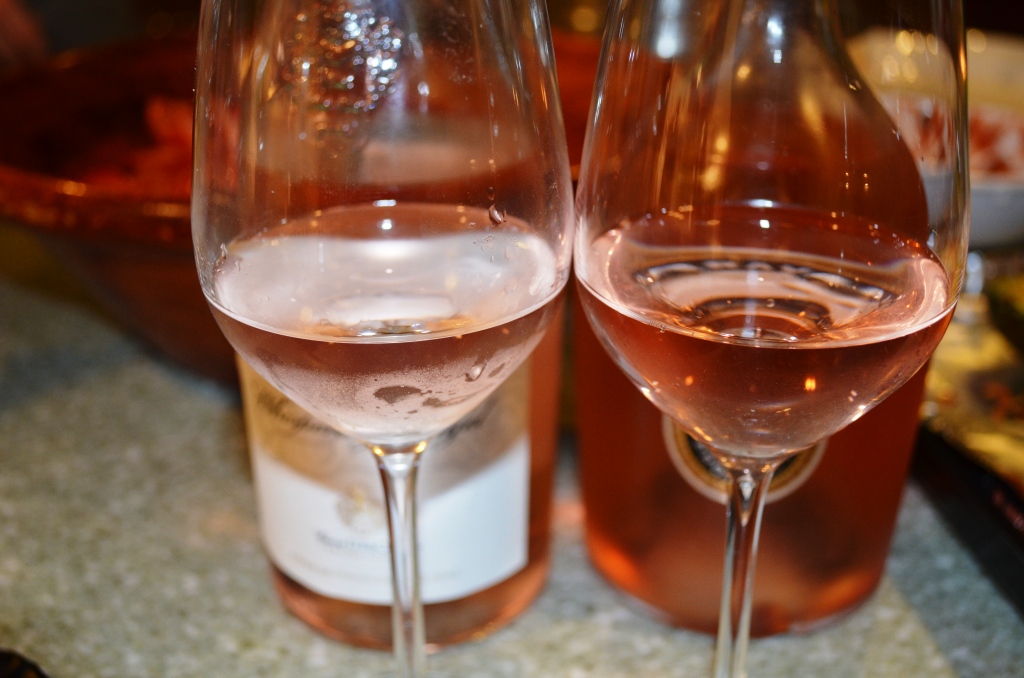
Whispering Angel and Miraval, now in the glass
2012 Whispering Angel Rosé Caves D’Esclans Côtes de Provence AOC ($17.99, 13.5% ABV) – supposedly a blend of Grenache, Rolle, Cinsault, Syrah and Mourvedre – the reason I say “supposedly” is because I didn’t find this information at winemaker’s web site or the back label – see the rant above.
Literally non-existent color in the glass. Pretty intense nose, more on the sweet side, with some tropical fruit (uncommon for Rose?). On the nose, it is more white wine than a red wine. Opens with the degree of sweetness on the palate, but as wine warms up, the sweetness disappears. After the wine opened up a bit, the palate is almost insignificant – there no traditional strawberries and onion peel. The wine is pleasant, but behaves more as indistinct white. Drinkability: 7
2012 Miraval Rosé Côtes de Provence AOC ($21.99, 13%ABV) – a blend of Cinsalt, Grenache, Syrah and Rolle. Syrah was vinified by saignée (bleeding, the pink juice is collected separately instead of leaving the juice in contact with skin for the short period of time), and the other varieties were direct pressed. 5% of the cuvee was aged in the oak casks.
Here are the tasting notes: Nice rose color, more intensity that the previous wine. Some strawberries on the nose, no sweetness. Nice density on the palate, more strawberries, very round but with the character. Drinkability: 7+
Time to conclude our small Rosé competition. I would give a small edge to Miraval, it was a bit more interesting. Miraval Rosé was good, but – it was not a wow wine I can’t live without. In that price range ($20+) there are plenty of interesting Rosé, lots of options are available to the curious palate in need of refreshing sip – in other words, I don’t think I will be specifically rushing over to the store to pick up whatever supply is left for either one of these Rosé.
Before we done here (I know, I keep testing your patience), I want to mention an excellent Rosé post by The Armchair Sommelier (I hope you discovered and follow her blog already, if not – fix that problem immediately). One of the dishes in that blog post looked so good and simple – Grilled Avocado with melted cheese – that I asked for the recipe (very easy – take avocado, make some holes with the fork, smother with the hot sauce, cover with cheese and broil for 5 minutes). I made it to accompany my Rosé and the dish came out perfectly and was very enjoyable, especially with the wine.
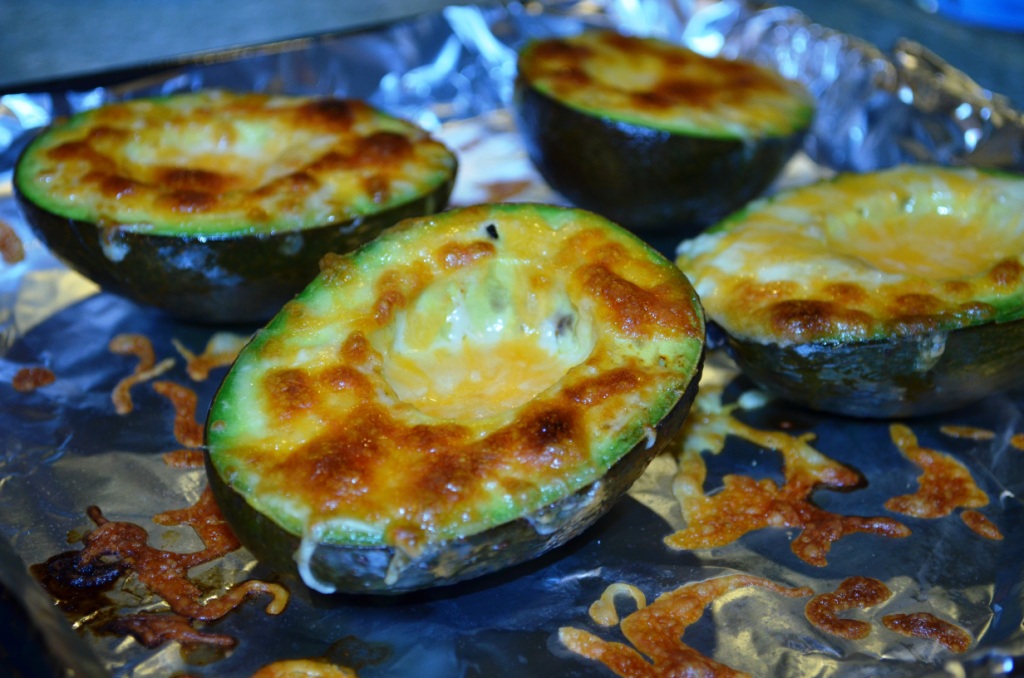
Grilled Avocado with melted cheese
Now it is the time to conclude for real. Until the next time – cheers!
Daily Glass: Wine Happenings – Georgian Wines, New French Discoveries, Australia Grand Experience and more
Every week (or almost every week) I think that I should start writing a summary post similar to what Jeff at therunkenccyclist does so well – once a week he produces a summary of the wines he had during the past week (here is an example of his recent post), which I think is a great way to round up your experiences.
My “Daily Glass” designation was supposed to be [almost] a daily summary for me, but as you know, things don’t always work in life as we think they should. Nevertheless, the week which is ending today was very “wine eventful” hence I’m sharing those wine happenings with you.
Let me start from 2005 Domaine Lafage El Maset Cotes du Roussillon. I got it at Last Bottle Wines during their last “madness” sale. At $8, you really have nothing to lose, right? Wine arrived about 3 weeks ago, looking good – inviting label, heavy bottle, good punt at the bottom – overall looks quite solid. Before opened the bottle, I went to look for information online – and I didn’t find much except a number of notes on Cellar Tracker, all looking very peculiar. Looks like people had very sporadic luck with this wine, with only one bottle out of three being drinkable, and another claim of one out of 10 (!).
First thing I didn’t like when opened the bottle was the cork. You see, I love real corks (yes, I had my share of corked wines – but this is not the subject of this post). I’m completely okay with screwtops – I would be surprised to see a screwtop on the bottle of DRC, but in general, I get it – and it makes it easier to open a bottle, especially when you travel. But the type of corks I have a problem with are plastic and synthetic corks. They are hard to pull out, and just look very artificial – they just don’t belong to the wine world, in my opinion. Besides, somehow I think that they have the worst impact on aging ability of the wine .


This wine was closed with red plastic cork ( you can see it in the picture). Okay, moving along. It is 8 years old wine, how about pop and pour? Pour, swirl, sip – ouch! The feeling of biting into a freshly cut tree brunch. Bitterrrr! My wife had her taste, put the glass down, and politely said “I think it should breath a little first”. Okay, got a decanter, pour half of the bottle in. By the way, the interesting fact is that after that first bitter sip, the wine stayed in my mouth with a very long and rather pleasant (!) finish – probably for the next 10+ minutes. Two and the half hours later… I wish I can tell you the wine magically transformed – no, it became only somewhat better. Dark fruit appeared, tannins became mellower, but the wine was not together – there was no harmony there.
We finished the bottle next day, and it still didn’t improve much more – may be it needed more time? I’m not sure, but I have one more bottle, which I plan to give a little time – will see what will happen. But I also have to tell you that I had one of the most surprising pairings with this wine – as you can guess from the picture, this wine paired excellently (I’m serious) with … cherry preserve! They were literally meant for each other – take a spoon of cherry preserve, sip of this wine – perfect! I never thought of wine and preserve together before – may be I should try it more often? This wine will stay unrated for now, as it is very hard to put a handle on this experience.
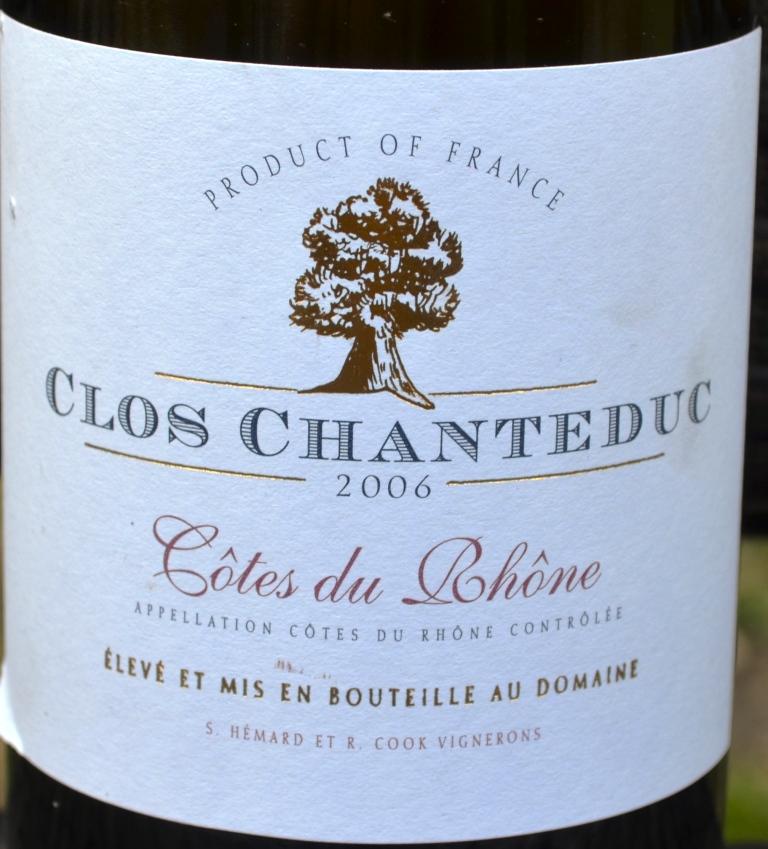 Next wine was also sourced from the Last Bottles – 2006 Clos Chanteduc Cotes Du Rhone. I was unable to find good information on this 2006 vintage, current available vintage of this wine is 2010, but I would assume that the composition stayed about the same, so it should be Grenache/Syrah blend (2/3 Grenache, 1/3 Syrah), a classic Rhone blend. The wine is associated with Patricia Wells, a well known chef living in France. While looking for information about this wine, I found an interesting post about 2009 version in the blog called Wayward Wine – here is a link for you, it is a good reading. Getting back to this 2006 wine, it was rather a typical Cote du Rhone – soft, supple, good mid-palate of plums and cherries – but may be too soft and too supple, it was missing a wow factor. Drinkability: 7.
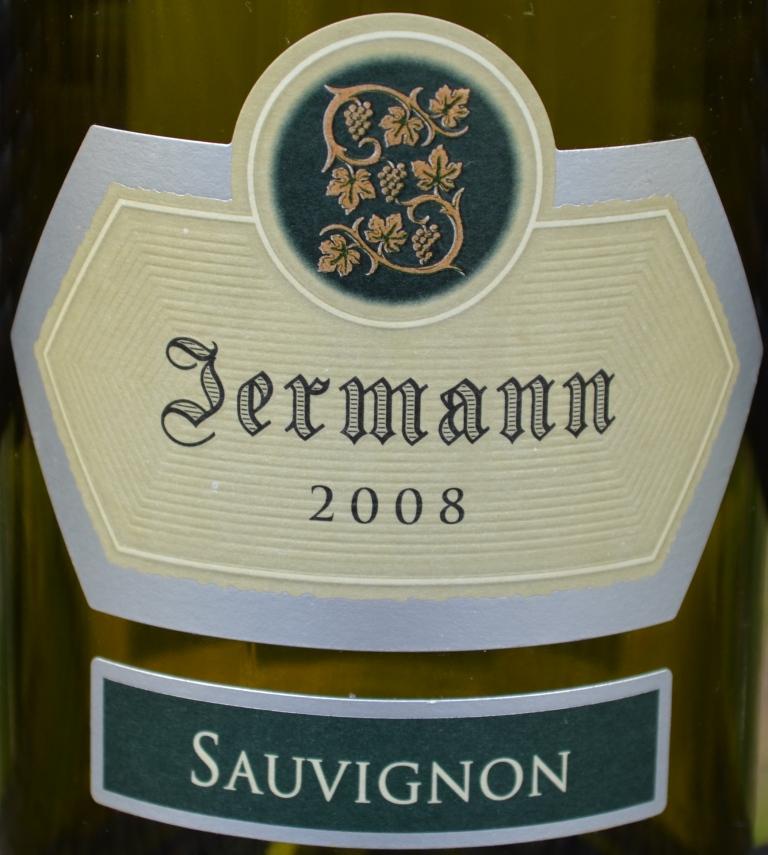 The next wine I want to mention is 2008 Jermann Sauvignon Blanc Venezia Giulia IGT. Jermann is one of my all time favorite Italian producers – I don’t think I tasted any wines I didn’t like from Jermann. This Sauvignon Blanc was closed with screwtop, and the wine is 5 years old – but it came out clean and round on the palate, with perfect amount of white fruit, some herbal notes, perfect minerality and acidity – very enjoyable by itself and with the food. Drinkability: 8-
Now, let’s get to the subject of this post and talk about Georgian and new French wines I discovered. Last Friday I stopped at the tasting at Fairway Market in Stamford, where Michael from importing company called Corus was presenting new Georgina wines. There were four wines included in the tasting, three of them definitely standouts.


2012 Marani Mtsavane is made out of 100% of indigenous Mtsvane grape – very dry, more reminiscent of Muscadet than anything else, with cutting acidity. Will be perfectly refreshing wine for the summer day, also will be very appropriate every time you will decide to serve oysters. Drinkability: 7+
2005 Wine Man Mukuzani – this wine is made out of 100% Saperavi grapes, also grown in one single place – village of Mukuzani. This wine is made by David Maisuradze, who makes amazing wines – here is my post mentioning couple of his wines I tasted before. When I took a first sip, my first thought was about dramatic difference this wine had with the 2005 El Maset I just had a few days ago (both wines are from 2005) – silky smooth, perfect dark fruit, cherries, blackberries, round tannins and balancing acidity – overall, a wine of perfect harmony. Drinkability: 8
2009 Wine Man Kinzmarauli – Kindzmarauli is one of the most famous Georgian wines. Because it was so famous before, you can’t even imagine the amount of fake insipid concoction which arrived to US about 10-15 years ago, knowing that Russian ex-patriots will buy anything under that name. When people realized that they had been doped, the wine lost its appeal and now have to slowly work up its reputation. Kindzmarauli is also made out of 100% Saperavi grapes, but it is semi-sweet. The fake Kindzmarauli wines had nothing but the sugar in them. When you taste this 2009 Kindzmarauli, you actually first get the perfect dry grape underpinning, and then the residual sweetness comes in. Excellent wine to serve with cheese – I think it might even beat Port when served next to Stilton. Drinkability: 8-
Now, for my French discovery – it might not be a discovery for you, but it is a new line of wines which are just being imported to Connecticut. The wines are made by Domaine Laroque in the area called Cité de Carcassonne, a part of Langueoc-Rossillion (Cité de Carcassonne has a status of IGP).


2012 Domaine Laroque Sauvignon Blanc Cite de Carcassonne – in a blind tasting, I would definitely say that this is a restrained version of New Zealand Sauvignon Blanc. Perfectly bright, with hint of grapefruit and lemon zest, refreshing, uplifting – make sure you have enough on hand for your summer entertainment – or you will deal with some upset guests. Drinkability: 8-
2012 Domaine Laroque Rose de Cabernet Cite de Carcassonne – nice, clean Rose, good amount of strawberries, good acidity. Drinkability: 7
2011 Domaine Laroque Cabernet Franc Cite de Carcassonne – this was a “wow” wine. Cabernet Franc is one of my favorite single-grape wines, which are so hard to find. This is two notches up most of the Loire stuff – I guess it is much closer to the best of Bordeaux and Calidornia – prefect dense red fruit, good minerality and herbs, firm structure, supple tannins and overall very balanced. This is what I call a “dangerous wine” – once you start drinking it, it is almost impossible to stop. Drinkability: 8
Are you tired of me yet? Okay, good – I have two more wines to tell you about.
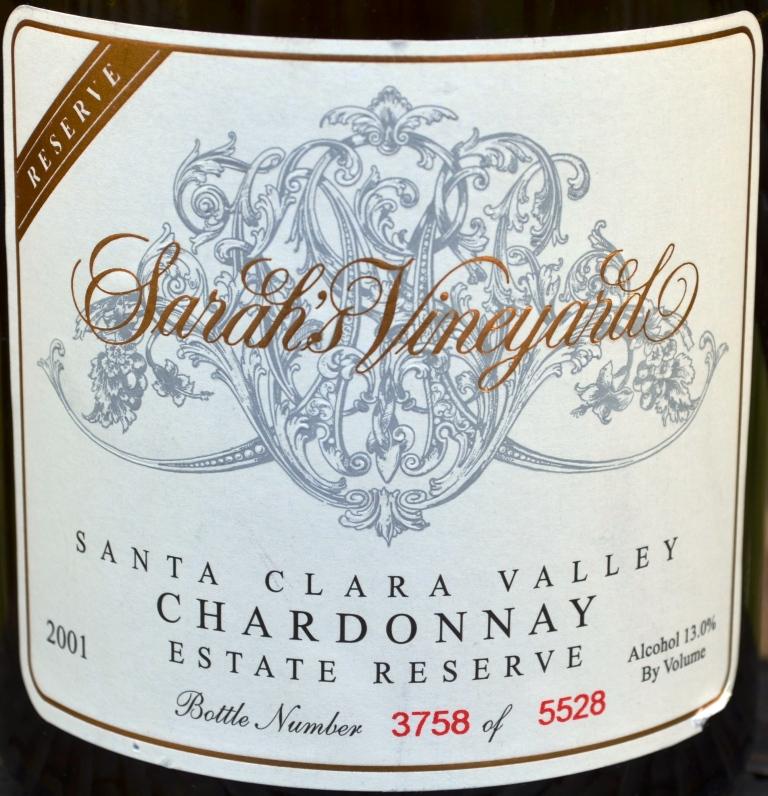 2001 Sarah’s Vineyard Chardonnay Estate Reserve Santa Clara Valley – I got it as Bin Ends in Massachusetts last year. The unfortunate part – this wine was past prime. Well, it was more like a nice sherry – dark yellow color, nicely oxidized. I was able to finish the bottle, but this was not an amazing experience by all means. Mostly you could taste almonds, and that was about all you could find on the palate. I will not rate this wine as it would be simply not fair.
Last, but not least at all – an amazing Aussie experience.
1999 Grant Burge Shadrach Cabernet Sauvignon South Australia – from the very first smell, the expectation was that a “wow” wine is ahead. Perfect dark fruit on the nose, a whiff of chocolate. And the very first sip confirmed that “wow” – blackberries, cherries and cassis, dark chocolate, cocoa, eucalyptus, touch of roasted flavors, perfectly firm and structured. Pronounced acidity, supporting tannins – all perfectly balanced. This was an outstanding glass of wine (it was my one and only bottle, sigh). By the way, you should read an interesting story behind the name of this wine – I don’t want to retype it, hence the picture of the back label below.Drinkability: 8+


That’s all I have for you for today. What was your best wine experience of the week? Have a great week ahead and cheers!
Re-post: Best Hidden Secrets Of The Wine World: Wines of Languedoc
During 2011 I wrote a number of posts for the project called The Art Of Life Magazine – of course talking about my favorite subject, wine. The project closed and even web site is down, but as I still like the posts I wrote, so I decided to re-post them in this blog. Also, in that project, posts were grouped into mini-series, such as “Best Hidden Secrets” you see here – I will continue re-posting them from time to time.
Also note that the series was written for a slightly different audience – I hope none of my readers will take offense in the fact that sometimes I’m stating the obvious…
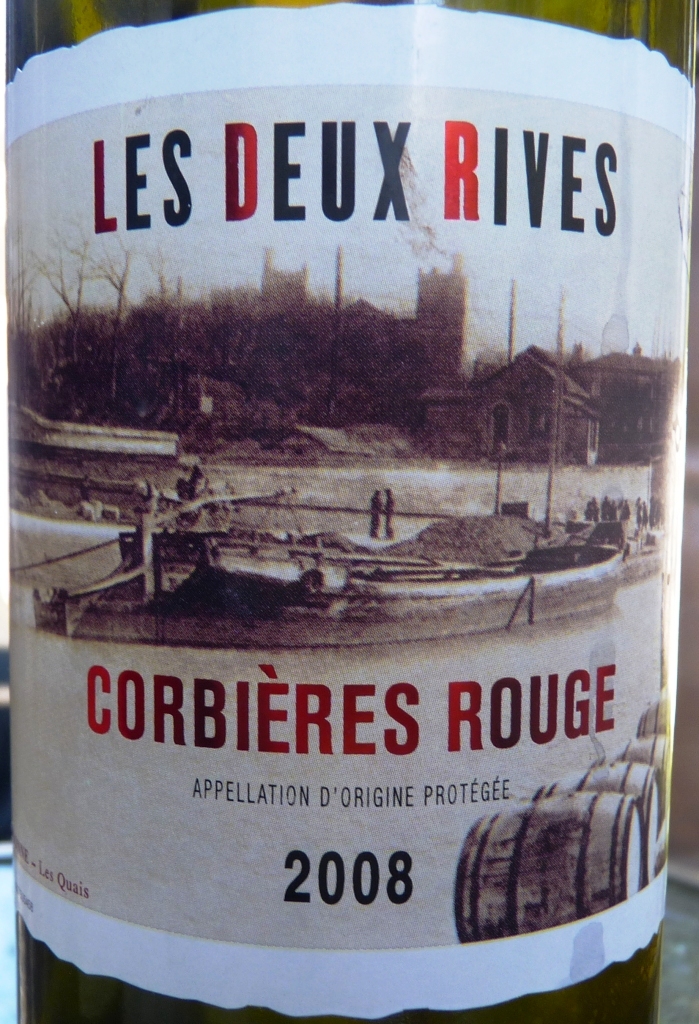 Continuing our “Best Secrets” series, we are going to … France again. However, we are going all the way down south, to the region called Languedoc-Roussillon (in most of the cases it is simply call Languedoc).
Why France again, and moreover, what is so special about Languedoc? First, don’t worry, we are just getting started in our “experiences” journey, we will be going all over the world, I promise. Now, to answer the question “why Languedoc”, let me simply give you some facts. Languedoc-Roussillon is single biggest wine making region in the world! It also produces one third of all the wines made in France. I think this is not bad for the beginning.
One of the great things about Languedoc wines is that while many other regions in France are strictly limited in the grape varieties used in the winemaking in that particular region, Languedoc is not. All white wines from Burgundy are made out of Chardonnay, and all the reds are from Pinot Noir. Red Bordeaux are predominantly made out of Cabernet Sauvignon and Merlot grapes – yes, with the addition of some other grapes, but in any case you will not find any wine which proudly specifies Bordeaux on the label and made out of Pinot Noir or Syrah. Languedoc is different – a lot more grapes can be used in the wine production throughout the region. Red wines can be made out of Cabernet Sauvignon, Merlot, Syrah, Grenache, Mourvedre, Cinsault and Carignan, whites can be made out of Chardonnay, Sauvignon Blanc, Chenin Blanc, Marsanne, Roussanne, Viognier, plus many other red and white grapes can be used in the wine production (for more information about the region, you can always look into Wiki page).
If you are surprised that you didn’t know about Languedoc wines before – don’t be, I’m sure you had Languedoc wines unknowingly. How come? A lot of it is in the labels. Have you seen “Vin de Pays d’Oc” on the labels of wine you were drinking? “Vin d Pays” literally means “Country wines” – level of quality which is one step above “vin de table” table wines, but less than level of AOC wines. But if Vin de Pays can be used with many wines, when you see “d’Oc” added to that it squarely points to Languedoc (last two letters of the region’s name) – if you think about it, I’m sure you had those wines before. There are other well known appellations within Languedoc, such as Corbieres, Minervois and St. Chinian, plus a number of other lesser known appellations. I want to point out that we already discussed one of the Languedoc wines in this “secrets” series of posts when we talked about French Sparkling Wines. That Blanquette de Limoux is produced in the Limoux appellation which is part of the Languedoc region (by the way, if you still didn’t give that Blanquette de Limoux a try, you should do it quickly!).
So what is so “secret” about Languedoc wines? Languedoc is one of the most dynamic wine making regions in France – new appellations created, rules are changing. Languedoc winemakers have more freedom to create, and they are making more and more of the high quality age-worthy wines. And because those wines are not as well known to the public as many others, they happen to represent a great value. Let me give you few examples.
 Let’s start with white: 2009 Domaine de L’Olivier Chardonnay Pays d’Oc. If you like Chardonnay, this is the wine to try. Very nice and very clean, great fruit expression – tropical fruits, touch of grapefruit, all with balancing and refreshing acidity and barely noticeable tannins. Great wine which delivers a lot of pleasure. To put things even in a better prospective I would like to note that retail price of this wine is about US $10 – you would have to get to the $30-$40 price range for Burgundy or California to achieve the same level of experience.
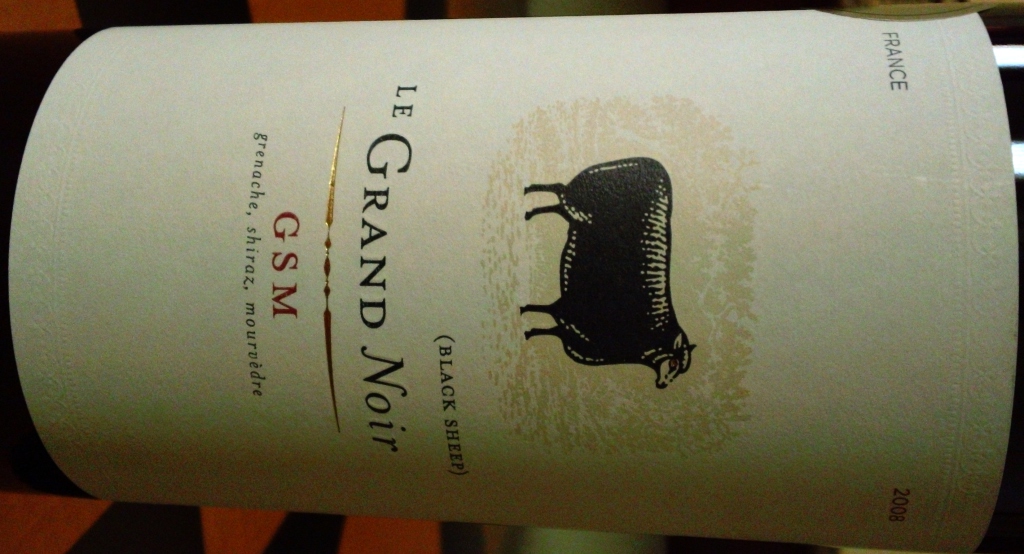 Another example – 2008 Black Sheep Le Grand Noir GSM blend from Minervois. As label suggests, this wine is made out of Grenache, Shiraz and Mourvedre grapes (which is a classic combination of the Rhone grapes). Again with the price tag of about US$10, this is a great deal. Very soft and gently layered fruit, soft tannins are present, but unobtrusive. Good acidity complements this wine well, delivering nice and pleasant experience. Again, considering the price, this is the wine to look for.
Now that you learned yet another secret, it is time to put that knowledge to the practical use. Did you have Rioja wine yet, or may be tried some second label? Now you know about Languedoc wines, so “to do” list just got longer. Go find the bottle and experience this wine tonight – and let me know if your experience was worth reading this article. And just to tell you about what’s ahead, the next time we will talk about something else – will take a break in the secrets series. For now I can only tell you that this “something else” is quite rare and almost forgotten – and I will tell you more the next time we meet…
Weekly Wine Quiz #43: Which One Doesn’t Belong?

Domaine Romanee-Conti La Tashe 2008
Time to play our weekly wine game!
I still don’t have a good idea for the series of quizzes, so we will continue jumping around for a while. As you can guess from the picture, today we will be talking about Burgundy.
When it comes to the grapes, Burgundy is probably the easiest to remember appellation in the world – they only use two grapes – all the reds are made out of Pinot Noir, and all the whites are made out of Chardonnay – easy, right? When you see a bottle of Burgundy, you don’t need to read the back label or search on internet to find out what grapes this wine is made out of, you immediately know it.
However, as everything in this world has two sides, so does Burgundy. The payback for the “grape simplicity” is probably the most complex in the world system of naming the wines, with Grand Crus, Primier Crus, Domaines, Clos and so on (no, we are not going into the Burgundy crash course here, this is just a prelude to the question).
Playing on this complexity (see, I’m honest), below is the list of Burgundy wineries, but one of them doesn’t belong – you will need to figure out which one and why:
- Clos de Lambrays
- Clos du Tart
- La Grand Rue
- La Romanée
- La Romanée Conti
- La Tache
Have fun and good luck! Cheers!
Second Dozen (And Some) of 2012
 Anywhere you look, people are summing up their experiences for the year which will become history in the mere 5 days. “The best thing I did last year”, “the best thing I ate”, “the best trip I took”, “the best picture” and so on and so forth.
This very blog is not an exception to that “the best thing I had” phenomenon. I have my top dozen wines summarized for 2010 and 2011, and now it is time for 2012. But I have to tell you that this year I have an issue. Last two years I managed to identify precisely 12 wines I wanted to include in my “Top” list. This year, it appears that I tasted so many great wines, that I feel that the limit of 12 is too constraining – hence this post, where I will share with you the second dozen (or more) of wines which caused an “aha” moment, and stirred my memory and emotions. In the other words, these are the wines which I would gladly (very gladly) drink at any time. As usual, all the wines will be linked to the original posts in case such post exists, and I will provide pricing information where I can. Here we go.
26. 2011 Walnut Block Wines ‘Collectables’ Sauvignon Blanc, Marlboro, New Zealand ($11.99). In general, I like New Zealand Sauvignon Blanc – may be I had a few that I didn’t really care for, but for the most of the cases I really enjoy that fresh in-your-face acidity with bright fruit underpinning and fresh cut grass. This wine happened to be single best New Zealand Sauvignon Blanc I had last year, perfectly matching the description I just provided.
25. 2012 Flat Creek Estate Winery Viognier, Texas ($NA) – that experience of drinking literally just blended wine was first and unique, and the wine was excellent. I will be very happy to get a bottle of the released 2012 Flat Creek Estate Viognier and compare the notes.
 24. Domaine Ste. Michelle Cuvee Brut NV ($10.99) – one of the best sparkling wines I tasted throughout the year. It is perfectly brut, perfectly acidic and perfectly balanced. I really want to see this wine in the blind tasting, against any of the $30-$40 Champagne – so many people will lose their bets, swearing that they just tasted a perfect glass of Champagne, and finding out that it was a domestic sparkler. Next time you see it on the shelf – do me a favor, pick up a bottle and let me know what you think (you can thank me later).
23. 2010 Anakena Indo Sauvignon Blanc, D.O. San Antonio Valley, Chile ($15) – A perfect Sauvignon Blanc for my palate. Beautiful fruit and acidity combination, a touch fruitier than NZ Walnut Block, but absolutely refreshing.
22. 2005 Giribaldi Cento Uve Langhe DOC ($75) – Very much Barolo-like (no wonder – 50% of the grapes are Nebbiolo), but they didn’t use for nothing 152 grapes to produce this wine – this is a very perfumy Barolo, with a lot of floral notes. No, I didn’t taste all those grapes by themselves, but sheer number of grapes (152) used in production of this wine is enough to put you at awe.
21. 2009 Craggy Range Te Kahu Hawkes Bay, New Zealand ($25) – Craggy Range is an area in New Zealand which became a source of the great wines, and it also know for the cost of land being dirt cheap about 30 years ago, and becoming absolutely unaffordable nowadays. This wine is an excellent Bordeaux blend, except that you don’t need to wait for 15-20 years before you can enjoy a glass – you can just open and pour. Perfect fruit and perfect balance – if you didn’t try this wine before, and you like Bordeaux style, you just owe it to yourself to find the bottle and enjoy it.
20. 2008 Torres Atrium Merlot, Penedes, Spain ($26 in the restaurant) – this was total surprise – the wine was suggested to us in a restaurant in Florida, as previous two choices were unavailable. We didn’t have much expectations – until the first sip. Dark fruit, soft, supple and round, perfect acidity, long finish. The second surprise came when we saw the bill – I never had a wine of this quality in the restaurant for $26. My only issue – this wine is only available for restaurants, and even my friend Zak who owns wine store, can’t get this wine. If you can – send me a note…
19. Abrau-Durso Semi-Dry NV, Russia ($12.99) – Never heard of this wine until this year, and it appears that this is a very old Russian “Champagne” house which was supplying sparkling wines for Tzar. Didn’t have much expectations before trying this wine – and it was delicious. Touch of sweetness, perfectly refreshing and supple – this actually will be the sparkler I plan to pour to ring the New Year in.
18. 2009 Wente Small Lot Petite Sirah, Livermore Valley, California ($35) – Wente Small Lots Grenache was #6 on my Top 2011 list. This year I opened Petite Sirah – an absolute beauty, silky smooth, dark fruit, perfect acidity and tannins, very balanced. It is unfortunately only available from the winery or through the club, but if you are in the area, don’t miss it.
17. 2009 Sant’Elena Pinot Grigio, Friuli, Italy ($18.99) – Yes, I’m a wine snob – as the result, Pinot Grigio is typically not the wine which would be served in my house. And Pinot Grigio is usually not the wine I would include into any of the “high regad lists”. Except when it is truly outstanding. And this wine is exceptional. Yes, it is called Pinot Grigio – but this is only due to the grape used in production of this wine. Otherwise, this is an “orange wine” – dense, concentrated, with dark white fruit, very complex and thought provoking.
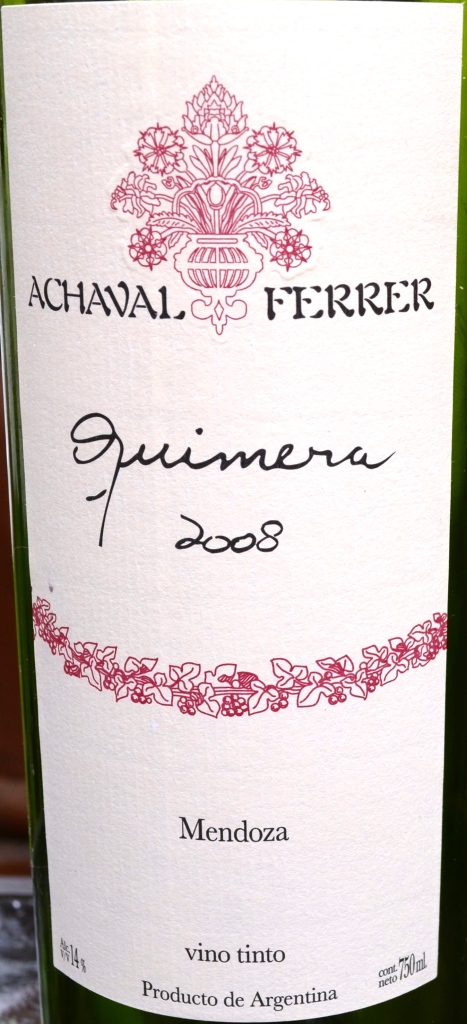 16. 2008 Achaval-Ferrer Quimera Mendoza, Argentina ($24.99) – I wanted to try wines of Achaval-Ferrer for a very long time, but they are not exactly affordable on a given day. Thanks to WTSO ( who else?), I was able to get few bottles of this Bordeaux blend called Quimera, and boy, was that a great wine. Dense and powerful, with lots of dark fruit, very delicious. And – it will definitely improve with time, so I’m glad I still a few bottles left.
15. 2009 Beaulieu Vineyard Reserve Tapestry Red Blend Napa Valley ($60) – it seems that I discovered so many worthy great Bordeax blends this year, from all the different regions. Yet this BV Tapestry squarely hold place on its own – dark, robust, classic, with all the cassis and eucalyptus flavors you want, it rolls on your tongue and delivers pleasure, as you expect your wine to do.
 14. 2006 Laetitia La Colline Pinot Noir, Arroyo Grande Valley, California ($24.99) – I can’t believe I didn’t put this wine into the top dozen. When you take a sip of wine, it usually generates a reaction. It can be “hmm, this is nice”, “hmm, I should let it breathe”, “hmm, I need some food”, “hmm, now I need steak”. And then there are wines where you reaction has no hmms in it, it is “I need a refill now, before this deliciousness is all gone”. This Laetitia La Colline Pinot Noir is exactly that type of wine – round and delicious from the get go, you just want you rglass to last for long, very long time.
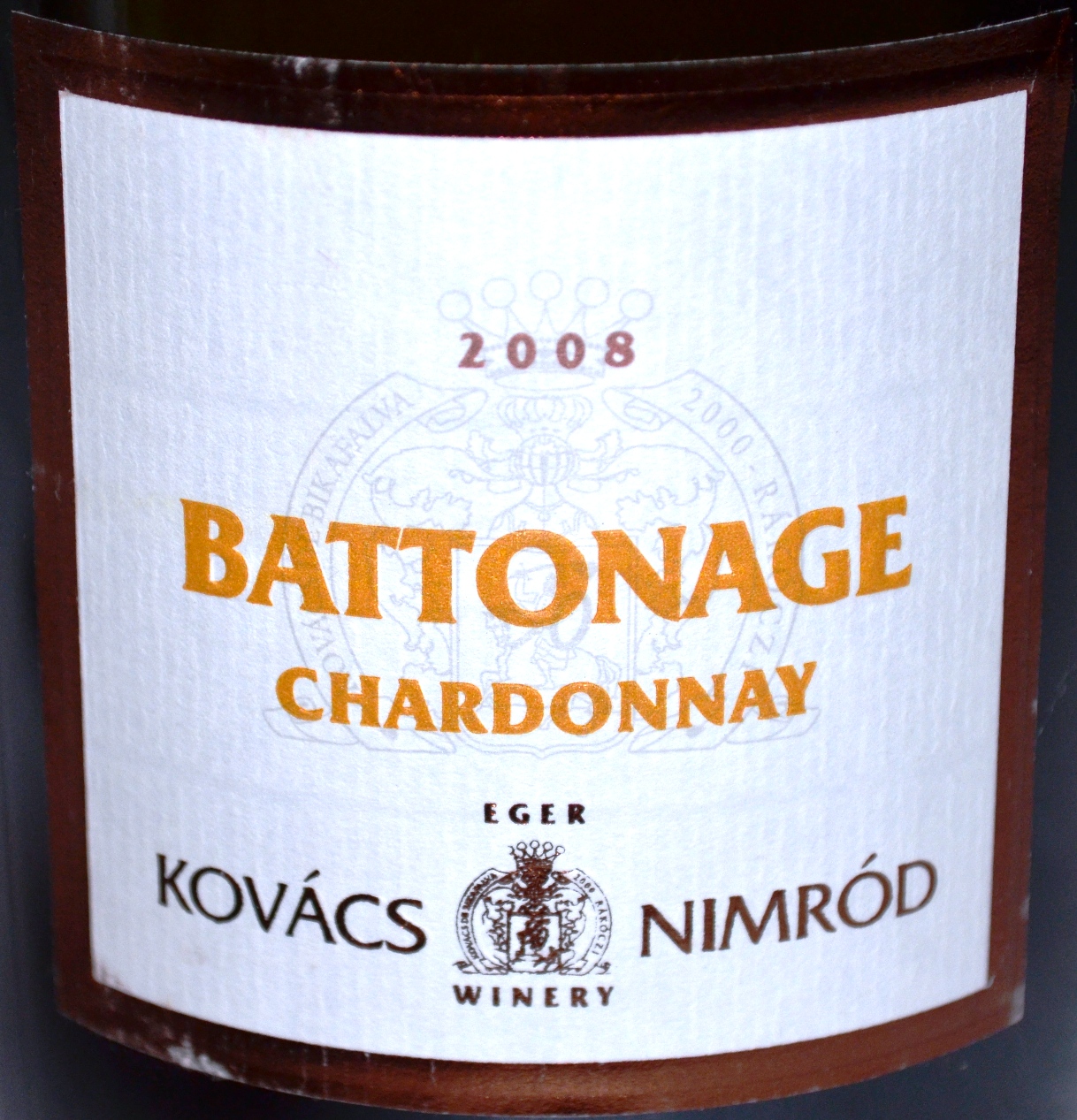
13. 2008 Kovacs Nimrod Battonage Chardonnay, Eger Winery, Hungary ($20.99) – I love Chardonnay – and I so rarely get to enjoy it, unfortunately. I don’t have any deep cellars of Burgundy, and a lot of wineries in California and outside are trying to make Chardonnay to taste like Pinot Grigio – beats me. Luckily, not this Chardonnay from Hungary. This wine greets you the nose with vanilla and butter, and perfectly supports that round package on the palate – more vanilla, more butter, toasted oak, golden delicious apples – just the Chardonnay I want to drink.
That’s all for today, folks – will be happy to hear your thoughts. Have you tried any of the wines above? Did you like them? And yes, my Top Twelve of Twelve is coming out very soon. I’m not going to spoil a surprise for you, but I’m sure you will find my Wine of the Year choice a bit unusual (if you want to guess, write your ideas down in the comments section). Cheers!
Beaujolais Nouveau 2012 – Not To Be Missed!
 Walk into the wine store on third Thursday in November, and most likely you are greeted with the abundance of wines with brightly colored labels, which were not there just a day ago. Yes, that means that Beaujolais Nouveau, the wine of new vintage, made out of grape called Gamay in Beaujolais in France, has arrived.
As with many other wine in France, Beaujolais wines have a very long history, despite the fact that officially Beaujolais AOC was established only in 1937. It was always a tradition in the region to make young fresh wine of the current vintage just to celebrate harvest. For the long time this was only a local tradition. In the 1970th, it became national phenomena in France. In the 1980th, the tradition of celebration spread out in Europe and then got to the North America – largely with the help of Georges Duboeuf, a négociant who recognized the marketing value of Beaujolais Nouveau (here is Wikipedia link if you want to read more on the subject).
Interestingly enough, the sheer marketing success of  Beaujolais Nouveau became its biggest problem, as many serious wine drinkers simply dismiss the wine as a marketing gimmick, which was definitely not something intended to happen.
This years marks 30th anniversary of Georges Duboeuf Beaujolais Nouveau celebrations, so a little bit of magic had being used to acknowledge the occasion. Each bottle of 2012 Georges Duboeuf Beaujolais Nouveau is wrapped in an Augmented Reality label, which can be used to deliver magical experience via free Georges Duboeuf Magic application available for download from iTunes (for more information use this link).
For many years by now, I’m always looking forward to trying Beaujolais Nouveau once it is released. What I remember from those past years is that the wine would show up very grapey and not very balanced. True, it is a young wine, but overall, I didn’t get much pleasure out of it. However, for the past 2-3 years, Beaujolais Nouveau had been steadily improving, showing more finesse, more substance and more balance. This year, 2012 – it simply got me to say “wow”.
2012 Georges Duboeuf Beaujolais Nouveau (ABV 12%, $8.99) had nice and inviting bright ruby color. From the moment the wine went into the glass, the aromas of fresh strawberries and raspberries literally filled the room. This is the wine which I can smell indefinitely. On the palate the wine was fresh and open, with the same strawberries and raspberries flavor profile, supplemented by good acidity. Medium body, very balanced and with medium length finish – definitely the wine to enjoy. Drinkability: 8
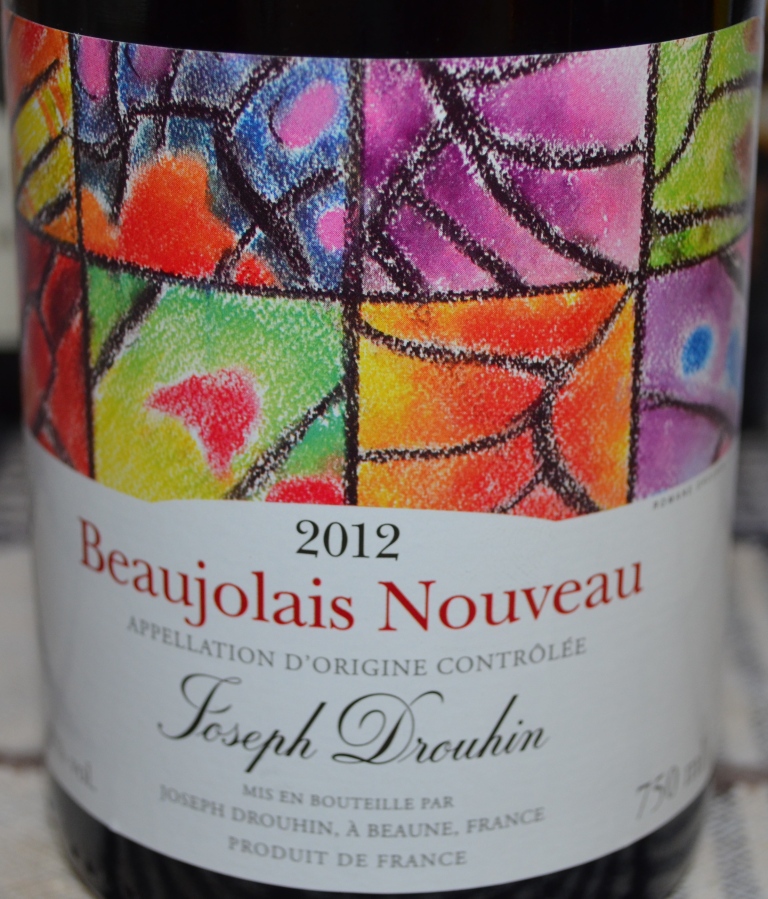 Almost as a tradition by now, I always get another bottle of Beaujolais Nouveau – for the most of the cases it is Beaujolais Nouveau made by Joseph Drouhin. This 2012 Joseph Drouhin Beaujolais Nouveau (ABV 12%, $10.99) had very similar color to Georges Duboeuf wine, may be a touch darker. The nose was less explicit with the actual fruit and somewhat grapey. On the palate this wine was a touch more dense than Georges Duboeuf, but also more closed in comparison with it. While Joseph Drouhin was a very decent wine in my opinion (Drinkability: 7), my strong preference goes to the Georges Duboeuf.
I don’t know how do you feel about Beaujolais Nouveau overall, but 2012 is definitely not to be missed. The wine is not only representing a great QPR, but it will also give you a lot of pleasure. Beaujolais Nouveau wines don’t age, and when they gone, they are gone. Don’t miss your chance to experience Beaujolais Nouveau – it’s worth it.
That’s all I wanted to share with you, folks. Until the next time – cheers!
Crus of Beaujolais, Year 2011 – Part 2
I like sequels, Well, in the movies – sometimes, not so much. But when it comes to the writing, whatever you forgot to say in the first part, you can say in the second, and feel good about it, claiming that this was the intent from the get go.
What I didn’t mention in the first post about great tasting of Georges Duboeuf 2011 Beaujolais portfolio is that red Beaujolais make one of the best red wines for summer – they are typically light in alcohol (if you noticed, 13% ABV was the most for all wines mentioned in the first post), and they also taste the best when they are slightly chilled. Considering how hot this summer is across pretty much the whole US territory, I hope this will help you to find a good red wine for the hot day, because sometimes it just have to be red.
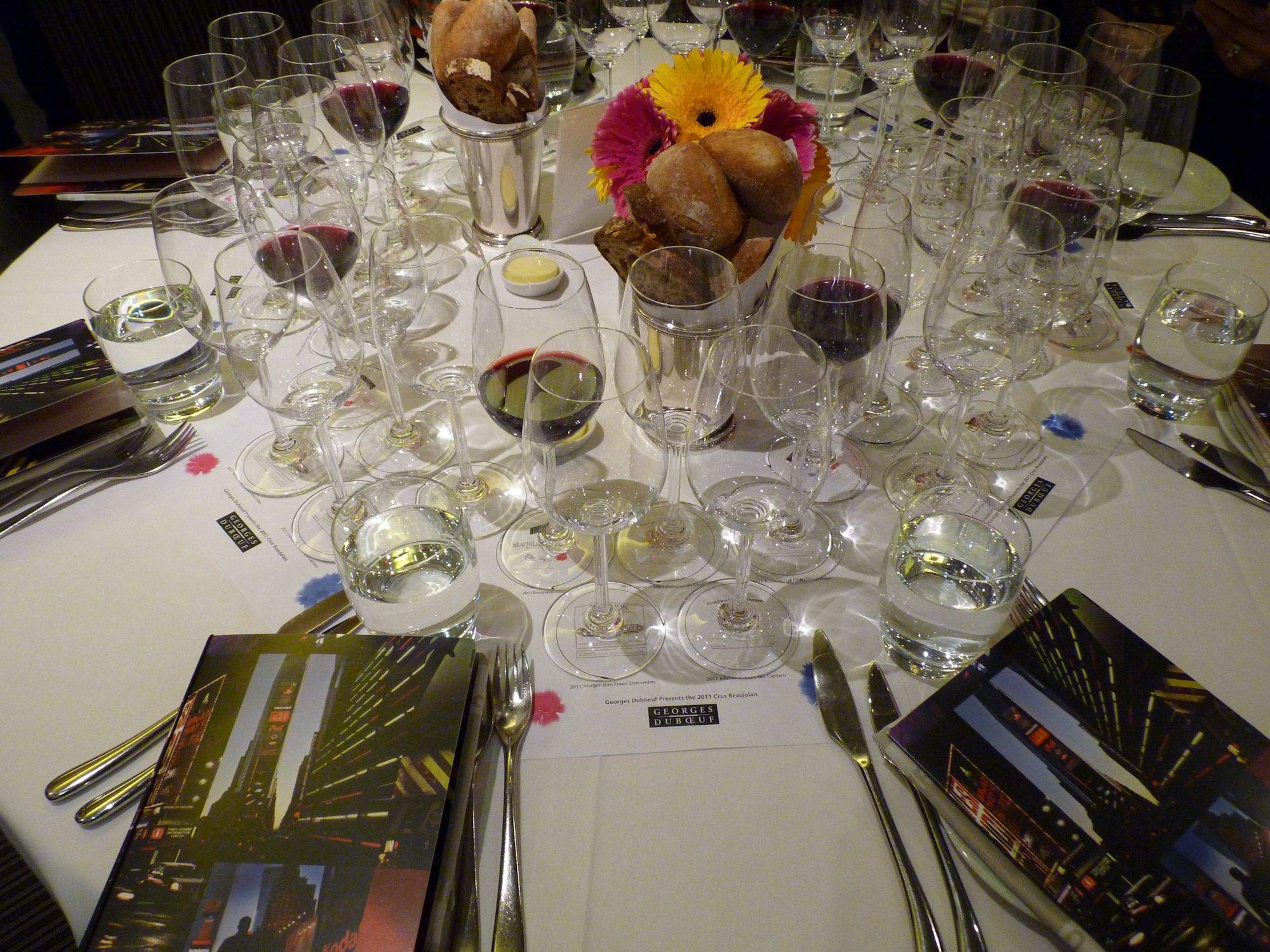
In the first post, I described a self-guided part of tasting. That tasting was followed by the lunch, both of which (tasting and the lunch) taking place at db Bistro Modern, one of the restaurants of the famous chef Daniel Boulud.
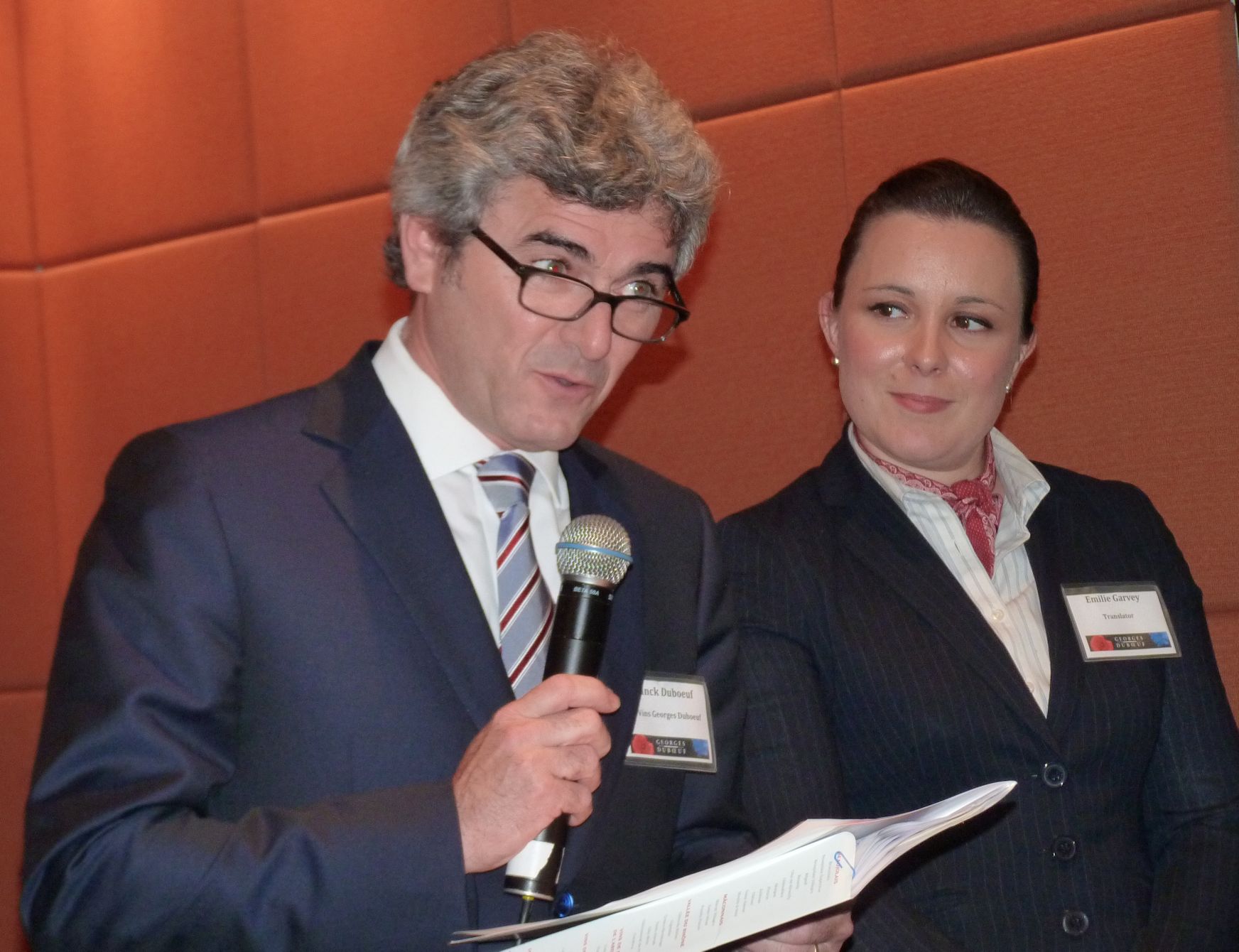
Georges Duboeuf opened the event with presentation of 2011 vintage. Here is my best effort transcript of what he said (remember, I’m not a professional journalist, I’m only pretending): “2011 was a great year. Budding started in April, then flowering started in June, and then harvest started August 22nd and lasted for two weeks. Some areas experienced periods of drought. Overall, grapes reached very good level of ripeness. 2005 and 2009 (considered best in a very long time) were good, but 2011 might be even a little bit better than 2009. Throughout the vintage, there are lots of black cherry and earthy notes.”

After Georges Duboeuf’s presentation, the first dish was served – “Legumes du Marche” – Young Garden Vegetables, Fromage Blanc Dressing, Lavender Honey Vinaigarette.
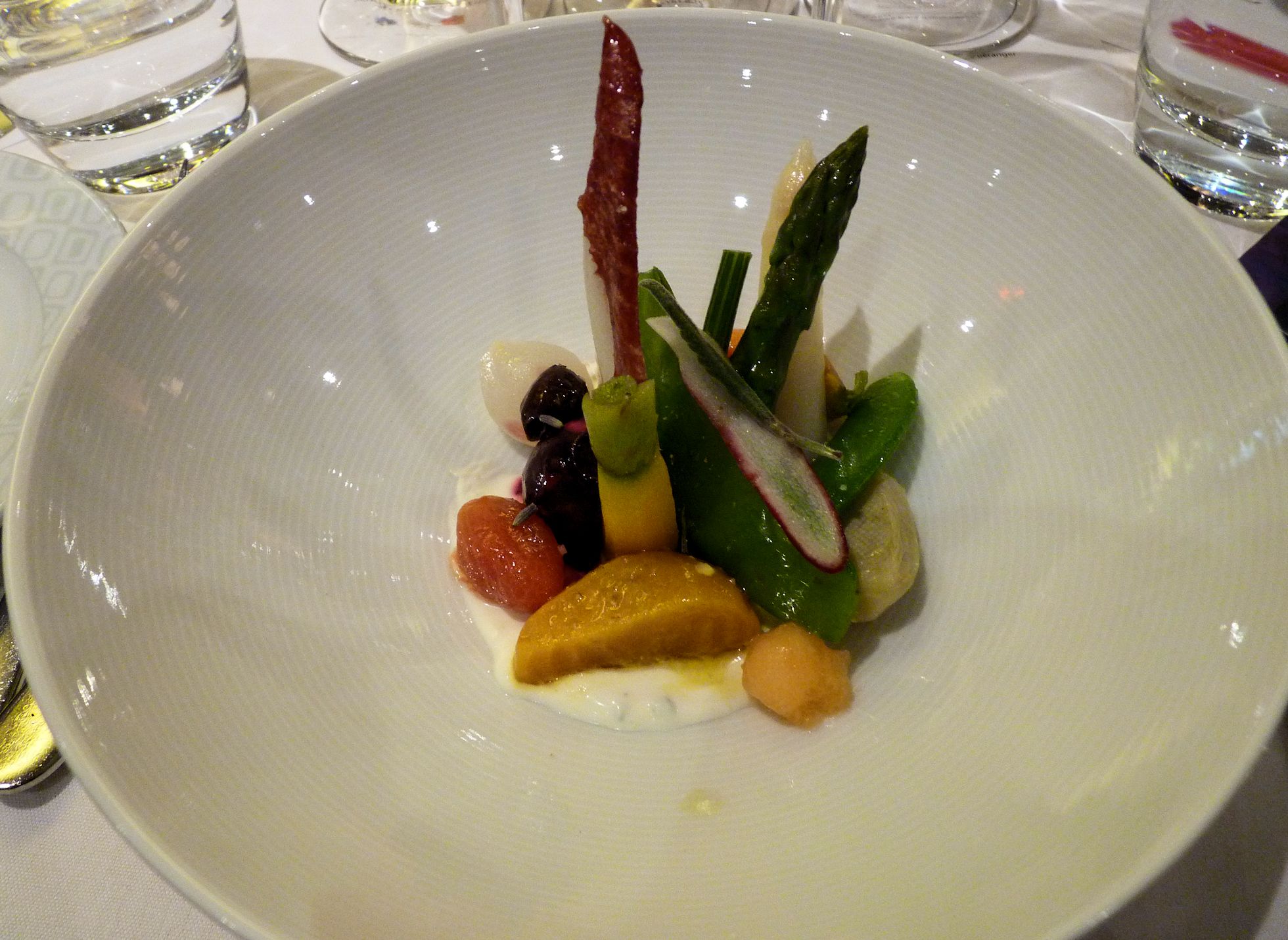
This dish was paired with 2011 Georges Duboeuf Beaujolais-Villages, and it worked together very well by wine complementing soft and earthy flavors of the vegetables.
Next, Frank Duboeuf presented two white wines, Macon-Villages and Pouilly-Fuisse (please see detailed note below). He said that 2011 was equally good year for both whites and the reds, which is a very rare situation. I didn’t take the detailed notes though, as I was preoccupied with parallel discussion at the table and delicious pairing of wine and food ( bad journalism : ( )
White wines were served with the next course, Seafood Risotto – Black Sea Bass, Scallops, Squids, Cockles, Fennel, Tomato Confit “Fumet” Emulsion.

Pouilly-Fuisse worked perfectly well with risotto, which was a unique experience for me. Creaminess of risotto cancelled out some sharpness of the chardonnay, creating next level of experience.
For the next course, Georges Duboeuf presented two red wines, Morgon and Julienas. He described Morgon as having “violet, cassis, kirsch on the nose, same flavors on the palate. A lot of structure. This wine will age very well”. Regarding Julienas, he said that “it is a very special wine, it has great personality. 2011 was a lot like 2009. This particular wine had the biggest success over the last 5-6 years. It was very critical to expand the vineyard (by 4 acres) for the success of this wine. This is a very noble wine with great aging potential. The wine was bottled a week before, right before the event”.
These two reds accompanied the last course of the meal – Duo of Beef – Braised Short Ribs, Beef Tenderloin, Spring Vegetables, Sauce Bordelaise.
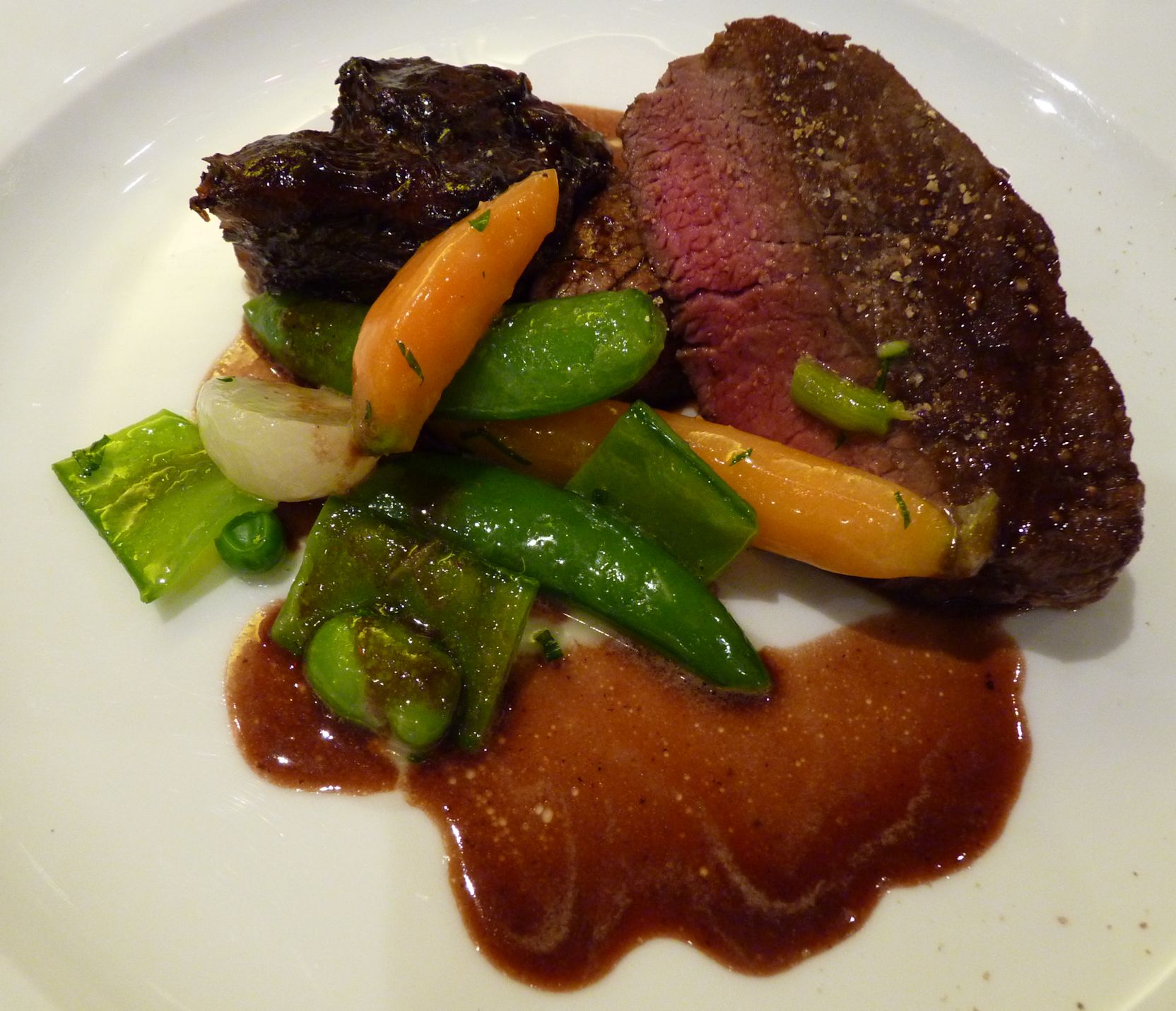
I have to tell that while both food and wine were delicious in its own right, they didn’t work together, so the pairing was not successful by not elevating the whole meal to the next level. But I also have to admit that both food and wine really didn’t bother each other too much – they were really two absolutely parallel experiences without a merge or a collision (which is often the case when wine and food don’t work together).
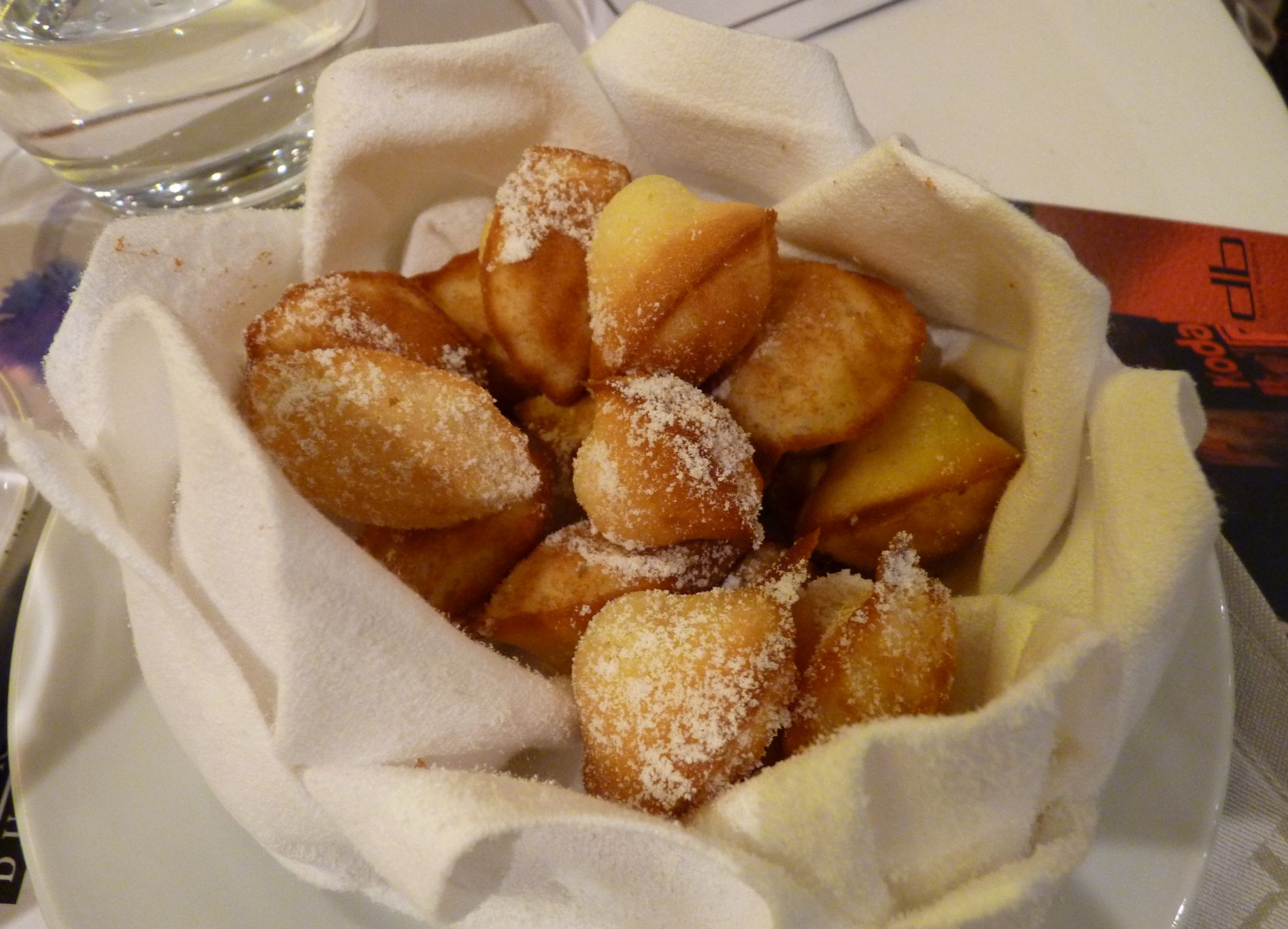
And then…there was a dessert, which was delicious and not paired with any wines (I also have no idea how this little cookies should be called, but it was very hard to stop eating them).
Here are the detailed notes for the wines:
2011 Georges Duboeuf Macon-Villages Domaine Les Chenevieres, Maconnaise, France (100% Chardonnay, SRP: $13.99, 12.5% ABV, 5000 cases produced) – Very nice, hint of hazelnut and citrus on the nose, good fruit, good balance, good acidity, hint of white apples, touch of vanilla and touch of oak on the palate. (Drinkability: 7+)
2011 Georges Duboeuf Pouilly-Fuisse Domaine Beranger, Maconnaise, France (100% Chardonnay, SRP: $17.99, 13% ABV, 3500 cases produced, 1200 imported) – this wine comes from the best area, the actual town of Pouilly-Fuisse. This wine had more pronounced chardonnay qualities than the previous wine – vanilla, touch of citrus and oak notes, excellent balance. (Drinkability: 8- )
2011 Georges Duboeuf Beaujolais-Villages, Beaujolais, France (100% Gamay, SRP: $9.99, 12.5% ABV) – very nice, good balance, a little tartness on the palate, but good overall. (Drinkability: 7)
2011 Georges Duboeuf Morgon, Domaine Jean Descombes, Beaujolais, France (100% Gamay, SRP: $15.99, 13% ABV) – good acidity, fresh fruit, light, soft, a bit too grapey to be great – but should improve with time. (Drinkability: 7)
2011 Georges Duboeuf Julienas Chateau des Capitans, Beaujolais, France (100% Gamay, SRP: $18.99, 14% ABV) – excellent depth, good power, good body, excellent balance. (Drinkability: 8)
All in all, it was one great event, both in the information and experience. Summer is still on, my friends – go find a bottle of Beaujolais to kick it off after a long day. And make an extra effort to find one of Georges Duboeuf wines – it will well worth it. Cheers!
Crus of Beaujolais, Year 2011
(this self-rant doesn’t belong to this blog post, but I have to let it out of the system. I don’t understand how this works – this post was supposed to be out more than a month ago – the event was great, and the content was very clear in my head – nevertheless, it took soooo long to actually write it. Sometimes, the road from the head to the paper medium is all so twisty, not straight at all. The things are not what they appear… But I think we can proceed now.)
 When you hear the word “Beaujolais”, what is the first thing which comes to mind? Beaujolais Noveau? Yes, me too. At the same time, Beaujolais is a large wine producing region, in area much bigger than Burgundy which it is technically considered to be a part of. And of course there is a lot more wine produced in the Beaujolais region than just a Beaujolais Noveau, a celebratory wine of a new vintage.
At the beginning of June, I was lucky enough to be invited for the tasting of the 2011 portfolio of wines of Georges Deboeuf. Georges Deboeuf is one of the largest and well-known wine merchants in France. He is credited with literally single-handily creating the Beaujolais Noveau phenomenon and often is called the “King of Beaujolais”. I also think that his success with Beaujolais Noveau, both wine and celebration of the new vintage with pleasant but very simple grapey wine, appearing in the stores all over the world always on the third Thursday in November, is also an enemy of serious Beaujolais wines, which can be absolutely fantastic – but this can be a subject for a whole different post, so let’s talk about the portfolio tasting of 2011 Georges Duboeuf Beaujolais wines.
 No, wait. Before we talk about the wines presented in the tasting, let’s take a quick look at Beaujolais wine region. Beaujolais region is located to the south of Burgundy. Red wines constitute absolute majority of wine production in Beaujolais, and Gamay is pretty much the only grape used in the production of that red wine (with small plantings of Pinot Noir been phased out little by little). White wines are produced from Chardonnay with Aligote been also allowed, but overall production of white wines is miniscule. Three levels of wines are produced in Beaujolais – Beaujolais, which allows usage of the grapes from the whole appellation – these wine should generally be avoided; Beaujolais-Villages, which are better quality wines, and so called Cru wines (top level). There are 10 Crus in Beaujolais – Brouilly, Côte de Brouilly, Chénas, Chiroubles, Fleurie, Juliénas, Morgon, Moulin-à-Vent, Régnié and Saint-Amour. In general, Beaujolais wines are considered simple and easy (and thus work well with wide variety of food), and also have lesser aging potential than, for instance, the wines of neighboring Burgundy (however aging is usually defined by the talent of winemaker more than anything else). Now that you know all the theory of the Beaujolais wines, let’s talk about tasting.
The tasting was organized by CRT/Tanaka and I would like to thank Caroline Helper (@ForgetBurgundy) for invitation. The tasting took place at DB Bistro Moderne in Manhattan, and it was split into two parts – self-guided tasting of 12 different newly released wines from Georges Duboeuf portfolio (some wines on the list were denoted as barrel samples, as they were just bottled a week before the event), following by organized lunch. Little bites of food were served during the self-guided tasting, and I had an opportunity to try a famous Daniel Burger (with foie gras inside!) – and it was absolutely delicious.
Here I will share with you my notes from the self-guided tasting – description of the lunch, where both Georges and Frank Duboeuf presented their wines, will make up a separate post (ahh, I hope it will not take me another month to write it!). Of course I can’t leave you with just notes, so you will also see some pictures.
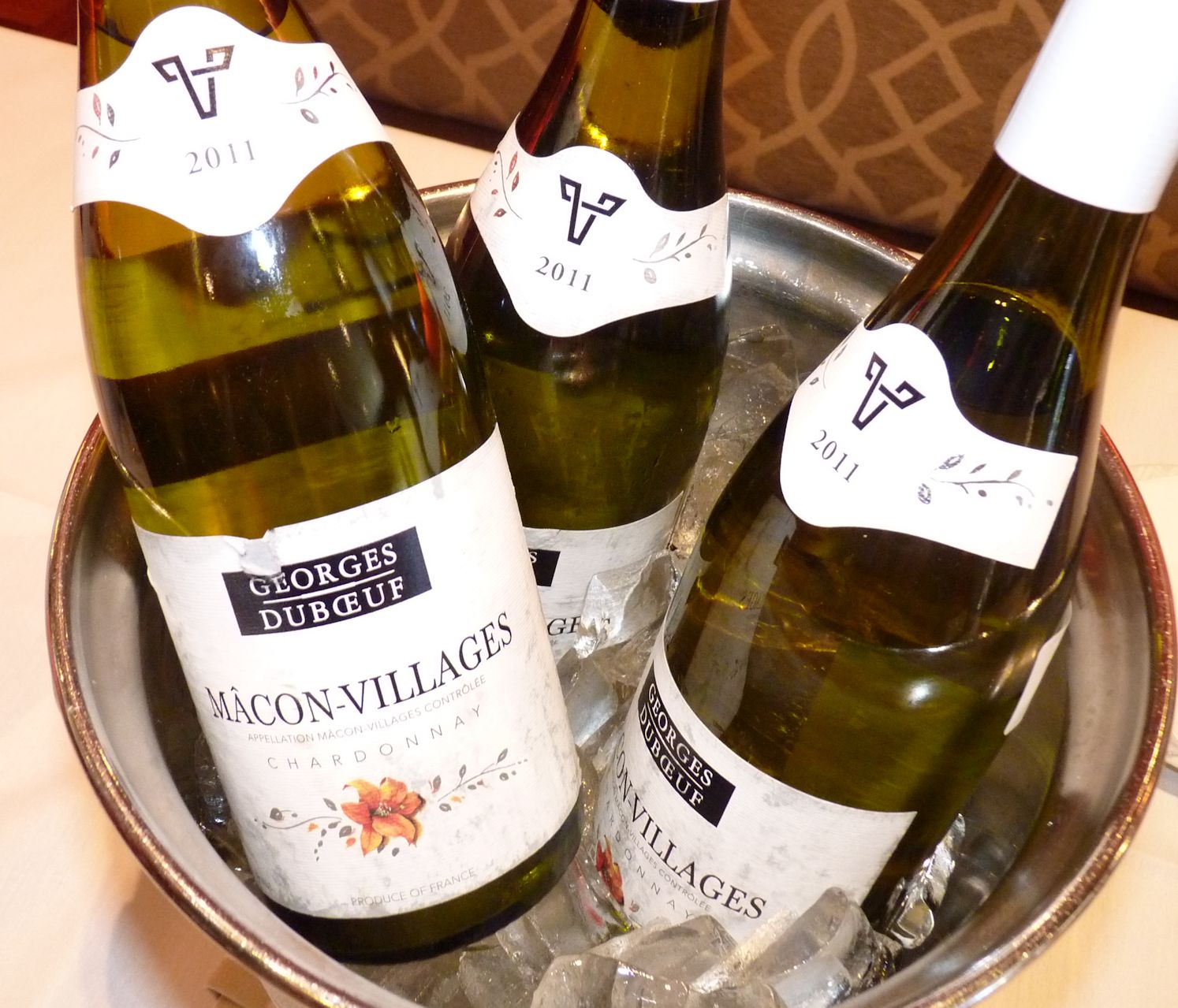
2010 Georges Duboeuf Macon-Villages, Maconnaise, France (100% Chardonnay, SRP: $12.99, 13% ABV) – Crisp acidity, interestingly nutty nose, hint of green apple, very mineral on the palate, with hint of limestone (Drinkability: 7)
2011 Georges Duboeuf Pouilly-Fuisse, Maconnais, France (100% Chardonnay, SRP: $19.99, 13% ABV) – green notes on the nose, lime zest, light, effervescent and crisp on the palate, with a hint of tropical fruit, very refreshing (Drinkability: 8- )
2011 Georges Duboeuf Beaujolais-Villages, Beaujolais, France (100% Gamay, SRP: $9.99, 12.5% ABV) – Fresh fruit nose, very tannic, more fruit and tannins on the palate, with tannins literally reaching Barolo levels. Needs time and may be different temperature (Drinkability: 6 at the moment, but this wine needs to be reassessed)
2011 Georges Duboeuf Chiroubles, Beaujolais, France (100% Gamay, SRP: $13.99, 13% ABV) – plums, acidity out of balance, tamed red fruit on the nose, tannins on the second taste (Drinkability: 6+)
2011 Georges Duboeuf Brouilly, Beaujolais, France (100% Gamay, SRP: $14.99, 13% ABV) – tart cherries on the nose and palate, more balance than the previous wine, but still lacking a bit (Drinkability: 7- )
2011 Georges Duboeuf Brouilly Chateau de Nervers, Beaujolais, France (100% Gamay, SRP: $15.99, 12.5% ABV) – closed, not balanced, all over the place – fruit, acidity, tannins are not harmonious (Drinkability: 6+)
2011 Georges Duboeuf Morgon, Beaujolais, France (100% Gamay, SRP: $14.99, 13% ABV) – very nice nose with open fruit, too dry on the palate, very tannic, needs more fruit (Drinkability: 7- )
2011 Georges Duboeuf Fleurie, Beaujolais, France (100% Gamay, SRP: $15.99, 13% ABV) – good fruit, ghood acidity, reasonably balanced (Drinkability: 7)

2011 Georges Duboeuf Fleurie Domaine des Quatre Vents Beaujolais, France (100% Gamay, SRP: $18.99, 13% ABV) – very nice! Round fruit on the nose and the palate, very good balance (Drinkability: 8- )
2011 Georges Duboeuf Julienas, Beaujolais, France (100% Gamay, SRP: $14.99, 13% ABV) – pleasant nose, good acidity, but fruit is closed (Drinkability: 7)
2011 Georges Duboeuf Moulin-a-Vent, Beaujolais, France (100% Gamay, SRP: $15.99, 13% ABV)- fresh fruit on the nose, lacks substance on the palate, needs more power – this wine is red like white (Drinkability: 7)
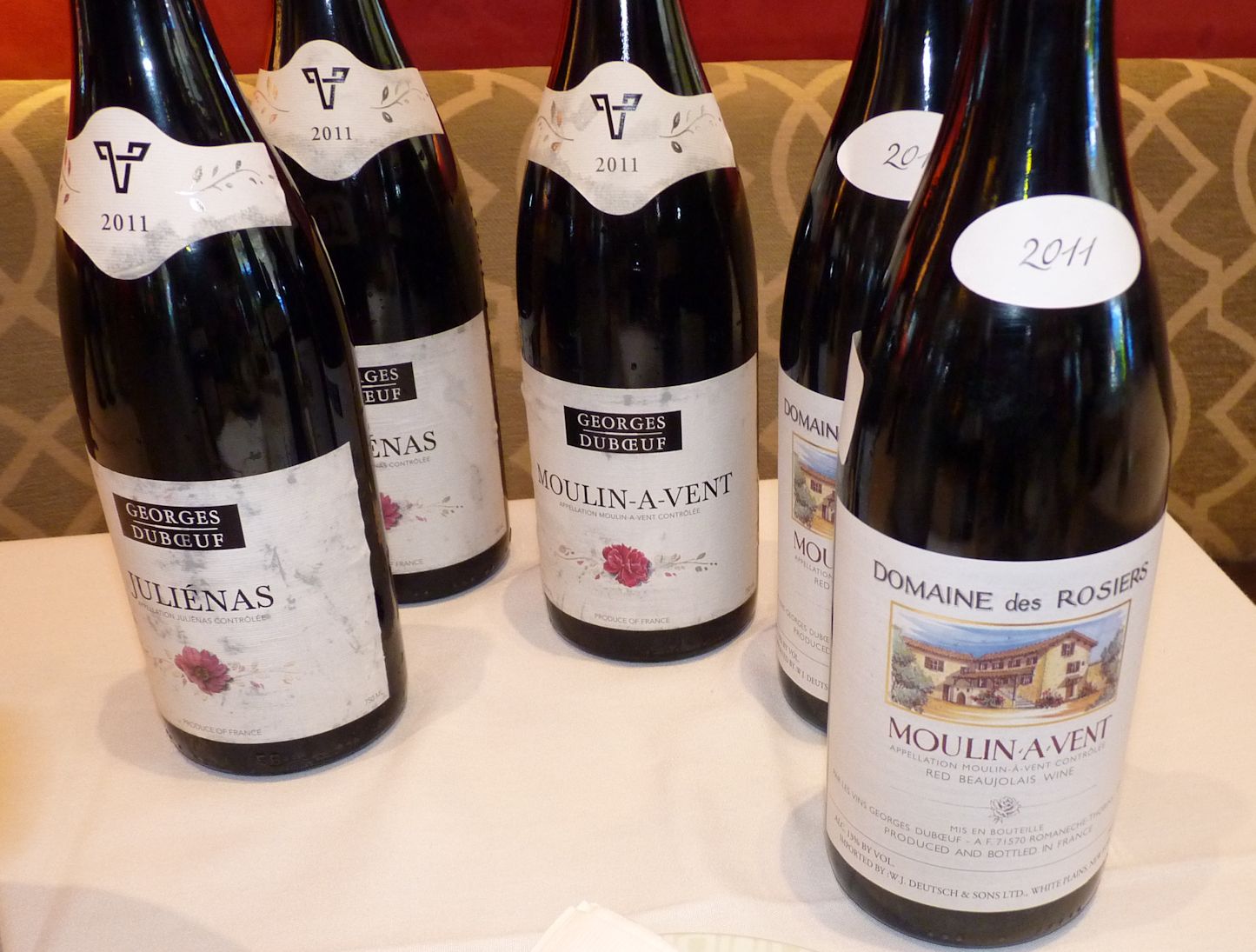
2011 Georges Duboeuf Moulin-a-Vent Domaine des Rosiers, Beaujolais, France (100% Gamay, SRP: $17.99, 13% ABV) – very nice, beautiful color, good fruit on the nose, hint of minerality and spices, good red fruit, plums and raspberries on the palate. Best of tasting. (Drinkability: 8- )
In the end of the day, all the wines were showing very well, and if you think about QPR, all the wines were great values. Make no mistake – some of these wines are in a very limited production (especially all the Domaine-denoted wines), so you will need to make an effort to find them. But – it worth the reward!
That’s all for my first part of the report, folks. Until the next time – cheers!
Do You Believe in Coincidences?
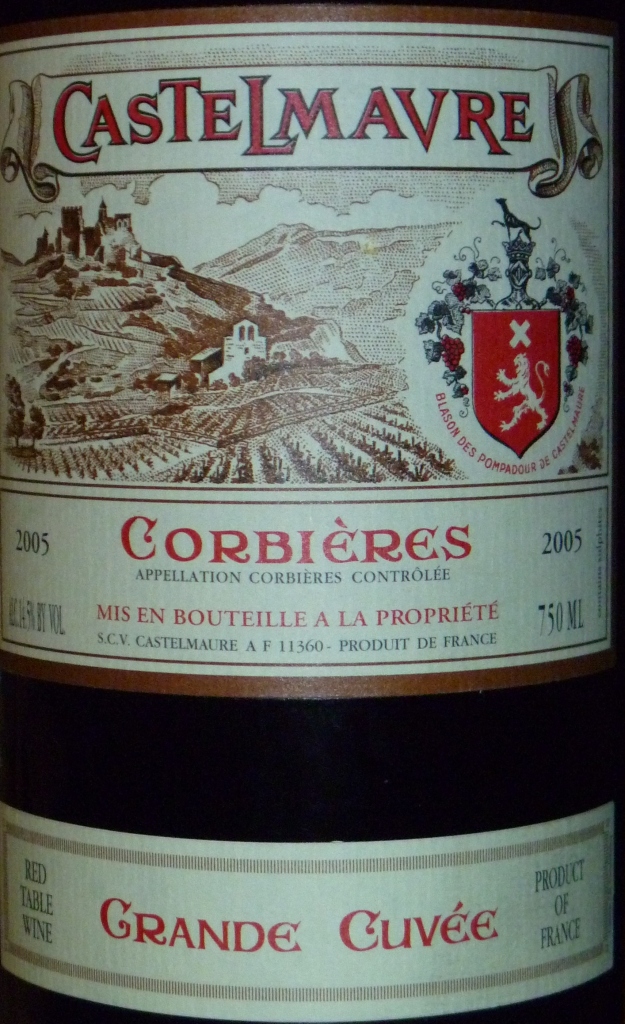 Yesterday, I was doing my usual search for the bottle to open – happens every time if I don’t have a plan upfront. Maybe this one? No, probably too young. That one? That’s a last one, maybe not now. Ahh, this one? No, not now – need a special moment. Then I finally reached out and grab a bottle of 2005 Castelmaure Grande Cuvee Corbieres Rouge – one of the two bottles I had. I was thinking about opening it many times before, but somehow the decision was always to wait until some other time.
This wine is a blend of mostly Syrah and Grenache (45% each) with the addition of Carignan. Opened the bottle, and the wine is beautiful from the get-go – deep, concentrated, showing good dark fruit, some cedar box, nice peppery mid-palate, great acidity and very balanced overall (Drinkability: 8). Next thing I’m going on Twitter to post the message about this wine and there I catch a glimpse of something while scrolling through the updates – Languedoc? #LanguedocDay?
It turns out that on November 10th, the world of social medial celebrated Languedoc Day – Languedoc is a wine region in the South of France. The wine I opened, Castelmaure, comes from Corbieres, which is one of the appellations within Languedoc! The great thing about Languedoc wines is that the appellation rules allow the making of a wide variety of wines from a wide variety of grapes, and due to the fact that the region is not as famous as Bordeaux or Burgundy, lots of great wines are available at a great QPR. I even wrote a post about Languedoc wines at The Art Of Life Magazine in the “Best Hidden Secrets of the Wine World series”.
Now, let’s go back to the subject of the post. At any given moment, I have about three hundred bottles of wine in the house, very few of those are from Languedoc (maybe 2-3 bottles at the most). I had no idea about #LanguedocDay before I selected the bottle. What is the probability of opening a bottle of wine from Languedoc specifically on that particular day, considering that we drink wine literally every day? I believe it is very (did I say “very”?) small. I don’t know how this worked, but somehow it did, so we happened to enjoy the right bottle of wine on the right day.
If you got any good “coincidences” stories, please share them! And no matter what was in your glass yesterday and what will be in it today, I hope you enjoy it. Cheers!
P.S. Don’t forget about PJ Wine Grand Tasting, which will take place next Friday, November 18th – if you want to taste Dom Perignon, Cristal, Krug, 2006 Cheval Blanc, 2000 Chateau d’Yquem, 1990 Mouton-Rothschild, 1985 Chateau Haut-Brion, 1952 CVNE Vina Real Gran Reserva and many other incredible wines, all in one night, click here to get your tickets and don’t forget to use your $10 discount code Talk-A-Vino.
Daily Glass: Margaux Experience
 Few days ago we had a magnificent experience with two great Bordeaux wines from Margaux Appellation (I love my friends!). Margaux appellation is located on the left side of Gironde river in Medoc, and it is a home to so called First Growth, Chateau Margaux, and it also has the biggest number of classified second and third growth out of all other appellations in Bordeaux. Cabernet Sauvignon, Merlot, Cabernet Franc and Petit Verdot are the main grapes used in the wine production.
Two wines we had with the dinner were 1998 Chateau Palmer (classified third growth) and 2001 Chateau Lascombes (classified second growth). We decanted both wines for about an hour, just to get them to open up. Chateau Palmer showed lots of white truffles on the nose from the get go, and those white truffles stayed with the wine until the last drop. Chateau Lascombes started very tight, and opened up little by little to show some black truffles on the nose.
I can’t help but to mention that Chateau Palmer has a great web site, where you can find information about wines from the past vintages going back to 1959. The 1998 Chateau Palmer we were drinking was composed of 52% Merlot, 43% Cabernet Sauvignon and 5% Petit Verdot. If you like wines with the little age on them, this wine was just amazing. White truffles on the nose, white truffles on the palate. Round and polished, with great structure and tannins which are not firm already, but have enough grip if you swish the wine around in the mouth for a few moments. Good acidity, overall very balanced. One word description – delicious. Drinkability: 9-.
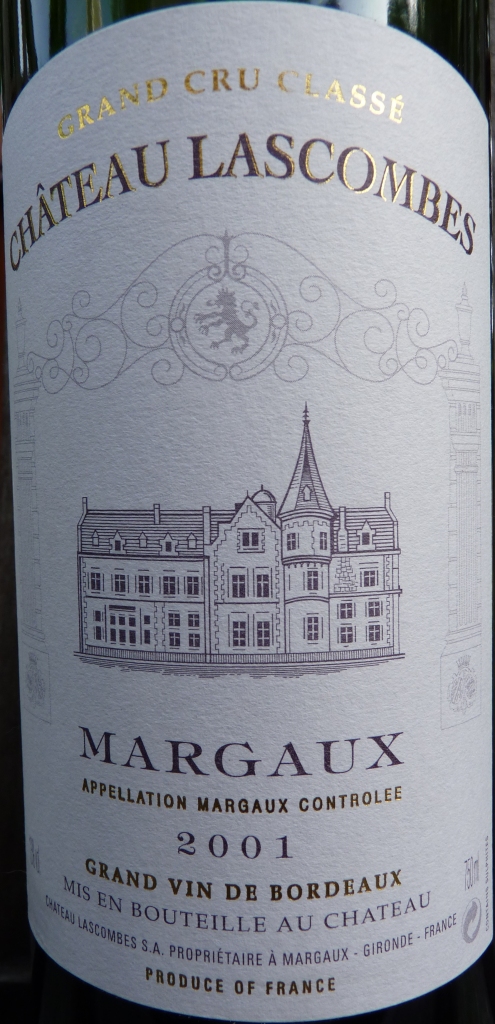 Chateau Lascombes was three years younger, but of course that age difference has little meaning when it comes to wines which can last for 50 years or longer – growing conditions would have much bigger effect. 1998 had nice and dry summer, and 2001 had very hot summer and rainfall right before the harvest time (here is the link to the wine information on the Chateau Lascombes web site). This is all interesting, right? Well, okay – not that we could taste it in the wine. 2001 Chateau Lascombes was big and powerful. Hint of black truffles lasted for a while after the wine was open, but it was not present on the palate. The wine was very structured, still with the firm tannins and lots of dark fruit on the palate, very balanced. Drinkability: 8.
This was definitely a great experience with magnificent wines (I can’t thank Emil enough!). I don’t know how I would do in a blind tasting, but it was very interesting to find great similarities in the wines made in a close geographic proximity and technically having very similar terroir. White truffles or black, but the wines were similar on the nose, which I find fascinating – it was the first time I tasted wines of such level effectively back to back, so it was a great learning moment.
That’s all for now, folks. I wish you great wine discoveries – cheers!
Last Bottle Sign Up ($10 credit)




 Talk-A-Vino