Archive
Pleasures of Obscure and Difficulties to Express it in Words
German Pinot Noirs are hard to find in the US.
This story is not about Geman Pinot Noir, but the quest for one played a major role here.
I follow a group of wine-os on Twitter X who are swearing by Pinot Noir from Germany, particularly from Ahr, being the best Pinot Noir in the world, easily rivaling Burgundies in quality. Naturally, my interest was piqued and I started looking for the Pinot Noir from Ahr in the US. The problem is that Ahr is a tiny appellation to begin with, and given the popularity of Ahr Pinot Noir in Europe, this was not an easy task. I found Ahr Pinot Noir on Wine.com and confirmed with the group that it was a good producer. The wine itself was $56 or so, adding shipping and tax was making it even more expensive. Now, American Express credit card often has special offers for variety of merchants, Wine.com often being one of such merchants. I think the deal I registered for was $20 off a $100 purchase – considering that Wine.com shipping for 1 bottle is the same as for 3 (I think it is $20), it was a no-brainer – I just had to find a few bottles to reach $100 and get the discount.
At first, I was looking at some of the familiar wines to add to that Ahr Pinot, but then it dawned on me that I might look for wines to add to my rare grapes collection, which is exactly what I did. In the picture below, you see an end result – a Pinot Noir from Ahr and two wines made from the grapes I have not tried yet.
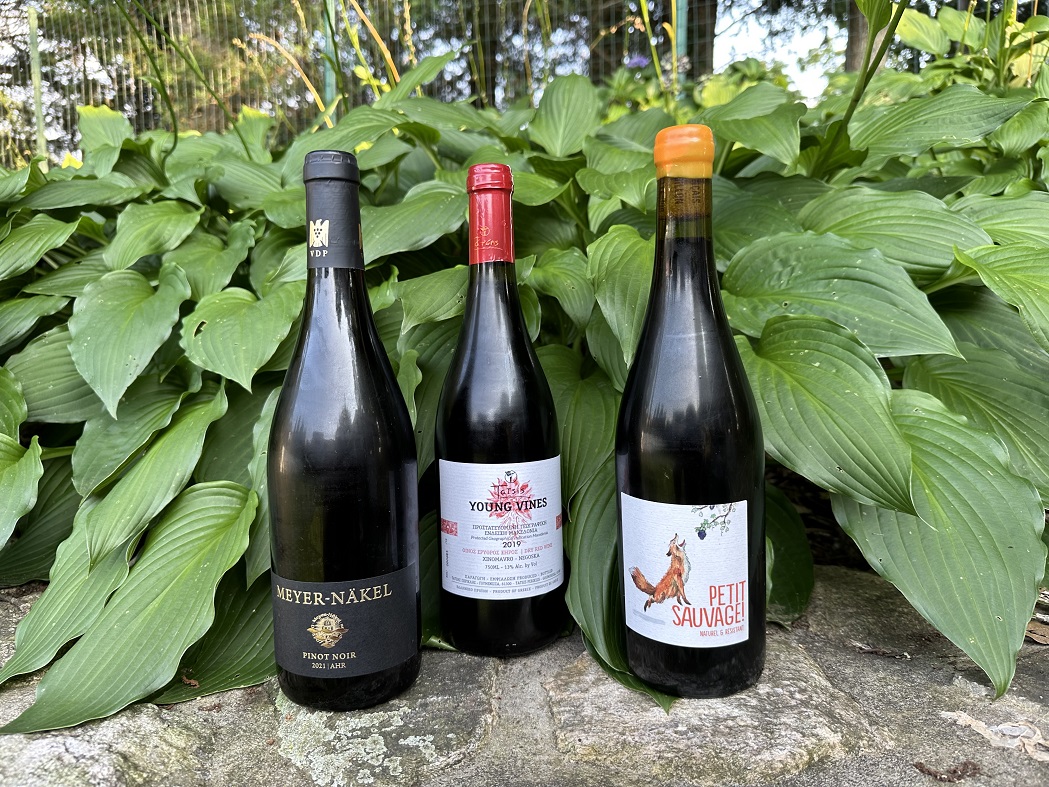
As you might know, I have been a grape geek for a long time, ever since I was bitten by The Wine Century Club bug (probably close to 20 years by now). I’m always happy to taste the wines made from unknown grapes, whether I will be delighted or terrified – it is all a good experience. Also trying a wine made from an unknown grape is extra fun as you can always approach such a wine with an open mind having no references (read: constraints) of any kind.
The 2022 Petit Sauvage Rouge Vin de France (13% ABV) was made from the grape called Cabernet Cortis which I have never had before. Cabernet Cortis is a hybrid grape, created in 1982 in Germany by crossing Cabernet Sauvignon and Solaris, another hybrid grape (last year I tasted the wine made from Solaris in Sweden). The grape was developed to be better adapted to climate change as well as to be disease-resistant.
The wine was uniquely delicious. Some of the uniqueness I need to attribute to the fact that I was unable to describe the perceived qualities of this wine in English. Yes, you heard that right. My mother tongue is Russian, and while Russian is really not the language of wine, one of the Russian words was the best for describing this wine – терпкий (terpkii). The word describes both taste and textural sensation. To give you an idea of the best textural association, I have a strange question for you – have you ever licked velvet with your tongue? I’m serious. Have you ever seen a TV episode where Gary Vaynerchuk explains wine descriptors to Conan O’Brian and forces him to chew on a wet sock? Something like that, only without socks. So if you would ever try to lick a piece of velvet (make sure it is clean if you do), this would be the closest you would get to that descriptor.
I tried translating it using Google Translate, and the best I can get is “tart” – here are a few more options from the Russian-English dictionary: терпкий — tart, harsh, acerbic, acerb, acidy. None of these would do. As a wine descriptor, tart generally means acidic, and devoid of fruit. And this doesn’t describe the textural and taste sensation I experienced when tasting that wine. Tannins probably would work best, especially those called “velvety tannins”, but I’m still not convinced that this is the best way to describe the taste of this Cabernet Cortis wine. All in all, the wine was delicious, a little bit racy and gamey, but this was perfectly integrated into an overall taste profile. And I would gladly drink this wine again if I had a chance.
Well, the only way we can solve this is for you to find this wine, taste it, and explain to me how little I know about wine – I promise to listen, and will be happy to expand my wine vocabulary.
By the way, speaking about tart – the second wine, 2019 Domain Tatsis Xynomavro – Negoska Young Vines Macedonia Greece, made out of Negoska grape, was actually tart, it was tart beyond belief, and basically, not drinkable. It didn’t improve even after a few days. You do have to kiss a lot of frogs in life… But it’s okay, a part of the process.
Here you are, my friends. There are lots more of the rare grapes I need to report on, so stay tuned…
Last Bottle Sign Up ($10 credit)




 Talk-A-Vino