Archive
Reminiscing About Chardonnay
It’s been two weeks since the Chardonnay Day (May 23rd). So far I missed all the grape holidays this year, so why bother bringing it up, right?
Well, there are a few reasons. First, after carefully checking the blog, I realized that I never wrote about Chardonnay Day, which is a pity, because…
And here is the next reason – Chardonnay is one of my most favorite grapes. Of course, as a wine lover, you can say that I share this sentiment about every grape. Somewhat true, and yet in my book Chardonnay is different than most other white grapes.
While considered to originate in France, Chardonnay today is growing everywhere. I’m not sure if there is any well-known winemaking country that doesn’t produce Chardonnay – France, Italy, Australia, New Zealand, USA (everywhere – New York, Pennsylvania, California, Washington, Oregon, Virginia, Texas…), Chile, Argentina, South Africa and literally everywhere else.
Chardonnay can be produced in all wine “forms” – still, sparkling, dessert. In still wines, Chardonnay is best known as a solo player, even though sometimes it can be added to the blend. In sparkling wines, Chardonnay can be used just by itself, producing Blanc de Blancs sparklers, but it also plays very well with others, such as Pinot Noir and Pinot Meunier in the case of classic French Champagne. But even in the still format, the range of Chardonnay’s expressions is endless, from steely, razor-sharp cut-through acidity in the young Chablis or some of the unoaked Chardonnay wines from the new world to the big, buttery, “love my every curve” wines that almost are not made anymore in California. And speaking about dessert, let’s not forget “stickies” from Australia.
Another important characteristic of Chardonnay – properly made wines can age. There are very few aging-capable white wines. Riesling probably holds a crown there, but anyone who tried well-aged Chablis or Burgundy knows the joy of the heavenly, honey-and-lemon liquid which forces you to meditate over a glass of wine, not just drink it.

To prove my “special affinity” to Chardonnay, I decided to enlist the help of my Top Wine of the Year lists. At the end of every year, I publish the list of the most memorable wines of the year – what can be a better proof of recognition? I analyzed all of the lists from 2010 to 2023 to see how often Chardonnay was included, and only in its pure form, not as a part of the blend – and it appears that Chardonnay wines were a part of the Top Wines lists in 12 out of 14 years. For comparison, my beloved Rioja only made it into the 8 Top lists out of 14.
For what it is worth, in addition to my favorite collage picture of the Chardonnay wine labels over the years, I’m including here the list of my favorite Chardonnays of all time. I’m sure there are other wonderful Chardonnay wines that simply didn’t make it to the top list, but the list of wines below is still well-representative, Let’s take a look, in chronological order:
2010, #11 – Cambria Bench Break Chardonnay 2006, Santa Maria
2011, #4 – 2009 Peter Michael “Belle Cote” Estate Chardonnay
2012, #13 – 2008 Kovacs Nimrod Battonage Chardonnay, Eger Winery, Hungary
2013, a double entry
#12 – 2008 Seresin Chardonnay Reserve Marlboro New Zealand
#2 – 2005 Frédéric Gueguen Chablis Les Grandes Vignes
2015, #14 – 2012 Marchesi de’ Frescobaldi Pomino Bianco Benefizio Riserva DOC
2016, again a double-entry
#17 – 2001 The Lucas Winery Chardonnay Lodi California
#9 – 2015 Vidon Vineyard Chardonnay Estate Chehalem Mountains, Oregon
2017, yet another double
#13 – 2012 Sandhi Chardonnay Santa Barbara County
#12 – 2016 Salabka LA COQUINE Chardonnay Praha Czech Republic
2018, #6 – 2015 Domaine Jean-Noel Gagnard Chassagne-Montrachet Blanc 1er Cru Les Caillerets
2019, a triple!
#17 – 2017 Oceano Chardonnay Spanish Springs Vineyard San Luis Obispo County
#16 – 1990 Dom Ruinart Ruinart Blanc de Blancs Champagne
#9 – 2005 Giulio Ferrari Riserva del Fondatory Metodo Classico Trento
2020, a double
#10 – 2016 Domaine Anderson Estate Chardonnay Anderson Valley California
#8 – 2018 Landmark Vineyards Overlook Chardonnay Sonoma County
2021, a double again
#9 – 2013 Lynmar Estate Chardonnay Russian River Valley
#4 – 2018 Le Cadeau Vineyard Chardonnay Willamette Valley
2023, #1 – 2021 Balverne Chardonnay Russian River Valley AVA
Just to give you another bit of information, among the 19 wines listed above (creme de la creme of Talk-a-Vino Chardonnay experiences) there are 2 sparkling wines, the rest are still wines from 7 different countries and winemaking regions – France, Italy, California, Oregon, New Zealand, Hungary, Czech Republic.
Here you are, my friends. I already feel better – two weeks later, but I acknowledged one of my most favorite grapes.
What are your most memorable Chardonnay wines?
Weekly Wine Quiz #97: Grape Trivia – Blends, Part 1
 The Wine Quiz series is not meant to intimidate. The whole idea here is to have fun and learn something new. When answering the questions, it is fully encouraged to use all available sources of information, including Google or any other search engine. There are no embarrassing answers – the most embarrassing thing is not giving it a try…
Welcome to the weekend and your new wine quiz!
We are continuing our grape trivia series, but changing gear slightly. Until now, we talked only about specific grapes – each weekly quiz was dedicated to one and only one grape, whether it was red or white. Of course some of the questions included mentions of the blends, but still, the single varietal was a star. For the next few quizzes, I want to change that. Most of the wines we drink are blends. So why don’t we talk about blends for a while? Let’s mix things up.
At this point, as I’m not entirely sure yet of the exact direction. Below you will find 5 random questions regarding blending of the grapes – in the particular wines, and in particular regions. We are not going to focus on a single region, and will be blending both red and white grapes. Some questions might also be just opposites of the blends. We shall see. And yes, please comment and let me know what you think.
And now, to the quiz!
Q1: Which grape is missing?
– Cabernet Sauvignon
– Merlot
– Cabernet Franc
– ?
– Petit Verdot
Q2: Wines of this region, made out of Sauvignon Blanc and Sémillon, considered some of the best white wines in the world. Can you name that region?
Q3: This wine might be the biggest officially sanctioned blend of the grapes in the world. Do you know what wine is that?
Q4: This simple wine is classified as a field blend. This is probably best known European white field blend wine. Now:
a. Can you explain what field blend is?
b. Can you name this wine?
Q5: This wine, one of the most famous in the world, is often made from 70% Cabernet Franc and 30% Merlot. Do you know what wine is that?
Good luck, enjoy the quiz and your weekend! Cheers!
Wednesday’s Meritage – Wine Quiz Answer, Wine Spectotor Top 100, Perfect Holiday Gift Solution, and more
 Meritage time!
First, let’s start with the answer for the wine quiz #82, grape trivia – Gamay.
In the quiz, you were supposed to answer 5 questions about red grape called Gamay. Here are the questions, now with the answers:
Q1: Gamay is closely associated with every third Thursday in November. Can you explain why?
A1: Beaujolais Nouveau is coming into town! While Beaujolais Nouveau was always the first wine of the harvest to be delivered to the restaurants and shops in Europe, in 1985 the phenomenon became more organized, settling on the third Thursday of November to make the new release available.
Q2: Carbonic maceration is an important method in production of wines made out of Gamay. Can you briefly explain what is carbonic maceration and how does it helps here?
A2: Carbonic maceration is a process where the grapes in a sealed tank are subjected to the flow of CO2, which start fermenting the juice inside of the whole grapes before they will be crushed. The resulting wine becomes fruity with very low presence of tannins. This process is particularly used inproduction of Beaujolais Nouveau and other Beaujolais wines. For more information, please refer to Wikipedia article.
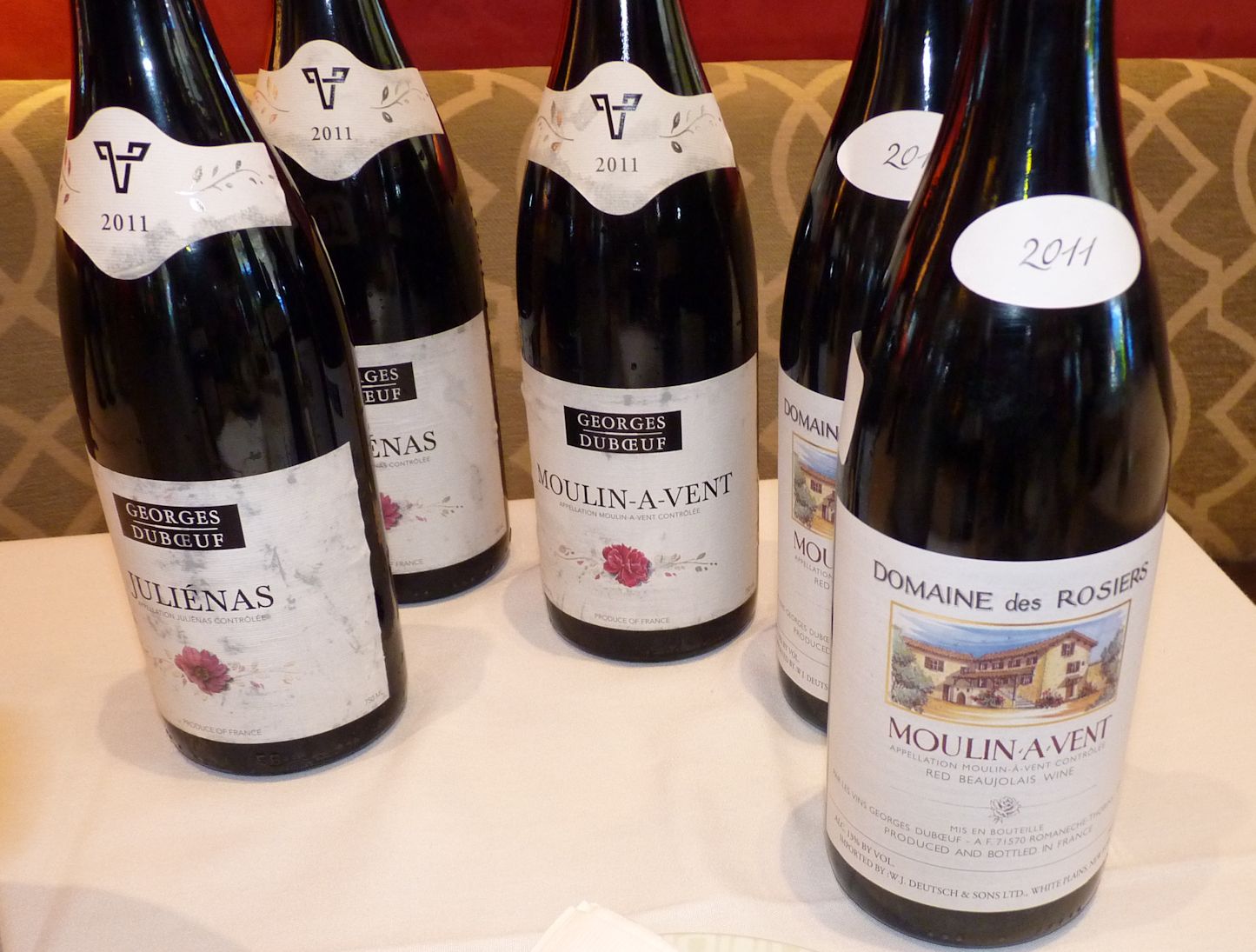
Q3: Fill in the blanks: In Beaujolais, Fleuri is considered to produce the most ___ wine, and Moulin-à-Vent produces the most ___ wines.
A3: In Beaujolais, Fleuri is considered to produce the most feminine wine, and Moulin-à-Vent produces the most masculine wines. Feminine and Masculine are the descriptors typically used by wine professionals to describe the wines of Fleuri and Moulin-à-Vent wines.
Q4: Which one doesn’t belong and why:
a. Brouilly, b. Côte de Brouilly, c. Côte Chalonnaise, d. Juliénas, e. Régnié
A4: c. Côte Chalonnaise. The other four names are part of Cru de Beaujolais ten villages, but Côte Chalonnaise doesn’t belong there (it is an AOC in Burgundy).
Q5: True or False: Beaujolais Nouveau wines can be aged for a few years before consumption.
A5: False. The whole point of aging the wine is to wait for it to develop further in the bottle and become more enjoyable. Beaujolais Nouveau is meant to be enjoyed right away and should be consumed by May of next year – it doesn’t improve in the bottle.
So for the winners, Jeff the drunken cyclist continues his winning streak – he got correctly 5 out of 5, including the difficult question #3. Great job, Jeff – unlimited bragging rights are yours! I would like to also acknowledge Wayward Wine,Whine And Cheers For Wine and Eat with Namie who all correctly answered 4 questions out of 5. Well done!
Now, to the interesting stuff around the vine and the web!
On Monday, November 18th, Wine Spectator published their Top 100 list of Wines. Yes, I know, many dismiss the whole notion of Wine Spectator ratings and Top lists as closely associated with the advertizement dollars spent with publication. True or not, but I still have a lot of respect to Wine Spectator and definitely curios to see their “top wines” list. As Wine Spectator celebrates 25th anniversary, they whole web site is open to the public (typically it requiressubscription). I would highly recommend that you will take advantage of this opportunity and explore the site which has a great wealth of wine information. Also, here is the link to the WS Top 100 wines of 2013. I have to admit that I’m happy with Wine Spectator’s choice for the wine of the year – 2004 Cune Rioja Imperial Gran Reserva. In general, Cune Imperial makes great wines, and I think it is an excellent choice for the wine of the year.
Thinking about holiday gifts? Does your list include any wine lovers? If yes, you are in luck, but you will need to act quick. On December 2nd, WTSO will conduct a Gift Marathon (full info can be found here). As a traditional WTSO Marathon, there will be no announcements of new wines. But each wine will come gift packaged, with one bottle and two varietally correct Riedel glasses in the box. Most importantly – free shipping on each package (no minimums), and each packaged can be shipped directly to your gift recipient – this is the best part! Prices start from $44.95 per box (free shipping). I think this is a deal not to be missed, so point your browser to WTSO on December 2nd and happy hunting!
You know Wine-Searcher is a great resource for finding the wines online and comparing the prices. Are you curious what the other people looking for on the wine-searcher? Here is an interesting article, which tells you what the consumers in America are looking for. Based on the article, looks like most of the times people are looking for red Bordeaux blends – which makes sense, as there are a lot more Bordeaux blends produced nowadays. Anyway, for your own analysis and lots more data, take a look at the article.
When you make dinner, how often do you think about what wine should be opened for the food you are serving? Sometimes the pairing can be quite difficult, so I have no problems taking my food and wine separately. But when you hit the mark and the wine and food “work” together, it becomes the whole new level of experience. To help you in this process of pairing food and wine, here is the link to the web site I recently came across – I think it has a lot of good suggestions. Take a look – you might be able to pleasantly surprise yourself and your guests during your next dinner.
That’s all I have for you for today, folks. The glass is empty – but refill is on its way. Until the next time – cheers!
Weekly Wine Quiz #82: Grape Trivia – Gamay

Gamay grapes
Source: Wikipedia
The Wine Quiz series is not meant to intimidate. The whole idea here is to have fun and learn something new. When answering the questions, it is fully encouraged to use all available sources of information, including Google or any other search engines. There are no embarrassing answers – the most embarrassing thing is not giving it a try…
Welcome to the weekend and your new wine quiz!
We are continuing our grape trivia series, with the focus again on the red grapes, and today’s subject is Gamay, also called Gamay Noir, and fully officially a Gamay Noir à Jus Blanc.
Gamay is a purple-skinned grape, taking its name from the village of Gamay, located south of Beaune in France. Gamay is considered to be a cross between Pinot Noir and ancient white grape called Gouais Blanc. First mentions of Gamay go all the way back to the 14th century, so it had being around for a while.
Gamay grapes have thin skin, and have a tendency to overproduce, creating the grapes with very high level of acidity and low sugar, which often results in the production of lightly colored and quite acidic wines. The overproduction and high acidity were the reasons for the Gamay being literally outlawed and pushed out of Burgundy by the royal rulers at the end of 14th century, to give way for much rounder Pinot Noir. As the result, Gamay mostly settled in Beaujolais area, where it became the major red grape variety. Gamay is used in Beaujolais to produce a wide range of wines, starting from the famous Beaujolais Nouveau, the wine produced within 6 weeks of the harvest – young, grape-y and quaffable, but usually not very exciting; and then going to the Cru Beaujolais ( there are 10 villages in Beaujolais, which have this status), which can be dense, concentrated and age-worthy.
In addition to Beaujolais, Gamay is also growing in Loire region, where it is often blended with other local grapes such as Cabernet Franc and Cot ( Malbec) and it is used to produce both red and Rosé wines. The Rosé from Loire are typically a lot fruitier than the ones from Provence. Gamay is also successfully grown in Switzerland, especially in the area around lake Geneva – it is often blended with Pinot Noir there. Outside of France, Gamay is planted in the number of regions, such as United States and Italy, but it doesn’t produce much of the well known wines. Interestingly enough, a world renowned wine writer and critic, Jancis Robinson, was raving about Gamay wines produced by Sorrenberg of Beechworth in north east Victoria, Australia – she mentioned that it might be “one of the most exciting Gamays I have ever tasted”.
And now, to the quiz!
Q1: Gamay is closely associated with every third Thursday in November. Can you explain why?
Q2: Carbonic maceration is an important method in production of wines made out of Gamay. Can you briefly explain what is carbonic maceration and how does it helps here?
Q3: Fill in the blanks: In Beaujolais, Fleuri is considered to produce the most ___ wine, and Moulin-à-Vent produces the most ___ wines.
Q4: Which one doesn’t belong and why:
a. Brouilly
b. Côte de Brouilly
c. Côte Chalonnaise
d. Juliénas
e. Régnié
Q5: True or False: Beaujolais Nouveau wines can be aged for a few years before consumption.
Good luck, enjoy the quiz and your weekend! Cheers!
Weekly Wine Quiz #4 – Which One Doesn’t Belong?
Each wine region in the world has a number of specific characteristics, such as terroir, the style of wine and so on. One of such important characteristics is kinds of grapes growing in the region and used for the winemaking. Moreover, in a lot of cases only specific grapes are allowed to be used in the wine if the wine will carry region’s name on its label.
Below is a list of grapes allowed to be used in the wine production in one of the world’s most famous regions – except that one grape doesn’t belong there. Do you know which one it is? Have fun! Cheers!
Wine Century Club Treble Journey – Xynomavro, Grape #241
 I would be nice if I can open this post with “this is a quick update on the progress”, but such a statement would be strange, as I don’t believe anyone asked for my updates. Therefore, this is a “memory knot” post for myself, just to be able to look back one day and see the path to Treble status in The Wine Century Club. (you can read more about Treble “journey” in my previous post ).
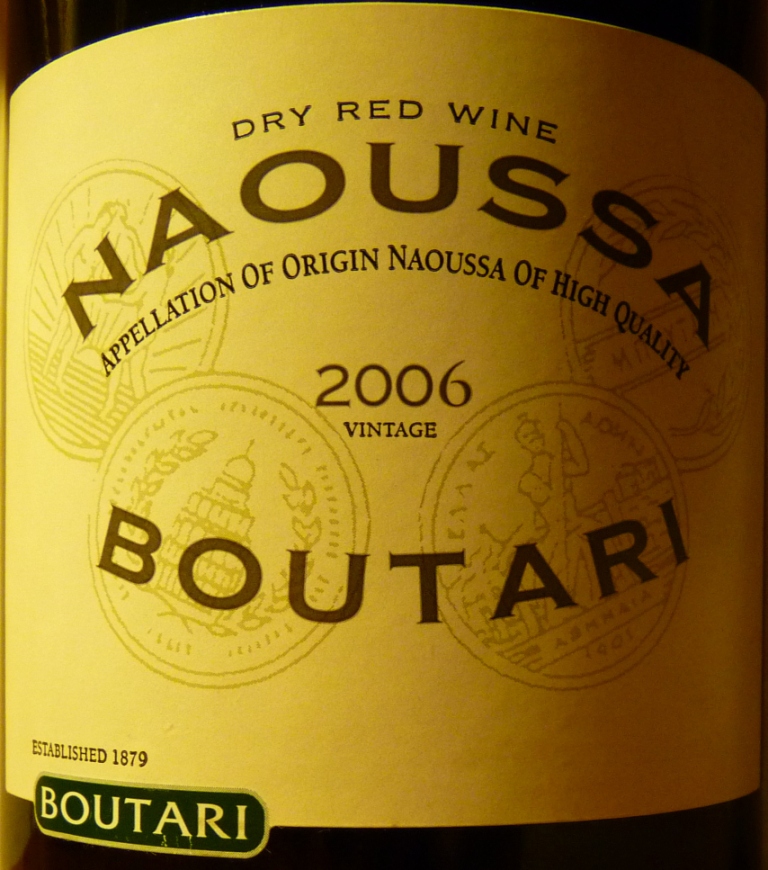
So the grape called Xynomavro happened to become number 241 on my list. The wine Boutari Naoussa 2006 was made from 100% Xynomavro. This grape is described as one of Greek’s best in terms of firm tannins and aging potential. Unfortunately, the Boutari Naoussa 2006 was not the best representation of the grape, with tannins being somewhat off and having isolated taste on a side of the mouth, and the rest of the wine being not very impressive grape juice.
If anyone wonders about the rating, you can imagine it will not be too high…
Drinkability: 6-
In general, I think it would be safe to state that we drink wine because it gives us pleasure (I’m absolutely NOT talking about being “drunk and happy”) – and it should be a pleasure of taste, pleasure of flavor sensation unfolding in your mouth. So when the wine doesn’t taste good, it is really a disappointment (of course nobody is talking about pain). However, when you have an additional purpose, not just a sensual pleasure, it changes the perspective – when trying to reach a next level in The Wine Century Club, even the wine which doesn’t taste great still gives you a pleasure of inching towards your goal. Having realize that, I’m feeling better already!
Let’s go to Treble!
Cheers!
Last Bottle Sign Up ($10 credit)




 Talk-A-Vino