Archive
One on One With Cristina Mercuri, Master of Wine
As you might know, I love interviews.
That didn’t happen from the first day of blogging. It took me some time to realize the value of conversation. But once it “clicked”, interviews became one of my favorite subjects on this blog – “Stories of Passion and Pinot” series might be the best proof of that.
Today’s interview is a bit different than the most. The majority of my interviews are with winemakers. However, today I would like to offer to your attention my conversation (virtual, as it often goes, even though this is one of the cases where I would much prefer a face-to-face format) with Cristina Mercuri, Master of Wine.
Cristina Mercuri is the first woman Master of Wine (MW) in Italy, and the fourth Italian MW overall. To put things in perspective, only 521 people have become Master of Wine since 1953, according to the Institute of Master of Wine as of February 2026. This is definitely an achievement to celebrate, so I was very excited when I got an opportunity to talk to Cristina. She is also the founder of Cristina Mercuri Wine Club – we will touch on that in our conversation below.
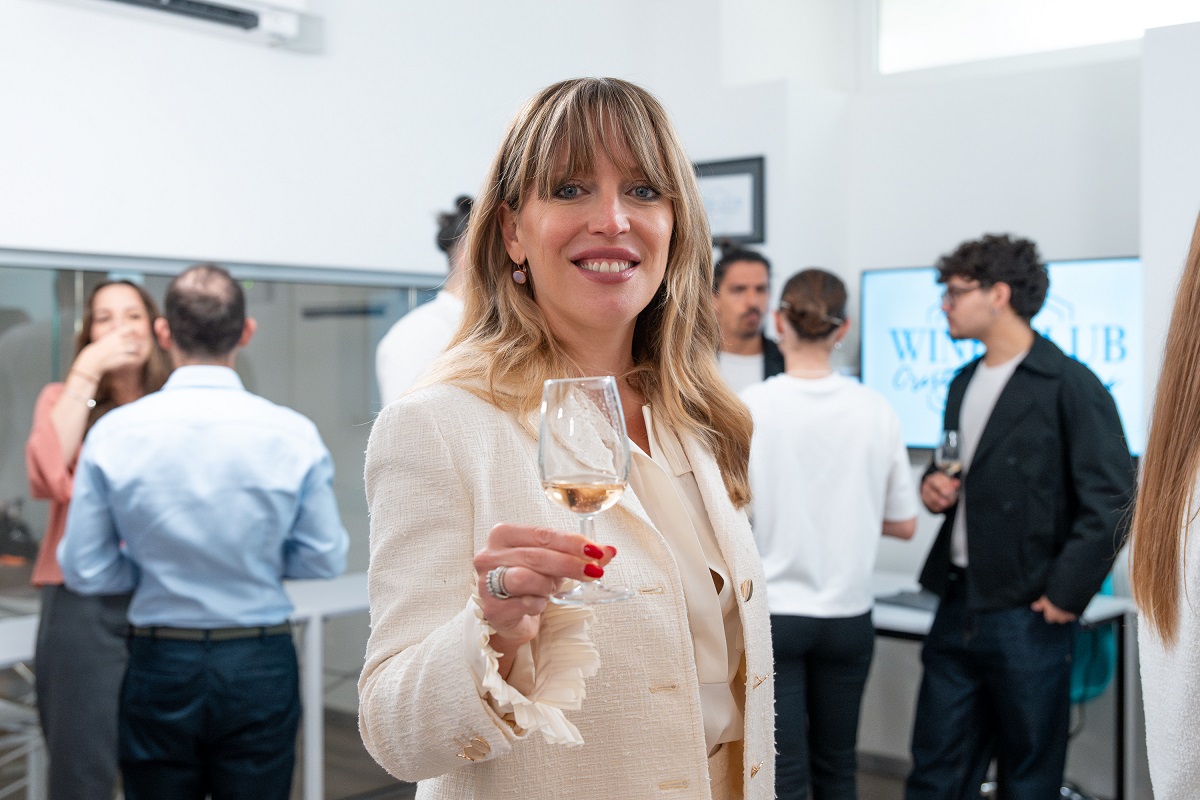
Cristina Mercuri
Here is what transpired in our conversation:
[TaV]: This might be a “duh” question, as you grew up in Italy, and yet – as a wine lover, not as a wine professional, how did you get into the world of wine? Family traditions? Was there a pivotal wine in your life?
[CM]: Wine was always present in my life in the way it often is in Italy: around the table, as part of everyday culture rather than something intellectualized. It belonged to meals, to conversations, to conviviality.
My real entry into the wine world happened much later. I was working as a lawyer and, despite having built a solid career, I felt increasingly bored and disconnected from what I was doing. I needed a radical change, something intellectually stimulating and culturally rich. Wine offered exactly that.
I began studying through the WSET programmes while still working in law, initially out of curiosity. Very quickly that curiosity turned into a serious commitment. By the end of 2015 I decided to leave the legal profession entirely and dedicate myself to wine. What started as a personal exploration became a new professional path.
[TaV]: What made you switch from a successful career in law to the unpredictable world of wine?
[CM]: Law gave me a very strong analytical framework, discipline and the ability to structure complex reasoning. But at a certain point I felt the need to work in a field where cultures creativity and human connection were more present.
Wine offered exactly that. It is an industry where agriculture, craftsmanship, economics and storytelling coexist. Each bottle represents a product, but also a narrative about land, people and time. I realized that the skills I had developed in law — critical thinking, precision, strategic analysis — could be applied in a different way to the wine world.
Leaving law was a significant decision, but it never felt like abandoning something. It felt like redirecting the same intellectual energy toward a field that resonates deeply with identity, culture and global exchange.
[TaV]: You recently became the first woman Master of Wine in Italy (and only the 4th in Italy overall) – how does it feel? What was the hardest part of the MW journey? What was your favorite part of studying?
[CM]: Becoming the first Italian woman Master of Wine is both a personal achievement and a symbolic milestone. In a different world it would be big news that another professional became an MW. In today’s reality, it also represents a small step toward greater diversity in a sector where leadership has long been male-dominated.
The hardest part of the journey is consistency. The MW programme is not only intellectually demanding, it requires years of sustained discipline while continuing to work professionally. Preparing for the Stage 2 examination felt almost like an Olympic training period: blind tasting every day, theory study, mock exams, mental preparation.
My favorite part was the intellectual depth of the programme. It forces you to think about wine from every possible perspective: viticulture, economics, geopolitics, consumer behaviour, communication. It teaches you that wine is not only about what is in the glass, but about the entire system around it.
[TaV]: If at all possible in this format, can you share with us the gist of your master thesis, “Wine, Women and Fascism: A Visual Analysis of the Representation of Women in Propaganda in Enotria (1922–1942)”?
[CM]: My research paper examined how women were represented in the Italian wine magazine Enotria during the Fascist period. I analyzed the covers published between the 1920s and early 1940s using visual semiotics and historical analysis.
What emerged was a very clear pattern: women were rarely portrayed as producers, professionals or decision-makers within the wine world. Instead, they appeared mainly as decorative figures, symbols of beauty, domesticity or national mythology. The visual language reflected broader political and cultural narratives of the time, where gender roles were tightly controlled and instrumentalized.
The research was interesting because it connects visual culture, political ideology and wine communication. It also helps explain why certain stereotypes persisted for decades in the way wine — and women in wine — have been represented.
[TaV]: I heard many times that women are better tasters than men. Do you share the same opinion?
[CM]: I don’t think wine tasting is determined by gender. Sensory ability can vary enormously between individuals, but excellence in tasting comes primarily from training, discipline and experience.
The best tasters I know share certain qualities: concentration, memory, analytical thinking and intellectual humility. Blind tasting especially is a skill that develops through repetition and structured practice.
Reducing tasting ability to gender risks oversimplifying something that is actually much more complex. Wine evaluation is a professional competence that can be developed by anyone willing to dedicate the time and rigor required.
[TaV]: There is a lot of talk everywhere that the world of wine at large is in trouble, as younger people either don’t drink wine at all, or have very specific requirements (low alcohol seems to be one of the most important ones, no oak, etc.). What do you think about young adults and wine? Does the wine industry at large need to do something to address it, or is it just a part of the cycle?
[CM]: I think the conversation around younger consumers often starts from the wrong assumption. It is not that young people reject wine; it is that they expect wine to speak a language that resonates with them.
For decades the industry communicated mainly through tradition, hierarchy and technical jargon. Younger consumers tend to look instead for transparency, authenticity and clarity. They want to understand what is in the glass, who made it, how it was produced and why it matters.
This requires a shift in communication more than a reinvention of wine itself. When wine is presented with honesty, clarity and relevance, younger audiences respond very positively. The future of wine depends largely on our ability to listen to those audiences and adapt the narrative accordingly.
[TaV]: Do you have a favorite Italian wine and/or producer?
[CM]: Italy is incredibly diverse, so choosing one wine is almost impossible. But if I had to mention a style that fascinates me deeply, I would say Etna Bianco. The combination of volcanic soils, altitude and Mediterranean light produces wines with remarkable tension, precision and aging potential.
Producers such as Maugeri or Palmento Costanzo are doing extraordinary work in expressing the subtle differences between contrade and elevations. Etna is a perfect example of how a historic territory can also represent the future of Italian wine.
[TaV]: Same question, taking the view of the world – can you share some names of your favorite wines and/or producers from around the world?
[CM]: I have always been deeply fascinated by Burgundy, particularly producers like Olivier Leflaive or Alain Chavy, who express incredible precision and terroir transparency in Chardonnay.
In Champagne, houses like Krug, Philipponnat or Yann Alexandre represent a philosophy of blending and long maturation that creates wines of extraordinary depth and longevity.
I also admire producers who work with clarity and restraint in different parts of the world — those who allow the vineyard to speak rather than imposing heavy stylistic signatures, like Creation in South Africa.
[TaV]: Do you have a wine cellar? If you do, what would we find there?
[CM]: Yes, I do have a cellar, although I tend to think of it as a working cellar rather than a collector’s one. You would find a mix of Italian classics — Barolo, Brunello, Etna — alongside Champagne and Burgundy.
There are also many bottles linked to personal moments: wines opened to celebrate milestones, wines shared with friends, wines connected to travel or professional encounters. For me a cellar is not only about aging potential; it is also a memory archive.
[TaV]: Can you tell us more about your project, Mercuri Wine Club? What are your aspirations? What are you trying to achieve? How do you see this project evolving over the next 10 years?
[CM]: Mercuri Wine Club was born from a desire to combine education, communication and strategic consultancy within the wine sector.
The project has two main dimensions. One focuses on education, offering structured training programmes that help professionals and enthusiasts understand wine with clarity and depth. The second focuses on strategic consultancy, helping wineries and wine institutions position themselves more effectively in international markets.
Over the next ten years I see the project evolving into a broader platform that connects education, market intelligence and communication. The wine industry needs more bridges between production, markets and consumers, and that is precisely the space where Mercuri Wine Club operates.
[TaV]: Last question: have you had a chance to watch Drops of God series on Apple TV? If you have, what do you think of it? If not, I can’t recommend it highly enough 🙂 [CM]: Yes, I have watched it, and I found it fascinating from a cultural perspective. The series captures something very real about wine: the emotional dimension, the role of memory, and the intensity of sensory perception. In that sense it does a good job of showing that tasting is not just technical evaluation, but also interpretation and personal experience.
At the same time, what slightly disappointed me is the risk of portraying wine tasting as something almost supernatural or accessible only to a few exceptional individuals. In reality, tasting wine is a skill that anyone can develop with curiosity, attention and practice. Blind tasting is not about superpowers, and it certainly shouldn’t be intimidating.
If anything, wine should invite people in, not push them away. The real beauty of tasting is that it sharpens perception and encourages dialogue. Anyone can sit at a table, taste a wine blind, and enjoy the process of discovering it. That sense of curiosity and shared exploration is what truly makes wine special.
Here you are, my friends. I hope you enjoyed reading our conversation, and until the next time – cheers!
Last Bottle Sign Up ($10 credit)




 Talk-A-Vino