Archive
Taste Expectations, Or Notes From The Blind Tasting
 If you had been drinking wine for a while, I would expect that you have developed certain taste expectations. As you drink the wines from the different regions, you find that the wines from the same geographic locality made from the same grapes would have somewhat of a similar taste and style (yes, of course, I just described what is properly called Terroir without using the word itself). At some point, the associations between the origin of the wine and its expected taste become engrained in your mind. Looking at the bottle of New Zealand Sauvignon Blanc, you are expecting to find bright acidity and citrus flavor profile even without opening the bottle. Looking at the bottle of California Cabernet Sauvignon you are expecting to find a good amount of fruit with some explicit black currant notes and a probably good amount of tannins – note that I’m really trying to generalize here, but you got the point.
This is the way the wine was for a very long time. However, when you taste modern wines, do you have a feeling that your expectations are no longer valid and don’t match reality any longer? I have had this experience many times lately, when Amarone didn’t taste like anything expected (you can find my rant of pain here), or when unoaked Chardonnay tastes rather like Pinot Grigio – and there are many more examples of “taste confusion”.
Recently, I had another case of “broken” taste expectations – this time it was somewhat sanctioned, as we did a double (almost) blind tasting. The theme was set a bit ambitiously, as France and Italy. The “ambitious” part is coming from the fact that these two countries on their own have such a variety of wine production that it makes it literally impossible to recognize the grape or at least the style of wine (either one of those countries would provide a plentiful selection for a double-blind tasting on its own). Anyway, with the main goal of having fun with the wines, we actually had a great time.
We blind tasted 5 wines, which happened to be 4 reds and one white. For what it is worth, here are my notes as we were moving along:
#1 – Very nice, a bit too sweet. I think Italy, Super Tuscan/Barbera/Dolcetto
#2 – earthy, nice, little green bell peppers, roasted notes? Bordeaux?
#3 – France, nice bright fruit, good sweetness, not enough acidity? No idea about the grape.
#4 – interesting, lots of fruit, very nice – no idea.
#5 – great, round, good fruit – no idea.
While I understand that these a rather limited wine descriptions, would you try to guess what was what? Well, you can see the answers below in the picture (wines are set in the order we tasted them, left to right):
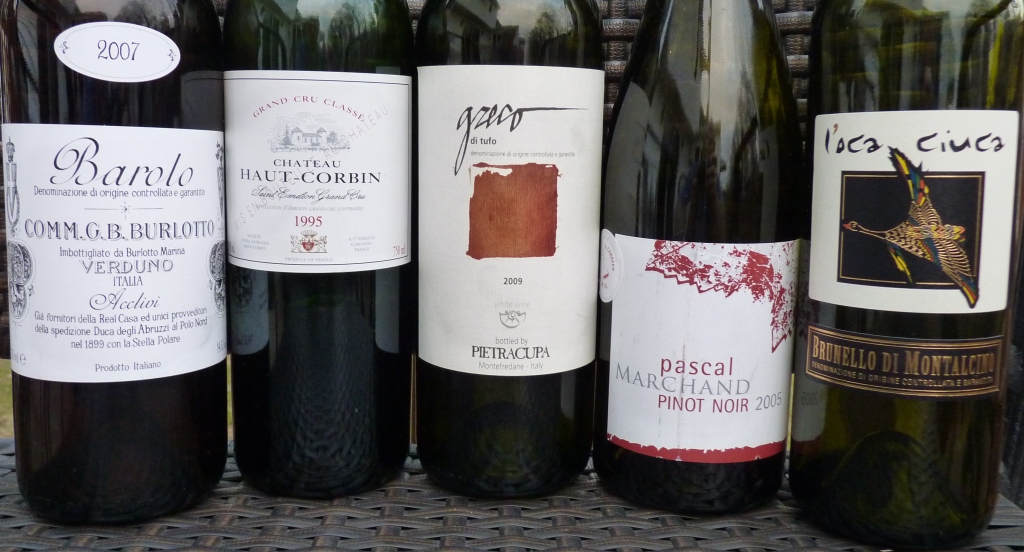
Here is an actual list: 2007 Comm. G. B. Burlotto Barolo Verduno; 1995, Chateau Haut-Corbin Saint-Emillion Grand Cru; 2009 Petracupa Greco di Tufo; 2005 Pascal Marchand Pinot Noir and L’oca Ciuca Brunello di Montalcino DOCG – now compare that with my guesses above…
In case you are curious – of course, we voted for the favorite – Brunello (#5) was a clear winner, with Greco de Tufo (#3) trailing it closely behind (one point difference).
Where is the case of broken taste expectations? Fruit forward, bright and loaded wine with well-masked tannins and almost non-existing earthiness, bright purple in color – 2007 Barolo? I’m very far from a Barolo expert, but this doesn’t match my expectations of Barolo, albeit well decanted. Even winning Brunello was quite uncharacteristic, lacking earthiness and tartness, the traditional Brunello bite. I can’t comment on Greco do Tufo (it was actually quite nice), and the only varietally correct wine was 1995 Bordeaux. Am I making too big of a deal from varietal correctness and taste expectations here? It depends. On their own, both Barolo and Brunello were good wines, but if I would order either one in the restaurant with the goal of pairing it with food, that could’ve been quite disappointing…
Okay, I can’t leave you with this sad impression of disappointment – it was not that bad at all. Also, we had a great cast of supporting wines, even with some pleasant surprises.

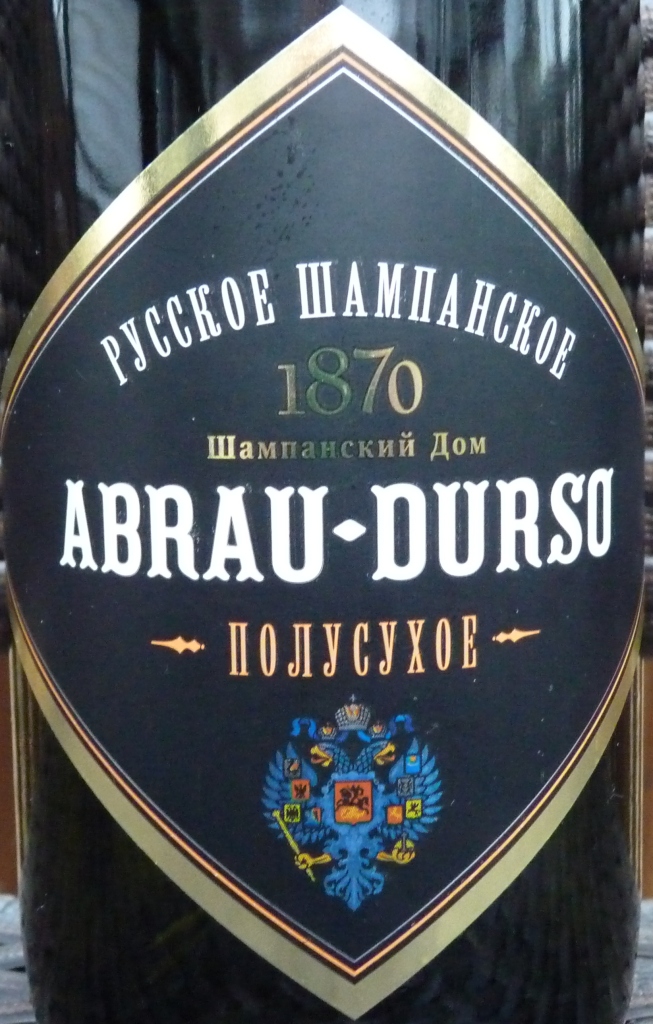
First, two sparkling wines. Chevalier de Grenelle Cuvee Reserve Saumur AOC, a blend of 90% Chenin Blanc with 10% Chardonnay was a very good, full-bodied sparkling wine, with good notes of apple and toasted oak. In addition to good wine, this was also a very special bottle – a magnum with the metal imprinted label. The second sparkling wine was even more unusual – Abrau-Durso Semi-Dry – a sparkling wine from Russia, made by the reincarnated famous producer of sparkling wines for the Russian Tzar (the original company was created in 1870). This wine had just a hint (a whiff) of sweetness, lightly toasted apple and nutmeg on the palate. Very refreshing and delicate. I suggest you will find a bottle and try it for yourself – there is a good chance you might like it.
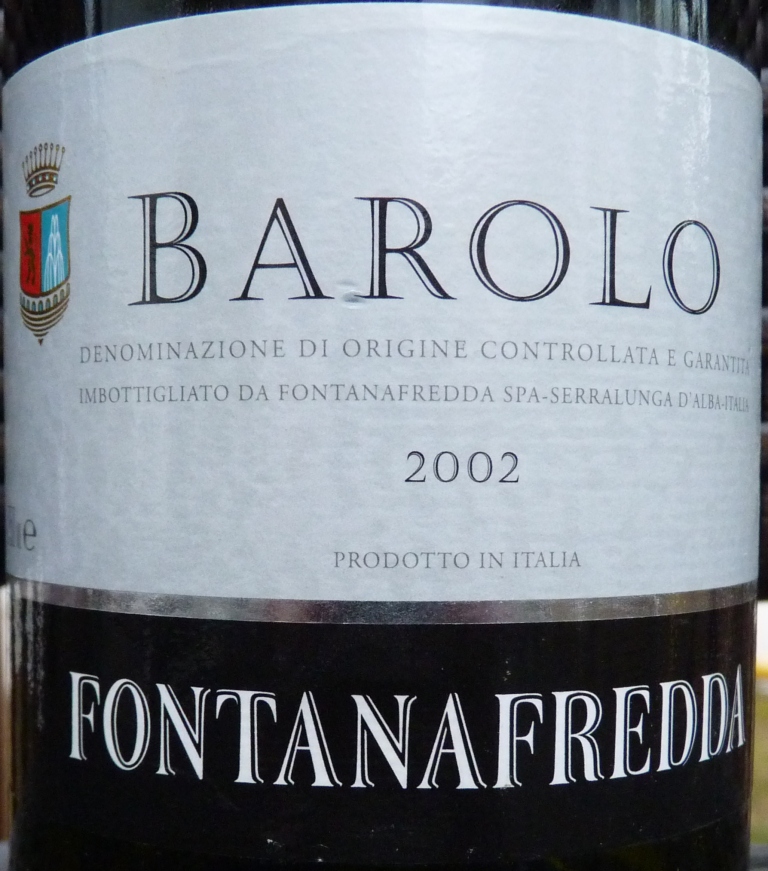 And for the last surprise – 2002 Fontanafredda Barolo DOCG. Why surprising? If you will look at the Wine Spectator’s Vintage Chart, you will see that 2002 was regarded as a very bad year for Barolo, with a rating of 72 and recommendation of wines being past prime. I decanted this bottle at some time in the late morning, and by the early evening, when we actually drank it, it opened up very nicely – while it was lacking powerful tannins, otherwise, it was quite enjoyable wine, very balanced with quite a bit of finesse.
Play with your wine, get friends together and do the blind tasting – I guarantee you will learn something new about your palate, your wine preferences, and maybe even your friends!
Cheers!
Can Wine Tasting Be Double Blind?
 Can wine tasting be double-blind? You think this is a misnomer, right? Let me explain myself. The basic premise of the “blind” wine tasting is that the taster has no idea what is he or she is dealing with, and by using swirling, sniffing, gargling and any other techniques should identify grape (or grapes), the place where the wine was made, and ideally the producer and the year. For the example of amazing blind tasting I have to refer you to the movie Bottle Shock (if you are into wines, definitely worth watching).
In general, tasting wines 100% blind is rare. What I mean is that even in the case of the blind tasting, there are some limiting factors which help you to identify the wine. For instance, when the wines are tasted blind for Wine Spectator ratings, usually the territory and a year and well known (and the goal of the tasting is simply to rate the wines as good and bad, not to identify grapes and producer). Even when I was tasting the wines for the Certified Sommelier exam (for more info – see About section), it was known that there will be no Pinot Grigio in the glass and grape choices would be really limited.
So what would I call a double-blind wine tasting? I was asked to taste home made wine and provide my opinion. I was asked a number of times and couldn’t refuse. I do call this double-blind – all I know is that the wine is made at home of someone leaving in Connecticut, and I don’t even know if it is made out of grapes or may be berries? Of course the whole purpose of this exercise was only to say whether I like the wine or not (no need to identify producer and the year 🙂 ), but who doesn’t want to play detective in such a case? Yes, I want to guess the grapes, and I want to guess it right!
While sharing my detailed tasting notes is really useless, as absolute majority of my readers will never taste this wine, I would like to still share a short summary. First and foremost, I did like it! I honestly don’t classify myself as a wine snob – I would gladly drink two buck chuck, as long as it tastes good. But I had a lot of home-made wines before – they are all sweet concoctions, mostly made out of fruit with addition of powerful alcohols – so they really have nothing to do with actual grape wines. This wine actually looked, smelled and tasted good, so here my notes, for what it worth:
Color: dark garnet.
Nose: wine opened with freshly squeezed berries, like raspberries and blueberries, complemented by lime zest.
Palate: very nice fruit (again raspberries, blueberries, ripe plums, some tropical fruit – very unusual for red wine), complemented with vibrant acidity and good tannins.
As you can see, it is a description of a very nice wine – and it was very nice indeed. So was it perfect? Well, it took me some time to realize what this wine was lacking. It was lacking place. There was no notion of terroir, no earth and no minerals. This wine can be from anywhere (and being made in Connecticut, it definitely is). Again, the wine was very drinkable, and a lot of commercially made wine have no notion of place whatsoever – but I think this is something to note when tasting the wine, so here it is.
What would you put as a grape(s) under such description? My top guess is Zinfandel, and if not, my next guess is Syrah. I don’t know the right answer, and I promise to share it – once I will find out.
And as I mentioned before – blind tasting is fun! Get your friends together and play the wine detectives game – I guarantee you a great time!
Last Bottle Sign Up ($10 credit)





