Archive
Wednesday’s Meritage – Wine Quiz Answer, #MWWC7 Few Days Left, Cali Crush Report, Wines At State Dinner, And More
Meritage time!
Let’s start with the answer for the wine quiz #92, grape trivia – Montepulciano. In the quiz, you were supposed to answer 5 questions about indigenous Italian grape called Montepulciano. Here are the questions, now with the answers:
Q1: In the number of regions, Montepulciano is often blended with … [name that grape]
A1: Sangiovese is a popular blending partner of Montepulciano.
Q2: Wine Spectator calls wines rated in 95-100 range Classic (the highest and the most prestigious category). True or False: there are no Montepulciano – based wines rated in the Classic category
A2: False. There a few Montepulciano wines with the ratings of 95 or above. For example, 2000 Emidio Pepe Montepulciano d’Abruzzo got 97 points from the Wine Spectator.
Q3: From the list below, which state in US doesn’t make any Montepulciano wines of notice:
a. California, b. Maryland, c. North Carolina, d. Texas, e. Washington
A3: Interestingly enough, Washington so far doesn’t have any Montepulciano plantings of notice.
Q4: True or false: from 2000 to 2010, plantings of Montepulciano in Italy increased by more than 15%
A4: True. Plantings of Montepulciano in Italy increased from 28,679 acres in 2000 to the 34,824 in 2010.
Q5: Best known Montepulciano wine comes from Abruzzo in Italy and it is known as Montepulciano d’Abruzzo. Do you know the name of the white wine commonly produced in Abruzzo?
A5: Trebbiano d’Abruzzo is a white wine from the Abruzzo region.
When it come to the results, first of all, we had very good participation in the quiz, quite a few answers. And, most importantly – we have a winner! Tracy Lee Karner answered all 5 questions correctly, so she gets the top prize of unlimited bragging rights! Great job! I also would like to acknowledge Suzanne of apuginthekitchen and Mario Plazio (no web site), who both got 4 questions out of 5 correctly. Very well done!
Now, to the interesting stuff around the vine and the web!
Boy, I have a lot of interesting reads for you. First of all, there are only a few days left to submit your entry for #MWWC7, “Devotion”. Over the past few days there were quite a few submission, which is great. I have a problem to come to grips with this theme, as “devotion” doesn’t trigger any mental image for me – I would much happier deal with “obsession” or at least a “dedication”. Anyway, may be my muse will still come, all covered in the snow? No matter – get your wine devotion story going! Here you will find rules and submissions to the date.
Like the grapes and the numbers? I personally do – I don’t even know why. Anyway, the California Agricultural Statistics service just released the numbers for the 2013 grape crush report – 4.23 million tons of grapes were crushed last year, up 5% from the 2012. The most crushed grape in California was Chardonnay, closely followed by Cabernet Sauvignon and then Zinfandel. For all the numbers please take a look at this article at WineBusiness.com.
Now, I want to share with you two interesting articles from the Dr. Vino’s blog. First, it is always interesting to know what the other people drink, right? Don’t you try to glance at the label of the wine been served at the table next to you? So this is not just some other random people we are talking about here – Dr. Vino analyses selection of the wines from the State Dinner given by US President in honor of the high guest from France. Here is the article – and similar to the Dr. Vino’s opinion, my question is – really? These are the best wines made in US? Okay, okay – I didn’t taste either one of the particular 3 wines served at that dinner – in case you have, I would be really interested in your opinion.
Last, but not least for today is another article from Dr. Vino’s blog – a short post about the sale of the wines at the auction in Chicago. Considering all the stories about the counterfeit wines nowadays, it is not surprising that the wines with the guaranteed provenance are sold at the premium nowadays. But for me personally, it is the data in that old receipt which is very interesting – $78.99 for the Echezeaux or $68.99 for Vosnee-Romanee – sigh, and another sigh – are those days gone forever?
And we are done here. The glass is empty – but the refill is on its way! Cheers!
Weekly Wine Quiz #92: Grape Trivia – Montepulciano
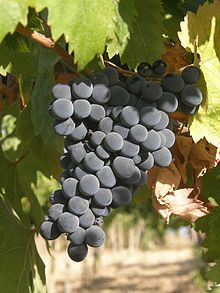
Montepulciano grapes Source: Wikipedia
The Wine Quiz series is not meant to intimidate. The whole idea here is to have fun and learn something new. When answering the questions, it is fully encouraged to use all available sources of information, including Google or any other search engine. There are no embarrassing answers – the most embarrassing thing is not giving it a try…
Welcome to the weekend and your new wine quiz!
We are continuing our grape trivia series, with the focus still on the red grapes, and today’s subject is Montepulciano.
Montepulciano is an indigenous Italian grape variety, recommended for use in 20 out of 95 wine regions in Italy, and one of the most planted red grapes in the country. The origins of Montepulciano are hard to pinpoint, with some sources citing the grape been growing on the hills of Abruzzo since the ancient times, and some sources suggesting that the grape was brought into the Abruzzo region from the neighboring Tuscany at the end of the 18th century. Also an interesting “gotcha” is associated with the name of the grape itself. It seems that the name of the grape, Montepulciano, is given after the town in Tuscany, also called Montepulciano, where the grape supposedly came from. But the problem is that the wine produced in Montepulciano has nothing to do with Montepulciano grape! Town of Montepulciano produces the wine called Vino Nobile di Montepulciano, which is made out of 100% Sangiovese grape! Yep, that’s what I call confusing.
Montepulciano is a late ripening variety, with thick black skin and relatively low acidity. It produces wines which are quite dry, with cherry and cherry pit (did you ever try to eat the content of the cherry pit?) flavors, full bodied and easy to drink. While a lot of Montepulciano wines are easy to drink but not necessarily memorable, proper care and reduced yields can result in the world-class wines. Absolute majority of Montepulciano wines are produced in Italy, with Montepulciano d’Abruzzo, Rosso Piceno and Rosso Conero probably been best known areas, but Montepulciano plantings also exist in Argentina, New Zealand and the United States.
And now, to the quiz!
Q1: In the number of regions, Montepulciano is often blended with … [name that grape]
Q2: Wine Spectator calls wines rated in 95-100 range Classic (the highest and the most prestigious category). True or False: there are no Montepulciano – based wines rated in the Classic category
Q3: From the list below, which state in US doesn’t make any Montepulciano wines of notice:
a. California
b. Maryland
c. North Carolina
d. Texas
e. Washington
Q4: True or false: from 2000 to 2010, plantings of Montepulciano in Italy increased by more than 15%
Q5: Best known Montepulciano wine comes from Abruzzo in Italy and it is known as Montepulciano d’Abruzzo. Do you know the name of the white wine commonly produced in Abruzzo?
Good luck, enjoy the quiz and your weekend! Cheers!
Wednesday’s Meritage – Wine Quiz Answer, #MWWC7 12 days left, Don’t Forget OTBN, How Much Would You Pay For A Cocktail?
Meritage time!
First, let’s start with the answer for the Wine Quiz #91, grape trivia – Cinsault. In the quiz, you were supposed to answer 5 questions about the red grape called Cinsault (it is Cinsaut for French-proper). Here are the questions, now with the answers:
Q1: Name 3 grapes, traditional blending partners of Cinsault in Provençal Rosé
A1: When it comes to Provençal Rosé, Carignan, Grenache and Mourvèdre are most often blended with Cinsault.
Q2: In which US state the history of winemaking is associated with Cinsault?
a. Oregon, b. Texas, c. Virginia, d. Washington
A2: Interestingly enough, early history of winemaking in Washington is associated with Cinsault, which was introduced in the Walla Walla region by Italian immigrants.
Q3: The oldest continuously producing Cinsault vineyard in the world is located in:
a. Algeria, b. France, c. South Africa, d. United States
A3: It was recently discovered that the small vineyard in California is actually the oldest continuously producing planting of Cinsault, and was planted in 1885. For more information, here is an interesting article by W. Blake Gray.
Q4: True or False: Cinsault is one of the 30 most planted grapes in the world
A4: True. According to the statistics of 2010, Cinsault was 25th most planted grape in the world with slightly less than 50,000 acres planted worldwide.
Q5: Considering Cinsault plantings worldwide, sort the countries below from the largest area plantings to the lowest:
a. Algeria, b. France, c. Morocco, d. South Africa
A5: France (about 20,000 acres), Algeria (about 7,500 acres), Morocco (about 3,500 acres), South Africa (about 2,000 acres).
Talking about the results, somehow this quiz had very low participation – may be the subject of somewhat obscure grape, may be the snow, but something got in the way of hundreds of people who I know wanted to play. Anyway, there is a next time for everything. But – one person attempted to solve the quiz, so I would like to acknowledge Suzanne of apuginthekitchen, as this also was her first participation in the wine quizzes here – well done!
And now, to the interesting news around the vine and the web!
First, I would like to remind everybody that the deadline for #MWWC7 is rapidly approaching – only 12 days are left until the deadline. Are you devoted to wine something or someone? Get your passion flowing, devote some time, pour yourself a glass of wine (want a “brute force” solution? find the bottle of Dowsett Family Wines Devotion Red and just do the review), but really, it is time to get more devoted to the #MWWC7. For all rules and regulations, please check SAHMMelier’s blog post.
Do you know what OTBN stands for? Need another two seconds? Okay. OTBN stands for Open That Bottle Night – the movement started by Dorothy J. Gaiter and John Brecher, brilliant wine columnists writing the wine column for Wall Street Journal for many years. The idea of OTBN is that all of us have our “special bottle(s)” waiting for the special moment(s) to be open. And for the sake of the wine – and our own sake – in many cases it is better for the wine and for the people to have that special bottle opened rather sooner than later. OTBN is meant to encourage people to open and enjoy that special bottle. OTBN is celebrated during the last Saturday of February, thus OTBN 2014 will be taking place on February 22nd – here you can find the full calendar of all past OTBN events. Start thinking about that special bottle of wine you will open – that is definitely a fun part of the experience.
Quick question – how much are you willing to pay for the cocktail? Okay, $11.95, of course. What are you saying? You can sometimes splurge the whole $30, especially if you are in the best New York hotel? Okay, sure, make sense. So, how about $50,000? Shocked? Absurd, you are saying? Yes, I’m with you – it is an absurd all the way if you ask me, but apparently someone found it quite palatable to pay $50K for the diamond studded glass filled with Hennessy Richard (most exquisite cognac made by Hennessy). I wonder if he got to keep the glass… Hope he did. To make it more fun, before you read the story, try to think about the place (city?) in the world where someone will pay $50K for the cocktail. Here is the link to the article about that $50K extravaganza.
That’s all I have for you for today. The glass is empty – but the refill is on its way. Cheers!
Weekly Wine Quiz #91: Grape Trivia – Cinsault
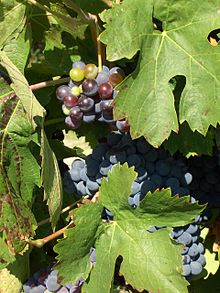
Cinsault Grapes. Source: Wikipedia
The Wine Quiz series is not meant to intimidate. The whole idea here is to have fun and learn something new. When answering the questions, it is fully encouraged to use all available sources of information, including Google or any other search engine. There are no embarrassing answers – the most embarrassing thing is not giving it a try…
Welcome to the weekend and your new wine quiz!
We are continuing our grape trivia series, with the focus still on the red grapes, and today’s subject is Cinsault – for the French purists, we should drop an “l” there and call the grape Cinsaut.
At first, I wanted to call Cinsault an “unsung hero”, but I don’t think it would be the right way to put it. Yes, about 20 years ago, Cinsault plantings in France were exceeding those of Cabernet Sauvignon – but this was 20 years ago. Cinsault is best known for 2 things: it is a blending grape in many of the Rosé wines in Provence and Languedoc, and it is a father (or mother, if you prefer) of Pinotage – the unique South African grape we talked about last time. Cinsault is a black-skinned, early ripening grape which has a tendency to overproduce, easily yielding 6 – 10 tons of grapes per acre (high yield typically means less flavor in each grape). When the yield is controlled at 2 – 4 tons, Cinsault produces very aromatic, fragrant grapes. Cinsault grapes also naturally low in tannin but impart good color, which makes them well suited for Rosé production.
While the biggest Cinsault plantings are still located in France, the grape is growing all other the world – Algeria, Chile, Italy, Morocco, South Africa, Turkey, United States and number of other countries have Cinsault plantings. What is interesting to note that today, when winemakers are constantly in the quest to produce unique and different wines, the single grape red (!) Cinsault bottlings from Chile, South Africa and the United States from the last few vintages have wine critics and writers rave about beautiful, fresh and elegant characteristics of the wines. I think we didn’t see the last of Cinsault yet.
And now, to the quiz!
Q1: Name 3 grapes, traditional blending partners of Cinsault in Provençal Rosé
Q2: In which US state the history of winemaking is associated with Cinsault?
a. Oregon
b. Texas
c. Virginia
d. Washington
Q3: The oldest continuously producing Cinsault vineyard in the world is located in:
a. Algeria
b. France
c. South Africa
d. United States
Q4: True or False: Cinsault is one of the 30 most planted grapes in the world
Q5: Considering Cinsault plantings worldwide, sort the countries below from the largest area plantings to the lowest:
a. Algeria
b. France
c. Morocco
d. South Africa
Good luck, enjoy the quiz and your weekend! Cheers!
Wednesday’s Meritage – Wine Quiz Answer, #MWWC7 Theme, Booze Map of the World, Wine Obsessions
Meritage Time!
Let’s start with the answer to the wine quiz #90, grape trivia – Pinotage. In this quiz, you were supposed to answer 5 questions about South Africa’s signature grape, Pinotage. Here are the questions, now with the answers:
Q1: Explain the origin of the name Pinotage
A1: While Pinotage was born as the result of the cross between Pinot Noir and Cinsault, Cinsault, one of the Rhone varietals, was known in South Africa as Hermitage (which is actually the name of the region in Northern Rhone), hence the name Pinotage.
Q2: While Pinotage primarily grows in South Africa, California also has some plantings of the grapes. Can you estimate the approximate size of Pinotage plantings in California?
a. 50 acres, b. 250 acres, c. 500 acres, d. more than 1000 acres
A2: The amount of Pinotage growing in California is miniscule, but it is trending up. The correct answer is 50.
Q3: Here is the list of of nasty aromas often associated with the smell of Pinotage wines, except one. Do you know which one doesn’t belong?
a. Burnt rubber, b. Rusty nails, c. Paint solvent, d. Sauerkraut
A3: Sauerkraut flavor is not generally associated with Pinotage.
Q4: Wine Spectator calls wines rated in 95-100 range Classic (the highest and the most prestigious category). True or False: there are no Pinotage-based wines rated in the Classic category
A4: True. 93 is the highest rating allotted by Wine Spectator to Kanonkop Pinotage.
Q5: Pinotage was created in 1925, but for the long time it was used only as blending grape. Do you know when single-grape Pinotage bottling was first released in South Africa?
a. 1946, b. 1961, c. 1976, d. 1989
A5: b, 1961. While the first released vintage was 1959, the wine was commercially available in 1961.
I’m glad to report that we had a good number of participants in the quiz, who also expressed a lot of admiration for Pinotage wines. We have 3 winners this time around – barring spelling mistakes, the drunken cyclist, the winegetter and Wine Everyday answered 5 questions correctly, so they all get the coveted prize of unlimited bragging rights. I would like to also acknowledge Caspernick who correctly answered 4 questions out of 5. Well done!
And now, to the interesting stuff around the vine and the web.
The new #MWWC7 Theme had been announced, and it is … Devotion! With all the love and devotion in the air (February 14th – Valentine’s Day – is rapidly approaching), the theme sounds very appropriate. Pour yourself a glass of wine, sharpen your pencil (okay, flex your fingers) and start writing! The submission deadline is February 17th. For the detailed rules and regulations, please take a look at the announcement post by SAHMMelier, the winner of #MWWC6.
Want to know what is the most popular drink in the United States? Italy? China? Now you can! Few days ago, Yahoo! published Booze Map of the World (if you want to skip the article, here is direct link to the map). So it seems that Vodka is a drink of choice in most of the places (USA included), but then Rum in Italy? Really? Was Grappa even on the list? Anyway, have fun analyzing the map.
Last but not least – are you wine obsessed? Do you search for the most unusual wine on the restaurant wine list? Do you remember what is the next “almost extinct” grape you always wanted to encounter in the bottle? Matt Kramer, one of my all time favorite wine writers and Wine Spectator columnist, wrote a very interesting article regarding the wine obsessions – I suggest you will read it for yourself here, it definitely worth your time.
That’s all I have for you for today. The glass is empty – but the refill is on the way! Cheers!
Weekly Wine Quiz #90: Grape Trivia – Pinotage
The Wine Quiz series is not meant to intimidate. The whole idea here is to have fun and learn something new. When answering the questions, it is fully encouraged to use all available sources of information, including Google or any other search engine. There are no embarrassing answers – the most embarrassing thing is not giving it a try…
Welcome to the weekend and your new wine quiz!
We are continuing our grape trivia series, with the focus still on the red grapes, and today’s subject is Pinotage.
Have you heard of Pinotage? Have you ever tasted it? What do you think of it? What, looks like I start with the quiz before the quiz? Well, kind of. Just setting the scene.
Pinotage is a unique grape, purposefully created in South Africa by Professor Abraham Izak Perold in 1925. Pinotage was created as a cross between Pinot Noir and Cinsault grapes. Originally used only for blending, little by little Pinotage developed into a signature grape of South Africa, similar to what Zinfandel is for California, or Malbec for Argentina.
Pinotage might be one of the most polarizing grapes in the world – well, not the grape itself, of course, but rather Pinotage wines. From the very first smell, not even a sip, Pinotage effects a love/hate relationship on wine consumers and professionals alike. Sometimes, the off putting aromas are so strong, it really makes people to put Pinotage into the “never again” category.
Lately, with the advance of the latest winemaking methods and improved winemaking knowledge, there are more and more Pinotage wines which are easy to like. A good Pinotage typically shows dark ripe berries, accompanied with hint of smoke and earthiness, without any of the “non-wine related” flavors. While Pinotage is a South Africa’s signature grape, it is also successfully growing in many other parts of the world – New Zealand, California, Virginia, Brazil, Australia are all making interesting wines out of the Pinotage.
And now, to the quiz!
Q1: Explain the origin of the name Pinotage
Q2: While Pinotage primarily grows in South Africa, California also has some plantings of the grapes. Can you estimate the approximate size of Pinotage plantings in California?
a. 50 acres
b. 250 acres
c. 500 acres
d. more than 1000 acres
Q3: Here is the list of of nasty aromas often associated with the smell of Pinotage wines, except one. Do you know which one doesn’t belong?
a. Burnt rubber
b. Rusty nails
c. Paint solvent
d. Sauerkraut
Q4: Wine Spectator calls wines rated in 95-100 range Classic (the highest and the most prestigious category). True or False: there are no Pinotage-based wines rated in the Classic category
Q5: Pinotage was created in 1925, but for the long time it was used only as blending grape. Do you know when single-grape Pinotage bottling was first released in South Africa?
a. 1946
b. 1961
c. 1976
d. 1989
Good luck, enjoy the quiz and your weekend! Cheers!
Wednesday’s Meritage – Wine Quiz Answer, #MWWC6 Results, WTSO Marathon Next Week, Champagne in Numbers
Meritage time!
Let’s start with the answer for the wine quiz #89, grape trivia – Dolcetto. In the quiz, you were supposed to answer 5 questions about the red grape from Piedmont called Dolcetto. Here are the questions, now with the answers:
Q1: Except the “sweet little one”, what is the other possible explanation to the name of the Dolcetto grape?
A1: Dolcetto is likely named after the hilltops where the grape is growing (“duset” in Piedmont dialect).
Q2: Sort these Piedmontese grapes in the order of time of ripening, from earlier to the later: Barbera, Dolcetto, Freisa, Nebbiolo
A2: Typically, Dolcetto ripens two weeks earlier than Barbera, and Barbera ripens two weeks earlier than Nebbiolo. Freisa ripens a bit earlier or about at the same time as Nebbiolo. Thus correct answer is Dolcetto – Barbera – Freisa – Nebbiolo (the last two can be also swapped in place).
Q3: Wine Spectator calls wines rated in 95-100 range Classic (the highest and the most prestigious category). True or False: there are no Dolcetto-based wines rated in the Classic category
A3: True. The highest rated Dolcetto wine is only has a 93 rating, thus there are no Dolcetto wines in the Classic category.
Q4: One of the North American grapes for the long time was assumed to be identical to Dolcetto ( until recent DNA tests proved it wrong). Do you what grape was that?
a. Chambourcin, b. Charbono, c. Marechal Foch, d. St. Croix
A4: It was actually a Charbono grape which was erroneously assumed to be Dolcetto.
Q5: What is the suggested serving temperature for Dolcetto wines?
a. 65ºF to 75ºF, b. 60ºF to 65ºF, c. 50ºF to 60ºF, d. 45ºF to 50ºF
A5: The answer here of course is not universal, as the serving temperature should be rather linked to the style of wine – light style Burgundy will command different serving temperature comparing to the full bodied Pinot Noir from California. However, on average, Dolcetto wines are considered to be light-bodied, or lighter style reds, which are generally recommended to be served slightly chilled, at under 60ºF. Thus correct answer is c, 50ºF to 60ºF.
This time around we don’t have a winner, unfortunately. Yes, I understand that the grapes are getting a bit more obscure, but hey – they are still no too obscure for Google! I can give you a hint for what to expect in this grape trivia series – we still have quite a few interesting grapes to talk about, so you should expect to see here Pinotage, Tannat, Montepucliano, Bonarda, Viura, Gruner Veltliner and others. See, now you have a head start!
Now, to the interesting stuff around the vine and the web!
First, the Monthly Wine Writing Challenge #6 with the theme of “Mystery”, hosted by Jeff a.k.a. The Drunken Cyclist, has its winner! Alissa of SAHMMelier is the new queen of the MWWC! Here is the link to her winning post, in case you didn’t read it yet. Alissa is now working on the announcement of the new theme, which will be … spoiler alert? nope, you will have to wait for it to appear in Alissa’s blog.
I’m repeating here my note from the last week. Wine Til Sold Out, better known as WTSO, is conducting their Cheapskate Marathon next Tuesday, January 28th, starting 6 AM Eastern – be there ( in front of your computer), or risk missing out on the great wine deals. The Marathon will be conducted with the usual rules: all the wines are priced in $7.99 to $18.99 range, no e-mail announcements, all new wines are announced on twitter and only on twitter, new wines are offered every 15 minutes or sooner if the previous wine is sold out, free shipping for the quantities of 4 and up of the same wines. Happy hunting!
Last interesting item I want to bring to your attention is a few numbers about the sales of Champagne. It looks like the sales of Champagne worldwide are down for the second year in the row – there were 5 million bottles less sold in 2013 compare to 2012, and 2012 had even bigger slump comparing with 2011. Here is the link to the article in The Drinks Business which contains a lot more of the detailed numbers, including statistics by the different countries.
And we are done here. The glass is empty – but the refill is on its way! Cheers!
Weekly Wine Quiz #89: Grape Trivia – Dolcetto
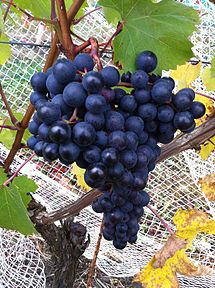
Dolcetto grapes. Source: Wikipedia
The Wine Quiz series is not meant to intimidate. The whole idea here is to have fun and learn something new. When answering the questions, it is fully encouraged to use all available sources of information, including Google or any other search engine. There are no embarrassing answers – the most embarrassing thing is not giving it a try…
Welcome to your new wine quiz!
We are back to our grape trivia series, continuing with the red grapes, and today’s subject is the grape called Dolcetto.
If you look at [probably best] known Italian wine regions, you will find some very interesting differences. If we take Tuscany, which probably comes to mind among the first, its signature grape, Sangiovese, is successfully growing in many other parts of the world, and lots of international varieties is producing magnificent wines on the Tuscan soils (super-Tuscan, anyone?). If we will now look at Piedmont, the home to Barolo, the king of wines, and Barbaresco, that region produces magnificent wines almost exclusively from the local indigenous grapes – and those local grapes are very scarcely distributed around the world, producing the wines of limited value.
Dolcetto, the subject of our today’s trivia, is one of the three better known red grapes of Piedmont – Nebbiolo and Barbera are two others. It is not very clear how Dolcetto made it to Piedmont, with some of the references suggesting that it had been growing there at least from the 16th century. The name of Dolcetto technically stands for the “little sweet one”, but it is believed that this is rather a coincidence and the name has actually a different source. Dolcetto is an early ripening variety which produces wines which have nothing to do with sweetness. Dark thick skin of Dolcetto contains large amount of anthocyanins, and imparts quite a bit of tannins to the resulting wines, as well as the dark color. Generally, Dolcetto wines are dry, lighter style than Barbera or Nebbiolo, with dark red and black fruit profile, such as black cherries and plums.
Best Dolcetto wines are mostly produced in the 7 different DOCs of Piedmont. It is also growing in Liguria under the name of Ormeasco. Dolcetto has very limited success around the world, growing in Australia and in a few regions of United States – California, Texas and Oregon.
And now, to the quiz!
Q1: Except the “sweet little one”, what is the other possible explanation to the name of the Dolcetto grape?
Q2: Sort these Piedmontese grapes in the order of time of ripening, from earlier to the later: Barbera, Dolcetto, Freisa, Nebbiolo
Q3: Wine Spectator calls wines rated in 95-100 range Classic (the highest and the most prestigious category). True or False: there are no Dolcetto-based wines rated in the Classic category
Q4: One of the North American grapes for the long time was assumed to be identical to Dolcetto ( until recent DNA tests proved it wrong). Do you what grape was that?
a. Chambourcin
b. Charbono
c. Marechal Foch
d. St. Croix
Q5: What is the suggested serving temperature for Dolcetto wines?
a. 65ºF to 75ºF
b. 60ºF to 65ºF
c. 50ºF to 60ºF
d. 45ºF to 50ºF
Good luck, enjoy the quiz and the rest of your weekend! Cheers!
Wednesday’s Meritage – Wine Quiz Answer, #MWWC6 Vote, WTSO Marathon, Shoe as a Corkscrew
Meritage time!
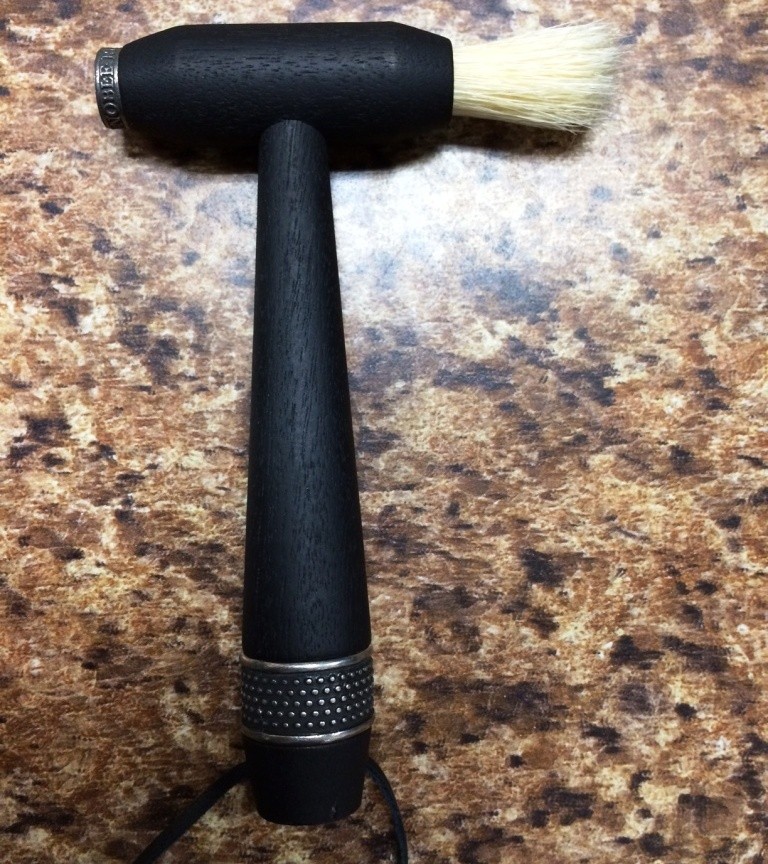
Let’s start with the answer for the wine quiz #88, What Is It? In the quiz, you were given a picture with wine (alcohol) related object, and you were supposed to explain what this object is for and how it is supposed to be used.
Below is the quiz picture with two additional pictures, which together should give you a good idea of what and how:


This tiny hammer is packaged with every bottle of Beluga Vodka Gold Line – hammer is intended to be used to break the wax seal on top of the bottle and brush should be used to clean up all the small pieces of wax.
This quiz had a number of comments with the answer, but pretty much for the first time I remember running these quizzes, many people referred to one of the previous answers as a correct one, instead of providing their own answer. This creates an interesting challenge in announcing the winner. Nevertheless, the winners of this quiz are Misha and Emil, and Patty of Bota and The Beast, Julian of VinoInLove, Trace Lee Karner and Suzanne of apuginthekitchen are all getting a “supporting winner” title. Well done!
Now, to the interesting stuff around the vine and the web!
First, the Monthly Wine Writing Challenge #6 with the theme of “Mystery”, hosted by Jeff a.k.a. The Drunken Cyclist, has concluded with the record number of participants (25). Now it is time to vote for your favorite post (actually, you can vote for up to three) – for all rules and regulations please refer to Jeff’s post here.
WTSO is doing it again! Mark your calendars – Tuesday, January 28th, starting 6 AM Eastern – you better be glued to your computer, or you are risking to miss out on hundreds of great deals! WTSO marathon (a Cheapskate Marathon) will be taking place with all the usual rules: all the wines are priced in $7.99 to $18.99, no e-mail announcements, all new wines are announced on twitter and only on twitter, new wines are offered every 15 minutes or sooner if the previous wine is sold out. Happy hunting!
Last interesting item I want to bring to your attention is a video about using the shoe as a wine opener in the crisis – okay, not really a crisis, but if you have a bottle of wine, and you want to drink it, your date is getting impatient – and there is no corkscrew in site – does that constitute a crisis in your book? Well, shoe is to the rescue! You can read about using the shoe as a bottle opener in the Dr. Vino’s blog, where he also offers a collection of cork screw errr shoe-opener videos – here is the link.
And we are done here. The glass is empty – but the refill is on its way! Cheers!
Weekly Wine Quiz #88: What Is It?
The Wine Quiz series is not meant to intimidate. The whole idea here is to have fun and learn something new. When answering the questions, it is fully encouraged to use all available sources of information, including Google or any other search engine. There are no embarrassing answers – the most embarrassing thing is not giving it a try…
Welcome to the weekend and your new wine quiz!
I was planning to go back to the grape trivia series with this quiz, but then I was shown an object so peculiar that my immediate thought was – I have to make a quiz out of it! Here we are: take a look at the picture below – you don’t need to name the object (not sure if it has any specific name), but you have to explain what it is for and how it is used. Sorry – I know, this is not the best photo ever, but it shouldn’t be a problem for solving this quiz.
Good luck, enjoy the quiz and your weekend! Cheers!
Last Bottle Sign Up ($10 credit)




 Talk-A-Vino