Archive
#WineWednesday or #WhiskyWednesday? No Matter, As Long As It Is Tasty
 If you follow social media, especially Twitter, I’m sure you’ve noticed big amount of #WW tags in the messages on Wednesday. This abbreviation stands for Wine Wednesday or Whisky Wednesday, depending on who and when is using it, and it means a special dedication to one’s favorite beverage of the day.
What is so special about Wednesdays and wine ( or whisky for that matter)? I honestly have no idea. I think any day is a good day for a glass of wine (or whisky), but may be people feel like they need a special declaration of sort “I will be drinking this Wednesday, instead of waiting for Friday”. Anyway, my take a simplistic one – any day is a good day for wine or whisky, as long as it tastes good. Sometimes, even that can be “bettered” – that is when you have a tasty treat and learn something new.
So on Tuesday (!) I tried very good Scotch and made a discovery (fine, not by myself, I was simply educated by my friend Zak). Until Tuesday, I thought that single malt scotch can come only from Scotland or Japan. Then I learned that it can also come from … India (ha, I’m sure you didn’t expect that).
Enters Amrut, the only Single Malt Scotch from India. Word Amrut means “Elixir of Life”, and actual scotch which I tried, was quite lively. Amrut scotch is produced in Himalaya, at about 3000 feet above sea level. The combination of the high altitude and tropical climate doesn’t allow for extended barrel aging – the scotch evaporates at much higher rate than it matures. Despite that, even in the young form, it really tastes like an actual Scotland classic.
I had an opportunity to try four different Amrut scotches, and here are my notes:
Fusion – nice and relaxed, very reminiscent of a Highland scotch, such as Glenlivet. Feels like it is 12 yeras old, while it is not
Cask strength – on the nose, first is a sensation of pure medicinal alcohol. Then it is very nice on the palate, with good oak notes. Feels like it has a lot of glycerine oils, I guess due to not being chill filtered.
Peated – feels like pure charcoal on the nose and the palate. It is different from Islay Scotches, I would call it “liquid fire”. Of course it is not surprising that the smoky component feels different, as I’m sure that Islay peat exists only on Islay – nevertheless, this was probably best of tasting Scotch.
Peated cask strength – it seems that “cask strength” should be the only difference with the previous one, but it appears to be an entirely different scotch – lots of sweetness on the palate, wood power comes only in the back – it doesn’t even feel peated. Again, substantial mouth feel of glycerin oils.
Amrut is making it’s way to US – if you like Scotch, I highly recommend you will make an effort to find it and try it. And let’s toast great discoveries, any day of the week – cheers!
Ode to Scotch
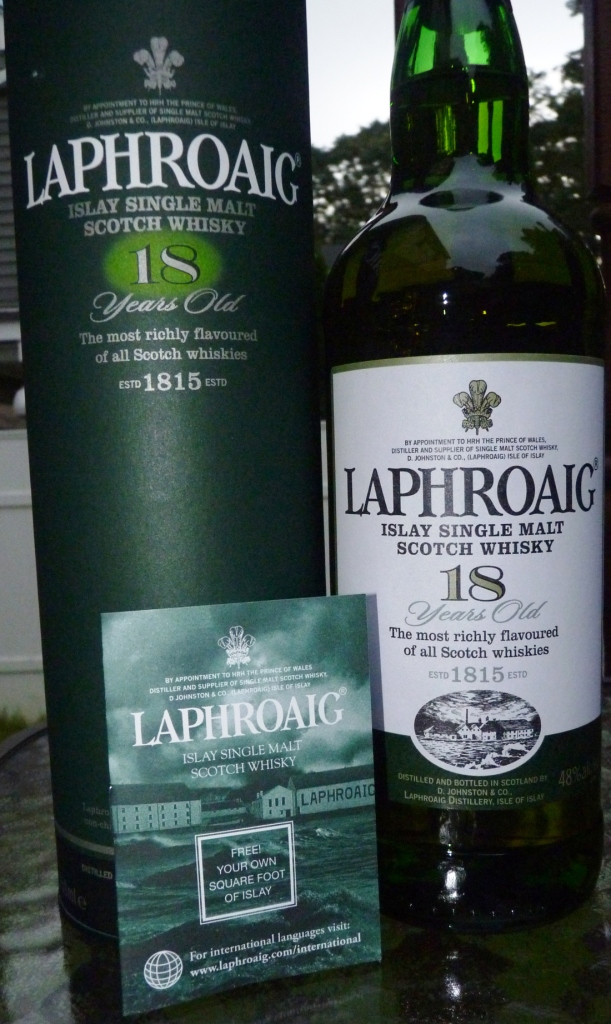 We talked about Scotch before in this blog – actually, one of the very first posts here was about Norma Jean restaurant in Tel-Aviv, great place for scotch lovers (you can find that post here). But “Ode to Scotch”? Well, it downed on me today when I was looking at unopened bottle of 18 years old Laphroaig – the difference between wine and scotch (at least for the person who enjoys both) is that bottle of scotch offers immediate gratification, where bottle of wine often does not. When you buy a bottle of wine, first, it might not be ready to drink right away – it might really benefit, really improve after few years in the cellar. That always presents a dilemma – do I drink it now? May be not, may be I will wait for a few (or ten) years? Another problem is that once you open a bottle of wine, you have a limited amount of time to enjoy it – 2-3 days at the most, and by that time you better be done with it.
A bottle of scotch doesn’t have the same issues. It doesn’t improve in the bottle – therefore, there is no need for aging. It doesn’t go bad once opened, hence you don’t need to wait for that special moment to open that special bottle – you can open a bottle of Scotch at any moment and enjoy.
All of this thought process was taking place while I was admiring a brand new bottle of Laphroaig 18. Laphroaig scotch comes from Islay, a home of smokey scotches, and Laphroaig is one of the smokiest of all. This was a first time I had an opportunity to try 18-years old Laphroaig, as typically it is only a 10 years old version which is available in the stores. This scotch had wonderful complexity, sweet and nutty aromas intermingled with smoke and acidity. Very nice and round, and very enjoyable without the need for splash of water, as some of the scotches do. All in all, great experience.
As an added bonus, I now own a square foot of Islay land which belongs to Laphroaig distillery – one of 380,000 lucky owners. You can own one too – for more information you can click on this link and become a Friend of Laphroaig.
So, what is your favorite scotch?
Scotch Experiences – Talisker, Hello from Oregon, and Something to Dream About
 As you probably know, scotch is my second favorite drink, right after the wine. When it comes to scotch, I pretty much like all of them, with a slight bias toward the smoky style. One of the most unique smoky whiskies is Talisker (one of my favorites), which has a unique, almost medicinal nose full of smoke, in addition to lots of smoke on the palate (it is different from traditional Islay whiskies which have very expressed smokiness on the palate, but not as much on the nose).
When my friend Zak said “you have to try this” and pointed to the bottle of Whiskey, I couldn’t believe it – single malt whisky … from Oregon? What is happening? Well, tasting is believing (seeing is not enough) – and when I tried this McCarthy’s Single Malt Whiskey I was literally blown away. While this whiskey is compared to Lagavulin (probably the most classic Islay scotch) on the producer’s website, my first impression was Talisker. I’m quite convinced that in a blind tasting I would confuse this whiskey for Talisker, both from the smell and the taste ( this probably shows my weak side, but I will live with it). On the nose, this whiskey exhibited the same medicinal smoky flavor, with lots of smoke following on the palate, with expressed minerality and perfect balancing acidity – this scotch was literally refreshing, if scotch can be considered a refreshing drink. At $49.99 at Cost Less Wines and Liquors, I think it is a great deal – if you like smoky peaty scotch, don’t miss it.
And then as I was leaving the store, I spotted this bottle of 1979 Glenrothes…

‘Nuf said… Until the next time – cheers!
Tasting The Art of Douglas Laing
 These plastic glasses don’t look much like anything, right? Well, overall aesthetics might not be much anything, but the content is a king as we usually say. These glasses contain 10 different scotches from Douglas Laing, an independent bottler and blender of premium malt scotch whiskies.
Until yesterday, I never heard of Douglas Laing (so don’t feel bad if you didn’t know about them either). It appears that since 1948 they had being in the business of creating their own custom whisky blends, and from 1998 started releasing single malts, to the great pleasure of whisky connoisseurs all over the world.
The group of scotches I had a pleasure tasting (thanks to my friend Zak), included some of the familiar names, like Macallan… come to think of it, this was the only familiar name. It was also very interesting to see very odd ages on many of the scotches. Typically the line you would see for the mainstream brands would be 10, 12, 15, 18 and 25, with the rare addition of 14 and 16. In the list below, you will see some very odd ages like 9, 11 and 20 – but this is something you can do, having amazing supply of good stuff such as Douglas Laing does.
Here is what I tasted with the brief notes (10 scotches in 10 minutes – this is too fast to be able to really reflect on the experience):
Blair Athol 11, Speyside – too tight, not showing much of anything
Benriach 18, Speyside – very nice, acidic, with some wood tones, no sweetness at all
Fettercairn 9, Highlands – nice big bouquet
Braeval 19, Speyside – nice and round, pleasant sweet notes
Craigellacchie 14, Speyside – smooth, with beautiful smokiness and great bouquet. My absolute favorite in the tasting.
Macallan 20, Speyside – this was smooth, but a bit flat.
Macallan 33, Speyside – nice, round, open, with hint of tobacco and tar in the back, very complex. Definitely another one of my favorites, but at around $400 per bottle, I don’t expect to see it in my collection any time soon.
Douglas XO – very soft and too simple, almost too sweet.
Clan Denny Speyside – this is a blend of Macallan, Glenrothes, Glen Grant, Mortlach, Longmorn and other Speyside scotches. Has lots of balanced sweetness. Taking Macallan 33 out of the equation, these was my second favorite (or third with Macallan, of course).
Clan Denny Islay – a blend of Ardbeg, Bowmore, Bunnahabhain, Caol Ila and other Islay scotches. Outstanding, very complex, with hint of smokiness. Also one of my favorites.
I also would like to mention that while I was searching for some information on the scotches, I came across site called Malt Madness, which I think is amazing – anything you need to know about Scotch, this would be a good place to start.
All three of my favorites ( Craigellachie, Clan Denny Islay and Clan Denny Speyside) are expected to appear soon on the shelves of Cost Less Wines and Liquors – if you like scotch, I’m sure you will be as happy as I am. Cheers!
Tasting Series At Cost Less Wines – Part 2, The Hills of Scotland, or Glenlivet Tasting
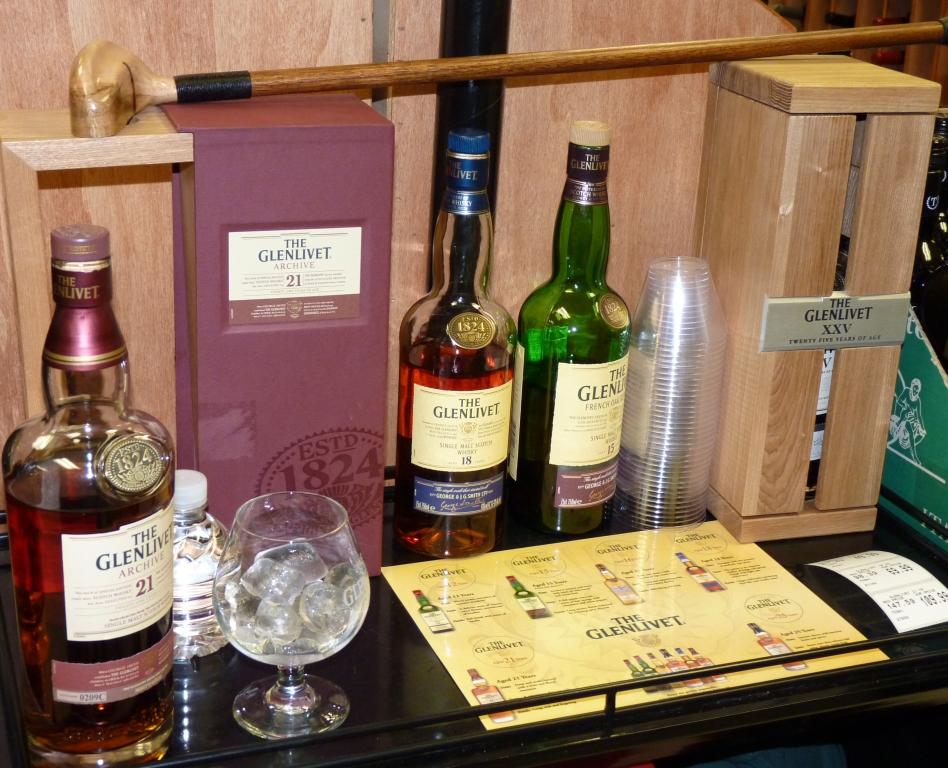 Continuing our tasting series courtesy of Cost Less Wines, we are now moving from Champagne region in France to Speyside in Scotland. As a group, Speyside scotches usually mild, with nice and round character, and not very peaty. Subject of this tasting was The Glenlivet, oldest (and legendary) legal distillery in the region (as usual, Wikipedia provides wealth of information about the distillery, and also you can take a look at the company’s web site, even though I find it no so easy to use).
Four scotches were represented at the tasting – 15, 18, 21 and 25 years old. Such a tasting is a great opportunity to explore, experience and learn. Effectively, at this tasting you had an opportunity to try a “vertical”. I understand that wine category “Vertical”, when you try wine from the same winery made in a succession of years, is not applicable to scotch. But it is amazing what every 3 years in the cask would do to the actual taste. In the event, there was nice and noticeable progression in the taste – starting from smooth and simple Glenlivet 15, gaining complexity with the 18, and being super-rich, complex and round with 21.
 To my taste, Glenlivet 21 was probably the best. It had very complex but clean taste profile (yes, it was my favorite in the tasting and it has great QPR at $110). However Glenlivet 25 was beyond complex. It had a lot of stuff going, including oily substances on the palate – or may be I simply didn’t spend enough time with it.
Does Glenlivet 25 worth $300? I think the answer is rather yes than no. At the same time, one have to really understand the virtues of taste of the fine scotch, in order to fully enjoy it. But in any case, it makes a fine present, especially for “someone who has everything”. I will be glad to try it again if I will have the opportunity, but for now – there will be more tasting events at Cost Less Wines, don’t miss it!
Norma Jean – Best Place for Scotch and Food in Israel (and Beer too!)
Let’s set things straight – this post will be more of a photo report. The words fall short to describe an amazing experience at Norma Jean, Bistro/Bar in Tel-Aviv. The best place to sit is in the bar, as stuff is extremely friendly and knowledgeable. You can start with the beer, which comes form all over the world, and needless to say, each served in its own proper glass. While you enjoy your first beer and glass and waiting for the food, your eye can rest on the walls full of scotch:

Among many bars, I’ve seen those where you will pay $500 for a shot, and but I never saw the one with such a selection of really great scotches which you can actually afford!
And then comes food – all fresh, succulent and great tasting:
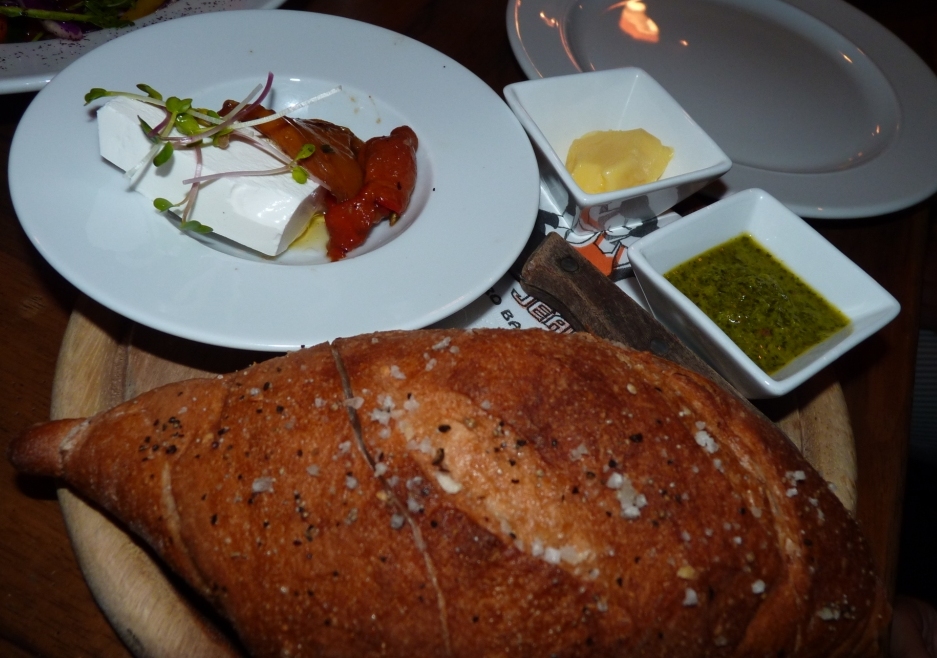 Bread with Feta Cheese
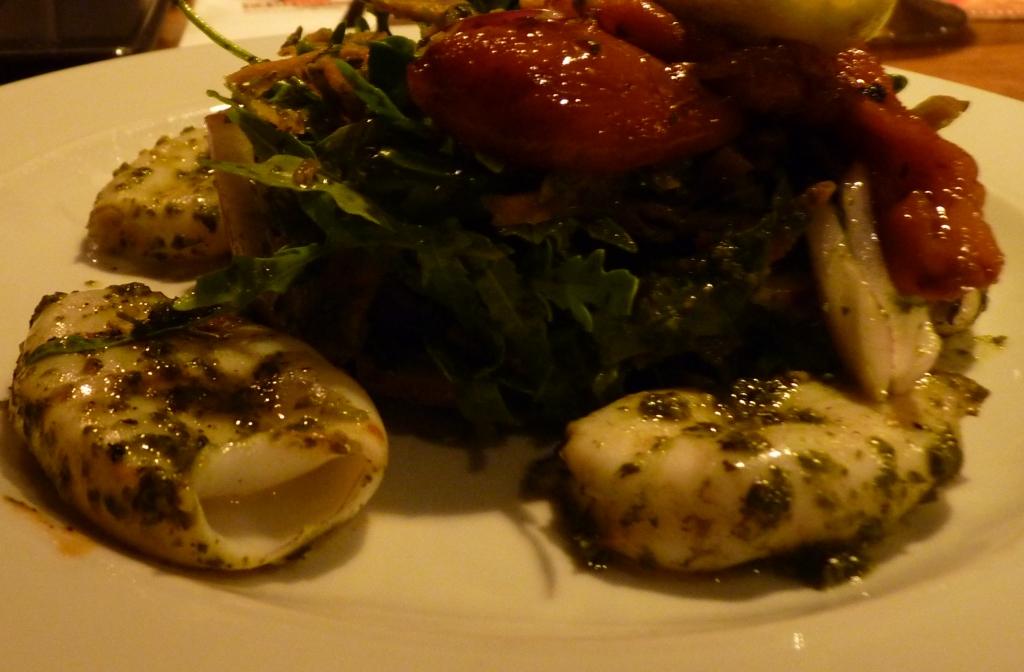 calamari
 and sausages
Of course the next step is the scotch. Based on the friendly recommendation, we couple of new scotches which we never had before. First one was coming form Speyside, a belnd of three different single malts, called Monkey Shoulder in the honor of those who developed a “monkey shoulder” condition throwing peat with the shovel, while making a great scotch for the rest of us:
 Monkey Shoulder – very smooth and delicate, with the hint of smoke at the end
The next one was Laphroaig Triple Wood, matured in the 3 different kinds of wood barrels, as you can see on the label:
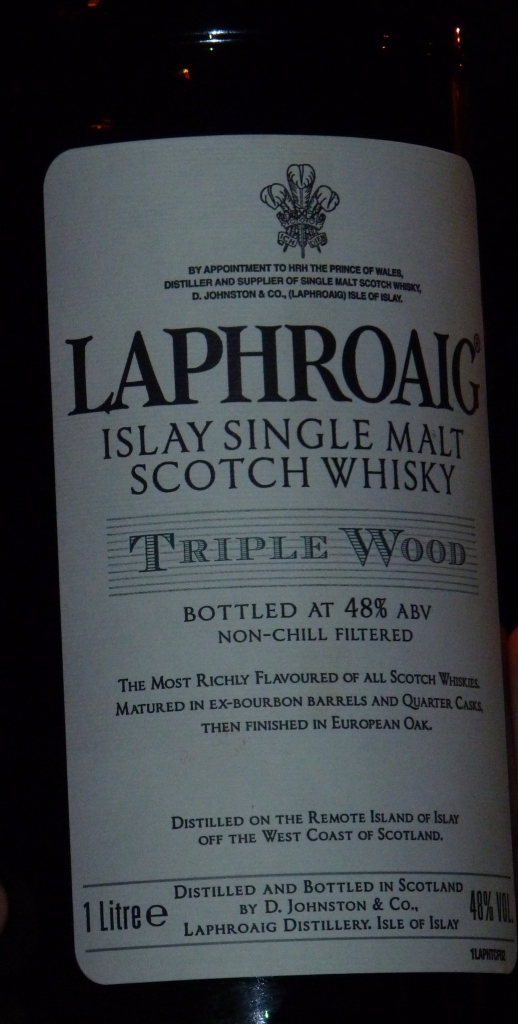 The smoke flavor and bite on this one were immense, like breathing the air coming from the smoker (or may be just chewing on the cigar :)). Too strong by itself, addition of 3 drops of water made a miracle – the scotch opened up beautifully, with big flavor profile and lots of depth.
And then… yep, a special dessert for the scotch lovers! Tartufo, made out of the best Belgian chocolate with addition of pepper and scotch:
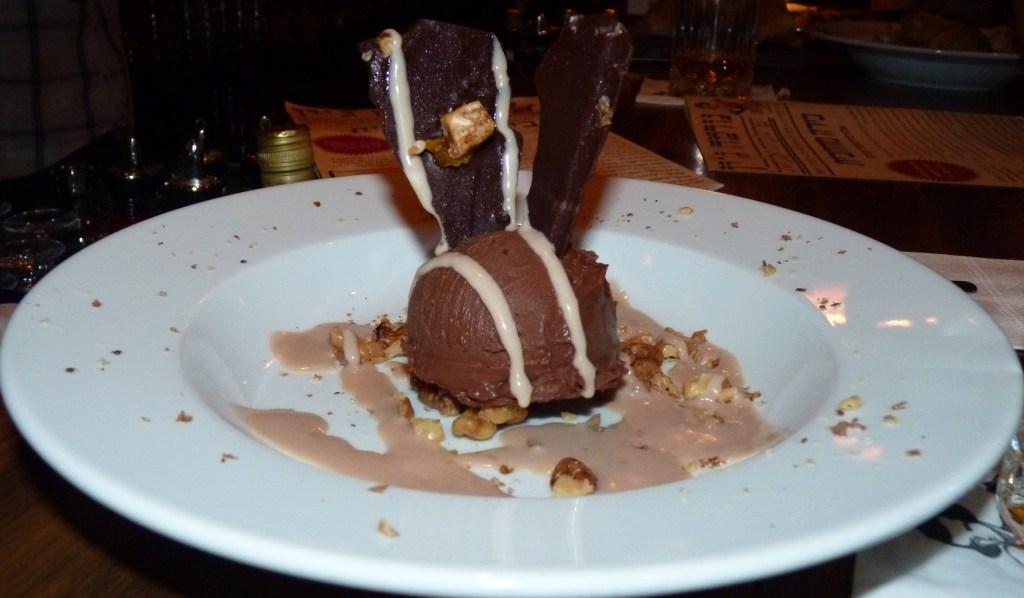 Great way to finish the evening of great tasting food and drinks.
I know that the picture worth a thousand words, and this is why you can see a lot of pictures. However, one should really experience the taste, this is where picture fails short – and this is why, if you even the smallest opportunity – head to Norma Jean in Tel-Aviv, you will not be disappointed.
Cheers!
Last Bottle Sign Up ($10 credit)




 Talk-A-Vino