Archive
Moscato d’Asti – The Joy of Sharing
 Wine should give you pleasure.
This pleasure can come in many forms.
The simplest one is a pure hedonistic pleasure of that sip itself, the burst of flavor overwhelming your taste buds, and the opportunity to mindfully reflect on that very burst.
Or, with one sip of familiar wine, you can be instantly transposed in time and space – the wine can bring back memories. You can instantly imagine yourself being in Italy 5 years ago, experiencing this wine for the first time, vividly seeing the faces of the people you were there with, and reliving that beautiful moment again.
And then there is possibly the biggest pleasure of all – an opportunity to share wine with people. It is great to enjoy good wine by yourself – but that pleasure amplifies disproportionally when you pour the wine for your guests and you hear the collective “oh, it is so good!”.
I’m happy to share all of my wines with my guests, but then there are some wines that I even prefer to share. Let me explain.
I’m happy to open a bottle of Cabernet Sauvignon, Chardonnay, Syrah, any still red, white, or Rosé. Even if nobody would share it with me, I can drink it by myself over the next 2-3 days, no problem. But I would be very reluctant to open a bottle of sparkling wine for myself – I definitely prefer to share it with friends. Especially if this is a dessert sparkling wine, such as Moscato d’Asti.
I love doing that at the end of the dinner, when nobody expects that more wine might be coming. Seeing another bottle being brought up to the table, guests’ usual and immediate reaction is “what, more wine???”. This question requires no answer; I just wait for the people to taste the wine first.
Moscato d’Asti might be one of the hidden gems of the wine world, lightly fizzed, low alcohol, and deliciously, “just enough” sweet. This wine, made from the Moscato Bianco (white Muscat) grape, comes from the area in Piedmont where Moscato wines have been made for hundreds of years. Moscato d’Asti wine in its present, lightly fizzed form was born in the 1870s, when a number of winemakers started producing it in commercial quantities. Yet despite its 150+ years of history, I would still call it a hidden gem, as many winelovers are not aware of this wine or have the wrong ideas because of its sweetness.
The beauty of Moscato d’Asti is in its lightness and effervescence, and sweetness well balanced with acidity. If you want a glass of wine with your dessert, you will have to search far and wide to find the wine that would pair better with literally any type of dessert. And at a typical 5.5% alcohol level, it is guaranteed not to overwhelm your dining experience with a heavy punch of alcohol.
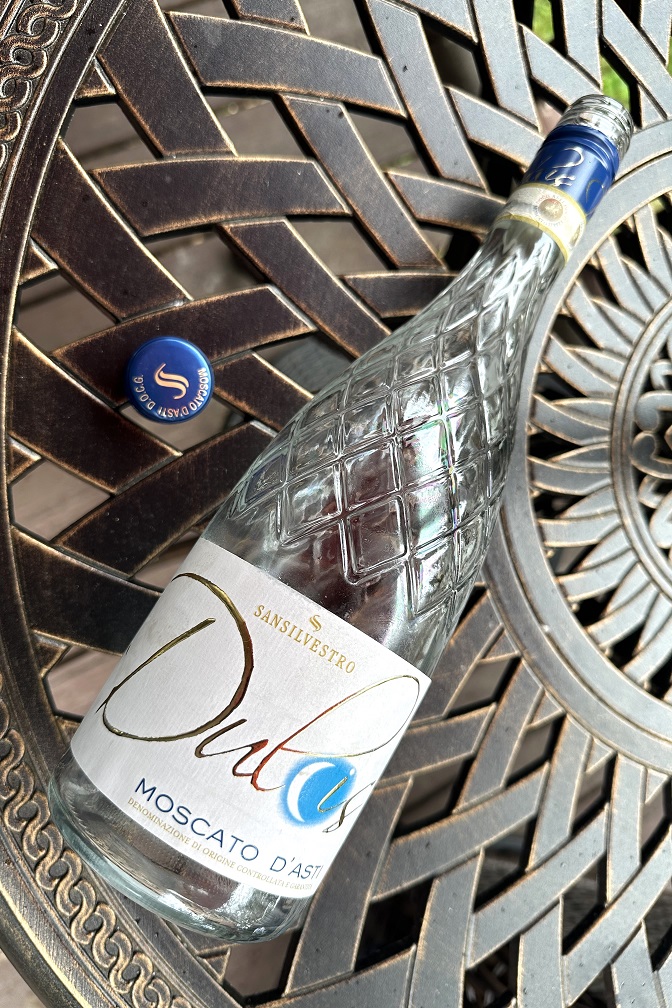
I recently had an opportunity to experience this “pleasure moment” when I opened the bottle of 2024 Sansilvestro Dulcis Moscato d’Asti DOCG (5.5% ABV) to serve with dessert. Overcoming the “what, more wine” resistance, I poured the wine for my guests and encouraged them just to take a sip. The next thing I heard was “oh my god, this is so good! Can I have more, please?” – there it is, that exact oenophile’s pleasure moment, equally as pleasant as taking a sip of the wine.
Moscato d’Asti is generally well priced, with a great selection of the wines at around $15 or less, so it definitely offers a great QPR and lots of pleasure without the need for an expense account. You should always have a bottle on hand, just in case you are craving a simple pleasure – double though considering the upcoming holiday season and all the get-togethers with friends.
By the way, on the subject of Moscato – back on May 9th, we celebrated Moscato Day (it is always celebrated on May 9th). I attended wonderful festivities in New York and never wrote about them, so if you care to see some of the images from that celebration, feel free to click “more” below.
Daily Glass: Memorable Wines
 Wine = Memories. Well, okay, we need to correct that statement. Great Wines = Memories, now that is better. Of course we remember the wines we drink, and this is how the opinions are formed and this is how the wine list in the restaurant doesn’t look that intimidating anymore. But this should be characterized more as a general knowledge, not specifically as “memories”. Great wines, on the other hand (I’m not going to define the term “great wine” – this is highly personal, you define it for yourself), become memory anchors. We remember when, why and how, we remember who we shared it with, and we can retrieve those memories on the moment’s notice. That is what “great wine” can do to you.
Case in point – a great evening with friends, which had all three elements at its perfection – the wine, the food and the company. An evening, when the time flies so fast, you don’t understand how late it is already. And the wines – stunning, each one in its own right. We started with Gosset Grand Réserve Brut Champagne – a non-vintage Champagne from one of the old and classic producers. I have to honestly admit that I was never impressed with other Gosset wines in the past, but this Grand Réserve, poured from the magnum, was outstanding – round, creamy, yeasty just enough, with a touch of apple and fresh bread on the palate – an excellent start of the evening.
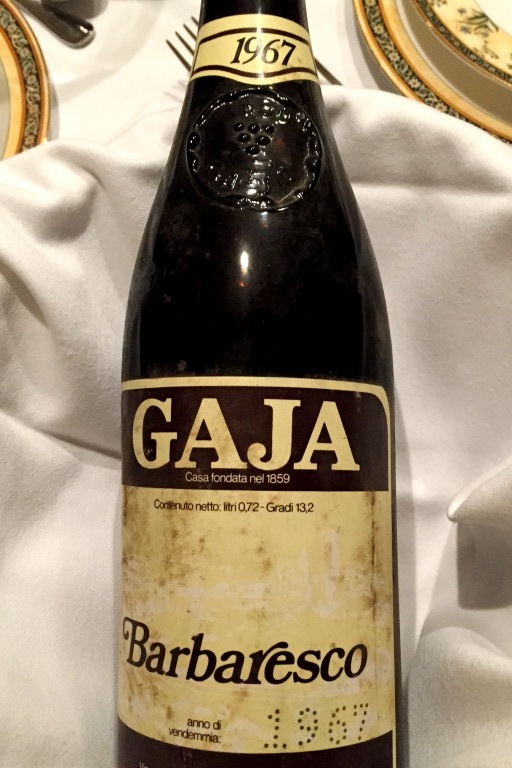
Then the awe inspiring, almost 50 years old 1967 Gaja Barbaresco was gently uncorked. It was not simple, as cork did crumble – but this is nothing which strainer and decanter can’t fix. The first whiff – nothing smells off, which is a great sign of relief. While we put the wine aside to let it breathe a bit, we reached out for another white – 2007 François Cazin Le Petit Chambord Cour-Cheverny AOC.
This is a rare French white wine made from 100% Romorantin grape. I remember a few years back trying this wine at a 10 years of age – and I remember been simply blown away by the exuberant beauty of this seemingly unassuming wine (new vintages retail at around $15 – the QPR is through the roof on this). The nose of that 2007 was amazing, with fresh white fruit, guava, mango, honeysuckle, lemon and lemon zest. On the palate, behind the first wave of Riesling-like appearance with touch of sweetness and tropical fruit notes, there were layers and layers of acidity and minerality. After about 10 minutes of breathing time, the wine was almost bone dry, very crisp and refreshing. I still have 3 bottles of the 2007, and now the trick will be to keep my hands away from them, as they still benefit from time.
Time to get back to that 1967 Barbaresco. We were somewhat waiting for the main course to start drinking it, and I was concerned that as it happens with many older wines, this wine might also succumb to the neverland if not consumed within that short window of time. Silly me. The wine kept going and opening for the next 2 hours. It had all those sweet plums, sapidity of the onion peel, minerality, all weaved around a well defined structure with perfect acidity and perfect balance. The “wows’ kept flowing until there was nothing left in the decanter – this was definitely a treat. And a perfect memory anchor, an experience which stays forever.


Our next wine was also very interesting and delicious in its own right, by fate or the accident made from the exact same grape as the Barbaresco, the Nebbiolo –2004 Ar.Pe.Pe Rocce Rosse Riserva, Valtellina Superiore Sassella DOCG, Italy. Valtellina red wines are typically made in the way similar to Amarone – with the grapes drying out after the harvest for about 120 days, and only then pressed and vinified. The Sassella Rocce Rosse from Ar.Pe.Pe stands apart, with Nebbiola grapes (locally known as Chiavennasca) left on the vine to raisin, and then pressed. Fresh, succulent plums and cherries on the nose and palate, together with effervescent lightness and firm structure (this might not make sense right away, but this is the way I perceive it), which I always find in Ar Pe Pe wines. Again, a delicious red.
Our last wine was 2003 Sella & Mosca Anghelu Ruju Rosso Passito Riserva Alghero DOC, Sardinia, Italy – very unique and interesting fortified wine, made out of partially sun-dried Grenache, locally known as Cannonau. This wine was mostly resembling the Port, with a hint of dried fruit on the nose, supported by perfectly balanced, soft body of plums and sweet oak, with perfect amount of sugar to make it a light dessert wine, but not an overbearing sweet monster.
Here we are – a perfect set of very memorable wines, compliments of dear friend Stefano (Clicks & Corks/Flora’s Table), and an evening with friends which will stay in memory, anchored by that 1967 Barbaresco. Considering that I’m finishing this post right on the Open That Bottle Night, I hope you increased your memory bank with some spectacular experiences, both of wines and the company – and I will be glad to hear about them. To the great life experiences! Cheers!
Last Bottle Sign Up ($10 credit)




 Talk-A-Vino