Archive
Wednesday’s Meritage – Wine Quiz Answer, Chardonnay Day, Wine Appellation Earth?, Best Blogging Tips and more
Meritage Time!
 First and foremost, let’s start with the answer to the wine quiz #57, Grape Trivia – Grenache. Below are the questions, now with the answers:
Q1: Name two grapes which are traditional blending partners of Grenache
A1: Yes, we are talking the famous GSM blends, and the blending partners of Grenache are Syrah (Shiraz in Australia) and Mourvèdre (known as Monastrell in Spain and often called Mataro in Australia).
Q2: Below is the list of countries which use Grenache in the winemaking. Sort the list by the area of Grenache plantings, from the highest acreage to the lowest:
A. Australia, B. France, C. Italy, D. Spain, E. United States
A2: The correct answer is France, Spain, Italy, US, Australia (so it will be BDCEA). The culprit here was Italy, in my opinion, there Grenache is known as Cannonau – I didn’t expect that Italy grows so much of it… Here is my source of data – an article at Wine Folly’s web site.
Q3: One winery in US is often credited with spearheading the success of Grenache in US. Can you name that winery?
A3: Tablas Creek winery in California – they imported Grenache cuttings from France to the US in 1990, and it was the beginning of great Grenache wines in US. Here is an excellent article about Grenache on Tablas Creek’s web site.
Q4: A few centuries ago, Grenache was a popular blending addition in one of the regions in France, until it became illegal by the AOC rules. Do you know what region was that?
A4: Actually, it was Burgundy, where addition of Grenache was popular way to add body to otherwise finicky Pinot Noir wines. Of course it is illegal practice for the long time.
Q5: Same as for the number of other grapes, Grenache exists in three different grape variations – Grenache Noir, Grenache Blanc and Grenache Gris. There is one wine where it is absolutely legal to use all three grapes as the part of the blend. Can you name that wine?
A5: Châteauneuf-du-Pape! Well, I should’ve post the question as “type of wine” – but in any case, Châteauneuf-du-Pape (CdP for short) AOC rules allow inclusion of all three different Grenache grapes into the same wine. I always thought that CdP allows 13 grapes to be blended together in production of CdP wines, but it appears that the rules has recently changed, and now there are 18 grapes which are all allowed for use as winemaker desires.
And the winner is…(drum roll)… The Drunken Cyclist with five correct answers! He is definitely on the winning streak for a while and once again he gets unlimited bragging rights. I want also to acknowledge The Winegetter, Red Wine Diva and Eat With Namie who all got 3 out of 5 questions right – definitely a commendable effort.
Now, to the interesting stuff around the web vine – boy, there is plenty to share!
First, sorry for the late notice, but tomorrow is 4th annual Chardonnay Day! Well, Chardonnay is not such a hard wine to get, right? You still got time to make sure you will celebrate in style, whatever your style is – Burgundy, Chablis, Big California, California-pretending-to-be-Chablis, I-am-unoaked-and-almost-like-Pinot-Grigio-chose-me – anyway, any kind of Chardonnay goes. And if you want to officially assert your participation, here is a link to the event page where you can officially join the ranks of Chardonnay aficionados.
Next, I want to bring to your attention an interesting post by Mike Veseth of The Wine Economist fame. The post is titled Is This the Beginning of Juice Box Wine? and it is talking about true globalization of wine in terms of production – one of the new wines from Barefoot called Impression and it is produced from the juice sourced from all over the world, so the wine doesn’t state any appellation on the label. What do you think of such approach to winemaking? Will this be a fluke, or will we see more of the wines from appellation Earth?
As you know, I’m a big fun of Stéphane Gabart’s blog, My French Heaven. I find his food pictures as some of the most incredible I ever come across, in the blogs or on Pinterest. Now Stéphane was very kind to write a blog post called “20 tips for stunning food photography“, which definitely worth your attention if you want to master your food picture taking skills. Also, as this is not the first time I refer to some of the “best tips and practices”, I decided to create a dedicated page for the Best Blogging Tips, where I will be collecting all the references like this one. If you have any suggestions as to what should be included in that “Best Blogging Tips” collection, please let me know – I hope to make it into a very useful resource for all.
Next subject is … beer! Yes, even in the wine blog there is a place for a beer. When you hear about the beer called Nuclear Tactical Penguin – is that the beer you would want to try? Well, okay, I don’t know about you, but I’m definitely interested. But turns out that this beer is practically impossible to get in US, so the best thing one can do is to enjoy it vicariously. This is what I did when I read this post at Wayward Wine blog. Outside of just great description of the beer, you can also learn about Frozen Beer category and how those beers are made – I think this reading will be well worth the time. Also, while looking for another beer from BrewDog company, this one called Sink the Bismark, I came across the list of 10 most expensive beers in the world! Now I want to try BrewDog’s The End Of History (55% ABV and still a beer!), but considering that it costs $765 for 330 ml, I will need a sponsor… anyone?
And last, but not the least subject for today – Wine Blog Awards finalists are finally announced. No, I didn’t make it to the list of finalists (sigh). But I would like to congratulate Jeff a.k.a. The Drunken Cyclist as he got into the finals in the Best Writing category. Anyway, this week is the public voting week, so you can cast your vote for the best blog here.
That’s all I have for you for today, folks. The glass is empty – but more wine is coming. Cheers!
Weekly Wine Quiz #57 – Grape Trivia: Grenache, a.k.a Garnacha

Grenache Noir picture from Wikipedia
And we are continuing the Grape Trivia series – today’s focus is the red grape called Grenache (also known as Garnacha and Garnaxta in Spain).
Grenache is one of the most planted red grape in the world. It is a late ripening variety, which typically produces spicy, juicy, berry-flavored wines with high alcohol content. In the number of regions, such as Priorat in Spain, Châteauneuf-du-Pape in France or California and Washington in US, Grenache produces outstanding single-varietal wines, but more often than not it is used as a blending companion, adding juicy component and structure.
And now, to the quiz!
Q1: Name two grapes which are traditional blending partners of Grenache
Q2: Below is the list of countries which use Grenache in the winemaking. Sort the list by the area of Grenache plantings, from the highest acreage to the lowest:
A. Australia
B. France
C. Italy
D. Spain
E. United States
Q3: One winery in US is often credited with spearheading the success of Grenache in US. Can you name that winery?
Q4: A few centuries ago, Grenache was a popular blending addition in one of the regions in France, until it became illegal by the AOC rules. Do you know what region was that?
Q5: Same as for the number of other grapes, Grenache exists in three different grape variations – Grenache Noir, Grenache Blanc and Grenache Gris. There is one wine where it is absolutely legal to use all three grapes as the part of the blend. Can you name that wine?
Enjoy your weekend, have fun and good luck! Cheers!
Re-post: Affordable Luxuries of the Wine World: Garnacha versus Grenache
During 2011 I wrote a number of posts for the project called The Art Of Life Magazine – of course talking about my favorite subject, wine. The project closed, but I still like the posts I wrote, so I decided to re-post them in this blog. Also, in that project, posts were grouped into mini-series, such as “Affordable Luxuries” you see here – I will continue re-posting them from time to time.
If you are interested as to “why now”, it is simple – Friday, September 21st is International #GrenacheDay – and I don’t have time to write the whole new post. I think this re-post will fit the bill quite well. Here it is.
 So far we talked about and compared Hermitage and Crozes-Hermitage wines, as well as sweet wines in our quest for “affordable luxuries” of the wine world. If you remember, Hermitage and Crozes-Hermitage are made out of the grape called Syrah. Today we are going to talk about Syrah’s brethren (totally unrelated, though), the grape which is often blended together with Syrah – we are going to talk about Grenache.
Grenache is one of the main winemaking red grapes in the world. It used to be the most planted red grape in the world, with biggest planting area being in Spain (Spain actually has the biggest area planted with grapes in the entire world). Grenache, which is known under the name of Garnacha in Spain, lost its “biggest plantings” status in Spain as a lot of vineyards were replanted with other grapes, such as Tempranillo, Cabernet Sauvignon and Merlot, and France took “the most planted” helm now.
Grenache is used in winemaking both by itself and as part of the blend. In Spain, Grenache, or rather Garnacha, is main ingredient of the blend in wines of Priorat, many of which have cult status, such as Clos Mogador. In another region, Campo de Borja, it produces amazing single grape wines, for instance, at Bodegas Alto Moncayo. In France, it is a key ingredient in wines of Southern Rhone, with Chateauneuf-du-Pape being most famous – there it is typically blended with Syrah. It is also used in production of Rose wines in Provence. In Australia, it is used in so called GSM wines, where GSM is simply an abbreviation for Grenache Syrah Mourvedre, three grapes used in production of the GSM wines. In California, it is very successfully used in production of the Rhone-style wines mostly in the Central Coast area, with many of the wines also achieving a cult status (which simply means that production is limited and wines are very hard to get – of course because they are good). As usual, you can take a look at the Grenache article in Wikipedia, which provides great depth of information.
When it comes to “affordable luxuries”, there are plenty of wines which can be compared. As this is Grenache versus Garnacha battle, let’s focus on pure Grenache wines. Of course blends would be fun to look at as well, but finding some of the better ones is a challenge in itself, so let’s stay our course.
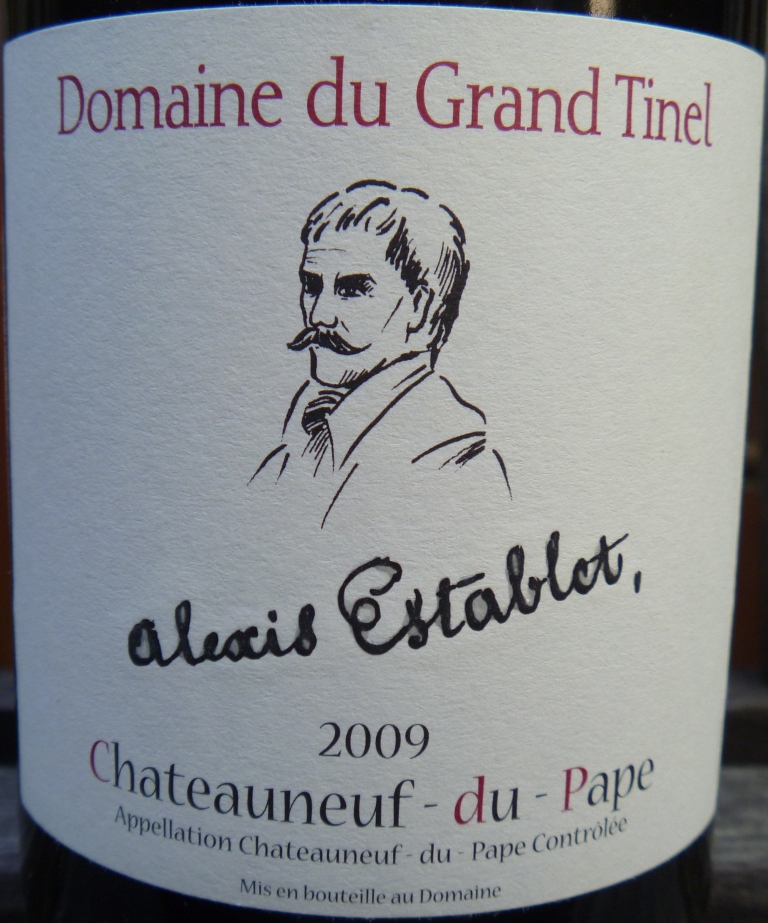
So today’s contenders are: 2009 Bodegas Borsao Tres Picos Garnacha Campo de Borja from Spain and 2009 Domaine du Grand Tinel Cuvee Alexis Establet Chateauneuf-du-Pape from France. It can’t get any better than that – we have here if not two of the best, then at least two of the most classic areas to produce Grenache wines. Both wines are 100% Grenache – which is very unusual for Chateauneauf-du-Pape, where blend can contain up to 13 different grapes.
 Let’s start with 2009 Domaine du Grand Tinel Cuvee Alexis Establet Chateauneuf-du-Pape. The wine is unfortunately way too young (give it 8-10 years, if you have enough patience, of course), but it was very drinkable from the get go – at least you get a punch of tannins at about 10 seconds after the first sip. It is very classic Grenache, with purple color, violets on the nose, and perfect balance of fruit and acidity. Don’t want to repeat myself, but it will be gorgeous – given enough time to mature.
2009 Bodegas Borsao Tres Picos Garnacha Campo de Borja is a full bodied wine, with hint of earthiness on the palate, with lots of dark fruit and hint of pepper. You can also detect violets, hint of cedar, spice box and tar. With supple tannins and medium finish, this wine is more approachable now than the previous one, but will also improve with time.
Is one of those wines better than the other? It is very hard to tell. And for the affordable luxuries, Tres Picos Garnacha costs about $12, and Domaine du Grand Tinel is about $70, so make your choice. And while you will be deciding, I’m going to raise my glass to the pleasures of wine discoveries – cheers!
Daily Glass: Martinet Menut
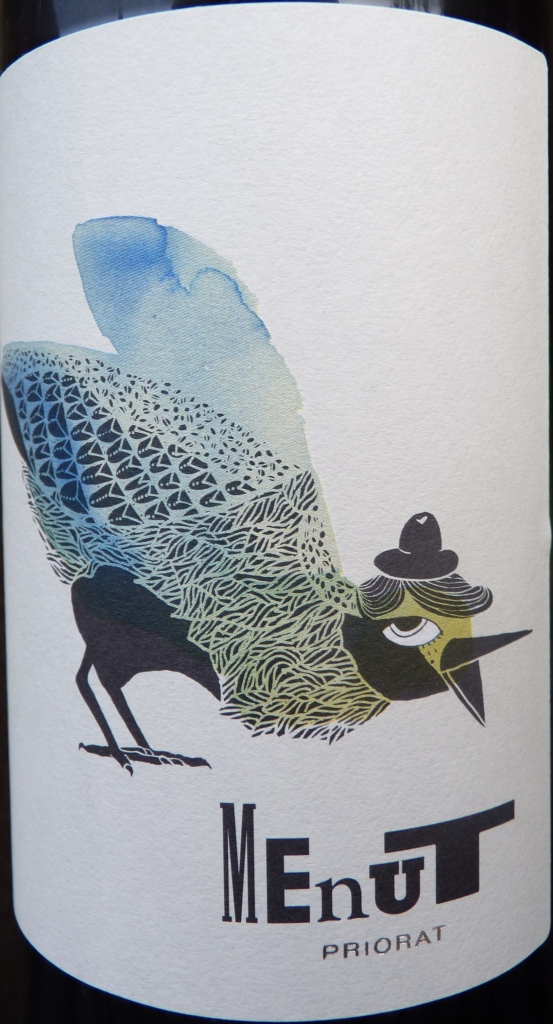 Looking for the bottle to open (this is not ready, not tonight, don’t feel like it,…) I stumbled upon a bottle with the bird picture on the label. Okay, I have no idea how this might taste, never tried that before, don’t know what grape(s) it is made out of – yes, that looks like the right bottle to open.
Cork popped out, and the wine goes in the glass. Energetic swirl (exactly as taught by Kevin Zraly, without covering glass with the hand), sniff and… I couldn’t extort anything beyond sacramental “WOW”… It was a true sensory sensation – the wine had perfect vinous nose, with absolutely everything you want to find in glass of red wine – the fruit, the vineyard, spices, earth, terroir, mystery…
On the palate, it had lots of dark red fruit – plums and cherries, all coupled with good acidity and tannins. Of course, after being blown away so much, I had to check what is it I am actually drinking. This 2007 Martinet Menut is a red wine blend from Priorat region in Spain. I have to tell you – even today, in the age of Internet, there are still plenty of things which are difficult to find. Finding information about this Martinet Menut wine, as well as producer ( supposedly, Clos Martinet, one of the “cult” Priorat wineries) was very challenging. The wine apparently is Grenache-based blend, but this is about all information I’m sure at, so let’s leave it like this. This 2007 Martinet Menut can actually be compared with Clos Mogador I tasted at the Spanish Wine Festival (you can find post here) – definitely in the amount of pleasure one can get from a glass of wine. Drinkability: 8.
You think I got too excited? Always possible, so you’ll be the judge. Get the bottle, and lets compare the notes. Cheers!
Last Bottle Sign Up ($10 credit)




 Talk-A-Vino