Seeking Amarone: Grace and Beauty of Cesari Amarone Bosan
 What do you think of Amarone? I know that some people simply dismiss it as an alcohol bomb, as many Amarone wines nowadays are sporting 16.5% ABV, and winemakers blame climate change. Okay, climate change is not the subject of this post, so let’s quickly rewind before we go too far.
Let me repeat the question – what do you think of Amarone? Love it, hate it, or indifferent?
While you are deep in your thoughts, let me share my take.
I love Amarone. I tried it for the first time in 2003, during Kevin Zraly’s Windows on the World wine school class. The wine we tried was 1998 Le Ragoze Amarone. The contrast of dry fruit assemblage on the nose with lean, focused, powerful, and perfectly balanced palate was stunning, delicious and memorable. And that was the beginning of my love-hate relationship with Amarone (please keep reading, I promise to explain all the high emotions).
Maybe a quick historical perspective would be appropriate here. Amarone wines are made in the Valpolicella region in Veneto Province. While winemaking across Italy goes back to Roman times, Amarone has not been around for too long. Historically, the Valpolicella region was best known for its sweet wines called Recioto. The grapes for Recioto production were first dried under the sun to concentrate sugars (this process is called Appassimento), and subsequently made into the sweet wine. In 1936, supposedly, a barrel of Recioto was forgotten in the cellar, the fermentation continued, and resulted in the dry and powerful wine which was called Amarone, which means Great Bitter, contrasting it with sweet Recioto. Amarone wines began to be internationally recognized in 1970th. Amarone della Valpolicella received the status of DOC in 1990 and advanced to DOCG in 2010.
Amarone is not my pivotal wine. Actually, I don’t have a pivotal wine as some wine lovers do – many wines left lasting impressions on me and I would be very hard pressed to identify “one and only”. But Amarone is definitely one of my favorite wines – except that I more or less gave up on it for now.
The “Seeking Amarone” theme of this blog post is not random. I wrote a few posts under the same theme in the past (none as of late), as that spectacular experience with 1998 Le Ragoze happened to be really hard to replicate. With the exception of a few Masi single vineyard Amarone, most of the Amarone I taste are lacking balance, with alcohol being not well integrated and simply destroying any joy the wine could bring. Side note – 16.5% ABV in itself means nothing. Anyone who casually enjoyed Turley or Carlisle Zinfandels can attest to the perfect balance and harmony those wines exhibit, at the same 16.5% of ABV.
Possibly a bigger issue affecting Amarone was a dramatic expansion of the DOC growing area, which allowed subpar quality fruit to become a fuel for Amarone’s attempt to meet the global growing demand – Amarone production increased from 1 million bottles to 16 million bottles in 2008. However, that didn’t affect single vineyard Amarone, and this brings us to the intended subject of this post – Cesari Bosan Amarone, a single vineyard Amarone from the heart of the Amarone Classico di Valpolicella.
During the Tre Bicchieri 2026 event in New York, I was lucky enough to attend the masterclass where we had an opportunity to deep dive into the world of Cesari Amarone. And not just Amarone, but single vineyard Amarone Bosan.
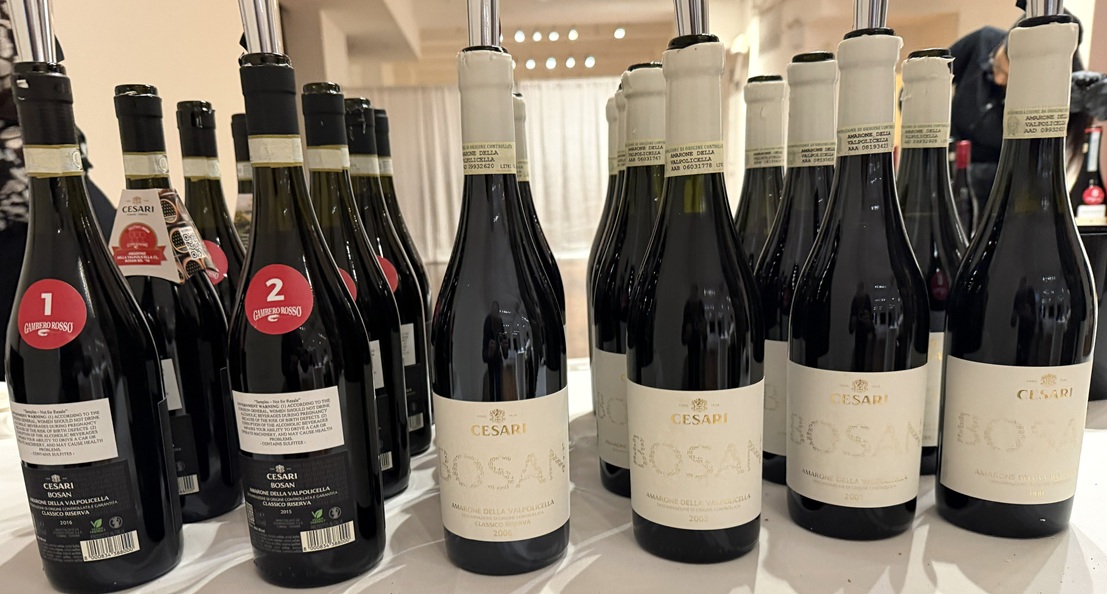
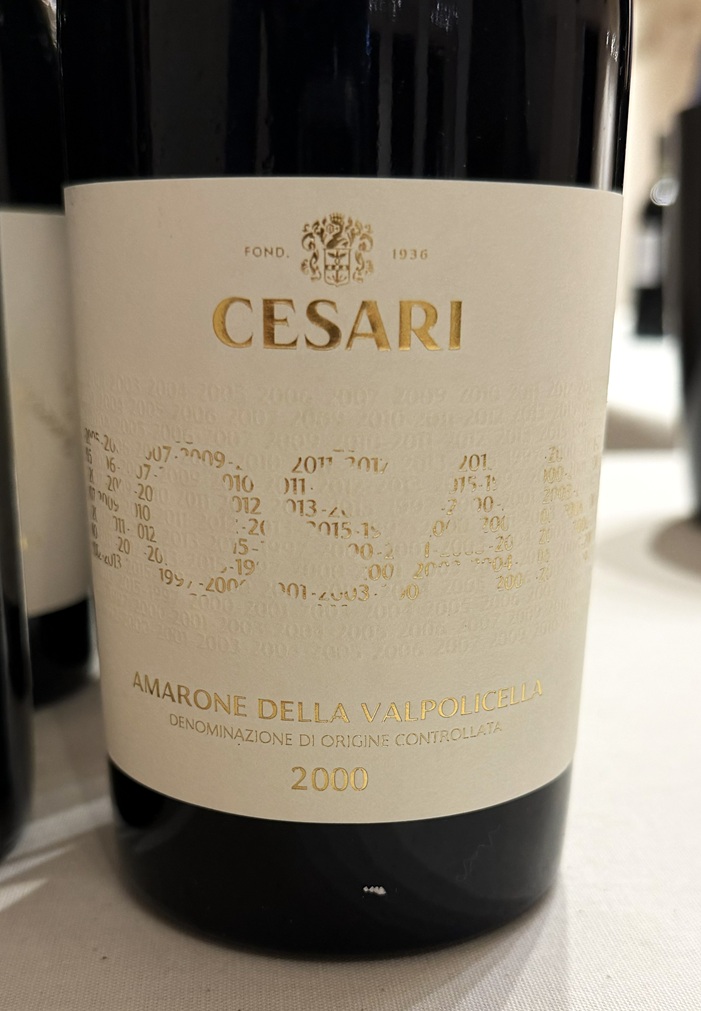
Cesari Winery was formed in 1936 (so this year Cesari is celebrating 90 years). The first vintage of Amarone was produced in 1971, and in 1973, Cesari Amarone began exporting to the USA. And talking about important dates, 1997 marked the beginning of production of Cesari’s single-vineyard Amarone, Bosan.
Bosan vineyard is located in the heart of the Amarone Classico della Valpolicella production zone, at about 1,500 feet elevation (500 meters), on the hills facing south and southeast with volcanic/limestone soils. The grapes for Bosan Amarone are harvested about 2 weeks prior to the grapes for the other wines in two passes. Speaking about the grapes, Cesari Bosan Amarone is always made from 3 main grape varieties, used always in the same proportions. Bosan wines are made from 40% Corvina grapes, giving structure and complexity; 40% Corvinone grapes, bringing freshness and crunchiness; finishing it up 20% of Rondinella grapes, bringing balance and color. By the way, while the grape composition remained the same over the years, the drying time (appassimento) has changed from 4 months in the previous years to about 3 months (90 days) now.
Production of Bosan Amarone is a labor of love for sure, as it takes 10(!) years to produce Amarone Bosan, and another 3 years for the wines to reach “historical vintage” designation. After drying the grapes, vinification and fermentation are conducted in stainless steel. After that, the wine rests in stainless steel for 3 years, then goes into the barriques for 2 years, back to stainless steel for 3 years, finishing off with at least 2 years in the bottle. If the wine is designated as a historical vintage, it will take another 3 years in the bottle. If anything, Cesari Amarone Bosan production commands respect.
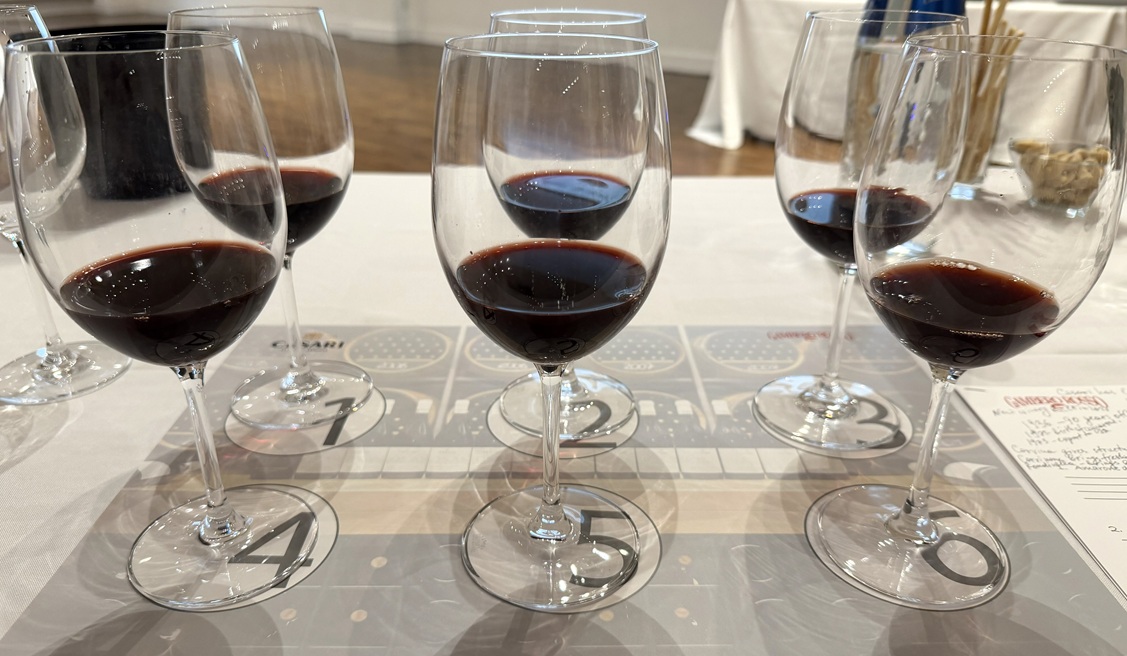
We had an opportunity to taste 6 Bosan Riserva wines, going all the way back to the 2000 vintage, thanks to the generosity of the Cesari family. To say that this was a special experience would be an understatement – the experience was truly one of a kind. Here are my thoughts on the 6 wines we tasted.
2016 Cesari Bosan Amarone della Valpolicella Classico Riserva DOCG (15.5% ABV)
Beautiful, a touch of gunflint, dark fruit, minerality, cherries, rocky undertones
Powerful, crisp, firm and crunchy, rocky undertones, well-integrated tannins.
8+, great food wine, but perfectly enjoyable by itself
2015 Cesari Bosan Amarone della Valpolicella Classico Riserva DOCG (15.5% ABV)
Legs are more expressive than in 2016
Dark cherries on the nose
Rounder on the palate than 2016, dark fruit, tannins a bit untamed, green notes on the finish. Needs more time
8-/8
2006 Cesari Bosan Amarone della Valpolicella Classico Riserva DOC (15.5% ABV)
Beautiful nose, with dried fruit and a touch of dried fig.
Wow! Beautiful, balanced, perfectly integrated tannins, round, spectacular.
8+/9-
2003 Cesari Bosan Amarone della Valpolicella DOC (15.5% ABV)
A bit too much of the dry fruit, the nose suggested past prime. After some additional time in the glass, just fine.
Sublime, just needed the time to open. Still fresh tannins on the palate, round, well integrated, layered, with dry fruit undertones on the palate. Wow. delicious!
9-/9
2001 Cesari Bosan Amarone della Valpolicella DOC (15.5% ABV)
Intense nose, clean, open, elegant, hint of roasted meat, fresh red fruit, cocoa powder, a wow nose.
Wow. I can’t spit this wine! Wow, Round, elegant, layered, mind-boggling elegance, a touch of dried fruit. Impeccable balance.
9, a wow wine all around
2000 Cesari Bosan Amarone della Valpolicella DOC (15.5% ABV)
Intense tertiary aromas with the addition of roasted meat.
No tertiary aromas on the palate. Wow. Sweet cherries, perfect acidity, round, elegant, outstanding.
9-
Here we are – an Amarone worth seeking. Cesari Bosan Amarone will not be inexpensive, but it might be well worth it as a special treat.
So, have you finally come up with an answer to my question? Do you like Amarone? Hoping that you do, what is your favorite Amarone? Cheers!
Last Bottle Sign Up ($10 credit)




 Talk-A-Vino