Pinot Noir Battle – Let the Best (but Most Unexpected) Win…Again
It all started with a few tweets. I noticed a very high praise for the German Pinot Noirs shared by some of the European wine lovers I’m connected to on Twitter (still can’t make myself call it X, so you will have to forgive me for that). Particularly, Pinot Noir from Ahr was regarded as the best in the world, handily beating Burgundies on any occasion. I was intrigued and started searching for the Pinot Noir from Ahr, which proved to be challenging.
Ahr is a tiny region, one of the smallest in Germany – according to Wines of Germany, Ahr has only about 529 hectares of vineyards (around 1,323 acres), which comprises 40 single vineyards. 65% of the vineyard area is planted with Pinot Noir, about 860 acres – for comparison, the Jackson Family mostly Pinot Noir plantings in Oregon alone amount to roughly 600 acres. You can imagine that finding Pinot Noir from Ahr in the US was rather challenging.
The more I saw Ahr Pinot-praising tweets, the more I wanted to try it. Then one day I checked Wine.com, and there it was – Pinot Noir from Ahr, made by Meyer-Näkel. I quickly went to the Twitter folks to check if this wine would sufficiently represent the Ahr region, got an approving nod, and bought a bottle.
Once the wine arrived, I thought of the best way to try it. When it comes to learning about wine, tasting wines side by side is the best way to learn. Oh yeah, and if you want to be honest with yourself, blind tasting is the only way. We tend to be led by what we know, by our beliefs. Once we know that the wine costs $100, we want to believe that it is better than the bottle which costs $50. Once we see a bottle of Cabernet Sauvignon from Napa Valley in California, we automatically assume that it will be much better than the Cabernet Sauvignon from Lake County or Lodi. Nothing is wrong with us, this is how the brain works – so once you remove all the factors of influence, once you get one on one with the liquid in your glass without knowing the producer, the region, the price – it is very easy to be honest with yourself. So blind tasting it is.
Sometimes we don’t realize how fast the time passes. I love talking about blind tastings when I’m talking about wine, and I have a few of my favorite blind tasting examples, one of them particularly being the Pinot Noir blind tasting we have done in the past. What I didn’t realize is that the particular wine tasting I remember so well took place almost 15 years ago (time flies, isn’t it). The outcome of the tasting was very surprising, with South African Pinot Noir from Hamilton Russell beating California, Burgundy, and others – 15 years ago I didn’t even know that South Africa produced Pinot Noir!
Many things have happened in the wine world over these 15 years – of course, Pinot Noir is one of the oldest red wines produced in the world, but now it is literally produced everywhere – I don’t know if today there is a country which doesn’t produce Pinot Noir wines (maybe Spain?). Also, the quality of Pinot Noir throughout the world got a lot higher. The tasting you are about to read about is the perfect illustration of both points – the widespread geography and quality.
Okay, a blind tasting of Pinot Noir. The Ahr Pinot Noir got high praise, so we need to compare it with the best of the best – which means that we have to have California, Oregon, and Burgundy in the tasting, plus whatever else we might be able to find. I asked for a few samples of Oregon Pinot Noir. Very conveniently, Last Bottle had an offer for Chacra Pinot Noir from Patagonia – a different Pinot Noir from Chacra was James Suckling’s wine of the year recently, so this was a good addition to the tasting. Bottle by bottle, we assembled 12 Pinot Noirs from around the world, and the battlefield was ready to be set up.
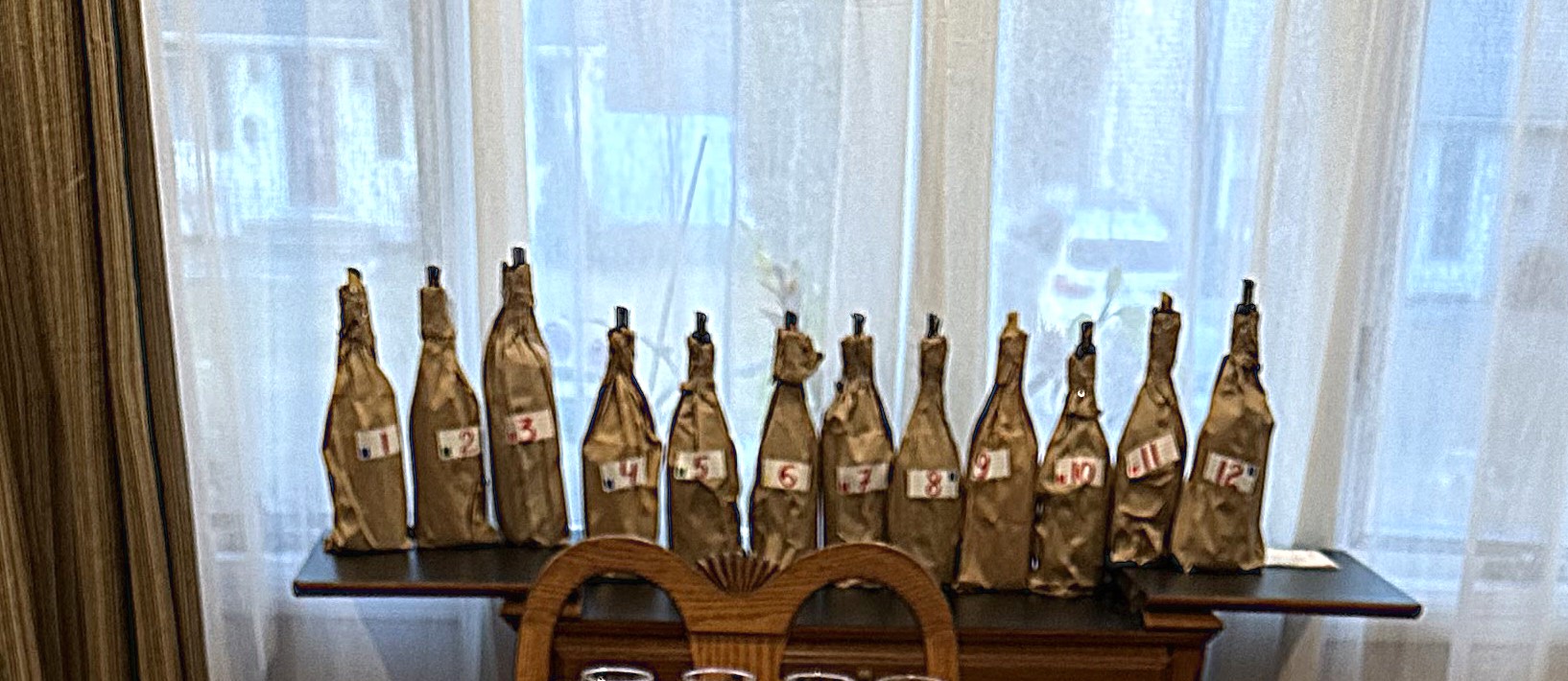
This is a blind tasting, so we placed all bottles in the paper bags, and then my daughter who was now a participant in the tasting put the labels randomly on the bags (15 years ago her role was limited only to attaching the labels :)). I also prepared a few of the “reference points” for everybody to use in the form of the crushed fruit in the glass – I didn’t find plums in the store, but we had many other relevant “references” – cherries, pomegranate, blueberries, raspberries, blackberries, and even liquid smoke.


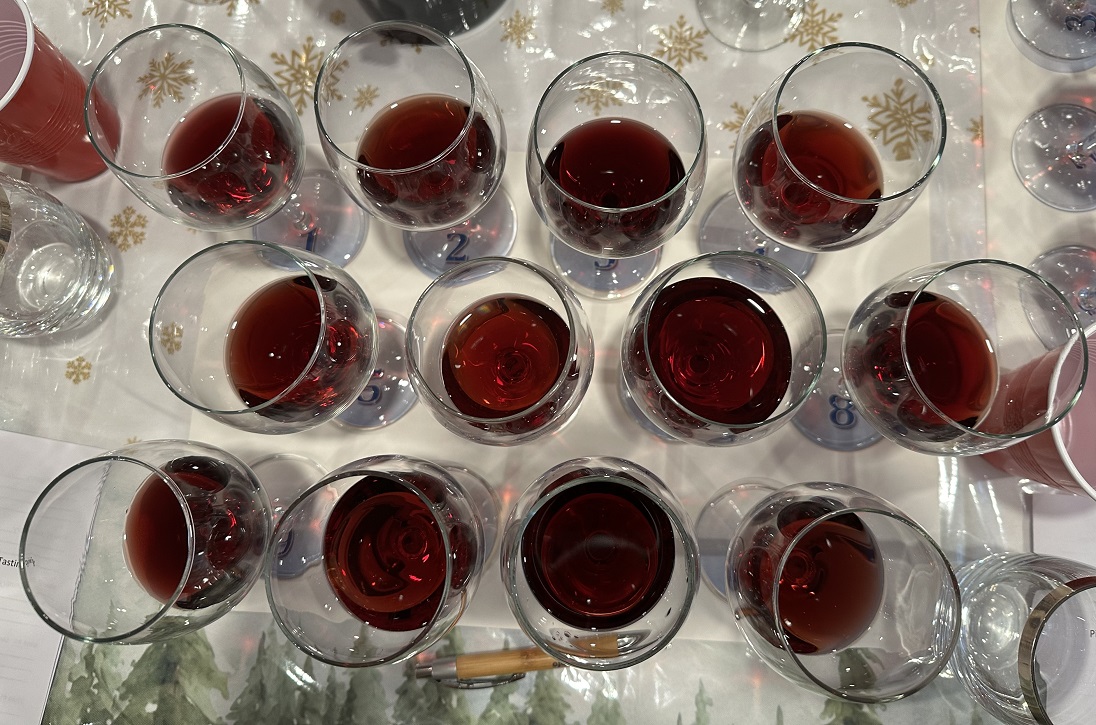
We also had paper for taking notes, and as a reference, I included all the countries that were present in the tasting so we could try guessing the countries for each wine. All countries except the two, as both Zak and I brought in one “surprise” each – Pinot Noir from the countries that are not really known as Pinot Noir producers – we didn’t know what wine the other person was bringing. Here is the list of countries that were offered for everyone’s reference: Argentina (Patagonia), California (Santa Rita Hills), France (Burgundy), Germany (Ahr), New York (Finger Lakes), New Zealand (Central Otago), Oregon (Willamette Valley, 2 wines), Poland, Washington, Surprise 1 (European country not listed above), Surprise 2.
Off we went, tasting and discussing the wines, trying to figure out what was what. Consciously tasting 12 wines in a row is not an easy fit, especially when you try to at least identify the countries. Also, each person (there were 8 of us) was supposed to decide on 3 of their favorite wines so we would be able to vote for the most popular wine of the night, so we had to score each wine. Here score is simply comparative within your notes – 1 through 5, E to A, doesn’t matter, as long as everyone can decide on their favorites.
Here are my notes for all 12 wines as the tasting was happening.
Wine #1: Country: New World (have no idea what I was thinking, I guess something outside of Europe), Vintage: 2021. Cherries, lots of cherries, raspberries, tart cherries on the palate, good balance, nice. Score: 8
Wine #2: Country: Oregon, Vintage: 2021. Iodine, cherries, tart, pepper, tannins, earthy, rocky. Score: 8+
Wine #3: Country: Poland?, Vintage: 2021. Cherries, initially fresh berries, fresh raspberries, sweet cherries, good balance. Score: 8
Wine #4: Country: Argentina?, Vintage: 2019. Gunflint, fresh, crisp, tart, rocky, cherries, excellent. Score:8/8+. Tasting again at the end of the tasting, the wine lost something, so finally score is 8
Wine #5: Country: California?, Vintage: ? Almost black color, dark, aged, medicinal nose, iodine, sweet cherries on the palate, tart. Score: 8-, after retesting later – 8, wine improved.
Wine #6: Country: Oregon? No, Vintage: ?, carrot juice on the nose, very grippy tannins on the palate, cherries. Score: 7+
Wine #7: Country: ? , Vintage: ? Beautiful color, Rutherford dust, hint of cherries, tannins and cherries on the palate, good balance. Score: 8 initially, 8+ after breathing
Wine #8: Country: Germany, Vintage: ? Love the garnet color, smoke, tar, concentrated nose. Wow! Superb – cherries, concentrated, good acidity, good balance. Score: 8++
Wine #9: Country: Oregon, Vintage: ? Pencil shavings, Rutherford dust, tannins, cherries, elegant but needs a touch more acidity. Score: 8
Wine #10: Country: ?, Vintage: ? Pomegranate seeds, cherries, very tight. Cool aid, cherry cola Score: 8-
Wine #11: Country: Finger Lakes, Vintage: ? Smoke and rubber, tar, on the nose. Rubber, tannins, cherries, became more balanced after breathing Score: 7+ initially, improved to 8 on the second tasting.
Wine #12: Country: Oregon, Vintage: ? Cherries, vegetation, cool aid on the nose. Cherries, good balance, good acidity, excellent. Score: 8+, went down to 8 after re-tasting as the finish showed sugar candy.
Ugh, this was not an easy tasting, but it was finally complete. Time to decide on favorites. First, everyone had to make their own decisions for the 3 favorite wines. After re-tasting and struggling, my list of favorites in descending order looked like this:
1st favorite: #8
2nd favorite: #2
3rd favorite: #7
Next, the vote. Remember, each person (there were 8 of us) was allowed to vote for 3 favorite wines, thus we just called the wine number and asked to see a show of hands. Here are the results.
Wine #1 – 1
Wine #2 – 5
Wine #3 – 1
Wine #4 – 0
Wine #5 – 0
Wine #6 – 3
Wine #7 – 3
Wine #8 – 3
Wine #9 – 3
Wine #10 – 1
Wine #11 – 1
Wine #12 – 3
Therefore we had a clear winner – wine number 2, and 5 wines in the second place with 3 votes each – #6, #7, #8, #9, and #12.
Next came the best and final part of the blind tasting – the reveal! Would you believe me If I told you that the revealed bottle elicited a loud “oh, wow, really” literally from everyone? Surprise after surprise after surprise.
The most popular wine? Pinot Noir from (drum roll, please)
Japan!
Seriously, Japan??? How? Yes, Japan makes wine, but to make Pinot Noir that shows better than Oregon, California, Burgundy, and all other countries? Just wow. Apparently, this is an impossible-to-get “cult” wine, produced in minuscule quantities, $100 wholesale but $300 retail if you can even find it? That was the first “surprise” wine.


Pinot Noir from Poland that was very good? How about that? My favorite wine of the tasting, Southern Lines from Central Otago, by some absolute miracle was $15 per bottle – how is that even possible (it is a case buy if you can find it at that price).
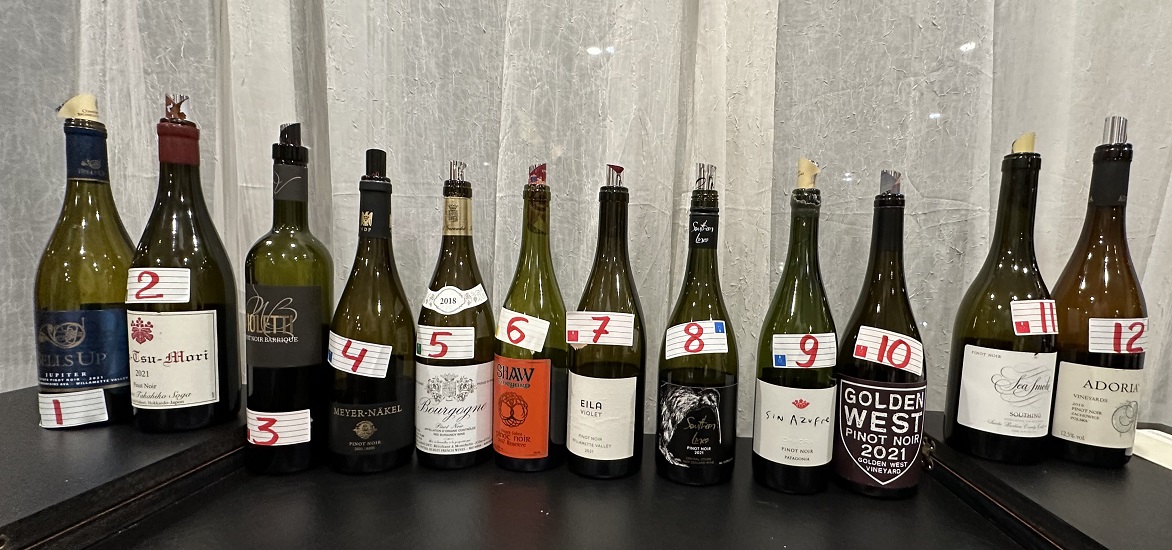
Here is the full list of wines in the numbered order:
- 2021 Bells Up Jupiter Pinot Noir Estate Chehalem Mountains AVA (13.5% ABV, $50)
- 2021 Domaine Takahiko Soga Nana-Tsu-Mori Pinot Noir Hokkaido Japan (13% ABV, $300?)
- 2022 Violetti-Rebbau Pinot Noir Barrique Vin de Pays Suisse (13% ABV, $N/A)
- 2021 Meyer-Näkel Pinot Noir Ahr Germany (12.5% ABV, $56 at Wine.com)
- 2018 Paul Garaudet Pinot Noir Bourgogne AOC (13% ABV, $39)
- 2017 Shaw Vineyard Pinot Noir Reserve Finger Lakes New York (13% ABV, $N/A)
- 2021 EILA Violet Pinot Noir Willamette Valley (12.7% ABV, $65)
- 2021 Southern Lines Pinot Noir Central Otago New Zealand (13.5% ABV, $15)
- 2022 Chakra Sin AzuFre Pinot Noir Patagonia Argentina (12% ABV, $30 Last Bottle)
- 2021 Golden West Pinot Noir Goden West Vineyard Royal Slope Washington (14% ABV, $21)
- 2011 Sea Smoke Southing Pinot Noir Santa Rita Hills Santa Barbara County (14.5% ABV, $100?)
- 2021 Adoria Vineyards Pinot Noir Zachowice Poland (12.5% ABV, $25)
You see, this is what blind tasting does. Under the guise of the brown bag, all wines are “the same”. You are not influenced by anything – “ahh, I brought this wine, it must be better”, “ahh, the guy in the store was raving about it so much”, “ahh, it got 99 points from Suckling” – none of this matters. You let your palate be the judge. Wine has to give you pleasure.


As the wines were left at my house after the tasting, I was the lucky bastard who had an opportunity to taste them over the few next days. This is not how the general population consumes wines, so this has very little bearing on the results and the whole tasting process, but I can tell you that for example, the Sea Smoke Southing became literally my favorite wine – it developed a depth of flavor and a beautiful complexity – if it would taste like that during the tasting it would be handily the wine number 1, for sure for me. The Pinot Noir from Ahr also developed additional layers, with gunflint and roasted meat notes now dominating the flavor profile in a very respectful manner, making it a lot more pleasant to drink – again, in that state it would again get a much higher rating in my book. And pretty much across the board, the Pinot Noirs continued their evolution and most of them were still drinkable even 5 days after being open – a testament to quality.
Here we are. 15 years later, the most unexpected Pinot Noir wins again. But this is the beauty of wine. The mystery, the enigma, the art. Wine is a liquid art form, and this tasting delivered an unmeasurable amount of pleasure and created new memories. This is what life is all about, isn’t it? Creating good great memories. And wine is exceptionally good at that. Onward and upward.
Leave a comment
Last Bottle Sign Up ($10 credit)




 Talk-A-Vino
No Aussie Pinots? Austrian?
Listen, don’t you think 11 countries/regions is good enough? Australia, Austria, Canada, Chile, Czech Republic, Italy, South Africa… I think our set was representative enough. Pinot Noir from Japan and Poland? Good luck beating that…
Was more thinking of adding to it…