Archive
Weekly Wine Quiz #98: Grape Trivia – Blends, Part 2
The Wine Quiz series is not meant to intimidate. The whole idea here is to have fun and learn something new. When answering the questions, it is fully encouraged to use all available sources of information, including Google or any other search engine. There are no embarrassing answers – the most embarrassing thing is not giving it a try…
Welcome to the weekend and your new wine quiz!
We are continuing our grape trivia series, with the focus now on Blends. All the questions below are focused on the grapes which work well in the blends – and occasionally on those which do not. White, Red, Rosé, Sparkling and not, dry, sweet and may be even fortified – all goes.
Let’s proceed!
Q1: This grape was created as a cross between Cinsaut and Pinot Noir. Can you name the grape?
Q2: Take a look at this list of the grapes: Chardonnay, Pinot Noir, ?, Arbane, Petit Meslier, Pinot Blanc, Pinot Gris. Two questions:
a. Name the missing grape
b. What wine is made most often by blending some of these grapes?
Q3: Which grape is missing?
– Tempranillo, Garnacha, ?, Graciano
Q4: This dry red wine from California is related to famous Caymus, and made out of the unknown, secret blend of grapes. Can you name this wine?
Q5: Carménère to Merlot is the same as Douce Noir to ?
Good luck, enjoy the quiz and your weekend! Cheers!
Weekly Wine Quiz #97: Grape Trivia – Blends, Part 1
 The Wine Quiz series is not meant to intimidate. The whole idea here is to have fun and learn something new. When answering the questions, it is fully encouraged to use all available sources of information, including Google or any other search engine. There are no embarrassing answers – the most embarrassing thing is not giving it a try…
Welcome to the weekend and your new wine quiz!
We are continuing our grape trivia series, but changing gear slightly. Until now, we talked only about specific grapes – each weekly quiz was dedicated to one and only one grape, whether it was red or white. Of course some of the questions included mentions of the blends, but still, the single varietal was a star. For the next few quizzes, I want to change that. Most of the wines we drink are blends. So why don’t we talk about blends for a while? Let’s mix things up.
At this point, as I’m not entirely sure yet of the exact direction. Below you will find 5 random questions regarding blending of the grapes – in the particular wines, and in particular regions. We are not going to focus on a single region, and will be blending both red and white grapes. Some questions might also be just opposites of the blends. We shall see. And yes, please comment and let me know what you think.
And now, to the quiz!
Q1: Which grape is missing?
– Cabernet Sauvignon
– Merlot
– Cabernet Franc
– ?
– Petit Verdot
Q2: Wines of this region, made out of Sauvignon Blanc and Sémillon, considered some of the best white wines in the world. Can you name that region?
Q3: This wine might be the biggest officially sanctioned blend of the grapes in the world. Do you know what wine is that?
Q4: This simple wine is classified as a field blend. This is probably best known European white field blend wine. Now:
a. Can you explain what field blend is?
b. Can you name this wine?
Q5: This wine, one of the most famous in the world, is often made from 70% Cabernet Franc and 30% Merlot. Do you know what wine is that?
Good luck, enjoy the quiz and your weekend! Cheers!
Weekly Wine Quiz #96: Grape Trivia – Alicante Bouschet
The Wine Quiz series is not meant to intimidate. The whole idea here is to have fun and learn something new. When answering the questions, it is fully encouraged to use all available sources of information, including Google or any other search engine. There are no embarrassing answers – the most embarrassing thing is not giving it a try…
Welcome to the weekend and your new wine quiz!
We are continuing our grape trivia series, still focusing on the red grapes, and today’s subject is Alicante Bouschet, or Alicante Henri Bouschet, if we want to use the full and official name.
How many of you ever heard of Alicante Bouschet, let alone tasted the wines made from that grape? How about Garnacha Tintorera? Still nada? Yes, I know – at this point, I’m reaching into the obscure grapes territory, the dark side of the wine world. But this grape, Alicante Bouschet, is so unique and different, in its past and present, that I can’t pass an opportunity to learn about it together with you.
Alicante Bouschet grape was created in 1866 by Henri Bouschet as a cross between Petit Bouschet and Grenache. To make things a bit more interesting, it is worth noting that Petit Bouschet was created by Louis Bouschet, the father of Henri Bouschet, this time as a cross between two ancient varietals, Teinturier du Cher and Aramon. Talking about unique – Alicante Bouschet is one of the very few red grapes in the world which are classified as teinturier – the grape which makes the juice of red color. Take any of the well known red grapes – Cabernet Sauvignon, Pinot Noir, Merlot, most anything – and break it apart. The juice which will be coming out will be clear. It is the skin which gives the color to majority of the red wines. When it comes to Alicante Bouschet (and other teinturier grapes, which are very few), the juice will be coming out as red.
After being created in 1866, Alicante Bouschet somewhat rapidly spread out all over the world. It was used in France to replant vineyards after the phylloxera devastation. It made it to Portugal and Spain, where it is known under the name of Garnacha Tintorera, and continued its successful journey further into Italy, Australia, Chile, United States and the number of other countries.
Alicante Bouschet is known to produce not even large, but rather huge crop. It is also an early ripening grape, which creates somewhat of a problem, as it doesn’t accumulate enough flavor depth and enough sugar to make it into the single-varietal wine. As the result, it is often used as part of the blend just with the purpose of adding the color (and the color it got!). Another important characteristic of the grape is a very thick skin, which helps it to withstand the long distance transportation. This quality of Alicante Bouschet made it extremely popular grape during prohibition times in the US, as it could sustain the long railroad voyage from west coast to the east. In addition to handling the long distance transportation quite well, Alicante Bouschet think skin and juicy flesh was allowing for it to be pressed three times (most of the common grapes will allow for one, or an absolute maximum of two pressings), thus one could get more decently colored wine from much lesser amount of grapes.
Today, the plantings of Alicante Bouschet decreased in the countries like France and United States, where it is used mostly for blending. However, the grape is increasingly popular in Portugal, where it makes wonderful concentrated wines in the Alentejo region. Southern Spain also has very substantial plantings of Garnacha Tintorera, and with controlled yield produces outstanding single-varietal wines.
And now, to the quiz!
Q1: True or False: according to the 2010 data, Alicante Bouschet is one of the 15 most planted red grapes in the world?
Q2: Wine Spectator calls wines with 90-94 ratings “Outstanding: a wine of superior character and style”. True or False: There are no Alicante Bouschet-based wines rated as Outstanding by Wine Spectator.
Q3: Alicante Bouschet makes a very popular addition (albeit in miniscule quantities, about 5% or less) to some of the very well known and popular California varietal wines. Can you name two of those popular California grape varieties?
Q4: Below is the list of countries growing Alicante Bouschet/ Garnacha Tintorera. Based on 2010 data, sort that list from the biggest area plantings to the smallest:
a. Chile
b. France
c. Italy
d. Portugal
e. Spain
Q5: Which one doesn’t belong and why?
a. Carlisle
b. Francis Ford Coppola
c. Ridge
d. Turley
Good luck, enjoy the quiz and your weekend! Cheers!
Weekly Wine Quiz #95: Grape Trivia – Tannat
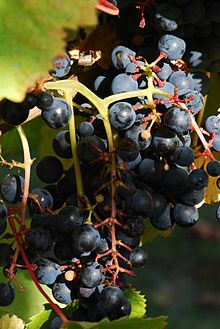
Tannat Grapes. Source: Wikipedia
The Wine Quiz series is not meant to intimidate. The whole idea here is to have fun and learn something new. When answering the questions, it is fully encouraged to use all available sources of information, including Google or any other search engine. There are no embarrassing answers – the most embarrassing thing is not giving it a try…
Welcome to the weekend and your new wine quiz!
We are continuing our grape trivia series, with the focus still on the red grapes, and today’s subject is Tannat.
It is interesting how different the grape stories are. Some grapes, like Bonarda/Charbono, have very convoluted history with changing names and uncertain origins. Some grapes, like Tempranillo, have a page-long list of synonyms, different names they are known under in the different parts of the world and even in the different parts of the same country. The Tannat story is a lot more straightforward. Wikipedia doesn’t list any synonyms for the name Tannat, which is quite rare – most of the grapes have some alternative names listed, and there are no confusions surrounding the Tannat grape.
Tannat originated in the Southwest France, in the area close to Pyrénées. Area surrounding village of Madiran was and still is the main wine growing area for Tannat, but today Tannat is growing in the number of countries in the world (albeit not in the major quantities). In the second half of 1800, Tannat made it to Uruguay, where today it is literally considered the national grape. In addition to Uruguay, the grape is successfully grown in United States – California is increasing its plantings quite a bit, and some other states are experimenting with the grape. Australia, Argentina, South Africa, Brazil, Italy are all also have some plantings of Tannat.
Tannat is a late ripening grape, with the thick black skin. That skin makes the grape resistant to the mildew rot, and also becomes a source of tannins. Tannat wines are generally known to make firmly structured, tannic and powerful wines, which require quite a bit of aging to soften those tannins up – however this is changing nowadays as many winemakers focus on making the Tannat wines more approachable while young. Similar to the other grapes with likewise characteristics (think thick skin/tannins), Tannat has very high level of procyanidins, which according to the Wikipedia are “good for reducing blood pressure, lowering cholesterol and encouraging healthy blood clotting”.
And now, to the quiz!
Q1: Tannat was the reason for one specific winemaking technique to be invented relatively recently. Do you know what technique is that?
a. Malolactic fermentation
b. Micro-oxygenation
c. Carbonic maceration
d. Reverse osmosis
Q2: True or False: Tannat is primarily harvested by hand and not by the machine. Provide an explanation for your answer.
Q3: Name 3 grapes, often used as blending partners when Tannat wines are produced in France
Q4: Wine Spectator calls wines with 90-94 ratings “Outstanding: a wine of superior character and style”. True or False: There are no Tannat-based wines rated as Outstanding by Wine Spectator.
Q5: Tannat ripens at about the same time as Cabernet Sauvignon. Assuming you have Tannat and Cabernet Sauvignon which are both slightly underripe, which grape would you make the better wine from, Tannat or Cabernet Sauvignon? Why?
Bonus: Have you ever had any Tannat wines? What do you think of them?
Good luck, enjoy the quiz and your weekend! Cheers!
Weekly Wine Quiz #94: Grape Trivia – You Say Bonarda, I Say Charbono

Bonarda Grapes, Source: Wikipedia
The Wine Quiz series is not meant to intimidate. The whole idea here is to have fun and learn something new. When answering the questions, it is fully encouraged to use all available sources of information, including Google or any other search engine. There are no embarrassing answers – the most embarrassing thing is not giving it a try…
Welcome to the summer time (for those of you in US – and no, don’t worry, I didn’t say “summer”, it is only a day saving time) and your new wine quiz!
We are continuing our grape trivia series, with the focus still on the red grapes, and today’s subject is the red grape called Charbono, also known as Bonarda, and … wait for it … Douce Noir!
If we are looking for the grape with the most confusing story of its origin, this well might be the winner. For the long time Bonarda, which is how the grape is known in Argentina, was considered to be the same as Bonarda Piemontese, the red grape from Piedmont in Italy. Charbono, which has almost the cult status in California (not in term of prices, but in terms of availability), even today is written up on some wine sites as “unique California grape of unknown origin”, however it was considered to be brought to California by Italian immigrants as Barbera. To complete the round of confusion, Douce Noir, a nearly extinct variety in France with only 5 acres planted today, was considered to be related to Italian Dolcetto (Douce in French and Dolce in Italian both mean sweet).
Douce Noir became known in France in Savoie region at the very beginning of the 19th century, and by the end of 19th century, it was the most planted grape in Savoie. It is also known in Jura under the name of Corbeau, which means “crow”, as the grape often has a shiny black color. About 15 years ago, based on DNA research it was established that both Bonarda and Charbono are in reality are Douce Noir grape!
Douce Noir is a very late ripening variety, it ripens after the Cabernet Sauvignon. It is known to have a very think black skin and has very high phenolic content, as well as high acidity, so it is capable of producing deeply flavored and concentrated red wines. It is found that the grape produces the best results in the areas where there is a substantial difference between day and night temperatures. While it is hard to find in France, the grape grows plentiful in Argentina (yes, as Bonarda). The plantings in California are small (less than 50 acres), but the resulting wines are quite unique and equally hard to find due to the very limited production.
And now, to the quiz!
Q1: True or False: Bonarda is one of the 30 most planted red grapes in the world?
Q2: These are some of the grapes growing in Argentina. Sort this list by the area plantings in the descending order:
a. Bonarda
b. Cabernet Sauvinon
c. Criola Grande
d. Malbec
Q3: Which one doesn’t belong and why?
a. Turley
b. Bonny Doon
c. Robert Foley
d. Mount Palomar
Q4: Wine Spectator calls wines with 90-94 ratings “Outstanding: a wine of superior character and style”. True or False: There are no Charbono wines rated as Outstanding by Wine Spectator.
Q5: True or False: From year 2000 to 2010, plantings of Bonarda in Argentina have increased by more than 20%
Bonus: have you ever had Charbono wines (talking specifically California here)? What do you think of them?
Good luck, enjoy the quiz and your weekend! Cheers!
Weekly Wine Quiz #93: Grape Trivia – Norton

Norton Grapes growing in Missouri. Source: Wikipedia
The Wine Quiz series is not meant to intimidate. The whole idea here is to have fun and learn something new. When answering the questions, it is fully encouraged to use all available sources of information, including Google or any other search engine. There are no embarrassing answers – the most embarrassing thing is not giving it a try…
Welcome to the weekend and your new wine quiz!
We are continuing our grape trivia series, with the focus still on the red grapes, and today’s subject is Norton, a uniquely North American grape.
When you ask people what is the America’s signature red grape, most probable answer you will get is Zinfandel. However, we need to remember that Zinfandel was actually brought here from Croatia and it still has its ancestors happily growing there – it doesn’t make it any less an American Signature Grape – but – there is actually a grape which is called The Real American Grape®, and this grape is Norton.
What makes Norton so special? The origins of the grape are somewhat unclear, most often associated with the work of Dr. Daniel Norton, who spent lots of time and efforts to create the grape which would survive in Virginia. You see, despite the similarities in the climate conditions between Virgina and Bordeaux, most of the European grape cuttings coming from France would simply die in Virginia soil. Norton, which was born some time around 1820, became the first cross of European and native American grapes which not only survived, but also produced very palatable wines. Actually, the wines were that good, that in 1873 at the worldwide competition in Vienna, the Norton wine from Missouri was declared the “Best Red Wine of All Nations“. I guess another mystery associated with Norton is the fact that even with such a high designation, it didn’t spread violently all over the United States. The fact that the Norton vines are very particular to the types of soil they grow in, plus mass destruction of the Norton vineyards during Prohibition (they were replaced with plantings of Concord), were some of the key factors standing in the way of Norton’s success. Today, Norton is successfully growing in many of the Mid-Atlantic states in US, but it is still mostly known locally, particularly due to the draconian wine shipping laws in US.
Norton has deep-blue colored skin, and it is known for the very high anthocyanin content, which in turn is associated with the number of health benefits, such as “antioxidant, anti-inflammatory, antimicrobial and anti-carcinogenic”properties, according to the Wikipedia. Norton wines are generally full-bodied, with an interesting earthy profile, good structure and showing off a red fruit notes. Norton wines can age quite well, and they actually require a few years in the cellar to be enjoyed fully.
And now, to the quiz!
Q1: Which of the following are synonyms of Norton?
a. Cynthiana
b. St. Croix
c. St. Vincent
d. Virginia Seedling
Q2: The winery in which state holds the trademark The Real American Grape®:
a. Arkansas
b. Missouri
c. Pennsylvania
d. Virginia
Q3: Norton is an official State Grape of:
a. Arkansas
b. Mississippi
c. Missouri
d. Virginia
Q4: Norton grape generally classified as:
a. Vitis Aestivalis
b. Vitis Cinerea
c. Vitis Labrusca
d. Vitis Vinifera
Q5: As you know, Riedel is the best known wine glass maker, which creates wine glasses designated for different varietals. True or False: Riedel makes a special varietal glass designated to Norton
Bonus: have you ever had Norton wine? What do you think?
Good luck, enjoy the quiz and your weekend! Cheers!
Weekly Wine Quiz #92: Grape Trivia – Montepulciano
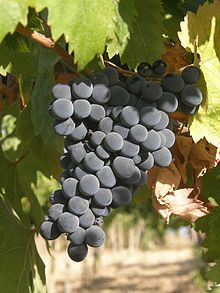
Montepulciano grapes Source: Wikipedia
The Wine Quiz series is not meant to intimidate. The whole idea here is to have fun and learn something new. When answering the questions, it is fully encouraged to use all available sources of information, including Google or any other search engine. There are no embarrassing answers – the most embarrassing thing is not giving it a try…
Welcome to the weekend and your new wine quiz!
We are continuing our grape trivia series, with the focus still on the red grapes, and today’s subject is Montepulciano.
Montepulciano is an indigenous Italian grape variety, recommended for use in 20 out of 95 wine regions in Italy, and one of the most planted red grapes in the country. The origins of Montepulciano are hard to pinpoint, with some sources citing the grape been growing on the hills of Abruzzo since the ancient times, and some sources suggesting that the grape was brought into the Abruzzo region from the neighboring Tuscany at the end of the 18th century. Also an interesting “gotcha” is associated with the name of the grape itself. It seems that the name of the grape, Montepulciano, is given after the town in Tuscany, also called Montepulciano, where the grape supposedly came from. But the problem is that the wine produced in Montepulciano has nothing to do with Montepulciano grape! Town of Montepulciano produces the wine called Vino Nobile di Montepulciano, which is made out of 100% Sangiovese grape! Yep, that’s what I call confusing.
Montepulciano is a late ripening variety, with thick black skin and relatively low acidity. It produces wines which are quite dry, with cherry and cherry pit (did you ever try to eat the content of the cherry pit?) flavors, full bodied and easy to drink. While a lot of Montepulciano wines are easy to drink but not necessarily memorable, proper care and reduced yields can result in the world-class wines. Absolute majority of Montepulciano wines are produced in Italy, with Montepulciano d’Abruzzo, Rosso Piceno and Rosso Conero probably been best known areas, but Montepulciano plantings also exist in Argentina, New Zealand and the United States.
And now, to the quiz!
Q1: In the number of regions, Montepulciano is often blended with … [name that grape]
Q2: Wine Spectator calls wines rated in 95-100 range Classic (the highest and the most prestigious category). True or False: there are no Montepulciano – based wines rated in the Classic category
Q3: From the list below, which state in US doesn’t make any Montepulciano wines of notice:
a. California
b. Maryland
c. North Carolina
d. Texas
e. Washington
Q4: True or false: from 2000 to 2010, plantings of Montepulciano in Italy increased by more than 15%
Q5: Best known Montepulciano wine comes from Abruzzo in Italy and it is known as Montepulciano d’Abruzzo. Do you know the name of the white wine commonly produced in Abruzzo?
Good luck, enjoy the quiz and your weekend! Cheers!
Weekly Wine Quiz #91: Grape Trivia – Cinsault
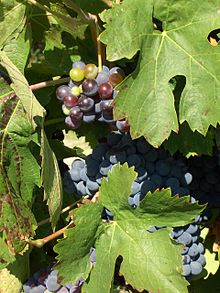
Cinsault Grapes. Source: Wikipedia
The Wine Quiz series is not meant to intimidate. The whole idea here is to have fun and learn something new. When answering the questions, it is fully encouraged to use all available sources of information, including Google or any other search engine. There are no embarrassing answers – the most embarrassing thing is not giving it a try…
Welcome to the weekend and your new wine quiz!
We are continuing our grape trivia series, with the focus still on the red grapes, and today’s subject is Cinsault – for the French purists, we should drop an “l” there and call the grape Cinsaut.
At first, I wanted to call Cinsault an “unsung hero”, but I don’t think it would be the right way to put it. Yes, about 20 years ago, Cinsault plantings in France were exceeding those of Cabernet Sauvignon – but this was 20 years ago. Cinsault is best known for 2 things: it is a blending grape in many of the Rosé wines in Provence and Languedoc, and it is a father (or mother, if you prefer) of Pinotage – the unique South African grape we talked about last time. Cinsault is a black-skinned, early ripening grape which has a tendency to overproduce, easily yielding 6 – 10 tons of grapes per acre (high yield typically means less flavor in each grape). When the yield is controlled at 2 – 4 tons, Cinsault produces very aromatic, fragrant grapes. Cinsault grapes also naturally low in tannin but impart good color, which makes them well suited for Rosé production.
While the biggest Cinsault plantings are still located in France, the grape is growing all other the world – Algeria, Chile, Italy, Morocco, South Africa, Turkey, United States and number of other countries have Cinsault plantings. What is interesting to note that today, when winemakers are constantly in the quest to produce unique and different wines, the single grape red (!) Cinsault bottlings from Chile, South Africa and the United States from the last few vintages have wine critics and writers rave about beautiful, fresh and elegant characteristics of the wines. I think we didn’t see the last of Cinsault yet.
And now, to the quiz!
Q1: Name 3 grapes, traditional blending partners of Cinsault in Provençal Rosé
Q2: In which US state the history of winemaking is associated with Cinsault?
a. Oregon
b. Texas
c. Virginia
d. Washington
Q3: The oldest continuously producing Cinsault vineyard in the world is located in:
a. Algeria
b. France
c. South Africa
d. United States
Q4: True or False: Cinsault is one of the 30 most planted grapes in the world
Q5: Considering Cinsault plantings worldwide, sort the countries below from the largest area plantings to the lowest:
a. Algeria
b. France
c. Morocco
d. South Africa
Good luck, enjoy the quiz and your weekend! Cheers!
Weekly Wine Quiz #90: Grape Trivia – Pinotage
The Wine Quiz series is not meant to intimidate. The whole idea here is to have fun and learn something new. When answering the questions, it is fully encouraged to use all available sources of information, including Google or any other search engine. There are no embarrassing answers – the most embarrassing thing is not giving it a try…
Welcome to the weekend and your new wine quiz!
We are continuing our grape trivia series, with the focus still on the red grapes, and today’s subject is Pinotage.
Have you heard of Pinotage? Have you ever tasted it? What do you think of it? What, looks like I start with the quiz before the quiz? Well, kind of. Just setting the scene.
Pinotage is a unique grape, purposefully created in South Africa by Professor Abraham Izak Perold in 1925. Pinotage was created as a cross between Pinot Noir and Cinsault grapes. Originally used only for blending, little by little Pinotage developed into a signature grape of South Africa, similar to what Zinfandel is for California, or Malbec for Argentina.
Pinotage might be one of the most polarizing grapes in the world – well, not the grape itself, of course, but rather Pinotage wines. From the very first smell, not even a sip, Pinotage effects a love/hate relationship on wine consumers and professionals alike. Sometimes, the off putting aromas are so strong, it really makes people to put Pinotage into the “never again” category.
Lately, with the advance of the latest winemaking methods and improved winemaking knowledge, there are more and more Pinotage wines which are easy to like. A good Pinotage typically shows dark ripe berries, accompanied with hint of smoke and earthiness, without any of the “non-wine related” flavors. While Pinotage is a South Africa’s signature grape, it is also successfully growing in many other parts of the world – New Zealand, California, Virginia, Brazil, Australia are all making interesting wines out of the Pinotage.
And now, to the quiz!
Q1: Explain the origin of the name Pinotage
Q2: While Pinotage primarily grows in South Africa, California also has some plantings of the grapes. Can you estimate the approximate size of Pinotage plantings in California?
a. 50 acres
b. 250 acres
c. 500 acres
d. more than 1000 acres
Q3: Here is the list of of nasty aromas often associated with the smell of Pinotage wines, except one. Do you know which one doesn’t belong?
a. Burnt rubber
b. Rusty nails
c. Paint solvent
d. Sauerkraut
Q4: Wine Spectator calls wines rated in 95-100 range Classic (the highest and the most prestigious category). True or False: there are no Pinotage-based wines rated in the Classic category
Q5: Pinotage was created in 1925, but for the long time it was used only as blending grape. Do you know when single-grape Pinotage bottling was first released in South Africa?
a. 1946
b. 1961
c. 1976
d. 1989
Good luck, enjoy the quiz and your weekend! Cheers!
Weekly Wine Quiz #89: Grape Trivia – Dolcetto
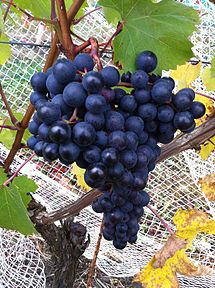
Dolcetto grapes. Source: Wikipedia
The Wine Quiz series is not meant to intimidate. The whole idea here is to have fun and learn something new. When answering the questions, it is fully encouraged to use all available sources of information, including Google or any other search engine. There are no embarrassing answers – the most embarrassing thing is not giving it a try…
Welcome to your new wine quiz!
We are back to our grape trivia series, continuing with the red grapes, and today’s subject is the grape called Dolcetto.
If you look at [probably best] known Italian wine regions, you will find some very interesting differences. If we take Tuscany, which probably comes to mind among the first, its signature grape, Sangiovese, is successfully growing in many other parts of the world, and lots of international varieties is producing magnificent wines on the Tuscan soils (super-Tuscan, anyone?). If we will now look at Piedmont, the home to Barolo, the king of wines, and Barbaresco, that region produces magnificent wines almost exclusively from the local indigenous grapes – and those local grapes are very scarcely distributed around the world, producing the wines of limited value.
Dolcetto, the subject of our today’s trivia, is one of the three better known red grapes of Piedmont – Nebbiolo and Barbera are two others. It is not very clear how Dolcetto made it to Piedmont, with some of the references suggesting that it had been growing there at least from the 16th century. The name of Dolcetto technically stands for the “little sweet one”, but it is believed that this is rather a coincidence and the name has actually a different source. Dolcetto is an early ripening variety which produces wines which have nothing to do with sweetness. Dark thick skin of Dolcetto contains large amount of anthocyanins, and imparts quite a bit of tannins to the resulting wines, as well as the dark color. Generally, Dolcetto wines are dry, lighter style than Barbera or Nebbiolo, with dark red and black fruit profile, such as black cherries and plums.
Best Dolcetto wines are mostly produced in the 7 different DOCs of Piedmont. It is also growing in Liguria under the name of Ormeasco. Dolcetto has very limited success around the world, growing in Australia and in a few regions of United States – California, Texas and Oregon.
And now, to the quiz!
Q1: Except the “sweet little one”, what is the other possible explanation to the name of the Dolcetto grape?
Q2: Sort these Piedmontese grapes in the order of time of ripening, from earlier to the later: Barbera, Dolcetto, Freisa, Nebbiolo
Q3: Wine Spectator calls wines rated in 95-100 range Classic (the highest and the most prestigious category). True or False: there are no Dolcetto-based wines rated in the Classic category
Q4: One of the North American grapes for the long time was assumed to be identical to Dolcetto ( until recent DNA tests proved it wrong). Do you what grape was that?
a. Chambourcin
b. Charbono
c. Marechal Foch
d. St. Croix
Q5: What is the suggested serving temperature for Dolcetto wines?
a. 65ºF to 75ºF
b. 60ºF to 65ºF
c. 50ºF to 60ºF
d. 45ºF to 50ºF
Good luck, enjoy the quiz and the rest of your weekend! Cheers!
Last Bottle Sign Up ($10 credit)




 Talk-A-Vino