Archive
Vinitaly and Slow Wine Tastings – Part 2, Wine Seminars
 This is the second post about my experience at Vinitaly and Slow Wine 2013 in New York. In the first post I only gave you some interesting stats. Now, it is time to actually talk about wines.
Attending big wine tasting is great, wine is everywhere, and lots of it – at the same time, it is also very challenging. You can’t really assess wine methodically, it is more of a “swirl (carefully), sniff, sip, suck air, spit” – in case you wonder, “swallow” is typically not the part of the process, otherwise your tasting will be very, very short. After “spit” goes “write a word, may be two or three”, and move on, either to next wine or to the next table. No, of course I’m not complaining, just explaining that as usual for this type of my “tasting posts” there will be lots of pictures, and a few words.
We – oh yes, let me explain “we” – I spent all of the time at the event with Stefano of Flora’s Table fame (by the way, Stefano also just started the new blog called Clicks & Corks – be sure to check it out). Stefano is a wealth of knowledge and a pleasure to be around – if it would not be for him, I’m sure I would miss out on a number of gems at this tasting.
Now, let’s start again . We spent most of the time in the Slow Wine section of the event, with the exception of two wine Master Classes and a few wineries in the actual Vinitaly section. Let me start from the seminars, and then we will talk about other wines (probably in yet another post).
The first Master Class was a vertical tasting of Nino Negri ‘5 Stelle’ Sfursat di Valtellina DOCG, a wine made out of Nebbiolo grape. Both Stefano and myself took care of pre-registering for this seminar (when I came to register, I got one of the last 3 seats). No matter. In addition to registration, program also mentioned that Master Classes are first come first serve events. So, do you think our registration helped us? Yep, you got it – not really. When we arrived about 15 minutes before the starting time, we were told that the room is full and there are no spaces left. Well, based on the fact that we had registered, we ignored the guy who was trying to stop us from getting inside of the room. But the room was full. No seats. And it is not that you need just seat – you also need a place for 6 glasses in front of you. I was witnessing a futile attempt of one of the organizers to remove two people who were sitting down and had no tickets. Nope, that was not happening. So when one wants to taste wine, this is what the one wants, right? Luckily for us, the place had very wide window seals. Stand by the window, get 6 glasses, ask for the wines to be poured. Actually, I have to say that service staff was super nice and super accommodating – we all got tasting placemats and we all got wine. Here are few pictures:


Just look at this bottle… Unfortunately, the wine was oxidized. But the bottle was way too cool.
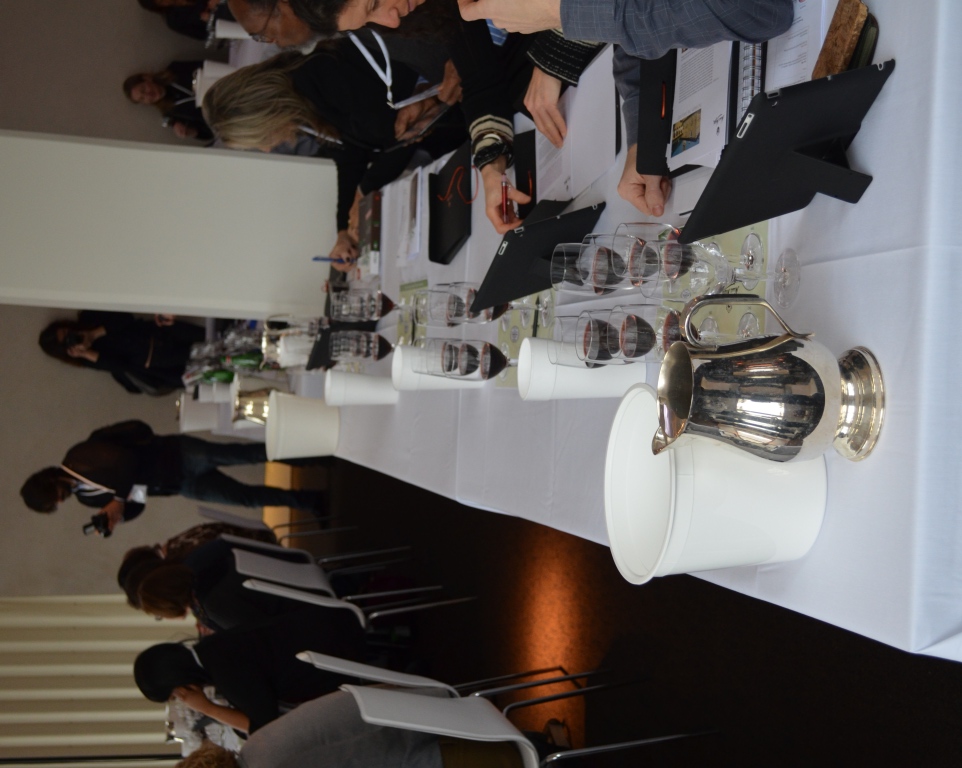
No tickets, but hey, who need tickets when it is first come first serve…
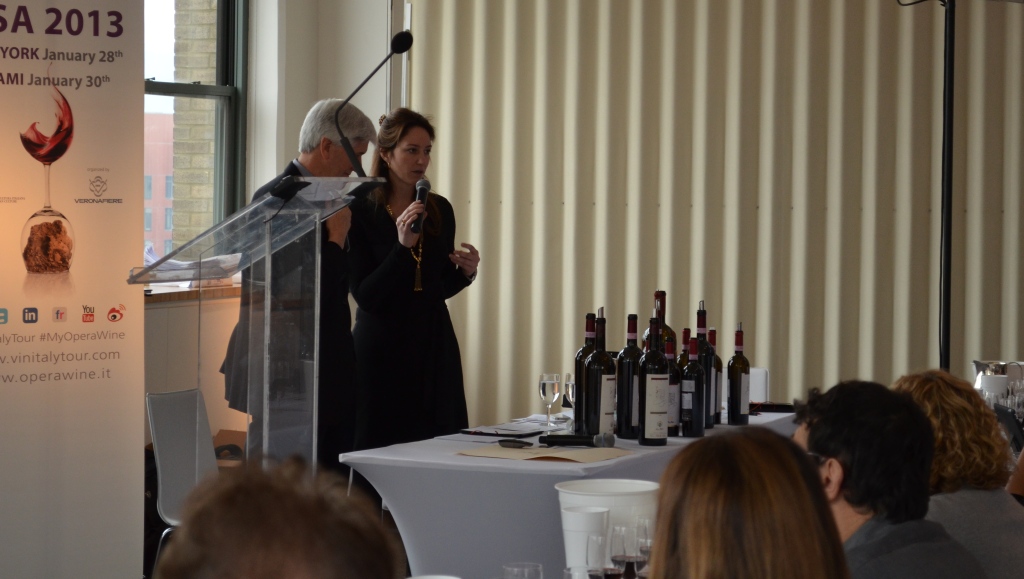
Casimiro Maule, Oenologist at Nino Negri, presents the wines. In 2007, he was awarded the title of “Winemaker of the Year” by Gambero Rosso
Nino Negri winery started in 1897 in the Valtellina region of Lombardy, in the area of Alps close to the Switzerland. This location makes harvesting of the grapes very difficult – actually, a helicopter is used nowadays to transport crates with grapes from the vineyard to the winery – here is a short video in case you want to see how the harvest looks like:
Nino Negri estate makes many different wines out of Nebbiolo grape. The wines we tasted, ‘5 Stelle’ Sfursat, are only made in the best years, and they are done in the style similar to Amarone. After grapes are harvested, they are dried outside for 100 days before they are pressed. During these 100 days, grapes are sorted a few times, and all the grapes which don’t cut it are used to produce some other wines. After 100 days of drying the grapes are pressed with subsequent long maceration, and then aged for 18 month in new French oak barriques and 6 month in the bottle. Note that all these wines are not for the faint at heart – they boast 15% – 16% ABV.

Just look at the beautiful color
Here are the notes for the wines we tasted, in the order we proceeded:
2009 – Prunes, brick dust on the nose, pretty green on the palate, very light for Nebbiolo, good minerality, short finish. Better on the second try, but too watery. Probably needs time.
2007 – According to the winemaker, 2007 was a great year. But – this bottle was oxidized. Some prunes on the palate, tasted more like a dry sherry than a normal wine.
2004 – this year had low yield, and drying season was very difficult. But the wine had nice power, good minerality, good tannins, long finish.
2002 – Prunes on the nose, with some raisins, soft, round, dark roasted fruit on the palate, tobacco, savory herbaceous notes, great balance, overall very nice.
2001 – Perfect beauty! Supple, round, with only a hint of dried fruits on the nose, perfectly balanced, really a outstanding wine. Hell with the rest of the tasting – need a full glass of this one to enjoy. Best of tasting.
1997 – This wine was as good as 2001 – more herbaceous notes than fruit, but perfectly elegant. Dried fruit on the nose (more than the previous wine), graphite and tobacco notes on the palate. Great complexity, balance and elegance. Borderline better than 2001 ( wait, didn’t I just called 2001 “best of tasting” – yeah, I always have trouble with making up my mind…)
All in all, tasting through the vertical of Nino Negri ‘5 Stelle’ Sfursat wines was a special experience and I’m grateful to organizers for making it happen – the beauty of the wines overweight the logistical challenges.
At the end of the day, we attended another seminar, this one dedicated to the wines made on Volcanic soils of Italy. We were preregistered, at this point knew what to expect, ready for a fight and this time got the seats.
If you look at the map below (maps were provided as part of the seminar):

Map of Italy’s Volcanic Wines
there are many volcanoes all over Italy, including even some of the active ones, like Etna in Sicily. Volcanic environments are uniquely different for all the things growing, vines included, and this whole “volcanic wines” project is dedicated to researching the effect of the volcanic soils on the resulting wines. It is also interesting to note that at this point, the whole project is only dedicated to white wines ( and I was hoping to taste some reds).
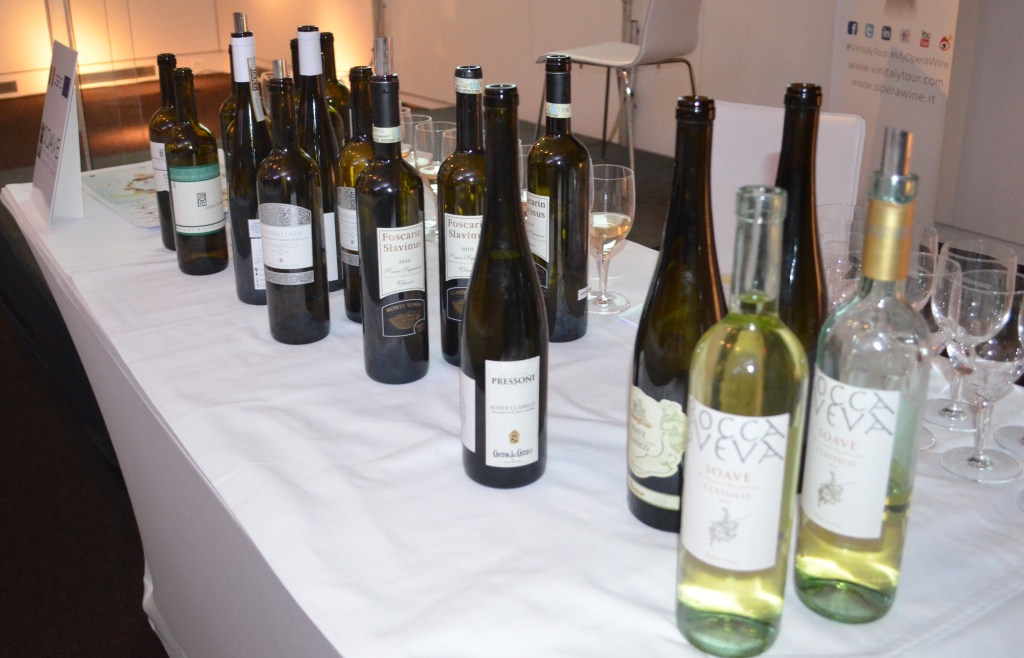
All together, we tasted 9 white wines:
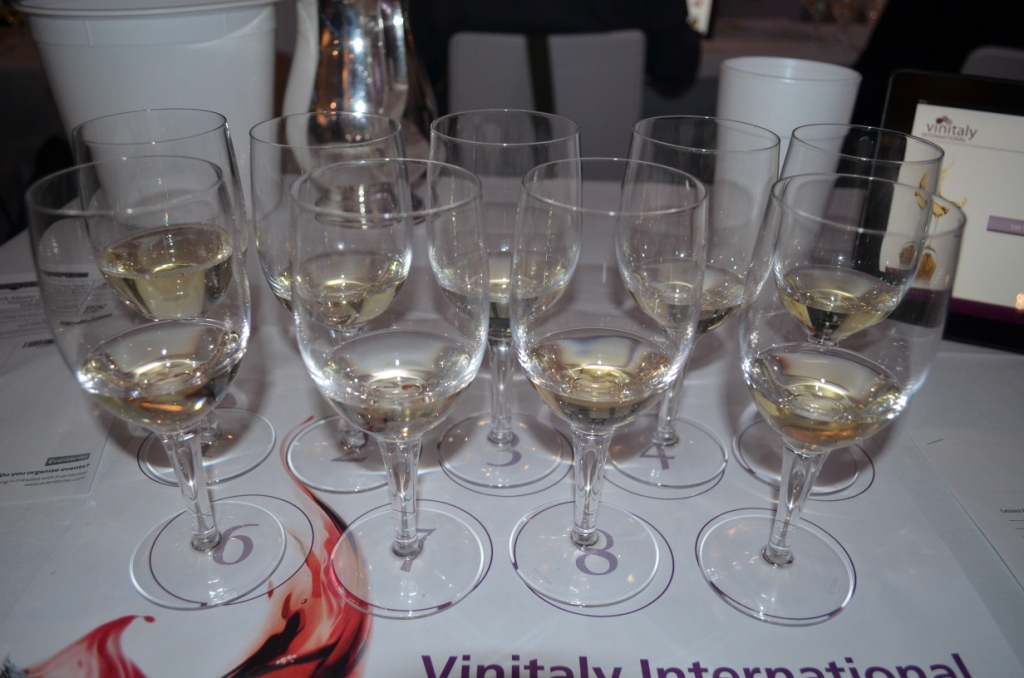
Overall, I wouldn’t say that I was super impressed with the wines. Some wines were better than the others, but there were no OMG moments. Here are the notes for my favorites:
Azienda Marcato – Lessini Durello Metodo Classico 36 Mesi NV – this was the only sparkling wine in the tasting, and it was outstanding. A blend of 85% Durello, 10% Chardonnay, 5% Pinot Nero, 12% ABV. Apple and toasted bread on the nose, nice minerality, smell of granite. Perfect minerality on the palate, very dry. Excellent.
2011 Cantina del Castello – DOC Soave Classico “Pressoni” – a blend of 80% Garganega, 20% Trebbiano di Soave, 13.5% ABV. Nice nose of lemon, green apple, good acidity. White apple and pear on the palate, good acidity, nice lemony aftertaste.
2011 Barone di Villagrande – Etna Bianco Superiore – 100% Carricante. Nice nose with minerality and some saltiness, very dry on the palate with pineapple aftertaste.
That concludes the part 2 of the Vinitaly experience. In the part 3, I will (finally) tell you about the wonderful wines we experienced at the event. Cheers!
Long Overdue–Notes From Michal Skurnik Wine Tasting
 Yes, this post is long overdue, as I hinted that it’s coming a while back. Better late than never, right? Here it is.
Let’s say you are in a wine store. Bottles, bottles are everywhere. Sometimes you know exactly what you want. Sometimes you don’t – and this is when it becomes challenging. How do you know if that bottle of wine is any good? Price is really not an indicator of quality. You can’t try the wine ( at least in the majority of cases). Yes, you can ask for the advice – then it really depends what store you are at (some of the store advice should be avoided at all costs). So, what do you do? Of course, using your iPhone is always an option, but this is not where I’m going right now. One possible solution is to look at the back label, which all the wines in the US have to have. Look for the name of the importer. And if it says “Michael Skurnik” or “Kermit Lynch”, you should smile, because you just learned that chances this bottle of wine is good just increased dramatically.
Why you are asking? Michael Skurnik Wines is so-called “importer” (they are also a wholesaler, but this information is typically not advertised on the label). It means that Michael Skurnik Wines company (MSW) works with thousands and thousands of wineries and other wine merchants all over the world to find the wines which will pass through their rigorous selection process and will be represented by Michael Skurnik Wines.
The wines chosen to be carried in the portfolio might not be all your favorite – but they all will be quality well-made wines. It means that MSW folks are doing all the hard work of selecting the best wines for you, and all you need to do is to enjoy the fruits of labor.
Few times a year wine importers and wholesalers organize special wine tasting events to present their portfolio to the trade. I was lucky to attend Michael Skurnik Wines Spring Grand Tasting, and I would like to share some of my personal highlights.
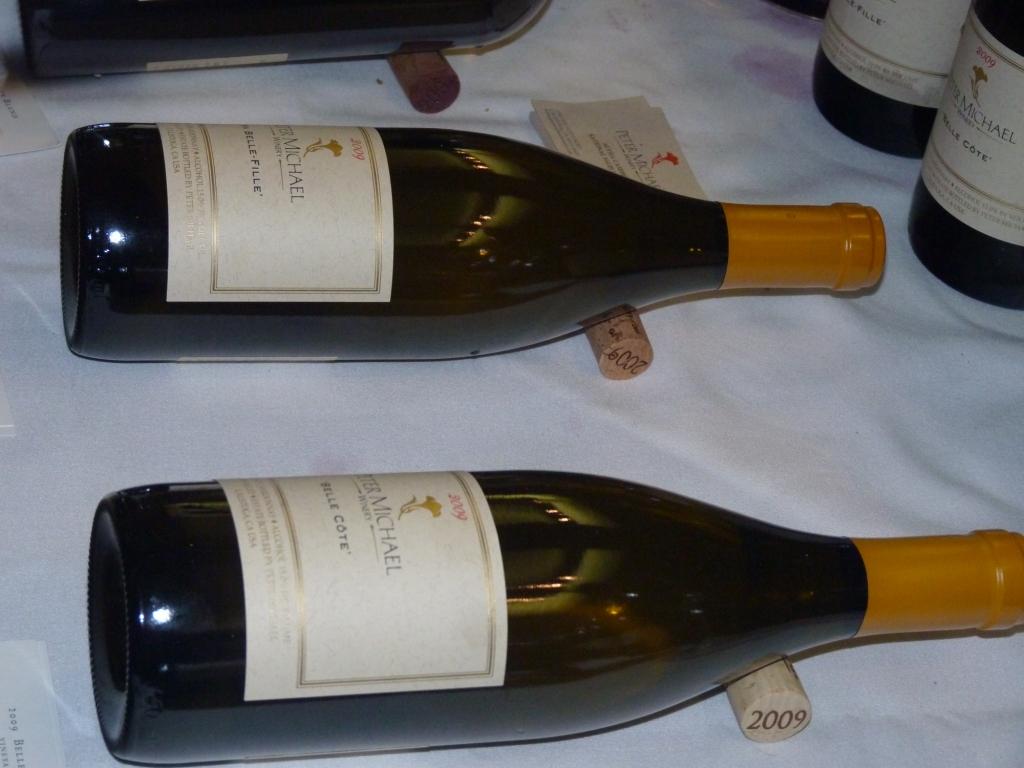
First and foremost, my personal “Best of tasting” is Peter Michael wines. Four 2009 Chardonnays were presented in the tasting (“Mon Plaisir”, “La Carriere”, “Belle Cote” and “Ma Belle-Fille”) – tremendous, all four are the best Chardonnays I ever tasted. Finesse and absolute balance – vanilla, toasted oak and butter all being present, but in absolute harmony with bright acidity, fruit and silky smooth tannins. I would put drinkability for all four at 9+. Just so you know, these are the cult wines, which affects the pricing and availability. These wines are available only through the mailing list or through select merchants – you might be able to find them at Wades Wines and Benchmark Wine Company.
The next highlight was an amazing line of Barolos. A mix of 2005, 2006, 2007 Barolos from Azella, Manzone, Renato Corino, Marengo, Altare, Clerico, Cavalotto – one was better than another, all beautiful and powerful wines. Anyone of the names I mentioned is worth seeking.
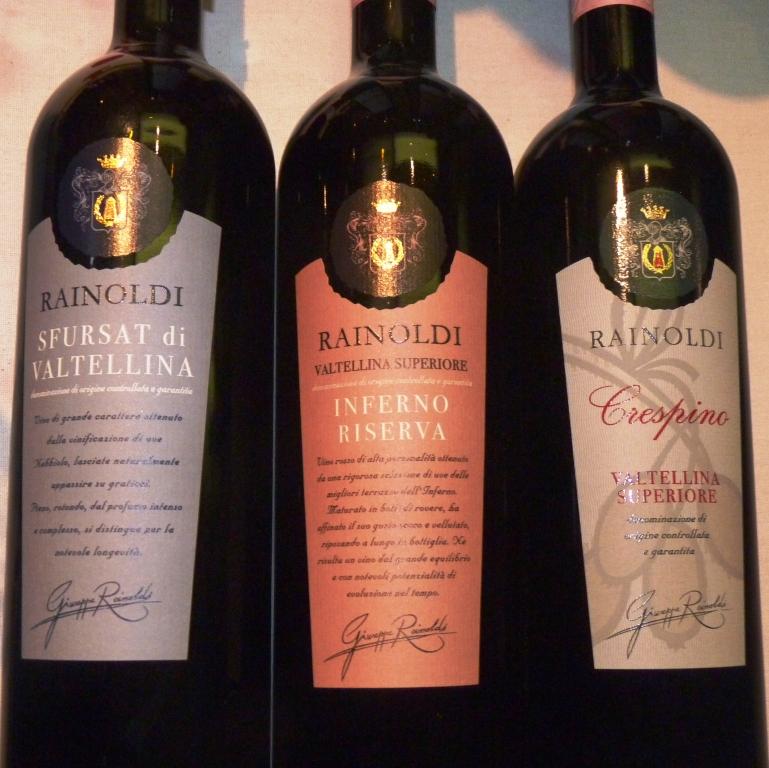 While the Barolos were great, they had a group of contenders, which were literally as good. Wines of Aldo Rainoldi come from the area in Lombardy region called Valtellina. These wines are produced from the same grape as all Barolos – Nebbiolo, with all the vineyards located at the very high altitude of 600+ meters (1800+ feet). I tried four different Aldo Rainoldi wines – 2007 Sassella, 2005 Crespino, 2006 Inferno Reserva and 2007 Sfursat Classico – all were truly outstanding and very comparable with great Barolos, but at the half price as the least.
In addition to all the wines in the tasting (about 700), there were some stronger spirits as well. One of the surprises was Calvados I tried. Calvados is a brandy which is made out of apples in the Calvados region of Normandy in France. Typically, I can drink it, but it is not something I would be seeking out. However, two of the Calvados presented at the tasting – Camut Calvados 6 years old and Camut Calvados Reserve 12 years old were simply incredible. Soft, smooth, elegant, great aroma of fresh apples, very delicate balance. They will not be easy to find, but I would highly recommend you will make an effort. You can try your luck at D&M, and believe me, you will not be disappointed.
That’s all, folks. There were many many more great wines, but you got to stop somewhere, right? Until the next time – cheers!
Last Bottle Sign Up ($10 credit)




 Talk-A-Vino