Archive
Art and Science of a Perfect Cup of Coffee
 Please close your eyes. Oops, no, not for real – please keep your eyes open to read, but do it at least in your mind. Imagine the aroma of the freshly brewed coffee – the unique smell in the air which nothing else can compare to. Sometimes that is the smell of a new day. Sometimes, it is a quiet moment in the afternoon. Sometimes, it is winding down the evening. Was this hard to imagine, even if you didn’t close your eyes? If you love coffee, I would bet that was a very easy exercise. And I hope you do love it, as coffee is what I want to talk about today.
I love comparing coffee with wine. Similar to the wine, coffee has a dependency on its area of origin. Kona, Jamaican Blue Mountain, Costa Rica, Ethiopia – each region imparts its own unique tasting profile. Similar to the wine, sustainability, and coffee growing process matter. Similar to the wine grapes, the best coffee is harvested by hand. Similar to the wine grapes, the coffee beans are sorted to achieve the best quality and consistency. Most importantly – similar to the perfect glass of wine, a perfect cup of coffee delivers lots and lots of pleasure.
Notice how I went from coffee bean growing to the coffee cup, skipping a few steps in between? Those few steps are what differentiates coffee from wine, making coffee ultimately a more complicated subject. Before you jump off a chair and click away, as the writer here clearly a lunatic, please allow me to explain.
Once the good quality grapes are obtained, they are pressed, fermented, aged, and finally, bottled. The bottle is the final form in which wine will reach you, the consumer. Now, to enjoy the glass of wine, all you need to do is to pop that cork (twist the screw top, if you insist), pour the liquid into the glass and voilà! Yes, there are few extra steps and hurdles which oenophiles happily enact for themselves to enjoy the wine “more better”, but really – unless someone does something really stupid, like leaving a wine bottle for a day in a hot car, the good wine in the bottle will easily translate to the good wine in the glass.
The things are different when it comes to the coffee. The final product of the coffee grower is dried green beans. Before coffee can be enjoyed, it has to be roasted and brewed. Roasting typically takes about 20 minutes, and those 20 minutes can either create a thing of beauty or an awful, terrible concoction which one can drink, but never able to enjoy. Brewing also offers multiple opportunities to convert those beautifully roasted, full of promise and anticipation beans into a dull or simply bad tasting brown liquid.
The process of coffee brewing is where the aromatics and flavors are transferred from the roasted beans to the water, which results in your final object of desire, a perfect cup. Before brewing, coffee beans have to be ground. The way coffee will be ground depends on what type of coffee would you like to drink – espresso requires the very fine grind, so higher flavor concentration can be achieved. For so-called “drip coffee”, the coffee particles are typically very coarse, as water is not pushed through the coffee with the high pressure, as it is done for the espresso. Now, let’s leave espresso aside and talk about the “drip coffee”, the one which we consume most often.
It turns out that there are many factors which are matter here, on the way to arriving at that perfect cup – temperature of the water (to the single degree of Fahrenheit!), the ratio of water to the coffee and the speed of extraction (how long the water will stay in contact with the coffee grinds). Just for you to understand: the ideal coffee brewing temperature is 201°F – and 203°F will result in the burnt taste! You need to maintain the ratio of water to coffee at 15.5 to 1 (15.5 grams of water per 1 gram of coffee). And you need to spend about 4 minutes making that perfect cup. How about it? Will you ever look at your morning coffee cup the same way again, after I shared with you all this information? Well, didn’t mean to scare you, honestly – all you need to do is just to taste the difference.
A couple of years ago I talked about a visit to the Shearwater Organic Coffee Roasters, the organic coffee artisans in Trumbull, Connecticut, where we learned about intricacies of the proper treatment of the fresh coffee beans from Ed Freedman, the owner of the company (here you can read about that experience). This year, Ed decided to deliver a full [proper] coffee experience to the people by opening Shearwater Coffee Bar in Fairfield in Connecticut. I had an opportunity to visit it few month ago and get exposed to the science and art of a perfect coffee cup.
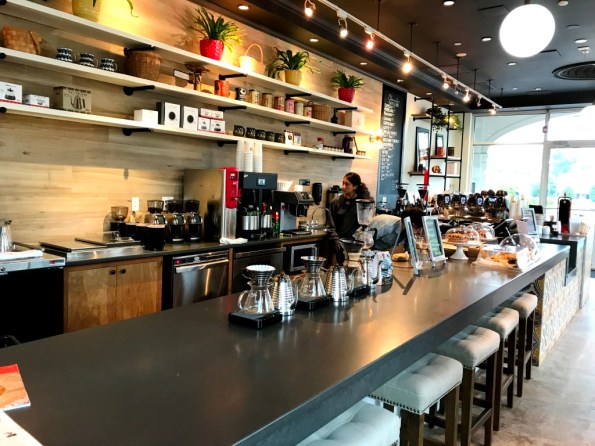
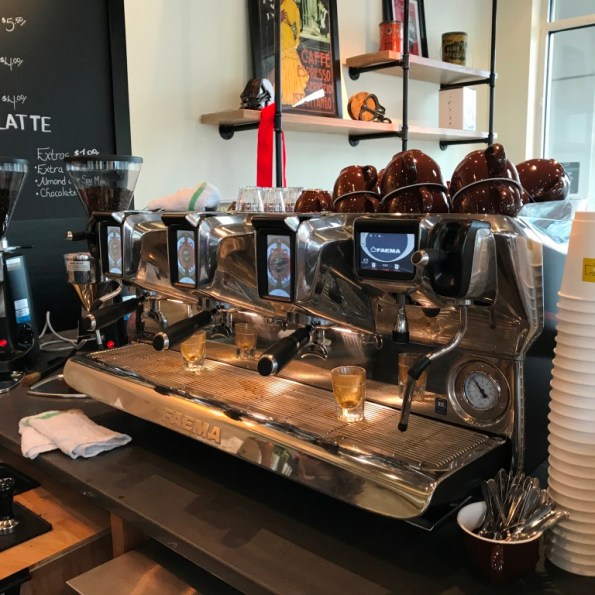
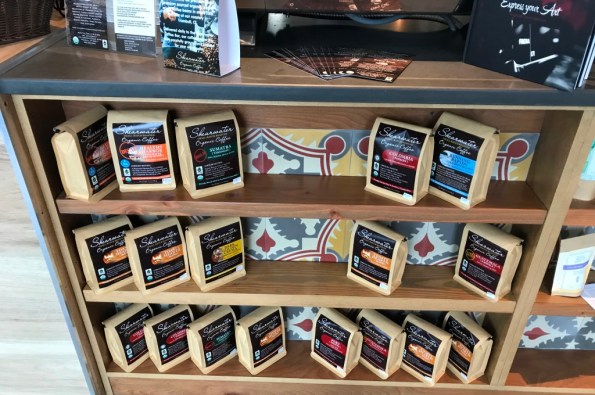
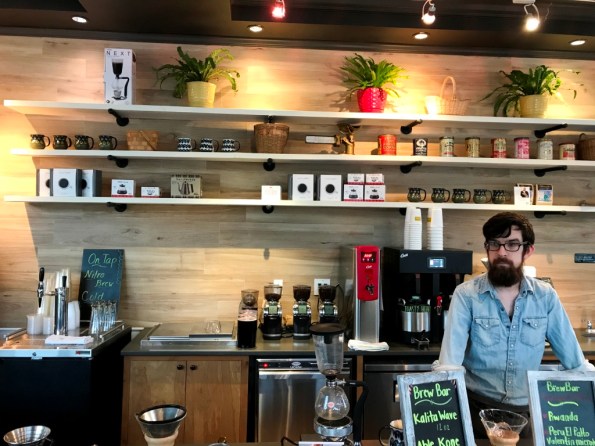
Jason The Barista is ready for action

The choice is yours
If the words “coffee bar” elicit an image of Starbucks in your head, shun that away please, as the Shearwater Coffee Bar is nothing like. Similar to the regular bar we are all used to, you can sit in front of the barista, have a conversation and watch as your beverage of choice is unhurriedly prepared in front of you. Unlike a typical bar, you sit comfortably on the normal height chairs, not on the “bar stools” which are not so much fun to get on and off. But if you ever observed a cocktail master who produced a drink which made you say “wow”, this coffee bar delivers exactly the same experience.

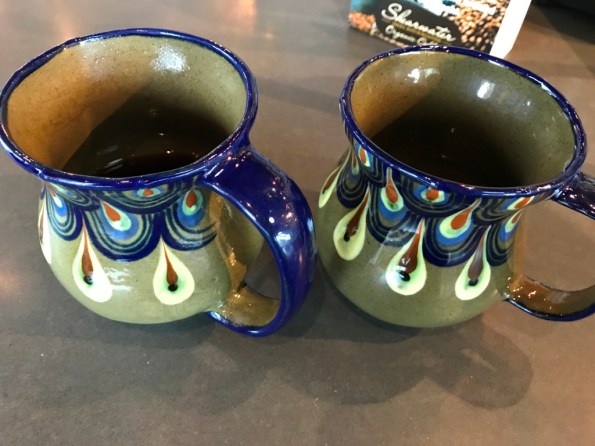
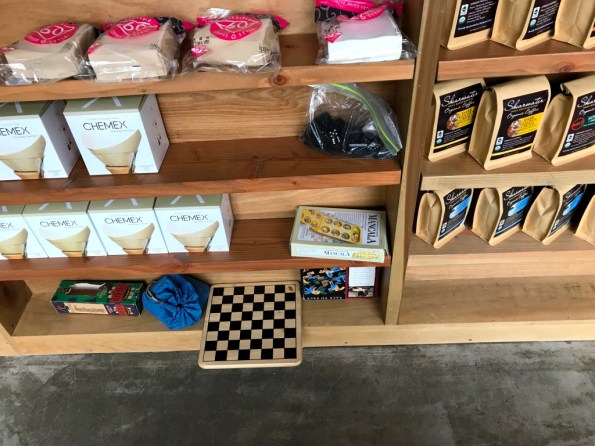
At Shearwater Coffee Bar, you have a choice of coffee to begin with – different origins, different roasts. Then you can choose your method – Pour Over, Chemex, Siphon – of course, espresso and cappuccino are available too if that is something you want.


Once you decide on what you want, the magic begins with the grinding of the coffee beans and then putting the glass vessel on the scale. The coffee goes in, the water is dispensed at the exact temperature (201°F, remember?), and then poured over (if you asked for Chemex or Pour Over), while the barista is carefully watching the scale. A few (4!) minutes later, the magic is complete and coffee goes into your cup – can you smell the aroma?


We tried Pour Over and Chemex coffees – the were some slight variations but I wouldn’t dare to try to give you any differentiating descriptors. Jason, our barista, also attempted to make a siphon coffee (this technology actually comes from Japan, where the fine art of coffee is well recognized). In the siphon method, the water is heated from the bottom, and once it reaches a proper boiling point (which is not truly “boiling” temperature), it should slowly percolate up and travel slowly through the coffee to gently extract the flavor. Something went wrong, the water went through too fast, and Jason refused to pour us that “bad” coffee. Well, this is why we are talking about art here – and if the artist is not happy with creation, it goes down the drain.


The creativity at Shearwater Coffee Bar doesn’t stop here. First, you have the cold brew. The cold brew is when coffee is made without heating up the water. It takes about 18 hours to make coffee using cold brew method – but the resulting coffee is much less acidic compared to the standard coffee cup, thus people who can’t drink regular coffee because it is too acidic for them can perfectly enjoy the cup of the cold brew.


Now, let’s add a little bit of nitrogen (yep, you heard me right) to the mix, and you got … the Nitro! Do you like Guinness beer? If you do, then Nitro is your drink, as it is a coffee which looks like beer with a perfect thick foam on top, tastes like beer (yes, it makes you say “ahh” after a sip) – but has no alcohol in it, so you are really not limited in how many Nitro you can consume before driving back home.


So what is your take on a perfect coffee cup? If you are looking beyond just a punch of caffeine and a bite of a pronouncedly bitter taste, then you should really seek the art and indulgence of a delicious drink, taking as much of the pleasure as it can offer. Don’t take my word for it – visit Shearwater Coffee Bar and see taste for yourself. Cheers!
Shearwater Coffee Bar
1215 Post Road
Fairfield, CT 06824
https://www.facebook.com/ShearwaterCoffeeBar
Ph: (203) 955-1098
How Do You Describe Coffee Smell In Words – Visiting Shearwater Organic Coffee Roasters
 Seriously, I really mean it as a question – how do you describe coffee smell? I’m asking here the people who cherishes or may be even worships the good cup of coffee – how one can describe that “pick-me-up” goodness when you walk into the room and smell freshly brewed, real, delicious coffee made with love? It is hard, right? You can describe the effects of that smell (invigorating, uplifting, awakening…), but not the smell itself. But – if you are into the coffee, it is enough to say “the wonderful smell of fresh coffee”, and we understand each other. And let me throw in a few pictures for the good measure…
When I walked into the shop of Shearwater Organic Coffee Roasters in Trumbull, CT, I felt like a kid in the toy store. It was all about coffee – the smell, the coffee makers, huge bags of coffee beans – it was all coffee, coffee, coffee. Shearwater Coffee Roasters has a very simple mission – to let people experience the best possible single origin organic coffee, one small batch at a time. This is a loaded sentence, so let me explain it in a few more words.
Let’s start with “organic“. All the coffee roasted at the Shearwater is USDA certified organic. The coffee comes from all of the world, from Guatemala., Colombia, Ethiopia, Costa Rica and other places, but only from the producers which had being certified by USDA as organic. USDA Organic requirements cover full lifecycle of the coffee production, from the soil and trees handling until the green coffee beans will be packaged for shipping. That organic certification also includes the Fair Trade Certification, which means that the people who grow the coffee are treated properly. Additionally, the Shearwater production process and the whole facility had being also certified by the USDA, so the final product which goes into the little yellow bags is in and out USDA Certified Organic.


Now, a few words about “single origin“. The best way to explain the concept is in the analogy with wine – this is the wine blog after all! Single Origin is really an equivalent of the appellation, or in some cases it can equated to the estate or even single vineyard. Same as grapes, the coffee is a product of mother nature – it exist in multiple varieties, and its taste will be affected by the soil type, the climate, the amount of water, the altitude – yes, you can call it a “coffee terroir” – and if coffee beans are treated properly from the bud breaking until it will make it into your cup, you will be able to taste it.
Now, the “small batch“: that simply means that coffee is processed (i.e., roasted) one small batch at a time. How small? 20 pounds to be exact. 20 pounds of fresh coffee beans are roasted at a time. That’s it – only 20 pounds. Working in the small batches, you have much better control over the process, and you can ensure that all the beans are roasted uniformly. And you can also make each batch to taste individually different. Which gets us to the last term I want to explain – “best possible”.
The “best possible” coffee combines everything which we talked about before – the organic, single origin, the small batch – but it is also a process of Artisan Coffee Roasting. At the heart of the Shearwater operation, supporting the passion of Ed Freedman, the Head Roaster, is the highly efficient machine called Diedrich IR-12, an infrared coffee roaster. This machine allows very efficient control of the temperature during the roasting cycle (which is very short – takes about 14 minutes to produce medium roast coffee), and the roasting process can be fitted exactly for each and every varietal and type of coffee, to allow it to achieve its fullest potential! How about that for the “best possible” coffee? As I said, I’m fully relying on pictures to share my excitement, so here is the machine:


The machine is controlled manually, but it allows full recording of the process (time/temperature changes ) on the computer, so for each batch it is known precisely how it was produced and how the process can be adjusted if and when necessary. On the pictures below you will see Ed Freedman explaining what happens during different stages of the roasting process and how it is recorded on the computer:


The process starts from the green coffee beans been loaded inside, and the temperature gradually increased until you hear coffee to start crackling, pretty much like popcorn. Once you hear that noise, depending on the type of roast you are producing (light, medium, French etc.), you will have to decide for how much longer to continue the process. Also you can all the time have the visual of the progress:
Once you are done, the coffee goes out of the roasting chamber and now it should be cooled off very quickly, to make sure it is not going to roast any more:


Once the coffee is cooled off, it goes into the bin to rest – the coffee needs to rest at least for 2 days before it can be packaged and sold:
 That’s it! Short 14 minutes, 20 lb of the green coffee beans become 17 lb of the wonderful roasted coffee, and you have a room full of delicious invigorating smell as a an added bonus. And you can also check what kind of roast did you achieve, using this simple set of the colored circles (of course you can buy a machine for $10,000 which will do that for you, but Ed feels quite happy with the circles : ) ):


That concludes my story about the Shearwater Coffee Roasters. They are located in Trumbull, Connecticut, so if you live close by or visiting the area, that might be a good place for you to visit (they sell all the coffees and coffee makers right at the shop). If you are not local, but still want to experience Artisan single origin organic coffee at its best, you can order directly from Shearwater web site.
I hope I managed to make your Monday morning – no, I can’t deliver the smell, but I hope I gave you enough coffee pictures so you can add the smell on your own. Oh yes, the cup of fresh coffee sounds divine – time to make one. Cheers!
Last Bottle Sign Up ($10 credit)




 Talk-A-Vino