Archive
Celebrate Marselan!
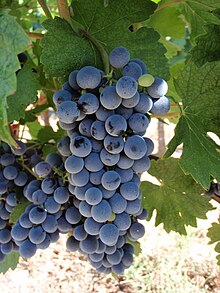
Source: Wikipedia
Have you heard of Marselan?
There is a good chance you never have, and nobody can blame you.
Marselan is a cross between Cabernet Sauvignon and Grenache, created by Professor Peter Truel in Languedoc near the French coastal town of Marseillan, which gave Marselan its name. Marselan is a blue-skinned late-ripening variety that produces large clusters of small berries, leading to a high skin-to-juice ratio in winemaking. Marselan prefers dry soil and a hot climate, and it has strong disease resistance to botrytis bunch rot, powdery mildew, and other grape maladies.
The grape was created in 1961, but its real fame came to the grape only in the 21st century. In 2001, the grape made it to China as an experiment. From the initial planting of less than 7 acres, as of 2024, Marcelan occupied more than 10,000 acres, second only to Languedoc, and it became one of the most important grape varieties in China. Maselan in China is often compared to Malbec in Argentina and Carmenere in Chile, having a real chance to become a signature country grape.
Marselan today grows and is used in winemaking in France, China, Israel, Bolivia, Uruguay, Italy, Spain, and other countries. Marselan is typically used as a blending grape, but since 2002, single-varietal Marselan wine has been produced, first in France and now around the world. 259 Marselan wines from 18 regions in 11 countries competed in the first Marselan competition in 2023 in China.
Today, April 27th, on the birthday of Professor Truel, we are celebrating Marselan Day. It is a given that I can’t show a collage of Marselan wines I tried, as I only have 2 wines with Marselan mentioned on the blog. Nevertheless, I would like to share a few interesting tidbits with you.
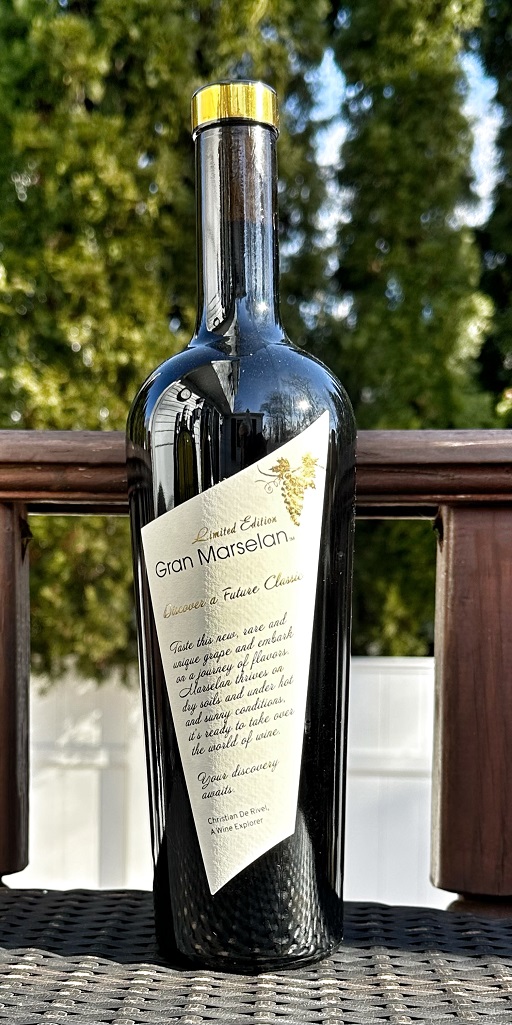
First, a detailed write up about a delicious Marselan discovery of this year – Gran Marselan wine I had an opportunity to play with. Next is an article from Decanter magazine, profiling some of the latest Marselan wines well worth your attention. And here is a good article about Marselan’s success in China.
Marselan has a bright future ahead of it, and not just as a blending grape, but as a star of its own.
Marselan wines are still difficult to find, but do yourself a favor and see if you can find and experience one, it will be worth the effort.
Until the next grape holiday (Sauvignon Blanc Day is coming up on May 2nd) – cheers!
Grape For The Future, Wine For Today
Source: Wikipedia
Have you heard of the grape called Marselan?
If you have – great, pat yourself on the back as you are ahead of many wine lovers.
If you have not – even better, as we are going to fix it right now.
Some grapes have been around seemingly forever (the winemaking is getting older and older with every new discovery – I just learned today that based on the latest research, the wines were made around 11,000 years ago – quite an age), and it is impossible to tell when particular grapes were born. For others, the history is much more definite, as those grapes have been bred with a purpose, and thus their “birthday” is well known.
Marselan is one such grape. It was bred by Professor Paul Truel in 1961. Marselan is a cross of Cabernet Sauvignon and Grenache, and it was bred to be heat-resistant and disease-resistant. While having those desired qualities, Marselan had small-sized berries, which was not a great trait in the 1960s – the desired grape was supposed to have a high yield, thus Marselan ended up on a shelf. As the climate was changing and the temperatures were rising, the need for heat-resistant and disease-resistant grapes became more apparent, and Marselan was brought back to life, entering an official INRA grape registry in France in 1990.
Marselan was bred by Professor Truel in Languedoc near the French coastal town of Marseillan which gave Marselan its name. Marselan is a blue-skinned late-ripening variety, producing large clusters of small berries, leading to a high skin to juice ratio in the winemaking. Marselan prefers dry soil and hot climate, and it has strong disease resistance to botrytis bunch rot, powdery mildew, and other grape malaises. While born in France, Marselan found its great fame in China, where it might be considered a “signature” grape according to Decanter magazine.
Marselan is best known as a blending grape. Nevertheless, varietal Marselan wines started being produced in Languedoc in 2002. Today, about 70 wineries in Languedoc produce varietal Marselan wines. In 2019, Marselan was one of four new red grapes authorized for use in the production of Bordeaux wines. In Bordeaux, Marselan can make up to 10% of Bordeaux Superior and Bordeaux AOC blends, though it cannot be listed on labels. In addition to France and China, Marselan today is growing in Spain, Switzerland, California, Brazil, Uruguay, Israel and other places.
Okay, the formal introduction is over, let’s move on to the fun part – tasting probably the best of the best wine Marselan has to offer – NV Gran Marselan Cuvée du Centenaire Vin de France (14.5% ABV, $169, 100% Marselan, 15 months in 2-years old French oak barrels, 1,716 bottles produced).
This wine had been produced by EdenGrapes with the grapes coming from two best and oldest (40+ year old vines) blocks of Marselan vineyards in Languedoc, discovered after an extensive search. The wine was released in 2024 to celebrate the 100th birthday of Paul Truel, creator of Marselan, who was born in 1924, hence the Cuvée du Centenaire designation.
While speaking with Christian de Rivel, the producer of Gran Marselan, he suggested that it would be very important to decant the wine for anywhere between 2 and 5 hours to let it shine. Well, you never need to ask the wine geek twice to play with his wine.
Long decant? Ha! I got you!
There are many ways to decant the wine. I don’t want to go too far on the tangent here, so I will just give you a “short brief”, and hopefully a more in-depth decanting rundown later in another post. I prepared a few decanting instruments I have at my disposal – a classic decanter, a couple of aerators – VersoVino and Venturi, and even a super-decanting tool, or rather a “hyper-decanting” tool, the blender.
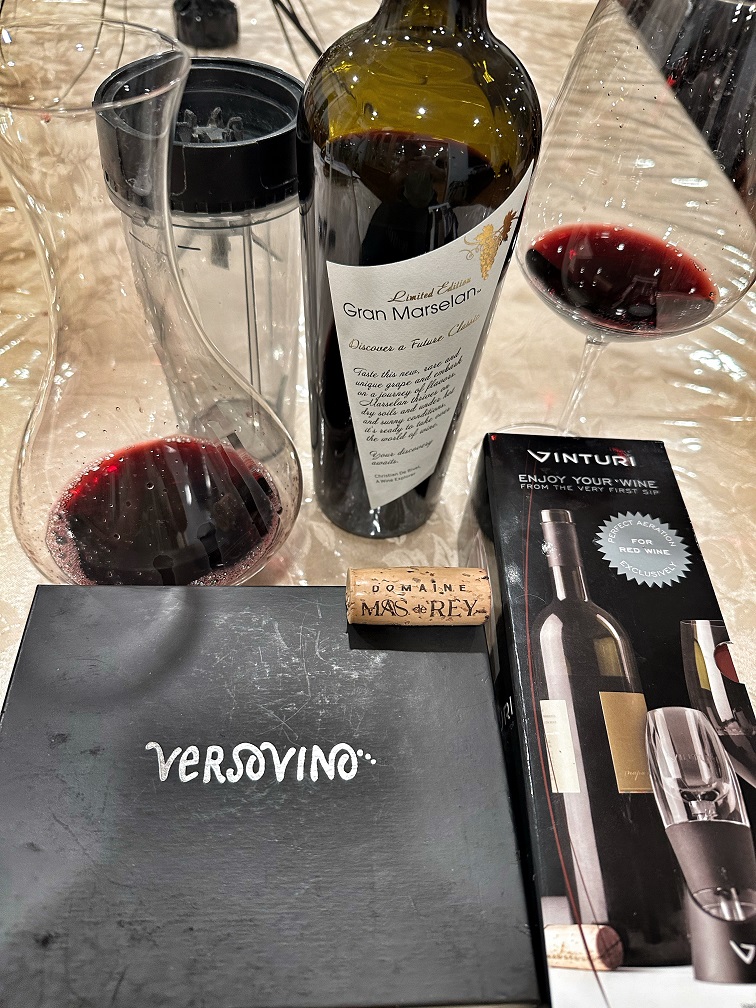
Wine Geek’s Mise an Place
Even if decanting is suggested, to decant or not to decant is a personal choice. I had to taste the wine to decide what I would like to do in terms of decanting, so first I just poured some wine into the glass:
Upon opening
Beautiful color, bright garnet
Nose of wild raspberries and wild blueberries, superb, earthy undertones
Beautiful palate of wild berries, well integrated velvety tannins, firm structure, good acidity, excellent balance 8+/9-, delicious overall and dangerous.
Based on tasting the wine “as is”, hyper-decanting was ruled out – the wine was perfectly drinkable from the get-go, no need for extreme measures. But I had to try the tools nevertheless:
VersoVino
Nose a bit more pronounced and open, adding tart cherries to the aromatics
Palate is a bit smoother, tannins become silkier, overall wine is more polished. I really didn’t expect that. Wow. 9-
Venturi
High intensity nose, now more Cabernet-like profile, a touch of eucalyptus
Excellent palate expression – it doesn’t have cassis, but instead offers gobs of dark fruit, good acidity, more of a chewy structure. After Venturi, the wine actually begs for a steak. It shows bigger. But it is now more in Grenache territory, with dark chocolate undertones. 8+
I definitely like the effect of VersoVino more. The wine is softer and more elegant with VersoVino compared to Venturi.
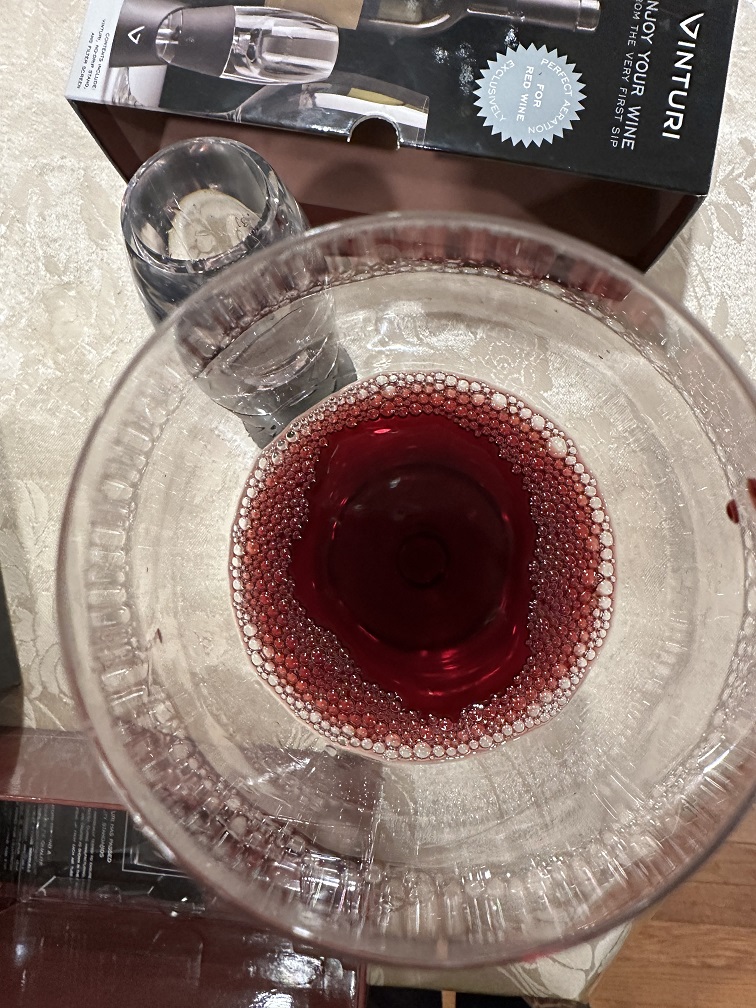
Bubbles – an effect of Venturi
Now we wait.
1 hour control point from decanter
Nose changed, now offering some sapidity undertones, became lean and powerful. Now nose promises big, “serious” wine
Delicious bouquet on the palate. Dark fruit, elegant, balanced, tart cherries woven over the firm structure. Elegant, delicious. 9-
2 hours later
Tart nose, earthy undertones, cherries
Lots of tart cherries on the palate, different representation, firm, tight, lots of energy, now gripping tannins which cut finish somewhat short. Wine is evolving. 8
4.5 hours later
Fresh berries returned on the nose with some earthy undertones
On the palate, the wine is tight with some brushy tannins, good clean dark fruit finish. The wine would perfectly complement steak, but for sipping I would prefer one of the earlier versions. 8
Second day
Still pretty much tastes like the wine after a few hours of decanting.
So what did I learn after tasting the Gran Marselan, besides the fact that I really didn’t need to decant it more than for an hour? The conclusion is easy. The grape has great future potential. But you don’t need to wait for the future – you can simply enjoy the wine right now. Also, I know what you are thinking – this Gran Marselan is expensive. While I can’t argue with that, if you are ever willing to spend $170 on a bottle of a special wine then this wine is well worth your consideration. I know of many California Cabernet Sauvignons in the same price range which will deliver much less pleasure, so this wine is definitely worth it. Maybe one day we will be able to compare the notes? Until that time – cheers!
Last Bottle Sign Up ($10 credit)




 Talk-A-Vino