Archive
Weekly Wine Quiz #84: Grape Trivia – Barbera
 The Wine Quiz series is not meant to intimidate. The whole idea here is to have fun and learn something new. When answering the questions, it is fully encouraged to use all available sources of information, including Google or any other search engine. There are no embarrassing answers – the most embarrassing thing is not giving it a try…
Welcome to the weekend and your new wine quiz!
We are continuing our grape trivia series, with the focus again on the red grapes, and today’s subject is Barbera.
It is interesting to see the level of difference in the available information for different grapes, especially when it comes to the historical data (not that it is unexpected). When it comes to the grape such as Cabernet Sauvignon, absolute majority of the different sources converge on the 17th century as the time when Cabernet Sauvignon become known as the particular grape. When it comes to Barbera, the range of opinion is rather stunning – some sources say that Barbera was mentioned for the first time only in 18th century, some say it was 13th, and some of them put it even back to the 7th. Therefore, I can’t tell you when Barbera first became known as a grape, but as a fun fact, do you know that Barbera is 3rd most planted grape in Italy, after Sangiovese and Montepulciano? Today, there are about 70,000 acres of Barbera planted throughout the Italy
Barbera is one of the main grapes in Piedmont, where it is often planted right next to its noble neighbour, Nebbiolo. Typically Nebbiolo takes over the best spots on the hills, and Barbera is planted right under. Some of the best Barbera wines are produced in Asti, Alba and Monferrato areas in Piedmont, with Barbera d’Asti and Barbera del Monferrato having the DOCG status (highest quality standing in Italian wine classification). Of course Barbera is planted in many other regions in Italy, such as Lombardy, Emilia-Romagna and others. Barbera spread out all over the world with Italian immigrants, nowadays planted in Australia, United States (California, Texas and others), Argentina, Brazil, Israel and other countries.
Barbera grapes have dark thin skin. Barbera has a well known tendency for overproduction, so the plantings have to be controlled to achieve higher quality of the wines. Barbera typically has high level of acidity and low tannins, which makes winemaking somewhat challenging to produce wines which will be able to age well – of course ageing in the oak barrels helps with that. One of the well known characteristics of Barbera wines is intense berries aroma, and the wines typically have a medium body, at least in the classical Italian versions ( some of the New World Barberas can be quite bombastic). Barbera wines are generally food friendly with their inherent acidity, and they complement quite well a wide range of traditional Italian dishes.
And now, to the quiz!
Q1: Based on the latest DNA analysis, which well known Spanish grape appears to be a close relative of Barbera?
Q2: What well-known grape became popular blending partner of Barbera as of late?
Q3: The new technique was introduced in making the wines out of Barbera in the second half of the 20th century, which helped to improved the quality of the wines. Which one do you think it was:
a. Malolactic fermentation
b. Fermentation and aging in the small oak casks
c. Carbonic maceration
d. Reverse osmosis
Q4: Wine Spectator calls wines rated in 95-100 range Classic (the highest and the most prestigious category). True or False: there are no Barbera-based wines rated in the Classic category
Q5: Fill in the blanks: Barbera typically ripens two weeks later than _____, but at the same time it is two weeks earlier than ____.
Good luck, enjoy the quiz and your weekend! Cheers!
Beauty of Montefalco Rosso and Power of Sagrantino
About two month ago (yes, I know, I’m the speedy one) I was invited to participate in the virtual tasting. The subject – Italian wines. To be more precise, the wines from Umbria, made out of the grape called Sagrantino.
I never participated in the virtual tasting before, so I was not sure how it was going to work. The idea was simple. I will get the wine, which should be opened and tasted in parallel with the winemakers, who will be doing it live on ustream. Of course I gladly agreed to take part in this wine drinking tasting.
The subject was wines from Umbria, from the region called Montefalco. Actually, it was not just one tasting, but two – one for the wines called Montefalco Rosso, and the second one for the wines called Montefalco Sagrantino.
It appears that Sagrantino is an Italian indigenous grape, which seems to be cultivated in Umbria for at least 500 years, if not longer. However in the 1960s it became literally extinct, and if it would not be the effort of the few winemakers, Sagrantino would be gone completely from the winemaking scene.
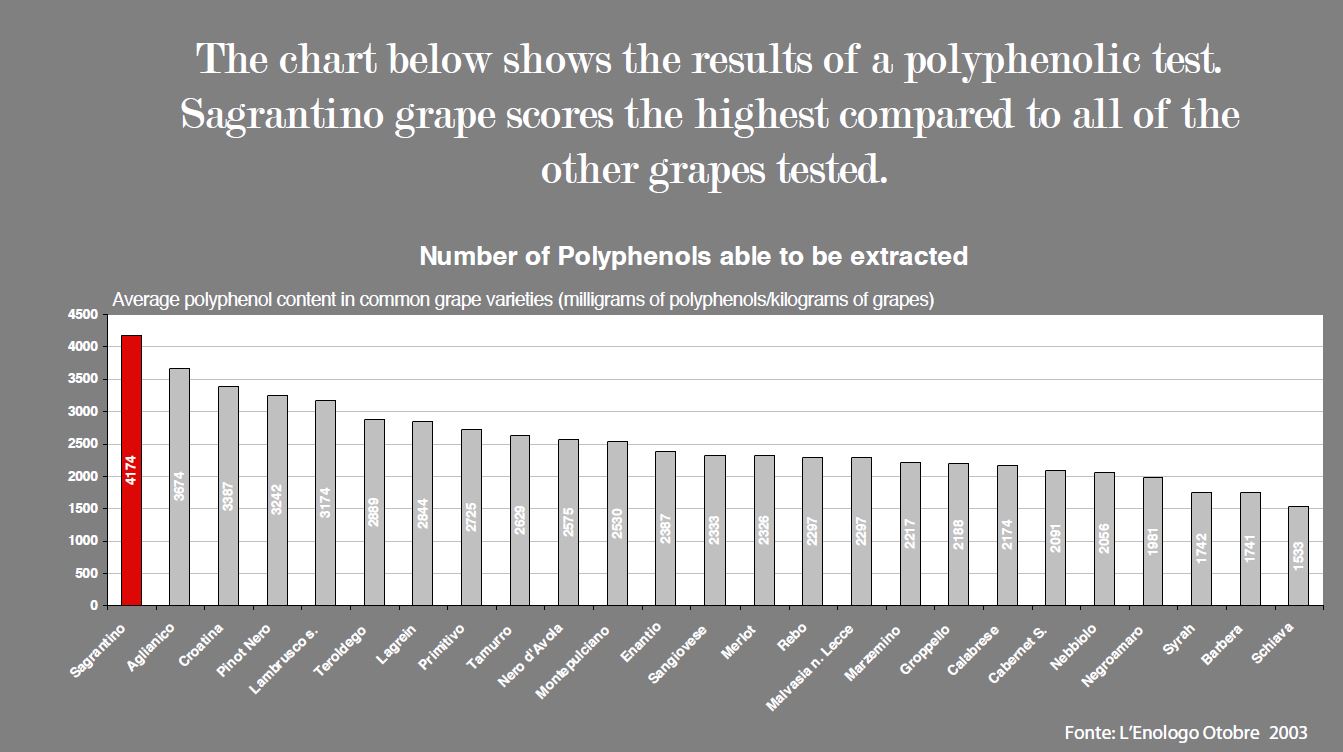
Sagrantino has dark and very thick skin, which results in very tannic and concentrated wines, literally black in color when young. Sagrantino has the highest polyphenolic content among most of the red grapes, if not among all red grapes in the world (take a look at the chart below). Just to get technical for a second, polyphenols (also called phenolic compounds) is a large group of chemical compounds, responsible for color, texture and mouthfeel of the wine (think tannins!), and the group also includes medically beneficial elements, such as reservatrol. As usual, I have to refer you to Wikipedia for additional reading, but I hope you get the point here.
My wines arrived few days before the tasting. As luck would have it, the day which the wines spent on the UPS truck, was one and only day in September when temperature outside reached 96F (extremely atypical for Connecticut in September). When I took the wines out of the box, I could feel that they are quite warm – on average, my wine thermometer showed all the bottles to be at around 84F, so I was obviously concerned… I opened a number of bottles the next day, and to my big relief, the was no sign of heat damage (I quickly closed the wines back using the gas canister) – I was ready for the tasting.
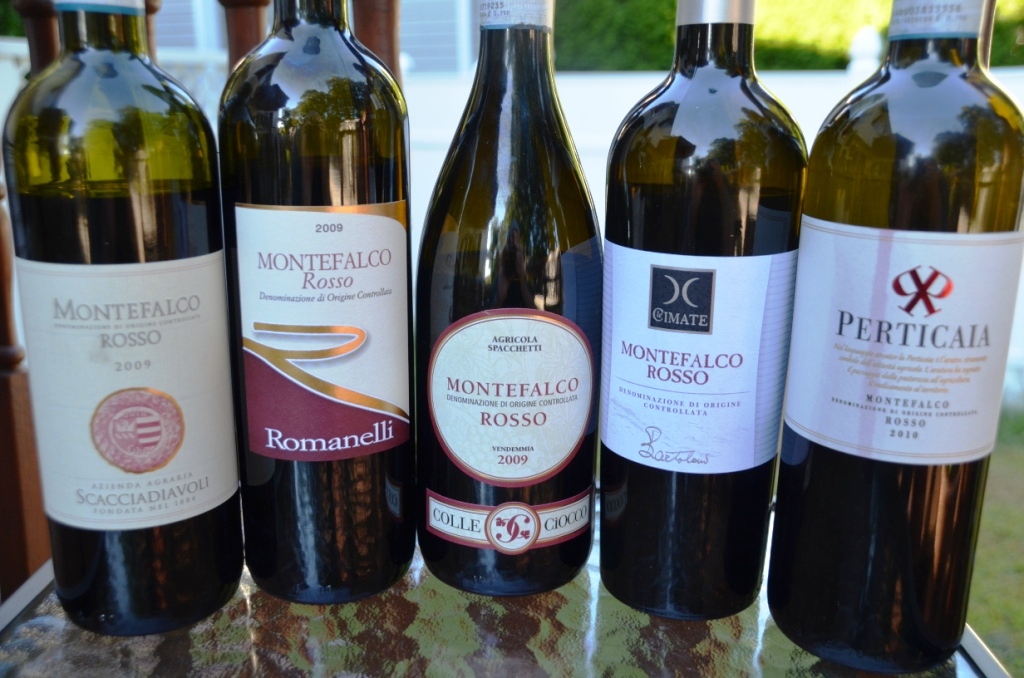
First day of tasting was dedicated to the wines called Montefalco Rosso. Montefalco Rosso wines typically are Sangiovese based, with the addition of 10% – 15% Sagrantino and 10%-15% Merlot and Cabernet Sauvignon. We had an opportunity to taste through 5 different wines:
At the specific time, the ustream broadcast started with live tasting, where the panel of winemakers from all 5 wineries were talking about their wines and answering the questions. The ustream broadcast was accompanied by the live twitter exchange among all the participants in the tasting. The twitter stream was used to ask panelists the questions, share tasting notes and impressions. Definitely was interesting to see and hear the diversity of opinion both from the panel, and from the audience on twitter. To be entirely honest, the most difficult part was to do a few things at once – taking my own notes, talking to the people on twitter and listening to the panelists – difficult, but well worth it!
Below are my notes for the 5 Montefalco Rosso wines we tasted (as you will see, not necessarily taken exactly during that live tasting session).
2009 Romanelli Montefalco Rosso DOC (14.5% ABV, Sangiovese 65%, Sagrantino 15%, Merlot 10%, Cabernet Sauvignon 10%, 12 month French oak, 6 month in the bottle) – good dark fruit, easy to drink. Drinkability: 7
2010 Perticaia Montefalco Rosso DOC (13.5% ABV, Sangiovese 70%, Sagrantino 15%, Colorino 15%, 12 month in stainless steel, 6 month in the bottle) – day 2 notes – outstanding. Dark inviting fruit with a hint of sage on the nose, spicy cherries (cherries + black pepper) on the palate, with tobacco notes in the background. Delicious! Drinkability: 8+
2010 Le Cimate Montefalco Rosso DOC (14.5% ABV, Sangiovese 60%, Sagrantino 15%, Merlot 15%, Cabernet Sauvignon 10%) – was perfectly drinkable 6 (!) days after opening the bottle. Spectacular. Supple, ripe cherries, perfect acidity, espresso and dark chocolate, powerful, balanced. Drinkability: 8+
2009 Scacciadiavoli Montefalco Rosso DOC (14% ABV, 60% Sangiovese, 15% Sagrantino, 25% Merlot, 12 month French oak, 6 month in bottle) – Excellent. Dark, spicy earthy nose with some gaminess. Excellent minerality and dark fruit on the palate. Drinkability: 8+
2009 Colle Ciocco Montefalco Rosso DOC (14% ABV, Sangiovese 70%, Sagrantino 15%, Merlot 15%, 12 month in oak barrels, 4 month in the bottle) – nice soft red fruit on the nose, sweet and supple fruit on the palate, good acidity, soft tannins. Drinkability: 7+
The next day we had the tasting of Montefalco Sagrantino wines. Montefalco Sagrantino wines are made out of 100% Sagrantino grapes. The tasting was done in the same format – panel of winemakers discusses the wines live via ustream, and twitter followers taste and discuss in parallel.
It was recommended to open wines one hour before the tasting. Considering how massive those wines are, I would think the right suggestion would’ve been to open them in the morning. I don’t know if it could make the difference, but I have to admit that my experience was rather frustrating during the live tasting. For the most of the wines, I couldn’t get any of the flavor descriptors and impressions, compare to what was exposed by the other twitter tasters. For instance, Arnaldo Caprai was showing literally as corked, where the other tasters had violets, black tea and other nice things to say. Literally only one or two wines cooperated with me during tasting. But – most of them came back nicely right after (see the notes).
Below are my notes for the Montefalco Sagrantino wines (all wines are 100% Sagrantino).
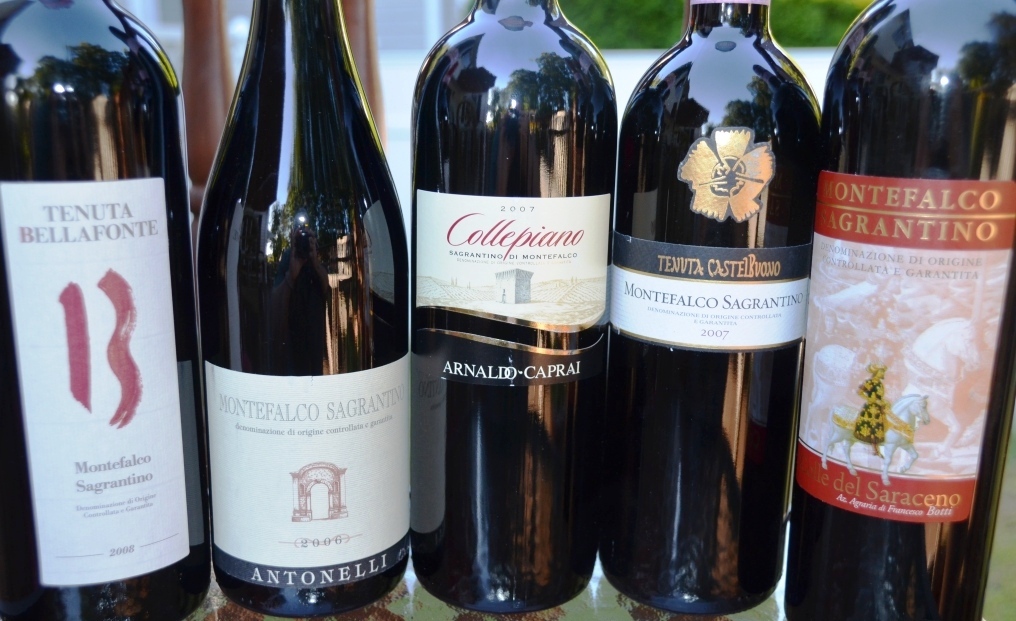
2006 Antonelli Montefalco Sagrantino DOCG (14.5% ABV, 15 month in oak, 12 month in the bottle) – Dark fruit on the nose, same on the palate, very restrained. I’m sure needed more time. Drinkability: 7+
2007 Caprai Collepiano Montefalco Sagrantino DOCG (14.5% ABV, 20-24 month in French oak barrique, minimum 6 month in the bottle) – opened on 09/17, then closed with the argon canister. Reopened on 09/23. Concentrated, very dark. Initially gave an impression of being mildly corked. After 3 days finally started to open up into something interesting. Very substantial tannins ( more of stem/seeds tannins than oak). Dark fruit with undertones of leather and black tea. Drinkability: 8-
2007 Tenuta Castelbuono Montefalco Sagrantino DOCG (14.5% ABV, 28 month in oak, 10 month in the bottle) – dark supple fruit on the palate, very powerful, a wine with “broad shoulders”. Beautifully opened over the next few days, showing roasted meat notes on the palate, good acidity, excellent balance. Drinkability: 8-
2008 Tenuta Bellafonte Montefalco Sagrantino DOCG (14% ABV, 36 month in large barrels, 10 month in bottle) – wine was first tasted on 9/17, then closed with gas canister. Reopened on 9/25. Powerful, concentrated, almost black color in the glass. Nice fruit undertones, cassis and plums, with more tannins coming in later. Overall delicious and “dangerous” wine. Drinkability: 8
2008 Colle del Saraceno Montefalco Sagrantino DOCG (14.5% ABV, 12 month stainless steel, 12 month French oak barriques, 6 month in the bottle) – this wine unfortunately showed signs of the heat damage. N/R.
All in all, this was a great experience. The virtual tasting format was pretty well done, and I definitely will be looking forward to more virtual wine tastings in the future. And for the wines – my notes are above, and I definitely recommend looking for Montefalco wines – both Rosso and Sagrantino well worth your attention. Cheers!
Disclaimer: The wines were provided complementary by the PR agency. All opinions are my own.
Weekly Wine Quiz #62: Wine Trivia – Nebbiolo
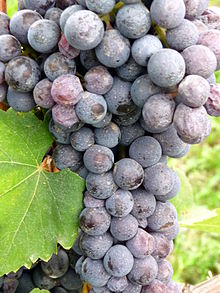
Nebbiolo grapes, picture from Wikipedia
Welcome to the weekend! Your new wine quiz has arrived.
Today our subject is the Italian grape called Nebbiolo – a power grape of Piedmont, solely responsible for some of the world’s best wines, Barolo and Barbareso.
As I’m working on this series of quizzes, I’m of course learning a lot myself. It was very interesting for me to realize, that unlike any other major red grape we talked about so far, Nebbiolo is pretty much confined to the 6 or so areas in Italy, where it makes wonderful wines – its world-wide spread is non existent, not even in the form of clones, like Zinfandel. And this is all despite the fact that Nebbiolo is quite an old grape, with first mentions going all the way back to the 13th century.
Nebbiolo is a very tricky grape to work with. It has the longest ripening cycle out of many grapes – buds early, ripens very late, prone both to mutation (there are about 40 known clones) and grape diseases. But – the resulting wines, like Barolo and Barbaresco, clearly worth the trouble, with wonderful aromatics, power and concentration. Also the ageing potential of the Nebbiolo wines is almost unlimited.
Now, to the quiz!
Q1: Explain the meaning of the name “Nebbiolo”
Q2: In one of the regions outside Piedmont, the wines are produced from Nebbiolo grapes in the style of Amarone – with grapes drying on the straw mats before they are pressed. Can you name that region?
Q3: True or False: Blending is not allowed for any of the wines produced from Nebbiolo grape in Piedmont region.
Q4: White grape used to be such a traditional blending partner for Nebbiolo that it was sometimes called White Barolo. Do you know the name of this grape?
Q5: In the blind tasting setting, the wines made out of Nebbiolo can be very distinguishable even before you take a first sip. Do you know what is this distinct feature of Nebbiolo wines?
Good luck, enjoy your weekend and cheers!
Weekly Wine Quiz #60: Grape Trivia – Sangiovese

Sangiovese grapes close up from Wikipedia
Welcome to the weekend! Yep, it is the time for the new wine knowledge test.
We are continuing our Grape Trivia series, and today we will talk about Sangiovese – one of the most famous Italian grapes. Sangiovese is typically associated with Chianti, but in reality, Sangiovese is one of the most planted grapes all over Italy. One of the interesting issues is that Sangiovese, similarly to Pinot Noir, is very clone-prone, so it is known in different places under different names, such as Sangiovese Grosso, Prugnolo Gentile or Calabrese, to take a few.
Sangiovese is black skinned grape with cherry-dominant, earthy and savory profile. Sangiovese is capable of a wide range of expressions, starting from simple food friendly wines from Chianti to the oak-loaded monsters requiring long ageing and long decanting, coming from different regions in Tuscany and beyond. Absolute majority of Sangiovese plantings are located in Italy, but the grape is also slowly becoming popular in the other regions such as United States or Argentina.
Now, to the quiz! I thought that Zinfandel was not a simple quiz to compose, but then I realized that it is even more difficult to create an interesting quiz all around Sangiovese. For what it worth, 5 questions are below.
Q1: Grape, blending partner mostly of the past, typically leading to Sangiovese wines becoming dull and unexciting.
Q2: What is Fiasco, and how is it related to the Chianti wines?
Q3: On some of the bottles of Chianti, you could see an image of the black rooster. What is the meaning of it?
Q4: Tuscany no doubts is the major source of Sangiovese wines. Can you name 4 sub-regions in Tuscany, producing great wines with Sangiovese as the main variety?
Q5: Name 3 leading regions in United States producing Sangiovese wines. For an extra bonus, add your favorite producer(s).
Have a great weekend, have fun and cheers!
Vinitaly and Slow Wine Tastings – Part 2, Wine Seminars
 This is the second post about my experience at Vinitaly and Slow Wine 2013 in New York. In the first post I only gave you some interesting stats. Now, it is time to actually talk about wines.
Attending big wine tasting is great, wine is everywhere, and lots of it – at the same time, it is also very challenging. You can’t really assess wine methodically, it is more of a “swirl (carefully), sniff, sip, suck air, spit” – in case you wonder, “swallow” is typically not the part of the process, otherwise your tasting will be very, very short. After “spit” goes “write a word, may be two or three”, and move on, either to next wine or to the next table. No, of course I’m not complaining, just explaining that as usual for this type of my “tasting posts” there will be lots of pictures, and a few words.
We – oh yes, let me explain “we” – I spent all of the time at the event with Stefano of Flora’s Table fame (by the way, Stefano also just started the new blog called Clicks & Corks – be sure to check it out). Stefano is a wealth of knowledge and a pleasure to be around – if it would not be for him, I’m sure I would miss out on a number of gems at this tasting.
Now, let’s start again . We spent most of the time in the Slow Wine section of the event, with the exception of two wine Master Classes and a few wineries in the actual Vinitaly section. Let me start from the seminars, and then we will talk about other wines (probably in yet another post).
The first Master Class was a vertical tasting of Nino Negri ‘5 Stelle’ Sfursat di Valtellina DOCG, a wine made out of Nebbiolo grape. Both Stefano and myself took care of pre-registering for this seminar (when I came to register, I got one of the last 3 seats). No matter. In addition to registration, program also mentioned that Master Classes are first come first serve events. So, do you think our registration helped us? Yep, you got it – not really. When we arrived about 15 minutes before the starting time, we were told that the room is full and there are no spaces left. Well, based on the fact that we had registered, we ignored the guy who was trying to stop us from getting inside of the room. But the room was full. No seats. And it is not that you need just seat – you also need a place for 6 glasses in front of you. I was witnessing a futile attempt of one of the organizers to remove two people who were sitting down and had no tickets. Nope, that was not happening. So when one wants to taste wine, this is what the one wants, right? Luckily for us, the place had very wide window seals. Stand by the window, get 6 glasses, ask for the wines to be poured. Actually, I have to say that service staff was super nice and super accommodating – we all got tasting placemats and we all got wine. Here are few pictures:


Just look at this bottle… Unfortunately, the wine was oxidized. But the bottle was way too cool.
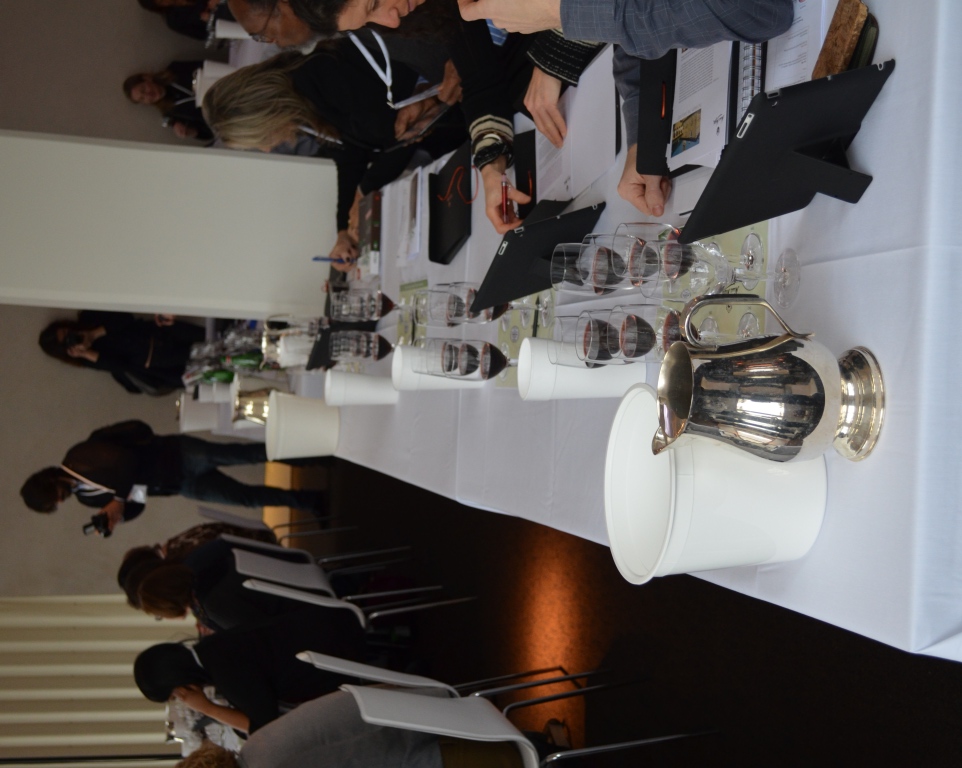
No tickets, but hey, who need tickets when it is first come first serve…
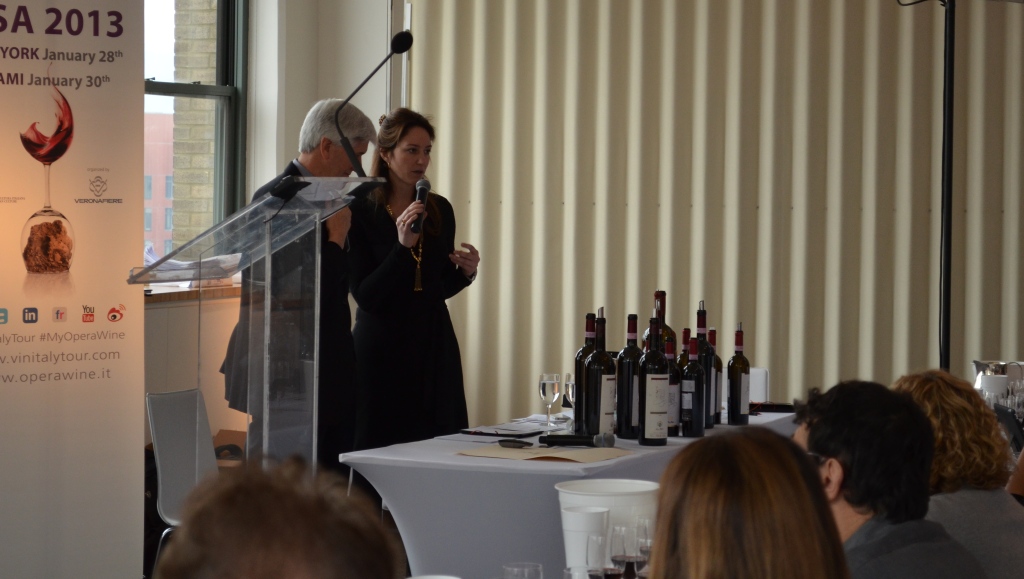
Casimiro Maule, Oenologist at Nino Negri, presents the wines. In 2007, he was awarded the title of “Winemaker of the Year” by Gambero Rosso
Nino Negri winery started in 1897 in the Valtellina region of Lombardy, in the area of Alps close to the Switzerland. This location makes harvesting of the grapes very difficult – actually, a helicopter is used nowadays to transport crates with grapes from the vineyard to the winery – here is a short video in case you want to see how the harvest looks like:
Nino Negri estate makes many different wines out of Nebbiolo grape. The wines we tasted, ‘5 Stelle’ Sfursat, are only made in the best years, and they are done in the style similar to Amarone. After grapes are harvested, they are dried outside for 100 days before they are pressed. During these 100 days, grapes are sorted a few times, and all the grapes which don’t cut it are used to produce some other wines. After 100 days of drying the grapes are pressed with subsequent long maceration, and then aged for 18 month in new French oak barriques and 6 month in the bottle. Note that all these wines are not for the faint at heart – they boast 15% – 16% ABV.

Just look at the beautiful color
Here are the notes for the wines we tasted, in the order we proceeded:
2009 – Prunes, brick dust on the nose, pretty green on the palate, very light for Nebbiolo, good minerality, short finish. Better on the second try, but too watery. Probably needs time.
2007 – According to the winemaker, 2007 was a great year. But – this bottle was oxidized. Some prunes on the palate, tasted more like a dry sherry than a normal wine.
2004 – this year had low yield, and drying season was very difficult. But the wine had nice power, good minerality, good tannins, long finish.
2002 – Prunes on the nose, with some raisins, soft, round, dark roasted fruit on the palate, tobacco, savory herbaceous notes, great balance, overall very nice.
2001 – Perfect beauty! Supple, round, with only a hint of dried fruits on the nose, perfectly balanced, really a outstanding wine. Hell with the rest of the tasting – need a full glass of this one to enjoy. Best of tasting.
1997 – This wine was as good as 2001 – more herbaceous notes than fruit, but perfectly elegant. Dried fruit on the nose (more than the previous wine), graphite and tobacco notes on the palate. Great complexity, balance and elegance. Borderline better than 2001 ( wait, didn’t I just called 2001 “best of tasting” – yeah, I always have trouble with making up my mind…)
All in all, tasting through the vertical of Nino Negri ‘5 Stelle’ Sfursat wines was a special experience and I’m grateful to organizers for making it happen – the beauty of the wines overweight the logistical challenges.
At the end of the day, we attended another seminar, this one dedicated to the wines made on Volcanic soils of Italy. We were preregistered, at this point knew what to expect, ready for a fight and this time got the seats.
If you look at the map below (maps were provided as part of the seminar):

Map of Italy’s Volcanic Wines
there are many volcanoes all over Italy, including even some of the active ones, like Etna in Sicily. Volcanic environments are uniquely different for all the things growing, vines included, and this whole “volcanic wines” project is dedicated to researching the effect of the volcanic soils on the resulting wines. It is also interesting to note that at this point, the whole project is only dedicated to white wines ( and I was hoping to taste some reds).
All together, we tasted 9 white wines:
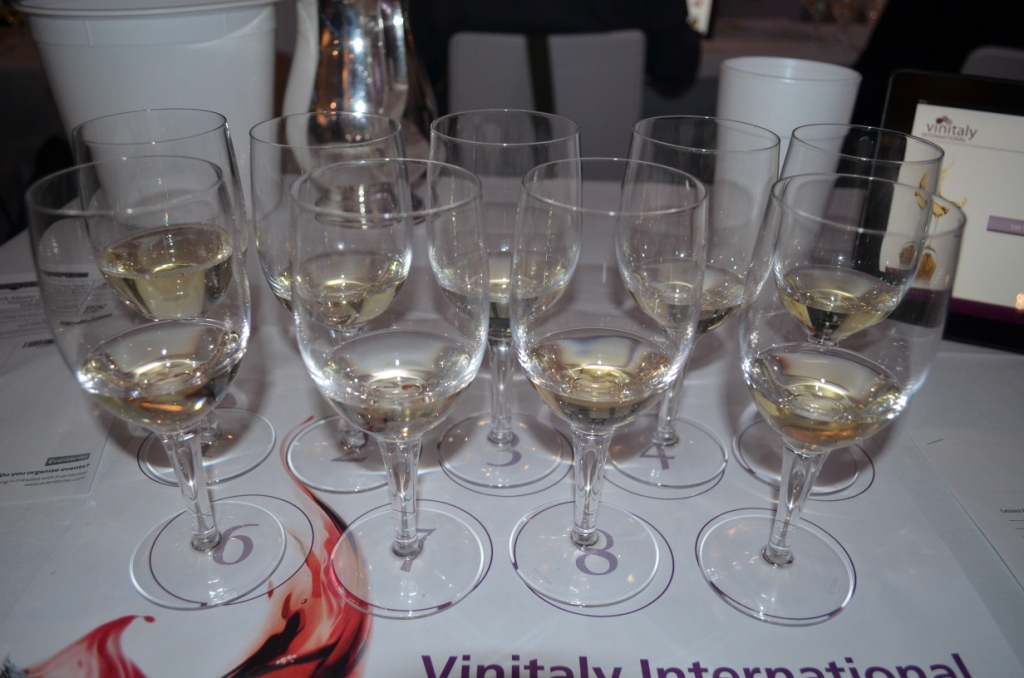
Overall, I wouldn’t say that I was super impressed with the wines. Some wines were better than the others, but there were no OMG moments. Here are the notes for my favorites:
Azienda Marcato – Lessini Durello Metodo Classico 36 Mesi NV – this was the only sparkling wine in the tasting, and it was outstanding. A blend of 85% Durello, 10% Chardonnay, 5% Pinot Nero, 12% ABV. Apple and toasted bread on the nose, nice minerality, smell of granite. Perfect minerality on the palate, very dry. Excellent.
2011 Cantina del Castello – DOC Soave Classico “Pressoni” – a blend of 80% Garganega, 20% Trebbiano di Soave, 13.5% ABV. Nice nose of lemon, green apple, good acidity. White apple and pear on the palate, good acidity, nice lemony aftertaste.
2011 Barone di Villagrande – Etna Bianco Superiore – 100% Carricante. Nice nose with minerality and some saltiness, very dry on the palate with pineapple aftertaste.
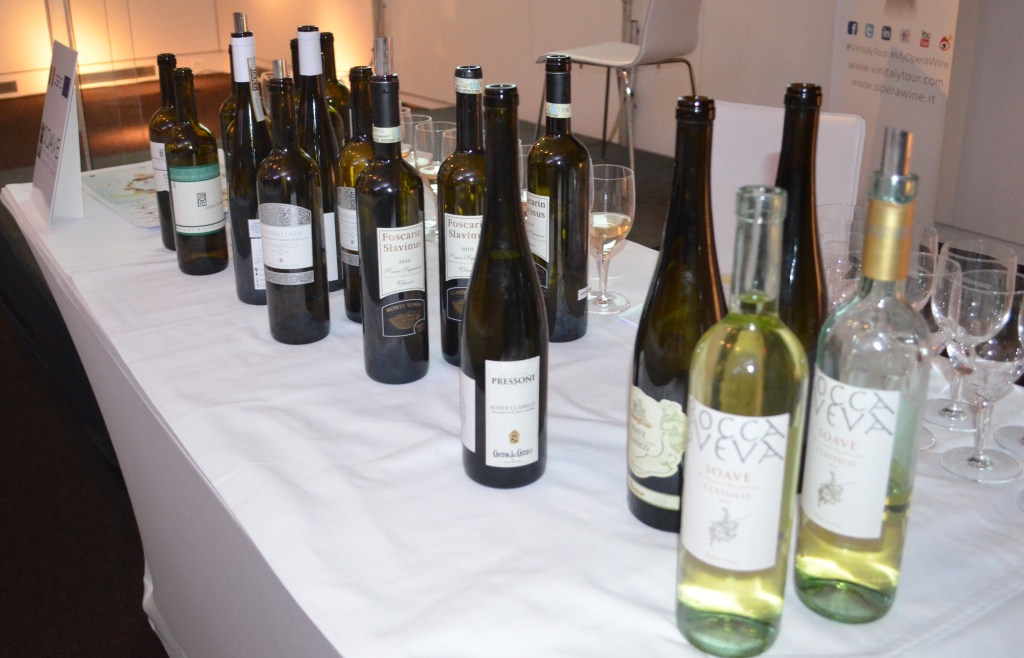
That concludes the part 2 of the Vinitaly experience. In the part 3, I will (finally) tell you about the wonderful wines we experienced at the event. Cheers!
Re-Post: Best Hidden Secrets Of The Wine World: Amarone
During 2011 I wrote a number of posts for the project called The Art Of Life Magazine – of course talking about my favorite subject, wine. The project closed, but I still like the posts I wrote, so I decided to re-post them in this blog. Also, in that project, posts were grouped into mini-series, such as “Best Hidden Secrets” you see here – I will continue re-posting them from time to time.
Also note that the series was written for a slightly different audience – I hope none of my readers will take offense in the fact that sometimes I’m stating the obvious…
 Continuing our “secrets” series, let’s talk about wine called Amarone. The reason to include Amarone as one of the “secrets” of the wine world is simple – I don’t think too many wine lovers know how great Amarone can be, to ask for it by name. I guarantee you – if you like wine, and you will happen to come across a good bottle of Amarone, it will blow you away. And, assuming that many wine lovers are not familiar with Amarone, let’s talk about it starting from the basics.
Amarone is an Italian wine which comes from the region called Veneto. Among [well] known wines produced in Veneto (which has the biggest wine production among all DOCs in Italy) are Prosecco, Soave and Valpolicella. While Prosecco is a famous Italian Sparkling wine, Soave makes dry white wines, and most of Valpolicella wines are red. Main grape varieties used in Valpolicella are Corvina, Rondinella and Molinara, plus there are some other grapes which are used in production of Valpolicella wines.
Amarone is one of the wines produced in Valpolicella. What is so special about it? Let me tell you about my first experience with Amarone. I tried that wine for the first time during the Italian wine class at Windows on the World Wine School, taught by Kevin Zraly. On the nose, that wine had pure raisins, and lots of them. Based on the smell, I was absolutely sure that the wine will be very sweet. The first sip of that wine showed off very dry, full bodied and powerful red wine. The contrast of smell and taste was so amazing – it stuck in my head forever. As an interested side note, once we all smelled the wine, Kevin Zraly asked the class (about 100 students) what we’re thinking about when we smell the wine. Before anyone else had a chance to say anything, the woman in the front row literally jumped from her seat screaming “Sex!”. In case anyone curious, the wine we tasted in that class was 1997 Le Ragose Amarone della Valpolicella.
Outside of such an interesting reflections, what puts Amarone apart from many wines is the way it is made. Once the grapes are harvested, they are put out on the straw mats (used to be straw mats, now there are other techniques) to dry under the sun. The drying process, called Appassimento, usually takes between 3 and 4 month, and leads to the grapes shrivel to literally become raisins – and then those shriveled grapes are pressed and fermented to become Amarone wines. Another interesting fact is that after the grapes are pressed for Amarone wines, the grape skin and seeds leftovers can be added to the Valpolicella wines, which helps to impart additional flavor onto the resulting wine. The wines produced using this method will be called Ripasso which will be designated on the wine label.
It is the time to open a bottle. Today we will actually open 3 bottles, all three from the same producer called Vaona, and we will be able to compare the way the wines are made and taste, progressing from Valpolicella Ripasso to Amarone of different levels.
The first wine is 2008 Vaona Valpolicella Classico Superiore Pegrandi Ripasso (Pegrandi Ripasso means that it used the grape skins left after production of Pegrandi Amarone). This wine is a blend of Corvina, Corvinone, Rondinella and Molinara grapes and it was aged for a year in a barrel and 4 month in the bottle. The resulting wine is very smooth and concentrated, with lots of dark fruit and spices on the palate.
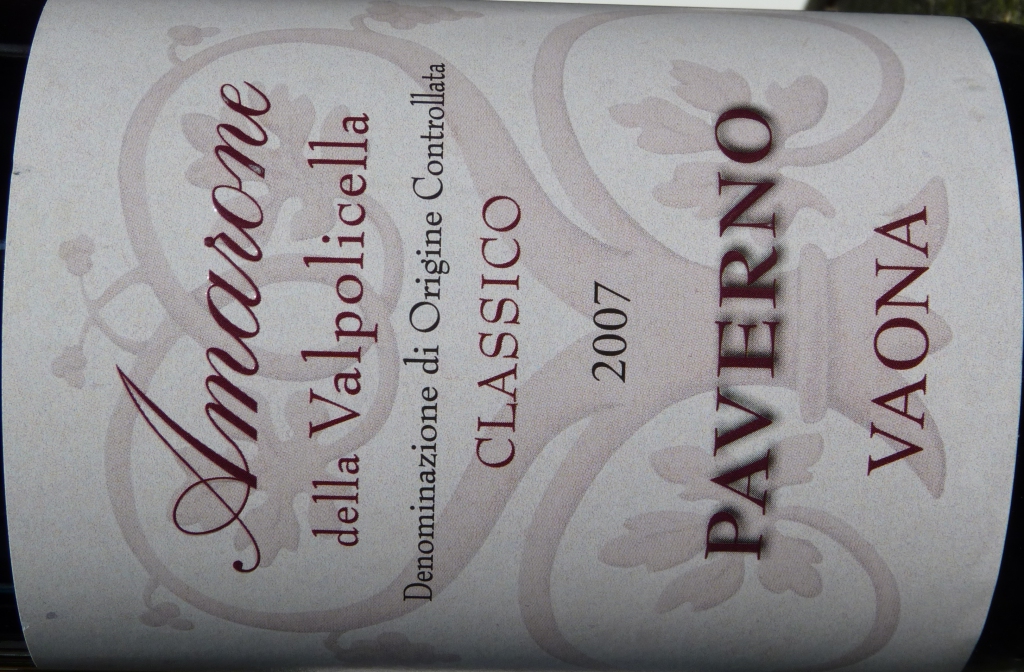 Our next wine is 2007 Vaona Paverno Amarone della Valpolicella Classico. It is made of the same grapes as the Vlapolicella wine (Corvina, Corvinone, Rondinella and Molinara). After the grapes were harvested, they were dried up in the wooden boxes for a period of 3 month, and then made into the wine. This wine is very nice and round, reminiscent of Charles Mara Pinot Noir, both in soft and round style and in masterful handling of the alcohol. This wine boasts 15.6% alcohol, and outside of reading the label, that level of alcohol can not be detected neither on the nose, nor on the palate – this is how balanced the wine is. The wine is showing some blueberries and a bit of tobacco notes on the palate.
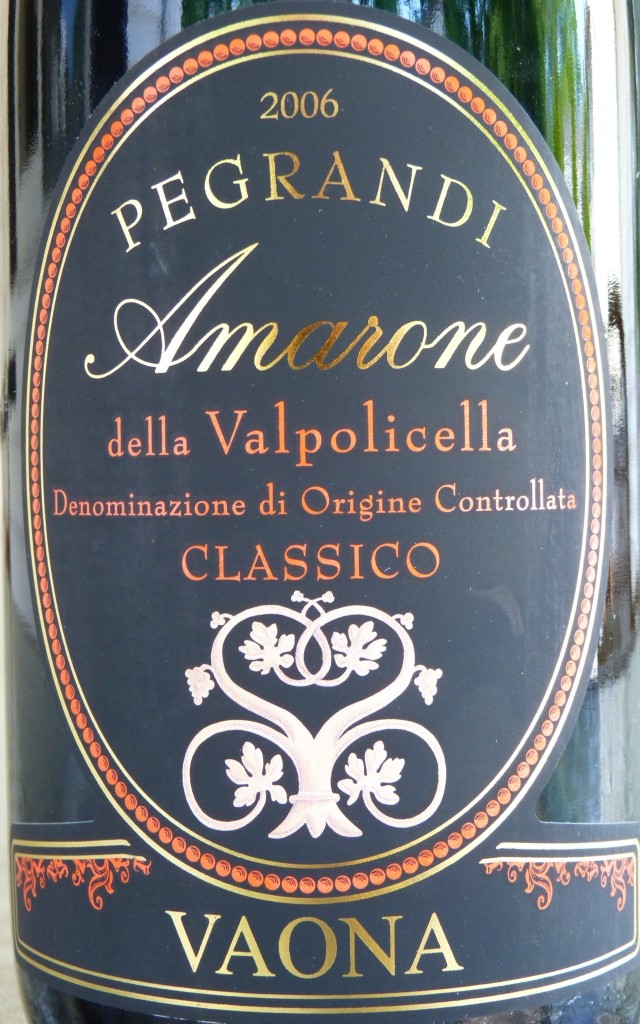 And now we can talk about the flagship wine – 2006 Vaona Pegrandi Amarone della Valpolicella Classico. The grapes for this wine come from the vineyard called Pegrandi, where the average age of vines is 30-40 years. The same Corvina, Corvinone, Rondinella and Molinara are used in the production of the wine, with an addition of local indigenous grape called Raboso Veronese. Once harvested, grapes are dried on the bamboo racks for more than 4 month before they are made into the wine. The resulting wine was aged for 24 month in the small barrels before the release. Again, the wine is incredibly smooth and balanced, regardless of the 15.8% of alcohol. On the nose, it shows fruit jam and dark chocolate. It is extremely rich on the palate, with lots of dark fruit and dark chocolate notes, powerful tannins and hint of tar and tobacco – and then more tannins. This wine should truly be experienced – describing it using words doesn’t do a true justice to it.
I really hope that once you read this article, you will run into the wine store, and ask for the best bottle of Amarone – this wine should be really experienced, and who knows – you might find your wine love forever.
P.S. This post was also prompted by the recent post on Vino in Love blog about best wines from the latest Gambero Rosso (famous Italian wine guide) and his rant about Amarone at the end of the post.
Last Bottle Sign Up ($10 credit)




 Talk-A-Vino