Archive
Wine and Time at Franklin Street Works (and some Hyper-Decanting too)
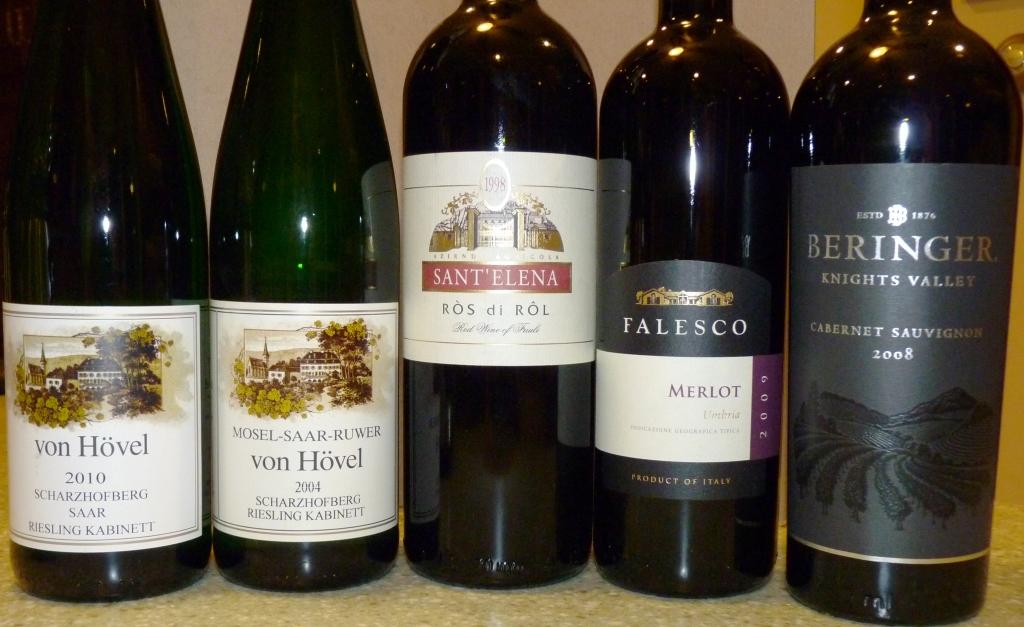 Yesterday we got together at Franklin Street Works in Stamford, CT to talk about wine, time and the relationship between the two (some thoughts on the subject had being posted to this blog before). As you can imagine, we not only talked, we also tried some wines, and even conducted some [not necessarily scientific] experiments.
Here are the wines which were presented in the tasting:
- 2010 von Hövel Riesling Kabinett Scharzhofberg
- 2004 von Hövel Riesling Kabinett Scharzhofberg
- 1998 Azienda Agricola Sant’Elena Ros di Rol Merlot, Friuli
- 2009 Falesco Merlot, Umbria
- 2008 Beringer Cabernet Sauvignon Knights Valley
- 2008 Beringer Cabernet Sauvignon Knights Valley (hyper-decanted!)
First, by pairing together 2010 and 2004 Riesling, we wanted to see the direct effect of aging in the same wine. Despite being called Kabinett, 2010 was rather on the sweet side (I would probably define it as Spatlese) – it was nice and round, and good acidity helped to show up quite fresh. 2010 was people’s favorite, as you might imagine – however, I really liked 2004. One reason is the contrast between the nose and the palate. On the nose it was literally “what the … is this” sensation – probably spoiled cabbage comes to mind first. But then the palate was very balanced, nicely dry and mature, with still a good showing of fruit and excellent acidity.
The Italian wines were good, but not necessarily what I wanted – 1998 Ros di Rol was closed up, dry and somewhat tannic, and 2009 Falesco was bright and fruity, but overall they didn’t play together at all (should look for different comparison tasting pairing).
The last part – Hyper-Decanting – worked out very interestingly (Hyper-Decanting is not my term – please see the origin of Hyper-Decanting here).
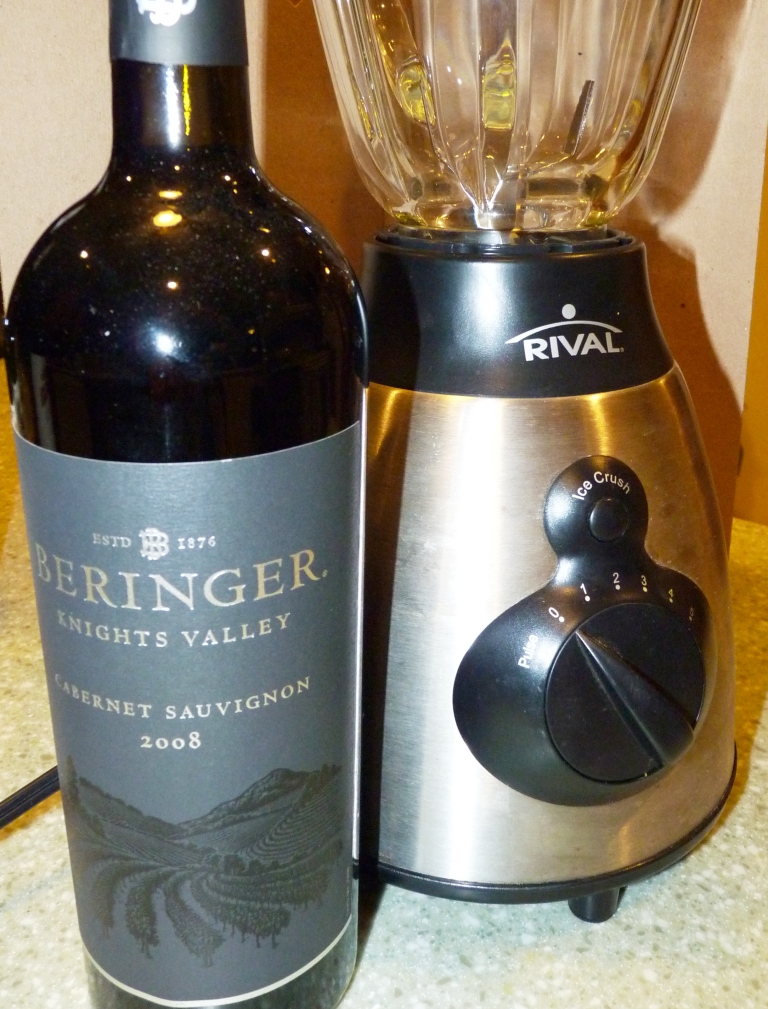
The 2008 Beringer Cabernet by itself showed up in a very classic way – some black currant jammed fruit on the nose, nice bite and nice green notes on the palate. After hyper-decanting ( about 1 minute in the blender), the wine changed dramatically, losing all its sharp edges and becoming soft and mellow.
Would I recommend hyper-decanting as a new way of fast-aging the wines? Probably not. Would I treat a classic Bordeaux this way? Most likely not, unless this is the last bottle left to entertain a party. Is this something you should try for yourself at home? Yes. It is simple, safe and easy, and you probably own the blender anyway, so there is no expense on your part. Will I try it again – yes, but again only as an experiment.
If any of the people reading this post attended the event – please comment, I want to know your opinion! And for everybody else – find the time to open the oldest bottle in your cellar soon, to honor 8000 years of wine and time relationship. Cheers!
Last Bottle Sign Up ($10 credit)




 Talk-A-Vino