Archive
New Recipe: Best Hummus Ever
Okay, here we go – a very modest title. “Best ever”, nonetheless.
Well, I love hummus, and outside of Israel, for the most part, I much prefer homemade hummus over any store-bought versions. There was one exception to this – for about 9 months, Costco carried ready-made hummus, which was spectacular – and then it disappeared. But for the most part, the store-bought versions just don’t cut it, so the only way for me to enjoy hummus is by making it myself.
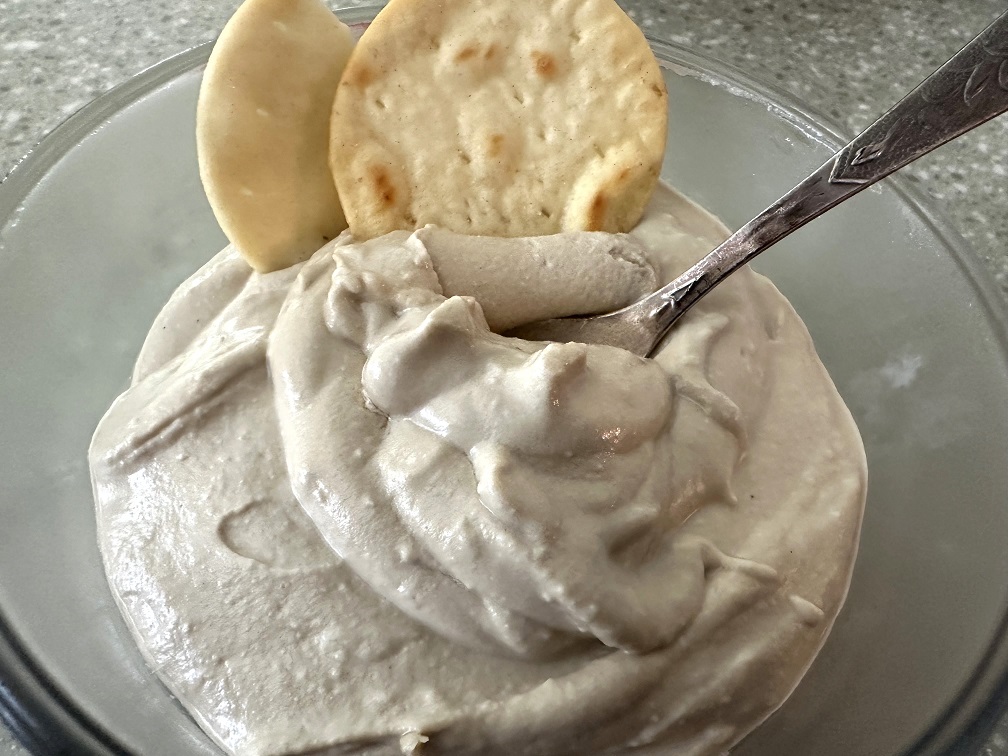
I already shared a hummus recipe on this blog – but since publishing it, I learned a few things, and while this updated recipe uses basically all the same ingredients, the proportions are different, as well as the methodology. Let me list the recipe ingredients first, and then we can talk about it.
Ingredients and tools:
- Dry chickpeas – 1 lb
- Olive oil – 6 tablespoons (approx)
- Kosher salt – 2 teaspoons
- Baking soda – 2 tablespoons
- Tahini – 1 lb (one jar)
- Roasted garlic + roasted garlic oil (see below)
- Fresh Garlic – 3 cloves
- Lemon – 2
- Ice-cold water, 1/3 of a cup
- Blender
In comparison with the previous recipe, this one uses only 2 teaspoons of salt instead of 2 tablespoons, and it requires much less olive oil than the previous one. At the same time, the amount of tahini has doubled. But still this is not a major change. Let’s go step by step through the prep process.
Before we talk about the main hummus ingredient, chickpeas, let’s talk about roasted garlic. In the previous recipe, the garlic was minced and then slowly roasted in the frying pan with olive oil. I now have a much simpler method to make delicious roasted garlic.
Roasted garlic simple recipe:
Preheat oven to 250°F. Peel cloves from 2 heads of garlic. Put garlic cloves in a single layer at the bottom of a small cast-iron or heavy metal oven-safe pan. Pour enough of good olive oil to cover all garlic cloves completely. Cover and put into the oven for 1 hour. In one hour, you will end up with golden roasted garlic cloves and deliciously infused olive oil. Let it cool off, pour into the air-tight container (any used glass jar from preserves or similar will do), and store in the refrigerator. You now have roasted garlic to use as your heart’s desire – for example, to make roasted garlic hummus :). Just take the jar out of the refrigerator a few hours before you are planning to use it (olive oil has a tendency to solidify in the refrigerator).


Now, let’s get back to our hummus.
First, we need to soak garbanzo beans (a.k.a. chickpeas) in cold water overnight, allowing dried beans to expand. Never use canned garbanzo beans as making a tasty hummus from them is mission impossible. By the way, I now have my favorite dried chickpeas to use in this recipe – non-GMO, family-farmed chickpeas from the state of Washington – you can find them on Amazon. In the morning, drain the chickpeas and let them dry a bit.
Put a large pan (the same pan you will use for boiling the chickpeas) on medium heat, put in the chickpeas, sprinkle two tablespoons of baking soda on top, and fry the beans (don’t add water or salt!) for 3-4 minutes. You will need to constantly stir the chickpeas so they will not start sticking to the bottom of the pan. After you see that the chickpeas are starting to get a bit of color, add cold water, bring to a boil, reduce the heat, and let it boil for about 40 minutes. Again, do not add salt! Salt will make the chickpeas cook for about 2 hours, and will make them a lot more dense. While chickpeas are cooking, remove the foam from the surface, and also use a slotted spoon to remove loose floating chickpeas’ “skins” – this will make hummus creamier. At around the 35-minute mark, start checking the chickpeas. Once they are fully tender, you can remove the pan from the heat and drain the chickpeas. Reserve a cup of liquid, just in case the hummus comes out too dense.
Once the chickpeas have cooled off slightly, we can proceed with the next step. Note: I like to make hummus in two batches, it lets me adjust the garlic/salt/lemon profile exactly as I want it to be – for example, if the first batch too garlicky, I can use less garlic in the second batch; if the first batch is undersalted, I can add more salt to the second batch – both batches end up in the same container anyway and get mixed.
For one batch, put into the blender juice of one lemon, 3 tablespoons of olive oil, 1-2 cloves of fresh garlic, any amount of roasted garlic and roasted garlic oil you desire, and blend them together for one minute – this way I’m making sure the garlic cloves are well incorporated into the liquid. Next, add half of the chickpeas, half a jar of tahini (make sure to mix the tahini in the jar well before using), and one teaspoon of kosher salt. Blend for 2 minutes. After two minutes, while the blender is still running, add a small amount of the ice water and continue blending for another 30 seconds. Stop the blender, pour hummus into the container, and taste for garlic, salt, and lemon. Repeat the process with the second batch, adjusting garlic, salt, and lemon as needed for your taste.
Voilà – now your delicious hummus is ready. It will keep in the refrigerator for about two weeks.
That’s all there is to it. Let me know your thoughts in the comments, especially if you decide to make it!
Simple Recipes: Roasted Garlic Hummus
Do you like hummus? Well, I can tell you about myself – yes and no.
No questions that everyone’s palate is different, so I can only speak for my perception. I absolutely LOVE well-made hummus – I can eat it by the bowlful. The problem is that it is almost impossible to find well-made hummus here in the US (if you are in Israel, it is an entirely different story). You can occasionally find something decent at an appropriate restaurant (typically Mediterranean or Middle Eastern), but it is practically impossible to find anything decent in the store – I encountered some exceptions, but they are really, really rare (for about 3 months, Costco was offering a hummus brand called Shamir – it was delicious. Then it disappeared, and I simply stopped buying any hummus from Costco).
It is hard to describe “well-made” hummus – it is a combination of taste and texture, and it shouldn’t have the annoying flattening acidity which makes everything taste so dull. So if you like hummus as much as I do, I have a recipe for you which I’m happy to share.

All you need to make a tasty hummus
Making a great hummus is simple – basically, you only need three ingredients to start – chickpeas, also known as garbanzo beans, salt, and olive oil. I’m sure you can make a nice hummus with only these three ingredients, but I like a bit more flavor in mine, so I add another 3 ingredients – garlic, tahini, and lemon. Here is the full list:
Ingredients:
- Dry chickpeas – 1 lb
- Olive oil – 2.5 cups (approx)
- Kosher salt – 2 tablespoons
- Tahini – 1 cup
- Garlic – 1 head plus 3-4 cloves
- Lemon – 1 large or 2 small
There are a few steps involved here. First, you will need roasted garlic-infused olive oil – you can prepare that in advance at any time (store it in a tight container and enjoy for weeks with a slice of bread or use in any cooking which might benefit from the garlic flavor). Roasted garlic-infused oil is very easy to make. Peel and clean a whole head of garlic, then mince it all finely (don’t use a garlic press, I don’t believe it will work well). Pour two cups of the olive oil in a large skillet, and put it on the lowest heat possible. Add minced garlic and let it slowly simmer until garlic will become lightly golden. It is important that you will use the lowest heat setting – even on the medium heat, minced garlic will roast in no time, and oil will not absorb the delicious sweet flavor of roasted garlic. Ideally, it will take you about 15 minutes to get to the lightly golden roasted garlic (don’t let it become dark/brown – at this point, it might become bitter) – you need to lightly stir it occasionally. Once you are done, remove from heat and let it cool off before pouring it off to a container with a tight lid (I use a large glass jar for this purpose).
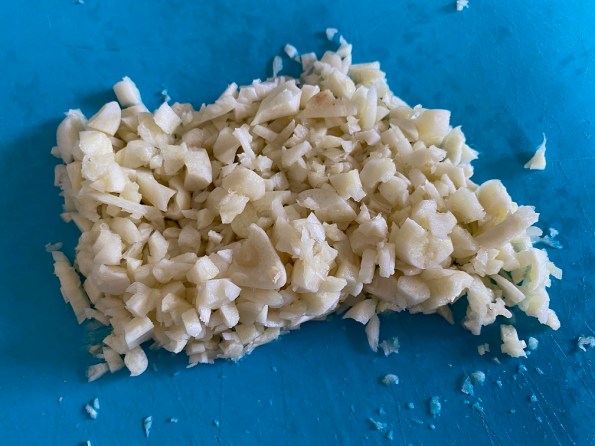
Minced garlic
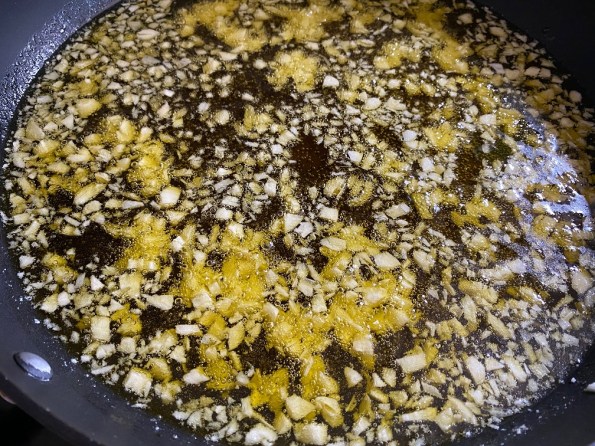
Roasted garlic in progress


Now, let’s start with chickpeas. We are using dry chickpeas here. Yes, you can use the chickpeas from the can, but I don’t believe you will end up with the quality hummus, so it is up to you if you want to cut the corners here. When using dry chickpeas, first you need to soak them. Take large (8 qt) pot, put in dry chickpeas, add about 6 qt of cold (!) water, cover, and let stand overnight. Try not to exceed 12 hours of soaking time – I happened to do so once, and when I opened the pot I found that the water was not clear with some foam on top as some process started with chickpeas – had to throw out the whole batch as I was afraid to cook with them. In the morning, put the pot on the high heat, wait until the water will start boiling. While the pot is starting to boil, you will see foam forming, same as with any broth – I prefer to remove that foam – it might boil over it, true – but again, I prefer to remove it. Once the water is boiling, add 2 tablespoons of the kosher salt, reduce heat and let it simmer until chickpeas are cooked through – will take you about two hours. Once chickpeas are ready, just remove the pot from the hit and put aside – don’t discard water as you will need it later.

Chickpeas before soaking
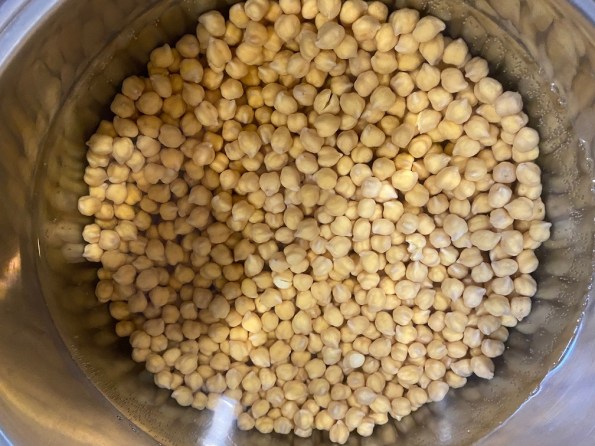
Chickpeas after soaking
Now, for a difficult part. To make hummus smooth and creamy, you need to remove the outer shell from the chickpeas, usually called the skin. This is not a simple task, as you mainly have to do it by hand, once chickpeas are cooked through and cooled off enough that you can handle them. What I’m trying to do it to remove the skins which will float in the pot while chickpeas are cooking, and then I work them one by one for as long as I have enough patience. I read about different methods such as using baking soda to help with the removal of the skin but it doesn’t sound appealing to me, so I never tried that. At the end of the day, if you will not remove all the skins, you will end up with a bit grainier hummus than you might want it to be, but it will be unquestionably tasty.
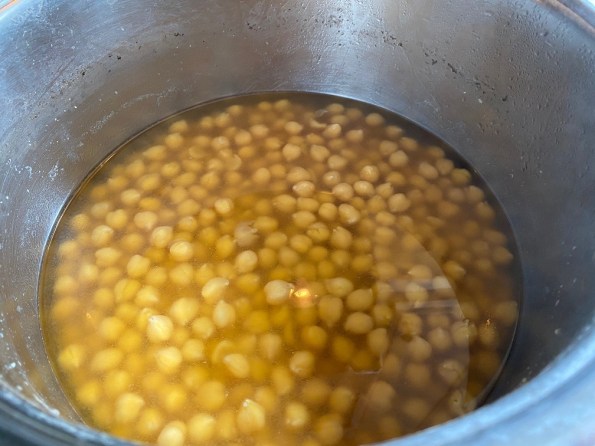
Chickpeas cooking is done


Now, your prep is done, and it is the time to make hummus. You will need a blender at this step. I’m sure you can use an immersion blender, but I’m using the standalone pitcher canister, so all the instructions and illustrations are for this method.
One quick word on tahini before we continue. Tahini is a sesame seed paste, which was always used in Mediterranean/Middle East cooking, and now it became popular in the USA. You can get it online, at many higher-end supermarkets (Whole Foods, Fairway) and even at Trader Joe’s. Once you open a jar, make sure to spend a few minutes to mix it well, as it usually clumps together – use the spoon or a fork to make sure the content of the jar is smooth and well mixed from the bottom to the top.
I prefer to process the chickpeas in two batches. For each batch, I do the following. First, peel 1-2 cloves of garlic and put it in the blender. Add 3-4 of tablespoons of water from the chickpeas pot with some occasional chickpeas. Squeeze juice of 1 lemon (or half of large one). Add two tablespoons of olive oil (garlic-infused or not, makes no difference at this point). Cover and blend until smooth -this will be our base to proceed with the chickpeas. Next, use a colander spoon to add half of the cooked chickpeas into the blender. Add half a cup of tahini and a cup of roasted garlic oil with garlic pieces. Cover and blend until smooth. Once done, move it from the blender to the container. I suggest you will taste it at this point for all the components – do you like what you taste? Need more lemon? Need more salt? Need more tahini? Is that smooth and creamy enough or is it a little tight? The reason you need to do it now because you can fix all the shortcomings with the second batch. Not enough lemon? Add extra. Not enough tahini? Add extra. Too dense? Add more chickpeas liquid or oil. With all the corrections in mind, make the second batch, then combine the two and mix them together. Voilà – your hummus is ready to be enjoyed. Well, make sure it is well chilled, and enjoy. When serving, you can smooth it out and put a drizzle of olive oil on top.


This recipe should give you a basic idea – from here on, you can make it yours by adding and removing any elements. But I would still suggest trying this recipe first and see how you want to change it. Also, keep in mind that the ingredients matter. At this point, I used chickpeas from three different sources – Goya (prepackaged), Fairway organic, and prepackaged ones from Lior (used it for the first time), and all three yielded different results. Fairway organic is my favorite. I’m okay with Goya, and I’m not buying Lior again (not very happy with the result). If you plan on making your own hummus all the time, find what works for you.
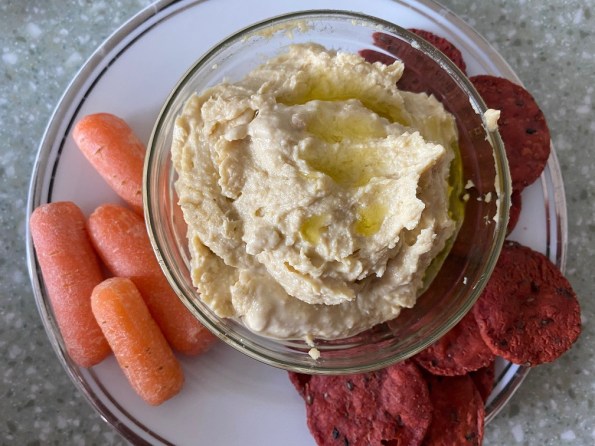
Hummus is served
That’s all I have for you, my friends. Not a word about wine in this post – but I promise to rectify it next time. Cheers!
Last Bottle Sign Up ($10 credit)




 Talk-A-Vino