Archive
Wednesday’s Meritage – Wine Quiz Answer, #MWWC6 Results, WTSO Marathon Next Week, Champagne in Numbers
Meritage time!
Let’s start with the answer for the wine quiz #89, grape trivia – Dolcetto. In the quiz, you were supposed to answer 5 questions about the red grape from Piedmont called Dolcetto. Here are the questions, now with the answers:
Q1: Except the “sweet little one”, what is the other possible explanation to the name of the Dolcetto grape?
A1: Dolcetto is likely named after the hilltops where the grape is growing (“duset” in Piedmont dialect).
Q2: Sort these Piedmontese grapes in the order of time of ripening, from earlier to the later: Barbera, Dolcetto, Freisa, Nebbiolo
A2: Typically, Dolcetto ripens two weeks earlier than Barbera, and Barbera ripens two weeks earlier than Nebbiolo. Freisa ripens a bit earlier or about at the same time as Nebbiolo. Thus correct answer is Dolcetto – Barbera – Freisa – Nebbiolo (the last two can be also swapped in place).
Q3: Wine Spectator calls wines rated in 95-100 range Classic (the highest and the most prestigious category). True or False: there are no Dolcetto-based wines rated in the Classic category
A3: True. The highest rated Dolcetto wine is only has a 93 rating, thus there are no Dolcetto wines in the Classic category.
Q4: One of the North American grapes for the long time was assumed to be identical to Dolcetto ( until recent DNA tests proved it wrong). Do you what grape was that?
a. Chambourcin, b. Charbono, c. Marechal Foch, d. St. Croix
A4: It was actually a Charbono grape which was erroneously assumed to be Dolcetto.
Q5: What is the suggested serving temperature for Dolcetto wines?
a. 65ºF to 75ºF, b. 60ºF to 65ºF, c. 50ºF to 60ºF, d. 45ºF to 50ºF
A5: The answer here of course is not universal, as the serving temperature should be rather linked to the style of wine – light style Burgundy will command different serving temperature comparing to the full bodied Pinot Noir from California. However, on average, Dolcetto wines are considered to be light-bodied, or lighter style reds, which are generally recommended to be served slightly chilled, at under 60ºF. Thus correct answer is c, 50ºF to 60ºF.
This time around we don’t have a winner, unfortunately. Yes, I understand that the grapes are getting a bit more obscure, but hey – they are still no too obscure for Google! I can give you a hint for what to expect in this grape trivia series – we still have quite a few interesting grapes to talk about, so you should expect to see here Pinotage, Tannat, Montepucliano, Bonarda, Viura, Gruner Veltliner and others. See, now you have a head start!
Now, to the interesting stuff around the vine and the web!
First, the Monthly Wine Writing Challenge #6 with the theme of “Mystery”, hosted by Jeff a.k.a. The Drunken Cyclist, has its winner! Alissa of SAHMMelier is the new queen of the MWWC! Here is the link to her winning post, in case you didn’t read it yet. Alissa is now working on the announcement of the new theme, which will be … spoiler alert? nope, you will have to wait for it to appear in Alissa’s blog.
I’m repeating here my note from the last week. Wine Til Sold Out, better known as WTSO, is conducting their Cheapskate Marathon next Tuesday, January 28th, starting 6 AM Eastern – be there ( in front of your computer), or risk missing out on the great wine deals. The Marathon will be conducted with the usual rules: all the wines are priced in $7.99 to $18.99 range, no e-mail announcements, all new wines are announced on twitter and only on twitter, new wines are offered every 15 minutes or sooner if the previous wine is sold out, free shipping for the quantities of 4 and up of the same wines. Happy hunting!
Last interesting item I want to bring to your attention is a few numbers about the sales of Champagne. It looks like the sales of Champagne worldwide are down for the second year in the row – there were 5 million bottles less sold in 2013 compare to 2012, and 2012 had even bigger slump comparing with 2011. Here is the link to the article in The Drinks Business which contains a lot more of the detailed numbers, including statistics by the different countries.
And we are done here. The glass is empty – but the refill is on its way! Cheers!
Weekly Wine Quiz #89: Grape Trivia – Dolcetto
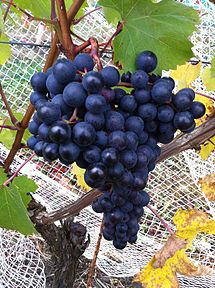
Dolcetto grapes. Source: Wikipedia
The Wine Quiz series is not meant to intimidate. The whole idea here is to have fun and learn something new. When answering the questions, it is fully encouraged to use all available sources of information, including Google or any other search engine. There are no embarrassing answers – the most embarrassing thing is not giving it a try…
Welcome to your new wine quiz!
We are back to our grape trivia series, continuing with the red grapes, and today’s subject is the grape called Dolcetto.
If you look at [probably best] known Italian wine regions, you will find some very interesting differences. If we take Tuscany, which probably comes to mind among the first, its signature grape, Sangiovese, is successfully growing in many other parts of the world, and lots of international varieties is producing magnificent wines on the Tuscan soils (super-Tuscan, anyone?). If we will now look at Piedmont, the home to Barolo, the king of wines, and Barbaresco, that region produces magnificent wines almost exclusively from the local indigenous grapes – and those local grapes are very scarcely distributed around the world, producing the wines of limited value.
Dolcetto, the subject of our today’s trivia, is one of the three better known red grapes of Piedmont – Nebbiolo and Barbera are two others. It is not very clear how Dolcetto made it to Piedmont, with some of the references suggesting that it had been growing there at least from the 16th century. The name of Dolcetto technically stands for the “little sweet one”, but it is believed that this is rather a coincidence and the name has actually a different source. Dolcetto is an early ripening variety which produces wines which have nothing to do with sweetness. Dark thick skin of Dolcetto contains large amount of anthocyanins, and imparts quite a bit of tannins to the resulting wines, as well as the dark color. Generally, Dolcetto wines are dry, lighter style than Barbera or Nebbiolo, with dark red and black fruit profile, such as black cherries and plums.
Best Dolcetto wines are mostly produced in the 7 different DOCs of Piedmont. It is also growing in Liguria under the name of Ormeasco. Dolcetto has very limited success around the world, growing in Australia and in a few regions of United States – California, Texas and Oregon.
And now, to the quiz!
Q1: Except the “sweet little one”, what is the other possible explanation to the name of the Dolcetto grape?
Q2: Sort these Piedmontese grapes in the order of time of ripening, from earlier to the later: Barbera, Dolcetto, Freisa, Nebbiolo
Q3: Wine Spectator calls wines rated in 95-100 range Classic (the highest and the most prestigious category). True or False: there are no Dolcetto-based wines rated in the Classic category
Q4: One of the North American grapes for the long time was assumed to be identical to Dolcetto ( until recent DNA tests proved it wrong). Do you what grape was that?
a. Chambourcin
b. Charbono
c. Marechal Foch
d. St. Croix
Q5: What is the suggested serving temperature for Dolcetto wines?
a. 65ºF to 75ºF
b. 60ºF to 65ºF
c. 50ºF to 60ºF
d. 45ºF to 50ºF
Good luck, enjoy the quiz and the rest of your weekend! Cheers!
Last Bottle Sign Up ($10 credit)




 Talk-A-Vino