Archive
A Quick Trip To California With Chalk Hill Estates
Have wine, will travel!
Let’s start with the question – equally eternal and pointless, but always fun – does size matter? Yes, of course, it does.
Now, a follow-up question – is bigger always better? Remember, this is still a wine blog, so please have the right perspective here.
While you are thinking about it, let me share what I learned from one and only Kevin Zraly during his Windows on the World Wine School class.
Kevin asked everyone to imagine a circle – let’s say, it would be California. Now let’s imagine a smaller circle inside of this one – let’s say, now it is Napa Valley. The wines from Napa Valley are better than the wines from the whole of California (I’m not doing any particular comparisons, just a general bottle of California appellation wine versus a general bottle of Napa Valley wine – there always will be exceptions, but this is not what we are concerned with right now).
Next, let’s place even a smaller circle inside of the Napa Valley – how about Oakville, one of the best appellations in Napa. Oakville designated wines should be (on average) better than Napa Valley designated wines, would you agree? But how about nesting next smaller circle inside – To-Kalon Vineyard, one of the most coveted vineyards in the whole of California? To-Kalon designated wines are some of the most sought-after wines in California, so the tendency is clear – the smaller circles get, the better wine should become. We don’t even have to stop at the vineyard level – we can continue to the blocks and plots, but I think you got the point.
So now, what is your answer to the question? Yes, when it comes to the wine appellations, smaller is usually better – but of course, don’t apply this logic when someone is asking if you would prefer a standard bottle of Screaming Eagle as your present, or if you would prefer a Jeroboam.
The Chalk Hill AVA (AVA is an abbreviation for the American Viticultural Area) is a tiny sliver of land located in the northeast corner of Russian River Valley AVA on the border with Alexander Valley AVA. The area is so small that it was first discovered by Fred Furth from his plane, while he was flying over the Russian River. Fred started the Chalk Hill Estates winery in 1972, and in 1983, the Chalk Hill area received the status of the AVA.
Chalk Hill’s name comes from the white chalk volcanic soils prevalent in the area. While Chalk Hill is a sub-appellation of the Rissian River Valley, it is warmer and has a lesser amount of fog, but more of the cooling breeze. Chalk Hill AVA is best known for its classically Californian grapes – Chardonnay, Sauvignon Blanc, Cabernet Sauvignon, Cabernet Franc, and Merlot. Malbec, Syrah, Sangiovese, and Zinfandel are also successfully growing there.
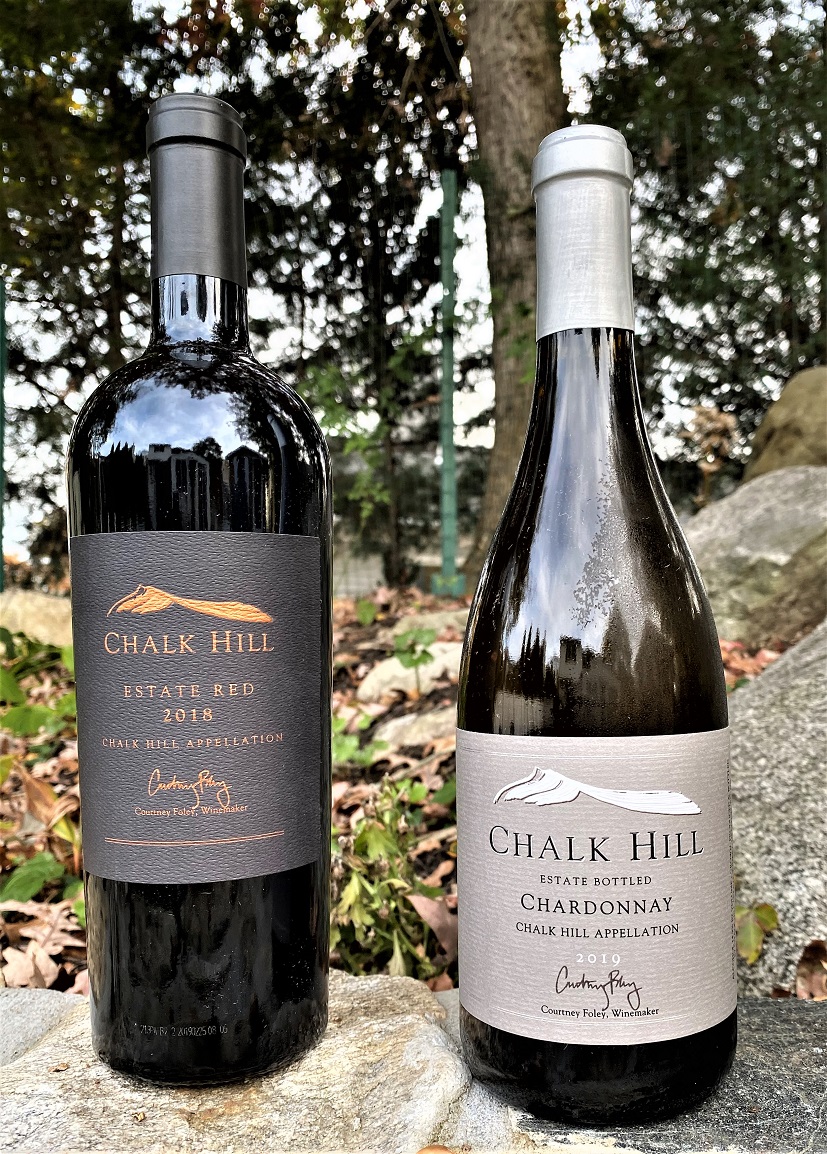
Chalk Hill Estate is a 1,300 acres property, with 350 acres of vineyards, planted vertically on the valley slopes. Chalk Hill Estate was acquired in 2010 from its original owner, Fred Furth, by Bill Foley, a successful financier turned vigneron, who smartly and successfully amassed a good number of famous California wineries under his Foley Family Wines brand. Actually, after the acquisition, Chalk Hill became home for the Foley family. Courtney Foley, the youngest daughter of Bill and Carol Foley, grew up surrounded by the beauty of Chalk Hill Estate, where now she became a winemaker working together with her dad.
Chalk Hill Estate vineyards are sustainably farmed, with a focus on soil and water conservation. Lots of work had been done in the vineyards to research how well different clones grow in the different sections of the vineyards, with particular emphasis on Chardonnay clones. To demonstrate the results of the study, Chalk Hill even produces a special Chalk Hill Clonal Collection set of wines.
I had an opportunity to try two of the Chalk Hill Estate latest release wines:
2019 Chalk Hill Estate Chardonnay Chalk Hill AVA (14.9% ABV, $45, 11 months in French oak, 40% new)
Light golden
A hint of gunflint, lemon, herbs
Butter, vanilla, good acidity, bitter undertones
7+, over-extracted for me, but I’m sure someone might like the raw power
2018 Chalk Hill Estate Red Chalk Hill AVA (15.5% ABV, $70, 54% Cabernet Sauvignon, 34% Malbec, 10% Petit Verdot, 2% Carménère, 21 months in French oak, 61% new)
Dark garnet
Cassis, pure cassis
Beautiful crunchy cassis, cherries, eucalyptus, a hint of espresso, well noticeable but not overbearing tannins, good balance, full-body, long finish.
8+, excellent
Somehow, the Chalk Hill Chardonnay is not made for me (this is not my first encounter with the wine, but the results are identical every time). The Estate Red was a pure delight, though.
And now it is time to conclude our trip. I hope you enjoyed a brief visit to the beautiful Chalk Hill Estate – next time, I’m sure it is worth a hands-on experience. Cheers!
Overcoming Writer’s Block (Actually, a Daily Glass Post)
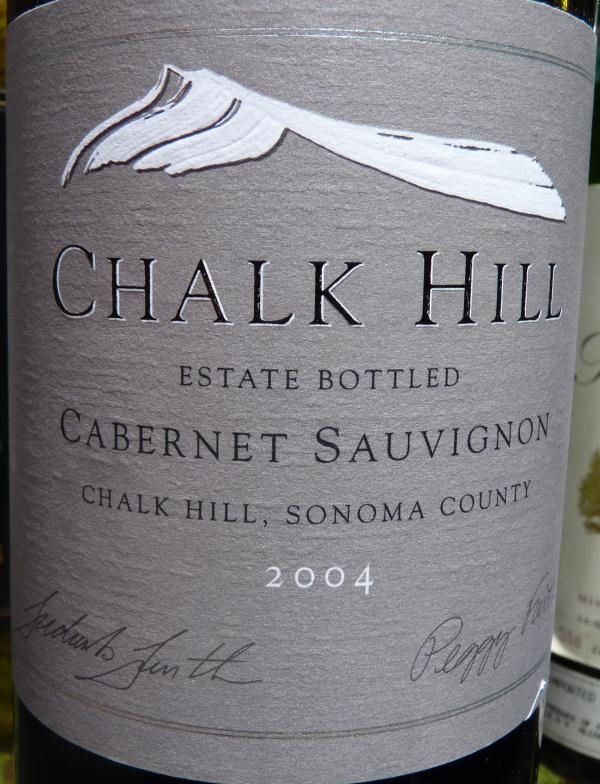 Over the course of last week, I found it almost impossible to write even a line in the blog. There is plenty of stuff to write about – Spanish Wine Festival, Bordeaux Vertical Tasting, many great wine encounters – and, nevertheless, not a line. Like someone turned the switch off. Until today, when I happened to share my frustration with my 12-year old son. He asked how my writing was going, and explained that it is not going well, as I can’t produce anything. Ah, writer’s block, he said, nodding understandingly. That’s it. As it often happens in my beloved Fantasy books, once you know the True Name of something or someone, you can control it. Here as well, once I managed to name my inability to write as a “writer’s block”, situation magically became controllable, and here I’m am – or to be more correct, here is the post, which I wanted to write before I will get to the couple of big subjects.
I wanted to talk about life lessons and tasting of the 2004 Chalk Hill Estate Bottled Cabernet Sauvignon, coming from very respectful producer in Sonoma County, Chalk Hill. Why life lessons, you ask? Very simple. I pride myself with being a semi-pro when it comes to wine. One of the important traits of such a self-image (in my opinion, of course), should be an ability to take the wines objectively – even if I don’t like the wine, I expect myself to be able to declare that while the wine is not in my style, it is still a good/well made wine.
First sip of this 2004 Cabernet – and I don’t follow that “objective” rule even for a split second – I declare wine as not my style at all and also simply as not being a goods wine. Reason for such declaration? The first sensation I got on the palate was “burnt fruit” – this is not necessarily a standard term, but I use it to describe an over-ripe fruit flavor, which used to be very common in inexpensive Australian Shiraz. Therefore, after the first sip, I declare that I can’t drink this wine at all.
Now, talk about luck – I was actually lucky that the wine, which was opened during a dinner with friends, was not finished completely. Subsequently, I had an opportunity to finish this wine two days after the bottle was opened (bottle was preserved with vacuum pump). As you can see, the word “opportunity” was used to describe the experience, so I guess you can sense some change. Yes, magical transformation took place over those two days. The wine became incredibly elegant, with silky smooth tannins and very gentle, yet powerful mouth-feel. Classic Cabernet fruit flavors, such as black currant and blackberries were present, together with hint of eucalyptus and cedar, in perfect harmony with acidity and tannins. This was truly a magnificent wine, and I was simply upset with my inability to recognize great wine from the get go. Drinkability: 9
Oh well, I learned my lesson, and I also learned to control writers’ block (hope both statements are true). And I will have to prove that I did by not repeating these mistakes again. Of course you will here about it – through this exact blog. Until the next time – cheers!
Last Bottle Sign Up ($10 credit)




 Talk-A-Vino