Archive
Saju Bistro – Great New York Midtown Dining Without Breaking the Bank
Dining in New York is tricky. Well, if you are on an unlimited expense account, it is pretty straightforward – New York has no shortage of amazing chefs, so your only hurdle might be scoring the reservation, and then you are almost guaranteed an amazing experience. It is a bit more complicated if you don’t have an access to that wonderful “no holds barred” source. In such a case, you have to do your homework, and still you are taking chances.
Going to the concert at the Town Hall in Midtown Manhattan, I did my homework and came up with the French restaurant called Saju Bistro Bar and Restaurant – 3.5 stars on Yelp, French cuisine, two dollar signs. Yes, 3.5 stars is not that much, but being in the Theater district, your options are quite limited, so all together it sounded like a place worth trying.
The place did feel like a French bistro from the moment we walked in. By the entrance, a sitting area open to the street – you can feel as you are in Paris, just sitting down with a cup of coffee, and watching the people and the street. If you do want to be in the more enclosed area, walk to the back and get the table surrounded by the French bistro-type paintings – the atmosphere is definitely there.
We got situated at our table and got the menus. Of course I had to start from the wine list, which was somewhat small. Wine list’s focus was on France and California, with the number of wines priced quite reasonably. Thanks to my encounter with Paul Mas wines earlier this year (here is the post), when I saw a 2011 Paul Mas Carignan Vieilles Vignes from Languedoc, this was a very easy decision (the fact that the wine was priced at $34 was also very helpful). The wine had a fresh red fruit on the nose, and medium body with a touch of warm spice, overall it worked quite well throughout the dinner.
The menu at Saju Bistro has a reasonable size – it doesn’t overwhelm and makes your dinner experience nice and easy. We decided to start with a few appetizers which can be shared among 4 of us.
Grilled Vegetables Aïoli (Zucchini, Yellow Squash, Carrot, asparagus, Eggplant, potato, Broiled Egg, home made Aïoli) – if you ever tried to grill vegetables, I’m sure you know that behind the seeming simplicity, grilled vegetables are super-easy to ruin. This dish was done perfectly, with the eye-happy grill marks and prefect crunch. Home made Aïoli was a delicious complement to all the vegetables.
Assiette de Charcuterie (Saucisson sec, procuitto, country pate, breseola, garlic sausage, cornichons) – I was a bit concerned that this dish would be enough to share for 4 people in a French restaurant, but our waitress, Alissa, assured us that it will be perfectly shareable – and it was. Very tasty selection, very generous amount, just an excellent dish all around.
Paté de campagne (Country paté, célery remoulade, cornichons, toasted bread) – you can’t go wrong with the Country paté dish in a french restaurant – you just have to make sure you save some bread in the bread basket, which we did. This was another excellent appetizer, again – perfectly shareable.


For the main course, we wanted to try all the different things, so here is what we got:
Lapin des Garrigues au Romarin (braised boneless rabbit, sautéed gnocchi, French sweet peas, white wine reduction with fresh rosemary) – this was so homey, an outstanding comfort dish, with the perfectly melding flavors.
Pumpkin Ravioli (two-colored pasta, pumpkin filling, truffle sauce) – seasonally appropriate, this was quite tasty, but the filling was a bit too sweet to my taste – I would take it more to the savory direction. Still, I would say it was a successful dish.
Filet Mignon au poivre (French fries, haricots vert, pepper sauce) – when it comes to the steak, proper execution is a key – and this steak was done perfectly – succulent cut of meat, delicious pepper sauce – excellent dish.
Grillade de la Mer (Grilled Shrimp, Octopus, Clams, Mussels, Calamari, Sea Bass, served with sautéed Pommes Rissolées. Grilled Asparagus and Persillade) – in a restaurant, I’m generally a seafood guy, probably 9 times out of 10. There were two dishes which I was considering – Bouillabaisse or Grilled seafood. Alissa recommended to go with the grilled seafood – and boy, was that a great advice. Perfectly cooked calamari, shrimp, mussels – absolutely delicious.


You can’t leave French restaurant without having the dessert, right? Of course not, that would be a crime! We chose two desserts to finish our evening:
Profiterole (Puff Pastry, Vanilla Ice Cream, Hot Belgian Chocolate) – profiteroles is one of my very favorite desserts, and these were delicious!
Lemon Panna Cotta (Chilled Eggless Lemon Custard and Red Berries Coulis) – perfectly refreshing, very light, great flavor and very generous amount of berries. An excellent dessert!


Before we part here, I want to acknowledge our waitress Alissa one more time – she took a great care of us – the food was coming timely, the wine was always in the glass just at the right amount – she did really an excellent job – thank you Alissa!
There you have it, my friends – a great restaurant experience in midtown Manhattan. If you see any of the Broadway musicals in your future, then you might want to check out Saju Bistro. Cheers!
Saju Bistro Bar and Restaurant
120 W 44th Street
New York, NY, 10036
Phone: 212-997-7258
http://www.sajubistro.com

Beer Versus Wine (And Don’t Forget The Cider) + Food
I don’t know what you think based on the title, but the premise of this [short] post is simple. The Wondering Gourmand has a permanent monthly feature in his blog, called “Beer Versus Wine Pairing Challenge”. In that challenge, you are given a choice of a dish, and you are supposed to come up with the wine or beer (and don’t forget the cider!) pairing suggestion which then gets voted for.
As a lucky winner of the September challenge, I had an opportunity to come up with the new dish for the challenge, and my suggestion was … deviled eggs! So now you can suggest a choice of pairing, and may be then get a lucky challenge of coming up with the next dish suggestion. Here is the link to the official post – use the comments section in the Wondering Gourmand post for your beer versus wine recommendations.
Beer Versus Wine Pairing Challenge – Deviled Eggs
Cheers!
Prime Time at Washington Prime
 When you come to the new restaurant, first you discover the food. Then drinks and wine. Then ambiance and decor. Then service. Well, yes, all of the above – but in the random order. The experience is somewhat like peeling the onion, only with an element of surprise – you don’t know what your next excitement will be. May be a new dish. Or may be, as I recently had, a creative interior which all of a sudden dawns on you, after you already spent more than hour in the restaurant.
About two weeks ago, we visited new restaurant in Norwalk, Connecticut, called Washington Prime. The restaurant is located on the Washington Street, hence the first part of the name. And for the second part, there can be multiple explanations, but as restaurant is a steakhouse, and it serves only Prime cuts of beef (for the readers outside of the US – Prime is a definition from the US Department of Agriculture for the best quality selection of beef), hence the second part of the name.
We walked into the restaurant, immediately got to our table, and started studying the cocktail selection and got into the conversation with our dining companions. Only an hour into our dinner I had an opportunity to walk around and see how creatively the dining room was decorated, with the grape vines on the ceiling above bar and green plants (yes, artificial, not live) covering the walls in the corridor. It became quire dark when I made the discovery, so the pictures wouldn’t do a justice to the decor, but nevertheless, you will get an idea.


The cocktail list was quite interesting, and it was not easy to make a selection. I went with the Basil Smash (basil, simple syrup, tanqueray 10, lemon just) – nicely refreshing and not overly sweet. Moscow Mule‘s presentation also looked quite interesting. Then, of course, we went for the wine. The wine list overall was interesting and well composed – but it was not easy to make a selection as I always go out of my way looking for value, and it was simply not that easy (lots of selections were priced at about triple retail, and you know that I have a problem with that). For the white, we had a 2012 Martín Códax Albariño, Rias Baixas – simple, food friendly wine with clean acidity and touch of white stone fruit. We also had 2013 Jean-Luc Colombo Cape Bleue Rosé Provence, which was light and loaded with strawberries.For the reds, we started with the 2012 David Bynum Jane’s Vineyard Pinot Noir Russian River Valley – young, smokey, light cherry flavor, good acidity. While this was a nice wine, we felt that it wouldn’t really stand up to our dinner which included steak, so the red wine we chose to stay with until the end of the meal was 2011 Ridge Three Valleys Sonoma County – notes of smokey raspberries, espresso, touch of dark chocolate, all weaved together over a firm structure with some earthy notes – excellent overall.
And now let’s talk about the food. Everything was split into the courses. We started with a few appetizers – Seafood Tower (colossal shrimp, local oysters, little necks, Alaskan king crab leg, Maine lobster, spicy mustard, house cocktail sauce, classic mignionette) and House Slab Bacon (). The bacon more resembled the pork belly than traditional bacon, and literally was melting in your mouth. The Seafood tower was excellent, great selection of fresh oysters and clams.


Our dinner continued with Small Plates. Lobster Bisque (parsley, crème fraische) was very concentrated, with nice flavor. Deviled Eggs (creamy yolk, prime meatball, pickled onions, foie gras powder) were unsuccessful, unfortunately. I love deviled eggs, one of my childhood favorite dishes – and we keep making it almost for each and every party. The deviled eggs served at Washington Prime were way too acidic, with pickled onion been just too much. I think this dish requires some work make it a success. Burrata (creamy slaw, sambal aioli, sesame, pretzel bread) was creamy and satisfying, just as you would expect the Burrata to be.


Poutine (oxtail ragu, house fries, cheese curds, green onions) was an interesting dish. The oxtail ragu was outstanding, with the flavor and texture creating irresistible, homey experience . However, the cheese curd didn’t fully integrate into the dish – at least with my memories of Poutine in Quebec.
Knuckle & Claw (blue cork grits, lobster sauce, tobiko) was okay – yes, I’m not really a big fun of lobster, so the blue corn grits and tobiko were the best components of the dish for me.
Octopus (pickled peppers, duck fat marble potato, pepper emulsion) was to die for. Perfectly cooked, with delicious flavor combination, it was definitely a star dish.
Wings (fried, kimchi sauce, scallions, soy, chilli) were crispy and very tasty (could use a bit less salt).


Finally (after about an hour of eating), the time had come for Salads. First, Prime Wedge (gem iceberg, pickled heirloom tomatoes, bacon, ewes blue cheese, chili, house ranch dressing) was spectacular. I love the Wedge, and I order it quite often – this was the very best Wedge salad I ever had – the bacon, the sauce, the sweetness of the lettuce were just spot on. And our next salad dish, Chop Chop Salad (iceberg and romaine, bell peppers, onion, carrot, provolone, salami, red wine vinaigrette) was also very much on par with the Wedge – fresh, light and delicious, with the very tasty sauce.


And the time had come for Land & Sea.
We were in a steakhouse, so of course there was steak! USDA Prime Steaks – 8 oz filet Mignon, 18 oz Ribeye, 32 oz. Porterhouse (dry aged 28 days) – were all served on the beautiful wooden boards, in its perfectly simple beauty. The selection of steak sauces, which also included spicy mayo and Chimichurri, was served on the side. The steaks were just outstanding, all three of them had a slight difference in texture and flavor, but they were all simply done at the “wow” level.
Representing the “sea” part, first we had Grouper (Carolina gold rice, tomato, asparagus, carrot butter sauce) – if the steak was “wow” dish, this was a double “wow”. I know that expression “melting in your mouth” is abused, nevertheless, this is the only way I can describe this dish – great flavor, and the fish was really melting in the mouth… And then there were Scallops (middlins, corn relish, nicoise olives, hunters sauce), my perennial favorite, done at the textbook quality – “perfectly seared, succulent and sweet” – the best way possible.


You didn’t think that we left without having a dessert, right? Of course not! Italian and New York Cheesecake, a Tartufo and an Ice cream cookie sandwich with cereal milk were all included in the sweet ending of our evening. All were excellent, but the ice cream sandwich with the cereal milk was a standout for me in creativity. In case you are wondering, the cereal milk of the day was Fruit Loops…


Executive Chef Jared Falco came out to check on us many times, and we had an opportunity to discuss the dishes and his approach to making his cooking stand out. All in all, we had a great time.
 That’s all I have for you, my friends. Yes, we had a great evening of food and wine, and the restaurant is definitely worth a visit if you are in a mood for steak, or simply a creative bite of food. Oh yes, and I meant to warn you not to read this post hungry – I guess it is too late now, sorry. Cheers!
I visited restaurant as a guest of the management. All opinions are my own.
Washington Prime
141 Washington Street
South Norwalk, CT 06854
Located at the corner of Washington and Water St.
TEL: (203) 857-1314
http://washingtonprimect.com/

…And Dinner Becomes an Experience
The dinner is a dinner is a dinner. Sometimes we eat just to satisfy the basic bodily crave for energy. We put something in the mouth, doesn’t really matter what, hopefully chew on it (or not) before gulping it down, and we are done. Then there are family dinners, let’s say spaghetti and meatballs – everything is home made and tasty, but the school day, upcoming play and huge homework project due tomorrow take over the whole experience. And then there are dinners where the food is perfect, the wine pairing is spot on and the good company of friends is amazing – those dinners become the experience.
We have a tradition with our friends – an adults getaway during late summer or early fall. Find B&B to stay within 2-3 hours of driving distance, visit nature trails, little towns and museums, visit wineries, have a good dinner, have fun and most importantly, enjoy the company of each other. Simple, isn’t it? This year would be the our fourth time doing this, and most of our trips had been described in this blog to the various degree. In 2010, we had a great time in Milford, Pennsylvania, and our dinner was definitely an experience. For that dinner, we were allowed to bring our own wines, so we managed to create the special experience (you can read about it here). The next year we went to the Grafton, Vermont – of course we had a great time, but when in Vermont, the cheese is much bigger deal than wine, so it didn’t really make it into this blog, and dinner didn’t make it into the “experience” level. Last year we stayed in the little town in the area of Woodstock, NY (the town was called Palenville), and the highlight of the trip was the visit to the Hudson Distillery (nope, dinner didn’t make it again). This year, we happened to stay in my home state, Connecticut, in the town of Norfolk. We had a great time visiting Connecticut wineries and visiting places in Connecticut, New York and Massachusetts (yep, you can move through all three states within 20 minutes of driving), but the highlight was … yes, you got it – the dinner.
Norfolk, a little town in northern Connecticut, is not exactly a Michelin-starred restaurant oasis. However, does the food needs to be acknowledged with the Micheline star to be good? Not really. It only takes a little bit of love and a little bit of soul. And when we take the soulful food, we can elevate it to the next level with … wine, of course (you didn’t expect me to say coke, didn’t you). And this is how you create an experience – one dish, one wine.
Once we had our plans for Norfolk set (meaning – we reserved our B&B), we reached out to the few restaurants in the area. We said that we are coming in a large group, and we asked for the special tasting menu, which we can pair with wine (preferably brought by us). Chef Heidi Dinsmore of the Wood Creek Bar and Grill offered a tasting menu – and graciously allowed us to bring our own wines without even charging a corking fee. The rest is history – one of the best dinner experiences ever, which you can see (sorry, only see) below.
Appetizers
Crostini with Roasted Pear Gorgonzola and a Balsamic Drizzle
Wine: 2009 Graham Beck Brut Rosé, South Africa


There was a nice combination of flavors in crostini, but we could probably use more pear and less cheese, and the toast itself could probably be a bit less garlic-y. The South African sparkler was very classic, with nice toasted nose, touch of yeast and fine mousse. As for the pairing, I would call it “unoffensive” – both the crostini and wine stayed in its own universe, and they didn’t collide nor complement each other.
Micro greens with Strawberries and a Lemon Vinaigrette
Wine: 2013 La Ferme Saint Pierre Cuvée Juliette Rosé Côtes du Ventoux, France


Salad was nice and fresh (what else do you want from the green salad, right?), and the wine had a nice strawberry profile. The pairing was excellent, the wine really complemented and enhanced the dish, despite the “simple salad” nature of it.
Shrimp with a Champagne Beurre Blanc
Wine: 2011 Bodegas La Cana Albariño Rias Baixas, Spain


Shrimp was cooked perfectly, and Beurre Blanc sauce was outstanding. La Cana Albariño is one of my favorite wines, and this bottle was no exception – bright fruit profile on the nose, but restrained and delicious on the palate. And the pairing? Spectacular, simply spot on. Wine’s acidity was a great complement to the sauce, so the dish was greatly enhanced.
Main Course
Poached Halibut over Spinach, Saffron Heirloom Tomato Sauce
Wine: 2012 Buil & Giné Joan Giné Blanc, Priorat DOQ, Spain


Halibut, which is one of my favorite types of fish, was done “just right”, and together with spinach and the sauce was creating just one spectacular flavor pop. And then the wine… This wine deserves a whole blog post dedicated just to that wine by itself. White Priorat, a blend of 40% White Grenache, 36% Macabeo, 20% Viognier and 4% Pedro Ximenez had stunning complexity – orange peel, white stone fruit, minerality – really an excellent wine, rivaling best Chardonnays. And together with the dish? Another spectacular, spot on pairing, complementing and greatly enhancing flavor.
Beef Tenderloin over Mashed Celery Root, Bordelaise, Tiny mini Potato au Gratin
Wine: 2010 Château de Pibarnon Bandol Rouge Les Restanques de Pibarnon, Bandol, France


Beef was perfectly cooked, and together with the celery root and Bordelaise sauce, every bite was literally divine. The Bandol wine, which is 90% Mourvedre and 10% Grenache, had a warm spice flavor profile, so together with the steak the pairing was just outright delicious.
Guinness Marinated Pork, Cherry Au Jus, Arugula, Crispy Polenta
Wine: 2011 Bodegas Caro ‘Amancaya’ Gran Reserva Malbec – Cabernet Sauvignon, Mendoza, Argentina


The pork was melting in the mouth and the combination with cherries was excellent. The wine, made from two of the Argentina star grapes – Malbec and Cabernet Sauvignon, had an open nose with spicy, cherry-loaded palate. As you can imagine, cherries in the sauce and in the wine played together wonderfully, creating – yep, again – a super-successful pairing.
Dessert
Fresh-made Sorbetto – delicious, clean, refreshing. Perfectly restored the palate before the dessert course.
Chocolate Tart with Fresh Fruit
Wine: 2000 Philip Togni Vineyard Ca’ Togni Sweet Red, Napa Valley


You can’t go wrong with the chocolate, and this dessert was a great proof of that – every bite was a decadent pleasure. And the wine… What can I tell you? It was definitely a mature wine, fragrant, with some sweet cherry notes and balancing acidity. Based on the information on producer’s web site, this wine was inspired by the famous South African dessert wine Klein Constantia, and it is produced from the grape called Black Hamburg (known as Black Muscat), which is quite rare in Napa Valley – and it is also a new grape for me (!). The wine perfectly complemented and literally added a new dimension to the chocolate tart, so our final pairing was again “just perfect”.
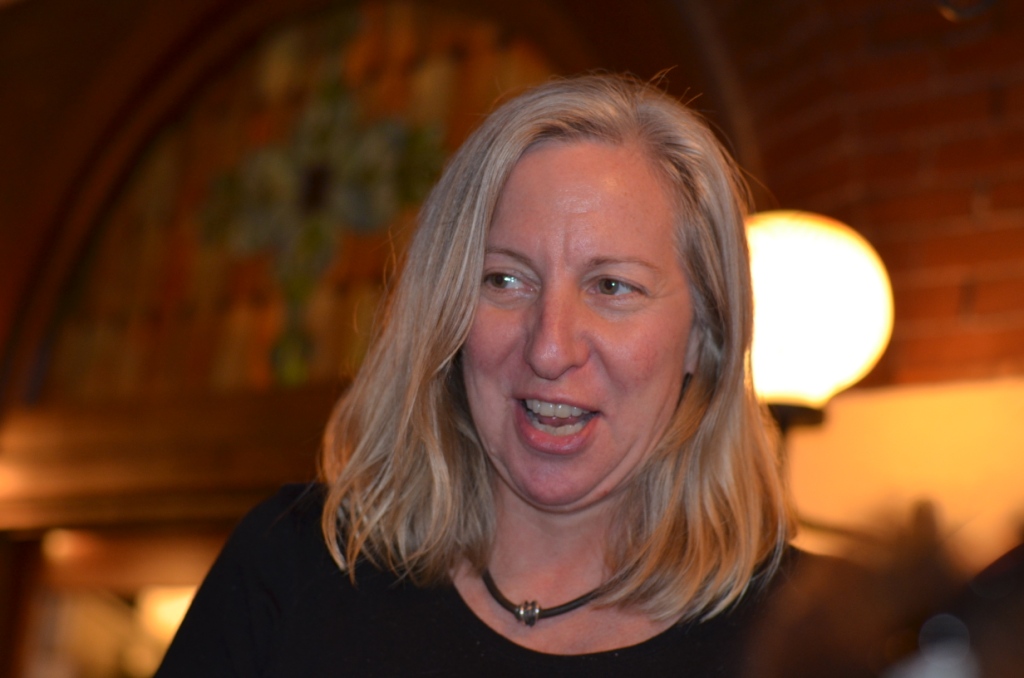
Chef Heidi Dinsmore
As we were settling into the dessert, Chef Heidi Dinsmore, the creator of the delicious experience, came to talk to us, so we had an opportunity to thank her and to tell her how much we enjoyed our evening, and how delicious the food was. If you are ever in the area of Norfolk, Connecticut, Wood Creek Bar and Grill should be on your list. Ahh, and I also have to say a very big thank you to our waitress Jessica, who did an amazing job managing our wine program, opening the bottles, changing the glasses and of course serving food – she was absolutely fantastic.
There you have it, my friends – the food, the wine and the company – a simple recipe for an unforgettable experience. Cheers!
Wood Creek Bar and Grill
3 Station Place
Norfolk, CT 06058
(860) 542-1200
http://www.woodcreekbarandgrill.com

Restaurant Files: Modern Classic or Classic Modern? Carl Anthony Trattoria in Monroe, CT
 When it comes to the Italian cuisine, or probably any cuisine for that matter, what constitutes a “classic cuisine” for you? Old familiar dishes, which stay unchanged for many many years (if it works, don’t touch it)? And then another question is what is the “modern cuisine”? You change the recipe all the time, just to make sure you use ingredients which are “in vogue” (like pork belly or Brussels sprouts today)? Or do you take the familiar dish and put a spin on it? If you ask me, I’m all for the “tasty” – I’ve had classics such as fried calamari or mozzarella sticks done in many unusual ways, so I generally don’t trouble myself with classification “classic versus modern” – if it tastes good, that’s all I want (okay, it is definitely a bonus when food also looks good).


Let me explain why I am taking about this classic/modern relationship. Few weeks ago we visited restaurant called Carl Anthony Trattoria in Monroe, Connecticut. The restaurant had been around for 15 years, and while it has a decidedly Italian flair, the menu represents that exact combination of classic and modern dishes I’m talking about here. You know what – forget this classic and modern – creative is the right word – and I think you will agree with me when we will be talking about food. But – let’s start with cocktails and wine.
The cocktail list was very creative (aha, see, I used that word again) – and here are some of the cocktails we tasted: Mambo Italiano (Averno Amaro, muddled mint and lemons, ginger ale), Black Cherry Mojito (Cruzan Black Cherry Rum, muddled mint and cherry), Cucumber Gimlet (Pearl Cucumber-fresh basil, lemon and lime juice on the rocks) and Clementine Caipirinha (Leblon Cachaça, St. Germain, clementine, orange & lime). Caipirinha was nice, but not necessarily my favorite – I simply prefer more lime.


The highlight of the cocktail extravaganza was the concoction called Campfire (graham cracker glass rim drizzled with chocolate syrup, Smirnoff Fluff Vodka, Baileys, flaming marshmallows). While I didn’t taste it, I captured it in the making:


When it comes to the wine, we didn’t really get a chance to look at the wine list, the wine were preselected for our dinner. The choice of red was 2011 San Giuseppe Pinot Noir Veneto IGT (12% ABV). I’m yet to find a Pinot Noir (or a Pinot Nero as it is typically called) from Italy which I would like – this was definitely not the one. This wine was flat and boring – it was drinkable, but really had no life in it (Drinkability: 7- ). The white wine, 2012 Donnachiara Fiano de Avelino DOCG Montefalcione (13% ABV) was very good – sweet fruit on the nose, plump, open, with touch of minerality and fresh cut grass, nice acidity (Drinkability: 8- ).


And now, to the food!
We started with the two appetizers: Bleu Chips (hand-cut potato chips, gorgonzola fonduta, fig jam, bacon) – a delicious combination, and besides – who can say no to the potato chips? And then the “Original” Balsamic Calamari – the name says it all – it is fried calamari, drizzled with the balsamic reduction – a somewhat unexpected, but a very tasty combination.


Our dinner continued with more appetizers. First, Heirloom Tomato Salad Bruschetta, where you could actually taste a difference in the tomatoes (many times I bought so called heirloom tomatoes in the store which tasted exactly the same as regular tomatoes). Next dish, Charred Hierloom Carrots (straciatella cheese, cilantro-honey citronette) was one of my favorites, as it was simple, yet delicious (I since made the carrots on the grill in the same style, and everybody loved them). Kobe Meatballs (tomato sauce, garlic bread) were very nice, but not necessarily better or worse many other well-made meatballs ( which to me means that they shouldn’t be too dense, and these were just fine). Burrata (bacon jam, pepperoncino) was traditionally delicious, but my very favorite appetizer was Fig & Beet (baby greens, goat cheese ricotta, onion, wildflower honey toasted oats, marcona almonds, Vincotto) – I’m very impartial to the beets salad in any shape and form, and the flavor combination of the beets, marcona almonds and figs was just spot on.


Next we had two entrees family style. “Loaded Baked Potato” Gnocci (hand-made potato pasta pillows, smoked bacon, broccoli, Italian cheddar) was can’t-stop-eating-this delicious and incredibly satisfying. I would even say “homey”, but – this is a descriptor for the next dish. Italian “Ramen” (hand-made noodles, chicken broth, local egg, parmigiano, pepperoncino) had such a surprising simplicity to it, nevertheless the whole table went “wow” after the first sip. I don’t know if chef Sam used some kind of magic potion on this soup, but despite the hot day, this soup was literally warming up the whole body and soul, and this dish alone will definitely worth a separate trip as the temperatures will stop dropping. Our last entree was served on individual plates, and consisted of Pig Roast (slow roasted “Porchetta alla Romana”, broccoli rabe, pickled farm stand tomato) and Wild Ivory King Salmon (spicy spinach, Sultana raisin vinaigrette, walnut romesco aioli). The Pig Roast was perfectly done – meat was falling apart, while the skin was delightfully crisp. And the Ivory King Salmon? Wow. This was my very first encounter with the white salmon – delicious, mild flavor profile, again, very comforting and satisfying.


Believe it or not, but we still got dessert after such a meal. Blueberry Upside-down cake was every morsel delicious. Then Coffee & Doughnuts. I can tell you that in general, I’m not a fan of doughnuts. But this cappuccino/chocolate semifreddo sauce was beyond delicious, it was divine – together with the doughnut, it was one incredible flavor combination. And the Quattro Crème Brûlée? You must love this dish for the presentation alone – and as a bonus, it was outright delicious.


As usual, we had an opportunity to talk to the Executive Chef and Owner Sam DeVillis:
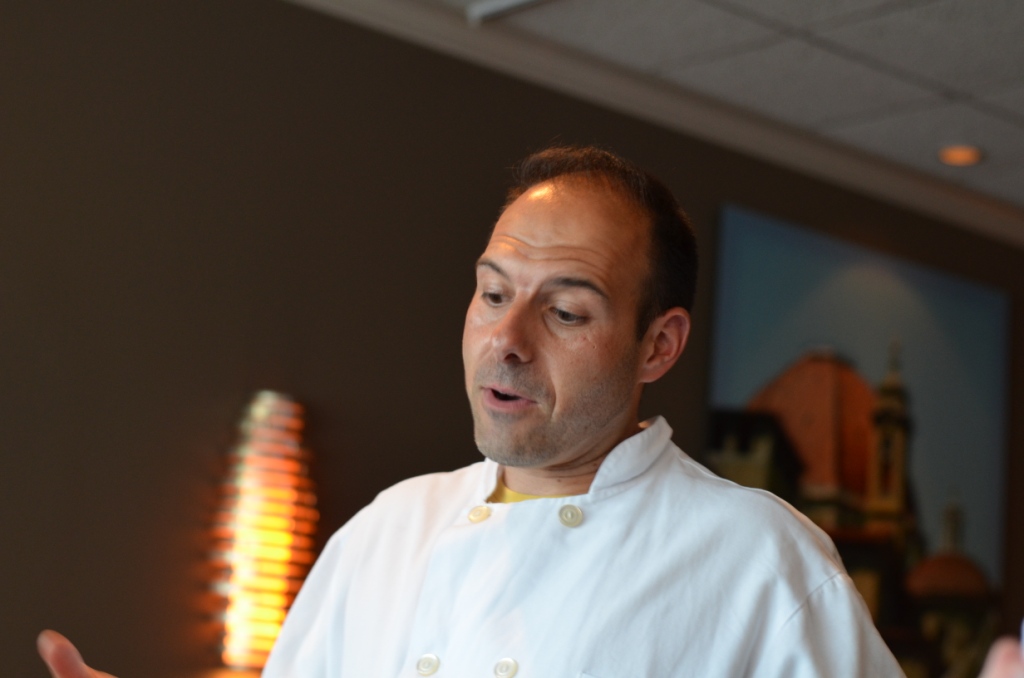
and of course we thanked him wholeheartedly for the spectacular meal.
There you have it, my friends. I can’t tell you if our dinner was more of a classic or modern, but it was top notch creative, and in and out delicious. As Carl Anthony Trattoria celebrates its 15th anniversary this year, I can only wish Chef Sam and his team best of luck to continue satisfying all the demanding foodies for many many years ahead. Cheers!
Disclaimer: I visited the restaurant as a guest of the management. All opinions are my own.
Carl Anthony Trattoria
Clocktower Square
477 Main St
Monroe, CT 06468
(203) 268-8486
http://www.carlanthonys.com/index.htm

How Do You Describe Coffee Smell In Words – Visiting Shearwater Organic Coffee Roasters
 Seriously, I really mean it as a question – how do you describe coffee smell? I’m asking here the people who cherishes or may be even worships the good cup of coffee – how one can describe that “pick-me-up” goodness when you walk into the room and smell freshly brewed, real, delicious coffee made with love? It is hard, right? You can describe the effects of that smell (invigorating, uplifting, awakening…), but not the smell itself. But – if you are into the coffee, it is enough to say “the wonderful smell of fresh coffee”, and we understand each other. And let me throw in a few pictures for the good measure…
When I walked into the shop of Shearwater Organic Coffee Roasters in Trumbull, CT, I felt like a kid in the toy store. It was all about coffee – the smell, the coffee makers, huge bags of coffee beans – it was all coffee, coffee, coffee. Shearwater Coffee Roasters has a very simple mission – to let people experience the best possible single origin organic coffee, one small batch at a time. This is a loaded sentence, so let me explain it in a few more words.
Let’s start with “organic“. All the coffee roasted at the Shearwater is USDA certified organic. The coffee comes from all of the world, from Guatemala., Colombia, Ethiopia, Costa Rica and other places, but only from the producers which had being certified by USDA as organic. USDA Organic requirements cover full lifecycle of the coffee production, from the soil and trees handling until the green coffee beans will be packaged for shipping. That organic certification also includes the Fair Trade Certification, which means that the people who grow the coffee are treated properly. Additionally, the Shearwater production process and the whole facility had being also certified by the USDA, so the final product which goes into the little yellow bags is in and out USDA Certified Organic.


Now, a few words about “single origin“. The best way to explain the concept is in the analogy with wine – this is the wine blog after all! Single Origin is really an equivalent of the appellation, or in some cases it can equated to the estate or even single vineyard. Same as grapes, the coffee is a product of mother nature – it exist in multiple varieties, and its taste will be affected by the soil type, the climate, the amount of water, the altitude – yes, you can call it a “coffee terroir” – and if coffee beans are treated properly from the bud breaking until it will make it into your cup, you will be able to taste it.
Now, the “small batch“: that simply means that coffee is processed (i.e., roasted) one small batch at a time. How small? 20 pounds to be exact. 20 pounds of fresh coffee beans are roasted at a time. That’s it – only 20 pounds. Working in the small batches, you have much better control over the process, and you can ensure that all the beans are roasted uniformly. And you can also make each batch to taste individually different. Which gets us to the last term I want to explain – “best possible”.
The “best possible” coffee combines everything which we talked about before – the organic, single origin, the small batch – but it is also a process of Artisan Coffee Roasting. At the heart of the Shearwater operation, supporting the passion of Ed Freedman, the Head Roaster, is the highly efficient machine called Diedrich IR-12, an infrared coffee roaster. This machine allows very efficient control of the temperature during the roasting cycle (which is very short – takes about 14 minutes to produce medium roast coffee), and the roasting process can be fitted exactly for each and every varietal and type of coffee, to allow it to achieve its fullest potential! How about that for the “best possible” coffee? As I said, I’m fully relying on pictures to share my excitement, so here is the machine:


The machine is controlled manually, but it allows full recording of the process (time/temperature changes ) on the computer, so for each batch it is known precisely how it was produced and how the process can be adjusted if and when necessary. On the pictures below you will see Ed Freedman explaining what happens during different stages of the roasting process and how it is recorded on the computer:


The process starts from the green coffee beans been loaded inside, and the temperature gradually increased until you hear coffee to start crackling, pretty much like popcorn. Once you hear that noise, depending on the type of roast you are producing (light, medium, French etc.), you will have to decide for how much longer to continue the process. Also you can all the time have the visual of the progress:
Once you are done, the coffee goes out of the roasting chamber and now it should be cooled off very quickly, to make sure it is not going to roast any more:


Once the coffee is cooled off, it goes into the bin to rest – the coffee needs to rest at least for 2 days before it can be packaged and sold:
 That’s it! Short 14 minutes, 20 lb of the green coffee beans become 17 lb of the wonderful roasted coffee, and you have a room full of delicious invigorating smell as a an added bonus. And you can also check what kind of roast did you achieve, using this simple set of the colored circles (of course you can buy a machine for $10,000 which will do that for you, but Ed feels quite happy with the circles : ) ):


That concludes my story about the Shearwater Coffee Roasters. They are located in Trumbull, Connecticut, so if you live close by or visiting the area, that might be a good place for you to visit (they sell all the coffees and coffee makers right at the shop). If you are not local, but still want to experience Artisan single origin organic coffee at its best, you can order directly from Shearwater web site.
I hope I managed to make your Monday morning – no, I can’t deliver the smell, but I hope I gave you enough coffee pictures so you can add the smell on your own. Oh yes, the cup of fresh coffee sounds divine – time to make one. Cheers!
Restaurant Files: Canoe Restaurant in Atlanta – Great Food, And Close Encounter With The Rare Bird
Think about your best restaurant experiences – what do they consist of? Of course the company is first and foremost – if you are in the wrong company, nothing will taste or appear right – this is given. So outside of the company, food, wine, service, views, decor, ambiance – all play a role, these are all essential factors of your great restaurant experience.
As I mentioned many times before, when traveling, I always look for the opportunity to experience new restaurants. My last trip to Atlanta, Georgia was not an exception by all means – of course I looked for a good restaurant to visit. I used Yelp as my reference source, and it worked quite well. Canoe restaurant, located in the Vinings neighborhood, was well worth the 4.5 stars yelp rating out of 626 reviews (this was the number of reviews at the time of our restaurant visit).
I read in some of the reviews that the Canoe Restaurant had a perfectly romantic appeal. It definitely had, especially considering how dark it was in the dining room (hooray to all the FlashLight apps on the smartphones, we would be left hungry without them). But on a more serious note, the restaurant is situated right by the river, with luscious greens and smart lighting making an outside look like it was a Thomas Kinkade’a painting. My photos will not do any justice to that outside setting, but I hope they will give you an idea of beauty and tranquility.


Going back to our dinner, while everybody were looking at the menus, I grabbed the wine list (what a surprise, right?). That wine list…. How can I describe it… It was probably the best wine list I ever held in my hands – there was an incredible amount of the excellent wines (that it not necessarily unique), priced in a very (did I say “very”?) appealing way. Moreover, one line in that list almost made me speechless – the rare bird was there, and it looked almost, almost – for the group of like-minded friends – affordable. Take a look below – can you spot the rare bird I’m talking about?

I’m assuming you found it – yes, it is the Screaming Eagle. Of course $850 is an exorbitant amount of money for the bottle of wine, but considering that this wine is simply impossible to find at any price, it might not sound that bad – I have a few friends who would simply jump at such an opportunity. But I was not with those friends, so as you can imagine, I was left salivating about such a close encounter with this rare bird.
Have you ever got excited of seeing something, took a picture, and only later on, looking at the picture, noticed that there was a more to see in the object of your “excitement-driven” photograph? This was precisely my case. Only looking at. The picture I realized that the Screaming Eagle bottle was actually a second label of this cult wine, called Second Flight (it doesn’t make a difference from point of view of the opportunity of trying this rare wine). Then also noticed lots of other cult wines being present in that list, such as Harlan and many others, many at a extremely reasonable price (for example, Peter Michael Le Pavots retails for $175 – $225 on the wine list is a steal). Anyway, I think I have a great incentive to go back to Atlanta, and drag a couple of friends along.
Enough about the wines we didn’t drink, let’s talk about the wines we had. For the white, we got the 2012 Sigalas Assyrtiko-Athiri, Santorini, Greece – touch of minerality on the nose, white stone fruit, refreshing palate with crisp acidity and more of the white stone fruit undertones. Our choice of red was 2011 Chehalem Three Vineyards Pinot Noir from Oregon – nice smokey nose, good fresh red fruit on the palate, some raspberries and sweet cherries, good acidity and good overall balance. It was nice and easygoing wine to drink, and it complemented well most of the group’s dinner selections.


Now, let’s talk about the food. Our waiter (we had a great service, by the way) explained that the restaurant’s specialties are the game and seafood. Somehow, I felt like embracing seafood (we only scored 9 pm reservation, so it was rather a late dinner), and I didn’t regret that at all. For the started, I had an Grilled Australian Octopus (Chorizo, Peppers, Horseradish Tomato Broth) – the octopus was perfectly cooked and it was chewy just enough to preserve the texture, and very tasty overall. For the entree, I went with Bacon Wrapped George’s Bank Monkfish (Asparagus, Brioche, Grape Tomato Vinaigrette), which was absolutely delicious – perfectly cooked, the flaky fish was melting in the mouth, and the vegetables were nicely fitting in.


And then it was the time for a dessert. Our waiter, who brought the dessert menu, mentioned that restaurant’s pastry chef was a genius, so after such an endorsement I had to change my mind (I wanted to skip the dessert altogether). With the dishes such as Caramelized Goat’s Cheese Cake (Bourbon Cherries, Balsamic) or Rhubarb Crisp (Strawberry Ice Cream, Oatmeal Crunch), it was almost impossible to decide on something. I ended up taking Popcorn Ice Cream Sundae (Canoe’s Cracker Jack), which was absolutely delicious and very unusual. Freshly made vanilla ice cream with chocolate covered popcorn and caramel sauce – this might be one of the possible spellings for “nirvana”.
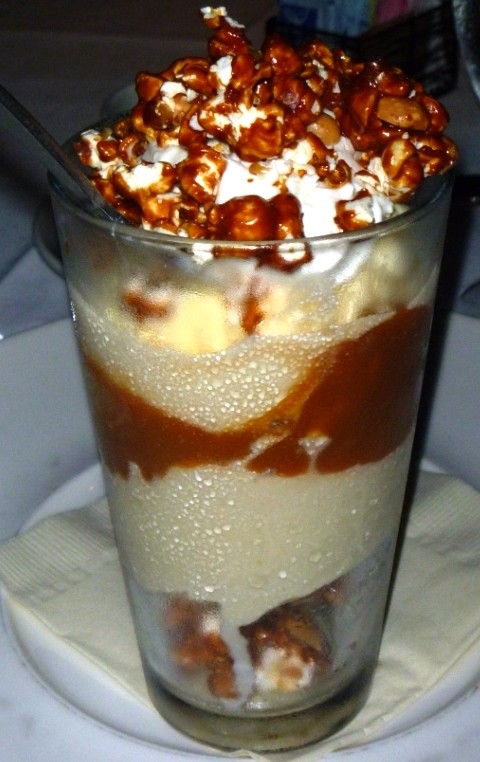
To conclude my report of the wonderful dining experience, I can only say that this was an excellent and very memorable meal, and if your travel plans will take you to Atlanta, I highly recommend you will find the time to visit the Canoe Restaurant – and you can thank me later. Cheers!
Canoe Restaurant
4199 Paces Ferry Road, SE
Atlanta, Georgia 30339
(770) 432-2663

From Family Recipes: Olivie Salad
There are recipes. And then there are family recipes. What is the difference, you ask? Family recipes are more of a traditions. They don’t have to be secret recipes (well, let’s leave the secret recipes discussion for another time), but they are passed from a generation to generation virtually unchanged. They are treasured, and they have a lot of memories connected to them.
It just happened that for me and for my wife, as we were growing up in the same city (large one, mind you – with about 1.6M people living there), one and the same salad was a food icon. This salad, called Olivie, was probably the most popular and famous salad in Russia, or may be I’m simply biased. The origin of the salad is unclear. I was always under impression that this salad came to Russia from France – but according to many sources on Internet (well, they all might be copying from each other), the salad was created in 1860s by the Belgian Chef Lucien Olivier (hence the name of the salad), who was working in Moscow in the French-style restaurant called Hermitage. It seems that the list of ingredients supposedly in the original salad varies widely from the source to the source, and really has nothing to do with the Olivie salad as I know it. But, at this point, I think this is rather a matter of historical curiosity, and not overly important for what we are talking about here.
The salad essentially is very simple, and has only 7 ingredients – potatoes, carrots, meat, pickles, boiled eggs, sweet peas and mayo. Of course a number of variations exists, firstly evolving around the use of different kinds of meat (bologna, boiled/roasted chicken and boiled beef are all possible options), but then some of the other ingredients sometimes can be omitted or substituted. But – once the recipe is changed, it is not the family recipe anymore, it becomes “some other recipe”. In a nutshell, here are all the ingredients of the Olivie Salad:
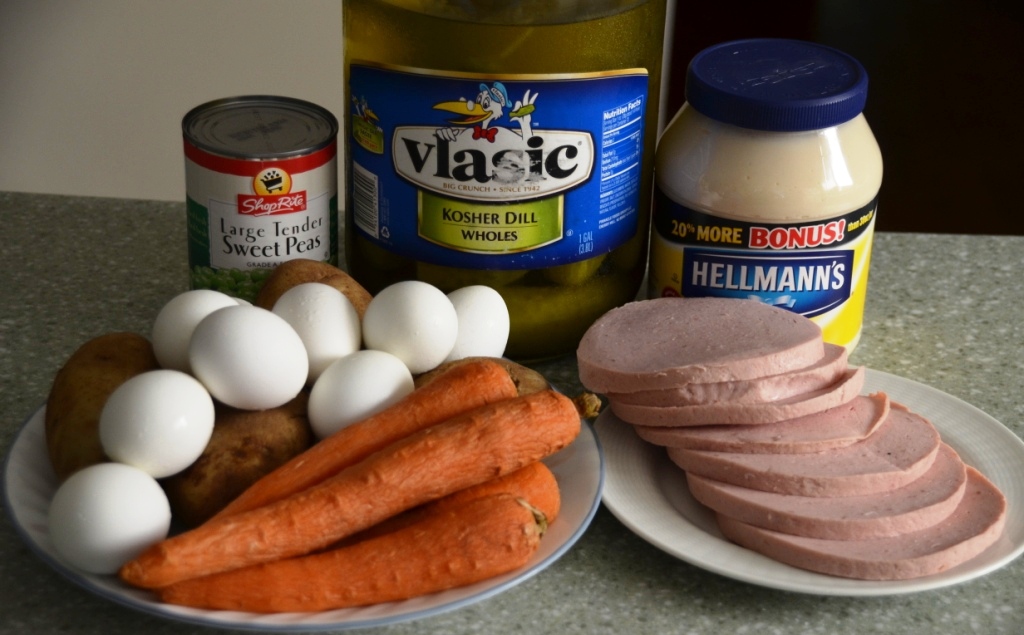
Here is the same, but zooming in on all the individual ingredients:


The family recipe is often associated with the happy moments in life, as it would be typically invoked for the special moments, whatever they are. While now we can make this salad any day (it was not always the case growing up back in Russia – some of the ingredients, like sweat peas, for instance, were very hard to find), it is still typically associated with holidays or at least special dinners of some sort (like a visit of good friends). Also, it is almost a privilege to make this special recipe – 95% of the time my wife simply doesn’t let me to make this salad, exactly as my Dad was, as I don’t always cut all the ingredients uniformly, and this is a big issue in her eyes (and I can’t argue with perfection).
In general, when I cook, I take very relaxed approach to the substitution of the ingredients, use of specific brands etc. – I believe it is totally okay to perform substitutions as needed. Except when it comes to this Olivie salad. If you want to make Olivie salad according to the Levine family recipe, no substitutions or changes are allowed, outside of what I will mention below. Don’t get me wrong – you are free to do what you want, it just not going to be the Levine family Olivie salad.
Okay, time to get to it. Below is the list of the ingredients you will need, and the instructions (very simple, mostly in pictures!) are follow. One more important note – the recipe below will yield the amount good enough to feed a small army, but this is the only way we make it, so feel free to cut it down accordingly.
Levine family Olivie Salad:
4 Medium Potatoes, whole, unpeeled (Russet, White or Idaho – don’t use Yukon gold, it will not retain the shape after it is cut)
4 Large Carrots, unpeeled
1.25 lb good bologna, whole or sliced into quarter an inch rounds (don’t use supermarket deli Bologna, go to the German or Polish specialty deli)
8 medium size pickles, use only Vlasic Whole Kosher Dills, no substitutions!
8 medium hard boiled eggs
1 large can of sweet peas (any brand :))
About 1/2 cup Hellmann’s Real Mayonnaise – no substitutions!!!
Wash potatoes and carrots, don’t peel, and boil them for about 20 minutes (start timer after the water started to boil). You can check readiness with the knife – you should be able to poke through with very little resistance. You want to boil carrots and potatoes with the timer, as you don’t want them to overcook – if they do, they will lose shape once cut. Once potatoes and carrots are boiling, boil eggs for about 10 minutes. When potatoes and carrots are done, transfer them into the cold water to stop cooking process, also cool down the eggs. Get all the ingredients on the plate, and let them cool off so you will be able to handle them.
Next step – peel off and discard skin from potatoes and carrots. Peel off the shell from the eggs, then wash them and dry – you don’t want any pieces of shell in the salad. Okay, now all the prep work is finished, and all you have to do is to cut the ingredients (dice might be a better word).


Dice potatoes into about quarter of inch squares, same goes for carrots, eggs, bologna. Cut the pickles and put them in the strainer – you don’t need extra liquid in the salad. Open sweet peas, drain them completely (again, use strainer), and add them to the bowl.


At this point you need to mix everything together – tread lightly, as you don’t need a mush instead of a salad. Once you are done mixing, taste it – you looking for the balance of flavors. If you think you need more salt or acidity, add more pickles – in the end of the day, you just want to arrive to the tasty combination.


Now, the last step – you need to add mayo. This should really be done “by the taste”. Start from the small quantity, mix it, taste it, and add more if you think you need it. This salad must be served cold, so you have to put it in the fridge before you will serve it. The best thing to do is to let the salad chill, and then add more mayonnaise right before you will serve it – this way it will look and taste the freshest.


There are few possible modifications to this recipe. One is to replace bologna with chicken or beef. The trick is that to cook either one just enough that it will be ready, but not overlooked, because overlooked meat will just break down and it will not be Olivie salad anymore. You can bake or boil chicken breast (should be breast only, as you don’t need any extra fat). If you will use beef, you have to boil it – or if you will decide to roast, it will have to be well done, as you can’t have any blood in this salad.
Last modification you can make is to add a tiny amount finely finely diced white/yellow onion. My dad used to do this, and it adds a nice note to the salad in my opinion, but it is a big no-no in our house now.
There you have it – Levine family recipe Olivie salad. Feel free to comment, especially after you will try it. Cheers!
Magnificent Views and Delicious Food – The Mountain House in Woodside, California
 When it comes to selecting the restaurant for a dinner, especially if you have a time to plan it, the overall location and “the view” are important in that process. Thinking about my own experiences, most of my “views” had been of the water – sea, bay, lake, river – some type of water was involved most often. Dining out looking at the sea is definitely magnificent and memorable, but that shouldn’t limit your choices.
I remember about 5 years ago stumbling upon a restaurant in the San Francisco area, up on the mountain drive. We were just passing by, enjoying the beautiful drive through the redwoods park, but then we thought – hmmm, might be a good place for a dinner. The experience was wonderful (I didn’t have a blog at that time though 🙂 ), so I always wanted to come back and experience the place again. Finally, the opportunity presented itself during my very recent trip to San Francisco, and making reservation at The Mountain House was one of my top priorities of the trip.
In essence, your restaurant experience starts from the moment you enter the Redwoods park – well, mine did for sure. I don’t know about you, but when I look at the redwoods, straight as an arrow, and almost having no start and no finish, just going up into the sky, I almost feel an awe, a reverence. A slow drive while surrounded by those magnificent trees (the road has enough of the very tight curves and turns to ensure your ride will be slow), creates a certain atmosphere, it puts you in the very special mood. Once you arrive, if you are a few minutes early, you can fully admire those amazing trees. And if you want to feel it for the fullest, arrive really early with some spare shoes, drive about a mile past the restaurant and spend time on one of the hiking trails – the silence which you can experience while standing among those trees, is something which is only possible to feel in a very few places on Earth, especially for those of us who lives in the cities and towns.


Finally, you are in the restaurant and ready for the dinner. The best place to seat ( assuming you are there during the warmer times) is outside on the terrace. The terrace is completely screened, but you can see an open sky and the magnificent trees right above you, which greatly enhances your dining experience. Before we talk about food and wine, I would like to mention that the restaurant has a long history. It had been around since 1920s, and through all these years had only three owners. The present owners had been at helm for about 27 years – all of this history commands great respect in my book.
Okay, food time. Err, no. Let’s select the wine first. The wine list at The Mountain House is expectedly California-based, which doesn’t come as a surprise. Two things make me very happy with that list. First, the selection is very good, with enough variety, but not overwhelming. Second, a lot of wines are offered at a very reasonable prices, often at around double retail or even better. I couldn’t make up my mind between 2010 BV Rutherford (retail about $25, restaurant – $63), 2008 Ridge Zinfandel Lytton Springs (retail – about $40, restaurant – $72) and 2010 St. Clement Oroppas (retail – about $45, restaurant: $70), until Irene, Matr’D, confidently said – try Oroppas, you will not regret it.
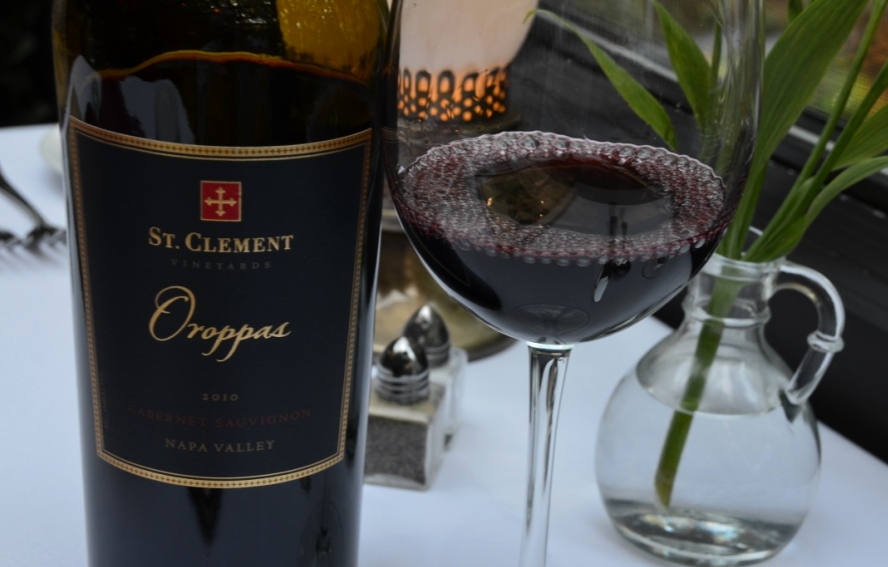
I had St. Clement wines before, and have a lot of respect for them. 2010 St. Clement Oroppas Cabernet Sauvignon Napa Valley (14.6% ABV) had beautiful dark garnet color in the glass. On the nose, the wine showed cassis, a hint of blueberries and a touch of espresso. And the palate… Boy, it is so hard to describe what was going on on the palate. On the palate, this wine was powerful and dense. Dark fruit, perfectly restrained, thick, practically chewy mouthfeel, perfectly structured and dry, and layered and silky smooth at the same time. The wine was at the level when you want to follow every sip with the words “mmm, this is good”. Drinkability: 9-
And finally, it is the time to talk about food! We started with Ahi Tartare Tacos (cucumber, avocado, tahini – miso vinaigrette with jicama slaw), which had very interesting Mediterranean flavor profile, I guess due to the tahini, and nice texture, based on large chunks of tuna and avocvado. We also had a simple Kale Salad (shredded brussells sprouts, marcona almonds, pecorino romano, lemon vinaigrette), which was very refreshing.


The Mountain House’s specialty is game, so it was easy for us to decide on the entreé. In a word, Tea Smoked Pheasant Breast (Apricot-Sherry wine Sauce and Mediterranean couscous) was outstanding – moist, delicious, with incredible flavor profile, very very tasty. And then the special of New Zealand Elk Medallions, prepared with cherry port reduction sauce and served with steamed vegetables, was simply spectacular – the meat was melting in the mouth, the sauce was perfectly complementing the meat, and the wine fully matching both the sauce and the meat – definitely one of the very best pairings I ever experienced. I also want to add that the wine was working very well with the first entreé, complementing the gaminess of the dish.


Despite the fact that we didn’t leave the morsel on the plate, we still decided to try the dessert, just to see if it would be on par with the delicious meal. Strawberry-Rhubarb crisp (vanilla ice cream) and Butterscotch Pot de Creme (creme fraiche, caramel and sea salt) were both very tasty, with me having a small preference towards Pot de Cream – salt and caramel are always good together. However I have to mention that this Por de Cream dessert was a bit too rich, so we couldn’t finish it.


Service was great, timely and attentive.
That concludes my report about The Mountain House. If you are in the area, you definitely don’t want to miss this restaurant – I’m sure you will enjoy it as much as I did. Cheers!
The Mountain House
13808 Skyline Boulevard
Woodside, CA 94062
(650) 851-8541
http://www.themountainhouse.com/

Restaurant Files: Davanti Enoteca, Rama Thai and Sushi Ota in San Diego
In my previous San Diego post, I gave you my version of a perfect day in San Diego, where of course the food was a very important part of the experience. Today, I want to add a few more of the restaurant suggestions, just to expand your cuisine selection.
Let’s start with Davanti Enoteca in the Little Italy neighborhood. The restaurant is appropriately Italian for the Little Italy area – but if the word “Italian” brings up an image of mozzarella sticks or a pasta with meatballs, shoo those images away, as they have nothing to do with modern, exquisite, creative Italian dishes served at Davanti Enoteca.
When you look at the Davanti Enoteca restaurant on outside, it is hard to tell what to expect. Inside, the restaurant is nice and welcoming, and offers a number of sitting options including [unexpectedly large] completely enclosed patio, which creates a great dining atmosphere.
So you are situated inside, and it is the time to eat. How about some Focaccia di Recco (Ligurian style baked focaccia, fresh soft cow cheese…must add honeycomb) for the starter? Very different from what you might expect, this one comes with the layer of soft cheese baked into a paper- thin crust. Addition of honeycomb on top increases “deliciousness” ten-fold. When you take a bite of that focaccia, the foodie’s climactic moan can be easily heard at the table. To keep the excitement level high, how about some Mascarpone Polenta with pork ragout – every morsel as delicious as the Focaccia. And then how about some Bruschetta? No, not the traditional tomato and onion, but may be a Creamy Avocado Mousse Bruschetta will do? Very unique and different again. Keep in mind that both Bruschetta and Mascarpone Polenta might have different toppings on different nights – but I’m sure they will be every bit as tasty as the ones we had.


When you look at the list of entrees, one thing becomes clear – it will not be easy to make a choice. You definitely got options. For instance, a Polpo con Rafano (seared octopus, warm fingerling potato salad, marcona almonds, finocchiona, fresh horseradish aioli) – perfectly cooked octopus (not an easy task in itself), absolutely delicious with all the little condiments there on the plate – every bite makes you happy. Spada Davanti (grilled swordfish, toasted bread crumbs, calabrian chili, brussel sprouts, calabrian chilies, mint) – another home run.


Craving meat? Davanti Burger (special blend beef burger, bacon jam, roasted tomato, cheese curd, arugula, roasted garlic mayo, shoestring fries) – it is just a wow on the plate. I had a pleasure to experience the famous Boulud Foie Gras Burger – this Davanti Burger will give it a good run for the money, it is so juicy and delicious (and those shoestring fries are addictive!). And if you are in a mood for a steak – Bistecca con Cippolini e Funghi (grilled hanger steak, cippolini onion, grilled oyster mushroom, saba, salsa verde) is just what doctor ordered – succulent meat and great combination of flavors.


You know I have to talk about wine, right? Wine list at Davanti Enoteca is not large, but it has a good amount of interesting selections at reasonable prices. Focus is mostly on the Italian wines as one would expect. We had two wines that evening. 2012 Attems Sauvignon Blanc Venezia Giulia had an excellent herbaceous profile, both on the nose and the palate, with some notes of fresh cut grass and hint of grapefruit skin, only a delicate hint, and perfect acidity. Definitely very nice wine. Our choice of red, 2012 La Fiera Montepulciano d’Abruzzo was fresh and lovely, with the very pronounced, but soft tart cherry profile and a hint, a whiff rather, of a cherry pit – light and simple, and very versatile food wise.


When it came to the dessert, I honestly stopped paying attention to what exactly did we order – I know that I tried a few different desserts and they all were very tasty.


Let’s continue. So far, considering both San Diego restaurant posts, I offered to your attention mostly restaurants with European cuisine. I think it is time to change the direction and go towards Asia.
Rama Thai Restaurant is located in the Gas Lamp Quarters, a primary dining destination for people living in San Diego and visiting from afar. From the moment you set your foot inside the restaurant, you are transported – you know I like to use this term a lot when I talk about wines, and it simply means that your experience affects your emotional state, the way you feel at the moment. This is definitely the case with Rama Restaurant. The ambiance, lighting, decor, the music, pictures on the walls, muted sound of creek-running water, statues of Buddha – all of it puts you in a different mood.
And then, to our delight, the food perfectly matched the overall atmosphere. We started with the few appetizers. Satay Skewers (chicken and beef with peanut sauce and cucumber salad) was perfectly done, with peanut sauce being simply delicious. Same goes for Fresh Spring Rolls, which were super fresh and crunchy, also served with similar peanut sauce, with just enough heat to make it very tasty. The Pot Stickers (pork, ginger soy sauce) were not necessarily unique, but cooked just right.
For the entrees we went with a very nice selection of the dishes. While Pad Thai is generally considered “The Dish” in the Thai restaurants, my personal favorite is Drunken Noodle (flat rice noodles, thai basil, tomato, chili garlic, kai lan) – for me, it has some homey delicious feeling, this is my ultimate Thai comfort food, which I’m ready to eat any day. The next wow dish was called Garlic and Pepper (crusted chicken, beef or shrimp, sweet and spicy reduction) – we had the chicken version, and every bite was perfectly crunchy and just right spicy – I can highly recommend this dish. Salmon Panang curry (ka‑r lime leaves, green beans, cherry tomatoes) was very well balanced dish, with Panang curry flavors being present, but mild enough. Last, but not least were Pan Seared Sea Scallops (with sautéed spinach, chili sauce) – you know, when the scallop is seared and done just right, it needs no explanation to any scallops aficionado, so this was our case. All in all, great meal, and I can’t recommend this restaurant high enough as a whole experience, with ambiance being a big part of it (and great service). Sorry, have no pictures for you – to get the pictures, I would have to use the flash, and I really didn’t want to disrupt the atmosphere…

Last but absolutely not least for today is the Japanese restaurant called Sushi Ota (yes, we are continuing to explore the Asian cuisine of San Diego). Sushi Ota is considered to be one of the very best sushi restaurants in San Diego (4.5 stars based on 1676 reviews on Yelp, very impressive), so one would probably expect to find such a restaurant again in the Gas Lamp district or may be somewhere in downtown, surrounded by many other restaurants. When you drive to Sushi Ota, you take the highway exit, and the very next thing you do is start thinking if you had the right address written down, as you clearly see that you are in the area of car dealerships and small business offices, far away from the perceived “hot dining setting” by all means. But then GPS tells you that you have arrived, and you barely notice the name “Sushi Ota” on the sign of the tiny strip mall. Yep, you actually arrived to the one of the very best sushi joints in San Diego. I also hope you actually made a reservation at least few days in advance, because otherwise, you will need tremendous amount of luck to score even single sit by the bar.
At 5;30 pm, when the restaurant opens for dinner, it instantly gets at least half full, and it is a full house at 6 pm. What matter is that you got your table, so it is time to eat.
As a starter, we took a Tuna Tartar dish. This is not your average Tuna tartar – it is presented on top of tempura eggplant, and each one of the 4 pieces has different topping. This dish was done more of a single bite style (a big bite, I have to say), and really delicious.


Next up – Clam Miso Soup. It is a “kicked up” Miso soup as it contains a few clams in the traditional aromatic broth – definitely a nice touch.
 Our next selection (highly recommended) was the Spanish Mackerel sashimi. What you get is essentially the whole fish, with all the meat cut up in the small sashimi pieces. I like Mackerel sashimi in general, but it never tastes like the one we got at Sushi Ota. Typical mackerel sashimi is rather on the dry side, and can be even chewy. The one we had at Sushi Ota was succulent, sweet, soft and was literally melting in the mouth. Take a look at how it is served:
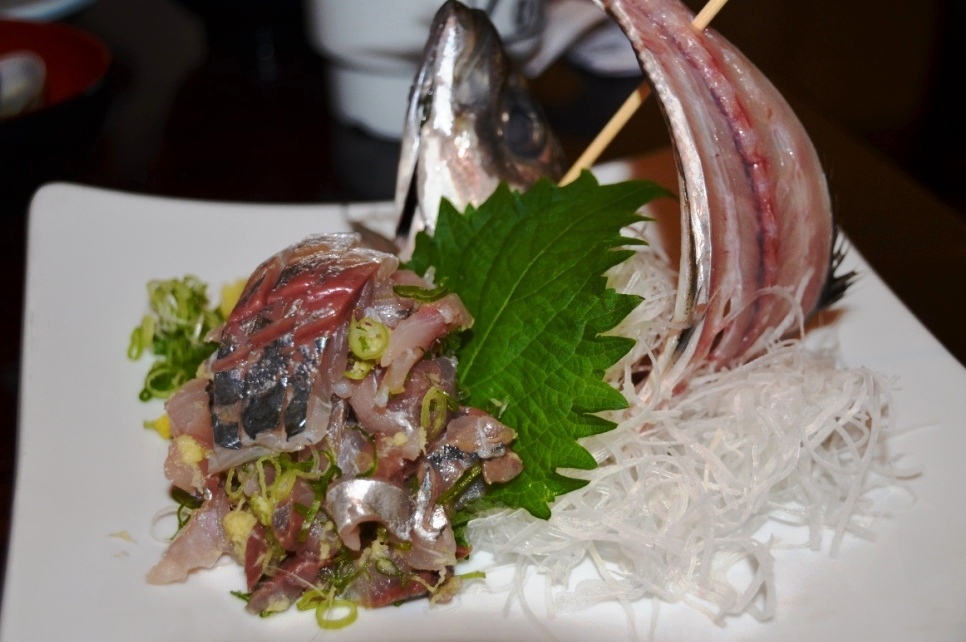 As you can see, you do get literally the whole fish. Wonder why you are get served the bones too? Well, once you done with the sashimi, the plate is taken away from you, only to be brought back in about 20 minutes after that fish skeleton was deep fried to the point that you can literally eat it like the potato chips! It is so tasty you literally can’t leave anything on the plate! Here you are:
 And then, of course, we had sushi. We got a few different rolls and Uni (uni, a.k.a., sea urchin, you can eat only when it is super-fresh, and that’s the way it is at Sushi Ota). For the rolls we got Double Double Tuna, which is a combination of spicy tuna and regular tuna on top, as well as Eel Roll – fresh and delicious. And to finish the meal, of course, the mochi ice cream – green tea and mango. All in all, an outstanding meal, which makes you to leave the restaurant with the promise to self to come back as soon as possible.


That’s all I got for you for today – more choices for your possible San Diego trip. If you have already or will visit any of these place, I would love to know what do you think. And until the next time – cheers!
Last Bottle Sign Up ($10 credit)




 Talk-A-Vino