Simple Recipes: Chicken Liver Pate
It’s been a while since I published any recipes on this blog. It doesn’t mean, however, that I don’t have any recipes to share. So let’s correct it.
As the title says, I like simple recipes. The meaning of “simple” is relative. For example, I’m sure that the absolute majority of people consider an omelette simple – both in recipe and in the making. And yet making an omelette can be a test for the chef, which is easy to fail. And take a look at the Japanese omelettes, those that are oozing when sliced on top of other food. Good luck making those in your home kitchen. Simple? Maybe not so much.
In my book, simple means primarily the way of cooking. For example, chicken legs or braised beef in the slow cooker are simple – put together all ingredients at once, turn it on, close the lid, walk away, come back in 6 to 8 hours for a delicious meal. That is what I call simple. Making delicious onion soup, on the other hand, is very far from simple. Despite a very few ingredients, the process is very involved – look away, and you will have to start all over. I’m sure you got my point.
Okay, now to the chicken liver pate. I love chicken liver pate. When it is well-made and tasty, just spread it on the toast, maybe add some onion preserve or a cornichon, take a bite, and your taste buds start singing. To me, it is one of the simple pleasures.
I started making chicken liver pate a while back, as it is very difficult to find a tasty version in the store. For the longest time, my go-to recipe was the one from Emeril Lagasse from the Food Network, which I followed very closely. Making chicken liver pate using this recipe is an involved step-by-step process, requiring about an hour or a bit more of active labor.
And then there is Instagram. It really became a source of cooking inspiration for me, with lots and lots of interesting recipes (not all recipes are created equal; you have to be ready to fail). A few days ago, I saw someone making a chicken liver pate in a very simple way, combining all ingredients in the tray and baking all at once in the oven, then processing it through the blender, and voila – enjoying the chicken liver pate. So I decided to try more or less the same, just incorporating a couple of elements from Emeril’s recipe into the process.
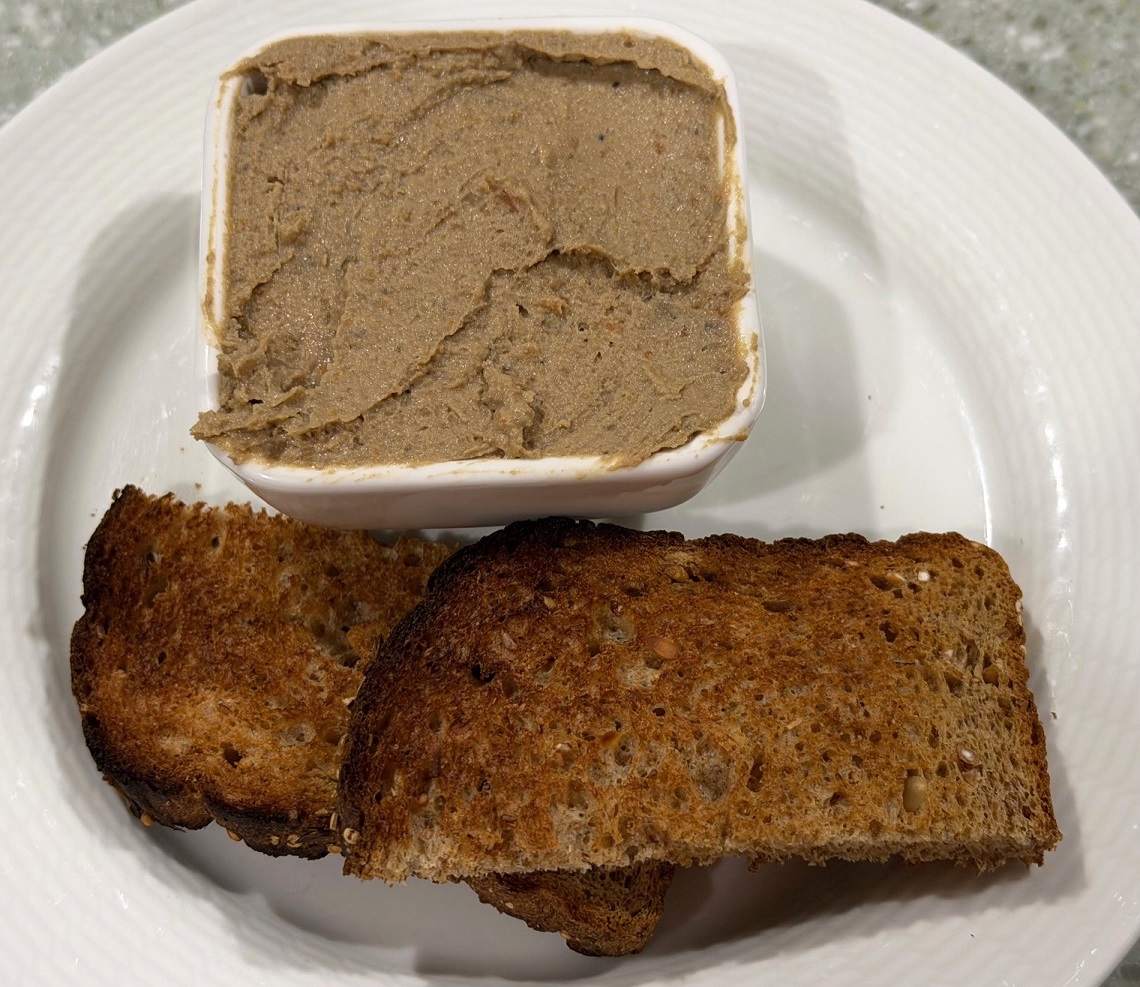
Two elements that I decided to add were cognac and green peppercorns. While making the chicken liver pate throughout the years, I tried different options, and found both irreplaceable, at least for my taste. So here is my new favorite recipe for the chicken liver pate.
Ingredients:
- 1 pound of fresh chicken livers
- 1 stick of butter
- 1 large red onion, sliced into 8 pieces
- 2 carrots, peeled and roughly sliced into big chunks
- 1 Granny Smith apple, cored and sliced into quarters (don’t peel it)
- 3-4 garlic cloves
- 1/4 of a cup Cognac or Brandy
- 1 teaspoon green peppercorns
- 3-4 bay leaves
- 3-4 allspice
- Salt and pepper to taste
Directions:
1. Preheat oven to 350 F
2. In a small roasting pan (I used a 9×9 glass pan), combine chicken livers, slices of carrots, onion chunks, apple chunks, garlic, 1/3 of the stick of butter sliced into chunks and placed evenly, bay leaves, and allspice. Add salt and pepper.
3. Put into the oven and bake uncovered for 45 minutes.
4. Take the pan out of the oven, add green peppercorns, and pour in the cognac. Mix the contents of the pan, and put it back into the oven for 10-15 minutes.
5. Take the pan out of the oven. Let it cool for 5 minutes or so. Remove bay leaves and allspice.
6. Transfer the content of the pan into a blender and add the rest of the butter (2/3 of a stick) to the blender in small chunks.
7. Blend until smooth, 2-3 minutes, scraping the walls of the can as needed.
8. Transfer into a glass container, let it cool off, and place it in the refrigerator for 3-4 hours (preferably overnight).
That’s all! Next, enjoy it with the toast or whatever way you like.
Notes:
1. Emeril’s recipe calls for soaking chicken livers in the milk for 2 hours in the fridge to remove bitterness. I have done it both ways, soaking and not, and I don’t see a difference. I didn’t soak it this time, and it was just delicious.
2. You can adjust the amount of green peppercorns to your liking. More peppercorns means spicier pate. But it is a mild spice.
3. Don’t substitute green peppercorns with black. The taste will be too aggressive. Green peppercorns are also softer, so if you use black peppercorns, the texture will be affected. If you can’t find green peppercorns in the store, you can buy them on Amazon.
4. Don’t substitute cognac with other types of alcohol (yes, you can use Armagnac or other brandy). Cognac brings both sweetness and a flavor profile that goes well with the other ingredients. I tried once using a bourbon, and the taste was ruined.
That’s all I have for you for now. But more of the simple recipes are coming.
Bon appetit!
Leave a comment
Last Bottle Sign Up ($10 credit)




 Talk-A-Vino
Good recipe! I’ve never used apple.
Thank you! It was unexpected for me as well, but I was very pleased with the result, so will keep it in from now on. The end result was really enjoyable 🙂
A dangerous downfall for me, as it is totally addictive and I do miss when it was just part of the complimentary appetizers for dinner at restaurants.
Just made a fresh batch today. Come on over!
Anatoli,
You are very kind, I think I may get my Bride to make some, she said that years ago, before I appeared on the horizon, she said that she used to make it quite often. We shall see.
– John