Archive
What Are [The World’s] Your Best Wines?
 This post was prompted by a Share and question posted on Facebook by my dear friend Kfir Pravda. He shared an article from The Art Of Life magazine titled “Some of the World’s Best Wines“. As I skimmed through the article, the very first feeling which came up was … anger. Anger is a very bad adviser, and in the most of the cases people regret the actions taken while angry. If you are angry, the best thing to do is to do NOTHING, and this is pretty much what I did – well, to be more precise, I promised to write a blog post on the subject, so here we go. Warning: this will be most likely long and mumbling post, more of thinking out loud in search for a truth which might not exist – if you are not in the mood for that, you should probably stop reading right now.
All the feeling aside, let me just explain what triggered the initial negative reaction. The article presents the list of “some of the best wines in the world” – all the wines cost in excess of $350 per bottle (with two exceptions), and many cost more than $1000 per bottle. All the wines except one come from France (one is from Germany). Last thing – I’m missing the logic behind the selection of the particular group of wines with designation of being “some of the best in the world” – if such claims are made, it is always good to see a logic behind it. With so many amazing and rare wines coming from all corners of the world, the top list must include the wines from Italy, Spain, Portugal, US and Australia, as a bare minimum.
Taking it one step further we can come up with an interesting question – is there a such thing as “best wine in the world”? Or even can there be such thing as “best wine in the world”? Yes, we like to designate objects to be “the best in the world”. Why is that done? I guess we need something to aspire to, something to adore, something to be moved by. It is also gives us something we want to experience – somehow, one day, yes, that would be great. When it comes to many “best in the world” things, such as art, architecture and places in general (like mount Everest), chances of “experience” are quite decent. We can experience such things ourselves – no, not own that Picasso painting, but to see it and to be as close to it as we want to at the art exhibit, for instance, or we can travel to Paris and take a tour of Eiffel Tower. If nothing else works, we can read a book or watch a movie – if good, this will bring us fullest possible experience of object of our desire, “the best in the world”.
When it comes to wine, it gets a little tricky. To begin with, I mentioned in a number of posts the definition of a good wine – in the words of Kevin Zraly, “the one which will give you pleasure”. How much pleasure can you get from reading the description of the wine, even if the wine is designated as best in the world and it is very expensive. Yes, from reading the description I can appreciate the fact that someone else thinks that this wine has a flavor of black currant, and that it costs more per bottle that trip to Paris to see Eiffel Tower, including cost of the meals – I don’t know about you, but I don’t get that much pleasure from reading about particular wine as from actually tasting it. Tasting of many “best in the world” wines will be difficult at best, due to the price and sheer availability of those wines. Therefore, the whole concept of “best in the world” is very challenging when it comes to wine (I’m sure it is true for the food in general). Let’s call the wine amazing, outrageous, unbelievable, divine, incredible, “to die for”, “a must try” (ok, enough, you got the point), but not “the best in the world”. Remember, the one which gives you pleasure – it is your own, personal, individual palate we are talking about. If we are to conduct wine tasting, with inclusion of the supposedly “best in the world” wines, but fully blind (you taste the wine without any information regarding what can it be), I wonder how “best in the world” wines would rate… I can bet that in a lot of cases they will not be even designated as “best in the tasting”, as tasting wines blind brings out ultimate truth – I mean your personal version of it.
So, what do you think, should the concept of “best in the world” be applicable to wine? I think the answer is no for the most of the cases (well, I will give it a benefit of a doubt, may be there one wine which is actually the best in the world, the one which I will never try…) For me, someone’s “favorite wines list” concept works a lot better – as long as I trust that “someone”. The someone can be magazine, like Wine Spectator or Wine Advocate, wine store owner, a wine writer or a blogger or your friend – all you need to establish is how your palates align, and then you are on the road to have fun with every bottle you open. Or not – in which case let’s just hope that you didn’t pay the price of “best in the world wine”…
Well, now, please tell me – what wine is the best in your world?
Swiss Wines and Treble Journey Advance (#278 – #282)
 Last couple of weeks brought a breakthrough in the Treble Journey with adding 11 new grapes, plus 5 more grapes available for tasting. The Treble 300 looks a lot more within the reach than before.
This breakthrough was mainly made with Swiss and Georgian grapes – and I would like to cover each group individually.
It is very difficult to find Swiss wines in US, so it really helps to have friends in the right places. I had an opportunity to try this quite unique wines with the help of my friend Patrick, who once again brought me a few bottles.
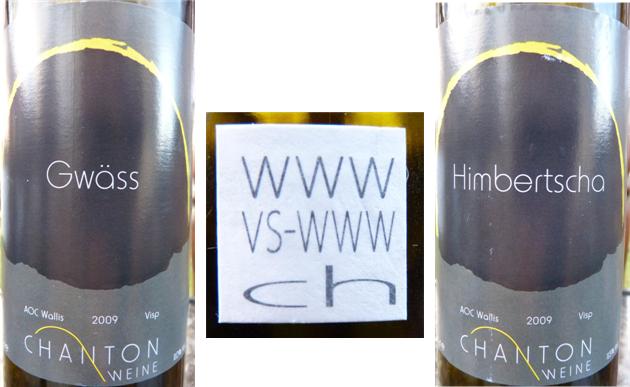
All the wines came from Chanton Visp in the region called Wallis. All three grapes are in the very scarce supply in Switzerland and the wines have very limited production. The first white wine was made from the grape called Gwass. Very dry and almost expressionless (I would call it bone-dry, but without acidity), this wine worked quite well with various Swiss cheeses which were accompanying our tasting.
Second white wine was made from the grape called Himbertscha. This wine was very different from the first one, with good tropical fruit expression on the palate, but without any unpleasant sweetness. Very nice and balanced, it would be perfect wine for the summer day (minor problem – good luck finding this wine in US). I would put drinkability of this wine at 8.
Last but not least in this group was red wine made out of grape called Eyholzer Roter. It is interesting to note minimalistic approach in labeling of this wine – the label is a tiny piece of paper ( half- an-inch by half-an -inch) with web address on it, and even more, this is web site of the ISP, and not of the winery itself. Despite the strange labeling, the wine was absolutely gorgeous – smooth and very playful, with perfect balance of tannins, fruit, earth and acidity, very easily drinkable (bottle ended too fast for some unknown reason…). This was definitely an 8+ wine – and needless to say that I would be very happy to find this wine in US…
Two more grapes are in the mix here. One is a white grape called Avesso, and it was a part of the blend in Portuguese wine called Famega Vinho Verde – simple summer wine with good acidity (it was begging for seafood). Another one was red grape called Monemvasia, which was part of the blend in the wine from Greece called Paros Moraitis Reserve 2006 – bone dry red wine, with some hint of fruit, and very pleasant overall – I would dare to say that this was if not The best, then at least one of the best Greek red wines I ever tried.
Five new wines, five new grapes, and getting closer to the Treble status.
But – it is the time to conclude the Treble Journey report for now, and Georgian wines will be next.
Last Bottle Sign Up ($10 credit)




 Talk-A-Vino