When Was The Last Time You Had Georgian Wine?
 Let me repeat the question – when was the last time you had wine from Georgia? I don’t mean one of the US states down south, I mean the Georgian Republic, the country bordering Russia in South Caucasus. I would expect that for some of you the answer will be “long time ago”, and for many others – never. And this is rather expected, but now is the time to change that.
Based on many sources, Georgia is regarded a birthplace of the winemaking. It is considered that winemaking in Europe goes back 5,000 years. Winemaking in Georgia seems to have a little edge over that with start at around 7,000 years ago. While we appreciate historical references, we are drinking the wines now, so the current state of affairs (I mean, of course, winemaking) is a lot more of interest.
Georgia’s wine industry had been through some rough times, starting with Prohibition attempt in former USSR during the 1980s. After Georgia became an independent country, there was a quick turnaround – for profit, it is. A lot of bad wines were produced in Georgia, and even more false Georgian wines were produced outside of it, to take advantage of historical value recognition of the Georgian wines. Luckily, as capitalism is taking hold in Georgia for good, there is a similar change in the Georgian winemaking, with honest people coming back to make honest wines and restore the “pride of the land”.
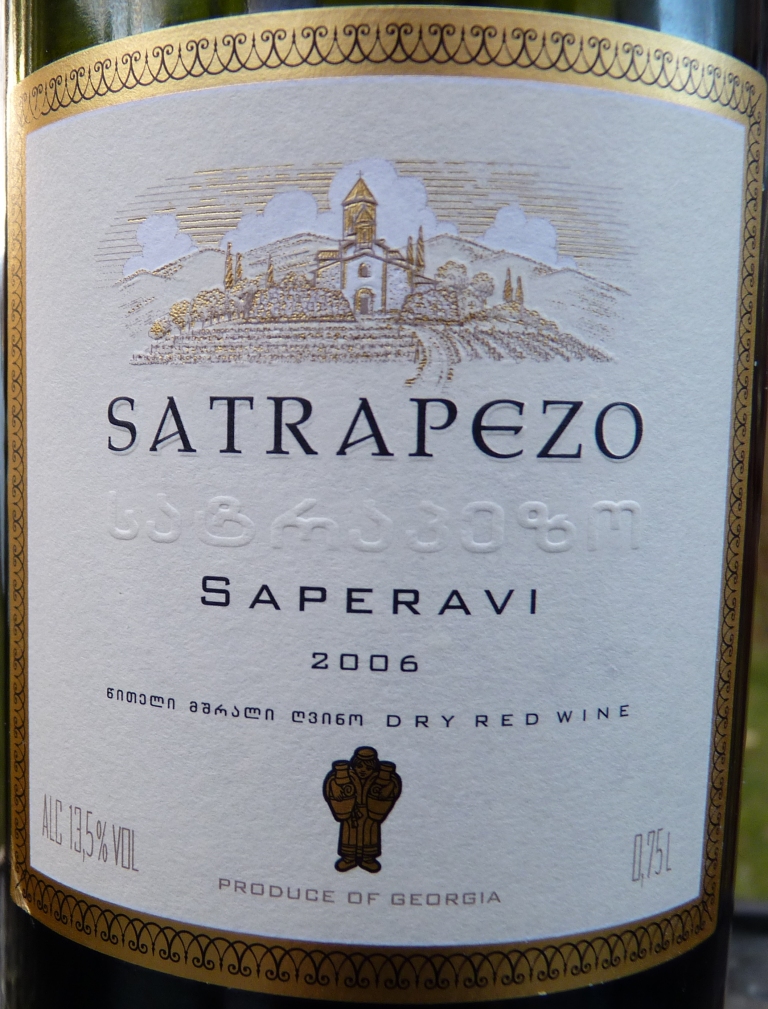
Seeing (oops, sorry, I meant tasting) is believing. Tasting the wine called Satrapezo, made from one of the Georgian authentic grapes, Saperavi, completely changed my perception of the Georgian wines, which I was definitely avoiding for a while. This wine is produced at the winery called Marani. Marani is really focused on making great wines, and it is showing in this flagship wine. Beautiful deep garnet color, layers of concentrated fruit (old world mature style, nice and gentle) and silky smooth tannins, balanced with good acidity and a very long finish. This is the wine to enjoy,…and enjoy, …and enjoy. In terms of Drinkability, this is definitely a 9.
 Another example was (totally unexpected to me) sparkling wine called Bagrationi. Made from three authentic grapes ( yay, Treble Journey advance!), Chinebuli, Tsitska, and Mtsvane, this wine had all the classic champagne traits – yeasty nose, hint of apples and fresh bread on the palate, dry and refreshing.
There are a lot more of Georgian wines to discover and enjoy. I’m glad to add Georgia to my personal wine map – and I highly recommend for you to do the same. Go find a bottle of Georgian wine and enjoy the results of 7,000 years of winemaking history!
Leave a comment
Last Bottle Sign Up ($10 credit)




 Talk-A-Vino
Very nice review!