Archive
Daily Glass: Not Your Mother’s Pinot Grigio
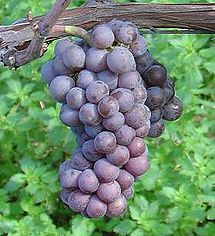
Pinot Gris grapes. Source: Wikipedia
Of course I don’t know your mother, and of course I don’t know her wine preferences. But assuming a general motherly image, cue in a hot summer day, I would make a pretty safe bet that refreshing beverage in the glass in her hand is a white wine. Continuing playing it safe, I would expect that white wine to be very easy to drink, unoffensive and simple, so traditional Pinot Grigio (think Santa Margherita) would perfectly fit the bill.
Now, what do you think would happen if after crushing the grapes, the juice will be left in the contact with skins for, let’s say, 24 hours? Yes, of course Pinot Grigio is a white wine, at least typically it is. But to give you a little hint, take a look at the picture of the grapes – this are not random grapes, these are exactly the Pinot Grigio grapes – or as they are known throughout the most of the world, Pinot Gris. Gris here stays for “gray”, this is how we can perceive the color of these grapes.
With this little hint – what do you think now about that juice left in contact with the skins for 24 hours? If you said that you expect it to gain some color, you are absolutely right. Here is an example of an end result for you:
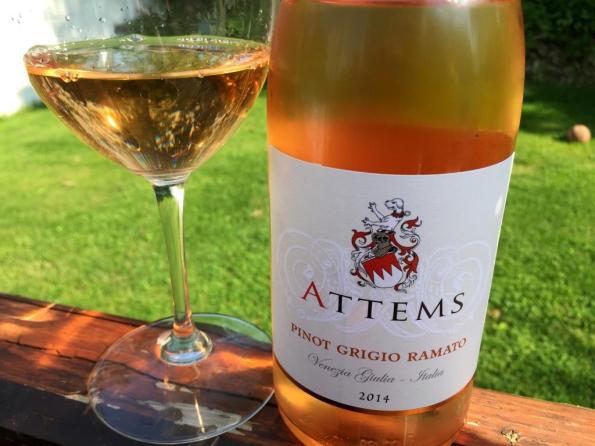 Isn’t it beautiful? The 24 hours of skin contact gave this wine this orange hue, which technically makes this wine a part of the “orange wines” craze. I don’t have an intention of getting into the “orange wine” debate, but I can tell you that it is not only the color which is different here. Before we talk about the taste of this 2014 Attems Pinot Grigio Ramato Venezia Giulia IGT (12.5% ABV, $18, 100% Pinot Grigio, stainless steel and barriques), let me give you a short explanation about the name of the wine and its color, from the winery’s web site: “Attems Pinot Grigio Ramato continues a tradition of the Republic of Venice, since “ramato,” or coppery, was the term that referred to Pinot Grigio in contracts. A special vinification practice led to the use of this term: the must remains in contact with the skins for 24 hours and this practice gives the wine a very distinctive coppery hue“.
It was not only the color which was different. The wine had a nose of intense honey, but the palate was dry and crisp – if anything, reminding a lot more of a great Provence Rosé with a hint of strawberries and an onion peel. An excellent and thought provoking wine, whether for the hot summer day or for any day when you crave a nice glass of wine. Drinkability: 8.
That’s all I have for you for today, my friends. White, Rosé, Orange, Red – enjoy whatever is in your glass and happy Independence Day for those in the USA. Cheers!
Wednesday’s Meritage – Wine Quiz Answer, Orange Wine Bad or Good?, Kegs of Wine, New Wine Magazine and more
Meritage time!
Let’s start with the answer for the wine quiz #44, What is in the numbers. In the quiz, you were supposed to identify what the numbers 100%, 75%, 85% and 95% mean all together and by themselves. As VinoinLove mentioned, it was a difficult quiz – I have to agree with him – but he cracked it nevertheless! So, yes, VinoinLove is a winner of the wine quiz #44, and here is the answer.
All the numbers are taken from the definition of American Viticultural Area (AVA):
100% – If California is specified on the label, 100% of the grapes should be from California (it is interesting to note that California is an exception – it is 75% for all other states).
75% – a grape source requirement for all other states
85% – a vintage designation requirement – if a vintage specified on the bottle, at least 85% of the grapes should be coming from that vintage. Interestingly enough, until 2006, the requirement was 95%
95% – has two meanings. When specific AVA is noted on the bottle (Napa Valley, for example), at least 95% of the grapes should belong to one and the same vintage. Also, when vineyard is specified on the label (for instance, To Kalon), at least 95% of the grapes should be sourced from that vineyard.
Care to learn more? Here is the link for you.
And now to the wine news. I found few of the interesting articles I want to bring to your attention. First, what do you think of orange wine? It’s being very much discussed subject for the past 2-3 years. You get orange wine when you ferment white grape in contact with the skin for a prolonged period of time. The resulting wine is typically quite distinguishable. With the popularity of course comes a controversy, a fad, chick and all other usual things. Here an article from SF Gate covering this subject of the orange wine. It is an interesting read, especially considering that the article starts with total bashing and ends with literally a praise for the orange wine. Do you have your own orange wine experience? If you do (or even if you don’t, but have an opinion), please share it in the comment section.
When you are in a bar or a restaurant, do you prefer beer on tap or in the bottle (well, of course assuming there is a decent selection of beer on tap)? My personal preference is beer on tap, as it is usually tastes fresher. Now, how about wine? On tap or in the bottle? What, never heard this question before? Coming to the bar near you – Wine on Tap. May be it is the time for you to get prepared? Here is the link for you with some good wine on tap suggestions. Let me know if you already experienced any of the wines on tap – I had not so far, but bused on the recommendations in the article, really would love to.
January 2013 was inaugural month not only for the US President, but also for the new wine magazine called By The Bottle. Magazine is available in electronic format only, currently for iPad with Android version coming soon. I just wrote the review about the first issue, which you can find here.
In the love of all the Top Ten lists and Statistics of all sorts, here is a list of Top Ten Wine Regions in the world, according to Wine Folly. Read, analyze, discuss, make conclusions – do whatever you usually do with numbers.
I think the glass is empty – will refill in a week. Cheers!
Last Bottle Sign Up ($10 credit)




 Talk-A-Vino