Weekly Wine Quiz #4 – Which One Doesn’t Belong?
Each wine region in the world has a number of specific characteristics, such as terroir, the style of wine and so on. One of such important characteristics is kinds of grapes growing in the region and used for the winemaking. Moreover, in a lot of cases only specific grapes are allowed to be used in the wine if the wine will carry region’s name on its label.
Below is a list of grapes allowed to be used in the wine production in one of the world’s most famous regions – except that one grape doesn’t belong there. Do you know which one it is? Have fun! Cheers!
Must Try Wines
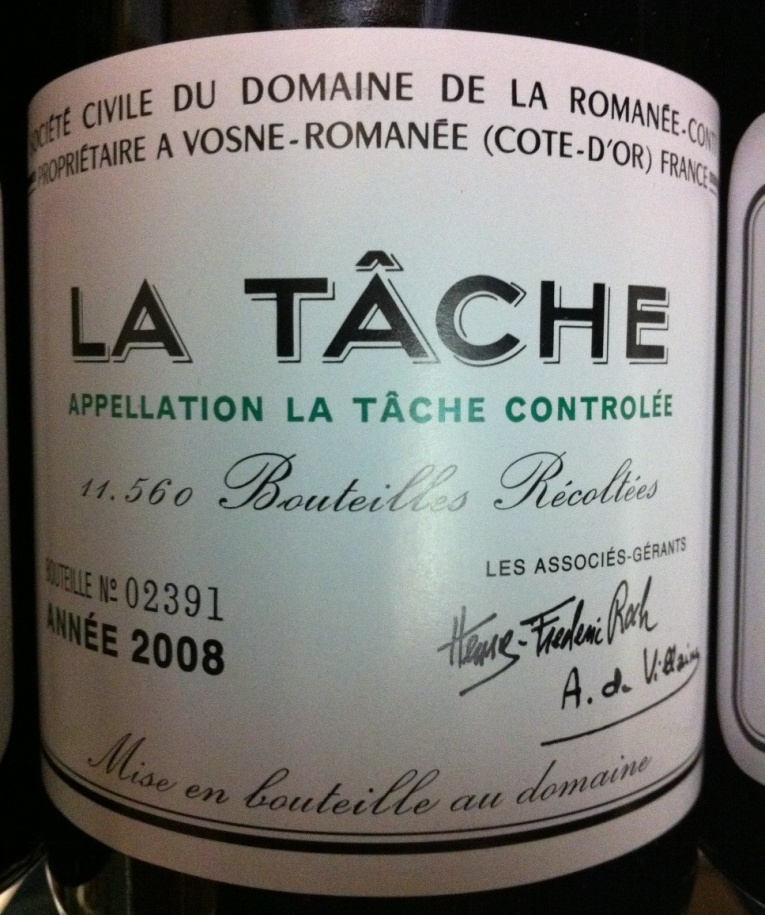 It is not so simple to talk about ”must have experiences” – as we move on in life, the idea of ”must have” can be changing dramatically, taking something which was considered divine to something you can literally despise.
Our experiences are personal, and they have value within our view, our picture of the world. This is true pretty much for everything, but this is ultimately true when it comes to food and wine. If someone is strictly a white zinfandel drinker, convincing him or her that this Chateau Latour is a good wine would be an impossible task. Therefore, does it make sense to come up with the list of ”must try wines”? I believe so. This doesn’t have to be a ”must try” list for everyone, but this is rather a personal belief based on the present relationship with the wine world. By reading books, blogs and magazine articles, talking to people (twitter conversations included), and then doing more reading, talking and thinking (and drinking!!!), this list came by as my personal reflection. These are the wines I would like to experience at least once – nothing more and nothing less.
Few notes about the list. First, it is built by country, and then sub-regions. The primary idea behind including most of the wines you can see on the list is their reputation, which is based on what I read and heard. Yes, the majority of the wines in the list are super-expensive, but this just a consequence of their reputation, I guess. Considering that, I also included possible substitutes for some of the wines – some of the substitution suggestions are based on the official (and semi-official) ”second labels” (here’s a link to the post I wrote for The Art Of Life Magazine on the subject of the second labels) – for instance, all of the Bordeaux First Growth have their official second label wines (some of them even have third labels now). Some of the other suggestions are simply based on geographic proximity and ownership – for instance, Chateau Hosanna is located next to the famed Chateau Petrus and both are owned by the same owner, Christian Moueix.
And few more points. If you want to get that list in the form of a PDF file, here is the link for you. If you are interested in my logic as to why particular wines and wineries are there – I will gladly explain, just ask a question. If you think there are other wines I should include in the list, let me know – I will greatly appreciate the suggestions. However, if you think that I’m wrong and some of the wines shouldn’t be on this list – well, tough luck – the is my personal list, and this is the way I see it at the moment.
Without further delay, here is the list. Cheers!
|
Country/Region |
Potential Alternative |
| France | |
|
Champagne |
|
| Krug Clos du Mesnil | Krug Grand Cuvee NV |
| Krug Clos d’Ambonnay | |
| Salon Le Mesnil | |
|
Bordeaux |
|
| Chateau Latour | Les Forts de Latour |
| Chateau Lafite Rothschild | Carruades de Lafite Rothschild |
| Chateau Mouton Rothschild | Le Petit Mouton |
| Chateau Haut Brion | Le Clarence de Haut-Brion |
| Chateau Margaux | Pavillion Rouge |
| Chateau Cheval Blanc | Le Petit Cheval |
| Chateau Petrus | Chateau Hosanna |
| Chateau Le Pin | |
|
Burgundy |
|
| DRC Grand Cru Échezeaux | |
| DRC Grand Cru Richebourg | |
| DRC Grand Cru La Tâche | |
| DRC Grand Cru La Romanée-Conti | |
| DRC Grand Cru Montrachet | |
|
Sauternes |
|
| Chateau d’Yquem | |
|
Northern Rhone |
|
| E. Guigal Cote Rotie La Landonne | |
| E. Guigal Cote Rotie La Mouline | |
| E. Guigal Cote Rotie La Turque | |
| Chateau Grillet | |
|
Southern Rhone |
|
| Chateau Beaucastel Chateauneuf du Pape Hommage a Jacques Perrin | |
| Pegau Chateauneuf du Pape Cuvee da Capo | |
| Italy | |
|
Piedmont |
|
| Gaja | |
| Bruno Giacosa Barbaresco Riserva Asili | |
| Bruno Giacosa Barolo Riserva Falletto | |
|
Tuscany |
|
| Ornelaia Masseto | |
| Antinori Solaia | |
| Tenuta San Guido Sassicaia | Tenuta San Guido Guidalberto |
| Ornelaia | Le Serre Nouve, Le Volte |
| Valdicava Brunello di Montalcino Riserva Madonna del Piano | |
|
Veneto |
|
| Giuseppe Quintarelli Amarone | |
| Spain | |
|
Rioja |
|
| 1964 Lopez de Heredia “Viña Tondonia” Gran Reserva Rioja | |
|
Ribero Del Duero |
|
| Vega Sicilia Unico | Valbuena 5° |
| Bodega Dominio de Pingus | |
| US | |
|
California |
|
| Bryant Family | DB4 |
| Colgin Family | |
| Harlan | Maiden |
| Screaming Eagle | Leviathan |
| Sine Qua Non | |
| Alban Vineyards | |
| Saxum | |
|
Washington |
|
| Cayuse | |
| Quilceda Creek | |
| Portugal | |
| Taylor’s Scion Very Old Port | |
| Australia | |
|
Barossa Valley |
|
| Penfolds Grange | |
| Seppeltsfield 100 year old Para Vintage Tawny |
Summing up Wine Blogging Wednesday, Plus Some Surprises
 In my last post about Wine Blogging Wednesday #75, I promised to sum up the experience with my Single – 2007 Mara Pinot Noir Laughlin Road Ranch, Russian River Valley, so here we go.
When I tasted 2007 Mara Pinot Noir about 1.5 years ago (October of 2010, here are the notes), the wine was coming out as big and brooding, with wide shoulders, and tremendous elegance and balance. One and a half years later, the wine took on a lot more subtle expression, coming out in elegant layers. Here are more detailed notes: Blueberries and blackberries on the nose, with a hint of nutmeg. Lots of red fruit on the palate, fresh strawberries and red plums, lots of tannins. More tannins. More tannins. Good acidity, and good balance. Lots of pleasure.
I always like to leave some amount of wine to be tasted at the next day just to see how the wine develops and what might be the aging potential (pumping the air out with Vacuvin) – this is exactly what I did with this wine. It became even more mellow than the day before, but still had lots of tannins in the finish, and perpetual elegance. I think this wine has at least another 8-10 years to reach its peak, so will see how it will develop. All in all, it was a great experience for the Singles night.
 Now let’s talk about the surprises. When I was reaching out for the bottle of Mara Pinot the day after Singles night, I noticed a bottle standing next to it with the Vacuvin rubber cork on top. This was a bottle of M. Cosentino California Ol’ Red – I completely forgot about this wine, which by now was standing there for 6 days. Oops was the first thought – this is going to the dump. It was nice and very drinkable when it was open on Saturday, but now, on Thursday? Also interestingly enough, this wine can’t be any further from Singles which I had the night before – if you remember our discussion about single vineyards, this Ol’ Red wine is made from the grapes coming from the biggest circle – entire California, and to top it off, it is not even a single vintage wine, as it doesn’t have vintage designation on the label.
Well, I have to give a chance to any wine, can’t just dump it – I have to at least give it a try, right? So with the first sip came literally a Wow emotion ( from oops to the wow) – the wine practically didn’t change since Saturday! It was still coming out as nice and complex red. Dark cherries and dark chocolate on the nose, more dark chocolate and cinnamon on the palate, blueberry jam, good tannins and good acidity (Drinkability: 8-). Coupled with the fact that this wine costs $11.99, you get here quite a value. I’ve had a very few wines which would last that long after the bottle was open (well, some of them, like Dunn Cabernet, need 6 days just to start opening, but this is whole another story), hence the nice surprise.
That’s all, folks. Let’s raise the glass to the great surprises in our lives. Cheers!
Weekly Wine Quiz #3 – Judgement of Paris
Our last weekly quiz was about of the most significant dates in the world of wine – 1855. Another very significant “wine” date is 1976 – this is when famous Judgement of Paris took place. Depicted in the movie called Bottle Shock (second movie called Judgement of Paris is in the works), it was an event where a number of California wineries submitted their wines for the blind tasting against their French counterparts. The judgement was done blind and by the French wine critics, and California wines came on top of the French for many of those critics. This was the event which squarely put California on the worldwide wine map.
So here is the list of California wineries which participated in the Judgement of Paris, except one – again, my recommendation is that you will try to figure it out without reaching out to Google for help. Have fun. Cheers!
Singles Night Out – Wine World Singles, It Is
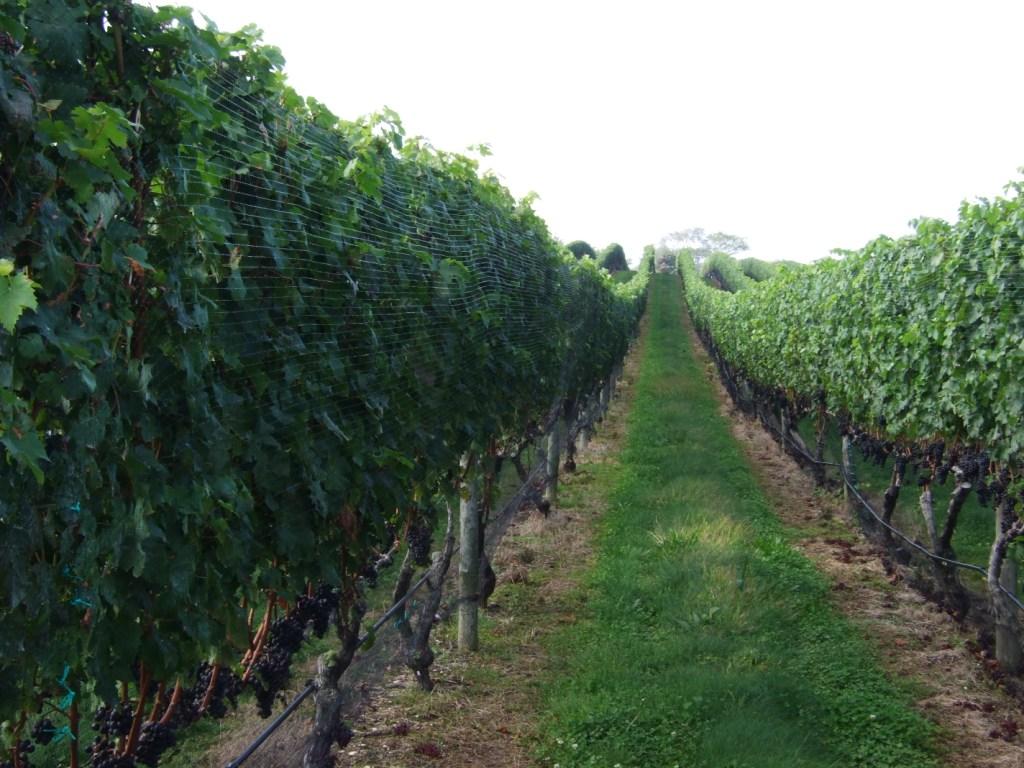 Confused by the title of this post? Don’t be. It is wine we will be talking about here, not marital statuses – but these are the wines which are usually quite special.
Looking at the wine label, you will always find designation of place. For new world wines, it is usually easy to see where the wine is coming from – Napa Valley in California, Maipo Valley in Chile, Barossa Valley in Australia. For some of the old world wines, it might be more tricky to figure out the place versus just the wine name, but with the little effort, you can always find out where the wine is coming from.
Wine is made in different places all over the world. Each place has its own unique characteristics, called Terroir – soil, climate, altitude, typical weather conditions, ecological surroundings – all contribute to unique terroir.
Let’s talk about wine origins for a second. Imagine nested circles. First circle is a big geographical area, like California or Bordeaux. If the wine is made out of the grapes grown anywhere in California, it can have a California designation on the label. If the wine is made out of the grapes grown anywhere in Bordeaux, it will have a Bordeaux designation on the label, most typically something like “Grand Vin de Bordeaux”. The next circle will be smaller, representing some specific area within the bigger region – for instance, Napa Valley instead of the whole California, or Medoc instead of the whole Bordeaux. If the grapes are grown only in Napa Valley instead of the whole California, this will be appropriately designated on the label. Inside Napa valley, there are again smaller grape growing areas, each one with its own unique terroir – for instance, Stag’s Leap District or St. Helena. Again, if the wine is made out of the grapes grown in such a specific area, it will be stated on the bottle.
Now we need to place one more circle inside of all the circles we already drew – this circle should signify the Estate, or the whole winery. If you saw something like “Estate Grown” on the label this is what it usually relates to. Okay, now let’s jump to the smallest circle of all – yes, we got to the level of individual vineyards. Wine makers and grape growers always made an effort to identify which vineyards or even parcels of the vineyards produce the best grapes, and subsequently, best wines have being produced from the best vineyards. The wine produced from one individual vineyard is commonly referred to as a “Single Vineyard” wine and often carries the name of the vineyard on the label. This is definitely a common practice for California wines – however, if you think about the place where the “single vineyard” concept reached its ultimate expression it would be Burgundy, where individual domains own vineyards or even specific parcels of the vineyards – of course you would only see a designation of Domaine on the label.
What is the importance of the “single vineyard” concept? This is usually where the best wines are coming from, the wines with the character, the wines which can be identified and related to. And these single vineyard wines are the subject of today’s Wine Blogging Wednesday event!
 This is the 75th Wine Blogging Wednesday, which is hosted by Joe Roberts, a blogger behind 1WineDude blog – and here you can find his post about the event and wine he have chosen for it.
What is my choice of the wine for today? I had a long back and force with myself, until I finally settled on one – the wine for tonight will be 2007 Mara Pinot Noir Laughlin Road Ranch, Russian River Valley, which was my personal Wine of the Year for 2010. It is a single vineyard Pinot Noir from Russian River Valley region, and it should be a perfect choice for tonight (I also have another reason to open a great bottle of wine – it is my daughter’s 10th birthday). It will be really interesting to see how this wine evolved and what my impression will be now – but this will be a subject of another post.
Happy Wine Blogging Wednesday! Find your special Single for tonight and have fun! And don’t forget to leave a comment about your experience! Cheers!
Casa Mono – Tapas Delight in New York City
 I always admired Mario Batali as an Iron Chef, and after visiting his flagship restaurant, Babbo in New York City, I fell in love with his cooking (tasting menu at Babbo is probably one of my biggest ever epicurean highlights). Thus when we decided to stop by Casa Mono for lunch after attending Michael Skurnik wine tasting (blog post to follow) in New York City, I was one happy camper.
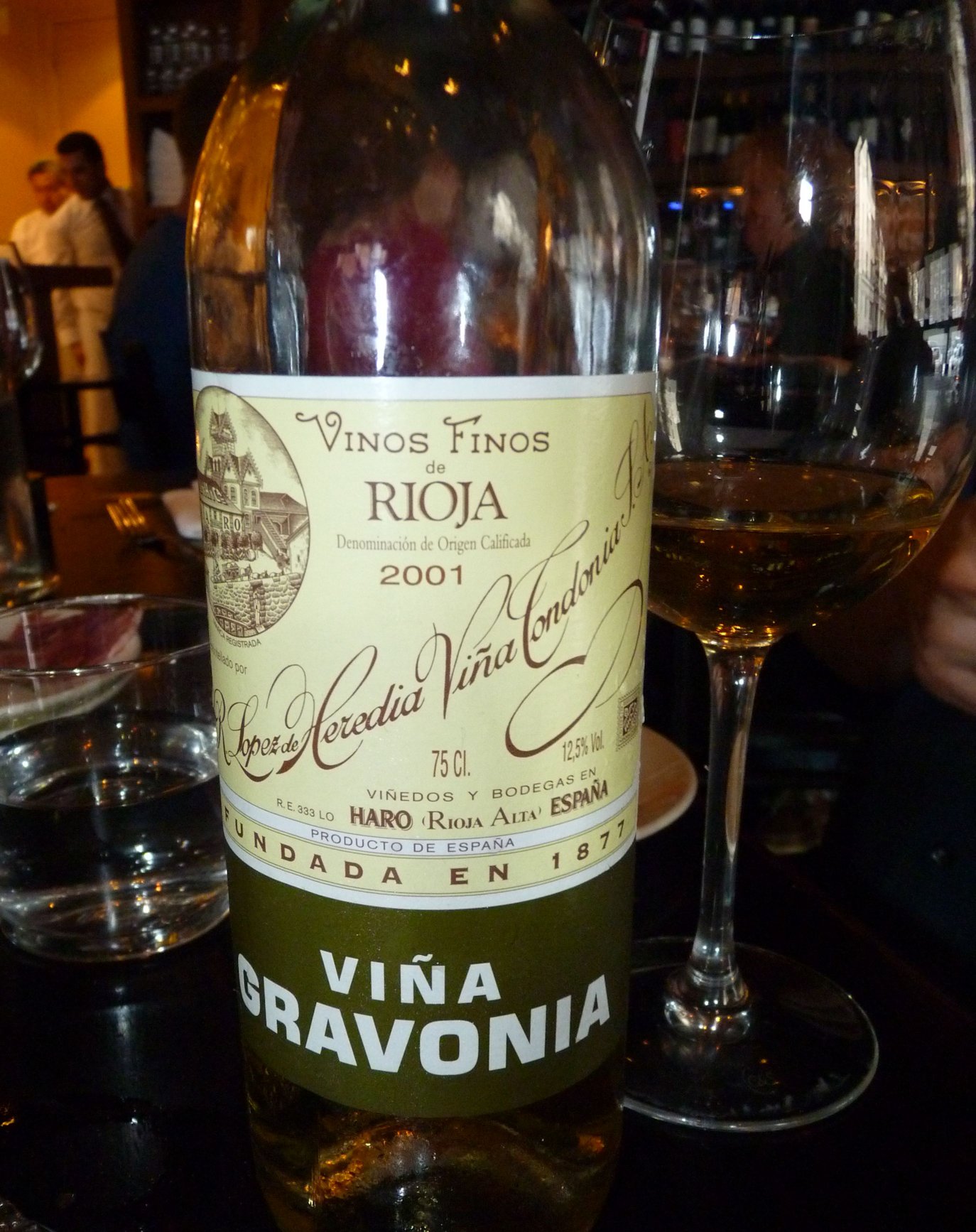
Never mind 100+ wines we tasted right before, we had to have some wine with lunch, right? Casa Mono sports an excellent wine list, focused on Spanish wines as one could anticipate. After tasting lots of young, big and dense red wines, we wanted to drink wine which would be easy enough to drink, but still the one which would complement the variety of Tapas offerings. Our choice was 2001 Lopez de Heredia Vina Gravonia, a white Rioja wine. Rioja wines are some of my favorite overall, but additionally, I think white Rioja is some of the most amazing white wines when it comes to aging – I had 18 years old Vina Gravona which was fresh and beautiful (you can find notes here). This 11 years old wine, 2001 Vina Gravonia, was just perfect – medium body, good acidity and minerality, good amount of fruit without being fruit forward, with hints of eucalyptus and anise. Very well rounded wine which paired perfectly with variety of the tapas dishes we had.
So for the food, as usual, it would be mostly a photo report. We were absolutely delighted with all of our choices, so without long overdue, here is the happy report.
Duck Egg with Moyama was one of the first tapas to arrive. Chicken eggs are boring – this is what I want for my breakfast!
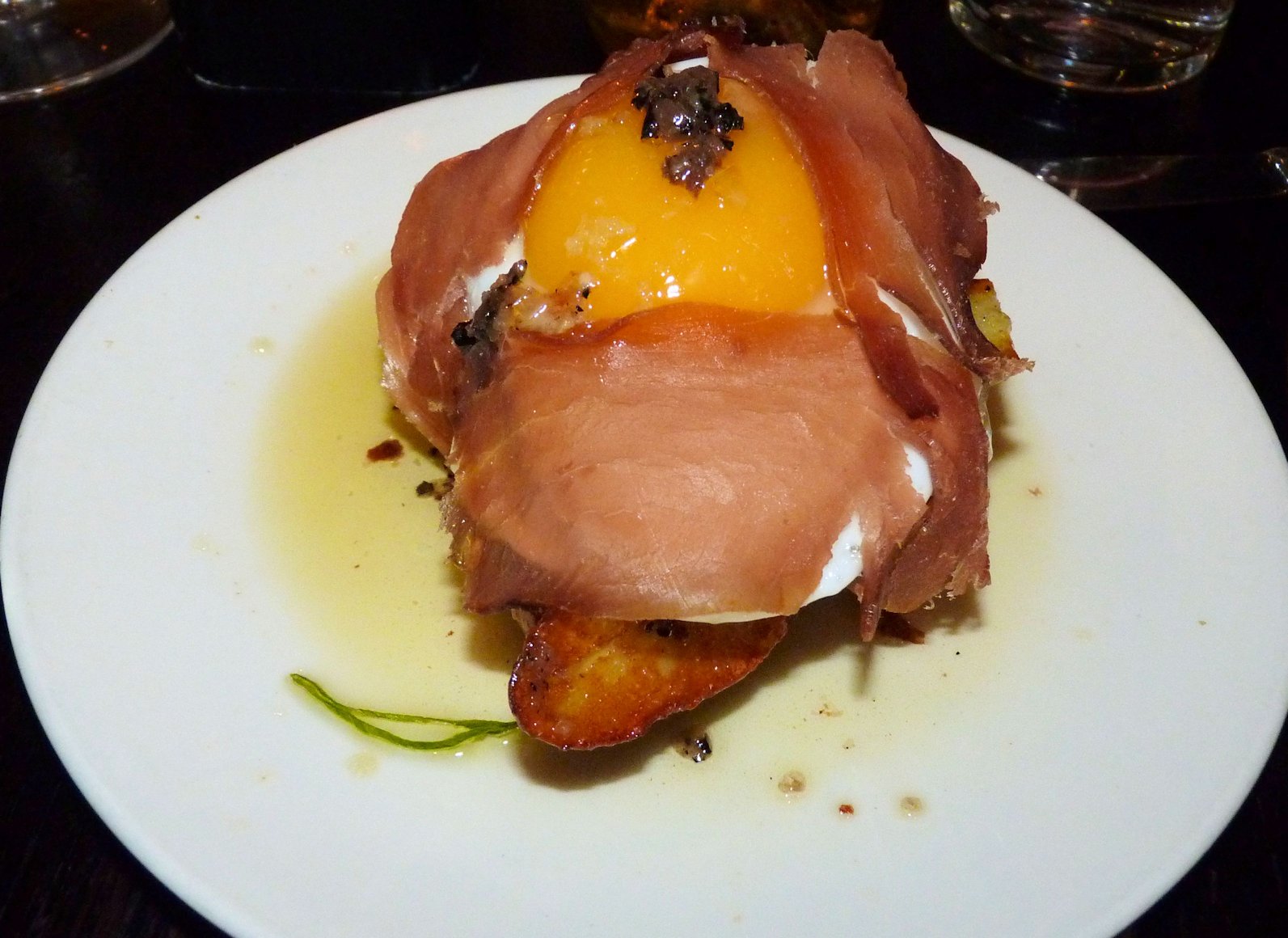
The next one was Mussels with Cava and Chorizo – perfect combination: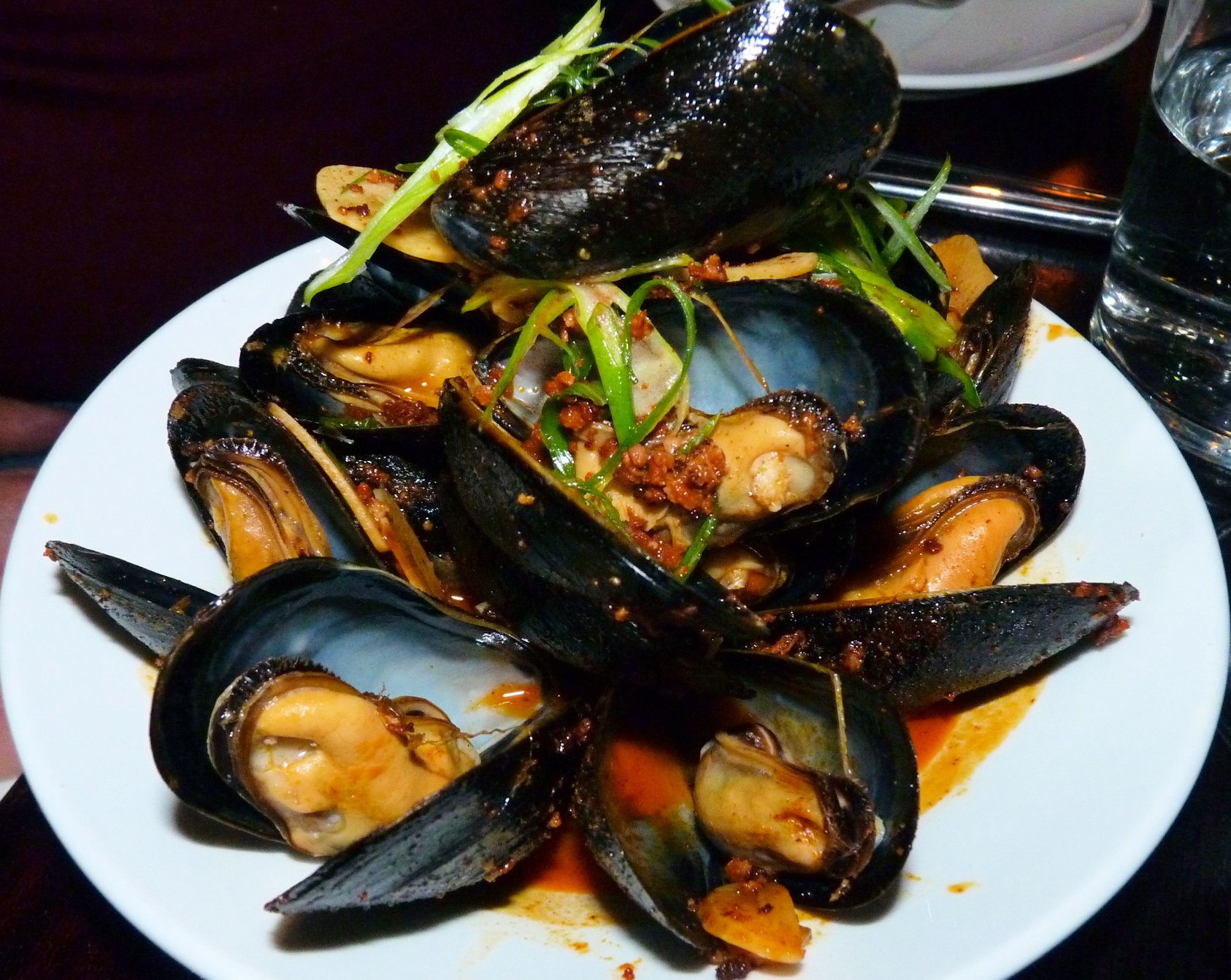
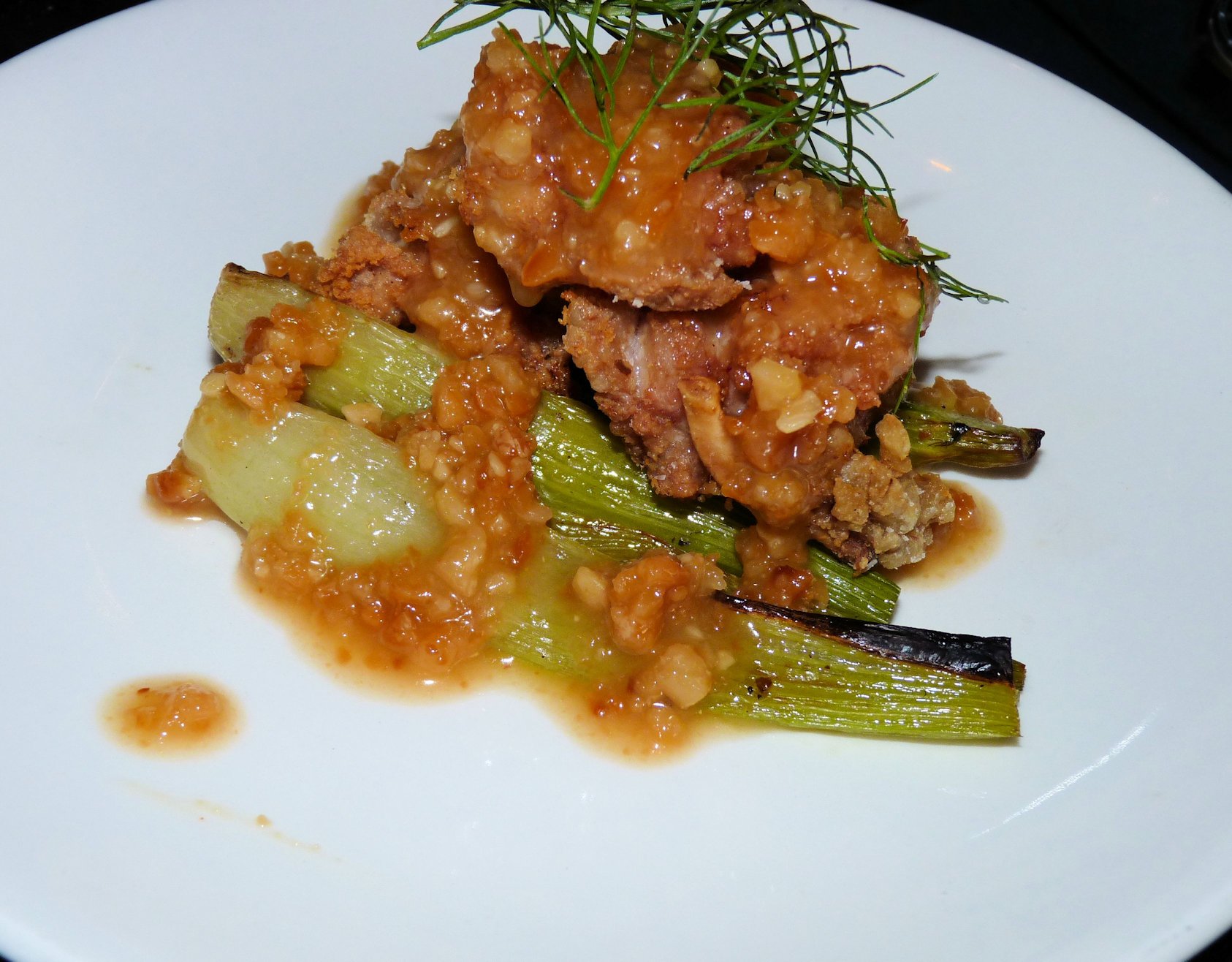
Sweetbreads with Fennel Al Mono – delicious and perfectly executed in the small bites format:
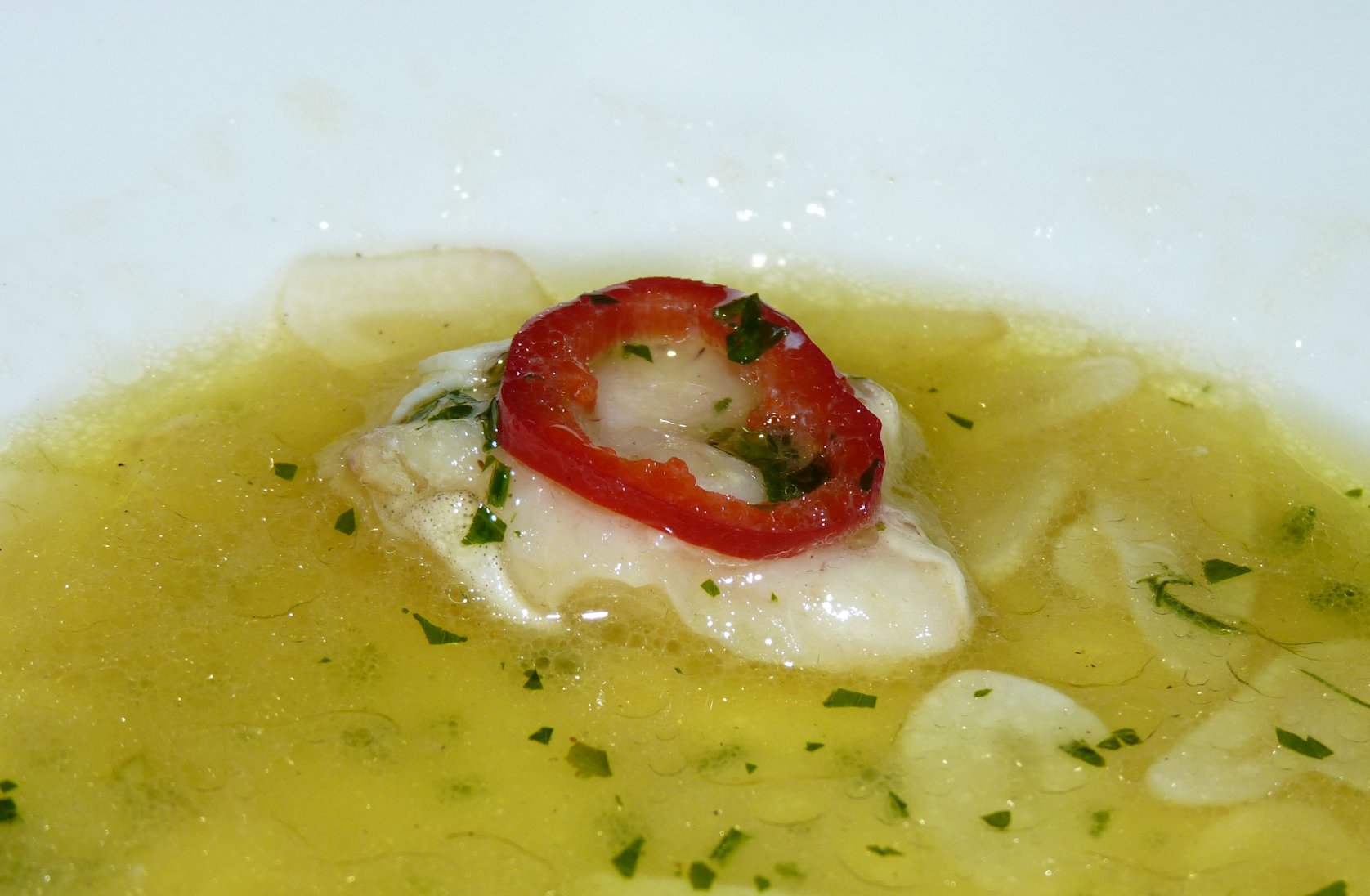
Cod Cheeks Pil Pil with Pickled Chiles – I almost forgot to take a picture. The texture and flavor profile of this dish – with garlic, savory broth and chiles, it was “more bread, please” kind of dish – not a drop of that delicious liquid can be lost!
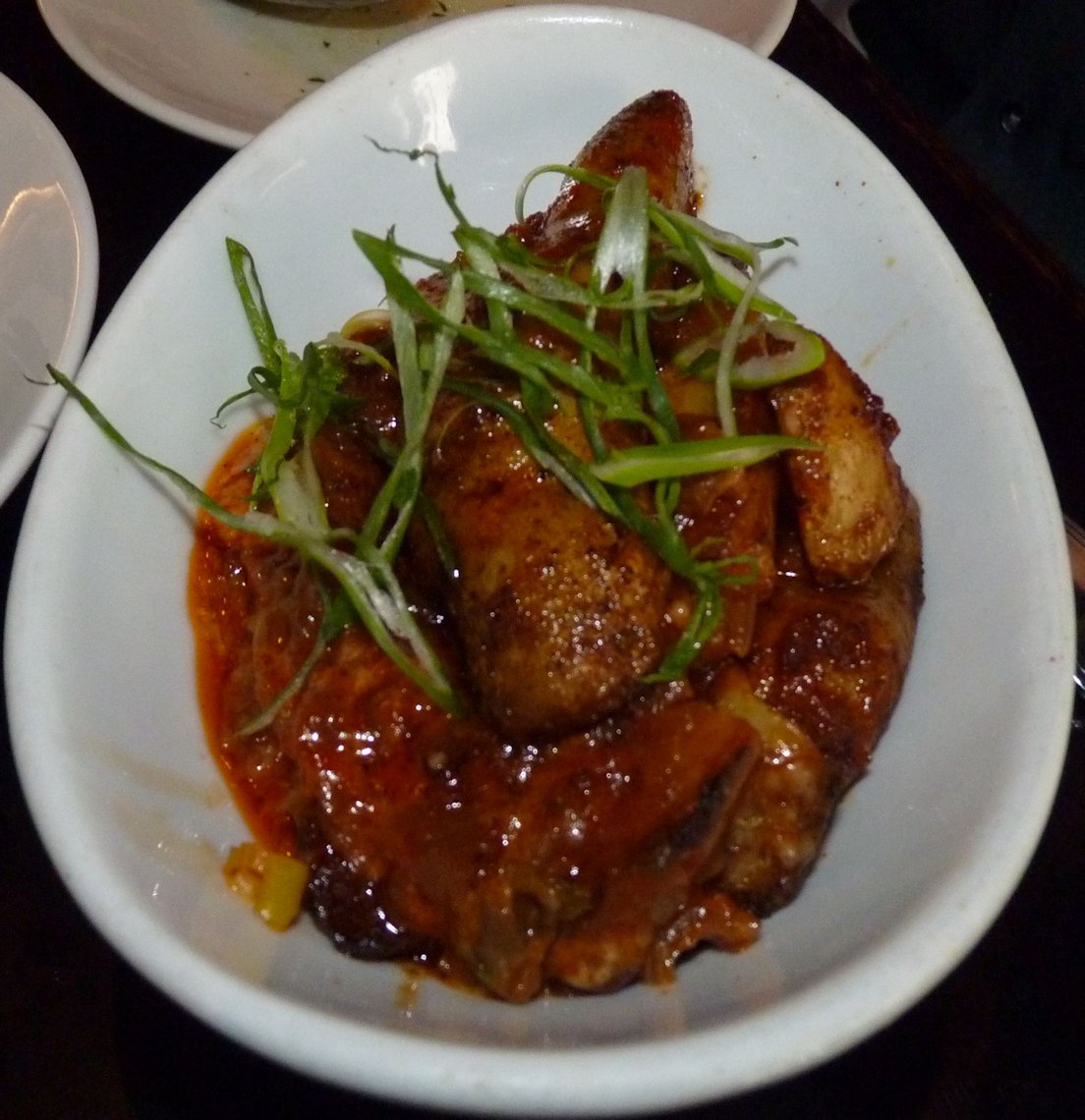
Potatas Bravas in the perfect tangy sauce:
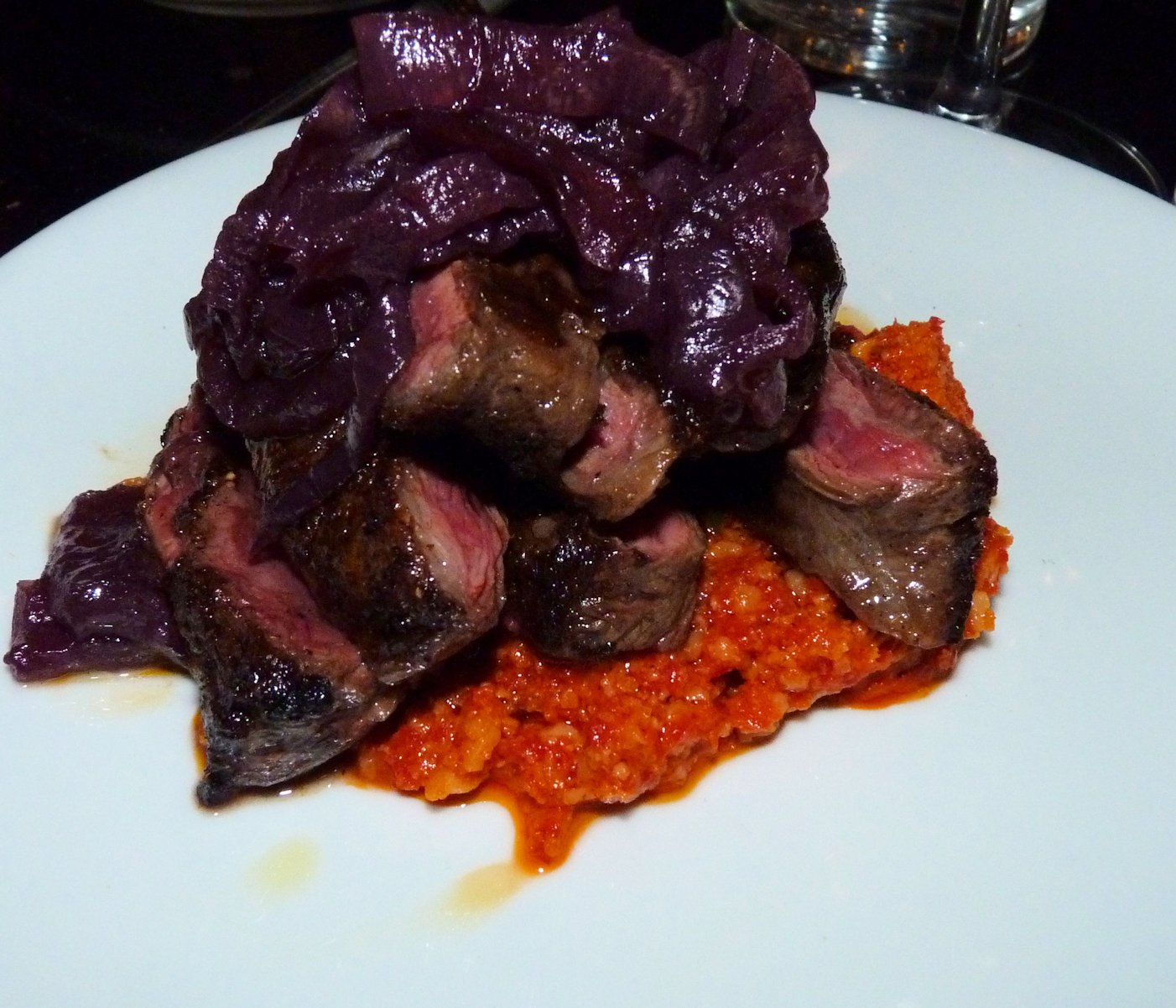
And the Skirt Steak with Onion Marmelada – meat perfectly done, and very tasty in combination with the caramelized onions:
Do you think we skipped the dessert? Ha, of course not! Here it is:
Deep Fried Bay Leaves with Burnt Vanilla Custard – who would’ve thought that you can deep fry a bay leaf??? But it was delicious, and paired perfectly with the custard:

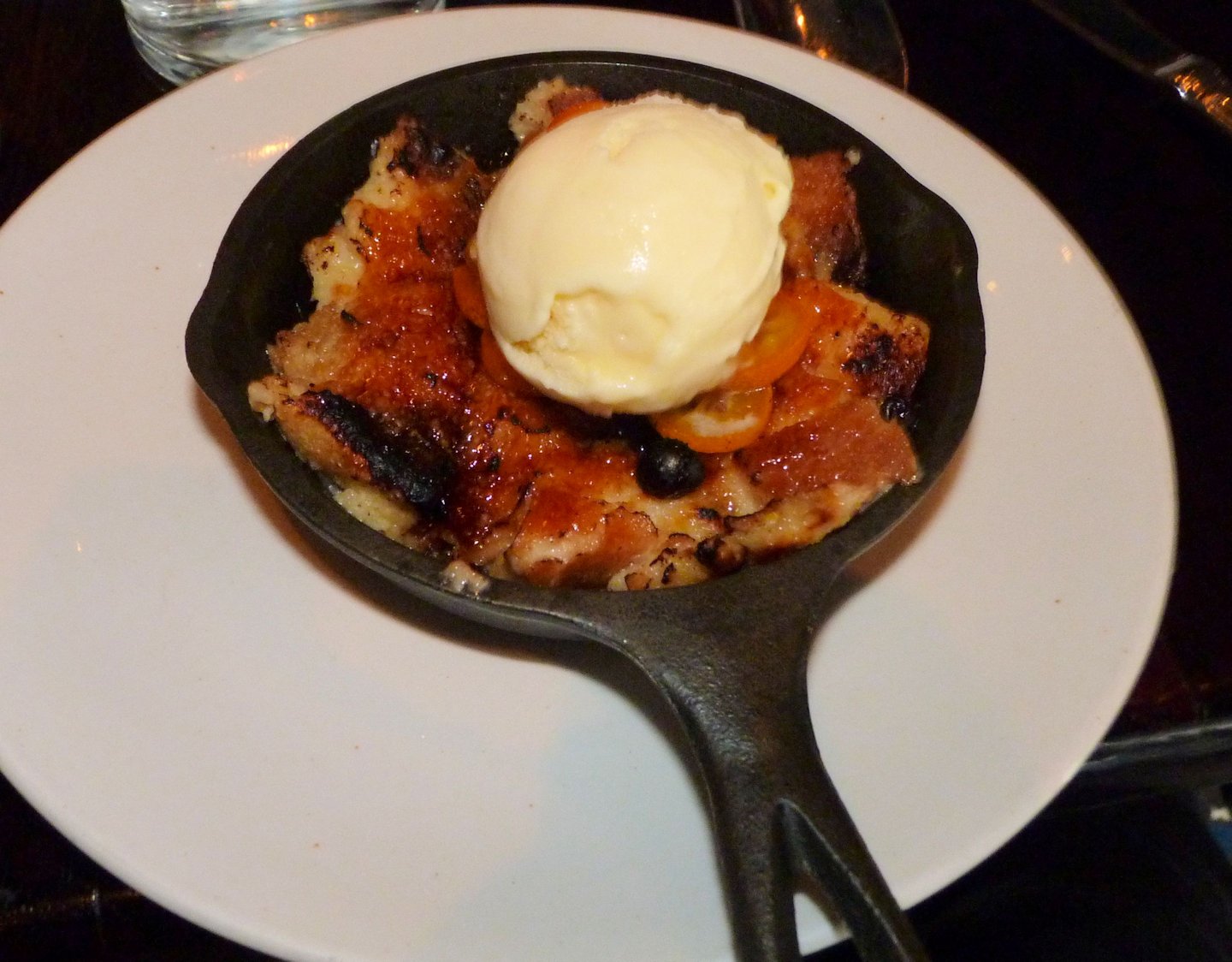
And last but not least, Orange Infused Bread Pudding with Horchata Ice Cream – the orange infusion makes this bread pudding feel absolutely the lightest and literally effervescent:
This was a great food experience, and I can only conclude with the words of the Iron Chef show host – Thank you for the wonderful meal, Chef Mario Batali!

Lets Play a Little Game – Here Is A Wine Quiz
1855. Exposition Universelle de Paris will be taking place in Paris. Emperor Napoleon III requests classification system to be created for best Bordeaux wines, to represent French wines at the Expo. Classification system is created by the wine brokers based on wine price and Chateau reputation, where all wines are classified in five Growth (Crus), with First Growth being the best. Only four estates became so called First Growth in the 1855 classification, and the fifth one was added more than a hundred years later.
Here comes the question – which First Growth Chateau was not a part of the original 1855 classification? As this quiz has no prize attached to it, I would definitely recommend that you will try to answer the question on your own first before you will be reaching out to Google for an answer – it is definitely more fun this way.
Have fun! Cheers!
Advent of Wine And Social Media
 Someone can probably run a very interesting study as to why people blog. I guess that we [bloggers] have something to say to the world, and the Internet gave us an ultimate platform to deliver the message – I’m not sure if this explains the phenomena of mass social media, but I will leave that research to the professionals, and while they are working on the answer, I will keep blogging.
Another interesting question for me is how do we [bloggers] come up with the subjects for the blog. I’m sure that some people have a plan. My method, though, should be called an “opportunistic blogging” – I rarely know in advance what my next blog post will be all about, so I’m blogging as the life takes place. Consequently, the subject I want to discuss here was not planned in advance at all – the idea for this blog post was born after reading the post by Joe Roberts, a.k.a. @1WineDude, which was called “This Is Me Totally NOT Lightening Up On Wine And Social Media“. The best thing you can do is read the original post – but to give the main idea, the blog post is about wineries not investing enough into the social media, not engaging the consumers through the social media channels and not building up their respective brands.
This is definitely an interesting discussion. How much time and effort should wineries dedicate to the social media? I don’t have an answer to that question – just some thoughts. Twitter and Facebook are two major social media outlets for the task of reaching out. The question is – are you reaching out wine professionals or the consumers? If we are talking about the need for wineries to engage wine professionals in the restaurants and the stores, wine writers and sommeliers – yes, I fully agree with that, this is an important way to communicate with your immediate target audience. Trying to reach the consumers? How effective it will be, outside of delivering your message to the people who are already in your club or the mailing list? In the store which has hundreds and hundreds of bottles from all over the world, where appearance of the label is the first deciding factor for majority of the wine purchases, will your social media message help?
Actually, as I warned you, I don’t have the answers. For someone like myself, social network recommendations and discussions play an important role – this is where I learn about new wines and decide what I want to try. But what about the majority? I guess the full blown study needs to be engineered to assess how much of the social media engagement by the wineries will translate into the actual buying decisions. While we can only hope that someone will actually conduct such a study, I decided to compare some simple numbers for wine world versus general food products in terms of the number of followers on Facebook (FB) and Twitter (T).
Here are some numbers. First, for the brands: Beringer Vineyards – FB: 18K, T: 9K; Robert Mondavi Winery – FB: 20K, T: 5.8K; Francis Ford Coppola Winery – FB :15K, T: 4K; d’Arenberg Winery – FB: 6.5K, T: 3.6K. Now, for comparison: Barilla Pasta – FB: 48K, T: 14K; Breakstone’s (sour cream etc.) – FB: 50k; Pepperidge Farm -F: 22K, T: 9K. Food products do have an edge over wineries, but the gap is not very big.
For retail, my comparison will not be fair, but I still find it interesting. Wine world: BevMo! – FB: 28K, T: 2.4K; Wine Library – FB: 39K, T: 21K; WTSO.com – FB: 10K, T: 10K (very interesting exception with the number of Facebook and Twitter followers being practically the same). For comparison: Target – FB: 9.9M, T: 300K; Wal-Mart – FB: 13M, T: 150K; Amazon – FB: 3.1M, T: 229K. Okay, as I said, this will not be a fair comparison.
For publications: Wine Spectator – FB: 61K, T: 48K. For comparison, Glamour – FB: 680K, T: 160K; Wall Street Journal: FB: 461K, T: 1.55M.
When we are talking about publications, I can’t help it but to mention that there are thousands of the wine blogs – of the time of this writing, 659 blogs are registered with the web site called Vinography – and that is considering the fact that you have to request to be listed on the Vinography site. Interestingly enough but that leads back to Joe’s point about social media engagement from the wineries – there are only 72 winery blogs registered on Vinography site. Talking about wineries’ engagement, I want to mention a blog post by Steve Heimoff, an Editor of Wine Enthusiast Magazine, which was titled “Staying relevant: for wineries, it can be tricky” – while Steve’s point is not directed at the social media, I think that in today’s world, “staying relevant” includes great degree of social media connection and engagement for any business, wineries included.
I also want to give you a great example of the social media engagement – if you look at the picture, you can see @KingEstate printed right on the cork – this cork is from the bottle of a very good Pinot Gris from King Estate winery in Oregon which we had a week ago. If someone needs a proof that wineries are taking social media engagement seriously, I think we don’t need to look further.
Okay, enough is enough. It’s time to round up this post. I gave you a lot of numbers here – if someone knows how number of followers translates in to the actual sales, I would be really curious to know. That’s all, folks. Cheers!
Daily Glass: Perfect Simplicity
 The idea behind “daily glass” posts was that they will be done, well, daily. This never materialized, so the Daily Glass posts take place really from occasion to occasion. Today happened to be one of those occasions – this wine was so nice and simple that I just had to write the “Daily Glass” post.
We brought this bottle of 2009 De Lavoie La Tourelle from Quebec, Canada last July. The wine is made out of St-Croix, Le Marechal Foch and Baco Noir grapes and boasts 12% ABV. It has hint of sour cherries and smokey almonds on the nose (the nose is reminiscent of a Pinot Noir). The wine has medium body and on the palate shows raspberries and gooseberries, hint of minerality and vivid acidity. The acidity lingers the longest, creating mouthwatering finish, uncharacteristic of a typical red wines – I’m sure this would be a perfect food wine, very simple and very easy to drink. Drinkability: 7+.
I have one problems with this wine though – I had only one bottle, and Canadian wines are hardly available in the States… That would be my only complaint. Cheers!
Lets Play a Little Game – Here Is A Wine Quiz
Okay, so I always wanted to play with wine quizzes – I think it is fun. I even tried a few times before, by creating polls on the side bar of this blog – this proved not to be poplar ( I think 0 responses means “not popular”). So let me try it again – here is little wine quiz for you. Okay, it is not about wine – but it is very closely related to it, so – have fun! You can answer in the poll or comment, or do both. Cheers!
Last Bottle Sign Up ($10 credit)




 Talk-A-Vino